


|
|

Volume 9 Number 1, First Quarter 1997

The groundwork laid over the last five years in networking infrastructure and application technologies has brought us to the verge of a new era, where Internet connections are becoming as indispensable to the average user as the telephone. But to get there, network services must be as ubiquitous and easy to use as a telephone and have a similar cost.
User demand propels the rapid growth of the Internet itself, while new multimedia-based applications and the explosion of users make it critical to efficiently manage the resulting torrent of data. Addressing these growing pains calls for a three-pronged approach: an infrastructure that handles larger amounts of data, "smart" software that actually reduces traffic volume while improving the quality of data delivered, and last, easy-to-use, powerful interfaces that users can make a part of their daily lives.
Cisco Systems is helping service providers and end users build a bigger, faster, and smarter Internet infrastructure by developing gigabit routers and switches based on Cisco Internetwork Operating System (Cisco IOSTM) software. Cisco-based backbones will carry all types of traffic--voice, video, and conventional data. While adding bandwidth will help the Internet prosper for some time to come, eventually the proliferation of users will generate too much traffic for that approach to be economically viable. And despite Cisco's ability to build these high-bandwidth backbones, we also must provide value-adding network services and efficiently link remote users with low-speed connections. We solve these problems via software.
For the millions of new users logging on each year, we're bringing new network services to Cisco IOS software to scale the Internet, streamlining the transmission of network-based multimedia applications. For example, about half the Internet traffic using the conventional request/reply model could move to a publish-and-subscribe method. As the Internet scales up, request/reply traffic chokes the network with its sheer volume. With publish-and-subscribe, an information source publishes a single stream of timely information worldwide, and thousands--even millions--of subscriber agents continually sift through it, selecting only what their subscribers need. This model eats up far less bandwidth than request/reply and will help the Internet survive its anticipated growth over the coming decades.
While the publish-and-subscribe model has been discussed for many years, only now are the necessary network technologies emerging to support it. In addition to multimedia features such as the Resource Reservation Protocol (RSVP) and IP Multicast, Cisco is developing technologies for secure encryption and compression, integrated voice transmission, and Digital Subscriber Lines, or xDSLs. New digital security technologies make network commerce on a mass scale possible in the near future, forging new pathways for companies to conduct business with suppliers and customers. Combined with new gigabit network platforms, these capabilities will support the sophisticated Internet applications under development today to fulfill the Internet's enormous promise as an economic and cultural boon.
Already, Cisco is creating the future of the Internet. Network commerce and Web access are just the beginning of a new realm of possibilities the Internet holds. Perhaps in the future users will have a single Internet device for incoming voice, video, fax messages, e-mail, and subscriber agent data, which is secured but accessible through a Web browser interface from anywhere. Cisco plans to lead the way into this future, developing the infrastructure and laying the foundation for the coming generation of Internet applications.
Edward Kozel
Chief Technology Officer
___________________________________________________________________________________________________________
How do networks evolve? People want to use networks in new and creative ways, driving the development of technologies that in turn enable even more applications. And the cycle begins all over again.
Years of these evolutionary cycles have yielded many intriguing options to companies seeking to address unique business requirements. Emerging innovations make highly distributed multiprotocol network services more powerful than ever. Leveraging the right combination of network technologies is essential for businesses to stay competitive. Today, this means supporting the latest mission-critical applications for enterprise and remote users-but it also requires keeping an eye on tomorrow's developments.
As always, Cisco Systems is looking into the future, investigating and investing in technologies that both meet users' demands for services and make these services easier to manage-thereby helping enterprise IS departments to keep training and maintenance costs down. Some of these technologies pertain to new application support, and others are about developing the infrastructure itself. This issue of PacketTM explores some of the innovations that Cisco is developing.
An emerging new breed of technologies widen the delivery pipe over the "last mile" of copper wire from central offices to residential customers or telecommuters who must balance costs with ease-of-use and bandwidth requirements. Digital Subscriber Line (DSL) modem technologies show promise as a cost-effective, easy way to deliver near-LAN speeds over the 700 million telephone lines already installed worldwide. To learn where the "xDSLs" are heading, take a look at "New DSL Technologies Enable High-Speed Delivery across Last-Mile."
Voice transmission over existing data networks can save users substantial long-distance telephone charges by leveraging their WAN infrastructures to transmit telephone calls and faxes. Cisco is exploring several technologies that users can apply to their own networks, whether IP, frame-, or cell-based. A successful voice technology strategy includes techniques such as compression, silence suppression, and quality of service. "Calling on the Network for Voice Communications" discusses these technologies.
With gigabit routing on the horizon, large service providers and very large enterprises can soon build Internet backbones with new products optimized for IP transport over cell- or frame-based interfaces at rates from OC-12 (622 Mbps) up to OC-48 (2.4 Gbps), moving data over SONET. Gigabit switch router solutions that provide robust quality of service (QoS) and class of service (CoS), along with scalable performance and capabilities such as traffic buffering and congestion control, will enable providers to offer their customers reliable, high-bandwidth, high-speed transport. "From Survival to Prosperity" presents some of the considerations facing developers and potential users of gigabit switch routers.
Gigabit Ethernet promises the dual benefit of seamless integration with the millions of Ethernet networks operating worldwide and ten times the bandwidth capacity of Fast Ethernet. Customers can enjoy greater bandwidth capacity with minimal retraining, because Ethernet is already a familiar technology. Cisco anticipates widespread adoption of Gigabit Ethernet and plans to provide Gigabit Ethernet support across its product line. For anyone considering a migration to this new technology, the article "Gigabit Ethernet Holds Promise for Scaling Campus LANs and Intranets" presents some forward-looking information.
These and other developments contribute to Cisco's strategy of building a rich set of network services through the Cisco Internetwork Operating System (Cisco IOSTM) software platform. These innovations will continue to bring customers reliable, scalable network services from end to end in even the most complex multiprotocol networks worldwide.
___________________________________________________________________________________________________________
One enigma clouding the Internet's promise as a global superhighway has been how to deliver high-speed data over the low-bandwidth "last mile" to remote users. Until now, users could only purchase expensive dedicated T1 or Frame Relay lines. Telecommuters, mobile users, and small or home offices often have to make do with more affordable Integrated Services Digital Network (ISDN), 28.8-kbps, or even the latest 56-kbps asynchronous modem connections, which provide a fraction of the bandwidth of dedicated lines.
This "last mile" bottleneck has frustrated those seeking to bring multimedia-based, data-intensive Internet services to residential customers or work-at-home employees stuck at the end of a low-speed connections. While bandwidth optimization and compression technologies have helped, the seemingly immense size of video and image files often causes impatient finger-tapping as remote users wait for large files or Web pages to download. New network-based multimedia applications incorporating voice, video, photographic, or animated images and data push bandwidth requirements even further, adding to remote user frustration.
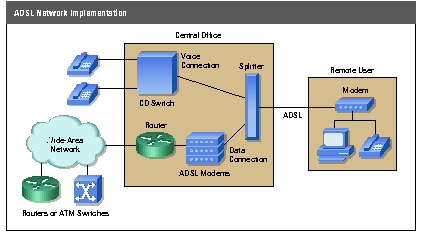
Remote users require transparent bandwidth, where data doesn't choke over slow pipelines. The networking industry has eyed several solutions over the last few years, including fiber-to-the-curb or cable television delivery. While they both have advantages, these two options have proven slow to implement and cost-prohibitive to the mass market.
One option that is gaining steady support over recent years is Digital Subscriber Line (DSL) technology, which uses the existing telephone system: the twisted-pair copper wiring already laid to 700 million locations worldwide. The Telecommunications Act of 1996 in the USA and similar deregulation worldwide have created new opportunities for telephone companies, cable television providers, and internetworking vendors. Now these groups compete for access to "dry" copper lines (telephone lines that are not connected to telco-owned equipment), enter new markets, and drive the global convergence of the Internet and telephone networks. This hybrid network raises customer expectations.
Although first conceived as a way to deliver video-on-demand services, the various DSL technologies (collectively referred to as xDSL) are now under investigation as high-speed transport methods for that "last mile" from central office to remote user. ISDN is a first try at DSL deployment. However, service providers and customers struggle with complex configuration and deployment issues inherent to ISDN. New xDSL technologies currently under development could deliver speeds from full-duplex T1 to 9 Mbps in certain areas. These newer DSL technologies are easier to install and maintain than ISDN, and as the technology matures, the cost should drop to within range of today's asynchronous modems, making xDSL not only efficient but available to more customers.
xDSL implementations today take several forms, with broad deployment of the first commercial high data-rate DSL (HDSL) T1 replacement solutions, and initial asymmetric DSL (ADSL) trials (see "What Is an xDSL," below). Remote user options may be a combination of PC network interface cards (NICs), xDSL modems, and Ethernet bridges and routers. These devices connect to xDSL modems at the telephone company central office, which in turn connect to Internet or intranet services over high-speed WAN services such as Frame Relay or ATM.
The standards for xDSL technology are immature, and product interoperability is still in the future. Field trials and customer preferences over the next few years will determine what directions the technology and market take. Coming generations of xDSL solutions will be less expensive and more scalable. It may be prudent for users to consider waiting for a solution that enables telcos and service providers to offer customers a variety of xDSL services.
An xDSL connection has the potential to be more than a mere pipeline. The question is, who will provide the most flexible, reliable, and powerful xDSL solution to telcos, service providers, and large enterprises at an affordable price? Customers have two options: a classical telephone equipment vendor or an internetwork solutions vendor. Telephone equipment vendors build reliable connectivity equipment, but may be unable to tackle the complexities of a multiprotocol network environment. The convergence of telephone networks and the Internet should yield a hybrid that offers the best of both. Most classical telephone equipment vendors will have to gather new expertise to satisfy customer demands. Network solution vendors already have the expertise and technology base to address the integration of the Internet with the telephone network.
As xDSL technology matures, the network infrastructure must address the issues of dynamic IP address allocation and management, virtual private networks (VPNs), security services, user-based Class-of-Service (CoS) and Quality-of-Service (QoS) features, multiprotocol translation, and multimedia services. These technologies are the domain of internetwork solutions vendors.
Industry-leading Cisco Internetwork Operating System (Cisco IOSTM) technologies exist today that Cisco will adapt to xDSL. These technologies include:
xDSL solutions based on Cisco IOS technologies would have the added benefit of seamlessly integrating with the Internet, powered primarily by Cisco IOS software, the world's most sophisticated and scalable software for deploying network services. Anyone considering an investment in xDSL solutions for remote users would do well to watch as the technology matures, preferred standards emerge, and intelligent, flexible xDSL solutions become available. Then customers will be in a good position to examine the breadth and reliability of solutions offered by each xDSL vendor.
| What Is an xDSL? |
|---|
| Digital Subscriber Line (xDSL) technologies enable "last mile" high-speed transmission from service provider to customer premises over most twisted-pair copper wiring, such as telephone lines. Contrary to what its name implies, DSL refers to modem technology, not to the line itself. A pair of xDSL modems on a standard copper line constitutes a DSL connection. While many standards have been defined, most xDSL technologies fall into one of four categories.
High Data-Rate DSL (HDSL) Several implementations of HDSL are in use today. HDSL typically supports 768-kbps full-duplex over a single twisted pair, T1-speed over two pairs, and E2 over three pairs. Currently HDSL is deployed primarily as a low-cost substitute for full T1 lines in symmetrical, business-oriented WAN applications. Single-Line DSL (SDSL) A single-Line version of HDSL, SDSL transmits T1 or E1 signals over one twisted pair. It can support standard telephone line transmission and T1/E1 simultaneously over the same line. SDSL technology is well suited for small subscriber premises (such as a home) equipped with a single telephone line. Asymmetric DSL (ADSL) With ADSL, available bandwidth is unevenly divided, and the larger portion is allocated to downstream traffic. Rates range from T1 to 9 Mbps downstream, with 16 kbps to 640 kbps upstream. ADSLs use either carrierless amplitude/phase (CAP) modulation or the newer discrete multitone (DMT) technique. ADSL should prove useful in small or home office WAN applications such as interactive video, client/server applications, and telecommuting, where most data flows one way. Very-High-Rate DSL (VDSL) Another iteration of ADSL, VDSL has the prospect of much higher speeds at shorter ranges, up to 52 Mbps downstream. VDSL is undergoing tests using several modulation techniques, and probably will be most useful in large-bandwidth applications such as medical imaging, real-time video, or HDTV. For more information on these technologies, visit the ADSL Forum Web site at http://www.adsl.com. |
___________________________________________________________________________________________________________
The emerging technologies for transmitting voice traffic over data networks present key opportunities for enterprises to reduce costs and enable new applications. By running real-time voice and fax transmissions over existing wide-area networks, companies can realize significant savings in long-distance telephone costs, especially for communications between company locations. In addition, this technology positions companies to implement capabilities for sending voice over the Internet, opening new avenues for marketing, customer service, and workgroup collaboration.
The standards and products for transmitting voice over data networks are coming to the forefront because of a fundamental shift in the economics of both private and public networks. Today, many enterprises have made substantial investments in private data network facilities, which have capacity available to carry additional traffic with little incremental expense. At the same time, these companies are sending voice traffic on separate networks, with the associated additional costs of links, equipment, and toll charges.
Enterprises used to justify the expense of private WANs by the cost savings these networks enabled for their voice traffic. But today, bandwidth requirements for data networks are so great that enterprises can add voice capabilities to these networks for minimal incremental cost.
Sending voice transmissions over data networks can be useful not only for regular telephone calls, but for specialized networked applications such as videoconferencing, discussions that accompany electronic whiteboards, and voice calls placed from World Wide Web pages.
Voice and data traffic have different requirements for network bandwidth. (From a technology standpoint, voice and fax transmissions are treated similarly.) A voice transmission requires only a small amount of bandwidth, but that bandwidth must be available continuously, with very little delay. Even delays measured in milliseconds can create a noticeable echo or gap in the conversation.
In comparison, data traffic can adjust easily to network delay, and with its bursty nature, can use the amount of bandwidth available in the network at any moment.
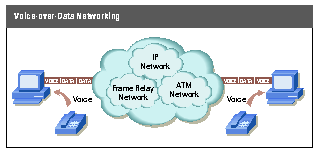
In order for voice over data to become a practical consideration for most organizations, it requires support on a variety of data network types, including IP, Frame Relay, and Asynchronous Transfer Mode (ATM). On an IP or Frame Relay network, technologies must transform "best-effort" communications into functionality that can support both continuous, streaming voice conversations as well as bursty data transmissions. ATM networks can already carry voice, because their design integrates all communications types--including delay-sensitive traffic--over a single network.
In addition to these general capabilities, specific features supporting voice transmission must also be implemented in network platforms. These features include:
Cisco Systems currently supports voice over data in the StrataCom® IGXTM and the LightStream® 1010 ATM switches. In the coming year, Cisco plans to expand support in these products and its remote access products and offer additional capabilities for switching in enterprises and the public network. This support will extend over all network types--IP, Frame Relay, and ATM--with full interoperability that will allow a call initiated on one network to be completed on a different network in another part of the enterprise.
Voice communications will be enabled through a combination of hardware and Cisco IOS software features, and customers will add voice equipment to their existing network platforms.
In addition to Cisco's forward-looking product development for voice over data, Cisco employees participate in several industry groups that are defining key technology standards. These groups include the Internet Engineering Task Force (IETF), which is defining RSVP, and the Voice over IP Forum, which is addressing interoperability issues for voice transmission over the Internet and IP networks.
For network managers, now is the time to begin considering the opportunities for transmitting voice over enterprise data networks. As a leader in developing the required technologies, Cisco will help customers turn the potential cost savings and communications gains into a reality.
___________________________________________________________________________________________________________
Gigabit Switch Routers Will Create Business Advantages for Service Providers, Large Enterprises
Skyrocketing volumes of traffic are driving Internet service providers (ISPs) to seek ever larger network "pipes" to accommodate customer demands. Likewise, managers of many large corporate networks who are consolidating backbone protocols and moving campus-to-campus traffic across the WAN anticipate a need for devices at the core of the network to offer multigigabit bandwidth.
These changing network requirements call for an entirely new class of device. Not only must these new devices meet burgeoning performance and scalability requirements, they must provide network services to enhance these customers' business and add value in a variety of ways. Primarily, they would operate at the core of the backbone where all network traffic is aggregated from distribution nodes.
Expectations for routers are changing. Until recently, many people believed that CPU- and software-based routers wouldn't scale to meet the Internet firestorm facing service providers. Today, new routing architectures are proving that routers can and will scale to gigabit performance. The emerging class of gigabit switch routers will not only address next-generation bandwidth and performance requirements, but support valuable network services that will translate into profitability for customers. The Internet's present robustness and scalability is attributed to Layer 3 intelligence provided by routers, which extend pivotal features such as security and traffic filtering. Gigabit switch routers will enhance those capabilities with performance comparable to that of projected switching rates--that is, into the tens of gigabits.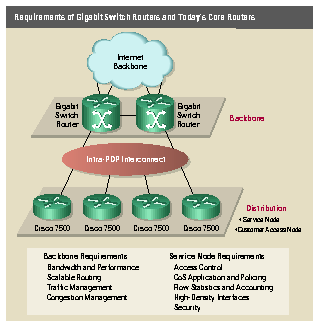
At the Next-Generation Networks '96 conference sponsored by McQuillan Associates last December, vendors and customers discussed the critical needs that gigabit switch routers must address, specifically those of service providers, but--in the next year or two--of enterprises as well. Graeme Fraser, Director of Core Engineering at Cisco Systems, used this forum to present a statement of direction for Cisco's plans in this field and to discuss Cisco's findings in terms of user requirements for gigabit switch routers.
"Performance and bandwidth are first on the list," says Fraser. Like a well-designed race car, every feature and function of a gigabit switch router must be pared down to necessity and tuned for speed. For example, unlike the gigabit switch router's multiprotocol forebears, this new device must be optimized for IP networks. Many enterprise customers have told Cisco that they are consolidating protocols at their backbones, largely in favor of IP, for which they need the Layer 3 network services that routers provide--but at speeds normally associated with ATM switching. Likewise, as aggregation centers, gigabit switch routers must be equipped with very specific media support and interfaces to provide the Internet's "fattest" pipes, such as Asynchronous Transfer Mode (ATM) and Packet over sonet (POS), scaling to OC-12, OC-48, and beyond.
Cisco's Tag Switching technology enables IP-oriented Internet services to be carried over ATM-based networks, which are capable of supporting multiple services and other traffic, including voice and video. For more information on Tag Switching, visit URL http://www.cisco.com/warp/public/733/scaling/pjtag_wp.html.
Fraser refers to "survival and prosperity modes for service providers," the idea being that presently, most providers are struggling simply to support the ever-growing use of the Internet. To continue to survive, they need devices that will scale--as high as OC-48 in the next year or two. But to prosper, they need a robust set of value-adding network services. "Certainly performance is critical," says Fraser, "but it's just the entry criterion."
In addition to performance, providers must meet several other survival requirements. The issue of availability is always paramount. Gigabit switch routers must present equipment redundancy, online insertion and removal for upgrades "on the fly," and user-friendly diagnostics in both hardware and software. Gigabit switch routers must also address network reliability through sophisticated traffic management techniques such as "route dampening" with the Border Gateway Protocol (BGP). A technique supported in Cisco Internetwork Operating System (Cisco IOSTM) software, dampening helps mitigate the effects of spurious route advertisements. (For more information on route dampening, visit the URL http://www.cisco.com/warp/public/459/16.html.) Another traffic management technique for optimizing network availability is the ability to prioritize routing updates over other traffic.
These requirements are basic for the service providers. Ideally, though, gigabit switch routers would move ISPs from merely surviving in the face of demand to prospering and finding new ways to improve their business. Toward this end, a new set of criteria comes into play.
High on the list is bandwidth optimization to offset the cost of WAN pipes. Much like overbooking on airlines, congestion is a cost-driven reality on the Internet. Gigabit switch routers must introduce new ways to solve congestion problems in order to utilize maximum bandwidth at all times.
Support for very large buffers also is critical. With OC-12 rates, line cards must provide significant buffering--up to 20 MB in some cases--in order to maximize IP throughput. Intelligent software features such as Random Early Detection (RED) offer congestion avoidance by controlling traffic "bursts" that lead to overflowing buffers.
To provide load-balancing during steady-state and failure conditions, gigabit switch routers must enable network managers to perform advanced traffic engineering that can define alternative routes (other than those defined by a routing protocol) based on priority to optimize traffic flows.
Class-of-service (CoS) features also will give gigabit switch routers the ability to differentiate traffic based on network-layer information. Service providers can use these features to define different classes of service for their customers--a capability that they can translate into higher profit margins.
Bandwidth and performance are a vital part of the solution to make the Internet scale, and Cisco is pioneering next-generation products that will support that scalability. But performance alone will never be the only issue. "We need to build real networks that are reliable, cost-effective, and provide a means of differentiation to help our customers to increase their profitability," says Fraser. "With those ideas in mind, Cisco is developing next-generation routing technology to solve scalability and service performance issues in the core of the backbone. And you'll see Cisco products targeted for these needs starting in the second half of 1997."
| Core Routers Today--The Cisco 7500 |
|---|
The Cisco 7500 series is Cisco's premier high-end platform for Internet backbone applications at OC-3 (155 Mbps) rates, as well as aggregation and distribution functions. With its scalable performance for network services and its high port density--up to 308 ports on a single unit--the Cisco 7500 will continue to play an important role in enterprise and Internet service provider networks. Some recent enhancements to the Cisco 7500 platform include:
For more information on the capabilities of the Cisco 7500 core routers, visit the URL http://www.cisco.com/warp/public/733/index.html. |
___________________________________________________________________________________________________________
The incredible growth of traffic over LANs is pushing network administrators to look to higher-speed network technologies. One of the most promising technologies on the horizon is Gigabit Ethernet, which will provide an order of magnitude increase for existing networks in Ethernet's already strong scalability story.
"High-performance file servers and campus backbones will especially benefit from the tenfold increase in bandwidth provided by Gigabit Ethernet over Fast Ethernet," says Nathan Walker, Cisco Systems Product Line Manager for Gigabit Ethernet technologies. Walker is also Vice Chairman of the Gigabit Ethernet Alliance, a vendor consortium of 100 companies seeking to accelerate Gigabit Ethernet standards. "The technology will also provide an upgrade path for environments with crowded bandwidth applications, such as high-end imaging, prepress, video, and CAD/CAM," continues Walker. "These were among the first applications to adopt Fast Ethernet technology."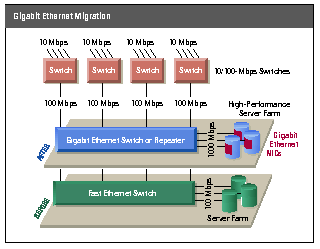
Gigabit Ethernet is an extension to the highly successful 10-Mbps and 100-Mbps IEEE 802.3 Ethernet standards. Offering a raw data bandwidth of 1000 Mbps, it maintains full compatibility with the installed base of over 70 million Ethernet nodes. Initially operating over optical fiber, Gigabit Ethernet will eventually be able to use Category 5 unshielded twisted-pair (UTP) cabling.
"Ethernet users have already developed expertise and tools that allow their networks to operate at peak capacity," Walker points out. "Gigabit Ethernet will complement and extend those investments."
Many customers believe that the evolutionary upgrade path represented by Gigabit Ethernet makes it a better choice than other high-speed network technologies such as Asynchronous Transfer Mode (ATM), which require more significant infrastructure changes. But Walker says both technologies have important roles to play. "Which technology you choose depends on your existing network, planned applications, and your deployment timing," he suggests. "ATM provides guaranteed quality of service and service integration capabilities, making it very useful for WAN access integration and combining data, video, and voice traffic. And ATM products are available for production networks today."
Gigabit Ethernet will provide low-cost bandwidth and enable customers with Ethernet investments to scale upward easily. Analysts believe that it will be an excellent solution for backbone and campus LAN applications, but it won't be ready for production use for at least another year. The IEEE task force is moving aggressively to develop and ratify Gigabit Ethernet standards; it expects to complete a specification by early 1998.
Current development work at Cisco is aimed at extending the technologies obtained in last year's acquisition of Granite Systems, a Gigabit Ethernet pioneer, and combining these technologies with other Cisco development efforts. Cisco's focus is on low-cost integrated circuit (IC) technology, Gigabit Ethernet MAC technology, and multilayer switching technology for both Layer 2 and Layer 3 interfaces. "This focus will deliver Gigabit Ethernet products that will easily integrate into customers' existing networks," Walker explains.
The initial applications for Gigabit Ethernet will target campuses or buildings that need greater bandwidth between routers, switches, hubs, repeaters, and servers. Examples include switch-to-router, switch-to-switch, switch-to-server, and repeater-to-switch connections. Although network analyzers will need to be updated to handle the higher-speed connections, the frame format and network topology are the same. Training for personnel will be minimal.
"We want customers to be able to get it right the first time," Walker concludes. "That means installing standards-compliant Gigabit Ethernet products. Our development schedules are consistent with the timing of the standards committee."
How does Gigabit Ethernet relate to 10/100-Mbps Ethernet?
An extension to the widely used 10- and 100-Mbps 802.3 Ethernet standards, Gigabit Ethernet will provide raw data bandwidth of 1000 Mbps while maintaining full compatibility with the huge installed base of Ethernet nodes. It will support full- and half-duplex operating modes and, for half duplex, Gigabit Ethernet will retain the familiar carrier sense multiple access/collision detection (CSMA/CD) access method.
Initial products will use Fiber Channel signaling technology that is adapted for data rates of 1000 Mbps over fiber-optic cabling. Advances in silicon technology and digital signal processing will eventually enable cost-effective support for Gigabit Ethernet operation over Category 5 unshielded twisted-pair (UTP) wiring.
How does Gigabit Ethernet fit into existing networks?
Gigabit Ethernet will fully comply with existing networks and preserve users' investments in network management and operating systems, applications, and protocols. It will retain the 802.3 and Ethernet frame format and the 802.3 managed object specifications, affording users an easy migration. Gigabit Ethernet will provide increased bandwidth in those portions of the network where it is needed, while integrating seamlessly with users' existing Ethernet infrastructures.
What are the distance characteristics of Gigabit Ethernet?
In theory, Gigabit Ethernet networks are unlimited in terms of either physical extent or number of nodes. Like 10/100-Mbps Ethernet, Gigabit Ethernet will support a variety of physical media with varying link-distance capabilities. The IEEE 802.3z Task Force has identified three goals for link distance: a multimode fiber-optic link with a maximum length of 500 meters; a single-mode fiber-optic link with a maximum length of 3 kilometers; and a copper-based link with a 25-meter maximum. A technology that would support link distances of at least 100 meters over Category 5 UTP wiring is also under investigation by the IEEE.
| Staying in Touch |
|---|
| The Gigabit Ethernet Alliance has established a Web site that provides easy access to Gigabit Ethernet Alliance news, updates and activities. Visit http://www.gigabit-ethernet.org for details on this evolving technology. |
___________________________________________________________________________________________________________
Enterprise network managers and service providers need products that deliver cost-effective solutions for the point where users connect to access networks. Several recent announcements highlight Cisco's expanding product line for remote access solutions.
The new Cisco 770 series access hubs extend Cisco's solutions for affordable, high-speed access over Integrated Services Digital Network (ISDN) lines. Available now, the four Cisco 770 models include the same features as the Cisco 760 series, but add a four-port Ethernet hub for easy LAN connections and a Call Connect/Disconnect switch for making or disconnecting data calls manually.
The Cisco 770 series enables multiple users to simultaneously share internal information and access the Internet. As networks in small and home offices become more advanced and require workstation address management, the Cisco 770 series delivers easy setup, simple address management, and security from outside intrusion.
The Cisco 770 series supports Port and Address Translation (PAT), a new feature of the Cisco Internetwork Operating System (Cisco IOSTM) software that enables a single IP address to be assigned to an entire LAN. This feature significantly conserves valuable IP addresses, simplifies network management, and reduces costs for both service providers and end users.
With the PAT feature, remote workstation and LAN addresses are dynamically assigned by the Dynamic Host Configuration Protocol (DHCP) server, which is now supported on all Cisco 700 series products. Users can maintain private network addressing schemes, because all WAN traffic is mapped on a single node--the Cisco 700 series router/hub. Only one IP address is accessible from the outside world, providing firewall-like security for the internal network.
Like all Cisco 700 family products, the new models offer numerous features, such as Cisco's ClickStartTM software, that simplify installation, configuration, and management by nontechnical users.
The new Cisco 1600 series access routers present an affordable solution to small and medium-sized businesses for connecting to the Internet or building intranets. This series delivers flexibility for changing network environments and offers greater security through firewall features, payload encryption, and extensive support for multimedia.
Also targeted to small remote offices of larger enterprises, the Cisco 1600 series delivers flexibility and investment protection against changes in WAN technologies and service availability. Four Cisco 1600 models are available now; each includes one Ethernet port, one built-in WAN port for ISDN or switched 56-kbps services, and one WAN interface card expansion slot for additional connectivity and media choices.
The Cisco 1600 routers offer a range of features that enable a diverse set of powerful networked applications. These features include bandwidth utilization for multimedia applications, address translation for Internet access, virtual private networking, and encryption technology. Cisco's ClickStart software configuration and monitoring tool allows PC or workstation users to install, configure, and monitor Cisco 1600 series routers in minutes with any Web-based browser. The series also supports Cisco AutoInstall for central-site configuration downloads, a Flash card for Cisco IOS software upgrades, and network management with the CiscoWorksTM applications.
The Cisco 3600 series is a new family of modular, cost-effective access servers that meet the dialup needs of regional and branch offices and small to midsized Internet service providers (ISPs). These new access servers allow remote users to efficiently connect to a wide array of advanced network applications.
As a modular platform, the Cisco 3600 series supports a mix of ISDN, asynchronous, and synchronous WAN interfaces with many different port densities. Modular interfaces in the product accommodate users with different network access, bandwidth, and cost requirements. For example, a Cisco 3640 access server can connect mobile users dialing in on asynchronous connections, power users at telecommuter and teleworker sites with high bandwidth requirements and long connection times, and branch offices with multiple-interface traffic.
Two or four network module expansion slots are available on Cisco 3600 models. These expansion slots deliver the flexibility to increase dial-access density or to add interfaces for evolving LAN and WAN technologies.
The following new interface modules for the Cisco 3600 series are available now:
The Cisco 3600 series supports the Cisco IOS software, including features such as dial connectivity and WAN optimization. The new products also support Multichassis, Multilink Point-to-Point Protocol (MMP), which enables scalable growth with multiple units. The Cisco 3600 series extends Cisco's complete, end-to-end solution set for dial connectivity with new levels of modularity, scalability, and flexibility.
Cisco has announced new modules for the Cisco 4500 and 4700 series routers that provide sophisticated internetworking for Ethernet and Token Ring LANs in regional offices. These new modules expand the media choices for Cisco 4000 routers, which already support a broad range of interfaces. Both modules are shipping now.
___________________________________________________________________________________________________________
This story represents the first in a series that will explore the benefits of telecommuting for companies and their employees.
Telecommuting, in-home routers, and residential high-speed data lines are becoming another facet of daily work at hundreds of companies. The Gartner Group, an information technology advisory firm based in Stamford, Connecticut, predicts there will be more than 30 million telecommuters in the US workforce by the year 2000. With such rapid growth predicted, this movement is far from a work habit; it's become a work style and way of life for an increasing percentage of US workers, including Cisco employees.
When family reasons prompted an out-of-state move in 1992, Spank McCoy, a staff writer for Cisco's Knowledge Products group, was offered the opportunity to telecommute on a trial basis--a first for his department. He now connects long-distance to the San Jose headquarters over Frame Relay, but originally started telecommuting five years ago over a 9600-baud dial-in line. His initial success, and management's validation of telecommuting as an acceptable workstyle, have proven very beneficial to the department and forged a path for his coworkers to work from home. Telecommuting options for qualified employees let the group hire and retain top-notch talent. "Work is an activity, not a place," says McCoy, from his home office in Wake Forest, North Carolina, 40 miles from the nearest Cisco office.
Desiree Altemus, a staff writer who also leads several Enterprise Network Management projects for Cisco, was a part-time telecommuter for over a year. When her husband made a career change, the family moved to Napa, California, and she began telecommuting full time. Now approaching her three-year telecommuting anniversary, Altemus has a full office setup and connects to the network from her Macintosh and PC using Frame Relay with a Cisco 2516 router. While she still drives the two hours to San Jose headquarters for occasional face-to-face meetings, it helps her to appreciate the benefits of working from home. Less commute time means more efficient use of work hours, which translates into increased productivity.
A full-time telecommuter for seven months, Marty Golden interacts with several different departments at Cisco in his role as Senior Database Specialist. His manager has been so supportive of his decision to telecommute that she has installed video cameras in both their offices so Golden can attend staff meetings in real-time video. Using a Cisco 1004 router with a direct Integrated Services Digital Network (ISDN) line to the company, Golden is able to work at home at the same data rates as he would have with a direct connection to the office LAN.
Donna Prust, a manager in the Knowledge Products Enterprise Network Management group, reiterates the Cisco management philosophy on telecommuting. "Telecommuting is one of the smartest things Cisco or any other company can offer to its employees. Certain individuals can be 20 to 25 percent more productive working from home than if they were on site every day, partially because they have the opportunity to focus on the task at hand without interruptions."
McCoy, Altemus, and Golden rely heavily on e-mail and voicemail and do their best to provide timely responses to battle the "out-of-sight, out-of-mind" issues that arise from working off site. Most try to attend occasional onsite meetings to get face-to-face interaction with coworkers and supervisors. But all report that the benefits of telecommuting are far reaching, and working from home helps contribute to increased productivity and job satisfaction.
| Do You Have a Telecommuting Story to Tell? |
|---|
| Are you a full-time telecommuter for your company? Contact us with your story, and you could be profiled in an upcoming issue of Packet magazine. Send e-mail to dandreas@cisco.com, using the subject line, "Telecommuting." |
___________________________________________________________________________________________________________
MCI and First Pacific Bank Move to Router-Based Connectivity Solution
Multiprotocol networks are the norm in today's large data centers as SNA shops merge their established mainframe networks with multiprotocol client/server networks, often based on TCP/IP.
MCI Communications is a prime example. The telecom giant is immersed in a US$20 million network retooling project called InfoLink that will combine SNA, TCP/IP, and Advanced Peer-to-Peer Networking (APPN) traffic on a single, low-maintenance network. Cisco Systems is helping to bring the multiprotocol network to life as more than 50 IBM front-end processors (FEPs) are replaced with ESCON channel-attached Cisco 7500 routers outfitted with Channel Interface Processor (CIP) cards.
What's the motivation for such a massive network conversion project?
Lowering costs, answers John Gerdelman, President of network MCI Services. Gerdelman and other MCI officials believe that replacing IBM FEPs with Cisco's channel-attached routers will quickly save the company as much as US$4 million per year in upgrade, maintenance, and service costs. The CIP-based routers allow network engineers to connect SNA/APPN hosts directly to the TCP/IP backbone, meaning that MCI can carry its internal network traffic over one network rather than two.
"Our goal is to build a TCP/IP backbone that supports all of our internal applications and protocols, especially SNA, which represents our major corporate information systems," Gerdelman explains. "Further savings will arise simply by shortening connect times and offering faster access to databases and other information resources across the WAN."
MCI had separate TCP/IP and SNA networks until 1995, when network engineers realized that maintaining parallel networks was not only inefficient but restricted user access to important information resources. The company evaluated IBM's 3746 FEP as a possible solution but determined that it could not match the speed and functionality of Cisco's routed solution. MCI is not alone. Many large companies are burdened by the increased administration of maintaining multiple networks. A fully routed, multiprotocol network backbone hosted by the CIP card solves the problem. "We want to transparently support whatever protocol users need," says Glen Tindal, a senior architect at MCI. "That means maintaining both a large SNA environment and a rapidly growing TCP/IP environment, along with proprietary protocols such as IPX."
The CIP delivers IP, SNA, and APPN traffic directly to the mainframe, eliminating the need for expensive intermediary equipment such as IBM 3172 Interconnect Controllers and 3745 FEPs. "CIP cards enable network routers to assume the functions of those devices, providing a more direct and cost-effective data path to and from the mainframe," says Tindal.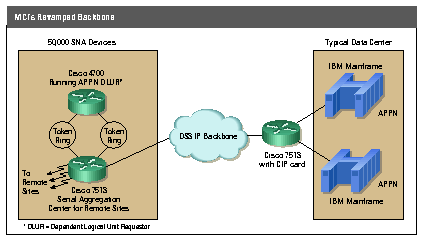
One attraction of CIP technology to MCI was Data-Link Switching Plus (DLSw+), a Cisco Internetwork Operating System (Cisco IOSTM) software capability that encapsulates SNA data in IP so that it can be transmitted efficiently over the TCP/IP backbone. The inherent flexibility of Cisco's CIP solution allows MCI to allocate front-end processing and routing to the same network device while offering room for expansion into new technologies such as Fast Ethernet and Asynchronous Transfer Mode (ATM).
Similar network conversions are happening all over the world. First Pacific Bank in Hong Kong chose CIP technology to directly connect its mainframe to a high-speed data network--one of the first installations of its kind in Asia. A direct mainframe-to-LAN link eliminates the need for slow and costly channel control equipment while enabling branch offices to access financial information residing on mainframe computers at the bank's Hong Kong headquarters.
"The key difference is speed," says Egbert Chan, Vice President of Information Technology at First Pacific Bank. "We recently installed new Windows NT-based banking applications at all our branches, which will lead to significantly more data traversing the network. We wanted a solution that will minimize user response time and maximize network throughput."
The CIP card fits directly into the bank's Cisco 7500 series router, replacing a pair of IBM FEPs and creating a direct connection between the mainframe and the rest of the network. "We became aware at the planning stage that the IBM 3745 FEPs would have difficulty coping with the increased volume of traffic from the new branch networks," Chan adds. "That's when we were introduced to the CIP."
First Pacific's strategic banking applications reside on a combination of IBM ES/9000 mainframe computers and IBM AS/400 midrange systems at its main data center. Until recently, users accessed these applications through IBM 4704 terminals attached to IBM 4701 controllers that connect to the FEPs over low-speed Synchronous Data Link Control (SDLC) links running at 2400 and 9600 bps.
CIP cards on the bank's router will pave the way to a more modern architecture by allowing LAN-attached PC devices to become the predominant SNA clients, Chan explains. IS professionals are introducing new PC-based LANs at each branch along with Cisco 2500 series routers. The routers will be used to provide connectivity between the data center and branch servers via Frame Relay, giving users in each branch office direct access to the host computers through graphical PCs.
"To meet the growing requirement for host access across the organization, SNA frames will be encapsulated in TCP/IP and delivered at high speed to the mainframe," Chan says. CIP technology provides a direct data path to and from the mainframe via IBM's 4.5-MBps parallel channel interface, he adds. All channel processing is handled on the CIP, enabling the bank to support the increased traffic volume generated by the new banking applications.
"We would rather invest in the Cisco CIP solution, which saves us money and provides the performance we need for our new applications," says Chan.
___________________________________________________________________________________________________________
With business expanding at 100 percent annually for five consecutive years and employee head count estimated to grow from 2200 to 4600 by the end of 1997, it came as no surprise to PeopleSoft, Inc. (Pleasanton, California) when Fortune magazine ranked it the 11th fastest-growing business in the United States. To create a network infrastructure that is robust, flexible, and scalable enough to meet the demands of this explosive environment, PeopleSoft invested in a Cisco solution, which is deployed to 37 offices in 15 countries around the world.
Founded in 1989, PeopleSoft is a leading provider of enterprise applications software. Focusing on open client/server-based solutions for human resources, finance, material management, distribution, and manufacturing, PeopleSoft applications are implemented in nearly every industry throughout Fortune 1000 corporations. "Building a communications network that will enable us to deliver information to employees around the world in support of hundreds of customers is a major business goal," says Steve Zarate, Chief Information Officer for PeopleSoft, "and Cisco is key to meeting that goal."
To meet this objective, PeopleSoft runs the Cisco Internetwork Operating (Cisco IOSTM) software and implements a full complement of Cisco solutions ranging from Cisco 4000 series routers to Cisco LightStream® 1010 and StrataCom® BPXTM/AXISTM Asynchronous Transfer Mode (ATM) switches to the latest Cisco 7200 routers and CatalystTM 5000 LAN switches. "We are a Cisco shop. Our whole local- and wide-area network runs on Cisco," says Dianne Wimmer, Manager of Network Services.
"With Cisco we're able to stay on leading-edge switching technology," continues Wimmer. "If we think a technology will give us better performance, we're on it; we're early adopters who test a technology before we roll it out to our offices worldwide."
PeopleSoft uses Cisco 4000 and 7200 series routers in its corporate headquarters and regional offices. The Cisco 7200 routers enable organizations to exploit the benefits of multiprotocol support including IP, IPX, AppleTalk, DECnet, and Banyan vines. In addition, the series supports both Cisco's Inter-Switch Link (ISL) protocol for transporting virtual LANs (VLANs) across Fast Ethernet and the IEEE 802.10 standard for transporting VLANs over Fiber Distributed Data Interface (FDDI) ports.
Cisco 7200 routers also deliver unprecedented price/performance levels to PeopleSoft. A 150-MHz RISC processor provides over 600 Mbps of bandwidth capacity and switching performance at 140,000 packets per second. These features extend network-layer capabilities to a much wider range of network configurations and environments.
"When you're growing at the rate that we are," says Network Engineer Stan Christensen, "you need to be able to add more capacity without much fuss. With Cisco we can definitely scale; in fact, quite tremendously. We know that our routing and switching technology can be deployed on a small site and then stretched to accommodate a very large site without having to buy more equipment. We just plug in another port to add the capacity we need. Cisco provides some of the largest port-density in the industry, and that's a big advantage for us."
The company is also reviewing NetFlowTM Switching for implementation. NetFlow is a Cisco IOS software switching mechanism that identifies traffic flows between network hosts and then switches packets in these flows at the same time that it applies relevant services. NetFlow Switching allows the Cisco 7200 router to combine high-performance network-layer switching with the connection-oriented application of network services, such as security access lists and traffic accounting. "With a network of our dimensions--encompassing both intra- and internetworks--we need a lot of security," maintains Christensen. "We want to tighten security on a router-by-router basis without affecting performance, and NetFlow Switching will give us the ability to add security to the router and not take a performance hit. This really gives us the option to expand on wider scales, especially in some intensive routing areas such as our development labs. NetFlow Switching will give us some capabilities security-wise that we've never had."
Opening up new technology doors, meeting demanding bandwidth requirements reliably and securely, and delivering end-to-end connectivity contribute to an efficient and responsive network. Yet, the inherent benefits of a single-vendor solution also give PeopleSoft a competitive edge. "Having one vendor makes our lives much easier," notes Wimmer. "With Cisco we can move equipment and know that we can count on a high level of functionality and performance. We've made a commitment to a single-vendor solution," she continues. "We see Cisco on the leading edge of technology, and because that is our business goal as well, we believe we're a good match with Cisco."
Reliability is also key to "peace of mind." Virtually every employee at PeopleSoft has a laptop with Web browser functionality. Developers can work around the clock. And each PeopleSoft site deploys at least one router and numerous switches. The network has to be up 100 percent of the time. "So you really need to have equipment that for the most part will not have problems," comments Christensen. "When I put something in a small site--for example in Perth, Australia--I can't be flying out there every other week to help them set it up or resolve some issue. It's got to work without my presence. And Cisco technology has definitely held together for us."
The benefits of a single-vendor solution also extend to areas of technical training. "One of our major costs is training," says Wimmer. "We consider training our engineers an investment, and we get the biggest return on that investment with a single-vendor solution. By using Cisco products, our training is focused and thorough and doesn't have to be repeated across multiple platforms and technologies.
"The Cisco alliance lowers our administrative overhead by giving us the ability to move equipment without redesigning or reconfiguring," continues Wimmer. "An engineer simply works with a CiscoWorksTM monitor, makes the required change, and we roll that change out to the world. And it doesn't matter if it's a Cisco 7200 router, a Cisco 4500, or whatever--we just roll the configuration out."
PeopleSoft's unified approach to networking allows the company to easily deploy new technologies. The network delivers a strategic business advantage. "Cycle time, bringing product to market, and doing that quickly and reliably to meet market expectations--all this is central to the success of PeopleSoft," says Steve Zarate. "Our network enables us to achieve those objectives, and Cisco has been able to scale to our requirements."
The latest example is ATM technology. While the company uses Frame Relay for LAN/WAN connections, it deploys ATM to accommodate bandwidth requirements between developers at corporate headquarters in Pleasanton, California, and Teaneck, New Jersey.
"Our users need more and more data at faster rates," notes Zarate. "They demand instantaneous response times, and the bar is set very high. We deployed the BPX ATM switch to help provide a bigger pipe that will deliver more information faster and more reliably than ever before; that's a prime example of how Cisco has moved us ahead." The multiservice design of the Cisco StrataCom BPX/AXIS switch makes it a highly flexible platform for both existing and emerging user requirements. It provides backbone ATM switching and integration of multiple services, including ATM, Frame Relay, Switched Multimegabit Data Service (SMDS), and circuit emulation. With BPX/AXIS technology, PeopleSoft will be able to exploit high-throughput and low-latency switching for a mix of traffic such as data, voice, images, and video.
"We really view our relationship with Cisco as a partnership," continues Zarate. "Cisco is committed to moving forward. And in this business, if you're not running forward, you're falling behind. Cisco has demonstrated the ability to run with the best of them." 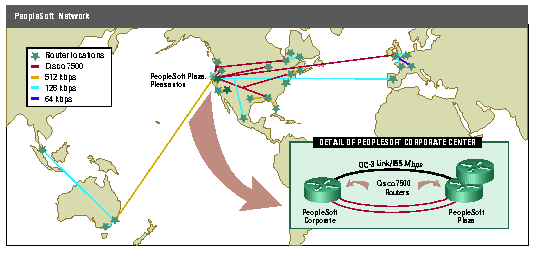
___________________________________________________________________________________________________________
Communication over the Internet and intranets has become the operational norm for many organizations. Now, network managers seek tools for delivering new types of information securely and economically over these networks. Cisco Systems continues to meet those needs with new products that harness the benefits of the World Wide Web and video communication and an enhanced security firewall for protecting enterprise networks.
Corporate broadcasts and remote training programs have traditionally required dedicated video cables, monitors, or viewing rooms. New Cisco IP/TV software, developed by Precept Software Inc., offers a cost-effective alternative. This product delivers full-motion video directly to a window on the user's Windows 95 or Windows NT computer via existing data networks.
Cisco IP/TV is a client/server application that uses IP Multicast services to distribute live or prerecorded digital video and audio streams to an unlimited number of users over any IP-based LAN or WAN. This product is ideal for applications such as:
The Cisco IP/TV product consists of three components, all available now. The Program Guide application provides multicast program setup and management based on World Wide Web technology. The IP/TV Server application delivers multicast programs, or those with many senders and receivers. The IP/TV Viewer is the user application for browsing program "listings" and viewing broadcasts on the network.
The Cisco IP/TV software complies with many Internet multicast and multimedia standards to save network bandwidth. The product can be used with any video for Windows-compatible hardware or software codecs.
Organizations large and small are implementing World Wide Web sites to give customers and prospects access to product literature and other information. Some organizations also are creating intranets to share Web-based databases and documents, such as benefits administration and training schedules, internally. These organizations need one or more servers to store the Web pages and handle communications with users. Cisco's new Micro Webserver addresses these needs with a cost-effective turnkey device. Designed specifically for Web and intranet functions, the Cisco Micro Webserver hosts Web pages and applications and handles all user access and communications.
The Cisco Micro Webserver is ideal for many networked applications:
Other server solutions require a high-powered computer, operating system software, Web server software, and additional utilities. This complexity can easily discourage small organizations with limited funding and technical expertise.
Available now, the Cisco Micro Webserver packages both hardware and software in a space-saving unit that is easy to install and configure.
Cisco is shipping a new software version for the Cisco PIX Firewall, a standalone device that helps users meet demanding security requirements for enterprise-wide Internet connections. The Software Release 3.0 product offers improved speed with "cut-through proxy" for security processing, a failover/hot standby feature, and a choice of encryption methods.
Cisco's new cut-through proxy technology provides faster throughput and minimizes bottlenecks while protecting networks from outside intrusion. Cut-through proxy also offers enhanced user authentication based on the industry-standard Terminal Access Controller Access Control System (TACACS+) or Remote Authentication Dial-in User Service (RADIUS) security databases. Most UNIX-based proxy server firewalls perform extensive processing on each data packet, slowing down network traffic. In contrast, a Cisco PIX Firewall using cut-through proxy technology increases the speed of security verification by dramatically reducing this processing and the associated network overhead.
For customers with mission-critical security needs, the new failover/hot-standby feature enables network managers to achieve maximum network reliability by removing any potential single points of failure in the security architecture. If the primary unit is not working, the secondary unit automatically assumes security processing without loss of system integrity.
Software Release 3.0, combined with the PIX Private Link encryption card, offers a cost-effective security solution for virtual private networks over the Internet using a choice of encryption methods. The PIX Private Link card supports the Data Encryption Standard (DES) algorithm as well as the proposed Internet Engineering Task Force (IETF) Authentication Header (AH) and Encapsulating Security Payload (ESP) standards (RFCs 1826 and 1827, respectively), which offer users a new way to encapsulate encrypted data.
Cisco PIX Firewall Release 3.0 is shipping now. Software upgrades are available at no charge through Cisco Connection Online (URL http://www.cisco.com) for all customers of Cisco's SMARTnetTM program.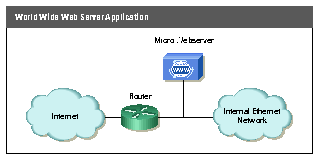
___________________________________________________________________________________________________________
Cisco Systems' acquisition of NETSYS Technologies--now complete--is helping Cisco maximize its network management offerings. New software provides consistent yet dynamic network modeling and design capabilities that are an important complement to Web-based management solutions.
NETSYS, provider of the first family of network-intelligent management software products, is a pioneer in network infrastructure management and performance analysis software. The NETSYS Enterprise/Solver family of network-intelligent tools aids problem solving, management, and planning of the overall network.
The NETSYS Connectivity Tools product is the first network management solution to collectively manage the network as a system rather than independent devices. The Connectivity Tools are the only network management tools to use the View, Isolate, Solve, Test, Apply (vista) network change methodology. vista allows users to quickly and effectively manage change on the network, helping to control the network-wide impact of any moves, additions, or changes. The NETSYS Connectivity Tools play an important role in ensuring consistent, effective security policies by evaluating the correctness and positioning of access lists.
The Performance Tools enable designers, planners, and operators to analyze the current state of their networks and predict how changes in traffic, application requirements, router configuration, equipment, and physical connectivity will impact network resources and end users.
The NETSYS Advisor offers more control over the changing network by bringing automated expertise to the NETSYS Connectivity Tools and Performance Tools. Advisor software keeps integrity, connectivity, and performance reports current with regularly scheduled collections of configurations and performance data.
Cisco will integrate the NETSYS network infrastructure management tools with Cisco Internetwork Operating System (Cisco IOSTM) technologies to simplify network management and planning for customers. The use of network modeling, planning, and analysis helps network managers consolidate and support their multimedia, multiprotocol, and multivendor network infrastructures.
For more information on the NETSYS network management solutions, visit the URL http://www.cisco.com/warp/public/734/toolkit/nesto_pl.htm. ___________________________________________________________________________________________________________
Security is not strictly a technology problem--networking vendors these days have vast amounts of security technologies. The real challenge is to enable network managers to implement a single policy. Today's security market is a jumble of point products: Internet firewalls, dial-in solutions, firewalls, and user authentication for the enterprise and network infrastructure. Implementing a consistent policy across the network has been disconnected and labor-intensive.
To address this industry-wide void, in February Cisco Systems announced the Cisco Enterprise Security strategy, the first comprehensive network security initiative proposed by any vendor. This initiative will enable dynamic links between customer policy, user or host identity, and network infrastructure through a cross product-line integration of available and emerging security technologies. With products scheduled for rollout over the next 18 months, this strategy integrates multiple product lines and takes a fresh approach: an enterprise-wide, user-oriented security policy that can be dynamically applied across a network infrastructure. It will transparently integrate current and new standards and technologies, including scalable certification authority, centralized policy management, dynamic access control, and authorization services.
Cisco Enterprise Security is based on three components: identity, integrity, and active audit. Identity refers to the dynamic linkage of user authentication, authorization, and location within the infrastructure, allowing use of a single policy for campus, dial, and firewall access. Integrity is the feature set that will provide secure firewalls, routing, and device configurations. Active audit will enable network managers to detect network anomalies, misuse, and attacks against the network, ensuring that the security policy is both consistent and operating correctly. This new approach to security will enable a consistent, centrally administered policy.
With this security solution, enterprise network managers will be able to:
Cisco is developing products in several phases to support the Enterprise Security strategy. The first of these products will be the Active Audit Server, which will provide security audits, verification, and reporting. Second will be the Enterprise Identity Server, a multitechnology server for centralized user location, authentication, authorization, and accounting. This server will be able to dynamically apply a policy to a network infrastructure, using the netsys modeling software. Cisco also has established a program for enterprise security partners as a forum for multivendor cooperation.
Cisco's Enterprise Security initiative will enable a single policy that can be applied to any potential entry point on the network. In other words, as users access the network from the internal LAN, from the road, or from home, the network knows who they are and what they can do, and network managers can track it all from one place.
___________________________________________________________________________________________________________
Users of 10-Mbps Ethernet who seek more performance at competitive prices can pick from several powerful new Cisco products: the CatalystTM 3100, 2820, and 1900 switches and the FastHub® 300 series 100BaseT hubs.
The latest addition to the Catalyst line of Ethernet switches--the Catalyst 3100--provides a stackable, 24-port multilayer switch with all the features to support speed-seeking desktop users while meeting all the management and connectivity requirements of enterprise networking.
With support for 100-Mbps Fast Ethernet, 155-Mbps Asynchronous Transfer Mode (ATM), and optional Integrated Services Digital Network (ISDN) links, the Catalyst 3100 may appear to be tailor-made for large organizations with specialized LAN or WAN requirements.
But the price puts the switch squarely within reach of midsized companies as well as remote offices of larger companies, stresses Catalyst 3000 family Product Manager Brad Danitz.
"With its stacking capability and uplink flexibility, this product offers tremendous value for growing businesses," says Danitz. "It's designed for dynamic networks that require flexibility and growth with minimum initial investment." Enabling that network growth is the Catalyst 3100's high-speed LAN uplinks and WAN access capabilities--which help satisfy the growing demand for more bandwidth and connectivity--and stacking capability, which allows LANs to scale more easily as networks expand.
"You can start small, and expand your switching system--up to an eight-switch stack--as your network needs grow," Danitz says.
Another strong feature of this switch is the FlexSlot, which supports existing and future multilayer Catalyst expansion modules. Because the FlexSlot supports both Layer 2 and Layer 3 modules, it allows users to customize the Catalyst 3100 stack to create just what they need, providing a high degree of flexibility.
Modules include support for 10BaseT/FL, 100BaseTX/FX, 100VG-AnyLAN TX/FX, ATM, and routed WAN (serial and ISDN). The configuration can also be changed by interconnecting from two to eight Catalyst 3100s and other Catalyst switches by using the Catalyst matrix, which provides 3.8-Gbps capacity.
The Catalyst 3100 supports advanced features such as remote monitoring (RMON), virtual LAN (VLAN trunking), Inter-Switch Link (ISL) capability, and the Cisco 3011 WAN access router module, which provides routed WAN connectivity to a single switch or an entire stack. "This switch offers integrated WAN access and all of the routed protocol capabilities of the Cisco 2500 series routers," Danitz says. The integrated WAN access module provides connections directly to the backplane of the switch.
The marriage of switching and routing in the Catalyst 3100 is an implementation of the CiscoFusionTM architecture, explains Danitz. The CiscoFusion approach to network design harnesses the benefits of Layer 3 routers and Layer 2 switches, and is strengthened by the advanced features of Cisco Internetwork Operating System (Cisco IOSTM) capabilities.
New capabilities in Catalyst Software Release 2.1 include enhanced ATM services and resiliency, additional network management capabilities, and enhanced security. WAN network services include protocol support for Frame Relay, IP, IPX, and Data-Link Switching (DLSw).
Danitz emphasizes that by combining some of the functions of routers and switches, Cisco has created an exceptionally powerful solution. "The integration you get with a genuine multilayer switch like the Catalyst 3100 is optimal. And by delivering multiple capabilities through the FlexSlot, the Catalyst 3100 provides tremendous investment protection."
Cost-effectiveness is also a key attraction of the Catalyst 1900 and 2820 series switches, says Steve Troyer, Product Manager for these switches. The architecture of the Catalyst 1900 and 2820 switches is well suited to handle the most demanding enterprise applications, such as videoconferencing. "This type of product has been targeted to larger businesses," Troyer explains. "But because it offers an excellent price per port, it's ideal for smaller companies, too." Organizations of all sizes can benefit from the Catalyst 1900 and 2820 switches, which are standalone devices that can improve the performance of 10BaseT networks.
The Catalyst 1900 provides 24 switched 10BaseT ports that link individual workstations and 10BaseT hubs; it also provides two 100BaseT connections for servers and backbones. Supporting as many as 1024 Media Access Control (MAC) addresses and an optional integrated 100BaseFX connection, the Catalyst 1900 is a smart alternative for organizations looking for low-cost desktop or workgroup switching.
The Catalyst 2820 also provides 24 switched 10BaseT ports and two high-speed expansion slots to support the widest range of high-speed LAN modules. It supports both switched and shared 100BaseT, copper, and fiber, as well as a future upgrade to ATM. With support for either 2048 or 8192 MAC addresses, these switches are flexible enough for even the largest environments.
The switch's ClearChannel architecture includes a shared-memory buffering design and an intelligent forwarding mechanism that allows large-burst packet capacity, even during peak loads.
In addition, the Catalyst 1900 and 2820 support the Cisco Group Management Protocol (CGMP). This feature enables a switch to selectively forward routed IP multicast flows to targeted multimedia end stations, reducing overall network traffic.
"The Catalyst 1900 and 2820 switches can handle bandwidth-hungry applications, such as multimedia, large file transfers, and imaging applications, that previously required more expensive hardware," Troyer says.
The low per-port price is also attractive to many enterprise organizations. For example, some large universities are replacing their shared 10-Mbps hubs and standardizing on the Catalyst 1900 to offer every student or user on campus a dedicated 10-Mbps segment for today's bandwidth-intensive applications and emerging networked applications.
The same advantages of cost-effectiveness, scalability, flexibility, and improved functionality are available through the FastHub® 300 series of 100BaseT repeaters, says Richard Martin, Product Manager for these manageable, stackable, Ethernet hubs.
Key to the FastHub 300 series is configuration flexibility. Two 16-port base configurations provide either all 100BaseTX or one 100BaseFX port, while two additional slots support a 100BaseTX expansion module and a network management module.
"The FastHub 300 is unparalleled in its configuration flexibility, which makes it an ideal solution for customers of almost any size," Martin notes. "You can use it in a small office with a workgroup of 16 users or an investment bank on Wall Street." Because the FastHub 300 series delivers 100BaseT throughput, it works very well in environments that require the sharing of large files across the LAN, whether the transmission is sustained or bursty.
Designed as a high-performance alternative to 10BaseT hubs, the FastHub series repeaters are the first 100BaseT hubs to offer port expansion and network management in a single unit. It can expand from 16 to 32 managed ports in a single hub and up to 128 ports in a single stack. And with its Class II design, customers can scale up to 254 ports in a single domain by cascading two stacks together. In addition, the FastHub 300 series allows users to distribute and connect hubs in different wiring closets without using a bridge, switch, or router. In enterprise networks, the FastHub 300 is also capable of supporting high-performance "server farms" when attached to 100BaseT-enabled Cisco routers or Catalyst switches.
Whatever the size of the network, the FastHub 300 series offers a range of management alternatives. "In most configurations," Martin says, "management is key." Besides support for Remote Monitoring (RMON), the FastHub 300 supports the Simple Network Management Protocol (SNMP) and Telnet management, as well as the CiscoWorksTM management applications for Windows. A single management module supports up to 128 ports.
"We also support Cisco IOS software features in the hub, so users get uniformity in terms of network management," Martin adds. "Many customers have deployed the FastHub 300 series in conjunction with Cisco's switching products, including the Catalyst 5000." Martin cites a Cisco customer that uses the FastHub 300 series to connect users' desktops while aggregating the repeaters with the Catalyst 5000. "Our customers like this approach," says Martin, "because they can leverage their investments in network management software by managing everything with the CiscoWorks management applications."
___________________________________________________________________________________________________________
Cisco, along with ten other companies, has announced plans to define Tag Switching technology as an open set of Internet Engineering Task Force (IETF) standards for scaling the Internet and large corporate intranets.
Tag Switching is a new multilayer switching technology for scaling corporate and service provider networks. The technology gives switched networks the scalability of today's global router backbones while enabling routers to support the advanced traffic management capabilities currently offered only by switched networks.
At an interim meeting in Cambridge, Massachussetts, in November, Cisco employees presented Tag Switching technology to a group of representatives from over 30 leading technology companies. These companies, along with a host of users and service providers, generated enough interest in the proposal to warrant the creation of a Tag Switching working group at the IETF meeting in December. At that meeting, approximately 400 attendees representing vendors, service providers, and users began defining the charter for a formal IETF working group. This group will seek to develop a common set of standards that incorporates Tag Switching and similar multilayer switching technologies developed by other vendors.
The ten companies that originally announced plans to work with Cisco to standardize Tag Switching technology are Adaptec, AG Communications Systems, Efficient Networks, Net2Net, Network General, NUKO Information Systems, Olicom, Optical Data Systems, Radcom Limited, and Whitetree.
Toshiba Corporation of Japan announced in November its intention to join Cisco and participate in the working group to help define the standards for next-generation multilayer switching technology (for more information, see "Toshiba and Cisco..." below).
"Cisco welcomes participation from these industry leaders," says Ed Kozel, Chief Technology Officer for Cisco. "Customers will benefit from the fact that numerous vendors will have ownership of the standardization process."
Tag Switching technology is expected to be available for field trials on Cisco 7500 series routers and Cisco LightStream® 1010 campus ATM switches in the first half of 1997. Versions for the Cisco StrataCom® BPXTM wide-area ATM switch and other Cisco products will be available later in 1997.
| Tag Switching Specification |
|---|
| Drafts of the Tag Switching specifications submitted to the IETF are available at http://www.cisco.com/warp/public/146/916_tag.html. |
Toshiba and Cisco recently announced cooperative efforts to define standards for next-generation multilayer switching technology for high-performance Internets. This technology is essential to assure the scalability of the Internet and the growing number of intranets. The effort will also support millions of new users and real-time networked multimedia communication.
The objective of the two companies is to establish open global standards within the Internet Engineering Task Force (IETF) for Internet and intranet communications. The joint effort will draw on the two companies' state-of-the-art multilayer switching technologies: Cisco's Tag Switching technology and Toshiba's Cell Switch Router (CSR) technology.
CSR, Toshiba's high-performance technology, will be installed at the test sites of the WIDE project, the large-scale, widely distributed Internet network project being undertaken by one of Japan's leading Internet-project consortia.
Cisco's Tag Switching technology combines the price, performance, and traffic management benefits of Layer 2 cell or frame switching with the scalability and functionality of Layer 3 routing, found in Cisco Internetwork Operating System (Cisco IOSTM) software.
Hewlett-Packard Company (HP) and Cisco Systems recently announced an expanded alliance to jointly develop Internet-ready networked computing solutions to maximize the benefits of combining networking and computing. This strategic partnership brings together Cisco's strength in enterprise and wide-area networking and HP's strength in enterprise and workgroup computing to provide customers with end-to-end solutions.
The agreement builds on an existing working relationship that the two companies have had for several years. HP and Cisco will begin or expand collaboration in four key areas: technology development, product integration, professional services, and customer service and support. Joint development efforts will focus on critical business applications such as intranets, networked commerce, distributed databases, and messaging.
As part of the new agreement, HP will standardize its solutions on Cisco's internetworking products and the Cisco Internetwork Operating System (Cisco IOSTM) software platform, and Cisco will endorse HP as its preferred partner for computing and technology codevelopment.
The alliance allows Cisco and HP to bring together two worlds--computers and networking--to provide customers with comprehensive, integrated, end-to-end networked computing solutions, including an emphasis on global, single-source service and support.
"Companies must rapidly start moving toward the model of a global networked business if they are to prosper in the years ahead," says John Chambers, President and Chief Executive Officer of Cisco. "HP and Cisco together will give customers the networked computing solutions they need to address critical business objectives."
Information about the alliance can be found at http://www.cisco.com/warp/public/146/HP_agreement.html.
The next stage of Internet development within academia is set to begin, with a large and growing number of universities (97 at press time) coming together in a cooperative effort known as Internet2.
Internet2 intends to deliver higher speeds and advanced quality of service to its subscribers, including network-wide, high-performance collaborative computation and seamless, multimedia, multisite conferencing to facilitate distance learning in the increasingly dispersed academic community.
Funding will come from participating research universities, leading technology companies, and the National Science Foundation. Additional financial support may come from the "Internet Next Generation" project introduced recently by US President Clinton.
Recognizing the special contributions that academia can bring to networking research, Cisco supports these efforts in an attempt to enhance the state of networking technology and the Internet.
For more information on Internet2, visit the URL http://www.Internet2.edu.
___________________________________________________________________________________________________________
Research Triangle Park in North Carolina is the location for Cisco's first Performance and Design Verification Center (PDVC), created to provide analysis and offer solutions for customer networking issues in an "at-scale" environment.
Customers are encouraged to request time in the lab, where they can work at no charge with Cisco engineers to complete performance and design reviews for their unique networks. Lab resources can be used to demonstrate compatibility and interoperability with other vendors' products, test proposed Cisco solutions for existing networking problems, mimic growth situations, test performance at various workloads, and provide designs in a lab environment before implementing them on site.
Opened in August 1996, the PDVC has already assisted over 20 companies, helping customers to see various technical implementations in action. The PDVC lab houses over 400 routers, switches, mainframes, and servers, and is rapidly expanding to respond to increasing interest from customers.
"Our customers want real-world solutions to their business problems," says John Edens, Senior Design Engineer at IKON Office Solutions Technology Services. "Cisco's PDVC lab lets us put theory into practice, simulating even the most complex design configurations quickly and easily, before we reach the implementation stage."
To use the PDVC facility, a customer speaks with its Cisco account team, which then reviews the request, and, if appropriate, reserves time in the lab. When testing is complete, customers receive complimentary copies of their configurations and test results, all of which are kept confidential.
The Performance and Design Verification Center is the first of its kind at Cisco. The company is planning other new centers in California, Europe, and Asia. For more information on the PDVC, visit the URL http://www.cisco.com/warp/public/625/pdvc/.
In a continuing effort to provide excellent service to customers worldwide, Cisco has selected Amsterdam, The Netherlands, as the location of its new centralized European fulfillment center.
Opened in early 1997, the new operations center helps Cisco continue to provide seamless customer service and plays an integral part in Cisco's around-the-clock support operations. The new facility includes a distribution center and a supply management function for contract manufacturers. In addition, this operation consolidates many of Cisco's administrative, distribution, and sales functions for markets in Europe, Africa, and the Middle East.
Growing demand for Cisco products and services in international markets provided the catalyst for opening the new hub in Europe. For more information, visit http://www.cisco.com/warp/public/146/926_neth.html.
To keep up with customer demands in today's fast-paced Internet service provider (ISP) market, service providers often need more technical assistance than they have available from their own staff. Cisco has filled this need by creating the ISP Expert Team, offering ISPs and telecommunications companies the highest level of support possible. The ISP team can empower companies to scale the Internet as well as optimize their networks.
ISP Expert Team members are specialists in the advanced routing protocols that service providers run on their high-speed networks. They offer senior-level technical account support, escalation assistance, and network consulting. The team's expertise in leading-edge technologies augments the core competencies of the service provider's staff to produce optimized network reliability and performance, heightening productivity of in-house technical resources and minimizing risk through design consultation. These benefits can, in turn, help service providers increase their return on infrastructure investment.
Created in April 1996, the ISP Expert Team was established to provide service providers with the industry's most knowledgeable technical support on a peer-to-peer basis. Team members make an initial visit to each service provider site to become familiar with its unique environment and specialized needs. The service provider is then assigned a designated support team that will put this knowledge to work and provide expert technical assistance around the clock.
"We would be unable to meet our service-level commitments to our customers if it weren't for the dedicated, high-level support of the Cisco ISP Expert Team," says Shafik Hirjee, Senior Network Engineer for Bell Solutions in North York, Canada. "We've been using the program since its inception, and we've been very pleased with the team's superior technical design and support services."
The ISP Expert Team program is available as a supplement to Cisco's service provider maintenance and support programs. Each one-year contract entitles a service provider to two site visits and offers high-level support, consulting services, network design assistance, specialized training, and upgrade assistance by development-level engineers who already have in-depth knowledge of the service provider's network.
For more information on the ISP Expert Team, contact your Cisco account representative or visit http://www.cisco.com/warp/public/625/ispx2_ds.htm.
___________________________________________________________________________________________________________
Cisco's second annual Cisco Certified Internetwork Expert (CCIE) conference took place in Istanbul, Turkey, in October and provided a platform to launch several new CCIE programs within the next year.
Attendance at the annual CCIE conferences is growing strongly. To accommodate growing interest in the program, a North American conference is scheduled for the first quarter of 1997, in addition to the annual European conference in the third quarter.
Leaders of the CCIE team presented an overview of a new CCIE recertification program at the October conference. Now CCIEs must attend these technical conferences at least once every two years as part of their ongoing training and to help them keep up with today's rapidly changing information systems environment.
Cisco is rapidly building new testing centers to accommodate engineers who want to take the CCIE certification laboratory test. Centers currently exist at Cisco facilities in San Jose, California; Research Triangle Park, North Carolina; and Brussels, Belgium. New centers were recently added in Nova Scotia and Japan.
The CCIE internetworking scholarship program is another new development. A cooperative agreement between Cisco and the Technical University of Nova Scotia has resulted in the creation of a masters program in internetworking. The CCIE team is working with the university to have a certification testing lab built on the university campus.
These developments reflect the need for high-level engineers in today's dynamic internetworking arena. CCIE status denotes proficiency in supporting internetworks that use routing and bridging technologies, and CCIEs are recognized throughout the industry as highly qualified technical professionals.
| Join the CCIE Team |
|---|
| Cisco designed the CCIE program as a high-level certification vehicle to ensure that customers, partners, and Cisco's technical staff have the expert level of internetworking knowledge required to meet the growing challenges of supporting mission-critical networks. Individuals can earn CCIE certification by satisfactorily completing the CCIE qualification test and certification laboratory. Benefits include recognition throughout the internetworking industry, privileged access to Cisco technological support for rapid problem resolution, and special access to the CCIE discussion database on Cisco's Web site (CCO). For more information on the CCIE program, visit http://www.cisco.com/warp/public/331/1.shtml. |
To fulfill the need to find scalable and reliable network design solutions for the growing number of networking topologies, Cisco Systems and Macmillan Computer Publishing USA (Indianapolis, Indiana), the world's largest computer book publisher, have announced a new cooperative publishing program called Cisco Press.
Under this agreement with Cisco, Macmillan will publish and distribute books addressing networking design, implementation, and technology that emphasize Cisco's unique perspective as the worldwide leader in networking for the Internet.
Cisco Press is a new and important medium for sharing Cisco's networking expertise and will allow Cisco and Macmillan to create a library of publications that provide practical information about the design and implementation of routers, switches, servers, and connectivity software.
Generally authored by Cisco subject matter experts, future books will include topics on WAN technologies, campus design, multimedia transport, Internet access, residential broadband, and IBM internetworking implementation. Internet Routing Architectures, written by Bassam Halabi, a product manager for Cisco's WAN business unit, launches the Cisco Press program and includes an introduction by Cisco's Chief Technology Officer, Ed Kozel, addressing the influential phenomenon of the Internet.
For more information about Cisco Press, visit the URL: http://www.ciscopress.com.
On January 23, 1997, Cisco joined Hewlett-Packard Company in sponsoring the unveiling of the "24 Hours in Cyberspace" exhibit and induction of its Web site into the historic archives of the Smithsonian Institution's National Museum of American History in Washington, D.C. (USA).
US Vice President Al Gore spoke at the ceremony, attended by representatives from the Smithsonian, Cisco (lead by Keith Fox, Cisco's Vice President of Corporate Marketing), Hewlett-Packard, the media, and others. As the worldwide leader in networking for the Internet, Cisco was a logical participant in this landmark event.
The exhibit, offering more than 200 photographs, has a far-reaching premise: within a single 24-hour period, the world's leading photojournalists were challenged to capture the human side of cyberspace and how the growing online revolution affects every facet of our lives.
This photographic time capsule is arranged to offer a glimpse into a myriad of topics including virtual communities, the revolution of commerce, education, religion, culture, telemedicine, and virtual relationships.
The exhibit is on view at the Smithsonian through April 13, after which it will travel around the USA for two years. As a sponsor of the event, Cisco is entitled to borrow the exhibit between museum venues.
The project was created by Rick Smolan, who is responsible for developing the "Day in the Life" photography books. The exhibit features photographs from the book 24 Hours in Cyberspace published by Que/Macmillan Press.
For more information, visit http://www.cyber24.com.
___________________________________________________________________________________________________________
PacketTM magazine is published quarterly and distributed free of charge to users of Cisco Systems products.
Direct address corrections and other correspondence to packet@cisco.com,
or to Packet, in care of:
Cisco Systems, Inc.
170 West Tasman Drive
San Jose, California, 95134-1706
USA
Phone: 408 526-4000
URL: http://www.cisco.com
Editor-in-Chief: Joanna Holmes
Assistant Editor: Deanna Andreasen
Art Direction and Design: Donna Helliwell
Production: Emily Burch
Project Coordination: Carol Rolin, Diana Caldwell
Published by the Cisco Systems News Publications Group
Special thanks to the following contributors: Laurie Brooke Adams, David Baum, Barbara Dallenbach, Tom Downey, Anne McLeod Haynes, Janice King, Nanci Mason, Gail Meredith, Pam Price-Hawley, Cheri Puls, and Jackie Thrasivoulos.
AXIS, BPX, Catalyst, CiscoFusion, Cisco IOS, CiscoSecure, Cisco Systems, CiscoWorks, ClickStart, IGX, NetFlow, Packet, PIX, SMARTnet, Stratm, and The Cell are trademarks; and Cisco, the Cisco logo, FastHub, LightStream, and StrataCom are registered trademarks of Cisco Systems, Inc.
Zip is a trademark of Iomega Corporation. All other products or services mentioned in this document are the trademarks, service marks, registered trademarks, or registered service marks of their respective owners.
Packet, copyright ©1997 by Cisco Systems, Inc. All rights reserved.
Printed in the USA.
No part of this publication may be reproduced in any form, or by any means, without prior written permission from Cisco Systems, Inc.
|
|