


|
|

Volume 9 Number 2, Second Quarter 1997

Market researcher IDC predicts that networked commerce, including consumer sales, will grow to US$116 billion by the year 2000. Business-to-business transactions, such as customer support and purchasing, will represent more than 70 percent of that total. Around the world, progressive companies are starting to use networks for employee communications, automated business processes, and traditional or Web-based electronic data interchange (EDI) applications.
What's the lesson here? At last, CIOs and network managers can use the network to save-and even earn-money for their companies. It's time to build networked connections with all your company's important constituencies.
Astute companies today are deploying networked applications on Web sites where users-whether customers, partners, suppliers, or other-can have individualized interaction, such as ordering a custom-configured product or checking the status of an insurance claim. These applications can offer a personalized experience for each user. For example, a company can identify users when they log on, retrieve information about the products they use, and send back custom-built Web pages.
This level of interactivity is what we have striven to accomplish with our own implementation of the Global Networked Business model. Cisco Connection Online (CCO) has been a particularly successful part of this model. Through CCO, we're giving customers and partners immediate, interactive access to our products, information, and technical support. Access to networked, Web-based CCO services allows everything from customer support to online product configuration and order placing. CCO features components that change the relationship between us, our reseller partners, and our customers. The site is designed to take time and work out of the business process -- for all of us. We're out to shrink delivery times, eliminate errors, reduce manual effort, and link various business processes more tightly than ever before.
The goal behind CCO is not so much to generate dollars as to minimize processing costs, boost productivity, and increase customer satisfaction. At every level, from marketing information to technical support, software downloads, bug tracking, customer service, order inquiry, pricing, and networked commerce, CCO lets us offer better, more proactive service. Customers and partners are learning to troubleshoot many of their own problems, order replacement parts, and download software patches with little or no assistance. We're also seeing a dramatic reduction in order processing costs. CCO currently has over 60,000 registered users and is the vehicle for 20 percent of our product orders.
Cisco is not alone. Thousands of companies large and small are discovering these same benefits as they embark into the new realm of business-to-business networked applications. It's hard to say whether the Internet has fostered corporate globalization or whether the Internet's growth is in response to the need to globalize. But one thing is sure: today's Internet, intranet, and extranet projects reflect the enormous changes that have occurred in the way goods are produced and business is conducted.
Activities such as product design, forecasting, production, sales, and distribution used to be centralized in one company and even in one location. Today, these processes are widely distributed and may be outsourced to partners located all over the world.
It's time to reap the tremendous benefits of business-to-business networked applications. Companies that do not deploy these applications in their fundamental business processes will soon find themselves at a serious disadvantage to competitors that implement a Global Networked Business model. Putting core business processes online is no longer a luxury. It is imperative. 
Peter Solvik
Chief Information Officer
.___________________________________________________________________________________________________________
Today, business is global. Markets are international, manufacturing is dispersed, sales offices dot every continent, and distribution partners communicate in many languages. Access to relevant information is essential to being successful and competing on a worldwide scale.
Yet many organizations cling to an outdated model of information technology that builds barriers around corporate information and systems, limiting productive access to a select few. Businesses that fail to take full advantage of their networks are missing opportunities and allowing competitors to gain an economic edge. Companies must open up the flow of information, fostering interactive relationships with prospects, customers, partners, suppliers, and employees. To do so, they need a new information technology model -- the Global Networked Business.
Becoming globally networked is no longer an option for most businesses. According to Michael Sullivan-Trainor, an analyst with International Data Corporation (IDC), "To remain competitive, all corporations must have a strategy for sales and support over the Internet."
But the process need not be disruptive or painful. Implementing a Global Networked Business model should be incremental and logical; companies should start small and grow as success builds on success. They can begin by selecting the one application with the greatest impact on their business. For example, Merrill Lynch, the largest US brokerage firm, sought to increase its share of the discount brokerage market. To support this goal, it is deploying Web-based network applications that support transactions over the Internet, giving its customers and financial consultants access to portfolio files, multiple market data streams, and research information -- whether from across town or across the world.
In another example, one large insurance firm saw an opportunity to increase the productivity of its telemarketing representatives through networking. Making these workers more productive is critical to success in a competitive industry where quality of customer service is often the key to retaining customers. With the new network and client/server applications, representatives will be able to pull up a caller's client history as well as frequently asked questions and answers on their screens before they ever answer the phone, providing faster response to customer requests.
Companies embracing the Global Networked Business model should look for breakthrough ways of sharing information, tools, and systems in order to build stronger business relationships. Acknowledging the growing international competition within the automotive industry, French auto-maker Renault took drastic measures to shorten product cycles. The company relocated its disparate design, engineering, and R&D functions to a single campus connected with a wide-ranging, high-speed network. This change allowed Renault to easily move people and equipment between workgroups, enabling more efficient cross-functional teamwork. The goal is to reduce the time it takes to develop a new model by over 30 percent within two years -- from eight years to five years, and eventually, to just three years.
Ultimately, the primary success factor in implementing a Global Networked Business model is a reliable, secure, and manageable network that delivers the services necessary to create networked applications that support critical business functions. When a company selects an application, the implementation team must be multidisciplinary, with representatives from not only IT, but from all stakeholders. Input from users, for example, ensures that the application will be easy to use. Upon implementation, the application should be constantly monitored, modified, and improved.
As the leader in networking for the Internet, it was natural for Cisco Systems to become a Global Networked Business. Beginning in 1991 and leveraging its own networking expertise, Cisco set out to create a networked fabric of systems and applications that facilitated the flow of information and services among all its constituencies. Today, Cisco Connection Online (CCO) is a comprehensive Web-based source for product information and networked applications that help prospects, customers, partners, and suppliers, while Cisco Employee Connection (CEC) provides a wealth of information to Cisco's 11,000 employees worldwide.
Through CCO, prospective customers can gain immediate access to information on Cisco's products, services, and partners. Nearly 350,000 existing and prospective Cisco customers visit CCO monthly. CCO allows them to register for seminars, purchase promotional merchandise, read technical documentation, and download public software files.
Customers and partners benefit from Cisco's Internetworking Product Center (IPC), a networked commerce ordering application within CCO. The IPC virtual storefront assists direct customers and partners in configuring equipment, leading to shorter delivery intervals and more accurate orders than those typically received through traditional methods. In its first nine months of operation, the IPC processed more than US$250 million in orders. CCO also provides technical assistance to Cisco customers, who open or query about 30,000 support cases each month. The online service improves the support process, speeds resolution of problems, and provides immediate global access to Cisco's support systems and engineers around the clock.
Through CEC, Cisco's intranet, the company addresses the unique needs of its networked employees with instant global communications, providing the backbone for immediate access to current information and services. CEC also streamlines business processes, reducing the time employees spend handling repetitive tasks. Cisco uses CEC, for example, to distribute the latest product and pricing information to employees, saving many thousands of dollars in printing and mailing costs and decreasing time to market. Employees can also use CEC to review their benefits or enroll in internal training courses on line, anytime, from anywhere, without ever speaking to representatives from those departments.
The new Global Networked Business model presents companies with a tangible way to maximize the value of information by sharing it, cultivating ongoing relationships between all parties. The value of that information can be considerable, helping everyone -- employees, partners, and suppliers, as well as prospects and customers -- to be more productive and successful. Every enterprise looking to the future should consider the Global Networked Business model as an essential element of its continuing success.
As of press time, Cisco's model for Global Networked Business is a finalist in the Computerworld Smithsonian "Innovation in Technology" awards. The model joins the Smithsonian Institution's permanent research collection at the National Museum of American History (Washington, DC) in June.
For more information on the Global Networked Business model, visit http://www.cisco.com/gnb.
___________________________________________________________________________________________________________
Cisco Carves Model for Networked Commerce
The Sears Roebuck catalog dramatically changed the way Americans purchased goods a century ago. Shoppers could peruse the "wish book" in the comfort of their homes, then place orders through the mail without ever visiting a store. Decades later, consumers found a new commerce vehicle in the ubiquitous telephone network, which enabled them to place orders instantly over the phone.
Today, a third wave of technology is coming on line for both retail and commercial consumers -- the Internet. The recent CommerceNet/Nielsen Media Internet Demographics Survey, conducted last December and January, reported that a quarter of all people over the age of 16 in the USA and Canada had surfed the Internet during the previous month, and 39 percent of all Web users surveyed had researched product information on the Internet prior to making a decision. Fifteen percent indicated that they had actually purchased goods or services over the Internet.
Analysts are focusing on the promise of "networked" commerce over the Internet. Companies are setting up retail Web sites and kiosks that offer a wide variety of goods and information. The highly publicized Web site Amazon.com, for example, carries more titles than any other book retailer, yet offers no retail stores.
While these retail examples are receiving most of the attention, many experts point to the business-to-business market where the bulk of networked commerce will take place over the next few years. The term "electronic commerce" is used widely, but is too limiting because it implies point-to-point transactions rather than the rich fabric of relationships enabled by networking. Market researcher IDC predicts that by the year 2000, networked commerce sales on the Internet will grow to US$116 billion, with more than 70 percent of that volume being business-to-business.
This market will fuel networked applications that will streamline the business processes having the greatest impact on the enterprise, transforming networks from expenses to profit generators. Networked commerce is a key element of what Cisco refers to as the Global Networked Business model, using the network to create interactive relationships among prospects, customers, partners, suppliers, and employees. Networked commerce helps to remove any barriers that separate companies from their customers, prospects, suppliers, and partners.
One company that has truly embraced the Global Networked Business model and networked commerce is FedEx. The company began offering its customers automated package pickup, delivery, and invoicing services in the early 1980s. Today, the company has over 550,000 customers on line. "We see the Internet as a natural extension of automating and connecting our customers," says Keith McGarr, Director of Internet Engineering with FedEx.
The addition of package-tracking functions via the Internet benefits both FedEx and its customers. Eliminating calls to its customer call centers saves the company $3 to $5 per call (based on estimates from industry experts), reducing the cost of doing business. The company has already generated more than US$1.6 million in shipping revenue from its interNetShip service. Most importantly, however, its customers find the service swift and ultra-convenient.
During the 1990s, Cisco Systems has transformed itself into a model Global Networked Business, implementing a wide variety of networked applications to support all its constituents (customers, prospects, partners, employees, and so on) through Cisco Connection Online (CCO) and Cisco Employee Connection (CEC). Its networked commerce applications, in particular, have become successful examples of how companies can use their networks to enhance relationships with customers.
Cisco has designed a comprehensive suite of Internet-based networked commerce applications that enable the company's direct customers and partners to place orders on line for Cisco equipment and services. Applications include the Internetworking Product Center (IPC), which lets users conveniently configure, price, route, and submit electronic orders directly to Cisco. Another application, IPC Remote, lets users download pricing and configuration information onto their desktops, configure and price orders, then upload the orders to Cisco via the Internet.
The advantages of IPC and IPC Remote are significant. Customers and partners can correctly configure and price Cisco solutions, eliminating the need for rework, which delays order processing. Orders are placed directly into Cisco's procurement database, where they are immediately queued for scheduling. They're processed and readied for shipment without delay, reducing lead times.
Cisco has also developed a suite of applications designed to help customers and partners manage the entire ordering process. These commerce-supporting applications consist of seven Commerce Agents that provide direct access to Cisco's internal product ordering and shipping database via the Internet. Users can monitor progress of orders and track shipments. Using these applications, customers gain improved order management and increased productivity.
These networked applications have received strong support. Within the first nine months of operation, customers ordered more than US$250 million in Cisco products on line. The applications are equally beneficial to Cisco, its users, and its partners. With its extensive knowledge and expertise in networking, Cisco has leveraged its own network to meet its customers' needs, as well as its own productivity.
The internal needs of the enterprise and the needs of prospects, customers, and partners play an important role in designing networked commerce applications. Becoming a Global Networked Business and deploying networked commerce applications has been compared to turning the corporation inside out. Much of the information locked up in corporate databases can be useful to customers, partners, and even prospects, only if it is made readily available via the network.
Ensuring that only authorized individuals have access to data is an ongoing concern for information technology professionals. Cisco's IPC application, for example, is available to representatives of direct customers and partners who are authorized at the time a networked commerce agreement is signed, and the application is password-protected.
Another networked commerce concern is reliability. One of the key advantages of online applications is their "24 by 7" availability (that is, available 24 hours a day, seven days a week). A benefit -- and expectation -- for users is to be able to access networked commerce applications when they choose to, whether at 1 p.m. or 1 a.m. Applications must be "as dependable as dial tone," performing consistently and reliably whenever users log on.
Companies like Sears Roebuck (mail order), FedEx (automated shipping systems), and the Home Shopping Network (telemarketing) have understood the competitive advantage of getting closer to customers -- and they have been rewarded for their innovations. Today's pioneers are forging new links to their constituents through networked commerce applications. With Cisco Systems leading the way, enterprises now have a clear path to the future of customer service.
| Security and Reliability Assured |
|---|
| Networked commerce applications demand high levels of access to corporate data as well as reliability. Cisco ensures connectivity, security, and reliability through its Cisco IOSTM software, a platform that delivers network services, enabling applications such as networked commerce. Through Cisco IOS network services, customers can rely on the network as a fundamental component of their business operations. |
___________________________________________________________________________________________________________
Sprint, the third largest long-distance service provider in the USA, is also a key provider of circuits that carry Internet traffic throughout the country. It was natural, therefore, that Sprint was able to leverage the Internet to streamline the process of ordering Cisco products, which make up much of the Internet's infrastructure.
Sprint began using Cisco's Internet-based Status Agent application two years ago to get immediate, up-to-date information on order shipments, allowing the company to schedule network projects much more efficiently. "Just knowing in advance when products were due to ship was helpful in coordinating the installation of access circuits with the delivery of hardware," says Frank Santafemia, a program manager with Sprint in Atlanta, Georgia. In 1996, when Cisco introduced its Internetworking Product Center (IPC) ordering application, Sprint quickly took advantage of the ability to configure, price, and order Cisco equipment via the Internet.
Before the IPC, the ordering process could be time consuming and complicated; it was a drill with which many Cisco customers are still well acquainted. Errors in configuration or pricing were common, requiring reworks that postponed the booking of orders and pushed delivery dates out. Projects were often delayed and had to be rescheduled.
"Even with careful scrutiny, the error rate for orders processed prior to our using the IPC was 20 percent," says Andrea Morson, the Sprint Purchasing Agent who works closely with Santafemia. "Today that rate has decreased to 2 percent," Morson observes.
The IPC application allows Santafemia to configure and price equipment correctly the first time, eliminating lengthy rework and delays. In the past, for example, one Sprint purchasing agent in Atlanta spent approximately an hour a day reviewing orders for errors. Today that time has been reduced to minutes. A brief scan for "human errors," a press of the Send key, and the order is placed directly into Cisco's procurement database, where it is immediately queued for scheduling. And because the Internet order is a valid binding request, there is no need to follow up with a hard-copy purchase order. "The elapsed time between my sending an order to purchasing and getting it booked used to be two or three business days," says Santafemia. "Now it's two or three hours."
At Cisco, these network orders are processed and readied for shipment without delay, reducing lead times. Shorter processing time translates into faster delivery, which helps Sprint meet tight deadlines. Everyone, including Sprint's network engineers, program managers, and purchasing agents, as well as Cisco's sales representatives, is more productive.
For more information on the IPC or other commerce applications, Cisco direct customers can send e-mail to ecrep@cisco.com.
___________________________________________________________________________________________________________
With the growing popularity of networked applications, network managers must regularly ask some basic questions: Who is using the network, and what are they using it for? How much bandwidth is being used? How much will it cost?
Cisco now helps network managers answer these questions with a significant addition to its suite of management capabilities. The new Cisco Enterprise Accounting family of network management accounting and billing applications empowers enterprises to make informed decisions concerning the costs of owning and operating networks. 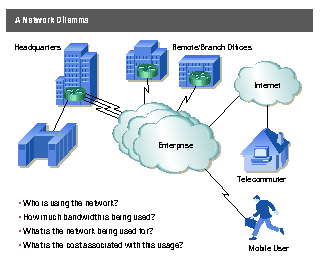
Data Communications magazine estimates that as much as 87 percent of an enterprise's monthly networking budget goes to transmission resources. Whatever the numbers, the financial officers who approve these bills seek ways to lower or minimize them. They, too, want to know who is using the network and in what ways.
Network accounting -- the process of accounting, billing, monitoring, and reporting on a usage-sensitive basis across network applications -- has great potential for lowering network costs. As an enabling technology, network accounting provides an enterprise with important information about the cost and resource utilization of a network. A direct result is that managers can take proactive measures to minimize costs while increasing service levels. The advent of network accounting promises dramatic improvements in productivity and cost containment as well as a generation of entirely new management applications.
The most exciting aspect of network accounting is that it strengthens policy-based management throughout enterprise networks. Policy-based management provides a mechanism to allow network usage based on resource limits, time-of-day provisioning, or access limitations. Cisco Enterprise Accounting also provides departmental billback, end-user accountability, organizational budgeting, capacity planning, and growth forecasting.
At the core of Cisco Enterprise Accounting is the call data generated by Cisco network devices. This raw call data is captured by the Cisco Enterprise Accounting Simple Network Management Protocol (SNMP) poller and is stored in Cisco IOSTM software Management Information Bases (MIBs). Cisco Enterprise Accounting then translates and filters this data into standardized or flexible call data records (CDRs) that are stored in a relational database. The database provides the intelligence for a rich set of applications, including end-user accounting, cost allocation, traffic statistics, exception reports, as well as network monitoring, which enables network managers to spot excessive usage patterns or those that violate an enterprise's policy.
The two software programs that make up the currently shipping Cisco Enterprise Accounting Version 1.0 application support Integrated Services Digital Network (ISDN). Running under Windows 95 or Windows NT, the PC-based accounting applications provide cost allocation, directory services, call detail records, traffic statistics, and exception reports. These applications are enabled with call detail information from an SNMP data collection engine running under SunOS. The engine polls, collects, translates, and correlates call history information from ISDN routers and access servers. Future Cisco Enterprise Accounting versions will support NetFlowTM Switching, asynchronous dialing, and other WAN and LAN applications.
For more information on Cisco Enterprise Accounting, visit http://www.cisco.com/warp/public/734/cea/cea_pa.htm.
___________________________________________________________________________________________________________
A globally networked business recognizes that the Internet is the lifeblood of its success. Networks must support worldwide mission-critical operations that strengthen relationships for a competitive edge in today's demanding business environment. A company's success in leveraging network technologies to build sophisticated, easy-to-use Internet applications can determine its competitive advantage into the next century. What's the key to that success? Equally sophisticated, highly specialized network services.
The Cisco IOSTM software platform delivers these network services and enables networked applications that keep businesses competitive. Operating from end to end, Cisco IOS software provides next-generation functionality to build scalable networks that support bandwidth-intensive multimedia applications. Today, businesses are using these high-powered network services to create new distribution channels with networked commerce applications, support distance-learning activities to train employees, and run desktop conferencing for day-to-day business communications.
Cisco IOS software contains a wide array of services that fall under two categories: foundation services and application enabling services. Within each of these categories is a handful of critical network services that can help solve the toughest problems facing enterprises today.
Foundation network services support basic requirements. They encompass connectivity, security, scalability, reliability, and management services.
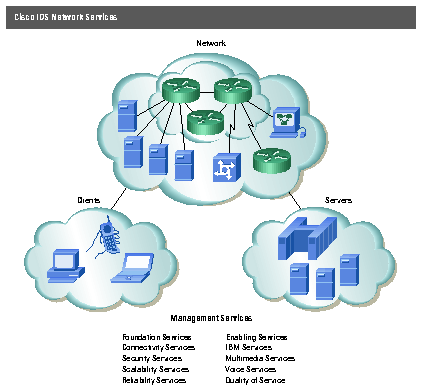
The means of establishing network connections -- whether across LANs or WANs and whether connecting homogeneous or disparate protocols and equipment -- is the basic focus of connectivity services.
Cisco devices interconnect more media types than any other networking vendor's. Recent additions to Cisco's extensive options for connectivity services include support for scalable, secure virtual private dialup networks (VPDNs). A specialized type of virtual private network (VPN), VPDNs offer an appealing way to cut costs by extending private networks across dialup lines -- with the security and scalability benefits associated with private networks. VPDN support gives enterprises an alternative solution to building, maintaining, and managing separate dialup networks for telecommuters or branch offices -- they can simply outsource these types of services to service providers with existing network infrastructures who are offering new types of VPDN-based services.
Today, Cisco's solution for secure VPDNs is Layer 2 Forwarding (L2F), a media-independent, multiprotocol tunneling technology. L2F allows users to invoke corporate security policies across any VPN or VPDN link as an extension of their internal networks. Cisco offers L2F in advance of the Internet Engineering Task Force (IETF) standard Layer 2 Tunneling Protocol (L2TP). Eventually Cisco will support both approaches for maximum industry interoperability. As a key author of the L2TP specifications, Cisco will be among the first to implement this standards-based solution.
If the Internet is to fulfill its commercial potential, users must be confident that information such as credit card numbers remains secure. Likewise, strategic and financial information, along with mission-critical applications stored on or carried by servers, must be protected.
New Cisco IOS technologies enable administrators to enforce corporate security policies across global networks, especially over wide-area links. Cisco IOS software offers security features for perimeter security (such as firewalls), advanced user authentication and accounting, and end-to-end information privacy. Among Cisco's powerful suite of security features are high-speed policy enforcement through packet filtering; digital certificates and signatures, which positively authenticate users or devices; and encryption, which protects data from eavesdropping. Encryption can be combined with L2F or L2TP over VPNs and VPDNs to further secure traffic across the Internet, which can be particularly vulnerable to attacks.
Every enterprise wants to grow its business -- but growth requires networks to scale. Scalability features in software can complement the more expensive hardware enhancements, performing critical services such as bandwidth optimization and traffic management.
Cisco IOS network services redefine scalability to extend beyond greater bandwidth and port density. Network Address Translation (NAT) scales the usage of IP addresses by mapping many internal IP addresses to just a few external IP addresses. NetFlowTM Switching and Tag Switching capabilities increase performance in Cisco switches and routers. NetFlow Switching streamlines the switching of CPU-intensive traffic in Cisco 7500 series routers -- and recently in the Catalyst® 5000 series switches -- to scale intranet performance exponentially. Tag Switching acts like a postal code to bypass conventional packet-processing across router hops and to speed delivery across very large networks such as the Internet.
| Tag Switching at a Glance |
|---|
| Tag Switching combines the performance and traffic management capabilities of Layer 2 (data-link layer) switching with the scalability and flexibility of Layer 3 (network layer) routing.
"Tag Switching defines a scalable means for routers to support the advanced traffic management capabilities currently offered only by switched networks, while allowing switched networks to scale in the same manner as today's global router backbones," says John Morency of The Registry, a network consultancy based in Newton, Massachusetts. Tag Switching works like this: source routers process packet headers, then "tag" them. Intermediate routers read only the tags and send packets to the next router hop. The destination router strips the tag and delivers the original packet to its end station or server. |
By definition, mission-critical applications are vital to business. Network downtime can cost millions of dollars per hour in lost revenue. A reliable network starts with a good design that includes redundant systems and links. Cisco IOS reliability services include the Hot Standby Router Protocol (HSRP) and its Asynchronous Transfer Mode (ATM) equivalent, Simple Server Redundancy Protocol (SSRP). These protocols communicate between router or ATM switch groups to detect device failures and initiate automatic reroutes that are configurable to less than one second failover.
Managing global-sized networks is a daunting task. Cisco IOS management services provide a variety of tools that centralize and simplify the tasks involved with managing networks of any size. Hundreds of debugging commands for basic troubleshooting are incorporated in the Cisco IOS software, which also interfaces with Web browsers to simplify configuration and monitoring.
Enabling network services give Cisco users true end-to-end support for competitive capabilities such as Systems Network Architecture (SNA) consolidation, multimedia, voice, and quality of service (QoS).
Cisco IOS software has proven its mettle in SNA-to-IP network consolidation with the highly successful CiscoBlue strategy. By cost-effectively improving the performance of SNA traffic across modern multiprotocol networks, Cisco ensures that the mainframe channel remains a viable network resource.
Applications with multimedia capabilities for videoconferencing, distance learning, and training are fast becoming a cost-effective way to communicate with employees, customers, and suppliers. New Cisco IOS features that help make these multimedia applications possible include Resource Reservation Protocol (RSVP), Cisco Group Management Protocol (CGMP), and Protocol-Independent Multicast (PIM). RSVP dynamically reserves end-to-end bandwidth for delay-sensitive IP traffic, while CGMP negotiates with Catalyst switches to route IP multicast video to specific ports, avoiding network and desktop PC processor overload. PIM is the architecture that allows the addition of IP multicast routing on existing IP networks.
Organizations can gain substantial cost benefits through the integration of voice and data traffic within their existing network infrastructures. Cisco IOS software support for voice services not only prepares businesses for the future, but can eliminate separate long-distance calling charges between sites around the world. Cisco now supports voice-over-data networking in the StrataCom® IGXTM and BPX®/AXISTM, LightStream® 1010, and Cisco 7200 products.
Distance learning and videoconferencing are examples of time-sensitive applications, while airline reservations or financial transaction systems typify mission-critical applications. QoS provides the ability to prioritize time-sensitive and mission-critical applications across a network.
Traditional priority-queuing and custom-queuing features in Cisco IOS software help users establish priorities for mission-critical applications. Weighted Fair Queuing (WFQ) automatically sorts among different traffic types to maintain the level of services that each type needs. Random Early Detection (RED) and the Resource Reservation Protocol (RSVP), two more recent Cisco IOS technologies, provide end-to-end QoS control. RED monitors traffic levels on very large networks, such as the Internet, to prevent congestion and ensure priority traffic delivery. RSVP establishes end-to-end bandwidth guarantees to readily support mission-critical and bandwidth-intensive multimedia applications.
To ensure the quality of Cisco IOS leading-edge, end-to-end network services, Cisco has vigorous software development procedures for timely integration of new feature and platform support. Tightly managed release cycles stabilize Cisco IOS software so that network services keep globally networked businesses competitive today and into the future.
___________________________________________________________________________________________________________
Critical business applications depend on the network to provide high-performance, reliable, secure, and fast connectivity across the network. Ensuring these services is a staggering challenge for network managers as their networks continue to grow in size, complexity, and importance. Cisco meets this challenge with the release of its Netsys Service-Level Management Suite of products. These products are the first in the industry that enable network managers to define, assess, and repair end-to-end network services across mixed switched and routed networks.
"Service-level management has been widely used for years to manage SNA networks," says David Jones, Director of Marketing at Cisco Systems' Netsys TechnologiesTM Group. "Now network managers have the tools required to establish, measure, and manage to service levels on TCP/IP and IPX networks. The Netsys Service-Level Management Suite is the only product offering that maintains a comprehensive understanding of your network configuration, packet flows, and network utilization across routers and switches. This capability is essential for ensuring that network services levels are met."
Using the Netsys Service-Level Management Suite, network managers can easily establish policies that explicitly define the levels of availability, performance, and security necessary for each networked application. The Netsys software assesses these service requirements automatically on a schedule established by the network manager. The resulting Web-based service "report card" quantitatively summarizes which requirements are being met and which have been violated. Violations can be quickly sorted by severity, type, and other criteria. An integrated, end-to-end topology view -- showing both Layers 2 and 3 -- makes it easy to spot areas that are impacted by service-level violations.
If a service-level violation occurs, network managers can quickly "drill down" to isolate the problem, then use the Netsys QuickSolver capabilities to suggest command-specific changes to solve the problem. Network administrators can safely test proposed changes off line using the simulation engine. The VISTA (View, Isolate, Solve, Test, Apply) network troubleshooting process dramatically reduces the mean time to repair service-level violations and other network problems.
The June release of the Netsys Service-Level Management Suite supports Cisco routers and Catalyst® switches. Support for StrataCom® switches (currently in early field trials) and Cisco PIX firewalls will follow in later releases. This end-to-end perspective enables users to confidently plan, deploy, and manage new business applications such as voice, video, and secure Internet commerce. The Netsys Service-Level Management Suite will also enable users to deploy and manage Cisco IOSTM software features, such as Tag Switching. Support for the Resource Reservation Protocol (RSVP) and encryption will be added later.
___________________________________________________________________________________________________________
Cisco has announced new models in its Catalyst® 5000 series of switches that reach unprecedented levels of scalability and performance, marking the next phase of the CiscoFusion architecture. The new Catalyst 5500 and 5002 products, along with enhancements to existing Catalyst 5000 systems, add multilayer intelligence, Cisco IOSTM network services, and Asynchronous Transfer Mode (ATM) switching to the Catalyst 5000 switch platform. Along with these enhancements come new software features, new Supervisor Engines, and new interface modules.
A Catalyst 5000 family switching solution substantially expands the CiscoFusion architecture, so it will continue to accommodate users' changing needs for many years. New Route/Switch modules manage communication between virtual LANs (VLANs), and Catalyst 5500 systems incorporate existing ATM switching technology from LightStream® 1010 ATM switches.
New Catalyst 5000 series functionality includes:
At home in the wiring closet, switched backbone, or data center, the Catalyst 5000 family scales the intranet with Cisco IOS network services. "Cisco is going well beyond platform and hardware products to deliver users a scalable network architecture," says David Passmore, Senior Analyst with Decisys Corporation (Sterling, Virginia). "They're not just selling boxes, they're addressing the huge challenge of integrated network services for corporate intranets."
Catalyst 5000 series switches support an unparalleled array of LAN (and future WAN) interfaces, with planned support for Token Ring and Gigabit Ethernet. Security provided by VLAN segmentation and new port lockdown features helps administrators enforce security policies. All models have a highly resilient switching fabric and support hot-swap interface cards for upgrades "on the fly." Catalyst 5500 and 5000 models also support dual Supervisor Engines and dual power supplies for failover protection. Management via embedded Remote Monitoring (RMON) agents and Enhanced Switch Port Analyzer capability, coupled with centralized management through CiscoWorksTM for Switched Internetworks, prepare Catalyst switched networks to support future policy-based management.
Catalyst 5000 series switches facilitate Cisco IOS network services with unique features of scalability, support for multimedia and IP multicast applications, security, and mobility.
The Catalyst 5000 family increases bandwidth and port density -- up to 528 group-switched Ethernet ports -- for wiring-closet applications, but its true scalability advantage lies in NetFlow Switching capabilities, currently available as Route/Switch modules and later as an add-on Layer 3 feature card in Supervisor Engine II modules. NetFlow Switching in Catalyst switches parallels NetFlow Switching in routers. Initial packets are processed and assigned services by an external Cisco router or an integrated Route/Switch module in the Catalyst 5000 switch. The NetFlow Switching mechanism learns the flow information for that data stream and switches subsequent packets without complex processing. NetFlow Switching in Catalyst switches reduces the amount of traffic processed by the router. It multiplies the benefits of "flow switching" by the number of Catalyst 5000 switches in a network to raise overall intranet performance by millions of packets per second.
"We're very excited about the new additions to the Cisco Catalyst 5000 series," says Mike Nash, Director of Windows NT Server Marketing, Microsoft Corporation. "In situations that require a high level of scalability, the Catalyst 5000 series of switches and new network services provide a great solution."
Time-sensitive multimedia application traffic requires Cisco routers to set up quality-of-service (QoS) parameters on Catalyst 5000 series switch ports using the Resource Reservation Protocol (RSVP). Bandwidth-intensive multicast streams need efficient distribution schemes, which they get via the Cisco Group Management Protocol (CGMP) and Protocol-Independent Multicast (PIM) on Cisco routers. CGMP and PIM work with Catalyst 5000 series switches to support multicast applications by sending traffic only to ports with registered clients. These advanced features can also prioritize mission-critical applications across a network.
Consistent with Cisco's recently announced security initiative, the Catalyst 5000 switches now ensure uniform security access via the Terminal Access Controller Access Control System (TACACS) authentication services and syslog audit trails. Appropriate firewall services also are available via access filters that network administrators can apply to Layer 2 MAC addresses or Layer 3 network addresses.
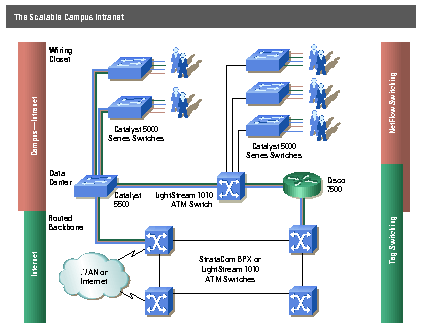
As multilayer switched intranets grow, the combination of dynamic VLANs and Dynamic Host Configuration Protocol (DHCP) can securely automate moves, adds, and changes for groups or single users without wiring-closet or end-station configuration changes. A DHCP server automates TCP/IP addressing functions. In conjunction with DHCP, dynamic VLANs control and automate network access by determining VLAN membership for each end station.
The new Supervisor Engine II module for the Catalyst 5000 family supports two Fast Ethernet uplinks, which can be aggregated to form Fast EtherChannel solutions. As a standards-based solution, Fast EtherChannel technology provides an outstanding migration path toward future Gigabit Ethernet and beyond, to Gigabit EtherChannel networks. Any Catalyst 5000 platform will support future Gigabit Ethernet with a Supervisor Engine or feature card upgrade. Completion of the Gigabit Ethernet standard is expected by early 1998.
Cisco customers agree. "At Pixar, our network backbone is critical for making movies. And because our network is a strategic asset, we cannot rely on prestandard, experimental equipment," says Greg Brandeau, Director of Information Systems at Pixar Animation Studios in Point Richmond, California. "What Fast EtherChannel technology does is provide us with additional scalable bandwidth and a reliable migration path to a higher-performance backbone."
| Fast EtherChannel Technology |
|---|
| Cisco Systems' Fast EtherChannel technology builds upon standards-based, IEEE 802.3 full-duplex Fast Ethernet to give network managers reliable, high-speed solutions for campus intranets. Requiring no changes to network applications or wiring, and with robust load-balancing and physical-link resiliency features, Fast EtherChannel solutions offer flexible backbone bandwidth from 200 Mbps to 800 Mbps. While fully compatible with Inter-Switch Link (ISL) VLAN trunking protocols, Fast EtherChannel also has its own peer-to-peer control protocol that simplifies setup and management with autoconfiguration and the ability to prevent transport over incorrectly paired interfaces.
The industry has rallied behind Fast EtherChannel technology as a migration path for future Gigabit Ethernet technology aggregation into Gigabit EtherChannel links, with pledged product support from Adaptec, Compaq Computer Corporation, Hewlett-Packard, Intel Corporation, NetFRAME Systems, Silicon Graphics, Sun Microsystems, and Xircom. |
Unique to the Catalyst 5500 switch is optional cell switching on an ATM switch processor (ASP) module. Like its frame-switching Supervisor Engine II counterpart, the ASP has a modular feature card for cost-effective migration to future ATM capabilities. The Catalyst 5500 supports all existing and future LightStream 1010 ATM switch interface modules and port adapters for highly interoperable systems that protect current investments. A Catalyst 5500 ATM-enabled system supports Cisco IOS network services for QoS, mission-critical application prioritization, with voice and video integration over data networks.
With three chassis sizes and a completely modular architecture supporting a range of interchangeable Supervisor Engines and interface modules, the Catalyst 5000 family offers users customizable solutions that preserve existing investments and grow to meet future needs. Existing Catalyst 5000 systems support the higher-performance, flexible Supervisor Engine II, enabling customers to take advantage of NetFlow Switching, integrated routing, WAN access, and future Gigabit Ethernet capabilities.
The expanded capabilities of the Catalyst 5000 family tackles intranet scalability requirements with a range of Cisco IOS network services, interface options, scalability features, and investment protection. The Gigabit Ethernet-ready architecture ensures longevity and value as intranet traffic increases in the future. NetFlow Switching and Fast EtherChannel technologies fully exploit the Catalyst architecture, guaranteeing maximum scalability and performance in the wiring closet, backbone, or data center.
For more information about scaling the intranet and the Catalyst 5000 family, visit the URL http://www.cisco.com/warp/public/729/c5000/ index.html.
| Policy-Based Management |
|---|
| New policy-based management capabilities enable network managers to determine criteria for the support of network services across the network. "Although considerable furor exists over how to implement policy-based management, the consensus is that business objectives must drive those policies," says Bill Erdman, Cisco Systems Product Line Manager for CiscoWorks for Switched Internetworks (CWSI). Cisco's plan for CWSI Version 2.0 includes automated policy servers that watch, warn, and correct network operations to enforce policy and avert potential problems before they become critical. |
___________________________________________________________________________________________________________
Novell NetWare networks are effective for sharing common computing resources such as printers and file servers in a workgroup setting. But because they rely on the Novell IPX/SPX protocol, NetWare users can't readily connect to TCP/IP-based networks or use popular Internet applications such as Web browsers. New Cisco IPeXchange Internet gateways provide these users with cost-effective, secure connections to the Internet and other TCP/IP-based networks. They allow multiple NetWare users to share the same IP address and the same TCP/IP stack, with no change required to the desktop PCs.
Initially available as a software offering on Windows NT, Novell NetWare, and select UNIX platforms, Cisco has extended the IPeXchange family to include popular Cisco router platforms such as the Cisco 1000 and 2500 series. This gateway product runs on the router to provide access to TCP/IP services over IPX networks as well as WAN security and firewall security between local and remote networks.
"As Internet use becomes more business-critical, companies are migrating from IPX to IP networks," says Manoj Goel, Product Line Manager for Cisco IPeXchange. "By offering IPeXchange as a Cisco IOSTM software feature on the Cisco 2500 router series, we give these companies the ability to use both protocols during their migration. This solution also preserves Cisco users' investments in router hardware."
These enhanced translation capabilities are a boon to the US Information Agency (USIA), a federal agency dedicated to providing information to US embassies and American libraries in major cities around the world. Most USIA offices rely on Novell NetWare 3 networks for common access to printers, scanners, and other computing resources. This approach is an effective point solution but has resulted in islands of automation broken off from the TCP/IP networks that predominate elsewhere.
"IPeXchange supplies easy, cost-effective access to our corporate intranet in Washington, DC, which uses TCP/IP," says Allyson Miller, Branch Chief of Special Projects for the USIA. "Through one connection to the Internet, an entire group of users at an overseas site can benefit."
USIA began by using IPeXchange software on NetWare servers but is now planning to deploy Cisco 2500 series routers for this task. "IPeXchange products act as an effective firewall between Novell networks and the TCP/IP networks they connect," Miller adds. "They give us a secure and scalable solution and avoid the expense of having to upgrade our Novell networks to TCP/IP networks."
IPeXchange 1000 and 2500 series products for Cisco routers are ideal for Internet service providers (ISPs). In addition to helping companies such as USIA, the technology allows ISPs to expand their services to support both small and large companies with the same overhead. By simplifying the IP addressing issues and offering expanded services to Novell NetWare sites, ISPs can dramatically expand their markets.
For more information on Cisco's IPeXchange, visit the URL http://www.cisco.com/warp/public/ 751/ipx/index.html.
___________________________________________________________________________________________________________
Cisco Network Speeds Home Loan Process
In the thousand or so days before the next century, millions of Americans will receive the keys to their first homes, thanks to Fannie Mae. The largest source of home mortgage funds in the USA, Fannie Mae has committed to provide US$1 trillion in targeted housing finance to help 10 million American families achieve home ownership by the year 2000. This landmark initiative is changing the housing finance industry, and solutions from Cisco Systems are integral to these changes and the company's goals.
"The Trillion Dollar Commitment defines our mission to provide low- and moderate-income Americans with housing," explains Martin Colburn, Vice President of the Technology Management Center (TMC) at Fannie Mae. "We're reaching out to renters and putting more folks in housing. As a corporation, we're committed to double-digit growth. To achieve these goals, our network must position us to handle ever-expanding volume, capacity, and growth," he stresses.
The TMC handles Fannie Mae's complete networking infrastructure for internal systems as well as providing value-added networks to its customers.
Fannie Mae employees in five regional offices support over 25 partnership offices and thousands of customers nationwide. Fannie Mae began the migration in the early 1990s from a mainframe/superminicomputing environment to a distributed client/server computing model. To make the transition, the TMC deployed Sun Microsystems on the server side, Sybase on the database side, and Cisco Systems for interconnectivity. "We run network-centric applications where the back end at headquarters distributes applications and services directly to our customers," says Colburn. "We wanted to partner with a networking vendor who would be able to deliver scalable interconnectivity solutions for an evolving, distributed architecture. We chose Cisco because they had the best product line and offered the best value for the price. That price/performance advantage has not changed since we began our relationship with Cisco in 1991," continues Colburn.
Today, the TMC supports two mainframe systems, more than 4000 PCs and workstations, 80 Sun servers, and several laptops. More than 200 Cisco devices connect the entire Fannie Mae network.
The compact Cisco 2500 router is a critical component in Fannie Mae's MORNETPlus network, which supports Fannie Mae providers such as Merrill Lynch and GMAC Lending. "MORNETPlus advances our commitment to reduce the cost of originating a mortgage," says Colburn. "Applications running on MORNETPlus automate underwriting decisions and eliminate manual tasks and interpretation of guidelines."
The Cisco 2500 router offers both LAN and WAN routing options, which Fannie Mae capitalizes on by deploying a Cisco 2500 to every MORNETPlus site connected by leased lines. One of the router's serial ports can be used for a Frame Relay connection through AT&T's AccuWAN into the MORNETPlus network. The second serial port can be used for legacy devices. The Cisco 2500 effectively reduces network costs by providing one LAN and two WAN connections in a single unit. It also protects Fannie Mae's investments in legacy systems by offering easy integration and support for a wide range of protocols through the Cisco IOSTM software.
Fannie Mae's network is steadily evolving to meet the day-to-day challenges that the company's Trillion Dollar Commitment brings. Part of this evolution is a migration from a pure routed environment to a mixed routed and switched network environment. The Cisco Catalyst® 5000 Ethernet switch is at the heart of this switched landscape. It supports all of Fannie Mae's current and emerging switching technologies, providing high-speed connectivity from the wiring closet to network backbones and workgroups. In the wiring closet, the Catalyst 5000 accelerates Fannie Mae's migration from a Token Ring to switched Ethernet environment. Fannie Mae also can rely on the Catalyst 5000 switch to support any future deployment of multimedia applications and Asynchronous Transfer Mode (ATM) internetworking.
The core of this expansive network comprises Cisco 7000, 7500, and 7200 routers. Providing industry-leading reliability, serviceability, and performance, these routers connect all of Fannie Mae's LAN and WAN environments.
Network performance is key to Fannie Mae's objectives. "As we move to decrease the costs and time required to originate a mortgage, the demands for online, real-time transfer of information increase," explains Colburn. "While our applications are not especially bandwidth intensive, they do require the fastest, most responsive routing technology available, and that's why we're with Cisco."
The Cisco 7000 family of routers delivers the performance that Fannie Mae's environment demands, with support from 500 Mbps to 2 Gbps of bandwidth and up to 500,000 packets per second (pps). "Our business promises to stress the network with increased traffic," says Colburn. "We're on an explosive growth path and we must be ready to meet these dynamic performance requirements. Cisco's routing solutions keep pace with the kind of expansion that's happening here."
As Fannie Mae reaches out to more customers and new markets, the company also can rely on a routing technology that supports the industry's widest range of LAN and WAN interfaces. The flexibility delivered with the Cisco 7000 router family helps Fannie Mae to establish a premier platform for "any-to-any" networking.
"As we look to the types of services that we want to provide to our customers," continues Colburn, "we don't want to be dealing with three or four different vendors -- it just isn't time or cost efficient. We like working with one partner who has end-to-end knowledge from the desktop all the way to the server, along with all the different interconnectivity points in between, and we get that from Cisco."
The single-vendor solution enables Fannie Mae to optimize its routed and switched network design while eliminating some of the complexity inherent in such projects. Even the routine and tedious tasks of matching software revision levels from different product lines are eliminated, according to Colburn. "We can rely on Cisco to handle all these issues for us while we devote our time to managing the network."
Colburn acknowledges that the success of his single-vendor solution is a result of Cisco's ability to integrate world-class technologies. "Cisco's done a great job of acquiring very top-notch companies," he observes. "As a result, it has built an extremely robust product line comprising different technologies that operate on industry standards. It's a cohesive solution that positions well into the next century."
___________________________________________________________________________________________________________
Many enterprises are building intranets as part of their information infrastructures to contain costs and expand business opportunities. Key to realizing these goals is the ability to support both TCP/IP and Systems Network Architecture (SNA) applications in the data center. Cisco Systems has enhanced its CiscoBlue strategy to provide tools for integrating intranets and the data center, as well as deliver planned enhancements in SNA networking and network management.
"Many of our SNA customers feared they would have to spend millions of dollars to port the functionality of SNA applications to intranet-capable platforms," says Betsy Huber, CiscoBlue Product Manager. "With our new CiscoBlue roadmap for intranets, Cisco has a strategy that changes IBM internetworking. Now we can deliver SNA applications to the desktop, rather than just delivering data."
The CiscoBlue intranet roadmap identifies Cisco's plans for delivering new and enhanced products to integrate SNA applications and intranets. New products will enable developers to convert Web browser output into standard SNA data streams and SNA text screens to graphical interfaces. Other tools will support both TCP/IP and SNA applications on host systems and maintain current levels of response time and security for SNA applications.
The first products and enhancements developed under this roadmap are available now, with more scheduled for release in the coming months.
| CiscoBlue in Depth |
|---|
| The multiphased CiscoBlue strategy has been extended to support the IBM environment when building the corporate intranet. For more information on the CiscoBlue strategy, visit Cisco's Web site at the URL http:// www.cisco.com/warp/ public/731/cblue/ cbovr_wp.htm. |
The first CiscoBlue intranet products, WebAccess for S/390 and Cisco IOSTM for S/390, give users access to SNA applications over intranets and the Internet.
Developed in a partnership between Cisco and OpenConnect Systems (Dallas, Texas), the WebAccess for S/390 product includes two tools: OC://WebConnect and OpenVista.
OC://WebConnect allows users to access host systems through a Java-enabled Web browser, using the familiar terminal interface for SNA applications. The product eliminates the need to install specialized emulation software on the user's desktop computer. The OC://WebConnect software resides on a network server and downloads Java applets to the user's browser in order to maintain a secure, continuous connection to the host.
OpenVista is an integrated visual development environment for creating a browser-style interface to SNA applications without reprogramming the applications themselves. In addition to replacing the traditional "green-on-black" screen with a more visually appealing interface, OpenVista helps developers automate the processes for maintaining multiple mainframe views.
A high-performance, fault- tolerant implementation of TCP/IP, Cisco IOS for S/390 enables the mainframe to act as an intranet or Internet server. It provides full support of host and network print services, legacy 3270 applications, and File Transfer Protocol (FTP) file exchange.
Cisco IOS for S/390 enables TCP/IP applications to run in the data center with the same reliability and security as existing SNA applications. It includes features of the Cisco IOS software and the Channel Interface Processor (CIP) card for the Cisco 7000 router family to provide features such as TCP Assist, which moves functions out of the TCP/IP stack and onto the CIP card to reduce host mainframe cycles. Cisco jointly developed this product with Interlink Computer Sciences (Fremont, California).
Enhancements to two Cisco technologies ensure that SNA applications deliver an acceptable level of performance over a TCP/IP-based intranet. SNA type of service (ToS) is a new capability in Cisco's data-link switching plus (DLSw+) product that prioritizes SNA traffic over a TCP/IP backbone for guaranteed SNA response time and efficient bandwidth utilization. For networks that use Advanced Peer-to-Peer Networking (APPN), managers will be able to prioritize or reserve bandwidth for SNA traffic using SNA Class Of Service transmission priority settings. In the absence of APPN, DLSw+ uses IP precedence bits and weighted fair queuing to prioritize network traffic.
Cisco's CIP card now supports CIP MultiPath Channel (CMPC), a streamlined channel protocol for APPN. Combining CMPC with High-Performance Routing (HPR) and the sysplex environment enables very high data-center availability.
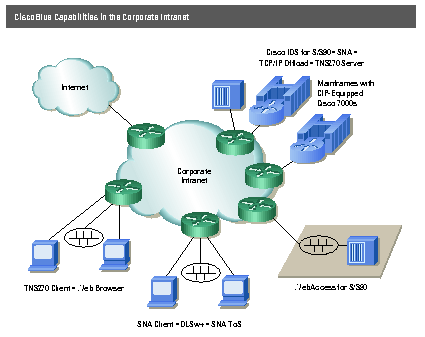
The ability to successfully support networked SNA traffic requires targeted tools for monitoring and managing network performance.
Cisco's new Internetwork Performance Monitor measures response times end to end and on each network segment to identify congestion points, isolate performance problems, diagnose latency, and perform trend analysis. These capabilities can monitor both IP and SNA session paths, collecting data on demand to check current performance levels and, over time, to determine long-term trends. This information helps network managers deliver consistent levels of network response times.
New releases of CiscoWorks Blue SNA View and CiscoWorks Blue Maps provide Web browser access to SNA resource information, support for additional operating systems, and year 2000 compliance. Working together, these products provide a graphical, logical view of SNA networks and detailed data on the status and configuration of SNA resources.
Cisco is committed to evolving the CiscoBlue strategy as users' needs change and new technologies emerge. This commitment is reflected in the CiscoBlue intranet roadmap, which enables customers to easily implement an intranet while preserving mission-critical SNA applications. The overall goal of CiscoBlue remains the same: to help IBM customers make the most of their investments while creating powerful, integrated networks across the enterprise.
___________________________________________________________________________________________________________
Cisco has announced the industry's first multiservice access concentrator. The new Cisco 3800 enables organizations to integrate all types of network traffic -- including legacy data, LAN traffic, voice, fax, and video -- over a single network. The Cisco 3800 integrates cell switching and routing technologies into a low-cost, high-performance system.
"Cisco has turned a corner in the industry by supplying not only a new networking platform, but a whole new class of network device," says Gary Borad, Senior Product Manager in Cisco's Service Provider Group.
The Cisco 3800 can be deployed over private or public networks. Unique switch-based routing technology in Cisco IOSTM software optimizes network performance for both routed and switched traffic. The Cisco 3800 was specifically designed to integrate multiple services over a common infrastructure, giving it the potential to cut wide-area communication costs in half.
The Cisco 3800 leverages routing and cell switching for the best possible performance. All ports on the Cisco 3800 are capable of running any of the Cisco IOS software protocols, making this device one of the most full-featured access products on the market. Additionally, to achieve optimal performance for real-time, high-quality voice transmissions that run concurrently with nonreal-time data, the Cisco 3800 uses a cell-based approach across the WAN.
"By nature, cell-based devices have built-in predictability, which is what allows real-time traffic such as voice and video to be transmitted smoothly," points out Byron Henderson, Marketing Director for Cisco's Multiservice Access Business Unit. "We've leveraged the cell-switching architecture to allow customers to mix different types of traffic over a common network, while at the same time maintaining the robust capabilities of Cisco IOS software on the user interface side of the product."
Borad notes that there are two situations in which the Cisco 3800 is a particularly good fit: when an organization wants either to establish multiservice access for a branch office or to create a corporate-wide, end-to-end business solution that supports both voice and data traffic. "If you want to enable multiservice access -- that is, if you want to do something more than just routing, such as integrate voice and video -- then the Cisco 3800 is the answer," he says.
| Switch-Based Routing Offers "Best-of-Both Worlds" Solution |
|---|
| The Cisco 3800 employs switch-based routing, a unique software technology that combines the flexibility of routing with the high performance of switching. Built into Cisco IOS software, switch-based routing allows voice and data traffic to be switched at Layer 2, while routed traffic receives full Layer 3 support. Per-port configuration on all serial data channels allows each port on the Cisco 3800 to be individually configured for either routing or switching. "Switch-based routing improves latency and throughput for switched voice and data traffic while still providing powerful Cisco IOS routing functionality," says Borad. "Network managers can now design multiprotocol networks -- either as switched or routed environments -- without changing equipment." |
Cisco has delivered integrated voice and multiprotocol data over cell-based architectures since 1986. With the emergence of Frame Relay and ATM standards in the early 1990s, Cisco adapted its early technologies to leverage these new cost-effective network services. The Cisco 3800 is an extension of this experience, and with its tight integration with the Cisco StrataCom® IGXTM switches, it is one of the most powerful business solutions on the market today.
The Cisco 3800 extends Cisco's industry-leading ATM switching solutions to small branch offices and corporate LANs. For example, branch offices can deploy the Cisco 3800 in conjunction with Cisco StrataCom ATM switches at headquarters to create a highly scalable, end-to-end ATM solution. The result is a corporate-wide, multiservice network comprising high-speed backbone products and high-performance, low-cost branch products -- all supporting the same set of capabilities.
"Customers can use the Cisco 3800 to bring voice, video, and LAN traffic into a branch and deliver it right to the back of the switch," Borad explains. "Typically, users need to collocate a separate access product next to the switch at headquarters in order to peel compressed voice or legacy data off the network. Because the StrataCom IGX switches and Cisco 3800 switches have a common set of voice and data algorithms, multiple network services can be delivered from a Cisco 3800 directly to a StrataCom IGX. This streamlining reduces infrastructure costs, simplifies management, and improves performance."
As companies look to the future, the Cisco 3800's ATM-ready architecture makes it ready to handle the most demanding applications. No other multiservice access concentrator can scale to T1/E1 ATM with a simple configuration change, and with a 1-Gbps backplane, the product offers plenty of room for growth.
"If you're interested in installing a multiservice network today and migrating to ATM in the future, the Cisco 3800 is the solution," Henderson says. "This platform will deliver either Frame Relay or ATM capabilities, allowing users to make the move with a simple configuration change."
Because the Cisco 3800 runs on Cisco IOS software, network managers can simplify network configuration and management tasks while optimizing bandwidth usage and keeping processing overhead low. This software flexibility gives the Cisco 3800 an unparalleled ability to adapt to rapidly changing WAN environments. For enterprise networks, service provider-based customer networks, or public Frame Relay and ATM services, few access devices can match the Cisco 3800 for scalable, multiservice network capabilities and high performance. "Multiservice support enables the Cisco 3800 to significantly reduce communication costs when connecting with either a public or private network," Borad concludes. "This capability enables network managers to design multiservice networks without being constrained by existing or future infrastructural commitments. That's an advantage that has generated a lot of interest among Cisco users."
The Cisco 3800 switching access concentrator is available from Cisco in June 1997.
___________________________________________________________________________________________________________
The biggest security problem that managers of enterprise networks face today is implementing and managing a cohesive, single security policy across their corporate network infrastructures.
In response to this problem, Cisco has formed the Enterprise Security Alliance. Through this alliance, the company is aligning itself with several market leaders to guarantee the interoperability of strategic security technologies and offer end-to-end security for enterprise customers. Participants include Cylink, Hewlett-Packard, Microsoft, Oracle, RSA Data Security, Security Dynamics, and VeriSign. The goals of the alliance are to help customers deploy interoperable, standards-based security across networked clients, servers, and infrastructures, and to enable those customers to create consistent, centrally managed security policies.
The alliance is a component of the Cisco Enterprise Security strategy announced in February and it is the first comprehensive network security initiative proposed by any vendor. The Cisco Enterprise Security initiative will provide a scalable, standards-based, open solution for customers who require a consistent enterprise-wide security policy that can manage privileges based on user identity rather than host location. It transparently integrates most available and emerging security technologies, enabling a dynamic, transparent linkage of customer policy, user or host identity, and infrastructure security.
To find out more about the security alliance and its participants, visit http://www.cisco.com/warp/public/779/largeent/security/news.html.
___________________________________________________________________________________________________________
Cisco has joined with Intel and Microsoft to accelerate the widespread adoption of networked multimedia applications through a collaboration called the Networked Multimedia Connection (NMC).
Networked multimedia is the combination of clients, networks, and applications to deliver voice, video, 3-D, and animation over private networks and the Internet from one desktop to another. The Networked Multimedia Connection will help corporate users and Internet service provider (ISP) customers ensure interoperability and easy deployment of networked multimedia applications while decreasing the cost of ownership. It will also help software developers by easing the development and testing of multimedia applications, and it brings the developers closer to end users. End users can benefit from more high-quality networked multimedia applications sooner, simplified deployment and usage, and lower cost of network access.
To speed users' deployment of networked multimedia applications, the three companies are working with independent software vendors, ISPs, system integrators, value-added resellers (VARs), and the IT organizations that offer computing solutions to end users. Also as part of the alliance, the companies will offer toolkits and technical support, and together they've opened a networked multimedia lab at Cisco headquarters in San Jose, California. The lab is fully equipped for customers to test applications on an advanced networked platform.
The three companies are using their partnership and the lab to support the promotion and adoption of standards for networked multimedia. They are collaborating to establish related technologies as industry standards with the Internet Engineering Task Force (IETF), International Telecommunication Union (ITU), and other international standards bodies.
The NMC collaboration recognizes and amplifies each company's essential contribution to the overall networked multimedia infrastructure. Those contributions include:
By uniting to break down multimedia barriers, establish standards, and collaborate on open testing and marketing of business solutions, Cisco, Intel, and Microsoft are putting their combined resources behind the development of enhanced multimedia applications in the areas of distance learning, rich information publishing, management tools, and conferencing.
For more information about the Networked Multimedia Connection, visit http://developer. intel.com/ial/ind_init/netmm/index.htm.
___________________________________________________________________________________________________________
Cisco recently announced the acquisition of privately held Telesend (Cupertino, California), a leader in developing digital subscriber line (DSL) technology that allows phone companies to offer high-speed Internet access connections using the existing telephone system -- the twisted-pair copper wiring already laid to 700 million locations worldwide.
Telesend's DSL innovation is based on Integrated Services Digital Network Digital Subscriber Line (ISDN DSL; "IDSL" for short) technology. DSL is a technology that relieves congestion on telephone voice networks that's caused by rising Internet use. IDSL allows telephone companies to offer Internet access connections at speeds of up to 128,000 bps.
This base technology has been incorporated into a new frame multiplexer, the Cisco 90i, which is ideal for small business users, telecommuters, and residential Internet access.
The technology in the Cisco 90i halves Internet access costs and gives users high-speed, uninterrupted access. The DSL technologies, collectively referred to as xDSL, are expected to play an important role in bridging what is referred to as the "last mile," or the connection from service providers into small businesses, remote offices, and homes.
For more information on xDSL, see "New DSL Technologies...," PacketTM magazine, 1st Quarter 1997. Information about the Telesend acquisition or its technology can be found at http://www.cisco.com/warp/public/146/ mar26_1997.html.
___________________________________________________________________________________________________________
Cisco has joined with Stardust Technologies (Campbell, California) and more than 60 other companies in support of the IP Multicast Initiative, a multivendor cooperative effort chartered to make the Internet a viable mass-broadcast medium and a means for distributing information and software.
Initiative members are lending their expertise to promote and deploy IP multicast, a bandwidth-conserving technology for multipoint communications that alleviates network congestion across intranets and the Internet. Unlike unicast and broadcast methods, multicast allows for the distribution of information to specific groups of users who want to receive it. It conserves bandwidth by letting a sender deliver a single stream of data simultaneously to multiple recipients.
The initiative's charter is to accelerate the industry adoption of IP multicast and Internet Engineering Task Force (IETF) standardization by providing a set of marketing and educational services that promote the creation, use, and deployment of IP multicast products and solutions. IP multicast is supported in all Cisco IOSTM software.
The first IP Multicast Initiative summit meeting took place in January in Santa Clara, California, and attracted more than 325 people representing a range of initiative member companies. Another summit meeting is planned for September 18 to continue the drive for standardization and widespread industry adoption of IP multicast technology.
For more information about the IP Multicast Initiative, membership, and the upcoming meeting, visit the URL http://www.ipmulticast.com.
___________________________________________________________________________________________________________
Tel*e*com*mut*ing -- A working arrangement between employer and employee in which the employee performs some significant portion of work at a location other than the employer's central office or plant -- typically at the worker's home.
The ever-increasing telecommuting workforce is giving incentive for companies around the world to focus on this growing corporate lifestyle. In an attempt to promote and develop telecommuting across Europe, several companies, including Siemens (Ballerup, Denmark), are encouraging their employees to work from home.
Kurt Jensen, employed at Siemens in Denmark, has worked from his home office for nearly ten years. When he was offered a product manager position at Siemens three years ago, he agreed, but on one condition: that he could work from his home office. The proposal was a logical one. Jensen's home office is near Aalborg, Denmark, and the Siemens headquarters is 300 kilometers (186 miles) away in Ballerup (near Copenhagen) on the island of Sjaelland -- and between the two is the Kattegat Sea. Commuting to the main office on a regular basis would be difficult.
In his decade as a telecommuter for various companies, Jensen has experimented with several different solutions for remote access. He started at Siemens using a modem solution, and now has been using an Integrated Services Digital Network (ISDN) line for the past two years. Siemens supplied him with a Siemens-Nixdorff Notebook with a docking station and a Cisco 1003 ISDN router, which combines Ethernet LAN routing capability with a variety of synchronous and asynchronous WAN options, making it ideal for telecommuters. "With the functionality of my ISDN router," states Jensen, "I can enjoy the same features and benefits on my home computer that I would have working on site in the Ballerup office."
New Siemens telecommuters may receive Cisco 760 series multiprotocol routers, which provide affordable, high-speed remote access to enterprise networks and the Internet in a modem-size package. Also, there is talk within the company in Denmark of outfitting field engineers with ISDN connections in their homes and installing Cisco 250 cards in their notebook computers, enabling them to troubleshoot customer networks from their home offices. The Cisco 250 access card combines ease of use with powerful Cisco IOSTM bandwidth management features, making it ideal for telecommuters who need high levels of performance.
Jensen feels that he has significantly boosted his productivity by working out of his home. He benefits from a pleasant work environment and flexibility in work hours while saving the company travel time -- hours that his work schedule absorbs. And from Siemens' perspective, implementing a telecommuting program has allowed them to hire top-notch personnel without worrying about geographical disadvantages.
| Do You Telecommute? |
|---|
| Are you a full-time telecommuter for your company? Contact us with your story, and you could be profiled in an upcoming issue of Packet magazine. Send e-mail to dandreas@cisco.com using the subject line "Telecommuting." |
___________________________________________________________________________________________________________
Cisco has taken steps to better serve customers worldwide -- in their own languages. This is just one more dimension of Cisco's implementation of the Global Networked Business model. To be successful, to be competitive, and for many companies, to even survive in the global marketplace today, organizations must leverage their networks, opening up their corporate information structures to customers, partners, suppliers, and employees. The Global Networked Business model enables companies to create innovative networked applications that provide its constituents with access to all the information and systems they need to be successful.
As one of the first companies to move into the realm of a Global Networked Business, Cisco delivers one of the most comprehensive networked customer support and commerce services in the industry through Cisco Connection Online (CCO). CCO provides extensive Cisco product information, problem solving and troubleshooting tools, and commerce applications. "Our objective is straightforward: to streamline business processes and speed up access to critical information and services," says Chris Sinton, Cisco's Director of Cisco Connection.
CCO offers a broad range of networked applications designed to help customers be more productive. Through CCO, customers can download the exact upgrades and utilities they need from the Software Library or receive the latest release notes, eliminating days of waiting for software to arrive in the mail. Bug Navigator and Bug Search can help customers get to the root of problems faster by searching for bugs based on products, keywords, or specific characteristics. Open Forum allows users to search a database for quick answers to technical questions and talk with experts online for the most difficult questions. Networked Commerce applications allow direct customers and partners to configure, price, route, and submit orders directly to Cisco. And CCO offers many more capabilities.
CCO handles more than 550,000 user logins each month. According to a Data Communications survey published in December 1996, Cisco ranked number one in "electronic service and support." Now Cisco has moved ahead with plans to better provide information and services to CCO's global audience through globalization. The "globalized" CCO includes information that is specific to individual countries and regions, offering content in local languages. And to provide streamlined access, Cisco is adding regional Internet access.
The globalization implementation gives users the option to link to local language content, local country content, or to local servers. For ease of use, CCO offers a consistent interface for all globalization services with intuitive links between them. It also provides identical local language and country content on multiple servers worldwide, with intuitive paths to those servers.
The globalization of CCO began in February 1997, making material available in Danish, Dutch, Finnish, French, German, Italian, Norwegian, Spanish, and Swedish, as well as links to Web-based translated content in Chinese, Japanese, Korean, Portuguese, and Russian. Index pages are also available, allowing users to see at a single glance all the translated content available for a given language.
In March, CCO added translated versions of its home page, root index pages (including products and ordering), and system pages (including help, registration, and first-time users). "Country" pages representing individual countries or regions provide content about local Cisco offices, local events, training courses and contacts, seminars, service and support contacts, as well as certified distribution and training partners. Forty-nine countries worldwide are now represented on CCO.
For some time, CCO has provided global customers with access to critical Cisco information and services through remote distribution servers in Amsterdam, the Netherlands, and Beijing, PRC. These local servers have provided faster access than connecting to CCO's main San Jose, California, site. As part of CCO's globalization plan, direct links between remote access servers in chosen countries and servers located in Hawaii will provide users with even faster access.
To keep information current around the world, content is automatically updated from the main San Jose site to the remote distribution servers every 12 hours. When fully deployed, all local language and local country content will be accessible on the remote distribution servers.
Users who visit Cisco's home page see a pull-down menu that allows them to choose a server, a language, or a country. Users who choose a server are taken directly to the home page for that server. Users who select a language are taken to the translated home page, with an option for linking to the language index page. Each link on the home page leads to additional translated text. If a country is chosen, the system takes the user to the country index page, which includes links to related languages and servers as well as the complete menu of CCO globalization services.
With the implementation of the globalization plan, CCO continues to offer users the most comprehensive range of networked information and services in the industry. Globalization opens the door for more users in more countries, helping people get what they need when they need it.
To access the globalized CCO, visit http://www. cisco.com/global/public/about.shtml.
___________________________________________________________________________________________________________
As today's corporate networks become increasingly vital to companies, network managers must work even harder to keep up with fast-changing technologies.
To help address these concerns, NetDesign, Siemens, and Tele Danmark have initiated the creation of a Cisco user group in Denmark. The group provides a forum for companies to exchange networking information, interact with industry peers, and discuss Cisco products and technologies.
"The development within networking is skyrocketing, and we're dealing with complicated technical equipment," says Joergen Joergensen, Engineer at NESA and member of the Danish User Group. "Therefore, it is extremely valuable to be able to exchange experiences with others in the same situation."
More than 75 interested customers convened at the first Danish user group meeting in January 1997. The event included discussion of an existing user group, a presentation by Cisco Country Manager Torben Haase, and a talk by a journalist who spoke on today's role of information technology. The group also began plans for hosting an annual user group meeting.
Cisco users throughout Europe are now discussing the creation of other Cisco user groups. These groups are also a communication vehicle to give Cisco staff an opportunity to get first-hand impressions of the experiences and future needs of Cisco customers. This information can help shape the direction of Cisco's products and services.
Customers interested in starting Cisco user groups in their areas should contact their local Cisco offices.
___________________________________________________________________________________________________________
Cisco recently announced several new support services for small and medium businesses, enterprise customers, and service providers. These new services provide customers with full life-cycle support of their Cisco products, including network planning, design, implementation, optimization, and operation assistance.
The new additions expand Cisco's current service offerings and encompass the entire life span of all Cisco products; they include:
In addition, Cisco continues to enhance Cisco Connection Online (CCO), the network site hosting industry-leading online support service. Available 24 hours a day worldwide, the Web site allows registered users to access a wealth of in-depth information, software upgrades, advanced online support, and networked commerce services.
These new services maximize network availability, performance, and life span of customers' products. They help users produce the best designs, implement them faster, streamline them, and operate them longer and more efficiently. For more details on Cisco's customer support offerings, visit http://www.cisco.com/ public/serv_cs.shtml.
___________________________________________________________________________________________________________
Mountains of mail. Overflowing in-boxes. Sound familiar? The amount of paper generated by businesses today is staggering. To address growing cost and convenience concerns, Cisco announces the PacketTM Electronic Reader program. This new program offers Packet magazine readers the environmentally friendly option of discontinuing their paper subscriptions in favor of reading Packet electronically over the Web on Cisco Connection Online (CCO).
There are several immediate benefits to readers who forego paper copies and register as electronic readers on CCO. Registered readers get e-mail notification when a new issue of Packet is posted on the Web, have real-time access to the those issues (including archives of past issues), and the opportunity to participate in surveys and provide feedback that may shape the future direction of Cisco's award-winning users magazine. Long term, this feedback helps editors better meet readers' needs by understanding who Packet readers are and what they want, all while reducing paper usage and providing an environmentally responsible way to access information.
Registered CCO users can become electronic readers at http://www.cisco.com/warp/customer/ 784/Packet_root.shtml.
___________________________________________________________________________________________________________
Attendees Discuss Strategic Direction of Networks
Cisco's first International Executive conference, held in March 1997 in Research Triangle Park, North Carolina, provided a forum for enterprise network executives to discuss several critical networking issues. Entitled "Reshaping Enterprise Networks -- The Mainframe/Intranet Convergence," the conference gave attendees the opportunity to examine issues such as maximizing legacy applications on the mainframe in intranet- and Internet-connected environments.
Hosted by John Morgridge, Cisco's Chairman of the Board, the gathering attracted more than 300 attendees from such industry leaders as AT&T, Chrysler Corporation, and Hitachi. Through several presentations and breakout sessions, the three-day conference addressed the future of enterprise networks, mainframe trends, and the role of IBM mainframes in today's global business environment.
With the growing need for seamless connections between companies' installed bases of mainframe and midrange computers, the Internet, and PCs, this conference provided information to lead businesses into the new world of mainframe-to-Internet connections.
For more information on the International Executive Conference, visit http://www.cisco. com/cxo-event/.
___________________________________________________________________________________________________________
Silicon Valley School Implements Switched Network
In the primary and secondary school arena, network managers have concluded that LAN switching -- with its low cost per port and dedicated bandwidth -- is an ideal solution for wiring schools to the Internet. To support that objective and provide a working model for other schools, Cisco and other NetDay supporters agreed to donate labor and equipment to create a high-performance, fully switched network at the French-American School of Silicon Valley (Sunnyvale, California). 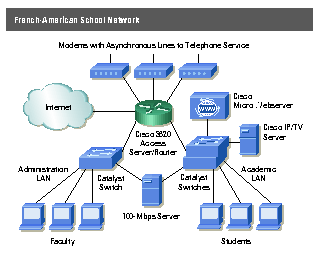
The network provides students and faculty with state-of-the-art switched Ethernet Internet access, Web page creation capabilities, and secure administrative functions, and enabled its students to participate in the Cisco-initiated NetDay ceremonies on May 9, 1997.
The components of the French-American School network include:
All Cisco components are provided to the school with Cisco's SMARTnetTM maintenance support program, which includes upgrades for Cisco IOSTM software, in addition to CiscoWorks network management applications that let the administrators manage the network remotely.
For more information on Cisco's education network solutions, grants, and programs, visit http://www. cisco.com/edu.
| Cisco Leads NetDay Ceremonies |
|---|
| NetDay, an all-volunteer effort, was developed with the ultimate goal of making every school Internet-ready. Spring 1997 marks the third California NetDay, the second US national NetDay, and the launch of NetDay activities in several other countries. The Cisco-initiated NetDay ceremonies (held on May 9) celebrated all state, national, and international NetDay accomplishments and connected schools around the globe in a live videoconference across the Internet. NetDay has been a catalyst in providing school-age children around the world with access to the wealth of information and people available via the Internet. For more information about past and future NetDay events, visit http://www.netday.org. |
___________________________________________________________________________________________________________
Packet TM magazine is published quarterly and distributed free of charge to users of Cisco Systems products.
Direct address corrections and other correspondence to packet@cisco.com, or to Packet, in care of:
Cisco Systems, Inc.
170 West Tasman Drive
San Jose, California, 95134-1706
USA Phone: 408 526-4000
World Wide Web URL: http://www.cisco.com
Editor-in-Chief: Joanna Holmes
Assistant Editor: Deanna Andreasen
Art Direction and Design: Donna Helliwell
Production: Emily Burch
Project Coordination: Carol Rolin
Published by the Cisco Systems News Publications Group
Special thanks to the following contributors: Seenu Banda, David Baum, Dorthe Dahlin, Barbara Dallenbach, Tom Fermazin, Anne McLeod Haynes, Judy Jones, Janice King, Gail Meredith, Pete Solvik, Patrice Steiner, Clare Whitecross, Sue Whiteside, and the Cisco Graphics Group.
AXIS, Cisco IOS, Cisco Systems, IGX, NetFlow, Netsys Technology, Packet, PIX, SMARTnet, and The Cell are trademarks; and BPX, Catalyst, Cisco, the Cisco logo, EtherChannel, LightStream, and StrataCom are registered trademarks of Cisco Systems, Inc. in the USA and certain other countries. All other trademarks mentioned in this document are the property of their respective owners.
Packet, copyright © 1997 by Cisco Systems, Inc. All rights reserved. Printed in the USA.
No part of this publication may be reproduced in any form, or by any means, without prior written permission from Cisco Systems, Inc.
|
|