


|
|

The FastHub can be configured and managed:
This chapter focuses on using the management console to configure and manage the FastHub and provides the following topics:
You can also configure and manage the FastHub by accessing the Management Interface Base (MIB) files and using SNMP-compatible network management applications. Accessing the MIB files and using SNMP are discussed at the end of this chapter in the
"In-Band Management" section.
To access the management console, you need to first connect the console port on the FastHub to the terminal or modem and start up your terminal emulation program or Telnet session. For information on how to connect to the console port on the FastHub, see the "Connecting to the Console Port" section in the "Installing the FastHub" chapter.
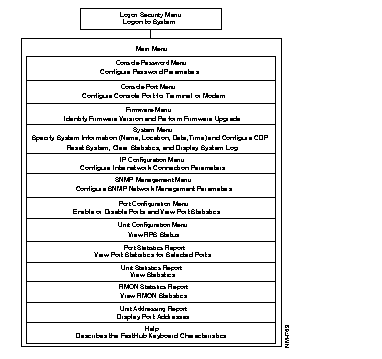
The management console of the FastHub is a menu-driven interface for configuring and monitoring the network conditions and statistics (see Figure 4-1). You can use the management console even when the network is down because the console communicates directly with the FastHub, bypassing the network.
When you use the management console, keep the following in mind:
Table 4-1 shows how to use a standard keyboard to control the management console interface and access online help:
| Task | Key |
|---|---|
| Move the menu cursor. | Left, right, up, or down arrow keys. |
| Select a menu item. | Position the cursor on the command or its parameter value, and press Return. |
| Move to the beginning of a text field. | Home key. |
| Move to the end of a text field. | End key. |
| Move the text-edit cursor. | Right and left arrow keys. |
| Move to the OK and Cancel buttons. | Tab key. |
| Access Help information for an item. | Select the item, then press either the F3 or ? key. |
The FastHub is shipped preconfigured with the default settings listed in Table 4-2. To use the default configuration, follow these steps:
Table 4-2 lists management console menu items and, if applicable, their default settings. The items are listed in the sequence that they appear in the management console menu tree (see Figure 4-1).
| Menu Item | Default Setting | Management Console Menu |
|---|---|---|
| Password intrusion threshold | None | Console Password |
| Silent time upon intrusion detection | None | Console Password |
| Modify password | - | Console Password |
| Baud rate | 9600 | Console Port |
| Data bits | 8 | Console Port |
| Stop bits | 1 | Console Port |
| Parity setting | None | Console Port |
| Match remote baud rate (auto baud) | Enabled | Console Port |
| Auto answer | Enabled | Console Port |
| Time delay between dial attempts | 300 seconds | Console Port |
| Number for dial-out connection | - | Console Port |
| Initialization string for modem | 0 | Console Port |
| Upgrade status | - | Firmware |
| Supervisor boot version | - | Firmware |
| Supervisor mgmt version | - | Firmware |
| Server accept TFTP upgrade requests | Enabled | Firmware |
| Name or IP address of TFTP server | - | Firmware |
| Filename for firmware upgrade | - | Firmware |
| Initiate TFTP upgrade | - | Firmware |
| Initiate XMODEM upgrade | - | Firmware |
| Name of system | - | System |
| Contact name | - | System |
| Location | - | System |
| Up Time | - | System |
| Management console inactivity timeout | None | System |
| Use Cisco Discovery Protocol (CDP) | Enabled | System |
| CDP message interval | 60 seconds | System |
| Reset system | - | System |
| Reset to factory defaults | - | System |
| Reset repeater | - | System |
| Display Supervisor log | - | System |
| Display CDP neighbors | - | System |
| IP address of system | 0.0.0.0 or no IP address | IP Configuration |
| IP subnet mask | 0.0.0.0 or no mask | IP Configuration |
| IP address of default gateway | 0.0.0.0 or no gateway address | IP Configuration |
| IP address of DNS server 1 | 0.0.0.0 or no IP address | IP Configuration |
| IP address of DNS server 2 | 0.0.0.0 or no IP address | IP Configuration |
| DNS domain name | - | IP Configuration |
| Use routing information protocol | Enabled | IP Configuration |
| READ community string | Public | SNMP Management |
| WRITE community string | Private | SNMP Management |
| Authentication trap generation | Enabled | SNMP Management |
| Write manager names | 0 | SNMP Management |
| Trap manager names | 0 | SNMP Management |
| Trap manager community strings | 0 | SNMP Management |
| Port name | - | Port Configuration |
| Port status (port enabled or disabled) | Enabled | Port Configuration |
| RPS status | - | Unit Configuration |
| Power source | - | Unit Configuration |
| Boot version | - | Unit Configuration |
| Mgmt version | - | Unit Configuration |
| Clear statistics | - | RMON Statistics Report |
You can use the management console locally from a terminal or remotely through a modem. When you connect to the console port, you must configure the terminal or modem to the same baud rate and character format as the console port. The default characteristics for the console port are the following:
Although the Match Baud Rate option (autobaud) matches the baud rate when the FastHub is answering an incoming call, the FastHub does not change from its configured rates when dialing out. Also, the FastHub only matches a rate lower than its configured rate. When a call is completed and the line disconnects, the FastHub always returns to its last configured baud rate.
You can change the console port characteristics of the FastHub through the Console Port Menu (see the "Console Port Menu" section later in this chapter). If you are using SNMP, these characteristics can be changed with the RS-232 MIB objects.
For information about connecting to the console port, see the "Connecting to the Console Port" section in the "Installing the FastHub" chapter.
The Management Console Logon screen (see Figure 4-2) is displayed after you connect the FastHub to a terminal or modem and start up your terminal emulation program or Telnet session. To log in to the management console and display the Management Console Main Menu, select Logon, and press Return.
If a password for the FastHub has been defined, you are prompted for the password when you display the Management Console Logon screen. Enter the password on the Logon screen, and press Return. Then press Return again to log in.
If you have forgotten the password, you can either
For further information about the Diagnostic Console menus and screens, see the
"Using the Diagnostic Console" section in the "Troubleshooting" chapter.
You can use any Telnet TCP/IP package to use the management console. The FastHub supports up to seven simultaneous Telnet sessions. Changes made by one Telnet user are reflected in all other Telnet sessions.

The Management Console Main Menu (see Figure 4-3) is displayed after you successfully log on from the Management Console Logon screen. Select an option from the Main Menu and press Return.

The Help option provides information on FastHub management console keyboard use, as described in Table 4-1 in the "Overview" section earlier in this chapter. The Exit option prompts you to confirm that you want to exit the management console. The rest of the options on the Main Menu are for configuring and managing the FastHub.
The Console Password menu (see Figure 4-4) is displayed from the Main Menu. Use the Console Password menu to configure the management console login parameters.

Password intrusion threshold--Enter the number of failed login attempts allowed before the management console shuts down for a configured duration.
Silent time upon intrusion detection--Enter the number of minutes during which the management console is unavailable after password intrusion threshold has been exceeded.
Modify password--Change your login password. To erase the password, either press Delete or the Backspace key, and then press Return.
Exit--Return to Main Menu.
The Console Port menu (see Figure 4-5) is displayed from the Main Menu. Use the Console Port menu to configure the network management console port.

Baud rate--Enter the signal speed for the console port.
Data bits--Enter the number of data bits for the console port.
Stop bits--Enter the number of stop bits for the console port.
Parity setting--Enter the parity setting for the console port.
Match remote baud rate (auto baud)--Enable or disable auto-baud detect for the console port. When enabled, the console port automatically determines the baud rate of an incoming call and switches to that baud rate.
Auto answer--Enable or disable auto-answer for the console port. When enabled, the system automatically answers incoming calls on a modem attached to the console port.
Time delay between dial attempts--Enter the time in seconds that the management console delays before each attempted dial-out connection.
Number for dial-out connection--Enter the number used for dial-out connection.
Initialization string for modem--Enter a modem initialization string.
Exit--Return to Main Menu.
The Firmware menu (see Figure 4-6) is displayed from the Main Menu. Use the Firmware menu to display system firmware version levels and perform firmware upgrades.

Upgrade status--Displays the firmware upgrade status and the IP address of the TFTP server where the upgrade file resided. Also indicates whether the upgrade was successful.
Boot version--Displays the version number of the bootstrap firmware.
Management version--Displays the version number of the management firmware.
Server accept TFTP upgrade requests--This is the first of three items used to configure a Trivial File Transfer Protocol (TFTP) upgrade. Use this item to specify whether the FastHub accepts TFTP write requests from the management console.
Name or IP address of TFTP server--This is the second of three items used to configure a TFTP upgrade. Use this item to name the TFTP server from which the firmware file is downloaded.
Filename for firmware upgrade--This is the third item used to configure a TFTP upgrade. Use this item to specify the name of the firmware upgrade file downloaded from the server.
Initiate TFTP upgrade--Initiate the TFTP upgrade process. Note that the second confirmation prompt allows you to verify the upgrade file path, filename, and the server address.
Initiate XMODEM upgrade--Initiate an out-of-band firmware upgrade. The XMODEM protocol is used to perform this upgrade.
Exit--Return to Main Menu.
The System menu (see Figure 4-7) is displayed from the Main Menu. Use the System menu to do the following:

Name of system--Enter a name for the system.
Contact name--Enter the name of the person or organization responsible for administering the system.
Location--Enter the location of the system.
Up Time--Displays how long the system has been up.
Management console inactivity timeout--Enter the number of minutes that the management console can go without activity, after which it becomes unavailable and a password needs to be reentered.
Use Cisco Discovery Protocol (CDP)--Enable or disable CDP on this FastHub. Using CDP, the FastHub can advertise its existence to other devices and receive information about other devices on the same LAN.
CDP message interval--Enter the interval in seconds that CDP messages are generated on this FastHub.
Reset system--Resets the FastHub hardware and firmware, does not run the power-on self-test (POST), retains all configured system parameters, and clears all network-related statistics.
Reset repeater--Resets the FastHub hardware, does not run the POST, retains all configured system parameters, and retains all network-related statistics.
Reset to factory defaults--Resets the FastHub hardware and firmware, does not run the POST, changes all configured system parameters to their factory defaults, and clears all network-related statistics.
Display Supervisor log--Displays supervisor log information.
Display CDP neighbors--Displays CDP cache information.
Exit--Return to Main Menu.
The Internet Protocol (IP) Configuration menu (see Figure 4-8) is displayed from the Main Menu. Use the IP Configuration menu to configure internetwork connection parameters.

Ethernet address--Displays the Ethernet address of the system.
IP address of system--Enter the system IP address.
IP subnet mask--Enter a subnet mask for the system.
IP address of default gateway--Enter the IP address of the default gateway.
IP address of DNS server 1--Enter the IP address of Domain Name System (DNS)
server 1.
IP address of DNS server 2--Enter the IP address of DNS server 2.
DNS domain name--Enter the DNS domain name.
Use Routing Information Protocol--Enable or disable the Routing Information Protocol (RIP) listener. The RIP listener automatically discovers IP gateways.
Exit--Return to Main Menu.
The SNMP Management menu (see Figure 4-9) is displayed from the Main Menu. Use the SNMP Management menu to configure SNMP network management parameters. The read and write community strings are used by the SNMP agent to control requests for information about, and access to, management information for the repeater.

READ community string--Enter the SNMP-agent read (Get) community string. The community string serves as a password to authenticate messages sent between the FastHub and the SNMP agent.
WRITE community string--Enter the SNMP-agent write (Set) community string. The community string serves as a password to authenticate messages sent between the FastHub and the SNMP agent.
Authentication trap generation--Enable or disable the generation of SNMP authentication traps. An authentication trap alerts a management workstation of SNMP requests that do not carry a valid read (Get) or write (Set) community string.
Write manager names--Identify which management workstations are allowed to issue write (Set) requests to the FastHub. Either the name or IP address of the management workstation can be entered. You can define up to four workstations. If no name or address is defined, then any management workstation can set the MIB objects.
Trap manager names--Identify which management workstations receive SNMP traps (alerts) from the FastHub. Either the name or IP address of the management workstation can be entered. You can define up to four workstations. If no name or IP address is defined, the FastHub does not send any traps.
Trap manager community strings--Enter the community string that accompanies an SNMP trap sent to each trap management workstation. The community string serves as a password to authenticate messages sent between the FastHub and the management workstation.
Exit--Return to Main Menu.
When you select the Port Configuration menu from the Main Menu, the Port Selection screen (see Figure 4-10) is displayed. After you enter the desired port number on the Port Selection screen, the Port Configuration menu is displayed (see Figure 4-11). Use the Port Configuration menu to enable or disable ports and display port statistics.


Port linkbeat status--Indicates whether link pulses are being received by this port.
Port autopartition status--Indicates whether the port is currently autopartitioned. Autopartitioned ports are automatically reconnected when the fault is rectified. Frequent partitions can indicate that the port is not terminated correctly or a connected device is faulty.
Port connector type--Indicates the port connector type.
Last source address--Indicates the MAC address of the last frame received at this port.
Source address changes--Indicates the number of different source addresses received at this port.
Port name--Enter a name for a designated port.
Port status--Enable or disable the port. A disabled port does not transmit or receive.
Previous port--Go to the Port Configuration menu for the port numerically before this port.
Next port--Go to the Port Configuration menu for the port numerically after this port.
Goto port....--Go to the Port Configuration menu for a specific port.
Port statistics--View the Port Statistics Report for the currently selected port. The Port Statistics Report presents frame transmit and receive statistics. See the "Port Statistics Report" section in this chapter.
Unit configuration--Go to the Unit Configuration menu.
Exit--Return to Main Menu.
The Unit Configuration menu (see Figure 4-12) is displayed from the Main Menu. Use the to do the following:

RPS status--Indicates whether an RPS is present and operational.
Power source--Indicates whether the power source is an RPS or the FastHub internal power supply.
Boot version--Displays the version number of the bootstrap firmware.
Mgmt version--Displays the version number of the management firmware.
Main board--Displays the revision number of the main board.
Port configuration--Go to the Port Configuration menu.
Unit addressing--Go to the Unit Addressing Report.
Exit--Return to Main Menu.
When you select the Port Statistics Report from the Main Menu, first the Port Selection screen (see Figure 4-13) is displayed. After you enter the desired port number on the Port Selection screen, the Port Statistics Report is displayed (see Figure 4-14).
Use the Port Statistics Report selection to display port statistics for individual ports. The Port Statistics Report presents frame transmit and receive statistics. You cannot modify any parameters through this report.

Total good frames--Total number of readable frames received by the port.
Total good octets--Total number of octets (bytes) received as part of good frames by the port.
Source address changes--Number of different source addresses received at this port.
Runts--Frames that are smaller than the minimum frame size for IEEE-802.3 standard frames. Runt frames typically are caused by collision fragments and are propagated through the network (runts are a normal part of IEEE 802.3 networks). If the number of runt frames exceeds the number of collisions, there is a problem with a transmitting device. Some protocols can also cause runt frames.
Collisions--Occur when two devices attempt to transmit at the same time (collisions are a normal part of 802.3 networks). If the collision count suddenly increases without an accompanying general increase in network traffic, you probably have a faulty device on your network. Check port collision statistics to find the port with the largest number of collisions. Ensure that the device connected to this port is operational and not in full-duplex mode.
Autopartitions--Number of times the FastHub has automatically partitioned the segment attached to this port. Autopartitioned ports are automatically reconnected when the fault is rectified. Frequent partitions indicate that the port is not terminated correctly or that a connected device is faulty.
Alignment errors--Total number of alignment errors at the port. Alignment errors occur if all bytes are not received whole. Check the cable and the connected device. Verify the network configuration; see the "Guidelines for Connecting FastHubs and Other Repeaters" chapter, and ensure that cabling distances have not been exceeded and that the number of repeaters in the network does not exceed the maximum allowed.
FCS errors--Frame Check Sequence errors indicating that frames of data are being corrupted during transmission; this number should be a very small percentage of the total data traffic. Check the cable and the connected device. Verify the network configuration; see the "Guidelines for Connecting FastHubs and Other Repeaters" chapter, and ensure that cabling distances have not been exceeded and that the number of repeaters in the network does not exceed the maximum allowed.
Frames too long--Frames that exceed the maximum size for 802.3 frames. The frame might have been corrupted during transmission. Some network protocols can cause these frames.
Symbol errors--Total number of frames of valid length with at least one occurrence of an invalid data symbol.
Data rate mismatches--Number of frames whose timing no longer matches the transmit frequency. Check the transmitting device.
Late collisions--Collisions outside the collision domain. These might occur if you have an oversized network or a segment that is longer than prescribed in 802.3. Verify the network configuration; see the "Guidelines for Connecting FastHubs and Other Repeaters" chapter, and ensure that cabling distances have not been exceeded and that the number of repeaters in the network does not exceed the maximum allowed.
Jabber errors--Occur when data packets exceed the lengths prescribed in 802.3. Check port collision statistics to find the port with the largest number of jabber errors. Ensure that the device connected to this port is operational and that the connecting cable is not faulty.
Isolates--The number of times the port automatically isolates due to false carrier events. This is generally caused by a faulty cable.
False carriers--This statistic is generated when port cables are connected or disconnected, or when connected devices are powered up and down. It can also indicate a faulty cable.
Short events--Short events are smaller than runt frames. They often indicate network problems caused by externally generated noise. Check cable routing and reroute as necessary.
Previous port--Go to the Port Statistics Report for the port numerically before this port.
Goto port....--Go to the Port Statistics Report for a specific port.
Next port--Go to the Port Statistics Report for the port numerically after this port.
Port configuration. Go to the Port Configuration menu for the current port.
Unit statistics--View the Unit Statistics Report for frame transmit and receive statistics for the FastHub. See the "Unit Statistics Report" section in this chapter.
Exit--Return to Main Menu.
The Unit Statistics Report is displayed (see Figure 4-15) from the Main Menu. The Unit Statistics Report presents frame transmit and receive statistics. You cannot modify any parameters through this report.

Total good frames--Total number of readable frames received by the FastHub.
Total good octets--Total number of octets (bytes) received as part of good frames by the FastHub.
Source address changes--Number of different source addresses received by the FastHub.
Runts--Frames that are smaller than the minimum frame size for 802.3 frames. Runt frames are typically caused by collision fragments and are propagated through the network (runts are a normal part of 802.3 networks). If the number of runt frames exceeds the number of collisions, there is a problem with a transmitting device. Some protocols can also cause runt frames.
Collisions--Occur when two devices attempt to transmit at the same time (collisions are a normal part of 802.3 networks). If the collision count suddenly increases without an accompanying general increase in network traffic, you probably have a faulty device on your network. Check port collision statistics to find the port with the largest number of collisions. Ensure that the device connected to this port is operational and not in full-duplex mode.
Autopartitions--Number of times the FastHub has automatically partitioned the segments attached to its ports. Autopartitioned ports are automatically reconnected when the fault is rectified. Frequent partitions indicate that a port is not terminated correctly or a connected device is faulty.
Alignment errors--Total number of alignment errors at the FastHub. Alignment errors occur if all bytes are not received whole. Check the cable and the connected device. Verify the network configuration; see the "Guidelines for Connecting FastHubs and Other Repeaters" chapter, and ensure that cabling distances have not been exceeded and that the number of repeaters in the network does not exceed the maximum allowed.
FCS errors--Frame Check Sequence errors indicating that frames of data are being corrupted during transmission; this number should be a very small percentage of the total data traffic. Check the cable and the connected device. Verify the network configuration; see the "Guidelines for Connecting FastHubs and Other Repeaters" chapter, and ensure that cabling distances have not been exceeded and that the number of repeaters in the network does not exceed the maximum allowed.
Frames too long--Frames that exceed the maximum size for 802.3 frames. The frame might have been corrupted during transmission. Some network protocols can cause these frames.
Symbol errors--Total number of frames of valid length with at least one occurrence of an invalid data symbol.
Data rate mismatches--Number of frames whose timing no longer matches the transmit frequency. Check the transmitting device.
Late collisions--Collisions outside the collision domain. These might occur if you have an oversized network or a segment that is longer than prescribed in 802.3. Verify the network configuration; see the "Guidelines for Connecting FastHubs and Other Repeaters" chapter, and ensure that cabling distances have not been exceeded and that the number of repeaters in the network does not exceed the maximum allowed.
Jabber errors--Occur when data packets exceed the lengths prescribed in 802.3. Check port collision statistics to find the port with the largest number of jabber errors. Ensure that the device connected to this port is operational and that the connecting cable is not faulty.
Isolates--Number of times the FastHub ports automatically isolate due to consecutive false carrier events. This is generally caused by a faulty cable.
False carriers--This statistic is generated when port cables are connected or disconnected, when connected devices are powered up and down, or it might indicate a faulty cable.
Short events--Short events are smaller than runt frames. They could indicate network problems caused by externally generated noise. Check cable routing and reroute as necessary.
Port statistics--Go to the Port Statistics Report (via the Port Selection screen).
RMON statistics--View the RMON Statistics Report for frame and receive statistics for the FastHub. See the "RMON Statistics Report" section in this chapter.
Exit--Return to Main Menu.
The RMON Statistics Report (see Figure 4-16) is displayed from the Main Menu. The RMON Statistics Report displays frame and receive statistics for the FastHub. You can also clear FastHub statistics through this report.

Total frames--Total number of readable frames received by the FastHub and the number of frames generated by the FastHub. This is a good indication of the total amount of valid data traffic passing through the FastHub.
Total octets--Total number of octets (bytes) received as part of good frames by the FastHub.
Runts--Frames that are smaller than the minimum frame size for 802.3 frames. Runt frames typically are caused by collision fragments and are propagated through the network (runts are a normal part of IEEE 802.3 networks). If the number of runt frames exceeds the number of collisions, there is a problem with a transmitting device. Some protocols can also cause runt frames.
Good broadcast frames--Total number of broadcast frames received by the FastHub.
Good multicast frames--Total number of multicast frames seen at the FastHub.
Total collisions--Total number of collisions seen at the FastHub. Collisions occur when two devices attempt to transmit at the same time (collisions are a normal part of 802.3 networks). If the collision count suddenly increases without an accompanying general increase in network traffic, you probably have a faulty device on your network. Check port collision statistics to find the port with the largest number of collisions. Ensure that the device connected to this port is operational and not in full-duplex mode.
FCS errors--Frame Check Sequence errors indicating that frames of data are being corrupted during transmission; this number should be a very small percentage of the total data traffic. Check the cable and the connected device. Verify the network configuration; see the "Guidelines for Connecting FastHubs and Other Repeaters" chapter, and ensure that cabling distances have not been exceeded and that the number of repeaters in the network does not exceed the maximum allowed.
Alignment errors--Total number of alignment errors for the FastHub. Alignment errors occur if all bytes are not received whole. Check the cable and the connected device. Verify the network configuration; see the "Guidelines for Connecting FastHubs and Other Repeaters" chapter, and ensure that cabling distances have not been exceeded and that the number of repeaters in the network does not exceed the maximum allowed.
Jabber errors--Occur when data packets exceed the lengths prescribed in 802.3. Check port collision statistics to find the port with the largest number of jabber errors. Ensure that the device connected to this port is operational and that the connecting cable is not faulty.
Oversize frames--Total number of frames that exceed the maximum size for 802.3 frames. The frames might have been corrupted during transmission. Some network protocols can cause these frames.
Undersize frames--The number of frames that are less than 64 octets long but are otherwise well-formed.
Port statistics--Go to Port Statistics Report (via the Port Selection screen).
Unit statistics--Go to Unit Statistics Report.
Clear statistics--Clears all statistics in the FastHub.
Exit--Return to Main Menu.
The Unit Addressing Report (see Figure 4-17) is displayed from the Main Menu. The Unit Addressing Report displays the port addresses for the FastHub. You cannot modify any parameters through this report.

Port--Indicates port number on the FastHub.
Source Address--Source address of port.
Unit configuration--Go to Unit Configuration menu.
Unit statistics--Go to the Unit Statistics Report.
Exit--Return to Main Menu.
You can configure and manage the FastHub by accessing the MIB objects through in-band management. This section focuses on in-band management through SNMP and provides the following information:
Parameter changes take effect immediately. However, changed parameters might not be written to permanent storage for up to 30 seconds. If you turn off the FastHub before the new parameters are written to permanent storage, the change does not take effect.
The MIB files contain variables that can be set or read to provide information on the FastHub. Also contained in the MIB files is information about the traps generated by the FastHub (see the "Traps and Trap Clients" section later in this chapter).
The following MIB files contain the MIB and trap information for the FastHub:
The FastHub is shipped with two diskettes, one for UNIX and one for DOS, containing the FastHub firmware and device-specific MIBs. You can also obtain a copy of the MIB files in the following ways:
You can obtain each MIB file with the following procedure:
Step 1 Use FTP to access the server ftp.cisco.com.
Step 2 Log in with the username anonymous.
Step 3 Enter your e-mail name when prompted for the password.
Step 4 At the ftp> prompt, change directories to /pub/MIBs.
Step 5 Use the get README command to display the readme file containing a list of available files.
Step 6 Use the get MIB_filename command to obtain a copy of the MIB file.
CCO serves a wide variety of users through two interfaces that are updated and enhanced simultaneously: a character-based version and a multimedia version that resides on the World Wide Web (WWW). The character-based CCO supports Zmodem, Kermit, Xmodem, FTP, and Internet e-mail, and it is excellent for quick access to information over lower bandwidths. The WWW version of CCO provides richly formatted documents with photographs, figures, graphics, and video, as well as hyperlinks to related information.
You can access CCO in the following ways:
For a copy of CCO's Frequently Asked Questions (FAQ), contact cco-help@cisco.com. For additional information, contact cco-team@cisco.com.
From the main menu, select Software Library. Then select MIBs and Public Files. The supportlists directory contains descriptions of the MIBs supported by the FastHub. Refer to the fh216 directory for FastHub products, including the FastHub 216T.
A trap is an alarm message that the FastHub sends to the trap client whenever the FastHub detects an alarm condition. The FastHub generates the traps listed in Table 4-3.
A trap client is a management workstation configured to receive and process traps. The FastHub supports up to four trap clients with separate community strings. At least one trap client must be defined before any traps are generated. See the "SNMP Management Menu" section earlier in this chapter for instructions on defining trap clients.
| Enterprise-Specific Traps (documented in the CISCO-FASTHUB-MIB.my file) | |
| logonIntruder | A user is repeatedly trying to log on to the management console using an invalid password. You can define the number of invalid passwords permitted before this trap is generated. The FastHub can shut down the management console following the generation of this trap. |
| hubStackDiagnostic | The FastHub issues this trap when its power-on self-test (POST) does not pass all tests. However, note that some failures are catastrophic, preventing the generation of this trap. |
| rpsFailed | An RPS is connected to the FastHub, but a failure exists in the power system. |
| ipAddressChange | This trap is issued when the FastHub is unable to complete its DHCPDISCOVER/DHCPREQUEST process, when it fails to extend the lease for the current address, or when it accepts an address change from the user. |
| Repeater Traps (documented in the SNMP-REPEATER-MIB.my file) | |
| rptrHealth | This trap conveys information related to the operational status of the FastHub. This trap is sent either when the value of rptrOperStatus changes or when a nondisruptive test completes. |
| rptrResetEvent | This trap conveys information related to the operational status of the FastHub. This trap is sent on completion of a reset action (such as an SNMP Set on the rptrReset object). |
| Remote Network Monitoring Traps (documented in the RMON-MIB.my file) | |
| risingAlarm | This SNMP trap is generated when an alarm entry crosses its rising threshold and generates an event that is configured for sending SNMP traps. |
| fallingAlarm | This SNMP trap is generated when an alarm entry crosses its falling threshold and generates an event that is configured for sending SNMP traps. |
| MIB II Traps (documented in the RFC1213-MIB.my file) | |
| warmStart | Generated when the repeater is reset or after the completion of a firmware upgrade. |
| coldStart | Generated upon a power-up reset. |
| linkDown | This trap is currently not generated by the FastHub. |
| linkUp | This trap is currently not generated by the FastHub. |
| authenticationFailure | Generated when the FastHub receives an SNMP message that is not accompanied by a valid community string. |
Before beginning any in-band management, you must configure the FastHub for SNMP management by assigning an IP address to the FastHub. You can assign an individual IP address to each FastHub or use the BOOTP/DHCP protocol to maintain a centralized database of these addresses. To assign an individual IP address to a FastHub, use the IP Configuration menu described in the "IP Configuration Menu" section earlier in this chapter.
To assign an IP address to a FastHub using BOOTP/DHCP protocol, set up a database containing a list of physical MAC addresses and corresponding IP addresses on a host machine with a BOOTP/DHCP server program. You can store other information in the database, such as the corresponding subnet masks, default gateway addresses, and host names, but this information is optional. The FastHub must be able to access the BOOTP/DHCP server through a FastHub port.
After a system reset, the FastHub searches its nonvolatile random-access memory (NVRAM) for a configured FastHub IP address. If one exists, the FastHub then searches for a default gateway address and an IP subnet mask.
If a FastHub IP address has not been configured, the FastHub transmits a BOOTP/DHCP request to all physically connected ports, requesting a mapping for each port's physical MAC address. A valid response includes the IP address, which is mandatory, along with the subnet mask, the default gateway, and the host name, which are optional.
The reception of a valid BOOTP/DHCP response immediately activates the rest of the system's protocol suite, without requiring a system reset. The information is also saved in NVRAM, so the next reset does not have to use BOOTP/DHCP. For more information about using BOOTP/DHCP, see the BOOTP/DHCP server documentation.
The FastHub MIB variables are accessible through SNMP. SNMP is an application-layer protocol designed to facilitate the exchange of management information between network devices. The SNMP system consists of three parts: SNMP manager, SNMP agent, and MIB.
Instead of defining a large set of commands, SNMP places all operations in a get-request, get-next-request, and set-request format. For example, an SNMP manager can get a value from an SNMP agent or store a value into that SNMP agent. The SNMP manager can be part of a network management system (NMS), and the SNMP agent can reside on a networking device such as a FastHub. You can compile the FastHub MIB files with your network management software. The SNMP agent can respond to MIB-related queries being sent by the NMS.
An example of an NMS is the CiscoWorks network management software. CiscoWorks uses the FastHub MIB variables to set device variables and to poll devices on the network for specific information. The results of a poll can be displayed as a graph and analyzed in order to troubleshoot internetworking problems, increase network performance, verify the configuration of devices, monitor traffic loads, and more.
As shown in Figure 4-18, the SNMP agent gathers data from the MIB, which is the repository for information about device parameters and network data. The agent can send traps, or notification of certain events, to the manager.

The SNMP manager uses information in the MIB to perform the operations described in Table 4-4.
| Operation | Description |
|---|---|
| get-request | Retrieve a value from a specific variable. |
| get-next-request | Retrieve a value from a variable within a table.1 |
| get-response | The reply to a get-request, get-next-request, and set-request sent by an NMS. |
| set-request | Store a value in a specific variable. |
| trap | An unsolicited message sent by an SNMP agent to an SNMP manager indicating that some event has occurred. |
| |
|
|