The Catalyst 2926 switch is a two-slot, fixed-configuration LAN switch that provides high-performance switching solutions between workstations, servers, switches, and routers using the same architecture and software as the Catalyst 5000 series switches. The Catalyst 2926 switch provides 24 10/100-Mbps, Fast Ethernet autosensing switched ports to the desktop, two 100-Mbps copper or fiber Fast Ethernet switched uplink ports for backbone and wiring-closet connections, and redundant AC-input power supplies.
For more information on Catalyst 2926 switch components, see Chapter 2, "Switch Description."
The Catalyst 2926 switch is available in two models, which differ only in the type of connectors and cabling used with the supervisor engine. The two models are:
- Model C2926T--uses RJ-45 and media-independent interface (MII) connectors with 100BaseTX Category 5 unshielded twisted-pair (UTP) cabling
- Model C2926F--uses SC connectors with multimode fiber-optic cabling
The Catalyst 2926 switch fits into a standard 19-inch (48.3-centimeter) rack, and all system connections are accessible from the rear of the chassis. The system includes the following:
- Supervisor engine that provides layer 2 switching, local and remote management, and two Fast Ethernet uplink interfaces that support Fast EtherChannel bundling and Inter-Switch Link (ISL) trunking
- 24 10/100-Mbps Fast Ethernet autosensing switched ports
- Dual, load-sharing, redundant AC-input power supplies that provide uninterrupted system operation
The Catalyst 2926 switch delivers more than 1 million packets-per-second throughput across a 1.2-Gbps, media-independent switching fabric. This switching fabric supports wire-speed switching for the 10/100-Mbps Fast Ethernet interfaces.
The Catalyst 2926 switch requires supervisor engine software release 2.4(1) or greater.
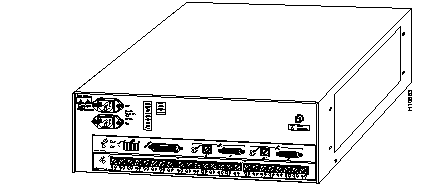
Figure 1-1 shows the Catalyst 2926 switch.
Figure 1-1: Catalyst 2926 Switch
The supervisor engine includes two full-duplex, 100-Mbps Fast Ethernet uplinks for redundant connections to switches, routers, and servers. The two 100-Mbps Fast Ethernet uplink ports support Fast EtherChannel bundling and ISL trunking. The supervisor engine has separate hardware that supports switching and network management, allowing the hardware-based switching ASIC to forward packets across the switching bus even if the network management processor fails.
The supervisor engine does the following:
- Controls data access to the backplane, prioritizes traffic, maintains up to 16,000 active Media Access Control (MAC) addresses in the bridge lookup table, and monitors system status
- Provides a common management path (separate from the data path) that delivers configuration information for the module, gathers performance information, and updates operational software information
- Supports up to 1000 virtual local-area networks (VLANs) network wide
The Catalyst 2926 switch includes network management tools that provide the following:
- Traffic management--Remote Monitoring (RMON) statistics provide visibility of network activity: statistics, history, events, and alarm groups.
- Traffic monitoring--Enhanced Switched Port Analyzer (SPAN) functionality enables you to mirror traffic on any port or VLAN to another Fast Ethernet port for analysis by a sniffer or RMON SwitchProbe device.
- Load balancing--Load balancing using VLANs and spanning-tree on multiple parallel Fast Ethernet ISL trunks increases capacity and fault tolerance between switches. Dynamic ISL (DISL) Protocol synchronizes configuration of two interconnected Fast Ethernet interfaces into ISL trunks.
- VLAN management--Spanning-Tree Protocol over VLAN, ISL, DISL, and VLAN Trunk Protocol (VTP).
- In-band/out-of-band management--Local out-of-band management through a terminal or modem attached to the EIA/TIA-232 interface; remote in-band management through Simple Network Management Protocol (SNMP), Telnet client, BOOTP, and Trivial File Transfer Protocol (TFTP).
Note EIA/TIA-232 was known as recommended standard RS-232 before its acceptance as a standard by the Electronics Industries Association (EIA) and Telecommunications Industry Association (TIA).
- SNMP management--Protocol that facilitates the exchange of management information between network devices.
- NVRAM--Nonvolatile random-access memory (NVRAM) for storing configuration data and software images.
- CiscoWorks management--CiscoWorks integrated, standards-based management, including CiscoView, TrafficDirector, and VlanDirector.



