


|
|

To validate CiscoWorks installation and configuration, you must edit the .cshrc file on your system. This chapter describes how to complete the validation of your CiscoWorks installation.
Follow these main steps to validate CiscoWorks installation:
To use your network management platform software, CiscoWorks and Sybase, you must verify that the appropriate environment variables and paths are set in your install.cshrc or .cshrc file.
Environment variables define how your particular system is set up, such as how directory paths locate specific files. Table 3-1 explains the environment variables and paths.
| Environment Variable or Path | Explanation |
|---|---|
| NMSROOT | On HP-UX 9.x, CiscoWorks is installed in the directory /usr/nmscw. On HP-UX 10.x, CiscoWorks is installed in the directory /opt/CSCOcwh. If the software was installed in a different directory, substitute the appropriate directory path to ensure a correct definition of the NMSROOT environment variable. |
| SYBASE | Directory path where Sybase is located. The HPUX 9.x default is $NMSROOT/ sybase. If you select the default on HP-UX 9.x, the Sybase software is installed in the directory /usr/nmscw/sybase. If you select the default on HP-UX 10.x, the Sybase software is installed in the directory /opt/CSCOsyb. The SYBASE variable refers to the NMSROOT variable and the Sybase directory following it. |
| CW_NMSDB | Name of nms database. Default for the database is nms. |
| CW_POLLDB | Name of the poll database. Default for the database is polldb. |
| PATH | Directory path for your NMS software and various CiscoWorks directories (including $NMSROOT/bin, $NMSROOT/etc, and $SYBASE/bin). The path should be specified to include HP OpenView, CiscoWorks, and Sybase. |
| MANPATH | Directory path for the CiscoWorks manual pages. |
| HHHOME | Home directory where the CiscoWorks online help system is located. |
| HHPATH | Directory path for the CiscoWorks online help system files. |
| XLIBI18N_PATH | Library path for HyperHelp. The default is $HHHOME/lib. |
| TCL_LIBRARY | Directory path for the TCL libraries. |
| TK_LIBRARY | Directory path for the TK libraries. |
| DSQUERY | Sybase server name. The default is $CW-SYBASE. |
| ESQRDIR | Directory path for starting ESQR.The default is $NMSROOT/bin. |
The installation and configuration scripts make the following changes to the $NMSROOT/etc/install.cshrc file:
Different steps are required to verify the .cshrc file changes depending on which shell you use. If you use a C shell, refer to the instructions in the ".cshrc File Changes Using the C Shell" section. If you are using a Bourne shell, refer to the instructions in the ".profile File Changes Using the Bourne Shell" section.
Verify that the correct changes were made to the install.cshrc file by performing the following steps:
Step 1 Execute the commands in the new install.cshrc file by entering the following command:
source /usr/nmscw/etc/install.cshrc
Substitute your CiscoWorks destination directory if it is not /usr/nmscw. Note the install.cshrc file is in the /opt/CSCOcwh/etc default directory (HP-UX 10.x).
Step 2 Display the new values of the environment variables defined for your login account by entering the following command:
printenv | more
The values of the environment variables appear on screen. Check that HP-UX 9.x, values similar to the following are set:
On HP-UX 10.x, check that values similar to the following are set:
The values on your screen will be different from those displayed above if you specify path names other than the defaults during installation and configuration.
Step 3 To copy the install.cshrc file into your existing .cshrc file, open both files with a text editor and copy the text from the install.cshrc file into the .cshrc file. Save the file and exit the editor when finished.
If you are using the Bourne shell, you cannot use the source command to run the install.cshrc file. You must manually change the .profile file to set the appropriate options.
 | Time Saver To change your default shell to the Bourne shell, run: chsh username /bin/shor simply type:/bin/sh |
To make the correct changes to the install.cshrc file or add those changes to your existing .profile file, perform the following steps:
Step 1 Open the install.cshrc file with a text editor and edit the file to adapt it for Bourne shell use.
This book does not discuss Bourne shell requirements. Refer to your UNIX reference manual for detailed instructions on changing from C shell to Bourne shell commands. For example, replace the setenv command with an equal sign (=):
On HP-UX 9.x:
C shell:
setenv NMSROOT /usr/nmscw
Bourne shell:
NMSROOT=/usr/nmscw
export NMSROOT
On HP-UX 10.x:
C shell:
setenv NMSROOT /opt/CSCOcwh
Bourne shell:
NMSROOT=/opt/CSCOcwh
export NMSROOT
Step 2 Save the file when finished.
Step 3 Open your .profile file and copy the text from the install.cshrc file into the .profile file. Modify the file, as necessary, for the Bourne shell. Save the file and exit the editor when finished.
Step 4 Run . .profile to execute the new commands.
Once you install and configure CiscoWorks and verify the install.cshrc file, you can start your network management platform software and display CiscoWorks applications. After you start CiscoWorks, you can verify that the appropriate CiscoWorks processes are running by opening the Process Manager window.
The Process Manager window tracks several different types of CiscoWorks processes or daemons. A daemon is a process that performs a specific function for the system.
Refer to your platform-specific instructions to start the CiscoWorks applications.
To start HP OpenView and CiscoWorks, perform the following steps:
Step 1 To start HP OpenView, enter one of the following commands:
HP-UX 9.x and HPOV 3.3:
ovw
% /usr/OV/bin/ovw
HP-UX 9.x/10.x and HPOV4.0:
% ovw
% /opt/OV/bin/ovw
The HP OpenView default network map appears (Figure 3-1 and Figure 3-2).
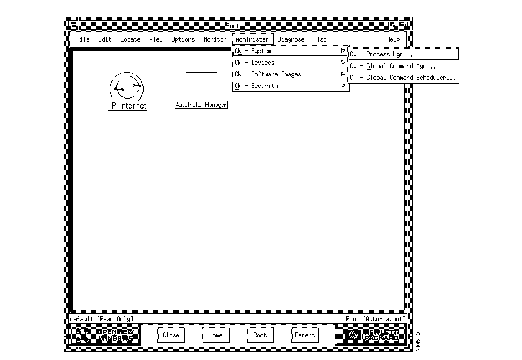

CiscoWorks applications are distributed among the HP OpenView menus. CiscoWorks menu items begin with CW.
Step 2 Select Administer>CW - System>CW - Process Mgr.
The Process Manager window opens (Figure 3-3).
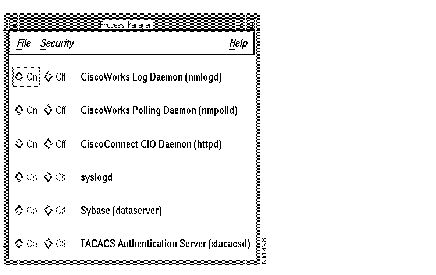
Step 3 To start a process, click the On checkbox next to it.
If the process starts successfully, the On checkbox is enabled.
Step 4 To exit the Process Manager application, select File>Exit.
After validating CiscoWorks installation as described in this chapter, proceed to the section "Learning to Use CiscoWorks," in the "CiscoWorks Getting Started" chapter to learn some simple tasks associated with CiscoWorks.
|
|