


|
|

The PA-12E/2FE Ethernet switch port adapter provides Cisco 7200 series routers with up to twelve 10-Mbps and two 10/100-Mbps switched Ethernet (10BASE-T) and Fast Ethernet (100BASE-TX) interfaces for an aggregate bandwidth of 435 Mbps, full-duplex. The PA-12E/2FE port adapter supports the Ethernet, IEEE 802.3, and IEEE 802.3u specifications for 10-Mbps and 100-Mbps transmission over UTP cables.
The PA-12E/2FE port adapter off-loads Layer 2 switching from the host CPU by using store-and-forward or cut-through switching technology between interfaces within the same virtual LAN (VLAN) on the PA-12E/2FE port adapter. The PA-12E/2FE port adapter supports up to four VLANs (bridge groups).
All interfaces on the PA-12E/2FE port adapter support autosensing and autonegotiation of the proper transmission mode (half-duplex or full-duplex) with an attached device. The first two PA-12E/2FE interfaces (port 0 and port 1) also support autosensing and autonegotiation of the proper connection speed (10-Mbps or 100-Mbps) with an attached device. If an attached device does not support autosensing and autonegotiation of the proper transmission mode, the PA-12E/2FE interfaces attached to the device automatically enter half-duplex mode. Use the show running-config command to determine if a PA-12E/2FE interface is autosensing and autonegotiating the proper transmission mode with an attached device. Use the full-duplex and the half-duplex commands to change the transmission mode of a PA-12E/2FE interface. After changing the transmission mode, use the show interfaces command to verify the interface's transmission mode.
This feature is supported on Cisco 7200 series routers.
Command descriptions use these conventions:
To configure the PA-2E/2FE port adapter, perform the tasks in the following sections (the first task is required, all other tasks are optional):
For information on other commands that can be used to configure a PA-12E/2FE port adapter, refer to the "Configuring Interfaces" chapter in the Configuration Fundamentals Configuration Guide. For information on bridging, refer to the "Configuring Transparent Bridging" chapter in the Bridging and IBM Networking Configuration Guide.
For PA-2E/2FE port adapter configuration examples, see "Configuration Examples" section later in this chapter.
This section provides instructions for a basic configuration. You might also need to enter other configuration commands depending on the requirements for your system configuration and the protocols you plan to route on the interface. For complete descriptions of configuration commands and the configuration options available, refer to the Cisco IOS Release 11.2 configuration guides.
To configure the interfaces on the PA-12E/2FE port adapter, perform the following tasks in global configuration mode:
| Task | Command |
|---|---|
| Step 1 Specify the type of Spanning-Tree Protocol.
The PA-12E/2FE port adapter supports DEC and IEEE Spanning-Tree Protocols; however, we recommend using the IEEE protocol when configuring bridge groups. | bridge bridge-group protocol ieee |
| Step 2 Enter the interface you want to configure. | interface fastethernet slot/port (ports 0 and 1)
interface ethernet slot/port (ports 2 through 13) |
| Step 3 Assign a bridge group to the interface. | bridge-group bridge-group |
| Step 4 Optionally, configure the interface for cut-through switching technology. The default is store-and-forward. | cut-through [receive | transmit] |
| Step 5 Optionally, if an attached device does not support autosensing or autonegotiation, configure the transmission mode for full-duplex. The default is half-duplex. | full-duplex |
| Step 6 Change the shutdown state to up. | no shutdown |
| Step 7 Return to configuration mode. | exit |
| Step 8 Repeat Step 2 through Step 7 for each interface. | |
| Step 9 Save the new configuration to memory. | copy running-config startup-config |
To enable integrated routing and bridging on the bridge groups, perform the following tasks beginning in global configuration mode:
| Task | Command |
|---|---|
| Step 1 Enable integrated routing and bridging. | bridge irb |
| Step 2 Enable a virtual interface on a bridge group. | interface bvi bridge-group |
| Step 3 Assign an IP address and subnet mask to the bridge-group virtual interface. | ip address address mask |
| Step 4 Change the shutdown state to up. | no shutdown |
| Step 5 Return to configuration mode. | exit |
| Step 6 Repeat Step 2 through Step 5 for each bridge group. | |
| Step 7 Specify the protocol for each bridge group. | bridge bridge-group route protocol |
| Step 8 Exit configuration mode. | exit |
| Step 9 Save the new configuration to memory. | copy running-config startup-config |
After configuring the new interface, you can display its status and verify other information. To display information about the PA-12E/2FE port adapter, perform the following tasks in EXEC mode:
| Task | Command |
|---|---|
| Display the configuration of the system hardware, the software version, the names and sources of configuration files, and the boot image. | show version |
| Display all current port adapters and their interfaces | show controllers |
| Verify the interfaces have the correct slot number and that the interface and line protocol are in the correct state. | show interface fastethernet slot/port (ports 0 and 1) show interface ethernet slot/port |
| Verify all bridge groups and their interfaces. | show bridge group |
| Verify the correct routed protocol is configured for each interface. | show interface ethernet slot/port irb (ports 2 through 13) show interface fastethernet slot/port irb |
| Display the protocols configured for the entire system and specific interfaces. | show protocols |
| Display the Layer 2 learned addresses for each interface. | show pas eswitch addresses fastethernet slot/port (ports 0 and 1) show pas eswitch addresses ethernet slot/port |
| Display the running configuration file. | show running-config |
| Display the configuration stored in NVRAM. | show startup-config |
The 12E/2FE VLAN Configuration WebTool, shown in Figure 1, is a Web browser-based Java applet that displays configured interfaces and bridge groups for PA-12E/2FE port adapters installed in Cisco routers. With the WebTool you can perform the following tasks:
You can access the 12E/2FE VLAN Configuration WebTool from your router's home page. For more information on the router's home page, refer to the Configuration Fundamentals Configuration Guide.
For complete procedures on how to use the VLAN Configuration WebTool, refer to the PA-12E/2FE Ethernet Switch10BASE-T and 100BASE-TX Port Adapter Installation and Configuration that accompanies the hardware.
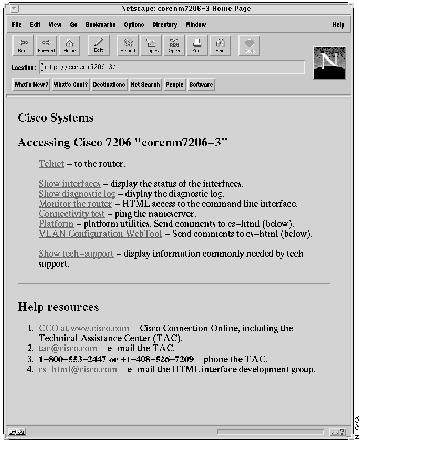
All Cisco routers, running Cisco IOS Release 11.0 or later have a home page. If your router has an installed PA- 12E/2FE port adapter, you can access the 12E/2FE VLAN Configuration WebTool from the router's home page.
Following is an example of a configuration for the PA-12E/2FE port adapter interface. Bridge groups 10, 20, and 30 use IEEE Spanning-Tree Protocol. The first four interfaces of a PA-12E/2EF port adapter in port adapter slot 3 use bridge groups 10 and 20. Each interface is assigned to a bridge group and the shutdown state is set to up. The PA-12E/2FE port adapter supports store-and-forward or cut-through switching technology between interfaces within the same bridge group; store-and-forward is the default. In the following example, the cut-through command is used to configure each interface for cut-through switching of received and transmitted data.
Router# configure terminal Enter configuration commands, one per line. End with CNTL/Z. Router(config)#bridge 10 protocol ieee Router(config)#bridge 20 protocol ieee Router(config)#bridge 30 protocol ieeeRouter(config)#int fastethernet 3/0Router(config-if)#bridge-group 10Router(config-if)#cut-throughRouter(config-if)#no shutdown Router(config-if)#exit Router(config)# %LINEPROTO-5-UPDOWN: Line protocol on Interface FastEthernet3/0, changed state to up %LINK-3-UPDOWN: Interface FastEthernet3/0, changed state to upRouter(config)#int fastethernet 3/1Router(config-if)#bridge-group 10Router(config-if)#cut-throughRouter(config-if)#no shutdown Router(config-if)#exit Router(config)# %LINEPROTO-5-UPDOWN: Line protocol on Interface FastEthernet3/1, changed state to up %LINK-3-UPDOWN: Interface FastEthernet3/1, changed state to upRouter(config)#int ethernet 3/2Router(config-if)#bridge-group 20Router(config-if)#cut-throughRouter(config-if)#no shutdown Router(config-if)#exit Router(config)# %LINEPROTO-5-UPDOWN: Line protocol on Interface Ethernet3/2, changed state to up %LINK-3-UPDOWN: Interface Ethernet3/2, changed state to upRouter(config)#int ethernet 3/3Router(config-if)#bridge-group 20Router(config-if)#cut-throughRouter(config-if)#no shutdown Router(config-if)#exit Router(config)# %LINEPROTO-5-UPDOWN: Line protocol on Interface Ethernet3/3, changed state to up %LINK-3-UPDOWN: Interface Ethernet3/3, changed state to up
The following example shows integrated routing and bridging enabled on the bridge groups. Bridge group 10 is assigned an IP address and subnet mask and the shutdown state is changed to up. Bridge group 10 is configured to route IP.
Router(config)#bridge irb Router(config)#interface bvi 10 Router(config-if)#ip address 1.1.15.1 255.255.255.0 Router(config-if)#no shutdown Router(config-if)#exit Router(config)# %LINEPROTO-5-UPDOWN: Line protocol on Interface BVI10, changed state to up Router(config)#bridge 10 route ip Router(config)# exit Router#
This section documents new or modified commands. All other commands used with this feature are documented in the Cisco IOS Release 11.2 command references.
To configure the interfaces on the PA-12E/2FE port adapter to use cut-through switching technology between interfaces within the same bridge group, use the cut-through interface command. To return each interface to store-and-forward switching, use the no form of the command.
cut-through [receive | transmit]| receive | (Optional) Selects cut-through switching technology on received data. |
| transmit | (Optional) Selects cut-through switching technology on transmitted data. |
store-and-forward switching technology
Interface configuration
This command first appeared in Cisco IOS Release 11.2 P.
Cut-through mode allows switched packets to be transmitted after 64 bytes are received. The transmission of the packets can start before the end of the packet arrives. This reduces the time spent in the switch, but allows packets to be transmitted with bad CRCs, because the transmission is initiated before the CRC is received or checked. Store-and-forward mode waits for the entire packet to be received before that packet is forwarded, but will check the CRC before starting transmission.
The PA-12E/2FE port adapter off-loads Layer 2 switching from the host CPU by using store-and-forward or cut-through switching technology between interfaces within the same virtual LAN (VLAN) on the PA-12E/2FE port adapter. The PA-12E/2FE port adapter supports up to four VLANs (bridge groups).
The following example configure interface 3/0 for cut-through switching:
Router(config)#interface fastethernet 3/0Router(config-if)#bridge-group 10Router(config-if)#cut-throughRouter(config-if)#no shutdownRouter(config-if)#exitRouter(config)#
show running-config
To display all bridge groups in the system and the interfaces configured for each bridge group, enter the show bridge group command.
show bridge groupThis command has no arguments or keywords.
Privileged EXEC
This command was modified in Cisco IOS Release 11.2 P to update the sample display.
The following examples are for bridge group 30 and bridge group 40 of a PA-12E/2FE port adapter in slot 3:
Router# show bridge group
Bridge Group 30 is running the IEEE compatible Spanning Tree protocol
   Port 19 (FastEthernet3/0) of bridge group 30 is forwarding
   Port 20 (FastEthernet3/1) of bridge group 30 is forwarding
   Port 21 (Ethernet3/2) of bridge group 30 is forwarding
   Port 22 (Ethernet3/3) of bridge group 30 is forwarding
   Port 23 (Ethernet3/4) of bridge group 30 is forwarding
   Port 24 (Ethernet3/5) of bridge group 30 is forwarding
   Port 25 (Ethernet3/6) of bridge group 30 is forwarding

Bridge Group 40 is running the IEEE compatible Spanning Tree protocol

   Port 26 (Ethernet3/7) of bridge group 40 is down
   Port 27 (Ethernet3/8) of bridge group 40 is down
   Port 28 (Ethernet3/9) of bridge group 40 is down
   Port 29 (Ethernet3/10) of bridge group 40 is down
   Port 30 (Ethernet3/11) of bridge group 40 is down
   Port 31 (Ethernet3/12) of bridge group 40 is down
   Port 32 (Ethernet3/13) of bridge group 40 is down
To determine which type of port adapter is installed in your system, use the show diag command.
show diag [slot]| slot | (Optional) Slot number of the interface. |
Privileged EXEC
This command was modified in Cisco IOS Release 11.2 P to update the sample display.
The following example shows specific port adapter information for a PA-12E/2FE port adapter in chassis slot 3:
router# show diag 3
Slot 3:
        Ethernet Switch port adapter, 14 ports
        Port adapter is analyzed
        Port adapter insertion time 20:51:22 ago
        Hardware revision 1.0 	Board revision AO
        Serial number     4294967295    Part number 	800-02611-05
        Test history      0xFF          RMA number     000-000-000
        EEPROM format version 255
        EEPROM contents (hex):
          0x20: FF 3F FF FF FF FF FF FF FF FF FF FF FF FF FF FF
          0x30: FF FF FF FF FF FF FF FF FF FF FF FF FF FF FF FF
To display information about the FastEthernet interfaces, use the show interfaces fastethernet command.
show interfaces fastethernet [slot/port]| slot | (Optional) Slot number of the interface. |
| port | (Optional) Port number of the interface. |
EXEC
This command was modified in Cisco IOS Release 11.2 P to update the sample display.
The following example of the show interfaces fastethernet command shows all the information specific to the first PA-12E/2FE interface port (interface port 0) in port adapter slot 3:
Router# show interfaces fastethernet 3/0
FastEthernet3/0 is up, line protocol is up
  Hardware is TSWITCH, address is 00e0.f7a4.5130 (bia 00e0.f7a4.5130)
  MTU 1500 bytes, BW 100000 Kbit, DLY 100 usec, rely 255/255, load 1/255
  Encapsulation ARPA, loopback not set, keepalive set (10 sec)
  Half-duplex, 100BaseTX
  ARP type: ARPA, ARP Timeout 04:00:00
  Last input 00:05:30, output 00:00:00, output hang never
  Last clearing of "show interface" counters never
  Queueing strategy: fifo
  Output queue 0/40, 0 drops; input queue 0/75, 0 drops
  5 minute input rate 0 bits/sec, 0 packets/sec
  5 minute output rate 0 bits/sec, 0 packets/sec
     312 packets input, 18370 bytes, 0 no buffer
     Received 216 broadcasts, 0 runts, 0 giants, 0 throttles
     3 input errors, 0 CRC, 0 frame, 0 overrun, 3 ignored, 0 abort
     0 input packets with dribble condition detected
     15490 packets output, 1555780 bytes, 0 underruns
     2 output errors, 0 collisions, 2 interface resets
     0 babbles, 0 late collision, 0 deferred
     0 lost carrier, 0 no carrier
     2 output buffer failures, 0 output buffers swapped out
Table 1 describes the fields in these displays.
| Field | Description |
|---|---|
| FastEthernet0 is... is up ...is administratively down | Indicates whether the interface hardware is currently active and if it has been taken down by an administrator. |
| line protocol is | Indicates whether the software processes that handle the line protocol consider the line usable or if it has been taken down by an administrator. |
| Hardware | Hardware type (for example, MCI Ethernet, SCI, cBus Ethernet) and address. |
| Internet address | Internet address followed by subnet mask. |
| MTU | Maximum Transmission Unit of the interface. |
| BW | Bandwidth of the interface in kilobits per second. |
| DLY | Delay of the interface in microseconds. |
| rely | Reliability of the interface as a fraction of 255 (255/255 is 100% reliability), calculated as an exponential average over 5 minutes. |
| load | Load on the interface as a fraction of 255 (255/255 is completely saturated), calculated as an exponential average over 5 minutes. |
| Encapsulation | Encapsulation method assigned to interface. |
| ARP type: | Type of Address Resolution Protocol assigned. |
| loopback | Indicates whether loopback is set or not. |
| keepalive | Indicates whether keepalives are set or not. |
| Last input | Number of hours, minutes, and seconds since the last packet was successfully received by an interface. Useful for knowing when a dead interface failed. |
| output | Number of hours, minutes, and seconds since the last packet was successfully transmitted by the interface. Useful for knowing when a dead interface failed. |
| output hang | Number of hours, minutes, and seconds (or never) since the interface was last reset because of a transmission that took too long. When the number of hours in any of the "last" fields exceeds 24 hours, the number of days and hours is printed. If that field overflows, asterisks are printed. |
| Last clearing | Time at which the counters that measure cumulative statistics (such as number of bytes transmitted and received) shown in this report were last reset to zero. Note that variables that might affect routing (for example, load and reliability) are not cleared when the counters are cleared. *** indicates the elapsed time is too large to be displayed. 0:00:00 indicates the counters were cleared more than 231ms (and less than 232ms) ago. |
| Output queue, input queue, drops | Number of packets in output and input queues. Each number is followed by a slash, the maximum size of the queue, and the number of packets dropped due to a full queue. |
| Five minute input rate, Five minute output rate | Average number of bits and packets transmitted per second in the last 5 minutes. If the interface is not in promiscuous mode, it senses network traffic it sends and receives (rather than all network traffic).
The 5-minute input and output rates should be used only as an approximation of traffic per second during a given 5-minute period. These rates are exponentially weighted averages with a time constant of 5 minutes. A period of four time constants must pass before the average will be within two percent of the instantaneous rate of a uniform stream of traffic over that period. |
| packets input | Total number of error-free packets received by the system. |
| bytes | Total number of bytes, including data and MAC encapsulation, in the error free packets received by the system. |
| no buffer | Number of received packets discarded because there was no buffer space in the main system. Compare with ignored count. Broadcast storms on Ethernets and bursts of noise on serial lines are often responsible for no input buffer events. |
| Received... broadcasts | Total number of broadcast or multicast packets received by the interface. |
| runts | Number of packets that are discarded because they are smaller than the medium's minimum packet size. For instance, any Ethernet packet that is less than 64 bytes is considered a runt. |
| giants | Number of packets that are discarded because they exceed the medium's maximum packet size. For example, any Ethernet packet that is greater than 1,518 bytes is considered a giant. |
| throttles | Number of times the receiver on the port was disabled, possibly due to buffer or processor overload. |
| input errors | Includes runts, giants, no buffer, CRC, frame, overrun, and ignored counts. Other input-related errors can also cause the input errors count to be increased, and some datagrams may have more than one error; therefore, this sum may not balance with the sum of enumerated input error counts. |
| CRC | Cyclic redundancy checksum generated by the originating LAN station or far-end device does not match the checksum calculated from the data received. On a LAN, this usually indicates noise or transmission problems on the LAN interface or the LAN bus itself. A high number of CRCs is usually the result of collisions or a station transmitting bad data. |
| frame | Number of packets received incorrectly having a CRC error and a noninteger number of octets. On a LAN, this is usually the result of collisions or a malfunctioning Ethernet device. |
| overrun | Number of times the receiver hardware was unable to hand received data to a hardware buffer because the input rate exceeded the receiver's ability to handle the data. |
| ignored | Number of received packets ignored by the interface because the interface hardware ran low on internal buffers. These buffers are different than the system buffers mentioned previously in the buffer description. Broadcast storms and bursts of noise can cause the ignored count to be increased. |
| abort | Number of packets whose receipt was aborted. |
| input packets with dribble condition detected | Dribble bit error indicates that a frame is slightly too long. This frame error counter is incremented for informational purposes; the router accepts the frame. |
| packets output | Total number of messages transmitted by the system. |
| bytes | Total number of bytes, including data and MAC encapsulation, transmitted by the system. |
| underruns | Number of times that the transmitter has been running faster than the router can handle. This may never be reported on some interfaces. |
| output errors | Sum of all errors that prevented the final transmission of datagrams out of the interface being examined. Note that this may not balance with the sum of the enumerated output errors, as some datagrams may have more than one error, and others may have errors that do not fall into any of the specifically tabulated categories. |
| collisions | Number of messages retransmitted due to an Ethernet collision. This is usually the result of an overextended LAN (Ethernet or transceiver cable too long, more than two repeaters between stations, or too many cascaded multiport transceivers). A packet that collides is counted only once in output packets. |
| interface resets | Number of times an interface has been completely reset. This can happen if packets queued for transmission were not sent within several seconds. On a serial line, this can be caused by a malfunctioning modem that is not supplying the transmit clock signal, or by a cable problem. If the system notices that the carrier detect line of a serial interface is up, but the line protocol is down, it periodically resets the interface in an effort to restart it. Interface resets can also occur when an interface is looped back or shut down. |
| babbles | The transmit jabber timer expired. |
| late collision | Number of late collisions. Late collision happens when a collision occurs after transmitting the preamble. |
| deferred | Deferred indicates that the chip had to defer while ready to transmit a frame because the carrier was asserted. |
| lost carrier | Number of times the carrier was lost during transmission. |
| no carrier | Number of times the carrier was not present during the transmission. |
To display the routed protocol configured for an interface, use the show interfaces irb command.
show interfaces {ethernet | fastethernet} [slot/port] irb| ethernet | fastethernet | Specify the type of interface. |
| slot | (Optional) Slot number of the interface. |
| port | (Optional) Interface number. |
EXEC
This command was modified in Cisco IOS Release 11.2 P to update the sample display.
The following example shows that IP is configured for the first PA-12E/2FE interface of the port adapter in slot 3:
Router# show interfaces fastethernet 3/0 irb
FastEthernet3/0
 Routed protocols on FastEthernet3/0:
  ip
 Bridged protocols on FastEthernet3/0:
  appletalk  clns       decnet     ip
  vines      apollo     ipx        xns
 Software MAC address filter on Ethernet3/0
  Hash Len    Address      Matches  Act      Type
  0x00:  0 ffff.ffff.ffff         0 RCV Physical broadcast
  0x2A:  0 0900.2b01.0001         0 RCV DEC spanning tree
  0xC2:  0 0180.c200.0000         0 RCV IEEE spanning tree
  0xC7:  0 00e0.f7a4.5130         0 RCV Interface MAC address
  0xC7:  1 00e0.f7a4.5130         0 RCV Bridge-group Virtual Interface
To display the Layer 2 learned addresses for an interface, use the show pas eswitch address command.
show pas eswitch address {ethernet | fastethernet} [slot/port]| ethernet | fastethernet | Specify the type of interface. |
| slot | (Optional) Slot number of the interface. |
| port | (Optional) Interface number. |
EXEC
This command first appeared in Cisco IOS Release 11.2 P.
The following example shows that the first PA-12E/2FE interface (listed below as port 0) in port adapter slot 3 has learned the Layer 2 address 00e0.f7a4.5100 for bridge group 30 (listed below as BG 30):
Router# show pas eswitch address fastethernet 3/0
U 00e0.f7a4.5100, AgeTs 56273 s, BG 30 (vLAN 0), Port 0
This section lists and describes Cisco IOS system error messages. The system software sends these error messages to the console (and, optionally, to a logging server on another system) during operation. Not all system error messages indicate problems with your system. Some are purely informational, while others may help diagnose problems with communications lines, internal hardware, or the system software.
The messages are organized according to the particular system facility that produces the messages. The facility sections appear in alphabetical order, and within each facility section, messages are listed alphabetically by mnemonic. Each error message is followed by an explanation and a recommended action.
System error messages begin with a percent sign (%) and are structured as follows:
%FACILITY-SUBFACILITY-SEVERITY-MNEMONIC: Message-text
FACILITY is a code consisting of two or more uppercase letters that indicate the facility to which the message refers. A facility can be a hardware device, a protocol, or a module of the system software. Table 2 lists the system facilities codes.
| Code | Facility |
| ESWITCH | PA-12E/2FE Ethernet Switch 10BASE-T and 100BASE-TX Port Adapter |
SUBFACILITY is a code that is relevant only in Channel Interface Processor (CIP) error messages. There are currently no CIP error messages in this section.
SEVERITY is a single-digit code from 0 to 7 that reflects the severity of the condition. The lower the number, the more serious the situation. Table 3 lists the severity levels.
| Level | Description |
| 0 - emergency | System unusable |
| 1 - alert | Immediate action needed |
| 2 - critical | Critical condition |
| 3 - error | Error condition |
| 4 - warning | Warning condition |
| 5 - notification | Normal but significant condition |
| 6 - informational | Informational message only |
| 7 - debugging | Appears during debugging only |
MNEMONIC is a code that uniquely identifies the error message.
Message-text is a text string describing the condition. This portion of the message sometimes contains detailed information about the event, including terminal port numbers, network addresses, or addresses that correspond to locations in the system memory address space. Because the information in these variable fields changes from message to message, it is represented here by short strings enclosed in square brackets ([ ]). A decimal number, for example, is represented as [dec]. Table 4 lists the representations of variable fields and the type of information in them.
| Representation | Type of Information |
| [dec] | Decimal number |
| [hex] | Hexadecimal number |
| chars | Character string |
Error message severity levels correspond to the keywords assigned by the logging global configuration commands that define where and at what level these messages appear. The default is to log messages to the console at the debugging level (7). For more information, see the system configuration chapter and descriptions of the logging command in the appropriate Cisco IOS configuration guide and command reference publications.
This section lists error messages alphabetically by facility, severity, and mnemonic.
Explanation A software or hardware error occurred.
Recommended Action Copy the error message exactly as it appears, and report it to your technical support representative.
Explanation A hardware error occurred.
Recommended Action Copy the error message exactly as it appears, and report it to your technical support representative.
Explanation A hardware error occurred.
Recommended Action Copy the error message exactly as it appears, and report it to your technical support representative.
Explanation A configuration error occurred.
Recommended Action Configure a bridge-group on the interface.
Explanation A configuration error occurred.
Recommended Action Configure only the allowed number of bridge-groups on the Ethernet switch port adapter.
Explanation A hardware error occurred.
Recommended Action Copy the error message exactly as it appears, and report it to your technical support representative.
Explanation A hardware error occurred.
Recommended Action Copy the error message exactly as it appears, and report it to your technical support representative.
Explanation A hardware error occurred.
Recommended Action Copy the error message exactly as it appears, and report it to your technical support representative.
Explanation A software or hardware error occurred.
Recommended Action Copy the error message exactly as it appears, and report it to your technical support representative.
Explanation A hardware error occurred.
Recommended Action Copy the error message exactly as it appears, and report it to your technical support representative.
Explanation A hardware error occurred.
Recommended Action Copy the error message exactly as it appears, and report it to your technical support representative.
Explanation A hardware error occurred.
Recommended Action Copy the error message exactly as it appears, and report it to your technical support representative.
Explanation A hardware error occurred.
Recommended Action Copy the error message exactly as it appears, and report it to your technical support representative.
Explanation A hardware error occurred.
Recommended Action Copy the error message exactly as it appears, and report it to your technical support representative.
Explanation A hardware error occurred.
Recommended Action Copy the error message exactly as it appears, and report it to your technical support representative.
|
|