|
|

This appendix provides the following pinout information:
The Cisco 3800 ERM comes with a console and auxiliary cable kit so you can connect a console (an ASCII terminal or PC running terminal emulation software) or modem to your ERM. The kit contains the following items:
For console connections, proceed to the section "Console Port Signals and Pinouts" later in this appendix; for modem connections, proceed to the section "Auxiliary Port Signals and Pinouts" later in this appendix.
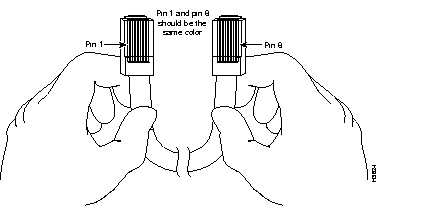
You can identify a rollover cable by comparing the two modular ends of the cable. Holding the cables side-by-side, with the tab at the back, the wire connected to the pin on the outside of the left plug should be the same color as the wire connected to the pin on the outside of the right plug. (See Figure B-1.) If your cable was purchased from Cisco Systems, pin 1 will be white on one connector, and pin 8 will be white on the other (a rollover cable reverses pins 1 and 8, 2 and 7, 3 and 6, and 4 and 5).
Use the thin, flat RJ-45-to-RJ-45 rollover cable and RJ-45-to-DB-9 female DTE adapter (labeled Terminal) to connect the console port to a PC running terminal emulation software. Figure B-2 shows how to connect the console port to a PC. Table B-1 lists the pinouts for the asynchronous serial console port, the RJ-45-to-RJ-45 rollover cable, and the RJ-45-to-DB-9 female DTE adapter (labeled Terminal).

| Cisco 3800 ERM Console Port (DTE) | RJ-45-to-RJ-45 Rollover Cable | RJ-45-to-DB-9 Terminal Adapter | Console Device | |
|---|---|---|---|---|
| Signal | RJ-45 Pin | RJ-45 Pin | DB-9 Pin | Signal |
| RTS | 11 | 8 | 8 | CTS |
| DTR | 2 | 7 | 6 | DSR |
| TxD | 3 | 6 | 2 | RxD |
| GND | 4 | 5 | 5 | GND |
| GND | 5 | 4 | 5 | GND |
| RxD | 6 | 3 | 3 | TxD |
| DSR | 7 | 2 | 4 | DTR |
| CTS | 8 | 1 | 7 | RTS |
Use the thin, flat RJ-45-to-RJ-45 rollover cable and RJ-45-to-DB-25 female DTE adapter (labeled Terminal) to connect the console port to a terminal. Figure B-3 shows how to connect the console port to a terminal. Table B-2 lists the pinouts for the asynchronous serial console port, the RJ-45-to-RJ-45 rollover cable, and the RJ-45-to-DB-25 female DTE adapter (labeled Terminal).
| Cisco 3800 ERM Console Port (DTE) | RJ-45-to-RJ-45 Rollover Cable | RJ-45-to-DB-25 Terminal Adapter | Console Device | |
|---|---|---|---|---|
| Signal | RJ-45 Pin | RJ-45 Pin | DB-25 Pin | Signal |
| RTS | 11 | 8 | 5 | CTS |
| DTR | 2 | 7 | 6 | DSR |
| TxD | 3 | 6 | 3 | RxD |
| GND | 4 | 5 | 7 | GND |
| GND | 5 | 4 | 7 | GND |
| RxD | 6 | 3 | 2 | TxD |
| DSR | 7 | 2 | 20 | DTR |
| CTS | 8 | 1 | 4 | RTS |
Use the thin, flat RJ-45-to-RJ-45 rollover cable and RJ-45-to-DB-25 male DCE adapter (labeled Modem) to connect the auxiliary port to a modem. Figure B-4 shows how to connect the auxiliary port to a modem. Table B-3 lists the pinouts for the asynchronous serial auxiliary port, the RJ-45-to-RJ-45 rollover cable, and the RJ-45-to-DB-25 male DCE adapter (labeled Modem).
| Cisco 3800 ERM Auxiliary Port (DTE) | RJ-45-to-RJ-45 Rollover Cable | RJ-45-to-DB-25 Modem Adapter | Modem | |
|---|---|---|---|---|
| Signal | RJ-45 Pin | RJ-45 Pin | DB-25 Pin | Signal |
| RTS | 1 | 8 | 4 | RTS |
| DTR | 2 | 7 | 20 | DTR |
| TxD | 3 | 6 | 3 | TxD |
| GND | 4 | 5 | 7 | GND |
| GND | 5 | 4 | 7 | GND |
| RxD | 6 | 3 | 2 | RxD |
| DSR | 7 | 2 | 8 | DCD |
| CTS | 8 | 1 | 5 | CTS |
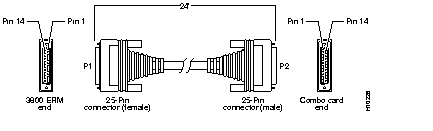
Figure B-5 illustrates the EIA-530 DCE serial transition cable used with the Cisco 3800 ERM synchronous serial port, which is always configured as DTE. Table B-4 lists the pinouts.
The serial cable is a DB-25-to-DB-25 straight-through cable with all pins connected. The connector at the Cisco 3800 ERM end is female and the connector at the Combo card end is male.
| Cisco 3800 ERM End Signal | DB-25 Receptacle | DB-25 Pin | Combo Card End Signal |
|---|---|---|---|
| Shield | 1 | 1 | Shield |
| TxD-A | 2 | 2 | TxD-A |
| RxD-A | 3 | 3 | RxD-A |
| RTS-A | 4 | 4 | RTS-A |
| CTS-A | 5 | 5 | CTS-A |
| DSR-A | 6 | 6 | DSR-A |
| GND (Signal) | 7 | 7 | GND (Signal) |
| DCD-A | 8 | 8 | DCD-A |
| RxC-B | 9 | 9 | RxC-B |
| DCD-B | 10 | 10 | DCD-B |
| TT-B | 11 | 11 | TT-B |
| TxC-B | 12 | 12 | TxC-B |
| CTS-B | 13 | 13 | CTS-B |
| TxD-B | 14 | 14 | TxD-B |
| TxC-A | 15 | 15 | TxC-A |
| RxD-B | 16 | 16 | RxD-B |
| RxC-A | 17 | 17 | RxC-A |
| LL | 18 | 18 | LL |
| RTS-B | 19 | 19 | RTS-B |
| DTR-A | 20 | 20 | DTR-A |
| RL-NC | 21 | 21 | RL-NC |
| DSR-B | 22 | 22 | DSR-B |
| DTR-B | 23 | 23 | DTR-B |
| TT-A | 24 | 24 | TT-A |
| TM-NC | 25 | 25 | TM-NC |
Table B-5 lists the pinouts for the 10BaseT Ethernet port. Figure B-6 shows an Ethernet 10BaseT cable assembly, and Table B-6 and Table B-7 list the 10BaseT cable pinouts you can use with the 10BaseT port.
| Pin | Description |
|---|---|
| 1 | TX+ |
| 2 | TX- |
| 3 | RX+ |
| 4 | - |
| 5 | - |
| 6 | RX- |
| 7 | - |
| 8 | - |

| RJ-45 Pin | Signal | Direction | RJ-45 Pin |
|---|---|---|---|
| 1 | TX+ | --> | 1 |
| 2 | TX- | --> | 2 |
| 3 | RX+ | <-- | 3 |
| 4 | - | - | 4 |
| 5 | - | - | 5 |
| 6 | RX- | <-- | 6 |
| 7 | - | - | 7 |
| 8 | - | - | 8 |
| RJ-45 Pin | Signal | Direction | RJ-45 Pin | Signal |
|---|---|---|---|---|
| 1 | TX+ | --> | 3 | RX+ |
| 2 | TX- | --> | 6 | RX- |
| 3 | RX+ | <-- | 1 | TX+ |
| 4 | - | - | 4 | - |
| 5 | - | - | 5 | - |
| 6 | RX- | <-- | 2 | TX- |
| 7 | - | - | 7 | - |
| 8 | - | - | 8 | - |
Table B-8 lists the Token Ring port pinouts. Use a Token Ring lobe cable (not included) to connect the Token Ring port to a MAU.
| 9 Pin1 | Signal |
|---|---|
| 1 | Receive |
| 3 | +5V1 |
| 5 | Transmit |
| 6 | Receive |
| 9 | Transmit |
|
|