


|
|

This chapter provides information on the Catalyst 5000 series of multilayer switching systems. The information is organized into the following sections:
Cisco's Catalyst 5000 series offers a complete set of enterprise switching solutions spanning everything from the campus backbone to the desktop. The Cisco Catalyst 5000 series of switches builds on the award-winning architecture of the Catalyst 5000, while delivering two new chassis to address campus intranet needs.
With integrated frame and cell switching, full support for Cisco IOS-based routing, full support for Fast EtherChannel and ATM, and a migration path to future gigabit Ethernet and gigabit EtherChannel, the Catalyst 5000 series is well positioned to evolve as campus bandwidth needs grow.
The Cisco Catalyst 5000 series consists of the following multilayer switching systems:



The Catalyst 5000 series of multilayer switching systems includes the following standard features and options:
Figure 137 shows a rear view of the Catalyst 5000 5-slot chassis with AC-input power supplies installed, and Figure 138 shows a rear view with DC-input power supplies installed.
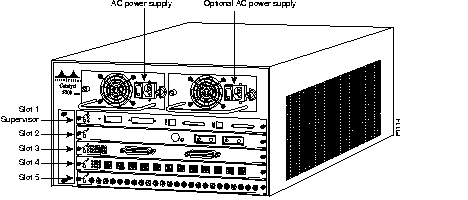
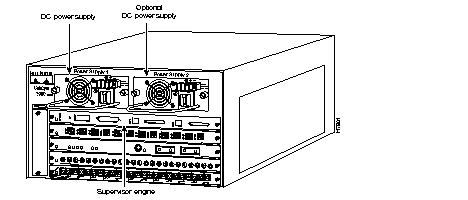
Figure 139 shows a rear view of the Catalyst 5002 2-slot chassis with one installed supervisor engine and one switching module.
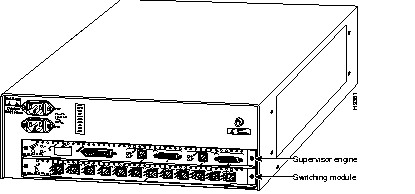
Figure 140 shows a rear view of the Catalyst 5500 13-slot chassis with two supervisor engine IIs installed in slots 1 and 2, and an ATM Switch Processor (ASP) module installed in slot 13 with four port adapter modules (PAMs) installed above it.
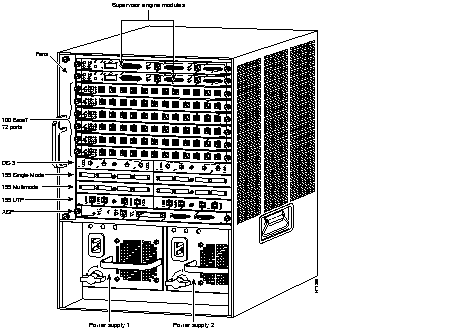
Table 85 summarizes the features of the Catalyst 5000 series, and Table 87 lists the environmental specifications.
| Characteristic | Description |
|---|---|
| Placement | Rack-mounted, front or back (standard 19-inch rack) |
| Switching backplane | 1.2 Gbps (Catalyst 5000 and 5002): Supports over 1 million pps1
3.6 Gbps (Catalyst 5500, future support on Catalyst 5000) |
| Memory | 4-MB Flash memory (all supervisor engine I models)
8-MB Flash memory (all supervisor engine II models) 20-MB DRAM 256-KB NVRAM 512-KB EPROM |
| Interfaces | Supervisor console: DB-25 (female)
Supervisor 100BaseTX: RJ-45 (female), MII 2(female) Supervisor 100BaseFX: MMF SC, SMF SC Group Switched 10BaseT: RJ-21 (female), 48 interfaces Switched 10BaseT: RJ-21 and RJ-45 (female), 24 interfaces Switched 10BaseFL Ethernet: MMF ST (female), 12 interfaces Group Switched 100BaseTX: RJ-45 (female), 24 interfaces Switched 10/100BaseTX FE3: MMF RJ-45 (female), 12 interfaces Switched 100BaseFX FE: MMF SC, SMF SC, 12 interfaces Switched Token Ring: RJ-45 copper UTP/STP (female), 16 ports Switched Token Ring: MMF 62.5-micron fiber, 16 ports ATM LAN Emulation: UTP RJ-45, MMF SC, SMF SC, dual PHY CDDI: RJ-45 (female), 1 interface FDDI: MMF MIC, SMF ST, 1 interface Optical bypass switch connector: 6-pin mini-DIN |
| Port adapter modules (for Catalyst 5500) | ATM OC-3: SONET STS3c/SDH STM1, MMF SC or SMF SC, RJ-45, 4 ports
ATM OC-12: SONET STS12c/STM4c, SMF SC, 1 port DS-3: 75-ohm coaxial BNC, 2 or 4 T3 DS3 ports E-3: 75-ohm coaxial BNC, 2 E3 ports T1/E1 ATM trunk: RJ-48, 4 ports, balanced or unbalanced T1/E1 circuit emulation: RJ-48, 4 ports, balanced or unbalanced 25 Mbps ATM: Telco cable 96-pin, 12 ATM25 ports |
| Duplex | 10-Mbps Ethernet: Full or half duplex
100-Mbps Fast Ethernet: Full or half duplex 10/100-Mbps Fast Ethernet: Auto-negotiated speed and duplex Token Ring copper: full or half duplex Token Ring fiber: half duplex FDDI: Half duplex ATM: Full duplex Group switched 10BaseT and 100BaseTX: Half duplex |
| Network management | CiscoWorks for Switched Internetworks GUI management including the following:
CiscoView VlanDirector Traffic Director ATMDirector NetSys Tools Cisco Discovery Protocol VLAN Trunk Protocol SNMP agent v1 (RFC 1155-1157) SNMP MIB II (RFC 1213) RMON (4 groups) Ethernet MIB (RFC 1398 and RFC 1643) Ethernet repeater MIB (RFC 1516) Interface Table (RFC 1573) Bridge MIB (1493) Token Ring MIB (RFC 1748) Source-Route Bridge MIB (RFC 1525) Cisco Stack MIB Extensions (Token Ring group) RMON Token Ring Extensions (RFC 1513) Token Ring extensions for Statistics, History, Alarms, and Events groups Ring Station Order Group Ring Station Control Table FDDI MIB (RFC 1512) SMT 7.3 (RFC 1285) AToMIC MIB (RFC 1695) ILMI MIB Cisco Workgroup MIB LEC MIB (ATM Forum LANE v1.0) Cisco LECS, LES/BUS MIB E-SPAN Text-based command-line interface based on familiar router interface Standard Cisco IOS security capabilities: passwords and TACACS Telnet, TFTP, BOOTP, LAN Emulation client, RFC 1577 Classical IP over ATM client, for management access |
| Standard protocols | Ethernet: IEEE 802.3, 10BaseT, and 10BaseFL
Fast Ethernet: IEEE 802.3u, 100BaseTX, 100BaseFX Token Ring: IEEE 802.5r, IEEE 802.5j FDDI: ISO 9314-1 FDDI PHY standard; ISO 9314-3 FDDI PMD standard; CDDI TP-PMD standard; ANSI FDDI X3T9.5 SMT 7.3 ATM: ATM Forum--3.1 UNI Specification, Q.2931 signaling protocols, ATM Forum LANE v1.0 |
| Maximum cabling distances | 10BaseT Ethernet: Category 5 UTP, 328 ft (100 m)
10BaseFL Ethernet: 62.5/125-micron fiber, 1.24 miles (2 km) 100BaseTX Fast Ethernet: Category 5 UTP, 328 ft (100 m) 10/100BaseTX Fast Ethernet: Category 5 UTP, 328 ft (100 m) 100BaseFX Fast Ethernet: 62.5/125 multimode fiber,.248 mile (400 m) half duplex, 1.24 miles (2 km) full duplex or 8.7/125 single-mode fiber, 6.2 miles (10 km), 4-Mbps Token Ring 150-ohm STP: Types 1, 1a, 2, 2a, 2460 feet (750 m); Type 8, 1234 feet (376 m); Type 9, 1640 feet (500 m) 4-Mbps Token Ring 100-ohm UTP: Category 3, 820 feet (250 m); Category 4, 1148 feet (350 m); Category 5, 1148 feet (350 m) 16-Mbps Token Ring: 150-ohm STP Types 1, 1a, 2, 2a, 952 feet (290 m); Type 8, 480 feet (146 m); Type 9, 656 feet (200 m) 16-Mbps Token Ring 100-ohm UTP: Category 3, 328 feet (100 m); Category 4, 656 feet (200 m); Category 5, 656 feet (200 m) CDDI: Category 5 UTP, 328 ft (100 m) FDDI: 62.5/125 multimode fiber, 1.24 miles (2 km) or 8.7/125 single-mode fiber, ATM LAN emulation module UTP: Category 5 UTP, 328 ft (100 m) ATM LAN emulation module MMF4: 62.5/125-micron fiber, 1.24 miles (2 km) ATM LAN emulation module SMF5: 8.7/125-micron fiber, 6.2 miles (10 km) |
| Fiber-optical specifications | Multimode specifications for modules WS-X5006, WS-X5011,
WS-X5114=, WS-X5101, WS-X5158, WS-X5031, and WS-X5506: Transmitter output power: -19 to -14 dBm6 Receiver sensitivity: -32.5 to -14 dBm Wavelength: 850 to 1360 nm Optical source: LED Maximum span: 1.24 miles (2 km) Single-mode specifications for modules WS-X5005, WS-X5157, WS-X5114=, WS-X5154, and WS-X5505: Transmitter output power: -14 to -8 dBm Receiver sensitivity: -32.5 to -8 dBm Wavelength: 1261 to 1360 nm Optical source: Laser Maximum span: 6.2 miles (10 km) Single-mode specifications for module WS-X5104: Transmitter output power: -4.0 to-7.0 dBm Receiver sensitivity: -33 to -14dBm Optical source: Laser Maximum span: 18.63 miles (30 km) |
| Fiber optical specifications for ASP port adapter modules | OC-12 multimode fiber PAM
Transmitter output power: -20 to -14 dBm Receiver sensitivity: -26 to -14 dBm Wavelength: 1270 to 1380 nm Optical source: LED Maximum span: 500 m OC-12 single-mode fiber IR PAM Transmitter output power: -15 to -8 dBm Receiver sensitivity: -28 to -8 dBm Wavelength: 1260 to 1360 nm Optical source: Laser Maximum span: 15 km (intermediate reach) OC-12 single-mode fiber LR PAM Transmitter output power: -3 to 2 dBm Receiver sensitivity: -28 to -8 dBm Wavelength: 1280 to 1335 nm Optical source: Laser Maximum span: 40 km (long reach) OC-3 multimode fiber PAM Transmitter output power: -20 to -14 dBm Receiver sensitivity: -30 to -14 dBm Wavelength: 1270 to 1380 nm Optical source: LED Maximum span: 2 km OC-3 single-mode fiber IR PAM Transmitter output power: -15 to -8 dBm Receiver sensitivity: -28 to -8 dBm Wavelength: 1260 to 1360 nm Optical source: Laser Maximum span: 15 km (intermediate reach) OC-3 mixed-mode fiber IR+ PAM For IR+ only. For MM specifications see OC-3 MM PAM above. Transmitter output power: -8 to -3 dBm Receiver sensitivity: -32 to -3 dBm Wavelength: 1270 to 1380 nm Optical source: Laser Maximum span: 30 km (intermediate reach plus) OC-3 single-mode fiber LR PAM Transmitter output power: -5 to -0 dBm Receiver sensitivity: -34 to -10 dBm Wavelength: 1280 to 1335 nm Optical source: Laser Maximum span: 40 km (long reach) |
| LEDs | Status LED on each module shows successful completion, minor and major failure of power-up diagnostics
Link Good LED shows status of any interface Switch Load LEDs show backplane utilization |
| Feature | Function | Benefit |
|---|---|---|
| Bandwidth Management | ||
| Fast EtherChannel | Enables two to four full-duplex Fast Ethernet links to be grouped together to form a single logical link or channel between devices that support Cisco's Fast EtherChannel. | Improves network performance by enabling higher-bandwidth channels. Provides bandwidth scalability within the campus by providing increments from 200 to 800 Mbps. |
| CGMP | CGMP allows Cisco IOS routers to download to a Catalyst switch the identity of multicast clients as they join a multicast group. Using this information, multicast streams are switched to only those ports interested in the specific multicast traffic. | CGMP provides scalable, multicast distribution for all IGMP-capable workstations. CGMP allows Catalyst switches to provide wire-speed multicast delivery while preventing excessive flooding across switched ports within a VLAN. |
| CGMP Fast Leave Processing | With CGMP Fast Leave Processing the Catalyst 5000 can detect an IGMP V.2 host leave message and immediately prune ports from the specified multicast forwarding tree after a quick check to make sure that no other host(s) on the interface need multicast traffic from that particular multicast group. | Reduces processing latency for nodes leaving a multicast group. Ensures maximum performance for every switch port by quickly pruning multicast tree from ports that no longer want multicast traffic. |
| Broadcast Suppression | Allows the user to set a threshold level for broadcasts on a switch port. Additional broadcasts beyond that threshold rate are discarded. | Preserves network bandwidth by automatically throttling broadcast traffic to a preset level. |
| Multiple Spanning Trees | Cisco's Catalyst switches run an instance of spanning tree on each defined VLAN for optimal path determination and link utilization. | Enables load balancing and efficient use of links in a switched internetwork through the distribution of VLANs across all available uplinks. |
| Network Resiliency | ||
| Redundant Supervisors | When redundant supervisors are present in a Catalyst 550X chassis, the active supervisor automatically keeps the standby supervisor image and configuration synchronized. | Ensures fast, reliable switch over to a redundant supervisor in a Catalyst switch while minimizing any impact on network users or disruption to connectivity. |
| Spanning Tree Protocol (STP) | STP is an algorithm which runs in Catalyst switches to ensure full connectivity, optimal path selection, and loop avoidance in a layer 2 switched network topology. | Standards-defined protocol for avoiding network loops at layer 2 and activating redundant links when a primary link fails or a better path becomes available. |
| Portfast | STP enhancement for user ports on a switch. Allows the port to go immediately into spanning-tree Forwarding state by bypassing Listening and Learning states. | Allows user ports to gain immediate access to the network and avoids loss of a client's first transmitted frames, which are often used by NT and Netware servers to establish server connections. |
| VLANs | ||
| Dynamic VLANs, MAC-address based | Allows the switch to dynamically assign ports to a VLAN based on the source MAC address of the hosts connected to a Catalyst switch port. Utilizes a new protocol, Virtual Query Protocol (VQP), which communicates with the VMPS to determine which VLAN a user's switch port should be configured to. | Allows switch fabric to automatically configure user ports to the correct VLAN with no intervention from the network administrator. After a policy has been set up for a given user's MAC address, that user may plug into any Catalyst 5000 switch carrying their VLAN and be automatically assigned to their VLAN for instant connectivity. |
| Policy Server, VMPS I | Virtual Membership Policy Server is a server process that manages a database of host source MAC address-to-VLAN mappings that enables a user's workstation to be placed into the correct VLAN. | Empowers network administrators with the ability to define in a central database the VLAN membership policies for their network. Provides user mobility for any port within a switched internetwork. |
| ISL Trunking Protocol | Inter-Switch Link is a VLAN multiplexing protocol that allows a single link to carry traffic for multiple VLANs between switches by becoming an ISL trunk. | Enables efficient distribution of VLAN traffic across a switched internetwork. |
| VTP, VTP2 | VLAN Trunking Protocol is a protocol that runs on Cisco Catalyst switches to ensure consistency of VLAN configuration between switches. VTP also dynamically maps VLANs across multiple LAN types with unique names and internal index associations. VTP2 extends this protocol to support Token Ring VLANs. | VTP greatly simplifies and helps avoid errors in the configuration of VLANs within the network. The dynamic mapping eliminates excessive device administration required from network administrators. |
| VTP Pruning | Allows the switch fabric to automatically prune the forwarding tree for VLANs in order to contain traffic from each defined VLAN to only those trunks that require this traffic. | Maximizes efficiency of inter-switch VLAN trunk bandwidth. Allows switched internetworks to scale more effectively by intelligently managing VLAN traffic on trunks and backbones. |
| Embedded Manageability | ||
| CDP | Cisco Discovery Protocol is a "hello-based" layer 2 protocol that allows network management applications and internetworking devices to learn important attributes about their neighbors and their capabilities. | Provides fast, efficient discovery of Cisco devices on the network. |
| SNMP, MIB II Agent | The Simple Network Management Protocol provides a light weight protocol for network management stations to access and modify information in a switch. MIB-II (Management Information Base) provides an extensive list of standards-defined information objects or items within the switch. | Standards-based network management access to important switch configuration and monitoring information. |
| RMON Agent | The embedded mini-RMON (Remote Monitoring) MIB provides the Statistics, History, Alarms, and Events groups with a virtual-agent on every Ethernet, Fast Ethernet, Token Ring copper, and Token Ring fiber port in the Catalyst 5000. | Standards-based RFC 1757 Remote Monitoring (RMON) provides a very effective traffic analysis capability for each switch port. The Alarms and Events groups can be employed to create a powerful proactive management solution by automatically alerting a network administrator when preset thresholds are exceeded. |
| SPAN and E-SPAN | Switch Port Analyzer allows the administrator to mirror traffic from a user port, trunk port, or VLAN to an external network analyzer or RMON probe for in-depth traffic analysis. | Provides an effective troubleshooting tool and traffic analysis aid for Catalyst switches while leveraging existing investments in external probes and network analyzers. |
| Traps | Multiple standard and enterprise-defined traps may be sent from the Catalyst 5000 when predefined system events occur. | Traps provide an efficient standards-defined SNMP-based mechanism for notifying network administrators of important system events. |
| Syslog | Enables the Catalyst 5000 to internally log important events and to send syslog messages to a syslog daemon running on a management workstation for external logging. | Creates a flexible logging and tracking system for network administrators to obtain detailed event logs and save historical event data to spot trends and aid in troubleshooting their networks. |
| DISL | Dynamic Inter-Switch Link is an enhancement to Cisco's ISL VLAN trunking protocol that allows neighboring switches to automatically configure ISL trunk links. | Automates network configuration and eliminates user errors from incorrect manual configuration. |
| Security Services | ||
| Port Security | This feature allows the Catalyst 5000 to block input to an Ethernet or Fast Ethernet port when the MAC address of a station attempting to access the port is different from the configured or learned MAC address for that port. Upon a violation the port is disabled, and a link-down trap is sent. | Provides a powerful and easy-to-configure security mechanism based on Media Access Control (MAC) address filtering on each switch port. |
| TACACS+ support | TACACS+ provides user authentication for access to the Catalyst 5000 system console by determining the identity of a user. Additionally, the 5000 encrypts the user's password using the MD5 encryption algorithm before transmitting it to the TACACS+ server for authentication. | Provides security for access to the Catalyst 5000 system console to ensure that only authorized personnel can configure critical networking devices. |
| IP permit List | Allows an administrator to create a list of permitted IP addresses or subnets to access the system console via Telnet and SNMP agent services. Can send an SNMP trap and log the event to the syslog table when an access attempt is denied. | Adds security to inbound Telnet supervisor console logins and SNMP agent access. Provides a console security mechanism that may be used with or without TACACS+ security. |
| Description | Specification | ||
|---|---|---|---|
| Temperature | Operating: 32 to 104°F (0 to 40°C)
Storage: -40 to 167°F (-40 to 75°C) | ||
| Humidity | 10 to 90%, noncondensing | ||
| Altitude | Operating: -60 to 4,000 m | ||
| MTBF1 | 7 years for system configuration | ||
| Safety certifications | UL 1950
EN 60950 CSA-C22.2 No. 950 93 IEC 950 | ||
| Electromagnetic emissions certifications | FCC 15J Class A
VCCI Class 2 on shielded UTP CE Mark on shielded UTP EN 55022A Class B on shielded UTP CISPR 22 Class B | ||
| AC power requirements | Catalyst 5500
8.0 Amps @ 230 VAC2, 50 Hz 16 Amps @ 115 VAC, 60 Hz Power consumption: 1100W kVA3 = 1.84 | Catalyst 5000
8.0 Amps @ 100-127 VAC, 60 Hz 4.0 Amps @ 200-240 VAC, 50 Hz Power consumption: 376W Heat dissipation: 562.5W, 1919.83 BTUs4/hour kVA = .8 | Catalyst 5002
5.0 Amps @ 100 VAC, 60 Hz 2.5 Amps @ 200 VAC, 50 Hz Power consumption: 250W kVA = .5 |
| DC power requirements | Catalyst 5500
-40.5 VDC5 to -72 VDC continuous Typical range (U.S. and Canada) Typical range (international) | Catalyst 5000
-40.5 VDC6 to -72 VDC continuous Typical range (U.S. and Canada) Typical range (international) | Catalyst 5002
Not applicable |
| Dimensions (H x W x D) | Catalyst 5500
25.25 x 17.3 x 18.25 in. (64.14 x 43.9 x 46.36 cm) | Catalyst 5000
10.4 x 17.21 x 18.14 in. (26.2 x 42.5 x 44.5 cm) | Catalyst 5002
5.75 x 17 x 18 in. (14.6 x 43.2 x 45.7 cm) |
| Weight | Catalyst 5500
Minimum: 70 lb (31.7 kg) Maximum: 160 lb (72.5 kg) | Catalyst 5000
Minimum: 43 lb (19.5 kg) Maximum: 88 lb (39 kg) Average shipping: 60 lb (27.2 kg) | Catalyst 5002
35 lb (15.9 kg) |

The Cisco Catalyst 5000 series features three modular chassis: 2-, 5- and 13-slot versions. All three versions fit a standard 19-inch rack. (Rack-mounting hardware and cable guides can be ordered as spares.) Each chassis supports one required supervisor engine (the 5500 supports two supervisor engines), and up to two power supplies. All three chassis share the same set of line cards and software features--providing scalability while maintaining interoperability across all chassis.
The Catalyst 5000 series supports hot-swapping of all system components including supervisor engines, interface modules, power supplies, and fans. (Hot-swapping means that all system components can be removed, added, or changed without rebooting or taking the system off line.) Switching modules offer a wide variety of interface choices to accommodate all local area network technologies.
This section describes some of the hardware modules available for the Catalyst 5000, the Catalyst 5002, and the Catalyst 5500 multilayer switching systems.
This variety of interface modules offers the flexibility to accommodate today's dynamic network topologies and the scalability to meet bandwidth, speed, and application advancements today and in the future.
The Cisco Catalyst 5000 series route switch module builds on the Route Switch Processor (RSP) featured in Cisco's premier multiprotocol routing platform, the Cisco 7500. It combines Cisco Systems proven software technology with the exceptional performance features of the Catalyst 5000 series of LAN switches to meet the requirements of today's mission-critical networks. The route switch module delivers the full suite of Cisco IOS software services, which includes the widest set of protocols available on any multilayer switch:
The Catalyst 5000 series route switch module offers multiple software feature sets and feature licenses, which allow the selection of a package that best meets the user's network needs. Network managers can select from multiple feature sets, which can be enhanced with additional feature licenses. If requirements change in the future, an easy software change can be made to upgrade to a higher-level feature set or add another feature license. Feature licenses include encryption, network address translation (NAT), and interdomain routing.
Installable in any Catalyst 5000 series switch chassis, the route switch module will support one optional VIP. The VIP is optimized for distributed switching, and one or two port adapters can be attached to it. The port adapters will provide additional media-specific interfaces to the route switch module such as High-Speed Serial Interface (HSSI), packet over Synchronous Optical Network (SONET), or ATM.
This section describes the product numbers associated with the Catalyst 5000 series. (Refer to Table 88.) If a product number ends with an equal sign (=), the item can be ordered only as a spare. If a product number does not end with an equal sign, the item can be ordered as a spare or as a configurable part of a system order. When you order a product as a spare, remember to include the equal sign.
| Description | Product Number |
|---|---|
| Catalyst 5800/5500 Wiring Closet Bundles | |
| Catalyst 5500 chassis, IAC, ITX SUP II | WS-C5500-WCTX |
| Catalyst 5500 chassis, IAC, IFX SUP II | WS-C5500-WCFX |
| Catalyst 5000 chassis, IAC, ITX SUP II | WS-C5000-WCTX |
| Catalyst 5000 chassis, IAC, ITX SUP II, IFX SUP II | WS-C5000-WCFX |
| Catalyst 5500 rack-mount kit and cable organizer (spare) | WS-C5599= |
| Catalyst 5500 RMON agent license | WS-C5500-EMS-LIC |
| Catalyst 5000 single AC power supply | WS-C5008A |
| Catalyst 5000 rack-mount kit and cable organizer (spare) | WS-C5099= |
| Catalyst 5000 RMON agent license | WS-C5K-EMS-LIC |
| Catalyst 5000 SMARTnet maintenance | |
| Catalyst 5000 Series User Guide
Catalyst 5000 Series Configuration Guide and Command Reference | |
| Catalyst 5002 System | |
| Catalyst 5002 chassis (with integrated dual AC power supplies) | WS-C5002 |
| Catalyst 5002 RMON license | WS-C5002-EMS-LIC |
| Catalyst 5002 SMARTnet maintenance | |
| Supervisor Engines | |
| Catalyst 5000/5002 supervisor engine I, 100BaseTX | WS-X5009 |
| Catalyst 5000/5002 supervisor engine I, 100BaseFX (SMF) | WS-X5005 |
| Catalyst 5000/5002 supervisor engine I, 100BaseFX (MMF) | WS-X5006 |
| Catalyst 5000/5002/5500 supervisor engine II, 100BaseTX and MII | WS-X5509 |
| Catalyst 5000/5002/5500 supervisor engine II, 100BaseFX (MMF) | WS-X5506 |
| Catalyst 5000/5002/5500 supervisor engine II, 100BaseFX (SMF) | WS-X5505 |
| Interface Modules | |
| Catalyst 5500, 5000, and 5002 | |
| Ethernet switching module (10BaseT, 24 interfaces, Telco) | WS-X5010 |
| Ethernet switching module (10BaseFL, 12 interfaces) | WS-X5011 |
| Group Ethernet Switching module (10BaseT, 48, Telco) | WS-X5012 |
| Ethernet switching module (10BaseT, 24 RJ-45) | WS-X5013 |
| Fast Ethernet 10/100 switching module (10/100 autonegotiating, 24, RJ-45) | WS-X5224 |
| Group Ethernet switching module (10BaseT, 48, Telco) | WS-X5020 |
| Fast Ethernet switching module (10/100BaseTX, autonegotiation, 24, RJ-45) | WS-X5213A |
| Group switched 100BaseTX Ethernet (24, RJ-45) | WS-X5223 |
| Fast Ethernet switching module (100BaseFX, 12 ports MMF) | WS-X5111 |
| Fast Ethernet switching module (100BaseFX, 6 ports MMF, 6 ports SMF) | WS-X5114 |
| Fast Ethernet switching module with Fast EtherChannel (100BaseFX, 12, SC) | WS-X5201 |
| Fast Ethernet switching module with Fast EtherChannel (100BaseTX, 12, RJ-45) | WS-X5203 |
| FDDI module (multimode, MIC) | WS-X5101 |
| FDDI module (single mode, ST) | WS-X5104 |
| ATM LAN Emulation module, dual PHY, UTP1,2 | WS-X5156 |
| ATM LAN Emulation module, dual PHY, MMF | WS-X5158 |
| ATM LAN Emulation module, dual PHY, SMF | WS-X5157 |
| Service and Documentation | |
| SMARTnet | |
| Documentation |
This section provides guidelines for configuring the Catalyst 5500 carrier modules and port adapters for the ATM switch processor module (ASP).
The amount of DRAM required for a Catalyst 5500 configured with an ASP module is a function of the number of active physical and logical ports (VP tunnels) and the expected number of active switched virtual circuits (SVCs) through the switch.
The base chassis does not ship with any carrier modules (CAMs); these must be ordered separately. They can be ordered at the same time as the chassis if you want to have them installed in the factory. Because each CAM can support up to two port adapter modules (PAMs), the minimum number of CAMs required varies with the number of supported PAMs.
Port adapter modules must be ordered separately. They can be ordered at the same time as the chassis if you want to have them installed in the factory. Note, however, that an appropriate number of CAMs should be ordered at the same time as the PAMs when all components are ordered with a switch chassis. There are no slot dependencies for PAMs--these can be plugged into any available PAM slot on any CAM.
| Product | Number of Interfaces Supported per Module | Catalyst 5002 | Catalyst 5000 | Catalyst 5500 |
|---|---|---|---|---|
| Catalyst 5002, 5000, 5500 Switching Modules | ||||
| Group Switched 10BaseT Ethernet | 48 | 48 | 192 | 528 |
| Switched 10BaseT Ethernet (RJ-21) | 24 | 24 | 96 | 264 |
| Switched 10BaseT Ethernet (RJ-45) | 24 | 24 | 96 | 264 |
| Switched 10BaseFL Ethernet | 12 | 12 | 48 | 132 |
| Group Switched 100BaseTX Ethernet | 24 | 24 | 96 | 264 |
| Switched 10/100BaseTX Fast Ethernet | 12 | 14 | 50 | 134 |
| Switched 100BaseFX Fast Ethernet | 12 | 14 | 50 | 134 |
| Switched Token Ring copper | 16 | 16 | 64 | 176 |
| Switched Token Ring fiber | 16 | 16 | 64 | 176 |
| ATM LAN Emulation | 2 | 1 (Dual PHY) | 3 (Dual PHY) | 7 (Dual PHY) |
| CDDI/FDDI | 1 | 1 | 4 | 11 |
| Calalyst 5500 ATM Switching Modules | ||||
| ATM OC-3 155-Mbps Multimode Fiber | 4 | N/A | N/A | 32 |
| ATM OC-3 155-Mbps Single-mode Fiber | 4 | N/A | N/A | 32 |
| ATM OC-3 155-Mbps Unshielded Twisted-Pair, Category 5 (UTP-5) | 4 | N/A | N/A | 32 |
| ATM OC-12, 622-Mbps Single-Mode Fiber | 1 | N/A | N/A | 8 |
| DS3 | 2/4 | N/A | N/A | 16/32 |
| E3 | 2 | N/A | N/A | 16 |
| T1/ET ATM Trunk | 4 | N/A | N/A | 32 |
| T1/E1 Circuit Emulation | 4 | N/A | N/A | 32 |
| 25-Mbps ATM | 12 | N/A | N/A | 96 |
The Flash memory PCMCIA cards are not required for operation and can only be ordered as spares.
The Catalyst 5000 series systems have many options. Use the Catalyst 5000 series Configuration Worksheets that follow to help you plan your order or to upgrade an existing system. One blank worksheet is provided for the Catalyst 5000 and the Catalyst 5002 combined, and one blank worksheet is provided for the Catalyst 5500. You can make extra copies as needed.
The following choices apply to all three models except where noted. Circle your choices, then plan your system configuration by filling in the appropriate worksheet.
Circle your choices:
| Chassis: | Catalyst 5000
WS-C5000 | Catalyst 5002
WS-C5002 | Catalyst 5500
WS-C5500 |
| AC power supply: | WS-C5008A | N/A | WS-C5508 |
| Dual AC power supply: (optional) | WS-C5008A/2 | N/A | WS-C5508/2 |
| DC power supply | WS-C5068 | N/A | WS-C5568 |
| Dual DC power supply: (optional) | WS-C5068/2 | N/A | WS-C5568/2 |
| Rack-mounting hardware: | WS-C5099= | N/A | WS-C5599= |
| AC power cord: | U.S. (CAB-7KAC)--standard if not specified | ||
| Italy (CAB-7KACI) | Australia (CAB-7KACA) | ||
| U.K. (CAB-7KACU) | Europe (CAB-7KACE) | ||
| Switching and Backbone Modules (One Per Slot Maximum) | Product Number | Slot1 1 | Slot2 2 | Slot 3 | Slot 4 | Slot 5 |
|---|---|---|---|---|---|---|
| Catalyst 5000 5-slot chassis | WS-C5000 | X | X | X | X | X |
| Catalyst 5002 2-slot chassis | WS-C5002 | X | X | X | X | X |
| Supervisor engine I, 100BaseTX | WS-X5009 |
| X | X | X | X |
| Supervisor engine I, 100BaseFX (MMF) | WS-X5006 |
| X | X | X | X |
| Supervisor engine I, 100BaseFX (SMF) | WS-X5005 |
| X | X | X | X |
| Supervisor engine II, 100BaseTX | WS-X5509 |
| X | X | X | X |
| Supervisor engine II, 100BaseFX (MMF) | WS-X5506 |
| X | X | X | X |
| Supervisor engine II, 100BaseFX (SMF) | WS-X5505 |
| X | X | X | X |
| Ethernet switching module (10BaseT) | WS-X5010 | X |
|
|
|
|
| Group Ethernet switching module (10BaseT) | WS-X5020 | X |
|
|
|
|
| Ethernet switching module (10BaseFL) | WS-X5011 | X |
|
|
|
|
| Fast Ethernet switching module (10/100BaseTX) | WS-X5213A | X |
|
|
|
|
| Group Fast Ethernet switching module (100BaseTX) | WS-X5223 | X |
|
|
|
|
| Fast Ethernet switching module (100BaseFX, MMF) | WS-X5111 | X |
|
|
|
|
| Fast Ethernet switching module (100BaseFX, MMF/SMF) | WS-X5114 | X |
|
|
|
|
| Token Ring copper switching module (UTP/STP) | WS-X5030 | X |
|
|
|
|
| Token Ring fiber switching module (UTP/STP) | WS-X5031 | X |
|
|
|
|
| CDDI module (UTP) | WS-X5103 | X |
|
|
|
|
| FDDI module (multimode) | WS-X5101 | X |
|
|
|
|
| FDDI module (single mode) | WS-X5104 | X |
|
|
|
|
| ATM LANE3 module (dual PHY, UTP) | WS-X5156 | X |
|
|
|
|
| ATM LANE3 module (dual PHY, MMF) | WS-X5158 | X |
|
|
|
|
| ATM LANE3 module (dual PHY, SMF) | WS-X5157 | X |
|
|
|
|
| Backbone, Switching, and Port Adapter Modules | Product Number | Slot 1 | Slot 2 | Slot 3 | Slot 4 | Slot 5 | Slot 6 | Slot 7 | Slot 8 | Slot 9 | Slot 10 | Slot 11 | Slot 12 | Slot 13 |
|---|---|---|---|---|---|---|---|---|---|---|---|---|---|---|
| Catalyst 5500 13-slot chassis | WS-C5500 | X | X | X | X | X | X | X | X | X | X | X | X | X |
| Supervisor engine II, 100BaseTX | WS-X5509 |
|
| X | X | X | X | X | X | X | X | X | X | X |
| Supervisor engine II, 100BaseFX (MMF) | WS-X5506 |
|
| X | X | X | X | X | X | X | X | X | X | X |
| Supervisor engine II, 100BaseFX (SMF) | WS-X5505 |
|
| X | X | X | X | X | X | X | X | X | X | X |
| Ethernet switching module (10BaseT, Telco) | WS-X5010 | X |
|
|
|
|
|
|
|
|
|
|
| X |
| Ethernet switching module (10BaseT, RJ-45) | WS-X5013 | X |
|
|
|
|
|
|
|
|
|
|
| X |
| Group Ethernet switching module (10BaseT) | WS-X5020 | X |
|
|
|
|
|
|
|
|
|
|
| X |
| Ethernet switching module (10BaseFL) | WS-X5011 | X |
|
|
|
|
|
|
|
|
|
|
| X |
| Fast Ethernet switching module (10/100BaseTX) | WS-X5213A | X |
|
|
|
|
|
|
|
|
|
|
| X |
| Group Fast Ethernet switching module (100BaseTX) | WS-X5223 | X |
|
|
|
|
|
|
|
|
|
|
| X |
| Fast Ethernet switching module (100BaseFX, MMF) | WS-X5111 | X |
|
|
|
|
|
|
|
|
|
|
| X |
| Fast Ethernet switching module (100BaseFX, MMF/SMF) | WS-X5114 | X |
|
|
|
|
|
|
|
|
|
|
| X |
| Token Ring copper switching module (UTP/STP) | WS-X5030 | X |
|
|
|
|
|
|
|
|
|
|
|
|
| Token Ring fiber switching module (UTP/STP) | WS-X5031 | X |
|
|
|
|
|
|
|
|
|
|
|
|
| CDDI module (UTP) | WS-X5103 | X |
|
|
|
|
|
|
|
|
|
|
| X |
| FDDI module (multimode) | WS-X5101 | X |
|
|
|
|
|
|
|
|
|
|
| X |
| FDDI module (single mode) | WS-X5104 | X |
|
|
|
|
|
|
|
|
|
|
| X |
| ATM LANE1 module (dual PHY, UTP) | WS-X5156 | X |
|
|
|
|
|
|
|
|
|
|
| X |
| ATM LANE1 module (dual PHY, MMF) | WS-X5158 | X |
|
|
|
|
|
|
|
|
|
|
| X |
| ATM LANE1 module (dual PHY, SMF) | WS-X5157 | X |
|
|
|
|
|
|
|
|
|
|
| X |
|
|