


|
|

Volume 3 Number 3, Third/Fourth Quarters 1997
In 1905, Paramount Pictures ushered in the 20th Century as Adolph Zukor's Famous Players Film Company. Today, with a film library of more than 4000 titles that spans from Mae West classics to the Star Trek series, Paramount is a division of the multibillion-dollar entertainment group Viacom. This industry giant is a completely self-contained, advanced production center and business community. As Paramount pushes the envelope toward the year 2000, it is poised to meet the dynamic demands of data communications, multimedia, and video projects with a Cisco-based high-performance Asynchronous Transfer Mode (ATM) networked communications architecture.
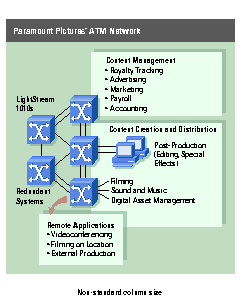
"In 1994 we assessed our entire communications infrastructure and developed long-range plans for updating the network to support data, voice, and video applications," recalls Stan Balcomb, Vice President of Computing and Network Services at Paramount. Immediate among these requirements was the ability to support new LAN applications for video distribution. These digital networked applications allow everyone connected with a film's production -- from executives to editors to special effects studios -- to instantaneously see videotape of daily filming without waiting for a courier to run cassettes across huge studio lots. Additionally, Paramount wanted to smoothly integrate these applications with the information systems network and the post-production network.
"We needed to move from a flat Token Ring networking architecture with lots of bridges and expand to an "any-to-any" connectivity environment," continues Balcomb. "Also, within three to five years there will be a broadband network connecting all the players in Hollywood, including the major studios and all the special effects and post-production houses located in the Los Angeles basin," says Balcomb. "ATM was the way to integrate these emerging wide-area services."
To meet Paramount's needs, the company's Network Services group and Michael Grimaldi, a network consultant for Computing and Network Services, proposed a high-performance ATM backbone architecture with system-wide redundancy and quality of service (QoS) to accommodate the special demands of video traffic combined with a service and support program. Additionally, through its ATM Associates Program, Cisco secures industry-leading and Cisco-compatible technologies that customers may require to complete a reliable hybrid network.
| ATM Associates Program |
|---|
| The ATM Associates Program advances Cisco's commitment to delivering end-to-end networking solutions. Through the program, Cisco provides customers with information about third-party products that can be used in Cisco ATM campus networks. Network managers planning to deploy ATM infrastructures may identify compatible products that are recommended for use with their Cisco LightStream ATM switches, ATM-equipped Catalyst LAN switches, and Cisco routers. Interoperability testing, integral to the program, is conducted prior to product shipments. By assuring interoperability, the ATM Associates Program helps customers to streamline and lower the cost of ATM deployment. |
The centerpiece of Cisco's solution is the LightStream® 1010 ATM switch. Currently, five LightStream 1010s are deployed throughout Paramount's 63-acre campus; they're complemented by Cisco 7500 series routers. The 5-Gbps modular ATM switch provides fault-tolerant operation and extremely high throughput, which are critical for the studio's production network where downtime costs thousands of dollars per second. The LightStream 1010's advanced traffic management mechanisms support current, bursty, best-effort traffic, while also delivering the QoS guarantees required for Paramount's current and future applications. Moreover, Paramount's network is especially well-positioned for future growth with the LightStream 1010's ability to support different types of ATM services and flexible bandwidth allocation.
"Cisco's standards-based approach to developing networking solutions was an important factor in our decision to go with Cisco," maintains Balcomb. "As we create a broadband network within our community, we need to develop partnerships with vendors who are committed to standards-compliant and interoperable technologies. Ultimately, we want to create a network that is as reliable as telephone and power systems, so that users can step up their production efforts. We're on the road to achieving that goal with Cisco."
To learn more about Paramount Pictures, visit http://www.paramount.com .
| ELEMENTS OF SUCCESS |
|---|
| Paramount's Top 3 1. Standards Compliance 2. Network Management 3. Cost Effectiveness |
| What are the top three elements that have made this project a success? Stan Balcomb answers, "First and foremost is Cisco's commitment to a standards-based ATM approach. We cannot be a closed community, and we need to create an environment for any-to-any connectivity. The LightStream® 1010 delivers a very elegant PNNI-1 feature, which has allowed us to smoothly integrate these switches with our existing devices. And lastly, it's really a toss-up between Cisco's tools for network administration and the cost-effectiveness of the entire solution-a solution that takes us from design and implementation to responsive service and support." |
___________________________________________________________________________________________________________
"Improving service and streamlining service delivery process at the lowest possible cost" -- it's a cross-industry clarion and nowhere does it ring quite as loudly as in the health care industry. The impact of managed care on academic health institutions has created a highly competitive environment, with industry experts predicting that of today's 105 academic health centers in the USA, only 65 will survive past 1999. The University of Southern California (USC) School of Medicine plans on being counted among the survivors and has chartered a course to be a leader in health care delivery.
Founded in 1885, the USC School of Medicine is the world's largest academic medical center today with a total caregiver base -- including faculty, physicians, interns, and affiliated hospital and staffs -- that approaches 7500 individuals. In 1993, the USC School of Medicine joined with NASA's Jet Propulsion Laboratory and the Northrop Grumman Corporation to form the USC Advanced Biomedical Consortium. This consortium's goal is to develop and deploy advanced telemedicine solutions that improve and expand health care delivery while efficiently managing the cost of that delivery. Advanced health information systems and the use of computerized patient records, referred to as electronic medical records (or EMRs), are key tools for the future that will net substantial savings for the US health care industry.
"It was incumbent upon us to secure integrated electronic medical records and related administrative systems to facilitate the creation, use, and transmission of electronic patient data, while providing the infrastructure to realize true administrative cost savings," says Rod Zalunardo, Director of the USC Advanced Biomedical Consortium's network services. "More importantly," continues Zalunardo, "uniform access to consolidated patient information will improve the quality and costs associated with providing care." By 1994, the USC Advanced Biomedical Consortium had embarked on procuring and deploying technologies that would fulfill requirements for managing patient-centered information and managed-care costs within a seamless, flexible, and interoperable information system. To achieve this goal, the USC Advanced Biomedical Consortium built a multivendor Asynchronous Transfer Mode (ATM) network that incorporates a full complement of Cisco routers and LightStream® 1010 ATM switches.
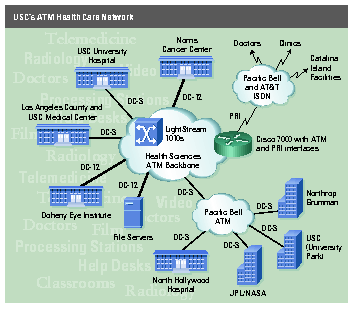
The LightStream 1010 switch is deployed at the Northrop campus, enabling the USC Advanced Biomedical Consortium to integrate legacy Ethernet with its new ATM backbone. "ATM switching has been integral to our development of completely integrated health care information systems," notes Zalunardo. Previously developed systems for health care and clinical information are now shared with the integrated electronic medical records. Electronic medical records are able to incorporate data and transactions from legacy heath care information systems by encapsulating translation and interoperability methods into the electronic medical records. This functionality is vital to an industry in which record-keeping becomes more complex as the number of hospital mergers and consolidations continues to spiral upward.
These integrated electronic medical records are delivering a wealth of advanced capabilities, such as telemedicine and videoconferencing applications. Telemedicine allows patient information to be shared among physicians using "whiteboard" applications that function as discussion and collaborative diagnostic methods. And videoconferencing is used to facilitate the exchange of detailed photography and time-dependent issues. According to Dr. William D. Boswell, Department of Radiology at USC School of Medicine, "For the first time, this network allows us to create and share 3-D images and use them for better, faster diagnosis and treatment -- saving time, dollars, and most important, lives."
| ELEMENTS OF SUCCESS |
|---|
| USC Medical School's Top 3 1. Seamless Integration 2. Standards Compliance 3. Reliability |
| What are the top three factors that made this project a success? "One of our main criteria in developing a new integrated network was to bring together best-of-breed solutions," says Rod Zalunardo. "For our success in this multivendor environment, the vendors we select must be able to talk to each other in a relatively seamless and uncomplicated way and have a high degree of standards adherence. Cisco has been successful on both counts. Lastly, simply put, our Cisco LightStream® 1010 works. It gives us a high degree of reliability, contributing to the overall success of the network and the applications running on it." |
___________________________________________________________________________________________________________
Companies are looking to Asynchronous Transfer Mode (ATM) technologies to deliver a whole new realm of networking capabilities such as scalable bandwidth, guaranteed quality of service (QoS), and virtual network management. ATM promises significant increases in bandwidth, lower costs, and the ability to transmit data, voice, and video simultaneously.
Such capabilities are particularly important to the Peoples' Bank of China as it rolls out the first phase of an immense, nation-wide network known as the China National Financial Data Communications Backbone Network (CFN). A sophisticated electronic payments network, CFN is designed to speed interbank transactions between the country's principal banks.
Constructed entirely from Cisco StrataCom® IGXTM ATM switches, the countrywide network will link the Bank of China's National Processing Center in Beijing to more than 400 branch processing centers in key cities across the country. These in turn will link up to some 2000 sub-branch processing centers connecting almost every financial institution in China.
Jointly funded by the central bank and China's Ministry of Post and Telecommunications, CFN is operated by Zhongyuan Financial Data Networking Company. "Data traffic moving between financial organizations is estimated to make up around 90 percent of all information flows in China," said Mr. Yi Ye, Chairman of Zhongyuan.
Due to be rolled out in phases, the data network will initially involve the deployment of approximately 200 StrataCom IGX multiservice switches, covering half of the proposed branch processing centers. These switches consolidate existing X.25, SNA, and LAN traffic.
Garry Scarborough, Cisco's Marketing Director for Greater China, notes that an important consideration in the selection of Cisco's solution was its ability to support ATM as well as Frame Relay services, allowing for mixed voice, data, and video traffic. "As network demand increases, new services can be implemented in a cost-effective way and system capacity expanded to migrate away from narrowband Frame Relay speeds to broadband ATM on the same platform," Scarborough says. "There will be ATM-based voice service in the network next year as the first step toward a variety of advanced multimedia applications."
Transmission links between the National Processing Center and provincial branch processing centers will be provided by leased lines supplemented by satellite uplinks. At the sub-branch processing level, individual bank branches and financial institutions will relay information to the Cisco switches over X.25 leased lines or dialup links.
"One of the essential requirements of CFN is that it is compatible with all international standards of data transfer," says Yi.
The advanced technology being implemented into CFN has already attracted widespread interest. "We've been approached by a number of banks looking to upgrade their own internal networks," says Scarborough. "CFN is a showcase for the rest of the nation's financial institutions."
| ELEMENTS OF SUCCESS |
|---|
| CFN's Top 3 1. Scalability 2. Quality of Service 3. End-to-end solution |
| What three leading factors have made this project successful? The first factor is the proven scalability of Cisco's switching and routing equipment, with its potential for migration to a larger and larger network infrastructure using Tag Switching technology. Quality of service (QoS) is also essential, particularly Cisco's support for closed-loop congestion control and queuing for permanent virtual circuits (PVCs) on a per-PVC basis. Finally -- and perhaps most importantly -- Cisco emerged as the only vendor that could provide a complete, end-to-end network solution. Cisco IOSTM software, resident in many different types of network devices, allows the People's Bank of China to construct a cohesive infrastructure based on a common set of network services. |
|
|