


|
|

Volume 9 Number 3, Third/Fourth Quarters 1997

Cisco customers know what it takes to make their networks successful. So when customers talk, Cisco listens. Products, features, functionality, enhancements, services -- much of what Cisco offers today has been influenced and shaped by input from customers. Even our acquisitions reflect what customers tell us they need.
From its very beginning, Cisco has focused on keeping its ears and eyes open to ensure that it captures the tenor of what customers are saying. We listen in a number of ways. The Networkers conferences give a large cross-section of users an opportunity to share their expectations. Technical advisory groups (TAGs) offer smaller segments of customers with common interests -- such as financial institutions, telephone companies, or insurance companies -- the chance to spend one or two days with Cisco engineers, providing very detailed input on networking issues.
Cisco also frequently works one-on-one with customers such as Citicorp, Boeing, and First Union National Bank to improve the availability, reliability, and quality of its products. System testing for compatibility, integration, and interoperability within customer networks can be a real challenge. Working with First Union and other customers enables Cisco to make deployment easier.
In another one-on-one, Cisco set up a proof-of-concept lab for Boeing that allowed the aerospace company to conduct tests prior to rolling out new products in its massive production network. Simulating the actual customer environment ensures that networks function as planned.
Input from customers can come in many ways. During a meeting of Cisco managers, for example, a representative from Citicorp addressed attendees regarding the need to continuously improve the quality of networking software.
Input from a considerable number of users has led to improvements in Cisco's Technical Assistance Center (TAC). Customers calling the TAC for advice were unhappy when they had to wait for an available engineer to call back. Cisco responded, and today, customers with urgent requests can be connected to engineers immediately.
Lead time is another issue with customers and partners. In response, Cisco has reduced lead times through streamlined manufacturing operations and innovative networked commerce applications such as the Internetworking Product Center (IPC). Customer feedback has been the driving force behind these improvements.
Within the past year, in an effort to enhance Cisco's listening tools, the company realigned itself into lines of business, concentrating on three areas: large enterprise customers, service providers, and small/medium-sized businesses. Focusing on specific types of businesses enables Cisco to better understand the needs of its customers.
One of the most prominent listening tools is the annual Cisco Customer Satisfaction Survey. Customers from around the world are asked to rate Cisco in a number of areas including product capabilities, quality, ease of use, and installation, as well as sales, service and support, and order fulfillment. While customer expectations continually increase, overall satisfaction has steadily gone up each year since the survey was introduced in 1992 -- a tribute to Cisco's listening skills and willingness to act on customer suggestions.
Each year, Cisco sets corporate goals based on the collective input from customers gathered from listening tools such as the Customer Satisfaction Survey, Networkers forums, TAG meetings, and others. Cisco believes that its success depends upon an ability to listen well and respond -- and in doing so, to make every customer's network a success. 
___________________________________________________________________________________________________________
Success breeds success, they say. And the success of Cisco customers directly feeds our own success. In this issue of PacketTM, we take a look at ten very different Cisco customers, their networks, and their front-line stories of how they implemented solutions tailored to solve some very specific challenges.
Cisco offers a broad range of network solutions to an equally broad range of companies and institutions. Customers featured in this issue extend from Hollywood to hospitals, public to private sector, service providers to energy providers, and financial services organizations stretching from the USA to the UK to the PRC.
We asked each company to identify three "elements of success" in implementing their networks. As diverse as these companies are, patterns emerged in their responses. The element most often mentioned was reliability. Lenny Post of Alberta Energy sums it up with this comment: "Cisco products are extremely reliable -- they're a solid product." Other customers concur. Advanced features and functionality mean little if customers can't ensure, as Clyde Heintzelman of the Internet carrier digex says, "One hundred percent up time." And John Bowling of mobileDATA Technologies Group adds in our telecommuter profile, "Having dependable equipment and a reliable network is crucial to the success of any telecommuter."
Teamwork and partnership were other frequently mentioned success elements. Cisco and its partners take an active role in making customers successful. In our story on Cisco's Network Supported Accounts (NSA) program, First Union National Bank's John Burns observes, "The most important factor was teamwork. Our NSA representative serves as part of our team and really takes ownership of our network." BZW's Colin Austin also feels that teamwork was "the most important element."
Standards compliance and seamless integration were cited as other key elements of success. According to Paramount Pictures' Stan Balcomb, "First and foremost is Cisco's commitment to a standards-based approach. We cannot be a closed community, and we need to create an environment for any-to-any connectivity." Paramount's network is profiled in The Cell. Rod Zalunardo of USC Medical School echoes Balcom, "For our success in this multivendor environment, the vendors we select must be able to talk to each other in a relatively seamless and uncomplicated way and have a high degree of standards adherence. Cisco has been successful on both counts."
Outgrowing technology can be costly when investments in infrastructure must be abandoned. Scalability protects investment and facilitates growth. When asked what was the critical success factor in building the China National Financial Backbone Network, a spokesperson replies, "The first factor is the proven scalability of Cisco's switching and routing equipment with its potential for migration to a larger and larger network infrastructure."
World-class support can eliminate downtime for world-class networks. If problems arise, resolving support issues quickly is critical. Customer service is another key success element identified by Cisco users. Jon Prall with the ISP Excite says, "We are always able to escalate important calls and get things resolved by experienced, knowledgeable people right away."
Other key success factors mentioned in this issue of Packet include planning, network management, performance, ease of use, and quality of service. In spite of their geographical and functional diversity, Cisco's customers share many of the same needs. Helping its customers to succeed is Cisco's number one element of success.
___________________________________________________________________________________________________________
AT&T Canada Long Distance Services Company practices what it preaches. The equipment platform that the nationwide carrier uses to provision reliable, high-availability networking services to customers bears a striking resemblance to the one that shuttles its own corporate data traffic among 65 nationwide sites.
The company's services platform comprises Cisco routers, switches, and remote access servers. AT&T Canada officials say their longtime use of Cisco equipment in their own enterprise network has given the company a high level of expertise that has translated into the successful provisioning of services to outside customers. AT&T Canada has long provided its DataVPN family of networking services off an end-to-end Cisco platform while running its internal leased-line WAN on Cisco routers. Now, the company is also well into the process of moving its internal dedicated-line traffic to the public Cisco StrataCom®-based Frame Relay service it offers to others, says Gerry Holmes, Director of Computer Operations.
Meanwhile, in a recent major upgrade of its LANs, the Toronto-based carrier has leveraged the Cisco Catalyst® 5000 multimedia switch to migrate thousands of users from shared Token Ring LANs to switched Ethernet and Fast Ethernet networks to relieve network bottlenecks and free up user access to resources.
| Who Is AT&T Canada? |
|---|
| AT&T Canada is the owner and operator of a cross-country telecommunications network running on 4500 km of fiber-optic cabling and 11,200 km of digital microwave links. The company provides the DataVPN family of services, including Frame Relay, Asynchronous Transfer Mode (ATM), and remote access offerings delivered via Cisco equipment. |
Officials at AT&T Canada say they believe in the homogeneous nature of equipment platforms from a single vendor, because the consistency of features across devices allows them to provide uniformity of services end to end. "One of the big selling points for our Frame Relay and ATM services is the full-featured interworking between them," says Michael Stephens, Director of Business Services Marketing, Data. "Feature sets can be launched simultaneously for Frame and ATM."
For example, AT&T Canada says it will concurrently introduce switched virtual circuits (SVCs) for both Frame Relay and ATM services in early 1998. SVCs allow a site to communicate on the fly with any other site on the same carrier's network without any preconfiguration of equipment.
Interworking also means that the end customer can choose the most appropriate interface for the traffic type and volume at a given site but still reap the speed efficiencies of ATM in the carrier's backbone. For example, if a site sends only data traffic, and volumes are moderate, the packet nature of the Frame Relay interface will likely prevail. Another site, however, might have voice and video needs in addition to data. These needs are better served by ATM cells, which carry more predictable delay.
"A lot of equipment vendors aren't doing Frame-to-ATM interworking yet," notes Stephens. "But our being able to offer it means our customers don't have to buy overlay networks, which increase management complexity and operations costs."
Adds Jack Hubley, AT&T Canada's Vice President of Business Marketing, "Cisco has proven to be an important partner in helping us ensure that our customers have access to the advanced features they need to make their businesses successful."
Perhaps the most important component of Cisco's StrataCom platform, says Stephens, is that one management system monitors both the Frame Relay and ATM equipment: the 10-Gbps StrataCom BPX® ATM switch; the AXIS adjunct to the BPX, which converts incoming Frame Relay packets to ATM cells; and StrataCom IPX® Frame Relay edge switches.
The StrataCom ForeSight® closed-loop congestion management is what Stephens describes as the platform's jewel in the crown. With this type of flow control, messages continually patrol the network, monitoring congestion. If they detect any, buffers in the StrataCom switches throttle back their transmission rate. "Other vendors' switches drop data when a blockage occurs. But then the end stations retransmit, which only makes congestion worse," notes Stephens.
With the ForeSight product, flow-control feeds into a credit management system that allows bandwidth to be allocated fairly among users, rather than simply allowing traffic that arrives first to take precedence. The result is that users can "burst" data onto the network with a minimal risk of discard, says Marc Dennis, a Cisco engineer who supports the AT&T Canada account. "A carrier or user can get 95 percent utilization out of a DS3 link because of the congestion and credit management," he says.
Since pricing is a major area where data service providers compete, this high utilization is important. "Our pricing is reflected in our cost of ownership, which drops as the efficiencies in the network increase," says Stephens.
Cisco is in the process of porting the ForeSight capabilities to its routers, which AT&T Canada resells to customers and manages for them under its Extended Connectivity Option (ECO) offering. "That will push flow control out to the customers' premises," Stephens says.
AT&T Canada has designed a fault-tolerant infrastructure, whereby the BPX/AXIS network is configured as a web of meshed DS3 links that are primarily self-healing Synchronous Optical Network (SONET) rings. "The BPX can do rerouting in 50 milliseconds," says Stephens. "Even if we have a trunk failure, customer networks stay up."
AT&T Canada offers the Public Dial Access (PDA) remote access service, a managed IP service, to commercial customers and internal AT&T Canada network users alike. Remote access services allow enterprise customers to outsource the installation and management of remote access equipment and network security. Modem pools and low-end access servers in the AT&T Canada network are being replaced with newer technologies, including the Cisco AS5200 universal access servers. "They allow us to offer many more features, including 56-kbps modem technology and Integrated Services Digital Network (ISDN). And their greater port densities mean our cost per port will drop by more than 50 percent," says Stephens.
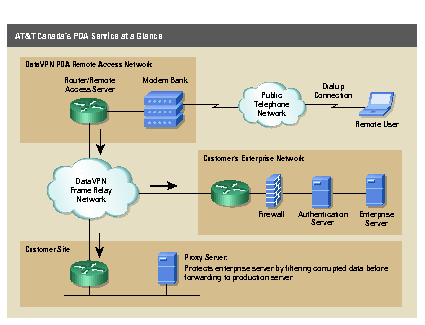
AT&T Canada is not only honing its WAN networks, it also is using Cisco solutions to take care of its internal LAN customers. The company has upgraded three of its major sites with switched 10- and 100-Mbps Ethernet LANs, as well as with a 155-Mbps ATM backbone in its computer center.
One impetus behind the move, now nine months along, was a problem with Token Ring technology. About once a month in the firm's 1000-user, multistory headquarters in metropolitan Toronto, a Token Ring workstation would experience a problem that resulted in beaconing, explains Holmes. "That would take out half a floor, which meant an hour of downtime for about 50 users per incident," he says.
AT&T Canada decided to use a switched LAN technology, anticipating a future need to deliver video to users' desktops. The company chose the economies of Ethernet, and is now providing switched Ethernet and Fast Ethernet to 3000 users via Cisco Catalyst 5000 switches.
This change has allowed AT&T Canada to create virtual LANs (VLANs), which eliminate the headache of constantly rewiring users moving around buildings, Holmes says. As part of that upgrade, file servers in the company's data center are now connected to a pair of 155-Mbps LightStream® 1010 ATM switches from Cisco for fast internal backbone connections.
"The network is no longer a bottleneck to data resources," Holmes concludes. "And staff no longer do redundant moves just to keep people together for the electronic exchange of information."
| ELEMENTS OF SUCCESS |
|---|
| AT&T Canada's Top 3 1. Partnership 2. Planning 3. Platform Integration |
| Partnership, planning, and platform integration were three big reasons behind AT&T Canada Long Distance Services' catapult to the top tier of Canadian fast-packet service providers, according to Mark Racansky, Director of Network Development. Racansky is responsible for technology development, capacity planning, network engineering, and access strategies at the company, and helped it transition from a number of separate networks supporting different networking services to the unified StrataCom platform several years ago.
"During the planning and implementation phases," he explains, "we met every six months so we could communicate which interfaces and applications we needed in the future to be competitive." Racansky says that integrating all AT&T Canada data networking services under one brand name -- DataVPN -- and running it off a common infrastructure has hoisted the company's reputation. "It's easy for a customer to move from one service to another now because of the common infrastructure. They still get one bill under the same service name," Racansky explains. The capacity-planning portion of Racansky's job has also benefited from the single-platform approach. "There are no overlay networks, and it's easier to build one huge pipe than ten small ones," he notes. |
___________________________________________________________________________________________________________
Cisco Systems' recent minority equity investment in TIBCO Software, Inc., a maker of "push" applications, reflects the fact that the Internet is becoming a mainstream medium for sending volumes of information to the masses. The evolving nature of the Net has fueled the need for sophisticated content-filtering schemes that allow users to be selective about what arrives on their PCs.
One reason is that users must pare down the mounds of information continually barraging them so they can make well-informed decisions. Another is that network traffic must be streamlined so that response times are fast and reliable.
These factors prompted Cisco to invest in TIBCO Software, a Palo Alto, California-based provider of publish/subscribe -- or "push" -- software that contains sophisticated filtering technology. Push applications enable data to be automatically distributed to users of IP networks such as the Internet without those users having to request the information.
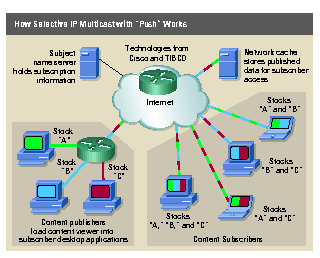
A key benefit of the Cisco-TIBCO relationship to enterprise networking staffs will be the consolidation of their router and push networks, says Seenu Banda, group manager for multimedia at Cisco. Cisco and TIBCO are working to modify TIBCO's TIBnet push applications to scale across large Cisco networks.
"Currently, many enterprises have set up parallel networks with special routers for push applications," Banda explains. "The integration of these services will enable Cisco customers to use their existing Cisco networks for TIBCO's TIBnet push applications. This capability will ease network management, scale the network, and reduce operations costs."
Cisco and TIBCO are also working on an enhanced version of the standard IP Multicast protocol that will ensure that all packets transmitted are reliably delivered. IP Multicast is an underpinning of push applications because it enables a single data or video stream to be sent economically to thousands of concurrent recipients.
TIBnet includes technologies that Cisco estimates can collectively reduce network traffic by 50 percent. Intelligent content filtering, for example, addresses users' requirements to receive only information that is specific to them, such as stock prices. "Everyone wants information on their favorite stock symbols, but few want the whole market report," Banda notes.
Adds Edward Kozel, Cisco's Chief Technical Officer, "It makes sense to send pieces of content, such as parts of a newspaper. Our investment in TIBCO Software will allow Cisco to offer such subscriber-sensitive network services."
Another TIBCO technology to be supported over Cisco networks is called Subject Name Server (SNS). This feature allows an application to selectively distribute information based on the interests of an individual, rather than by an IP address. "Such a capability could be a boon to users unaware of a data source, and to marketers seeking new prospects," Banda notes.
| Push and IP Multicast |
|---|
| For more on push technology, visit the following Web sites: http://monet.inria.fr/webcanal/push.html http://www.tibco.com/products/tib_tech.html
For further reading on IP Multicast technology and related issues, visit this Web site: http://www.ipmulticast.com/community/whitepapers/introrouting.html |
___________________________________________________________________________________________________________
Keeping up with growth in traffic and the number of users is becoming a tremendous challenge in both the Internet and enterprise networks. To help network managers address this challenge, Cisco Systems announced Tag Switching technology last year. The first implementations of this technology will be available in the coming months.
New Cisco IOSTM software (available in the fourth quarter of 1997) implements Tag Switching on the Cisco 7500 series of core routers and the Cisco LightStream® 1010 Asynchronous Transfer Mode (ATM) switch. A version for the Cisco 7200 router and Cisco StrataCom® BPXTM switch will be available in the first quarter of 1998. Tag Switching also will be implemented in the Cisco 12000 series of gigabit switch routers, planned for release in late 1997.
Tag Switching will help users to expand the capacity of their existing WAN backbones. The technology also supports a hierarchical structure that improves overall network scalability and manageability, and will also enable simplified support for network-layer quality of service (QoS) across ATM networks.
"Based on our field trials to date, Tag Switching has proven to be a robust, innovative, and scalable solution for merging the intelligence of routing and the performance of switching," says Clyde Heintzelman, President of Business Connectivity for digex, Inc., a national Internet carrier based in suburban Washington, DC. "We're eager to explore advanced network services, such as Layer 3 QoS across ATM networks, made possible by Tag Switching."
Tag Switching combines the performance and traffic management capabilities of Layer 2 (data-link layer) switching with the scalability and flexibility of Layer 3 (network layer) routing. Tag Switching is routing-protocol-independent and leverages users' current investments in equipment and network design.
A Tag Switching network consists of a core of tag switches (either conventional routers or switches), which connect to tag-based edge routers on the network's periphery. Tag routers and switches assign tags for each destination-based prefix within their Layer 3 routing tables and distribute this information to the next-hop tag-switch router referred by the route table. In this manner, once the routing protocol has provided the Layer 3 topology via the route table, this information enables the propagation of tag-to-destination prefix bindings throughout the tag-enabled network.
When a packet enters the network, the tag edge router searches its route table for the appropriate destination prefix, from which the corresponding tag is derived. The edge router adds this tag to the packet, allowing all receiving tag switch routers to forward the data by simply swapping tag labels, without the need for any Layer 3 table lookups. This method is much faster than querying routing tables, but it continues to use standards-based, Layer 3 routing protocols such as Open Shortest Path First (OSPF). Tag Switching supports both unicast and multicast traffic.
In networks that provide Internet service over an ATM backbone, Tag Switching enables ATM switches to act like routers, increasing the maximum size of those networks and supporting tight integration of IP QoS and multicast features with the ATM backbone.
In further detail, processing within a Tag Switching network follows these steps:
The packet reaches the tag edge router at the egress point of the network, where the tag is stripped off and the packet delivered.
| Tag Switching White Paper Available |
|---|
| A detailed explanation of Tag Switching techniques is presented in the Cisco white paper "Scaling the Internet with Tag Switching," available at http://www.cisco.com/tag . |
With its flexible mapping techniques, Tag Switching complements Cisco's NetFlowTM software, which provides high-performance processing of value-added Layer 3 services in tag edge routers. NetFlow software packets can be tagged in the router by destination prefix or by flow for packets that require special QoS processing within the network.
Cisco has proposed Tag Switching for standardization by the Internet Engineering Task Force (IETF), a process that the company expects to be complete by mid-1998. Standardization of Tag Switching will give users the benefit of interoperability among equipment from multiple vendors.
Alcatel Telecom has joined other networking vendors in announcing support for Tag Switching. Alcatel intends to use Tag Switching to deliver high-speed IP traffic in its ATM switches. More than ten other companies have announced support for Tag Switching. For a list of these companies, visit http://www.cisco.com/warp/public/ 797/16.html .
___________________________________________________________________________________________________________
mobileDATA Technologies Group (Arlington, Texas) is a company on the move. In addition to providing companies with design and consulting services and specializing in solutions for home office needs, mobileDATA uses its internal network to extend telecommuting capabilities to all employees.
With a projected growth rate of 300 percent annually, the company relies heavily on technology to help it grow and service its clients. mobileDATA believes that success lies in being its own best client; as such, it emphasizes the benefits of telecommuting and leverages Cisco products to get the job done.
mobileDATA CEO and Chief Technologist John Bowling is a perfect example of this policy. Telecommuting allows him to keep in constant touch with all aspects of his business around the clock and gives him the same capabilities he'd have sitting at his desk in his Arlington office, whether he's working at home or from customer sites throughout Texas.
With the hectic schedule of a CEO, he often works up to 75 hours weekly. After starting to work at mobileDATA, Bowling realized that the time commitment could cause a strain on his personal life and family, as well as on his mental health. Being able to telecommute nearly 50 percent of that time has helped him greatly. Those at mobileDATA hold fast to the belief that good technology makes them better, and great technology makes them the best; to that end, all employee telecommuters are outfitted with the best processors, the most RAM, large monitors, and dedicated 10 or 100BaseT to the desktop.
And having the best in networks and computers isn't all -- Bowling took it one step further and created the ultimate home office setup. In addition to having a computer in the house, he has created an elaborate home office in his backyard, overlooking the pool and allowing him to be near his children while they play. The office has all the capabilities of his corporate office across town, but with French doors, carpeting, and a relaxing environment, its a much more comfortable place to work.
From his retreat, Bowling connects to the office with a Cisco 766 router using an Integrated Services Digital Network (ISDN) Basic Rate Interface (BRI), which connects to a Cisco 4500 at the central site. He's installed two 4-line phones with an additional two metro lines and uses both a Dell Omniplex with a Sony 20-inch monitor and a Toshiba laptop. He has a docking station with another monitor, a scan station, and a fax machine. And the company recently added video and voice over IP to its capabilities. mobileDATA uses Cisco IOSTM software throughout the network for high throughput, low support costs, and strong reliability, and relies on CiscoWorks applications to manage all the connections.
"From poolside I can log in to any one of our six office servers, print to any printer in the network, or get Internet access through our Cisco PIX Firewall, as well as accessing many other resources -- my capabilities are virtually unlimited," he explains.
| Do You Telecommute? |
|---|
| Are you a full-time telecommuter for your company? Contact us with your story, and you could be profiled in an upcoming issue of Packet magazine. Send e-mail to dandreas@cisco.com using the subject line "Telecommuting" |
Bowling couldn't be happier with his backyard office setup. "It's great to be on a conference call and watch the kids swim," says Bowling. "And birds and squirrels in the morning are much more pleasant than bumper-to-bumper traffic." Despite the relaxing environment, he says he's better able to focus and get more work done than when he's in the office.
Bowling advocates the benefits of telecommuting not only for himself, but in his role as CEO, for mobileDATA as a company. He's seen evidence firsthand that it increases productivity, lowers costs, and provides a great benefit to employees, as well as reducing stress and helping the environment. As an integral part of the mobileDATA corporate culture, telecommuting is offered to all employees. "Our core belief is that people are assets to the company, so we encourage work from home -- it has unlimited benefits for all parties," he concludes.
Do You Telecommute? Are you a full-time telecommuter for your company? Contact us with your story, and you could be profiled in an
| ELEMENTS OF SUCCESS |
|---|
| mobileDATA's Top 3 1. Ease of use 2. Dependability 3. Performance |
| John Bowling, CEO and Chief Technologist for Arlington-based mobileDATA Technologies Group, enumerates the key elements that make telecommuting a success for him and the mobileDATA team. "The most important element is ease of use," says Bowling. "We can work from home just as we would in the office -- using the same applications, with the same access and security capabilities." The second is dependability. "Having dependable equipment and a reliable network is crucial to the success of any telecommuter," says Bowling. mobileDATA uses the Cisco 766 to connect to a Cisco 4500 at its central site because Bowling and his team know they can depend on them. The third vital component is speed. As mobileDATA's applications grow, the throughput achieved with the Cisco 766 and other products helps the company meet the demands required of a successful company on the move. |
___________________________________________________________________________________________________________
At a time when burgeoning Internet usage is causing many service providers to question the longevity of their dial-access infrastructures, Cisco Systems announces new hope for those lifespans with Cisco AccessPathTM-TS, its first carrier-class dial-access system for Internet service providers (ISPs) and large enterprises. The Cisco AccessPath system is optimally designed to support service provider point-of-presence (POP) sites and large corporate environments, where total cost, solution integration, and network management are critical decision criteria.
The AccessPath system employs an advanced dial-access architecture that combines distributed, stack-based hardware with centralized network management software to simplify the deployment of differentiated dial services.
"AccessPath lets service providers deploy multiple POPs quickly and cost effectively, dramatically reducing training time and ongoing operation costs," says Jim Capobianco, Cisco's AccessPath Product Manager. "For these providers, this capability means a competitive advantage in responding to rapid technology changes and increasing end-user connectivity requirements."
To deliver differentiated services, many ISPs are moving to stack-based remote access devices. Cisco's AccessPath solution enables providers to scale and centrally manage the connectivity requirements mandated by the flood of new users coming on line.
The AccessPath system facilitates a smooth transition from single-chassis solutions to distributed-process, multichassis architectures. It scales dynamically, enabling an array of Cisco IOSTM network services such as virtual private dialup networks (VPDNs). It is also the industry's first fully configured dial-access system that merges universal dial access, offload processing, industry-leading backhaul routing, and high-speed switch interconnect capabilities into a single scalable architecture.
Users can configure the AccessPath-TS system to connect more than 700 ports simultaneously. Its modular stack architecture delivers investment protection and flexibility, because new stack elements can be added to incorporate new aggregation shelves that will support diverse performance, capacity, and modulation technologies.
Part of the appeal of AccessPath is its management component, AccessPath Manager. Through a Web-based graphical user interface (GUI), the AccessPath Manager software aids in rapid access-port deployment and service activation and minimizes operational management overhead. AccessPath Manager rallies the strengths of several software modules. The monitor module can display single or multiple AccessPath units and single shelf-level views. The configuration module aids in creating and modifying AccessPath software configuration. And the reporting module facilitates capacity planning, statistical analysis, and diagnostics. The Cisco AccessPath Manager provides the tools and technology to deploy, maintain, and proactively manage the high-density dial solutions required in today's markets.
"Cisco has taken the toil out of working with multiple network hardware and software vendors by delivering a seamless, scalable dial architecture that is centrally managed through a comprehensive management application," notes Tush Nikkollaj, President and CEO of Logical Net, an ISP based in Albany, New York. "AccessPath combines Cisco's core technology strengths in routing, dial access, and Cisco IOS network services into a powerful, cost-effective, centrally managed solution."
Cisco AccessPath is available now. For more information on this product, visit http://www.cisco.com/warp/public/625/servprod/apath/apman_ds.htm .
___________________________________________________________________________________________________________
Alberta Energy Company, a US$2.5 billion oil and gas producer in Calgary, Alberta, Canada, knew it had a problem when its Token Ring network began to show 86-percent peak utilization rates. Most of its 600 users had high-performance workstations on the 16-Mbps network consisting of six rings. Workgroups accessed 20 Novell and UNIX servers through shared hubs connected to a collapsed router backbone. Alberta Energy's in-house network integrator, MetroNet Solutions, placed the network's average utilization rate at about 40 percent during office hours. But with peaks as high as 86 percent, network response times frequently lagged, taking a toll on productivity.
To solve the LAN performance problem, MetroNet devised a four-step plan for migrating Alberta Energy's network from Token Ring to Ethernet: determine performance requirements, evaluate and prepare the infrastructure, improve user performance at the desktop, and eliminate server bottlenecks.
MetroNet performed a series of lab tests to identify the best solution for Alberta Energy's particular setup. The results indicated that shared Fast Ethernet would be optimal. The new design called for shared 100BaseT to the desktop with an Asynchronous Transfer Mode (ATM) backbone.
The next step was to assess the infrastructure for the feasibility of a Fast Ethernet migration. The building had been wired years ago with both type 1A cable for Token Ring and Category 5 UTP cable. Fortunately, MetroNet discovered that only 3 percent of the wiring needed replacement or repair. Only minor cable upgrades were required, and 75 percent of the end-user workstations were based on Intel Pentium processors, which could take full advantage of the 100-Mbps rate, so a migration to Fast Ethernet would clearly meet affordability and performance requirements. To boost performance at the desktop, PCs and workstations received 100-Mbps network interface cards (NICs), while notebooks and network printers were migrated to 10BaseT.
Selecting network devices was the next step. MetroNet's criteria included collision domains of 12 to 24 users, expansion capability, and manageability down to the port level. They found that Cisco's FastHub® 100BaseT repeaters met all their needs. The product family offered good port density, with 16 ports in the base unit and a 16-port expansion module for growth. Adding a management module in a second slot of the base unit would provide stack, unit, and port-level statistics.
"FastHub repeaters allow us to deliver better performance to our users," says Lenny Post, Technical Architect at Alberta Energy. The migration team was also pleased with Cisco's end-to-end solution. "We can leverage our investment in network management software by managing everything with CiscoWorks," Post adds.
Eliminating bottlenecks was the final step of the migration. To accomplish this task, the MetroNet team used Cisco Catalyst® 5000 switches across an ATM backbone made up of Cisco LightStream® 1010 switches. They created virtual LANs comprising switched 100, switched 10, and shared Fast Ethernet throughout the building. The FastHub repeaters are aggregated by the Catalyst switches, which are in turn connected directly to the UNIX and Novell servers with a combination of ATM and Ethernet adapters.
Users now have Fast Ethernet to the desktop and can access servers via high-speed, switched uplinks. In June, some of Alberta Energy's remote offices were converted from Token Ring to Fast Ethernet, using technology implemented at headquarters in Calgary. Post adds, "We wanted to use strategically correct technology, and I feel that by choosing Cisco's FastHub repeaters, Catalyst 5000 backbone switches, and LightStream 1010 ATM switches, we won't have to make forklift upgrades any time in the near future."
| ELEMENTS OF SUCCESS |
|---|
| Alberta Energy's Top 3 1. Reliability 2. Scalability 3. Performance |
| Reliability, performance, and scalability were the three key factors that made Alberta Energy's network a success, says the company's Technical Architect, Lenny Post. "In terms of the amount of uptime they give us, Cisco products are extremely reliable -- they're a solid product," says Post. Equally important is scalability, "which, to us," he continues, "means being able to keep adding more users and functionality. The fact that we can add 200 people very quickly and easily is valuable to us." And, since Alberta Energy installed its shared Fast Ethernet Cisco network, Post says, "We're getting good performance -- and it doesn't seem to be taxing the network at all. It's working very well." |
___________________________________________________________________________________________________________
Cisco Systems is now shipping several products for meeting the networking requirements of small and medium-sized businesses. Among these solutions are new models in the FastHub® line of 100BaseT repeaters, a 10BaseT desktop hub, a bundled hub/router solution, an Asynchronous Transfer Mode module for the Catalyst® 2820 LAN switch, and a redundant power supply to help these businesses stay up and running.
Cisco expands its FastHub line of 100BaseT repeaters with two additions: the FastHub 116T and FastHub 200 series. The FastHub 116T, part of the FastHub 100 series of standalone, Class II repeaters, provides the lowest-cost 100-Mbps performance for power users and workgroups for whom management is not critical.
The FastHub 200 series delivers a low-cost, managed 100BaseT hub solution for smaller workgroups and server farms. The Class II, standalone hubs combine 100-Mbps performance and integrated management with Cisco IOSTM software in an extremely affordable solution. The first model in this series, the FastHub 216T, offers 16 100BaseTX ports for high-speed connectivity over unshielded twisted-pair (UTP) wiring. The FastHub 116 and 200 series are integral elements in Cisco's NetBeyondTM extended network system and CiscoFusion end-to-end solutions.
The hubs' Class II design allows users to connect two FastHub units and create a 30-port collision domain. The FastHub 116T and 216T can connect to each other and to other Class II repeaters. The FastHubs' Class II design also enables users to distribute and connect hubs in separate wiring closets without installing an intermediate switch, bridge, or router.
For more information on the FastHub products, visit http://www.cisco.com/warp/public/ 729/FastHub/index.html .
The Cisco 1500 series Micro Hub 10BaseT repeater is ideal for creating an affordable LAN in a small office. The Cisco 1500 series is compatible with many popular routers, but delivers a complete LAN and WAN solution when combined with Cisco 1600 series access routers.
A single Cisco 1500 Micro Hub can create a LAN that connects up to eight users, printers, fax machines, or other equipment. Network administrators can connect Micro Hub units in a manageable desktop stack to support up to 40 users or devices, or connect them to other compatible 10BaseT hubs or switches to form an even larger network.
For more information on the Cisco 1500 Micro Hub, visit http://www.cisco.com/warp/ public/729/c1500/index.html .
The Easy Connection Package for Small Offices is a combination of the Cisco 1500 series Micro Hub and the Cisco 1600 series router. Together they offer a complete LAN and WAN solution that is easy to install, operate, manage, and expand. The compact Cisco 1600 series provides a flexible connection to the Internet or WAN, with low operational costs.
With the new Asynchronous Transfer Mode (ATM) module for the Catalyst 2820 switch, Cisco is the only vendor to offer a complete ATM solution from the router to the workgroup. Catalyst 2820 ATM modules are available with multimode fiber or UTP connections, and support LAN Emulation. These modules connect workgroup users to an ATM backbone switch at 155 Mbps and support full-duplex operation, field-upgradable firmware, and management by Cisco's AtmDirectorTM product.
For more information on the Catalyst 2820 ATM module, visit http://www.cisco.com/warp/public/729/c1928/index.html .
Cisco's new 600-watt redundant AC power system (RPS) provides cost-effective hardware redundancy for a range of Cisco hubs, switches, routers, and access servers and delivers maximum uptime for mission-critical applications. Cisco's RPS is ideal for powering a stacked or rack-mounted set comprising up to four of any combination of these external devices. The RPS unit is also an optional element in the NetBeyond extended network system of modular, stackable LAN and WAN products.
For more information on the new RPS, visit http://www.cisco.com/warp/public/769/ 600w.html .
___________________________________________________________________________________________________________
Cisco Systems has just announced the Cisco 12000 Gigabit Switch Router (GSR) series, a family of lightning-fast, service-rich backbone building blocks for large IP networks. The products ensure that the Internet and sprawling corporate intranets will continue to scale upward under the weight of ever-burgeoning traffic volumes while also serving as a premier platform for value-added services.
The Cisco 12000 GSR series, which includes models 12004 and 12012, is based on a scalable (5 to 60 Gbps), nonblocking, cross-point switching fabric that eliminates the traffic bottlenecks and poor performance common to some other vendors' switching products, says Dale Boehm, Product Line Manager for Gigabit Switch Routers. It also features advanced class-of-service (CoS) techniques that enable businesses to accommodate different traffic and application types.
The GSR series is targeted at high-speed data backbones, including those of large enterprises and network service providers. The GSR's prioritization and speed capabilities, for example, speak to critical issues that Internet service providers (ISPs) face as the Internet grows. "ISPs are engaged in a feverish, high-stakes game of musical chairs to survive-and thrive-in an overcrowded market," Boehm notes. "Using a combination of Cisco 7500 and GSR technology gives them new ways to differentiate themselves with value beyond basic connectivity while also expanding their network capacity."
The GSR's architecture easily meets backbone requirements at speeds of OC-3/STM1 (155 Mbps), OC-12/STM4 (622 Mbps), and OC-48/STM-16 (2.4 Gbps) to address IP network operators' persistent challenge to keep their backbone capacity comfortably ahead of traffic loads. The GSR complements Cisco's 7500 series router, which will remain an Internet workhorse and premier backbone internetworking device at OC-3/STM1 (155 Mbps) speeds and below, says Boehm.
MCI Communications is already offering CoS services off the Cisco 7500, and ISP BBN Planet, another large Cisco shop, is testing CoS in its labs. "BBN has certainly found applications where CoS capabilities would be beneficial," says John Curran, BBN's Chief Technical Officer. "Some applications will require stronger guarantees, deliverable via bandwidth reservation schemes in Asynchronous Transfer Mode (ATM) or IP, to meet their throughput requirements."
| Why QoS Is Important |
|---|
| Today's service providers are losing revenue opportunities by not being able to provide differentiated services to their customers, who expect more than the current "best-effort" services. Cisco's GSR series is the only gigabit switch router to offer QoS as a unique opportunity for service providers to offer differentiated levels of service, thereby increasing their revenue potential. |
"The Cisco 12000 GSR is specifically targeted to meet the heavy demands of high-speed data backbones," explains Sam Madani, Product Manager for the Cisco 12012 GSR. "The GSR's scalable, redundant switching fabric enables the series to provide bandwidth from 5 to 60 Gbps. As a carrier-class platform, the GSR provides the industry's highest level of redundancy in a routing platform." The series includes support for the SONET automatic protection switching (APS) mechanism to help users design even more resilient networks.
In addition to the Cisco 12012 and 12004 GSR models (with 12 and 4 slots, respectively), three line-card types will be available this year:
A key GSR 12000 strength is the product's distributed buffering and queuing mechanisms. When combined with Cisco's advanced scheduling algorithms, the GSR supports the most efficient, hardware-assisted packet-forwarding engine in the industry. "Each of the line cards in the GSR series acts as a self-contained, 5-Gbps minirouter," Madani comments.
The Cisco 7500, as a multiprotocol platform, offers users a wide variety of speeds and interface types to complement the GSR at the aggregation layer. The GSR leverages users' existing investments in the Cisco 7500 platform by supporting OC-3 links that receive traffic from Cisco 7500s for connection to OC-12/STM4 and higher-speed backbones.
The GSR series supports Cisco's Tag Switching, a part of the Cisco IOSTM software, which allows the Layer 3 services inherent in IP to run across Layer 2 ATM networks. ATM networks support delay-sensitive traffic, such as voice and video, more reliably than packet-based networks.
For more information on the GSR series, visit the URL http://www.cisco.com/gsr/ .
___________________________________________________________________________________________________________
Excite, Inc. has become one of the Internet's most popular navigation hubs, receiving over 2.5 million visitors a day. According to a February report by PC Meter, the company's navigation service reaches nearly one of every two visitors to the Internet. With continuing rapid growth, Excite's concern for maintaining its high quality of service led it to implement a solution from Cisco that could scale its front-end Web servers and provide customers with the most rapid and reliable connections.
Excite's success and growth are the result of a diversification strategy that offers a broad range of services including topical news and content, reviews and guides, and bulletin boards and chat groups. "We have a solid network using the best technology the industry has to offer," says Jon Prall, Excite's Director of Network Operations. "As Internet usage increases, we want to ensure that our users can rely on the same quality of service and speed they've come to expect from us."
Prall needed a solution to help Excite's customers avoid the 'no response from server' message due to server crashes. "It was a classic story of the DNS round-robin problem," says Prall. If a server crashes while using DNS round-robin, users are still sent to the IP address of the crashed machine. DNS changes can take a long time to propagate and are usually a manual process. "In addition, we had to adhere to a strict management window for changes, and even then, some customers would inevitably hit the machine being maintained."
After considering several alternatives, Prall selected Cisco's LocalDirector. "We have experience working with Cisco. We know that Cisco products are dependable and that Cisco's customer support is very involved," says Prall. Excite already uses several Cisco solutions, including Cisco 7500 routers and Catalyst® 5000 switches.
LocalDirector dynamically load-balances traffic between multiple collocated servers to ensure timely access and response to Internet Web site requests. It works independently of domain name servers and applications, functioning as a front end to a group of servers. LocalDirector intelligently balances traffic demands between servers and speeds user access to server-based applications. Prall selected LocalDirector based on its performance and functionality. "It was a mature product and first to market. It allowed us to advertise one IP address and manage our back-end server farm without any effect on our customers," says Prall.
LocalDirector provides over 45 Mbps of throughput with small packets and is scalable to support the most demanding applications. Its secure, real-time embedded operating system delivers full utilization of hardware common programming interface (CPI) and memory for high performance. Supporting more than 700,000 simultaneous TCP sessions ensures users quick access to servers. Fully redundant with hot-standby failover, LocalDirector provides reliable service in mission-critical environments.
LocalDirector is also truly flexible in providing transparent support for all common TCP/IP Internet services-including Web, File Transfer Protocol (FTP), Telnet, news, and Simple Mail Transfer Protocol (SMTP)-without special software configuration. It supports up to 8000 virtual and real IP addresses, offering significant flexibility in domain names and network configuration. LocalDirector is compatible with any server operating system, giving system administrators the ability to mix and match server hardware and operating systems.
Excite currently uses four LocalDirectors to support two locations on each coast, with over 50 Web machines supporting almost 60 million hits per day. With maintenance and updates occurring almost daily, network management is made easy with LocalDirector. Servers can be added and removed transparently. "There's nothing to it," says Prall. "Everyone in our group manages them. It's a simple, straightforward configuration."
"The LocalDirector product has reduced operations costs, allowing us to do maintenance during business hours without worry," Prall comments. "Without the LocalDirectors, it would be more difficult to manage our site and customers would definitely experience more downtime."
To learn more about Excite, visit http://www.excite.com .
| ELEMENTS OF SUCCESS |
|---|
| Excite's Top 3 1. Reliability 2. Feature-Rich Products 3. Customer Service |
| "We depend on the LocalDirector for every hit the Excite network serves-it's proven to be an extremely reliable product," says Excite's Director of Network Operations, Jon Prall, who ranked reliability first on his list of factors that have made their Cisco implementation a success. Next on his list was Cisco's rich feature set. Prall cites support for features such as the Enhanced Interior Gateway Protocol (Enhanced IGRP), Border Gateway Protocol 4 (BGP4), traffic shaping, and route maps. Customer service was another important element. "The 'chase-the-sun' support is great," Prall says. "We are always able to escalate important calls and get things resolved by experienced, knowledgeable people right away." |
___________________________________________________________________________________________________________
From its first day of operation, DIGEX set out with a clear mission: to provide world-class services to companies that consider the Internet a critical part of their business strategies. Today, DIGEX is known and respected as a premier, first-tier national Internet carrier, offering complete Internet solutions to thousands of businesses across the USA. As a Cisco Powered Network, DIGEX exclusively uses Cisco routing, switching, and access equipment, combining Cisco's proven technology with exceptional performance, reliability, and serviceability.
"Our relationship with Cisco translates into a competitive advantage for our customers, all of whom rely on the Internet as a business tool," says Clyde Heintzelman, President of DIGEX Business Connectivity. "Our aim is to provide customers with an exceptionally fast and reliable Internet backbone. By implementing an end-to-end network system from Cisco, we can be assured that we're deploying consistent network services."
Headquartered in suburban Washington, DC, DIGEX ( http://www.DIGEX.net ) offers a comprehensive range of Internet solutions, including high-speed dedicated business connectivity, corporate Web site management services, and a variety of network products. DIGEX has worked with Cisco since January of 1996, when the company announced that it would collaborate with Cisco to develop and test emerging technologies. Today, DIGEX is actively involved with the integration and testing of some of Cisco's most advanced routing and switching solutions, such as Tag Switching, a multilayer switching technology that enables routers to more efficiently manage traffic on the Internet and corporate intranets. (To learn more about this Cisco IOSTM network service, see "Tag Switching Technology.")
"The purpose of this collaboration is to ensure that the next generation of Internet technology meets the needs of business customers," Heintzelman explains. "Tomorrow's Internet will be challenged more than ever by the demanding applications of corporate America. DIGEX is committed to providing the national network backbone that will most effectively serve those applications."
Along with its commitment to providing world-class services and support, DIGEX has engineered one of the fastest and most reliable networks available. The DIGEX GoldRing fiber-optic network consists of a series of dedicated, clear-channel DS3 fiber-optic rings linking 36 major US metropolitan areas. DIGEX also maintains multiple high-speed Fiber Distributed Data Interface (FDDI) and OC-12 (SONET) 622-Mbps connections to the major Internet peering and access points.
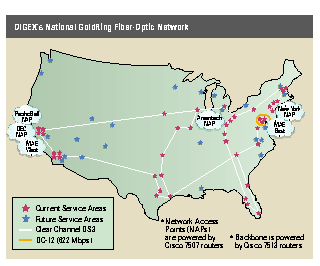
DIGEX relies on Cisco as its end-to-end networking solution provider to supply core backbone routers, remote office routers, and dialup access servers. DIGEX also sells Cisco solutions to its customers.
"Dealing with a single vendor brings efficiencies and economies of scale for troubleshooting and support, both internally and as it pertains to our customers' own support needs," Heintzelman points out. "Business customers will not put their critical applications on the Internet until they know that they have the right uptime and performance. We use end-to-end Cisco solutions because they give us far better control over the quality of the service we provide."
| ELEMENTS OF SUCCESS |
|---|
| DIGEX's Top 3 1. Reliability 2. Performance 3. Customer Service |
| When asked what the top three factors were that made this project a success for DIGEX, Heintzelman responds, "One hundred percent uptime, outstanding performance, and high-quality customer service. These are three of the essential ingredients for an ISP. My background is in the telecommunications industry, where quality of service has been the rallying cry for decades, so I know the importance of these objectives. Thanks in part to Cisco's innovative networking solutions, we continue to differentiate ourselves from other ISPs by the quality of service we deliver." |
___________________________________________________________________________________________________________
Many of today's IBM network managers are caught in a difficult position as they attempt to balance yesterday's investments in Token Ring networks with the promise of more advanced, low-cost switching solutions. Cisco Systems is helping these managers out of the bind with a family of next-generation Token Ring switches that enhance the capabilities and effectiveness of existing Token Ring networks.
The new family of solutions includes the Catalyst® 3900 Token Ring switch and the Catalyst 5000 Token Ring switching module. "The first generation of Token Ring switches fell short of meeting all the demands of today's enterprises," says Kevin Tolly, President and Chief Executive Officer of the Tolly Group (Manasquan, New Jersey). "Network managers are seeking switching solutions that combine all the best features and functionality of the first-generation switches, but at a lower cost per port."
The new platforms round out Cisco's switching product line with Token Ring solutions for both desktop and backbone. The Catalyst 3900 is designed as an end-to-end solution in pure Token Ring environments at a price point that encourages switched network services to the desktop. The Catalyst 5000, with its media-independent backplane and fault-tolerant features, is ideal for mixed LAN and switched backbone environments. Both switches offer a choice of uplinks that include Inter-Switch Link (ISL) and Asynchronous Transfer Mode (ATM). They support virtual LANs (VLANs) by port, with the ability to have a separate spanning tree for each VLAN to prevent loops in the network.
"Cisco's second-generation Token Ring switching offerings bring all the benefits of high-performance LAN switching technology to shared-media Token Ring installations," notes Eric Teagarden, Product Manager for Cisco's Token Ring switching solutions. "The new technology is ideally suited for LAN microsegmentation and backbone interconnect applications."
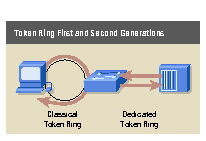
According to industry analysts, the introduction of the new Cisco products couldn't have happened at a better time. A recent study by the Dell'Oro Group (Portola Valley, California) projects that the market demand for Token Ring switching will grow to nearly US$1 billion by 1999.
"Second-generation Token Ring switching extends the life of existing Token Ring configurations, eliminating the shortcomings seen in earlier switches," Teagarden concludes.
Cisco is offering a program for current users who want to upgrade from Cisco's Catalyst 1600, 1800, and Catalyst 2600 Token Ring switches. For more information on this program, visit the URL http://www.cisco.com/warp/public/729/Token/index.html , or call your Cisco sales office.
___________________________________________________________________________________________________________
By Anura Guruge
According to Network Consultant Anura Guruge, second-generation Token Ring Switching is just the shot in the arm that IBM LANs need.
Second-generation Token Ring switching, as epitomized by recent product releases from Cisco, is a windfall and a much-needed fillip to the IBM LAN community and comes at a juncture when many have concluded that all LAN-related innovations are now confined to Ethernet technologies. Second-generation Token Ring switching significantly extends the productive life of any and all Token Ring configurations, and further maximizes existing investments in Token Ring. It is a persuasive alternative to a wholesale migration toward Fast Ethernet.
Second-generation Token Ring switching cogently and cost-compellingly addresses most, if not all, of the concerns currently besetting IBM LAN users, which include enhancing workgroup bandwidth, reducing backbone congestion, increasing LAN server throughput, improving network management, minimizing spurious broadcast traffic, and establishing migratory paths to broadband networking methodologies such as Asynchronous Transfer Mode (ATM). Second-generation Token Ring switching finally and credibly vindicates the potential, promise, and power of contemporary LAN switching à la Token Ring. 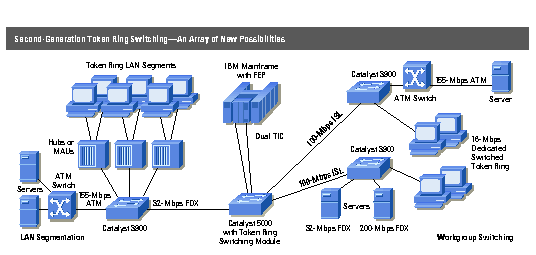
A relatively complex technology, Token Ring switching must deal with multiple forwarding modes (such as source-route, transparent, and source-route transparent bridging), as opposed to the single mode used by Ethernet, and handle value-added Token Ring-specific features such as ring numbers. Moreover, Token Ring environments, unbeknownst to many, have more nuances and idiosyncrasies than one would expect from a mature and supposedly standards-based technology. Consequently, the first-generation Token Ring switches that appeared on the market during the last 18 months at best provide only a glimpse of what is truly possible. Across the board they lack key features such as full-duplex mode, and some are plagued with serious reliability issues.
Second-generation Token Ring switches -- in particular, the new Cisco offerings -- eradicate all of the shortcomings seen in earlier switches and provide a range of solid and reliable solutions, replete with exciting new functionality such as 100-Mbps "Fast Token Ring" full-duplex uplinks, with no block size restrictions, for LAN server attachment and interswitch communications.
The key features of second-generation Token Ring switches include:
With Cisco's second-generation Token Ring switching, network administrators will find themselves in the somewhat unaccustomed situation of not having to make compromises when selecting a switch, whether it be related to feature set, price, migration options, or potential LAN configurations.
Token Ring switching has always had the potential of economically enhancing the throughput of existing LANs and minimizing backbone congestion with minimum disruption and very little risk. The second-generation switches not only make this potential a tangible reality, but build upon it in terms of greater performance, flexibility, and management. The new Cisco switching offerings bristle with functionality in every department, whether it be the various Token Ring forwarding modes, switching schemes, direct attachment, LAN server connection options, flexible virtual LAN (VLAN) configurations, and uplinks, incisive Remote Monitor (RMON)-centric next-generation LAN management, or powerful filters to eliminate unwanted broadcast traffic.
Cut-through switching and full-duplex mode operation, two functions that can noticeably expedite LAN and LAN server performance, are now standard features available on all ports of the Catalyst 3900. (The Catalyst 5000 module supports full-duplex mode and will support cut-through switching in a later release.) With cut-through capability, a switch begins forwarding the bits that make up a given Token Ring frame to its selected destination as soon as it has determined the relevant destination port -- without waiting to receive the end of the frame and checking the Frame Check Sequence (FCS) for any errors.
In many scenarios, cut-through switching -- which has a delay factor of only about 30 to 40 microseconds -- can be an order of magnitude faster than the store-and-forward scheme used by most of the first-generation switches. (With store-and-forward, the switch waits until it has received a complete frame before forwarding it to the destination port.) The new Cisco offerings support cut-through, store-and-forward, and a hybrid adaptive mode that automatically selects the optimum scheme based on a preset error threshold for a LAN port. Cisco also has leveraged the capabilities of its new, high-throughput Token Ring chipset to achieve minimal latency and optimal throughput from cut-through if the source and destination ports are within a four-port cluster served by a single chip.
Full-duplex mode, possible now with these new switches, ensures that Token Ring LAN servers equipped with full-duplex network interface cards (NICs) can operate at 32 Mbps -- sending data at 16 Mbps to a client PC while simultaneously receiving data at 16 Mbps from another. For those that want even greater server throughput, Cisco offers both 155-Mbps ATM uplinks with standard-compliant Token Ring LAN Emulation (LANE) and 100-Mbps InterSwitch Link (ISL) uplinks for full-duplex "Fast Token Ring" connections to servers.
The very low per-port cost of the new switching technology, moreover, ensures that Token Ring switching is now affordable for workgroup configurations, where individual PCs with existing NICs will be directly connected to the switch with dedicated bandwidth of 16 Mbps. At the same time, LAN servers and other hosts (that is, mainframes and midrange systems) that these PC users need to access will be available over high-speed uplinks, such as ATM.
Second-generation switching technology is also ideally suited and cost-compelling for LAN microsegmentation and backbone interconnect applications. If this isn't enough, Cisco's Catalyst 5000 with the Token Ring switching module delivers unsurpassed scalability, future 622-Mbps ATM uplinks, and unrestricted opportunity for interworking with other LAN media such as Fast Ethernet or, in the future, Gigabit Ethernet.
With Cisco's second-generation Token Ring switching offerings, IBM LAN users can finally enjoy the true benefits of contemporary, high-performance LAN switching technology; have seamless access to broadband ATM; and in addition, have a viable alternative to defecting to Fast Ethernet. Second-generation Token Ring switching is feature rich, ASIC powered, extremely cost effective, and above all, stable and reliable. Now, rather than having to think about costly and hugely disruptive migrations toward other LAN media, network administrators can easily extend the productive lives of their Token Ring environments well past the year 2000 by the judicious use of second-generation Token Ring switching.
| Anura Guruge is an independent technical consultant who specializes in all aspects of LAN/WAN internetworking for IBM environments, with special emphasis on SNA-capable intranets, Frame Relay, and ATM. He authored the recently published Reengineering IBM Networks (John Wiley & Sons) and the best-selling SNA: Theory and Practice (Elsevier/Pergamon). Anura's e-mail address is aguruge@mcimail.com. |
___________________________________________________________________________________________________________
For one London-based financial services company, trading offices has been a great deal more challenging than trading stocks and bonds. BZW is the UK-based global investment bank of the Barclays Group, with operations that had been spread over several sites in London and worldwide from Kuala Lumpur to New York.
In June 1994, BZW initiated plans to merge all of its London operations into a new headquarters in the city's Canary Wharf area. The new site would also serve as a blueprint for similar BZW offices around the world, enabling the company to provide worldwide IT support from London. Planners for BZW insisted on an infrastructure that was technically advanced, yet based on technology with proven dependability.
Dependability was of the utmost concern. BZW's 1000+ traders buy and sell equities, commodities, and foreign exchange currencies totaling in the millions of pounds each trading day. Mission-critical applications deliver up-to-the-second market data from Reuters, Bloomberg, and other providers. Information must be available instantaneously or the firm risks sizable losses.
The consolidation project gained approval in January 1995 and an infrastructure plan was drawn up by January 1996. BZW spent the next year designing, installing, and implementing the systems. The first users moved in during March 1997.
Trial networks based on the design for Canary Wharf were installed in Hong Kong and later in Milan and Madrid, allowing BZW to gain experience with Cisco Systems' Catalyst® 5000 switch, using Ethernet and Fast Ethernet switching technology.
The scale of the BZW consolidation project was impressive. Pinnacle, the cabling contractor, estimated that within the 700,000 square feet of office space at Canary Wharf, they ran 7 million miles of cable to more than 100,000 outlets -- the largest cabling job ever in the UK.
The diversity of existing legacy systems and applications was also mind-boggling. BZW had in excess of 400 business applications running on nearly 100 mainframes and large UNIX servers accessed by over 4000 users working on 20 different types and configurations of desktops. Four-hundred servers supported file, print and network services. The network also supported many information feeds from Reuters, Dow Jones, and other information services.
At the new headquarters, BZW decided to standardize on Compaq workstations and servers running Windows NT for the 750 dealing positions on each of three dealing floors. These workstations accommodate up to four Pentium processors, 64 MB of memory, and at least two hard drives -- with some dealers requiring as many as five screens and two workstations.
These high-powered computer platforms require a high-performance network to ensure that critical financial information is displayed in real time. BZW selected Cisco Catalyst 5000 switches, which can deliver the level of performance needed and handle future expansion as well. The Catalyst's flexible architecture allowed the bandwidth to be applied when and where it was needed. All together the network deploys approximately 160 Catalyst 5000s and about 38 Cisco 7500 core routers, with a further 10 Cisco 7507 routers providing connection to BZW's metropolitan-area network (MAN).
The BZW Canary Wharf network architecture is based on a modular design that enables BZW to scale the infrastructure from tens of users to several thousand. Each floor or switching domain consists of several user switches or access switches connected to two Catalyst 5000s. Each domain supports up to eight virtual LANs (VLANs), with 10-Mbps user connections to the network and server.
Each VLAN has dedicated 100-Mbps Fast Ethernet connections into a pair of Cisco 7500 routers running the Hot Standby Routing Protocol (HSRP) for IP resilience. Connectivity between domains is provided by a pair of Catalyst 5000s acting as high-speed backbones, with four Cisco 7500s providing routed connections to the MAN.
All software on the workstations is standard, and user-configured software sits on a server. If a workstation breaks down, a user can move to a spare desk, log on to the system, and be up and running in seconds with an identical display. The same standardization applies to back office desktops. The network can accommodate configuration changes quickly from the central management station, which runs CiscoWorks for Switched Internetworks (CWSI), with the help of VLAN capabilities on Catalyst switches.
Moves take place regularly. A hundred people can be moved easily overnight or over a weekend -- a task that used to take days. This ability to physically shift workers quickly from one spot to another is also important for teams of traders who may need to form or disband and regroup. Sudden changes in the market often mobilize such teams at BZW -- for instance, one or more governments might decide to delay adoption of the Euro as a single currency throughout Europe, triggering immediate market response.
The task of consolidating multiple offices into one required sophisticated logistics. Moving systems and people simultaneously over one weekend posed too great a risk. Colin Austin, BZW's Head of Global Networks, managed that risk by moving systems ahead of people. "If a move didn't work, we wanted to be able to put everything back the way it was by Monday morning," says Austin. 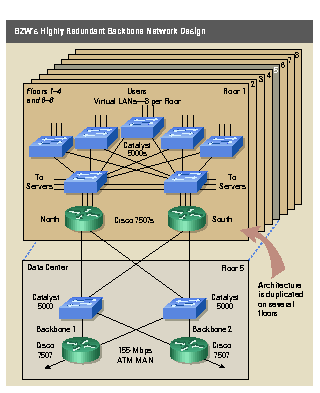
To enable this strategy, Austin's team installed temporary additional bandwidth to augment the FDDI MANs that linked the existing London locations with the new Canary Wharf site. A parallel 155-Mbps Asynchronous Transfer Mode (ATM) MAN now links the company's existing four offices with the new building. Users operate remotely until each group physically moves to Canary Wharf. As groups move out of their old locations, temporary MAN links are disconnected. Hardware for the entire network, including the ATM MAN, is provided by Cisco products. As of press time, approximately two-thirds of the employees have made the move, with a new department -- approximately 200 people -- relocating each weekend. All employees will be in the new quarters by October 1997.
Even as the project winds down, BZW is already considering plans for the future. "BZW intends to ensure that our IT remains state-of-the-art, requiring us to reengineer our applications," says Austin. "To stay ahead of these new applications, our IT group will need to understand the different products and the different ways of doing business around the world. We must have the network infrastructure in place before these new applications roll out." Future network enhancements include IP Multicast, Fast EtherChannel®, and Gigabit Ethernet.
| ELEMENTS OF SUCCESS |
|---|
| BZW's Top 3 1. Teamwork 2. Technology 3. Internal Commitment |
| Colin Austin, BZW's Head of Global Networks, points to the three key elements that made this project a success. "The most important element was the teamwork and dedication of BZW, Cisco, and NCR, our supplier of Cisco equipment," says Austin. "The second element was the technology, which has proven to be extremely reliable and stable. That is a tribute to our design effort and our taking the time to select the right products. The third key element was the financial commitment right from the beginning by our top management to do it right and design an infrastructure from the ground up." |
___________________________________________________________________________________________________________
Today's networking environments are becoming increasingly large and complex. As these networks grow, the need for reliability and responsiveness increases. To address these realities, Cisco has developed the Network Supported Accounts (NSA) program to provide customers with personalized, proactive, and expert consultative network support.
A perfect match for such a service is First Union Corporation (Charlotte, North Carolina). This large, multistate bank selected Cisco's advanced network services to establish itself as a premier, service-oriented bank, providing innovative remote services to its customers. This requires a balance between "24 by 7" uptime (24 hours a day, seven days a week) and complete network reliability for such uses as network data centers, ATMs, and overseas transactions. To complicate matters, First Union's full-service banking network has grown to more than 2000 offices -- serving 12 million customers from Connecticut to Florida -- and is the sixth-largest banking company in the USA with the nation's sixth-largest automated teller machine network. This network is supported by more than 500 Cisco routers and 350 Cisco switches.
When First Union's ability to deliver around-the-clock availability and service levels was challenged by continual expansion of its network, coupled with the complexities of implementing next-generation routing and switching platforms, the company looked to Cisco for assistance.
Cisco's NSA program is a premium, consultative service offered for customers who have dynamic, fast-growing networks. Each NSA customer has access to an on-call engineer who is designated to their account and knowledgeable in the details of their specific network. All program engineers are highly qualified Cisco Certified Internetwork Experts (CCIEs) or senior networking engineers. Equipped with network topology maps and configuration information, these specialists work closely with the customer's internal network design, implementation, and operations groups, functioning as an extension of the customer's own network support resources.
The NSA program has proven vital to the success of First Union's network. "With a required uptime of over 99 percent for a highly complex and innovative network, First Union places a high value on the benefits of Cisco's NSA program," says John Burns, Network Systems Engineer at First Union. "Providing expertise in consultation, planning, design, and operating system migration, the NSA program helps us take full advantage of the capabilities of our network."
For more information on the Network Supported Accounts program, visit http://www. cisco.com/warp/public/625/nsa/index.html .
| ELEMENTS OF SUCCESS |
|---|
| First Union's Top 3 1. Teamwork 2. Involvement 3. Networking expertise |
| John Burns, Network Systems Engineer at First Union Corporation, points to the three components of success for this project. "The most important factor was teamwork," says Burns. "Our NSA representative serves as part of our team and really takes ownership of our network." Second is involvement. Having a qualified engineer constantly available has been very beneficial to First Union. "We have daily involvement from our NSA contact, and the fact that he's so familiar with the details of our network means he can address our specific issues quickly and easily." The third most important component is First Union's access to networking expertise. "It's reassuring to know that our contact can track down the high-level expertise at Cisco to work through any possible network situation." |
___________________________________________________________________________________________________________
Web Services and Features Help Customers Do Business
Cisco Connection Online (CCO) is many things to many people -- but to everyone who uses it, CCO is a powerful resource for information and access to services. To be successful, to be competitive and, for many companies, to even survive in the global marketplace today, organizations must leverage their networks, opening up their corporate information structure and operational systems to customers, partners, suppliers, and employees. This is the Global Networked Business model, and CCO is the industry's leading example of how to implement a globally networked business.
CCO offers comprehensive online customer support and commerce services, providing extensive Cisco product information, online problem solving tools, and networked commerce applications. CCO lets customers handle all their business on line, from checking the status of orders to troubleshooting network problems. And with more than 550,000 logins each month, users are certainly making use of CCO.
Steve Bober, purchasing administrator with Westinghouse Communications, an outsourcing provider of voice and data services in Pittsburgh, Pennsylvania, is a regular CCO user. He has been using the Order Status Agent and Pricing Agent for more than a year and began using the Internetworking Product Center (IPC) ordering applications in May.
Bober has been purchasing Cisco equipment for seven years. "Before the supporting applications, it could take me half a day to get the status of an open order. Now it takes just seconds," says Bober. "I can get status information to my internal customers much more quickly and that makes me more effective for my company."
Availability of the ordering and supporting applications has streamlined the entire equipment ordering process for Bober. "The big advantage is the speed with which orders get into the factory. I can enter orders in the morning, and by afternoon, I have an estimated ship date. If I need to find out the status of an order, I can do that immediately. And if something has been shipped, the supporting applications provide me with the tracking number. This is particularly helpful when we drop-ship materials to customers," says Bober.
The system obviously works well. In a recent promotion for Cisco 2500 series products, for example, customers were promised a one-week delivery. "We had some orders that went out and were delivered within a few days," recalls Bober.
The use of CCO extends beyond the purchasing department at Westinghouse. The engineering department uses the Configuration Agent to configure networks. And when the engineers need a different version of software, they notify Bober, who places a purchase order. But they don't wait for the software to be shipped; they simply download it from CCO immediately. Project managers also use the Status Order Agent to track orders. "Sometimes they don't even bother to call me. They look it up themselves, which saves me time," says Bober.
Bober is sold on the benefits of CCO. "I can get an order placed right away, and I can get status on that order right away, even when it's 5 a.m. at the factory in California," he concludes.
___________________________________________________________________________________________________________
Following customer research and a completely different approach to product design, Cisco has launched its Ease-of-Use initiative, designed to make routers easier and more cost effective for customers to install and manage. Offerings that incorporate Ease-of-Use initiative features include the new Cisco Fast StepTM and ConfigMaker products, as well as ISDN Support Services.
Cisco Fast Step, an easy-to-use Windows 95 and NT 4.0-based tool, simplifies the setup and monitoring of Cisco routers for small office and home office users. The Cisco Fast Step setup software, along with new easy-to-follow instructions and a match-the-colors cabling design, allows even nontechnical users to connect a Cisco 700 series router to the Internet or corporate intranet -- all in less than 30 minutes. And after completing setup, customers can check the Cisco Fast Step Monitor for an instant reading of router status and the usage times of the Integrated Services Digital Network (ISDN) connection.
Customers purchasing Cisco 1000, 1600, 2500, and 3600 series access routers can use the new ConfigMaker application. The powerful Windows 95-based tool guides network administrators of small and midsized businesses through configuration of a small network of routers.
With ConfigMaker, installing and configuring a single Cisco router or network of Cisco routers is as simple as drawing a network diagram. ConfigMaker leads users step by step through network design and addressing and automatically delivers the correct configuration files to each Cisco 1000, 1600, 2500, or 3600 series router on the network -- all from a single workstation.
Cisco service products ensure that customers will achieve maximum utility performance and uptime from their network. Cisco offers ISDN Support Services at no cost to customers to help them quickly establish connectivity for their Cisco ISDN devices.
The Cisco ISDN Support Service is offered to users of Cisco's ISDN routers and access servers. Cisco's ISDN Support Service provides a single point of contact for users to gain assistance with setting up an ISDN connection and connecting Cisco equipment. Cisco support representatives work closely with users to capture information for their Internet service provider and long distance carrier, while helping to make the transition to ISDN easy.
These offerings result from over a year of research, and create a vast improvement in product usability for small office and home office users and network administrators in small or medium-sized businesses. For more information on the Ease-of-Use initiative, visit http://www.cisco.com/warp/public/769/ease.html .
___________________________________________________________________________________________________________
As part of Cisco's company charter, increases in customer satisfaction ratings go hand-in-hand with its success. To that end, customers in 30 countries were asked to participate in Cisco's annual customer satisfaction survey by answering questions about Cisco products, services, support, and field sales.
More than 1100 randomly selected customers in a wide range of industries indicated an overall increase in satisfaction in the USA to 4.15 (on a 5-point scale) from 4.13 in 1996. In Europe the figure increased to 3.85 compared with 3.74 last year.
The significant improvement in Europe is attributed to Cisco focusing more intently on customers and introducing new programs targeted at increasing customer satisfaction. The most significant new program is a sales model implemented in Europe that helps customers by using account managers and sales engineers to explain the capabilities and benefits of Cisco products and end-to-end solutions in users' networks.
Cisco users worldwide gave Cisco their highest marks in the categories of customer loyalty, product quality and reliability, and accuracy of product shipments, although they identified contract service offerings, timely problem resolution, and quality of software releases as areas for Cisco to improve.
"As the bar is raised with customer expectations, both Cisco and its partners need to address customer concerns to ensure success moving forward" says James Richardson, President of Cisco's European Operations. To address various customer concerns, Cisco is initiating several improvements targeted for customers:
Cisco's dedication to customer satisfaction is a cornerstone of its long-term success, and its continuous dedication and efforts to improve these satisfaction ratings can ultimately help customers experience success in their businesses.
___________________________________________________________________________________________________________
Cisco's Global Networked Business (GNB) model received an award of merit as a finalist in the Computerworld Smithsonian Awards Program and joins other nominees as part of the Smithsonian Institution's permanent collection in Washington, D.C.
In its ninth year, the Computerworld Smithsonian Awards Program was created to identify and honor those whose visionary use of information technology produces social, economic, and educational progress.
As part of the 1997 Innovation Collection, Cisco's GNB model helps enrich the Smithsonian's growing permanent collection covering the Information Age and becomes part of a national treasure that documents how information technology is being used to shape society and improve our world.
Cisco's GNB model exemplifies for customers the role that technology plays in all of our lives. Cisco Connection Online (CCO), the world's largest networked commerce Internet site, supports more than US$5 million in sales a day while providing improved customer service. (For more information on Global Networked Business, see PacketTM magazine, Second Quarter 1997.)
"Cisco Systems is using information technology to create strides toward remarkable social improvement in business," says Dr. David Allison, Chairman of the National Museum of American History's Division of Information Technology and Society. "We are delighted to have this excellent example of how information technology is being used to improve our world included in the national collection."
Cisco's inclusion in the Smithsonian Institution's Permanent Research Collection is located at the National Museum of American History in Washington, D.C. For more information on Global Networked Business, visit http://www.cisco.com/gnb .
___________________________________________________________________________________________________________
Highly qualified networking technicians are in great demand today. The Information Technology Association of America recently reported that there are approximately 190,000 unfilled positions for information technology employees in the USA alone. Lack of skilled workers was cited as the primary reason for this problem.
To help prepare students for jobs in the computer networking industry, Cisco has created the Networking Academies program. Launched in partnership with US schools, the program seeks to educate and certify high-school and community college students in computer networking.
Beginning in September 1997, the program will be available in 50 high schools and community colleges throughout the USA, with plans to expand to 400 sites by September 1998. The program will be taught by educators as part of the regular school curriculum, teaching students the conceptual and technical skills necessary to design, install, operate, and maintain state-of-the-art computer networks. Following completion of a four-semester curriculum, including hands-on experience in an internship program, students will become eligible to take an exam for Cisco Certified Network Associate (CCNA) certification.
Cisco staff members train trainers appointed from various school districts to deliver a Cisco-developed multimedia curriculum using the Cisco Micro Webserver. The Micro Webservers contain lesson plans, simulations, content updates, and connectivity demonstrations, as well as other support for both teachers and students. These trainers, in turn, train local teachers in the use of the online curriculum.
| Join the Program |
|---|
| Schools are invited to partner with Cisco to further expand the Networking Academies program. For more information on Cisco's education programs, visit http://www.cisco.com/edu . |
___________________________________________________________________________________________________________
In a move that strengthens the quality of the emerging high-technology work force, DalTech College, within the University of Dalhousie (Halifax, Nova Scotia), has joined with Cisco to create a one-year interdisciplinary Masters of Engineering in Internetworking program.
Starting in September 1997, the master's-level program will consist of ten courses and a project during a 12-month period. The program at DalTech (previously the Technical University of Nova Scotia) will not only cover the state of current internetworking technology, but will provide theoretical background to analyze the technology's strengths and weaknesses, its evolution, and the impending industry changes that lie ahead.
Cisco Systems helped to design this program and co-sponsors it with Maritime Telegraph & Telephone and Telecommunications Applied Research Association. Taught by an interdisciplinary team of educators, the curriculum is geared toward both seasoned networking professionals who want to expand their scope of knowledge and those less familiar with internetworking who want to enter this high-demand, high-paying field. Graduates will be well-versed in networking technology and positioned for success in many facets of the networking industry.
"We're proud to offer this first-of-its-kind program" says Dr. Bill Robertson, Head of the Electrical and Computer Engineering department at DalTech. "With our expertise and sponsorship from industry leaders, we've created a winning combination for both students and the networking industry at large."
In bridging the gap between traditional academic endeavors and industry needs, DalTech hopes that other universities will look at the program as a benchmark and create similar internetworking programs for their students.
| Program Overview |
|---|
| For more information on the Masters of Engineering in Internetworking program at DalTech, visit http://www.dal.ca/internetworking . |
___________________________________________________________________________________________________________
Governments are holding hearings on the problem. Newspapers and television have predicted disaster. Year 2000 T-shirts and coffee mugs are offered on the Internet. The Gartner Group consulting firm estimates it will cost up to US$600 billion to fix the problem worldwide, and that estimate is mounting.
To ensure that Cisco products recognize 2000 as a valid date and transition smoothly into the next millennium, Cisco has undertaken a company-wide initiative and put an active program in place to address the year 2000 challenge.
Key to Cisco's strategy is a definition that explains the nature of compliance and will serve as a company standard. The Cisco compliance definition is based on standards set by the US federal government, which will spend billions of dollars to ensure that its own network is ready for the next century.
Cisco's goal is to have 70 percent of its eligible products compliant by the end of 1997, with 100 percent compliance by April 1998. To that end, rigorous product testing of all eligible Cisco IOSTM-based software and hardware products is under way. Cisco is also requiring that its suppliers demonstrate delivery of year 2000-compliant products. This strategy will provide customers with a smooth transition into the year 2000.
Cisco has also applied to receive compliance certification from the Information Technology Association of America (ITAA) for its year 2000 project plan by the end of 1997. Certification from an external auditor such as ITAA will give impartial, expert validation to Cisco's compliance strategy.
For information on Cisco's year 2000 project plan, including a listing of products and software releases that have been tested for compliance, visit http://www.cisco.com/warp/public/752/2000/index.html .
___________________________________________________________________________________________________________
The Internet Engineering Task Force (IETF) recently approved final standards for the Resource Reservation Protocol (RSVP), a protocol developed to let applications designated as high priority reserve bandwidth on IP networks.
RSVP, a signaling protocol for IP unicast and multicast sessions, is designed to handle IP traffic streams generated by applications such as data-link switching (DLSw) or networked multimedia. It allows users to request quality-of-service (QoS) behavior, such as setting fair queuing weights or opening separate ATM virtual channels, for identified traffic across IP networks. Implementation of RSVP as a standard will allow enterprise customers as well as Internet service providers (ISPs) to offer their end users differing levels of service network-wide for specific high- and low-bandwidth uses.
"We believe that RSVP services will help enterprise customers and ISPs to identify traffic that has large volume and needs special services, like network multimedia traffic," says Fred Baker, Chairman of the IETF. "My guess is, however, that the big win will be for bread-and-butter traffic, like reserving bandwidth for DLSw."
The standardization of RSVP has paved the way for an unveiling of reserved-bandwidth product offerings. To show its commitment to the protocol, Cisco has included RSVP in Cisco IOSTM Software Release 11.2, while several major networking vendors, software developers, and large ISPs have also started building RSVP into their product offerings.
To learn more about RSVP, visit http://www.isi.edu/div7/rsvp/rsvp.html .
___________________________________________________________________________________________________________
To help customers begin planning for integration of their data and voice networks, Cisco has made several recent acquisitions and partnerships to further develop this growing market.
With the deregulation of the telecommunications industry, carriers are increasingly offering services that integrate voice, video, and data over common communication channels. As a result, the demand for low-cost, easy-to-use, multiservice access products for new carrier services is rapidly expanding.
In July, Cisco acquired Ardent Communications (San Jose, California), a pioneer in designing combined communications support for compressed voice, LAN, data, and video traffic across public and private Frame Relay and Asynchronous Transfer Mode (ATM) networks.
For customers with bandwidth needs of T1 and above, ATM is gaining popularity as an access alternative to Frame Relay. ATM lends itself to voice, video, and data transport and can help users of multiservice access devices save a great deal by trunking all of their voice traffic over the same T1 lines that carry data traffic.
The Ardent acquisition complements the Cisco 3800 series of multiservice access devices for branch offices and remote sites by improving integration of voice, video, and data.
Also in July, Cisco acquired privately held Skystone Systems Corporation, a leading developer of high-speed Synchronous Optical Network/Synchronous Digital Hierarchy (SONET/SDH) technology based in Ottawa, Ontario, Canada. The Skystone acquisition underscores Cisco's commitment to offering products employing IP over SONET/SDH.
SONET/SDH is an emerging technology used for carrying information in very high-capacity backbone networks such as those operated by telecommunications carriers and large Internet service providers. These companies all see large growth opportunities in offering IP data services over fiber-optic infrastructures. SONET/SDH is the preferred technology in this arena, with broad deployment likely in traditional carrier networks, new carrier networks, and corporate-campus environments.
Cisco plans to leverage Skystone's SONET/SDH transport technologies for integration into Cisco products, including backbone routers and WAN switches. The Skystone site in Ottawa will become Cisco's technology center for SONET/SDH to develop and accelerate this leading-edge technology for the service provider market.
Alcatel Telecom (Paris, France) and Cisco agreed in June to a broad, strategic alliance that includes the development of networking equipment to meet the growing demand to integrate the Internet with public telecommunications networks.
Plans include joint development of products for the network backbones used by phone carriers to handle large volumes of customers' traffic and integration of Cisco IOSTM technology into several Alcatel products used by service providers. Initial applications include adding Cisco routing technology to Alcatel's ATM and Integrated Services Digital Network (ISDN) switches.
Also as part of the agreement, Alcatel plans to use Cisco's new routing technology known as Tag Switching to transmit high-speed IP traffic over ATM networks, and Cisco intends to back Alcatel's high-speed network access technology known as Asymmetric Digital Subscriber Line (ADSL) and to integrate and market Alcatel's ADSL modems, chips, and products in its own systems.
As voice/video/data integration becomes adopted as a cost-effective means of interconnecting both public and private networks, Cisco's multiple efforts in this arena will serve to provide customers with comprehensive solutions. For more information about the Ardent or Skystone acquisition, visit http://www.cisco.com/warp/public/782/index.html . For details about the Alcatel alliance, visit http://www.cisco.com/warp/public/146/1903.html .
___________________________________________________________________________________________________________
To address the growing needs of WAN bandwidth, Cisco has signed an agreement to acquire Dagaz Technologies (Bridgewater, New Jersey), the Digital Subscriber Line (DSL) business of Integrated Network Corporation and an innovator in the area of Asymmetric Digital Subscriber Line (ADSL) technologies. The company has developed central office and customer premises technology that offers leading cost-effective solutions for delivering high-speed Internet or intranet access as well as voice/data integration over regular copper phone lines. Independent analyst IDC predicts that the US market for ADSL equipment will increase from approximately US$100 million in 1997 to over US$1.5 billion by the year 2000.
DSL technologies (collectively referred to as xDSL) provide high-speed transport for the "last mile" from central office to remote user. They are poised to solve the problem of high-speed access to many networked applications such as networked commerce, teleworking, and integrated voice, video, and data services, while using the existing twisted-pair copper wiring of the public switched telephone network.
Dagaz products complement existing Cisco xDSL offerings. The acquisition broadens Cisco's commitment to the growing DSL market and addresses key customer requirements-very high density, carrier-class products, voice-splitting capability, and upgradability. And with Dagaz technologies leveraging service providers' existing infrastructure and equipment, Cisco customers will be able to quickly deploy these new access solutions with minimal additional investment.
For more information about the Dagaz acquisition, visit http://www.cisco.com/warp/ public/146/1925.html .
___________________________________________________________________________________________________________
Centri Enhances Cisco's Firewall Expertise with Offering for Small and Medium-Sized Businesses
Firewalls are fast becoming a necessity as growing numbers of businesses open up their networks to Internet traffic for networked commerce, training, and networked information exchange. For the Windows NT firewall offerings, Cisco has acquired Global Internet Software Group, a subsidiary of Global Internet.Com Inc. (Palo Alto, California), its Centri Security Manager Windows NT firewall, and the Centri Security Manager for NT firewall policy console.
The Centri product will complement Cisco's enterprise-class PIX Firewall while Global Internet's Windows NT management software will allow small and medium-sized businesses to simply install the firewall in minutes. Graphical step-by-step instructions help the user determine appropriate security policies. This acquisition will enable Cisco to offer a Windows NT network firewall suite capable of examining credentials-including names, applications, IP addresses, and other inquiry characteristics-against access rules set up by the systems administrator.
Cisco is committed to supporting this suite of firewall products to meet customer requirements. While the Cisco PIX Firewall is ideal for enterprise customers, Global Internet's Centri product is an easy-to-use, affordable solution for small and medium-sized businesses, which are often without network staff to design, build, and support their network security structures.
For more information on Cisco's security solutions and the Global Internet Software Group acquisition, visit http://www.cisco.com/warp/ public/146/1905.html .
| Cisco Invests in TIBCO |
|---|
| Cisco Invests in TIBCO Cisco Systems has made a minority investment in TIBCO Software, Inc. (Palo Alto, California), a maker of "push" applications, addressing the need for sophisticated content-filtering schemes that allow users to be selective about what arrives on their PCs. To read more about the relationship and push technology, see "Cisco, TIBCO 'Push' Technology..." |
___________________________________________________________________________________________________________
Cisco's advanced 56-bit networked security and encryption products are now exportable to all US commercial trading partner countries with minimal export controls. Existing Cisco products, including the 56-bit DES PIX Private Link interface adapter and Cisco IOSTM 56-bit software, are globally available without modification.
Cisco has worked with the US Department of Commerce to reduce the burden of encryption export licensing, making it the first networking vendor to offer broad availability of strong encryption products to countries qualified as US commercial trading partners. The US government formerly required four to six weeks to review export license applications.
"We applaud Cisco's commitment to customer needs, government concerns for recoverable encryption, and industry interoperability," says William Reinsch, US Commerce Undersecretary for Export Administration.
With networks increasingly becoming the hub of modern business, data security is a major concern. Data encryption enables the secure transmission of sensitive information such as currency transmissions, personnel records, and research reports without fear of unauthorized review or modification. Encryption, considered to be the best available security technique, is the process of transforming intelligible information (clear text) into an unintelligible state. These features help protect and provide a foundation for a secure network.
For more information about export-related encryption, visit http://www.cisco.com/wwl/export/encrypt.html .
___________________________________________________________________________________________________________
In the latest of a series of agreements between the two industry leaders, Microsoft Corporation and Cisco Systems recently announced plans to deliver a unified framework for directory services.
As part of the agreement, Cisco will license Microsoft's Active Directory for use in managing network infrastructures and providing richer network services. The two companies will also work together to develop extensions to Active Directory to integrate advanced management of network services. Products developed as a result of this agreement will make it possible for network managers to unify their network infrastructures and accelerate the development of improved network services using Cisco IOSTM software.
Service providers will be able to simplify service delivery and provide new sets of services for their customers. The results of the joint effort give customers lower total cost of ownership, single points of administration for all network resources, and the ability to provide differentiated network services with individualized policy control.
"The need for a consistent directory across network infrastructure, clients, and servers means that the directory service standard has now been set," says Jim Allchin, Senior Vice President in the Personal and Business Systems Group at Microsoft. In the past, directory services could not simultaneously meet all of the demands of both Internet and enterprise customers.
This agreement, aimed at accelerating the development of next-generation network-based applications such as networked commerce, will form the basis of global networked businesses in the future. For more information on the agreement and related alliances, visit http://www.cisco.com/warp/public/146/1870.html .
___________________________________________________________________________________________________________
PacketTM magazine is published quarterly and distributed free of charge to users of Cisco Systems products.
Direct address corrections and other correspondence to packet@cisco.com, or to Packet, in care of:
Cisco Systems, Inc.
170 West Tasman Drive
San Jose, California, 95134-1706
USA
Phone: 408 526-4000
World Wide Web URL: http://www.cisco.com
Editor-in-Chief Joanna Holmes
Assistant Editor Deanna Andreasen
Art Direction and Design Donna Helliwell
Production Emily Burch
Project Coordination and Circulation Carol Rolin
Online Production Anne McLeod Haynes
Published by the Cisco Systems News Publications Group
Special thanks to the following contributors: David Baum, Beth Bellemore, David Croasdale, Barbara Dallenbach, Tom Fermazin, Janice King, Steve Phillips, Bob Singleton, Adam Stein, Jackie Thrasivoulos, Joanie Wexler, Clare Whitecross, and the Cisco Graphics Group.
AccessPath, AtmDirector, Cisco IOS, the Cisco Powered Network logo, Fast Step, CiscoWorks, IGX, NetFlow, Packet, PIX, SMARTnet, and The Cell are trademarks; and BPX, Catalyst, Cisco, Cisco Systems, the Cisco Systems logo, EtherChannel, FastHub, ForeSight, IPX, LightStream, and StrataCom are registered trademarks of Cisco Systems, Inc. in the USA and certain other countries. All other trademarks mentioned in this document are the property of their respective owners.
Packet, copyright © 1997 by Cisco Systems, Inc. All rights reserved. Printed in the USA.
No part of this publication may be reproduced in any form, or by any means, without prior written permission from Cisco Systems, Inc.
Customers registered on Cisco Connection Online (CCO) can subscribe to Packet via the Web at http://www.cisco.com/warp/ customer/784/Packet_root.shtml .
|
|