


|
|

This chapter provides the following information:
The FastHub front-panel LEDs facilitate troubleshooting during system operation.
Table 5-1 lists symptoms and possible causes associated with system problems and provides corrective actions. See Table 5-2 to isolate faults associated specifically with the power distribution system.
| Symptom | Possible Cause | Corrective Action |
|---|---|---|
| System status LED is off. | Power cord is not connected. | Plug in both ends of power cord. |
| System status LED is solid amber. | Power problem related to FastHub main system board (not to internal power supply or RPS). | Call Cisco Systems. |
Port status LED is off. | Devices is not powered up. | Ensure both devices have power. |
| Cable connection is loose. | Verify connection at both ends of cable. | |
| Wrong cable type. | Verify cable type (crossover vs. straight-through). | |
| Incorrect wiring. | See the "Connectors and Cables" appendix for pinout information. | |
| Faulty cable. | Replace cable with a known good one. | |
| Defective RJ-45 connector. | Call Cisco Systems. | |
| Port status LED is rapidly alternating green/amber. | Autopartition, jabber, or isolated (carrier integrity error). | Verify port termination and check integrity of connected devices. |
Port status LED is solid amber (port disabled or autopartitioned). | Device at other end is malfunctioning. | Investigate device at other end of cable attached to disabled port. |
| Port is disabled. | Enable port through in-band or out-of-band management. | |
| System status LED is flashing amber. | POST failure. | Attach a monitor to the console port to display the diagnostic console. See the "POST Failures" section in this chapter for troubleshooting information. |
| System Status LED | RPS LED | Meaning |
|---|---|---|
| Solid green | Off | Power OK (RPS is not connected or RPS is not powered up). |
| Solid green | Solid green | Power OK (RPS is powered up and OK). |
| Solid green | Solid amber | Internal power supply is not powered up; RPS is connected but not OK. |
| Solid green | Flashing green | Internal power supply and RPS are powered up. Only one power source can be supplying power to the FastHub. If you are using the RPS, the FastHub power cord must not be plugged in. If you are using the internal power supply, the RPS can be connected but must be powered down. |
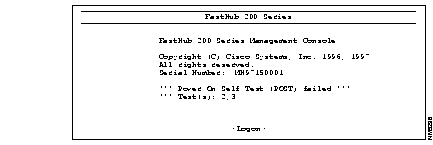
When the FastHub is powered up or reset, the FastHub begins its POST. Failure of the POST generates a "POST failed" message as shown in Figure 5-1. POST failures are usually not fatal, unless they happen to the RAM test or the timer interrupt test. When a nonfatal POST failure occurs, the repeater begins forwarding packets, but the system LED flashes amber, and a POST-failure message displays on the management console screen. See Table 5-3 for POST failure descriptions.
| Test Number | Failure Indication |
|---|---|
| 1 | Processor RAM functionality is lost. |
| 2 | Console port failure. Must use in-band management; other functionality not affected. |
| 3 | Ethernet address failure. Default addressing is used. |
| 4 | Timer interrupt functionality is lost. |
| 5, 6 | Real-time clock failure. System up-time functionality is lost. |
| 7 | Port loopback failure. Some port functionality is lost. |
The diagnostic console is a menu-drive interface that can be used in the following instances:
If the FastHub firmware has been corrupted, the Diagnostic Console Logon screen, shown in Figure 5-2, is displayed. Press Enter to display the other diagnostic console screens from the Diagnostic Console Logon screen.
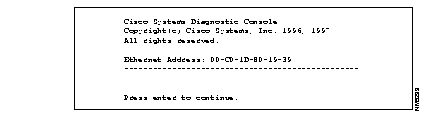
If the FastHub configuration prevents the firmware from executing properly and you cannot display the normal management console, you need to override the normal firmware startup and display the Diagnostic Console Logon screen by performing the following steps:
Step 1 Attach a monitor to the network management console port.
Step 2 There are two ways to override the normal firmware startup:
Press the LED MODE button on the front panel and hold it in. While holding in the LED MODE button, press the reset button.
The Diagnostic Console Logon screen is displayed.
The Diagnostic Console Systems Engineering menu (see Figure 5-3) is displayed after you log in from the Diagnostic Console Logon screen. Use the Diagnostic Console Systems Engineering menu to troubleshoot firmware problems and, after resolving the problem, to bring up the firmware.
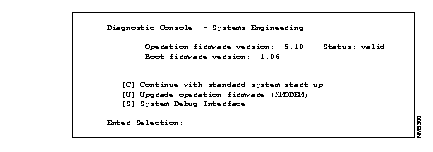
Operation firmware version: Status--Validity of the current firmware. If the current image is not valid, option C on the diagnostic console is not displayed.
Boot firmware version--Write-protected part of the firmware that supports the diagnostic console.
[C] Continue with standard system startup--Select this option after you have resolved the firmware problems with options [U] or [S]. It brings up the debugged or upgraded firmware.
[U] Upgrade operation firmware (XMODEM)--Select this option to initiate a firmware upgrade. This option works only with XMODEM and only uses the default EIA/TIA-232 parameters:
Use the following procedure to upgrade the firmware with the XMODEM protocol. This procedure is largely dependent on the modem software you are using.
Step 1 Select option U.
Step 2 When the first XMODEM request appears, use the appropriate command to start the transfer.
Step 3 The diagnostic console is displayed when the upgrade is complete. Press C to restart the FastHub using the upgraded firmware.
[S] System Debug Interface--Select this option to display the System Debug Interface menu, shown in Figure 5-4. You can use this menu to reset the network management console port or to reset the entire FastHub to factory defaults.
The Diagnostic Console System Debug Interface menu (see Figure 5-4) is displayed from the Diagnostic Console Systems Engineering menu. Use the Diagnostic Console System Debug Interface menu to reset the network management console port or to reset the entire FastHub to factory defaults. You can also use the management console to perform these functions.
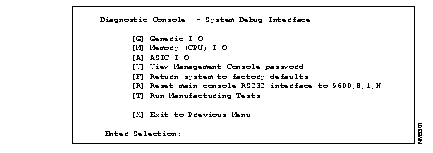
[G] Generic I/O--For Cisco personnel only.
[M] Memory CPU (I/O)--For Cisco personnel only.
[A] ASIC I/O--For Cisco personnel only.
[V] View Management Console password--Use this option to view the password currently assigned to the management console. If no password has been configured, the following message displays:
No password has been set.
[F] Return system to factory defaults--Use this option to return the FastHub to its factory default settings. All static and dynamic addresses are removed, as are the IP address and all configured system parameters. Enter Y or N and press Return. The changes take effect the next time the FastHub is reset.
[R] Reset main console RS232 interface to 9600, 8, 1, N--Select this option if you have lost the management console connection because of an improper modem configuration. The next time the FastHub is reset, the default RS-232 configuration is used.
[T] Run Manufacturing Tests--For Cisco personnel only.
Table 5-4 describes the various methods of resetting the FastHub.
 | Caution Resetting to factory defaults is not reversible; all system parameters revert to factory defaults, and the original configuration is irrecoverable. |
| Caution Resetting to factory defaults causes all ports to come up enabled. Ports that were previously disabled through "Port status" are enabled after the reset. |
| Results | Methods | ||||
|---|---|---|---|---|---|
Use the Management Console System Menu Actions | |||||
| Reset system action | Reset to factory defaults1 action | Reset repeater action | Use the Reset button | Unplug the power cord | |
| Resets hardware and firmware |
| ||||
|
Runs power-on self-test (POST) | |||||
|
Retains configured system parameters |
| ||||
|
Returns system parameters to factory defaults | |||||
|
Clears network- related statistics, learned addresses, etc. |
| ||||
| |||||
|
|