


|
|

This chapter contains detailed procedures for installing the Catalyst 2820 and 1900 on a table, shelf, or rack and connecting it to other devices. The first thing is to ensure that you have all the components. When unpacking the unit, turn to the "Packing List" section in the "Fast Install Guide" chapter for the list of included items.
The warnings in this manual are translated into several languages in the "Translated Safety Warnings" appendix.
Warning 
Do not work on the system or connect or disconnect cables during periods of lightning activity.
Warning
Do not touch the power supply when the power cord is connected. For systems with a power switch, line voltages are present within the power supply even when the power switch is off and the power cord is connected. For systems without a power switch, line voltages are present within the power supply when the power cord is connected.
Warning
Read the installation instructions before you connect the system to its power source.
Warning
This product relies on the building's installation for short-circuit (overcurrent) protection. Ensure that a fuse or circuit breaker no larger than 120 VAC, 15A U.S. (240 VAC, 10A international) is used on the phase conductors (all current-carrying conductors).
Warning
To prevent the switch from overheating, do not operate it in an area that exceeds the maximum recommended ambient temperature of 104×F (40×C). To prevent airflow restriction, allow at least 3 inches (7.6 cm) of clearance around the ventilation openings.
Warning
The device is designed to work with TN power systems.
Warning
This equipment is intended to be grounded. Ensure that the host is connected to earth ground during normal use.
Warning
Ultimate disposal of this product should be handled according to all national laws and regulations.
Warning
When installing the unit, the ground connection must always be made first and disconnected last.
Warning
Do not stack the chassis on any other equipment. If the chassis falls, it can cause severe bodily injury and equipment damage.
Warning
Only trained and qualified personnel should be allowed to install or replace this equipment.
Warning
Care must be given to connecting units to the supply circuit so that wiring is not overloaded.
Warning
A voltage mismatch can cause equipment damage and may pose a fire hazard. If the voltage indicated on the label is different from the power outlet voltage, do not connect the chassis to that receptacle.
The nature of rack-mounted equipment requires that the following guidelines be observed:
Follow these steps to install the unit in the rack:
Step 1 Use the included screws to attach the mounting brackets to the unit.
Step 2 Position the unit on the rack by lining up the mounting brackets with the holes in the rack, as shown in Figure 4-1.
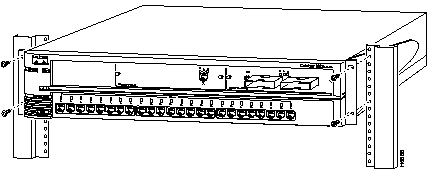
Step 3 Attach the Catalyst 2820 or 1900 unit to the rack with the four provided screws.
Step 4 Connect the power cord to the Catalyst 2820 or 1900 and to the power outlet.
The system LED turns green, and the Catalyst 2820 or 1900 automatically starts a series of self-tests described in the "Power-On Self-Test (POST)" section in this chapter.
Follow these steps to install the Catalyst 2820 or 1900 on a table or shelf:
Step 1 Attach the four rubber feet included in the shipping box to the bottom of the unit.
Step 2 Place the Catalyst 2820 or 1900 unit on the table or shelf near a power source.
Step 3 Connect the power cord to the Catalyst 2820 or 1900 rear panel and to the power outlet.
The system LED turns green, and the Catalyst 2820 or 1900 automatically starts the series of tests described in the "Power-On Self-Test (POST)" section in this chapter.
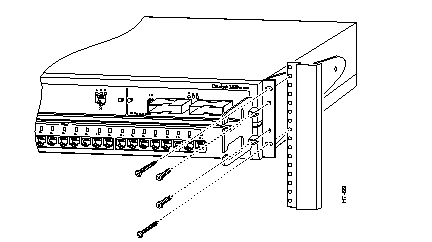
One cable guide is included with the switch. Attach this cable guide after you rack-mount the switch. Figure 4-2 shows the location of the cable-guide screws.
When the switch is first turned on and begins its POST, the system and port LEDs are green. As each of the 13 tests is run, the port LEDs, starting with number 16, turn off. Because there are only 13 tests, LEDs 15, 14, and 13 are unaffected.
If you are installing a 12-port Catalyst 1900, the LED for port A, the 100BaseT port, turns off first, followed by ports 12, 11, 10, and so on.
After the POST completes successfully, the port LEDs blink green and go off, indicating that the switch is operational. If a test fails, the port LEDs turn green, the port LED associated with the test stays off, and the system LED turns amber.
All POST failures except the real-time clock test (number 5) are fatal. If the real-time clock fails POST, the switch begins forwarding packets, but the system LED turns amber, and a POST-failure message appears on the console screen. Certain switch features, such as the bandwidth utilization meter, are lost if the real-time-clock test fails.
Once the Catalyst 2820 or 1900 is installed, you can begin connecting devices to its ports. Note that all UTP connections, whether 10BaseT, 100BaseTX, or FDDI UTP, must be within 100 meters of the Catalyst 2820 or 1900.
Use this procedure to connect to the 10BaseT ports.
Step 1 Insert the cable into a RJ-45 connector, as shown in Figure 4-3.
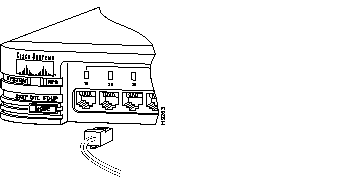
Step 2 Insert the other end of the cable into the RJ-45 connector of the target device. The port status LED comes on when both the unit and the connected device are turned on. If the port LED does not come on, the device at the other end might not be turned on, or there can be a cable problem or a problem with the adapter installed in the attached device. See the "Troubleshooting" chapter for more information.
Step 3 Reconfigure and reboot the connected device as needed.
Step 4 Repeat steps 1 through 3 for each device that needs to be connected.
Use this procedure to connect to the 100BaseTX ports.
Step 1 Insert the cable into the 100BaseTX port, as shown in Figure 4-4.
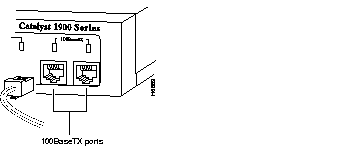
Step 2 Insert the other end of the cable into the RJ-45 connector of the target device. The port status LED comes on when both the Catalyst 2820 or 1900 and the connected device are turned on. If the port LED does not come on, the device at the other end might not be turned on, or there might be a cable problem or a problem with the adapter installed in the attached device. See the "Troubleshooting" chapter for more information.
Step 3 Reconfigure and reboot the connected device as needed.
Step 4 Repeat steps 1 through 3 for each device to be connected.
Use this procedure to connect to the 100BaseFX port A:
Step 1 Remove the rubber caps from the cable and insert the connector in the fiber-optic port, as shown in Figure 4-5, pushing until it snaps into place.
| Warning Class 1 laser product. |
| Warning Avoid exposure to the laser beam. |
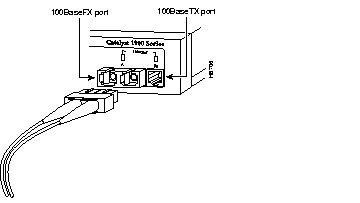
Step 2 Insert the other end of the cable into the 100BaseFX connector of the target device. The port status LED comes on when both the Catalyst 2820 or 1900 and the connected device are turned on. If the port LED does not come on, the device at the other end might not be turned on, the transmit and receive cables could be reversed, or there is a problem with the adapter installed in the attached device. See the "Troubleshooting" chapter for more information.
Step 3 Reconfigure and reboot the connected device as needed.
Procedures for installing Catalyst 2820 modules in the Catalyst 2820 high-speed expansion slots are included in the Catalyst 2820 Modules User Guide.
Use the AUI connector on the back panel to connect to an external transceiver for attachment to a thick coaxial, thin coaxial, or fiber-optic cable.
Step 1 Install the appropriate external transceiver on the network. Refer to the transceiver manual for installation instructions.
Step 2 Insert the AUI cable into the AUI connector on the switch, as shown in Figure 4-6.
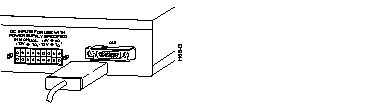
Step 3 Slide the latch into the closed position.
Step 4 Attach the other end of the cable to the transceiver.
Step 1 Using a null-modem cable, insert the serial connector into the receptacle, as shown in Figure 4-7. See Table A-3 in Appendix A, "Technical Specifications," for information on the pinout.
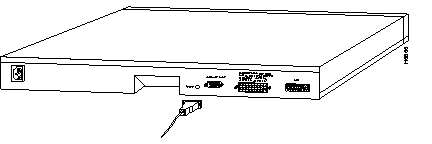
Step 2 Insert the other end of the cable into the terminal.
Step 3 Boot the terminal emulation program on your terminal.
The management console logon panel appears.
|
|