


|
|

After you have installed Resource Manager, the first thing you need to do to use the product is to populate the network inventory with devices.
The following sections are presented in this chapter:
Resource Manager enables you to manage and track your network inventory. You can import multiple devices or add them individually.
If you want to add only a few devices, add them individually. If you want to add a large number of devices, use the appropriate import feature.
After you have established how you will add devices, you can begin using Resource Manager to populate your network inventory. Resource Manager features the following methods to add devices to your network:
Each method supplies basic device information to the Resource Manager software. Use Add Devices to add individual devices. Use File Import to add multiple devices based on parameters specified in a Comma Separated Values (CSV) or Device Integration File (DIF). Use the NMS database import methods to import device information from a CiscoWorks, CiscoWorks for Switched Internetworks 1.3 (CWSI), HP OpenView, Network Node Manager (Windows NT), or SNMPc NMS.
Scenario: You have just installed Resource Manager, and you want to add a small number of devices to your network inventory.
To get started with Resource Manager, you might want to install just a few devices. Performing this task will provide you with a basic understanding of the device integration process and the kind of information that is maintained for each device. When adding a small number of devices, use the Add a Single Device method. This method uses online dialog boxes in which you enter access information and optional user attributes for each device.
To add a single device, perform the following steps:
Step 1 
Log in with administrator privileges.
Step 2 Click Admin on the button bar, then select Inventory > Add Devices.
The Add a Single Device dialog box appears. (See Figure 2-1.)
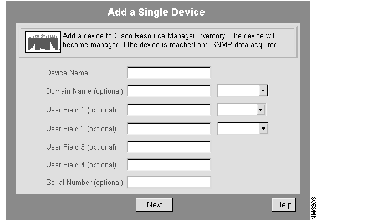
Step 3 Enter the access information in the Add a Single Device dialog box.
Step 4 Click Next.
The Add Passwords dialog box appears. (See Figure 2-2.)
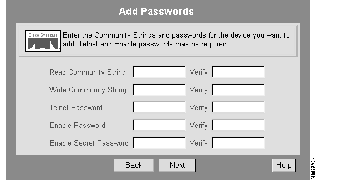
Step 5 Enter and verify the passwords in the Add Passwords dialog box, then click Next.
The Enter Authentication Information dialog box appears. (See Figure 2-3.)
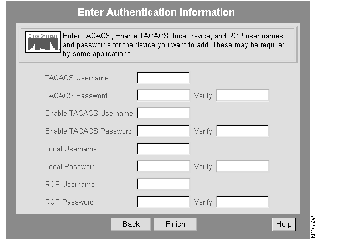
Step 6 Enter and verify the Terminal Access Controller Access Control System (TACACS) and remote file copy (RCP) names and passwords, then click Finish.
The Single Device Add dialog box appears. (See Figure 2-4.)
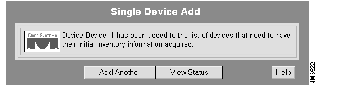
Step 7 To add another device, click Add Another and repeat steps Step 3 through Step 6. Otherwise, click View Status.
The Add/Import Status Summary dialog box appears. (See Figure 2-5.)
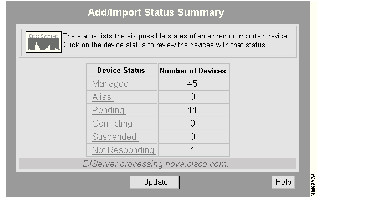
To check the status of devices you have added, click the Device Status links in the Add/Import Status Summary. The Add/Import status conditions are described in Table 2-1.
| Condition | Description |
|---|---|
| Managed | Devices currently managed by Resource Manager. |
| Alias | Devices reintroduced via a file add or import. |
| Pending | Unmanaged devices that can still become managed. |
| Conflicting | Unmanaged devices with the same DNS domain name and network host name as a currently managed device, but with one or more password elements that are different from the managed device. |
| Suspended | Unmanaged devices you have suspended in the Pending or Not Responding list or a managed device you deleted from the Resource Manager server. |
| Not Responding | Devices that are on an unknown host, are unavailable, are not responding to ICMP Echo requests, are not responding to SNMP Get requests, or do not support RFC 1213 (SNMP MIB II) attributes.
You can take the following actions with Not Responding devices:
|
Now that you have added one or more devices to your network inventory, you can configure device views, schedule inventory collection, run reports, and perform other Resource Manager tasks. Before you do so, read the following sections to learn how to import devices from a file or from a local or remote database.
Scenario: You have used Resource Manager to add devices one by one with the Add a Single Device task. Now you want to use Resource Manager to manage a larger number of network devices. You decide to import device information from a file.
You can import multiple devices by extracting data into a CSV file or DIF that you can later specify as input to Resource Manager. For ease of use, Cisco strongly recommends the CSV format. The CSV and DIF formats are presented in Appendix A.
Create the file using your own application, script, query language program, or other means. After you create your file, direct the device import operation to use the file as input.
After you create your file, use Resource Manager to import the devices in the file.
To import a file, perform the following steps:
Step 1
Log in with administrator privileges.
Step 2 Click Admin on the button bar, then select Inventory > Import from File.
The File Import dialog box appears. (See Figure 2-6.)
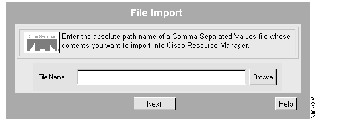
Step 3 In the File Name field, enter the fully qualified pathname of the file you want to import (for example, /db/cisco/file.txt) or click Browse and select a file.
If you click Browse, the Browse dialog box appears. The default directory is displayed in the File Name field. You can select another directory by entering the pathname in the File Name field or by clicking a directory name in the list.
Step 4 Select the file, then click Next.
The How to Resolve Conflicts dialog box appears. (See Figure 2-7.)
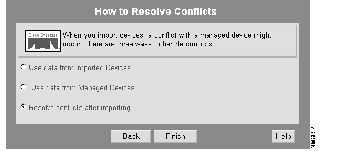
Step 5 Select one of the following:
Step 6 To finish the import, click Finish.
The devices are imported to your network.
The Add/Import Status Summary dialog box appears. (See Figure 2-5.)
Step 7 Click the Device Status links in the Add/Import Status Summary dialog box to check device status. Click Update to update the status information. See Table 2-1 for device status descriptions.
Step 8 Repeat Step 2 through Step 7 to import additional devices.
For additional information about importing devices from a file, refer to the online help.
You can import multiple devices from a local NMS database. There are prerequisites to the import, depending on which NMS you are importing from. The prerequisites are as follows:
| NMS | Prerequisite |
|---|---|
| CiscoWorks | bin must be a member of the CiscoWorks group. |
| HP OpenView | HP OpenView must be running. |
| CiscoWorks for Switched Internetworks 1.3 (CWSI) | bin must be a member of the "known networks" database group. |
Scenario: You have just installed Resource Manager and you want to import the basic device information contained in a CiscoWorks database residing on the local host.
To import devices from a local NMS database, perform the following steps:
Step 1
Make sure the user bin is a member of the CiscoWorks group before you start the Resource Manager web server. If bin is not a member of the CiscoWorks group, add it to the group, then stop and restart Resource Manager.
Step 2 Log in with administrator privileges.
Step 3 Click Admin on the button bar, then select Inventory > Import from Local NMS.
The Local Database Import dialog box appears. (See Figure 2-8.)
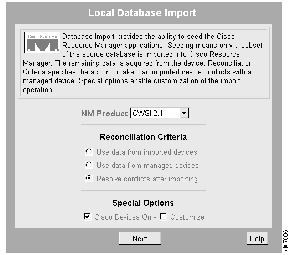
Step 4 Select the source database type from the NM Product drop-down list. For example, CiscoWorks.
Step 5 Select the reconciliation criteria you want to use for the import. The options are:
Step 6 Select special options:
Leave the Cisco Devices Only check box unselected if you want to import both Cisco and non-Cisco devices.
Select the Cisco Devices Only check box if you want to import only Cisco devices.
Select the Customize check box to specify values for nondefault settings. The Import Options dialog box appears. The import options vary depending on the NMS you are using.
Step 7 Complete the Import Options dialog box, then click Finish.
Step 8 Click Next. The Add/Import Status Summary dialog box appears. (See Figure 2-5.)
Step 9 Click the device status links in the Add/Import Status Summary dialog box to check device status. Click Update to update the status information. See Table 2-1 for device status descriptions.
For additional information about importing devices from a local NMS database, refer to the online help.
Scenario: You have just installed Resource Manager and you want to import the basic device information contained in the database of a supported network management system residing on a remote host.
You can import multiple devices from a remote NMS database. There are prerequisites to the import, depending on which NMS you are importing from. The prerequisites are as follows:
| NMS | Prerequisite |
|---|---|
| CiscoWorks | The remote user must be a member of the CiscoWorks Group. The Sybase server must be running on the remote host. |
| HP OpenView | HP OpenView must be running. |
| CiscoWorks for Switched Internetworks 1.3 (CWSI) | The remote user must be a member of the group bin and the group of the Known Networks Database. |
Before performing the import, identify the remote user. The remote user must have an .rhosts file in the remote user's home directory. The .rhosts file must contain an entry for the Resource Manager server. Additional considerations are as follows:
file on the remote server has been edited or is empty (AIX servers only), the import will not succeed.
To import devices from a remote NMS database, perform the following steps:
Step 1
On Solaris systems, verify that the remote shell daemon is running on the remote host.
Step 2 Log in with administrator privileges.
Step 3 Click Admin on the button bar, then select Inventory > Import from Remote NMS.
The Remote Database Import dialog box appears. (See Figure 2-9.)
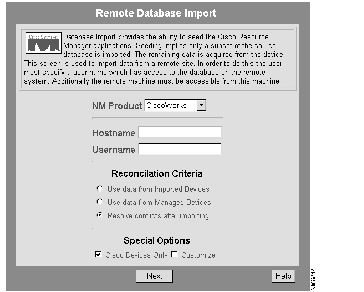
Step 4 Select the NM product, for example, CiscoWorks.
Step 5 In the Hostname field, enter the network name of the host on which the remote NMS resides.
Step 6 Before you import the file, examine the .rhosts file in the home directory (of the user specified in the username field) on the remote system hosting the NMS database.
Add the following to the file:
+ bin
or enter the remote server name:
myhost.cisco.com bin
Step 7 In the Username field, enter the username you entered in the username dialog box.
Step 8 Select the reconciliation criteria you want to use for the import. The options are:
Step 9 Select special options:
Leave the Cisco Devices Only check box unselected if you want to import both Cisco and non-Cisco devices.
Select the Cisco Devices Only check box if you want to import only Cisco devices.
Select the Customize check box to specify values for nondefault settings. The Import Options dialog box appears. The import options vary depending on the NMS you are using.
Step 10 Complete the Import Options dialog box, then click Finish.
Step 11 Click Next. The Add/Import Status Summary dialog box appears. (See Figure 2-5.)
Step 12 Click the Device Status links in the Add/Import Status Summary dialog box to check device status. Click Update to update the status information. See Table 2-1 for device status descriptions.
For additional information about importing devices from a remote NMS database, refer to the online help.
|
|