


|
|

This chapter briefly describes some CiscoWorks applications and provides instructions on how to use them. It also contains an overview of how CiscoWorks functions with your NetView network management platform. The chapter includes the following sections:
For detailed CiscoWorks application information, refer to the CiscoWorks online help system.
CiscoWorks now includes a new form of online help based on help systems supplied with Windows-based platforms.
Once you start the CiscoWorks online help system, you can jump to any topic within the system. For information on how to use the Help viewer, select Help>How to Use Help when the first help window appears.
Online help is available from several parts of CiscoWorks and its network management platforms:
CiscoWorks online help includes a Find button that allows you to do full-text searches within the help system. For information on how to do a search, select Help>How to Use Help when the first Help window appears
The online help system includes descriptions for all CiscoWorks menus and windows, including windows that do not have Help menus. You can view online help in the following ways:
CiscoWorks applications appear on your NetView menus. To use CiscoWorks features and your NetView software to the fullest, you must understand how to start the applications and complete some basic tasks. This section describes the location of the CiscoWorks applications on the NetView menus and provides an overview of the post-installation tasks to complete before you begin to use CiscoWorks.
Table 4-1 lists the CiscoWorks applications and their menu locations, and explains the tasks they perform. The CiscoWorks applications are listed in alphabetical order.
In NetView, start the CiscoWorks applications through any of the standard menu options (Administer, Monitor, Diagnose, or Misc).
| NetView Menu Location | Tasks |
|---|---|
| Help>CW - Application Help | CiscoWorks online help system that allows you to investigate different levels of details within the online help system by selecting highlighted text to open additional windows. The online help system provides overview, related information, procedures, and glossary data on the CiscoWorks applications and features. It allows both keyword and full-text searches to enable users to search for specific text. |
| Administer>CW - Devices>CW - AutoInstall Mgr | Remotely deploy a new router using a neighbor router. Perform AutoInstall tasks remotely by running CiscoWorks instead of a Telnet session. |
| Administer>CW - Devices>CW - Configuration Mgr | Access configuration files of local and remote Cisco Systems devices to analyze or edit them as necessary. Compare the contents of two configuration files in the database, or compare the configuration currently running on a device with the configuration that represents the last Database to Device command you performed. |
| Administer>CW - Devices>CW - Configuration Snap-In Mgr | Create and execute selected or custom UNIX commands on a device or group of devices at any time with Global Command Scheduler. |
| Monitor>Description>CW - Contacts | Obtain information about the contact for a specific device, including the complete name, phone number, e-mail address, title, location, and address of the person responsible for the operation of the device. |
| Administer>Cisco Devices>CW - Device Mgmt | Create and maintain a database that holds a complete inventory of your network--hardware, software, release levels of operation components, individuals responsible for maintaining the devices, and associated locations. Enter or change data in the database tables for network devices, networks, interfaces, contacts, vendors, and so on. |
| Monitor>CW - Device Polling | Probe and extract information about the condition of your networks using a polling feature. The information acquired is stored in the database for further evaluation and analysis. Compare the relative performance and status of devices and interfaces on the network. |
| Administer>CW - Software Images>CW - Device Software Mgr | Automate the upgrade of a system software or microcode image on a Cisco device. |
| Administer>CW - Security>CW - Domain Mgr | Create groups of devices (called domains) that CiscoWorks applications can use to accomplish network management tasks such as security, configuration, and device polling. |
| Monitor>CW - Environmental Monitor | View the environmental status of Cisco AGS+ and Cisco 7000 routers including temperature and voltage statistics. This function is available on AGS+ routers running System Software Release 10.3 or later with an ENVM1 card running ENVM Microcode Version 2.0 or later. |
| Administer>CW - System>CW - Global Command Mgr | Create, store, and execute system commands on a device or group of devices at any time with Global Command Scheduler. |
| Administer>CW - System>CW - Global Command Scheduler | Schedule commands or other jobs at regularly scheduled times using the crontab utility. |
| Monitor>CW - Health Monitor | View information about the status of a device, including buffers, CPU load, available memory, and protocols and interfaces being used. Enables you to display the Show Commands and Real-Time Graphs windows from the Health Monitor window. |
| Misc>CW - Login | Perform a generic login for all CiscoWorks applications that require user authentication so that you do not have to log in to each application separately. |
| Misc>CW - Logout | Log out of secured CiscoWorks applications to ensure security for those applications with authority checking turned on. |
| Diagnose>Network Connectivity>CW - Path Tool | View and analyze the path between two devices. Perform analysis on the path to collect utilization and error data. Display the devices encountered between the source and the destination device, the link speeds connecting these SNMP2 devices, and the interface names. |
| Monitor>CW - Polling Summary | Summarize the polling setup completed within Device Polling. Browse data, and stop and start polling. |
| Administer>CW - System>CW - Process Mgr | Start, stop, and view status of CiscoWorks-related processes including Polling (nmpolld), CW Log (nmlogd), System Log (syslogd), Sybase Server (dataserver), and TACACS (xtacacsd) daemons. |
| Monitor>CW - Real-Time Graphs | View device information such as the router health (buffer space, CPU load, environment, free memory, and security); interface health (bits per second, bytes, errors, packets per second, packets, and queues); and protocol traffic (IP, ICMP, SNMP, TCP, UDP, AppleTalk, DECnet IV, Novell, VINES, and XNS) using a grapher utility. |
| Administer>CW - Security>CW - SA Password | Change the password of CiscoWorks-internal user accounts. |
| Administer>CW - Security>CW - Security Mgr | Create authority checking procedures to protect selected CiscoWorks applications and network devices from unauthorized individuals by requiring a login to use protected applications. This protection ensures that only users with a valid account and password can perform tasks such as configuring a router, deleting database device information, or defining polling procedures. |
| Diagnose>CW - Show Commands | View device data about any SNMP device, including Cisco routers and communication servers. This data includes the software version, buffers, selected device interfaces, traffic mix, IP accounting checkpoint, ARP, and IP route. Emulates the EXEC show commands for Cisco routers. |
| Administer>CW - Software Images>CW - Software Inventory Mgr | Update the Sybase database to include current device software and hardware status. Sort device information according to platform and software image, and invoke Device Software Manager to update specific devices. |
| Administer>CW - Software Images>CW - Software Library Mgr | Maintain a master storage area that contains a list of all available Cisco system software. These Cisco IOS software images are retrieved by the user with a variety of methods. |
| Misc>CW - Sync w/Sybase
and Misc>CS-Sync Selected | Synchronize the NetView and Sybase databases. CiscoWorks maintains data in the Sybase database, whereas NetView maintains its own database. Sync w/Sybase ensures that device data from the NetView database is in the Sybase database (Sync w/Platform) and vice versa. Generally, synchronize the databases whenever new devices are added to your network. Use Sync Selected to add individual devices. |
| Misc>Sybase ESQR | Use Sybase ESQR utilities to run and print reports on any table created with the Device Polling application. |
| Administer>CW - Security>CW - TACACS Mgr | Maintain the TACACS password file on UNIX hosts that act as TACACS servers. Create and update TACACS accounts and computer-generated passwords. |
| Misc>CW - Toolbox | Allows you to start CiscoWorks applications directly, without using the menus on your network management platform. Click on an application's icon in the Toolbox window to start the application. You can also display help for each application from the Toolbox. |
Perform the following tasks before using any CiscoWorks applications on NetView:
To add a Cisco Device by hand, use NetView's Edit> Add> Object command and refer to "Adding Cisco Devices to the NetView Network Map" in this chapter.
CiscoWorks is integrated with NetView for AIX, an IBM network and system management tool, as a suite of applications that are accessible through NetView for AIX menus.
During installation and configuration, CiscoWorks adds customized schema files with Cisco-specific device types (such as the Cisco AGS+) to the platform's schema files directory. CiscoWorks also adds its applications to the NetView menus.
It is important to understand the NetView environment and how to use your platform software in conjunction with CiscoWorks. To answer your network management questions, refer to NetView documentation.
This section briefly explains two ways to start the NetView Console to run CiscoWorks. You can use several different commands to start the NetView Console. However, you must be running an X window manager such as Motif.
To start CiscoWorks when the database is present, select one of the following methods:
Step 1 To start the NetView Console initially (when no database is present) or when you want to bring up the last map file, enter the following:
nv6000
or
ovw
Step 2 Select File>Open/List Maps to load a database map file into the NetView Console.
Perform the following tasks to start CiscoWorks when no database is present or when you do not want to start NetView with a network map:
 | Caution The -i option starts the NetView Console and removes the current run-time database. If you have a run-time database and wish to preserve it, do not use the -i option, or you will lose this data. |
%nv6000 -i
% ovw -i
%nv6000 - mapmap_name
%ovw - mapmap_name
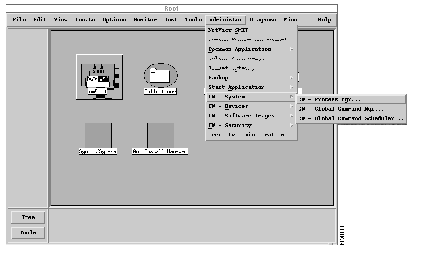
CiscoWorks applications appear in NetView menus and begin with "CW " as shown in Figure 4-1.
For example, to open the Process Manager application, select Administer> CW - System> and
CW - Process Mgr.
This section briefly outlines the steps you must complete on NetView before continuing with CiscoWorks tasks. For instructions on using specific CiscoWorks applications, refer to the appropriate sections in this section, or to the CiscoWorks online help system.
Follow these steps to learn about CiscoWorks applications that use the Sybase database:
Step 1 Start NetView.
Refer to the section "Starting CiscoWorks with the NetView Database," earlier in this chapter, to learn how to start NetView.
| Caution You must create a CiscoWorks user before you turn on security. If you do not create a CiscoWorks user, you will lock yourself out of Sybase. To find out how to create a user, go to the section "Setting Up the CiscoWorks Default Account" in the "Setting Up Domains and Securing Applications" chapter of the CiscoWorks User Guide. |
Step 2 Access Security Manager to turn on authentication checking and provide users and groups access privileges to CiscoWorks applications.
For more information, refer to the CiscoWorks online help section on setting up domains and securing applications in Security Manager.
Step 3 Set up your database using the utilities provided with NetView software.
Step 4 Use Sync w/Sybase to synchronize your NetView database devices with the CiscoWorks Sybase database.
If you are adding individual devices, use the Device Management, AutoInstall Manager, or Sync w/Sybase applications to add device data to the Sybase database. For information on AutoInstall Manager, Sync w/Sybase, and Device Management, refer to the appropriate CiscoWorks online help sections.
Step 5 Use the CiscoWorks applications and NetView utilities to help you monitor and manage your network activity.
Table 4-2 lists the general network management tasks and their responsible software applications. Use this table to determine which documentation set (CiscoWorks or NetView) to use if you have questions or need information. The X indicates that this information is located in the NetView manual set for the utility or application.
| Task | NetView | CiscoWorks |
|---|---|---|
| Start NetView and CiscoWorks software | X | |
| Use Manage Objects | X | |
| Create or find devices or device properties | X | AutoInstall Manager, Device Mgmt, Sync w/Sybase |
| Modify or change device or device properties | X | Device Mgmt, Sync w/Sybase |
| Move or connect devices | X | |
| Copy or delete devices | X | Device Mgmt, Domain Manager |
| Save your network map (run-time database) | X | |
| Modify a graph display | X | |
| Print graphs, windows, or text files | X | |
| Change the symbol type | X | |
| Check the cause of an event | X | |
| Change how symbol type changes propagate | X | |
| View or change the status of requests | X | |
| View error and traps | X | |
| Manage SNMP devices | X | All CiscoWorks applications |
CiscoWorks applications require a database of network devices and a network map that contains these devices. NetView automatically displays a default map, called an IP Map, which shows all the IP devices connected to the local NetView system. The Manage Objects command enables you to find the devices in the primary network to which your system is attached. Use Manage Objects to view your network and a run-time database for NetView.
To run Manage Objects, perform the following steps:
Step 1 Display the NetView Console by entering the following command:
ovw
Step 2 Click the IP Internet default map to open it.
Step 3 Click a device symbol to select it.
Step 4 Select Options>Manage Objects.
NetView displays a submap of the selected device's children (that are reachable in one hop). Newly appearing children could have been newly added to the network or explicitly unmanaged by a previous user. All newly appearing child devices are accessible by CiscoWorks.
Step 5 Select File>Save Map As to save the database of devices that you created.
For detailed information on how to run Manage Objects, refer to the online help.
To add a Cisco device to your new network map, perform the following steps:
Step 1 Display the network map.
Step 2 Select Edit> Add> Object.
The Add Object Palette appears.
Step 3 In the Symbol Class area of the Add Object Palette, click the Cisco Router icon.
Step 4 From the Symbol Subclass area, use the middle mouse button to drag a specific Cisco device icon to the network map.
The Add Object window appears.
Step 5 Complete the Add Object window, then click OK to record information about the object you just added.
Network devices that are discovered by Manage Objects may be assigned generic or incorrect symbols. You must identify them as Cisco devices to take advantage of CiscoWorks functionality.
To use Change Symbol Type to change device status from generic to that of a Cisco device, perform the following steps:
Step 1 Use the mouse to point to a Cisco device in the NetView Console window.
Step 2 Click the right mouse button or equivalent.
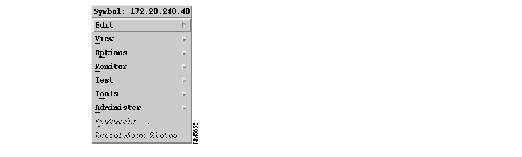
The Symbol Popup menu for the device appears, as shown in Figure 4-2.
Step 3 Select Edit from the Symbol Popup menu.
The Edit Popup menu appears, as shown in Figure 4-3.
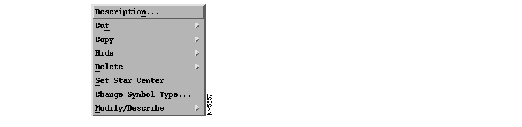
Step 4 Select Change Symbol Type from the Edit Popup menu.
The Change Symbol Type window appears, as shown in Figure 4-4.
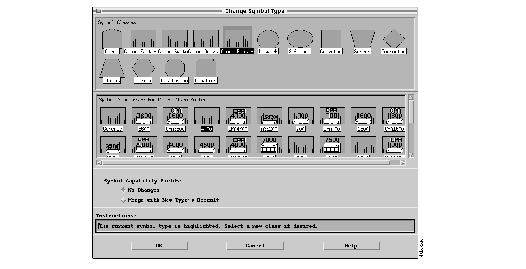
Step 5 In the Symbol Classes area of the Change Symbol Type window, click the correct symbol class of the selected device. For example, if the selected device in your network map is a Cisco 7000, select Cisco Router (because Cisco 7000 is a class of Cisco Router).
Step 6 In the Symbol Subclasses for the Class Cisco Router area of the Change Symbol Type window, click a specific icon to represent the selected device. For example, if the selected device in your network map is a Cisco 7000, select the 7000 symbol.
Step 7 Click OK.
Step 8 Repeat Steps 1 through 6 to identify other devices on the network map.
Step 9 Confirm that the selected devices have the correct SNMP community strings by viewing the SNMP Configuration window. Select Options>SNMP Configuration from the NetView menu bar.
CiscoWorks utilizes two separate databases:
These two databases must be synchronized before NetView for AIX and CiscoWorks can operate in concert.
Use the CiscoWorks Misc> Sync w/Sybase application to synchronize database information. Sync w/Sybase performs the following functions to enable you to use CiscoWorks applications:
Run Sync w/Sybase (as shown in Figure 4-5) if you just initialized NetView and need to synchronize both databases. (Use Sync Selected when you want to synchronize one or more selected devices.)
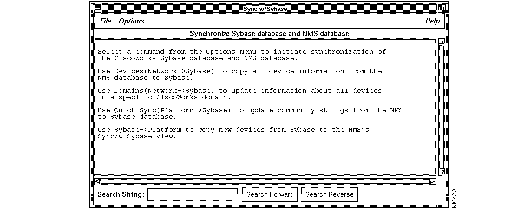
Depending on the number of database records and the information contained in each, database synchronization can be time-consuming.
 | Time Saver First-time CiscoWorks users should run the Device (Network>Sybase) option to synchronize all device information. If you are a first-time user and want the quickest method of synchronizing, use Quick Sync, which synchronizes all the devices, with the warning that device information will not be complete. If you use Quick Sync, you may want to return to Sync w/Sybase when you have more time to use the Device (Network>Sybase) option to fill in the incomplete device information. |
To adjust for synchronization time and to meet special needs, select one of the following commands from the Options menu of the Sync w/Sybase window:
Figure 4-6 illustrates the relationship between the NetView and CiscoWorks databases. Although you can add device names directly to either database, you must run Sync w/Sybase to confirm that the information about a particular device is correct in both places.
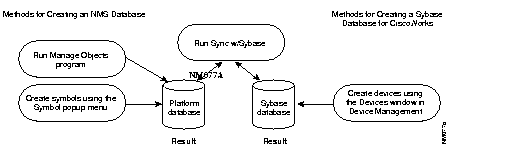
For more detailed information about the database and the Sync w/Sybase and Sync with Platform applications, refer to the CiscoWorks online help on Sync w/Sybase. For more information about the AutoInstall Manager application, refer to the CiscoWorks online help on AutoInstall Manager.
After you finish creating a run-time database with network devices, follow these steps to run the Sync w/Sybase application:
Step 1 Select Misc> Sync w/Sybase.
The Sync w/Sybase window, similar to the one shown in Figure 4-7, appears.
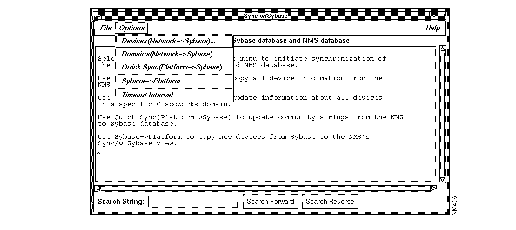
Step 2 Select one of the following commands from the Options menu of the Sync w/Sybase window.
Step 3 The synchronization process takes from 3 minutes to over an hour, depending on the size of the network and the number of devices you are synchronizing. Select File>Exit to stop the synchronization process at any time, or when synchronization is complete. The devices synchronized up to this point are saved in the Sybase database.
To use NetView and CiscoWorks, you must make sure that the environment variables are set correctly. Refer to the section "Verifying Changes to the .cshrc or .kshrc or .profile Files" in the "Validating CiscoWorks Installation" chapter.
This section provides a general idea of how to use a CiscoWorks application. It uses the Path Tool application as an example.
To use the Path Tool application, you must have at least two network devices in the Sybase database. Use Sync w/Sybase to add network devices to the Sybase database.
To graphically display the routing path between two devices, perform the following steps:
Step 1 In the NetView Console window, click an SNMP device and select Diagnose> Network Connectivity> CW - Path Tool.
A window, similar to the one shown in Figure 4-8, appears. The Path Source field automatically displays the device you selected.

Step 2 To select a destination device, click the Select button next to the Path Destination field or enter the complete device name in the Path Destination field.
The Device Selection window, similar to the one shown in Figure 4-9, appears. It lists the devices in the NetView database.

Step 3 Click on the device that you want to specify as the destination, and click the OK button.
The device name appears in the Path Destination field in the Path Tool window.
Step 4 Click on OK in the Path Tool window to display the Path Tool window.
A window appears, similar to the window shown in Figure 4-10. It displays the progress of the Path Tool as it makes each network hop from the source to the destination device.
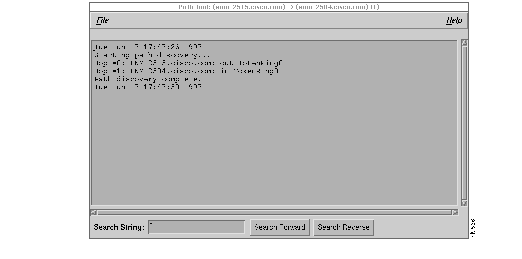
After the connection is established, another Path Tool window appears, similar to the window shown in Figure 4-11. It graphically displays the path between the source and destination devices you specified.

Step 5 Select File>Exit to close the window.
For more information on how to use the Path Tool, refer to the online help for Path Tool.
If you use the Security Manager application to protect specific applications, all users must enter a valid username and password to access applications. For a detailed description of which CiscoWorks applications you can protect, refer to the CiscoWorks online help section on setting up domains and securing applications.
Each CiscoWorks application has varying levels of access privileges. Users are granted inherent privileges to certain applications (such as the ability to display devices) based solely on their group-domain associations. The CiscoWorks administrator governing Security Manager can grant further levels of "application-specific" privileges (such as add or change database information) to selected groups.
| Caution You must create a CiscoWorks user before you turn on security. If you do not create a CiscoWorks user, you will lock yourself out of Sybase. To find out how to create a user, go to the section "Setting Up the CiscoWorks Default Account" in the "Setting Up Domains and Securing Applications" chapter of the CiscoWorks User Guide. |
When security is enabled, if you previously used the Login command to log in to CiscoWorks, a user identification window does not appear. If you do not use the Login command, CiscoWorks prompts you for a username and password each time you run a secured application. This login controls access to the application.
If you use Security Manager to secure your CiscoWorks applications, you can use Login and Logout. For more information on logging in and out, refer to the CiscoWorks online help section on Login and Logout.
| Time Saver By using Login, you need log in only once. If you do not use Login, CiscoWorks requires user identification information (username and password) each time you attempt to start a secured application. |
|
|