


|
|

| PROFILE No | FOR SYNCHRONOUS LINES OR B_CHANNEL LINES (ISDN) |
| 00
01 02 03 04 05 74 75 19 24 25 | Public network with facilities (Default option: TRANSPAC)
Subscribers without facilities Subscribers with facilities PSTN public network DTE inter-node DCE inter-node Physical X.75 DTE inter-node Physical X.75 DCE inter-node VX.32 public network (TRANSPAC) TRANSPAC inter-node TRANSPAC inter-node |
| PROFILE No | FOR FRAME RELAY LINES |
| 83
84 85 | FRCE SUBSCRIBER FR PROFILE (FRA)
FRSE/FRTE/PHYSICAL DTE FRSE/FRTE/PHYSICAL DCE |
| PROFILE No | FRAME RELAY FRTE STACK (CLASS 30) |
| 86
87 88 89 | Network FRI DTE (Transactional has priority)
Network FRI DCE (Transactional has priority) Network FRI DTE (File transfer does not have priority) Network FRI DCE (File transfer does not have priority) |
| 120
121 122 | FRSNA profile
FRIP profile FRT profile |
| PROFILE No | FOR ISDN -- D-Channel |
| 47 | DSSI/Q931 |
| PROFILE No | FOR HDLC LINES |
| 82 | HDLC-T CONNECTION |
| PROFILE No | FOR SDLC LINES |
| 17
18 | "Remote" Profile (TPAD)
"Front-end" Profile (HPAD) |
| PROFILE No | FOR BSC 3270 LINES |
| 60
61 | "Remote" (TPAD)
"Front-end" PROFILE (HPAD) |
| PROFILE No | FOR BSC 2780/3780 LINES |
| 70
71 72 73 | BSC 2780 CALLING
BSC 2780 CALLED BSC 3780 CALLING BSC 3780 CALLED |
| PROFILE No | FOR BSC-TRANSPARENT LINES |
| 100
101 102 | DTE Type
DCE Type TPC DRM |
| PROFILE No | FOR VIP LINES |
| 50
51 | "Remote" Profile (TPAD)
"Front-end" Profile (HPAD) |
| PROFILE No | FOR PSTN LINES |
| 20
21 40 41 | DTE PSTN back-up with automatic modem
DCE PSTN back-up with automatic modem DTE PSTN back-up with V.25bis modem DCE PSTN back-up with V.25bis modem |
| PROFILE No | FOR ASYNCHRONOUS LINES |
| 07
08 09 10 11 12 13 14 15 16 34 35 36 37 | Terminal with automatic baud rate detect
Direct connected terminal Terminal connection PSTN Terminal connected via dedicated line LSCP terminal - direct connection LSCP terminal - dedicated line connection LSCP-A terminal - direct connection LSCP-A terminal - dedicated line connection Minitel terminal - direct connection Minitel terminal - PSTN connection TTY terminal - PSTN connection (V.25 bis) Minitel terminal - PSTN connection (V.25 bis) Minitel terminal - PSTN connection (modem turnaround) Multistandard Videotex terminal |
| PROFILE No | FOR X.28+ ASYNCHRONOUS LINES |
| 27
28 | DIRECT CONNECTION TERMINAL
PSTN CONNECTION TERMINAL |
| PROFILE No | FOR MANAGEMENT FUNCTIONS (CLASS 24 RECURRENCE 0) |
| 06 | Management functions |
| PROFILE No | FOR SECURIZED VIRTUAL CIRCUITS (CLASS 24, RECURRENCE 1 AND 2) |
| 45
46 | TRANSPORT PROFILE (N4 + ESV)
NETWORK INTERFACE PROFILE (IR) |
| PROFILE No | FOR COMPRESSION FUNCTION (CLASS 24 RECURRENCE 4) |
| 96 | COMPRESSION PROFILE |
| PROFILE No | FOR DLM FUNCTION (CLASS 24 RECURRENCE 5) |
| 110 | DLM PROFILE |
| PROFILE No | FOR VIRTUAL ROUTER (CLASS 24 RECURRENCE 6, 7, 8) |
| 112 | Virtual router profile |
| PROFILE No | FOR X.29 REROUTING LINE |
| 81 | X.29 REROUTING PROFILE |
| Parameter No. | Synchronous X.25 connection or B-channel (ISDN) | Parameter No. | Synchronous X.25 connection or B-channel (ISDN) |
|---|---|---|---|
| 0 | Profile number | 32 | Time-out T1 |
| 1 | Type of Link, DTE, DCE, DSE | 33 | Time-out T2 |
| 2 | Type of Connection | 34 | Frame retransmissions (N2) |
| 3 | Scanning direction | 35 | Frame window size (K) |
| 4 | 1st incoming LCGN | 36 | Frame modulo (8/128) |
| 5 | 1st incoming LC | 37 | Primary address |
| 6 | Number of incoming LCGNs | 38 | Secondary address |
| 7 | Number of incoming LCs | 39 | Restart time-out (T10; T20) |
| 8 | 1st both-way LCGN | 40 | Reset time-out (T12; T22) |
| 9 | 1st both-way LC | 41 | Clear time-out (T13; T23) |
| 10 | Number of both-way LCGNs | 42 | Restart/reset/clear/return |
| 11 | No. of both-way LCs | 43 | Diagnostic code suppression |
| 12 | 1st outgoing LCGN | 44 | X.25 type of signalling (TE, NI) |
| 13 | 1st outgoing LC | 45 | 1 or 2 addr. in packet |
| 14 | Number of outgoing LCGNs | 46 | Local subscriber No. |
| 15 | Number of outgoing LCs | 47 | Subaddress transparency |
| 16 | Behavior if PVC not ready | 48 | CUG closed user group |
| 17 | Billing type | 49 | RC acceptance (Tx) Reverse charging |
| 18 | Receive filtering | 50 | Reserved |
| 19 | Send filtering | 51 | Transit time |
| 20 | Interface state/interface superv. | 52 | PDN link |
| 21 | Interface state/interface superv. | 53 | PDN address position |
| 22 | Interface scanning period | 54 | Tx fast select |
| 23 | Number of interface scanning | 55 | Rx. fast select |
| 24 | Interface state/interface superv. | 56 | Thuput class negotiation subscription |
| 25 | Interface state/interface superv. | 57 | Default TX throughput class |
| 26 | Setting of interface signal | 58 | Default RX throughput class |
| 27 | Not significant | 59 | Max. TX throughput class |
| 28 | Access Rate | 60 | Max. RX throughput class |
| 29 | Frame size (N1) | 61 | Packet size negot.subscription |
| 30 | Not significant | 62 | Default TX packet size |
| 31 | Initial transmission credit | 63 | Default RX packet size |
| 64 | Max. TX packet size | 86 | D Bit management |
| 65 | Max. RX packet size | 87 | Type of line |
| 66 | Min. TX packet size | 88 | Unknown facility |
| 67 | Min. RX packet size | 89 | Address conversion |
| 68 | Tx window size negot.subscription | 90 | Number of PVCs |
| 69 | Default TX window size | 91 | Position of first PVC |
| 70 | Default RX window size | 92 | Reserved |
| 71 | Max. TX window size | 93 | Type of LAP (A/B) |
| 72 | Max. RX window size | 94 | Securized VCs |
| 73 | Transfer request | 95 to 123 | Reserved |
| 74 | Call confirm.format | 124 | Consolidation counter |
| 75 | X.29 rerouting | 125 | Low percentage threshold |
| 76-77 | Reserved | 126 | High percentage threshold |
| 78 | Compression/scrambling | 127 | Reserved |
| 79 | Reserved | 128 | Cost of the medium remote |
| 80 | T11, T21 call request answer time-out | 129 | Remote address position |
| 81 | Trunk call return | 130 | Backup, changeover, overflow |
| 82 | Subscriber call return | 131 to 145 | Reserved |
| 83 | Facility marker CTRL | ||
| 84 | CLAM reaction | ||
| 85 | Clear TX format |
| Parameter No. | FRCE Connection | Parameter No. | FRCE Connection |
|---|---|---|---|
| 0 | Profile number | 37-38 | Not significant |
| 1 | Type of Link | 39 | Positioning threshold S2 (FECN/BECN) |
| 2 | Type of Connection | 40 | "DE ignored" threshold S3 |
| 3 | Scanning direction | 41 | "Frame ignored" threshold S4 |
| 4 | 1st incoming LCGN | 42-43 | Not significant |
| 5 | 1st incoming LC | 44 | Type signalling |
| 6 | Number of incoming LCGNs | 45 | 1 or 2 Address in packets |
| 7 | Number of incoming LCs | 46 | Local subscriber No. |
| 8 | 1st both-way LCGN | 47 | Subaddress transparency |
| 9 | 1st both-way LC | 48 | CUG Closed User Group |
| 10 | Number of both-way LCGNs | 49 | RC acceptance (Tx) Reverse Charging |
| 11 | No. of both-way LCs | 50 | Reserved |
| 12 | 1st outgoing LCGN | 51 | Transit time |
| 13 | 1st outgoing LC | 52-53 | Not significant |
| 14 | Number of outgoing LCGNs | 54 | Tx fast select |
| 15 | Number of outgoing LCs | 55 | Rx fast select |
| 16 | Time-out Ta | 56 | Thrughput class negot. subscription |
| 17 | Billing type | 57 | Default TX throughput class |
| 18 | Receive filtering | 58 | Default RX throughput class |
| 19 | Send filtering | 59 | Max. TX throughput class |
| 20 | Interface state/interface superv. | 60 | Max. RX throughput class |
| 21 | Interface state/interface superv. | 61 | Packet size negot.subscription |
| 22 | Interface scanning period | 62 | Default (Tx) packet size |
| 23 | Number of interface scanning | 63 | Default (Rx) packet size |
| 24 | Interface state/interface superv. | 64 | Max. TX packet size |
| 25 | Interface state/interface superv. | 65 | Max. RX packet size |
| 26 | Setting of interface signal | 66 | Min. TX packet size |
| 27 | Not significant | 67 | Min. RX packet size |
| 28 | Access rate | 68 | Tx window size negot.subscription |
| 29 | Frame size | 69 | Default TX window size |
| 30 | Not significant | 70 | Default RX window size |
| 31 | Initial transmission credit | 71 | Max. TX window size |
| 32 | CRC count | 72 | Max. RX window size |
| 33 | Number of flags (Tx) | 73 | Transfer request |
| 34 | Not significant | 74 | Call confirm.format |
| 35 | Frame window size | 75-77 | Reserved |
| 36 | Start of frame regr.thresh.S1 | 78 | Compression/scrambling |
| 79 | Reserved | 92 | Not significant |
| 80 | T11, T21 call request answer time-out | 93 | Type of LAP |
| 81 | Trunk call return | 94 | Securized VC |
| 82 | Subscriber | 95 to 123 | Reserved |
| 83 | Facility marker CTRL | 124 | Consolidation counter |
| 84 | CLAM Reaction | 125 | Low percentage threshold |
| 85 | Clear TX format | 126 | High percentage threshold |
| 86 | D Bit management | 127 | Reserved |
| 87 | Type of line | 128 | Cost of the medium |
| 88 | Unknown facility | 129 | Remote address position |
| 89 | Address conversion | 130 | Backup, changeover, overflow |
| 90 | Number of DLCIs | 131 to 145 | Reserved |
| 91 | Position of first DLCI |
| Parameter No. | FRTE/FRSE Connection | Parameter No. | FRTE/FRSE Connection |
|---|---|---|---|
| 0 | Profile number | 35 | No. of stop bits |
| 1 | Type of Link | 36 | Type of physical connection |
| 2 | Type of Connection | 37-39 | Not significant |
| 3-15 | Not significant | 40-43 | Reserved |
| 16 | Time-out Ta | 44 | X.25 type signalling |
| 17 | Billing type | 45 | 1 or 2 addr. in packet |
| 18 | Receive filtering | 46 | Local subscriber No. |
| 19 | Transmission filtering | 47 | Subaddress transparency |
| 20 | Interface state/interface superv. | 48 | CUG Closed User Group |
| 21 | Interface state/interface superv. | 49 | RC acceptance (Tx) Reverse Charging |
| 22 | Interface scanning period | 50 | Reserved |
| 23 | Number of interface scanning | 51 | Transit time |
| 24 | Interface state/interface superv. | 52-53 | Reserved |
| 25 | Interface state/interface superv. | 54 | Not significant |
| 26 | Setting of interface signal | 55 | Reserved |
| 27 | Not significant | 56-74 | Not significant |
| 28 | Access rate | 75-79 | Reserved |
| 29 | Frame size | 80-91 | Not significant |
| 30 | Not significant | 92 | Type of LMI |
| 31 | Initial transmission credit | 93-94 | Not significant |
| 32 | Inactivity time-out | 95-123 | Reserved |
| 33 | No. of bytes received in buffer | 124-145 | Not significant |
| 34 | Block of character mode |
| Parameter No. | FRTE Frame Relay Stack (FRT, FRIP, FRI) | Parameter No. | FRTE Frame Relay Stack (FRT, FRIP, FRI) |
|---|---|---|---|
| 0 | Profile number | 44 | Type signalling |
| 1 | Type of Link | 45 | Add no. in packets |
| 2 | Type of Connection | 46 | Local subscriber No. |
| 3 | Scanning direction | 47 | Subaddress transparency |
| 4 | 1st incoming LCGNs | 48 | CUG Closed User Group |
| 5 | 1st incoming LC | 49 | RC acceptance (Tx) Reverse Charging |
| 6 | Number of incoming LCGNs | 50 | Reserved |
| 7 | Number of incoming LCs | 51 | Transit time |
| 8 | 1st both-way LCGNs | 52 | PDN link |
| 9 | 1st both-way LCs | 53 | PDN address No. |
| 10 | Number of both-way LCGNs | 54 | Tx fast select |
| 11 | Number of both-way LCs | 55 | Rx. fast select |
| 12 | 1st outgoing LCGN | 56 | Thrughput class negot. subscription |
| 13 | 1st outgoing LC | 57 | Default TX throughput class |
| 14 | Number of outgoing LCGNs | 58 | Default RX throughput class |
| 15 | Number of outgoing LCs | 59 | Max. TX throughput class |
| 16 | Not significant | 60 | Max. RX throughput class |
| 17 | Billing type | 61 | Packet size negot.subscription |
| 18 | Receive filtering | 62 | Default (Tx) packet size |
| 19 | Transmission filtering | 63 | Default (Rx) packet size |
| 20-27 | Not significant | 64 | Max. TX packet size |
| 28 | Access Rate | 65 | Max. RX packet size |
| 29 | Frame size | 66 | Min. TX packet size |
| 30 | Not significant | 67 | Min. RX packet size |
| 31 | Initial transmission credit | 68 | Tx window size negot.subscription |
| 32 | Time-out T1 | 69 | Default TX window size |
| 33 | Time-out T0 | 70 | Default RX window size |
| 34 | Frame retransmission (N2) | 71 | Max. TX window size |
| 35 | Frame window size | 73 | Transfer request |
| 36 | Frame modulo | 74 | Call confirm.format |
| 37 | Primary address | 75 | X.29 rerouting |
| 38 | Secondary address | 76 to 77 | Reserved |
| 39 | Not significant Restart Time-out (T10, T20) | 78 | Compression/scrambling |
| 40 | Reset Time-out (T12, T22) | 79 | Reserved |
| 41 | Clear Time-out (T13, T23) | 80 | T11, T21 call request answer time-out |
| 42 | Restart, Reset, Clear, Retries | 81 | Trunk call return |
| 43 | Diagnostic code suppression | 82 | Subscriber call return |
| 83 | Facility marker CTRL | 94 | Securized VCs |
| 84 | CLAM reaction | 95 to 123 | Reserved |
| 85 | Clear TX format | 124 | Consultation |
| 86 | D Bit management | 125 | Low Threshold |
| 87 | Type of line | 126 | High Threshold |
| 88 | Unknown facility | 127 | Reserved |
| 89 | Address conversion | 128 | Cost and use of support |
| 90 | Number of PVCs | 129 | Remote address position |
| 91 | Position of first PVC | 130 | Behavior |
| 92 | Not significant | 131 to 145 | Not significant |
| 93 | Type of LAP |
| Parameter No. | FRTE Frame Relay Stack FRSNA | Parameter No. | FRTE Frame Relay Stack FRSNA |
|---|---|---|---|
| 0 | Profile number | 40 | PSH Segment |
| 1 | Type of Link | 41 | DLC type |
| 2 | Type of Connection | 42 | Not significant |
| 3 | Scanning direction | 43 | Frame window RW in reception |
| 4 | 1st incoming LCGNs | 44 | X.25 type signalling |
| 5 | 1st incoming LC | 45 | 1 or 2 addr. in packet |
| 6 | Number of incoming LCGNs | 46 | Local calling subscriber No. |
| 7 | Number of incoming LCs | 47 | Subaddress transparency |
| 8 | 1st both-way LCGNs | 48 | CUG Closed User Group |
| 9 | 1st both-way LCs | 49 | RC acceptance (Tx) Reverse Charging |
| 10 | Number of both-way LCGNs | 50 | Reserved |
| 11 | Number of both-way LCs | 51 | Transit time |
| 12 | 1st outgoing LCGN | 52-53 | Not significant |
| 13 | 1st outgoing LC | 54 | Tx fast select |
| 14 | Number of outgoing LCGNs | 55 | Rx fast select |
| 15 | Number of outgoing LCs | 56 | Throughput class negot. subscription |
| 16 | Initiative of XID IEEE (Tx) | 57 | Default TX throughput class |
| 17-18 | Not significant | 58 | Default RX throughput class |
| 19 | Virtual line credit | 59 | Max. TX throughput class |
| 20-21 | Not significant | 60 | Max. RX throughput class |
| 22 | Address Ta | 61 | Packet size negot.subscription |
| 23 | Slow call | 62 | Default TX packet size |
| 24-25 | Not significant | 63 | Default RX packet size |
| 26 | NLPID | 64 | Max. TX packet size |
| 27 | L2PID | 65 | Max. RX packet size |
| 28 | L3PID | 66 | Min. TX packet size |
| 29 | DSAP | 67 | Min. RX packet size |
| 30 | SSAP | 68 | Tx window size negot.subscription |
| 31 | SABME transmission initiative | 69 | Default TX window size |
| 32 | Time-out T1 | 70 | Default RX window size |
| 33 | Time-out T2 | 71 | Max. TX window size |
| 34 | No. of frame repetition (N2) | 72 | Max. RX window size |
| 35 | Frame window TW in transm. | 73 | Transfer request |
| 36 | Frame modulo | 74 | Call confirm.format |
| 37 | Time-out | 75-77 | Reserved |
| 38 | Acknowledgment counter N3 | 78 | Compression/scrambling |
| 39 | Dynamic window counter NW | 79 | Reserved |
| 80 | T11, T21 call request answer time-out | 92 | PAD character deletion |
| 81 | Trunk call return | 93 | Type of LAP |
| 82 | Subscriber call return | 94 | Securized VCs |
| 83 | Facility marker CTRL | 95 to 123 | Reserved |
| 84 | CLAM reaction | 124 | Consolidation counter |
| 85 | Clear Tx format | 125 | Low percentage threshold |
| 86 | D Bit management | 126 | High percentage threshold |
| 87 | Type of line | 127 | Reserved |
| 88 | Unknown facility | 128 | Cost of the medium |
| 89 | Address conversion | 129 | Remote address position |
| 90 | Number of controllers | 130 | Backup, changeover, overflow |
| 91 | Position of first controller | 131 to 145 | Reserved |
| Parameter No. | ISDN-DSSI/Q931 | Parameter No. | ISDN-DSSI/Q931 |
|---|---|---|---|
| 0 | Profile number (number 47) | 58 | Established mode of channel B2 |
| 1 | Type of Link | 59 | Network Termination Timer |
| 2 | Country | 60 | Inactivity Time-out on B |
| 3-31 | Reserved | 61 | TO monit.to move into service after having received a "service interrupted" on a B-channel |
| 32 | Country version | 62 | Control of controlled SA |
| 33 | Type of link | 63 | DDI Behavior |
| 34 | Type of access | 64 | Row of the S0 E.164@ |
| 35 | Scanning Time | 65 | Time-out between two attempts (List) |
| 36 | Number of scanning time | 66 | Time-out between two attempts (last No. in the list |
| 37 | S0 activation time-out | 67 | Number of cycle (multiple back-up) |
| 38 | S0 Time-out activation | 68 | Max. Time-out (multiple back-up) |
| 39 | S0 Time-out inactivity | 69 | Inactivity Time-out on D |
| 40 | No. of buffers for DMA | 70 | Activation mode for X.31 Line B |
| 41 | Priority access to channel D | 71 | HLC Tx, Rx and checking |
| 42 | No. of TEIs per SAPI0/Interf. | 72 | Teleservice coding type |
| 43 | No. of TEIs per SAPI16/Interf. | 73 | Teleservice |
| 44 | TEI assignment mode | 74 | LLC Tx, Rx and checking |
| 45 | Automatic TEI allocation | 75-93 | Not significant |
| 46 | SAPI0 transmission window (K) | 94 | Securized VC |
| 47 | SAPI16 transmission window (K) | 95 to 123 | Reserved |
| 48 | T303-Time-out after a Set-up | 124 | Consultation |
| 49 | T305-Time-out after a Disconnect | 125 | Low threshold |
| 50 | T308-Time-out after a Clear | 126 | High threshold |
| 51 | T308-Time-out after a Call proc | 127 | Reserved |
| 52 | T308-Time-out after a Connect | 128 | Cost and use of support |
| 53 | T308-Time-out after a Disc | 129 | Remote equipt class 22 position |
| 54 | T308-Time-out after a Register or Facility | 130 | Behavior |
| 55 | Reserved | 131-145 | Reserved |
| 56 | Number of B-channels | ||
| 57 | Established mode of channel B1 |
| Parameter No. | HDLC-T connection | Parameter No. | HDLC-T connection |
|---|---|---|---|
| 0 | Profile number | 37-40 | Not significant |
| 1 | Type of Link | 41 | "Frame discarded" threshold S4 |
| 2 | Type of FastPad Connection | 42-43 | Not significant |
| 3 | Scanning direction | 44 | Type signalling |
| 4 | 1st group of incoming LCGN | 45 | 1 or 2 addr. in packets |
| 5 | 1st incoming LC | 46 | Local subscriber Number |
| 6 | Number of incoming LCGNs | 47 | Subaddress transparency |
| 7 | Number of incoming LCs | 48 | CUG Closed User Group |
| 8 | 1st both-way LCGNs | 49 | RC acceptance (Tx) Reverse Charging |
| 9 | 1st both-way LCs | 50 | Reserved |
| 10 | Number of both-way LCGNs | 51 | Transit time |
| 11 | Number of both-way Lcs | 52-53 | Not significant |
| 12 | 1st outgoing LCG N | 54 | Tx fast select |
| 13 | 1st outgoing LC | 55 | Rx fast select |
| 14 | Number of outgoing LCGNs | 56 | Throughput class negot. subscription |
| 15 | Number of outgoing LCs | 57 | Default TX throughput class |
| 16 | Time-out Ta | 58 | Default RX throughput class |
| 17 | Billing type | 59 | Max. TX throughput class |
| 18 | Receive filtering | 60 | Max. RX throughput class |
| 19 | Send filtering | 61 | Packet size negot.subscription |
| 20 | Interface state/interface superv. | 62 | Default (Tx) packet size |
| 21 | Interface state/interface superv. | 63 | Default (Rx) packet size |
| 22 | Interface scanning period | 64 | Max. TX packet size |
| 23 | Number of interface scanning | 65 | Max. RX packet size |
| 24 | Interface state/interface superv. | 66 | Min. TX packet size |
| 25 | Interface state/interface superv. | 67 | Min. RX packet size |
| 26 | Setting of interface signal | 68 | Tx window size negot.subscription |
| 27 | Not significant | 69 | Default TX window size |
| 28 | Access Rate | 70 | Default RX window size |
| 29 | Frame size | 71 | Max. TX window size |
| 30 | Not significant | 72 | Max. RX window size |
| 31 | Initial transmission credit | 73 | Transfer request |
| 32 | CRC count | 74 | Call confirm.format |
| 33 | Number of flags (Tx) | 75 | Reserved |
| 34 | Not significant | 76-77 | Reserved |
| 35 | Frame window size | 78 | Compression/scrambling |
| 36 | Start of frame regr.thresh S1 | 79 | Reserved |
| 80 | T11, T21 Call request answer time-out | 92 | Not significant |
| 81 | Trunk Call return | 93 | Type of LAP |
| 82 | Subscriber call return | 94 | Securized VC |
| 83 | Facility marker CTRL | 95 to 123 | Reserved |
| 84 | CLAM reaction | 124 | Consolidation counter |
| 85 | Clear TX format | 125 | Low per centage threshold |
| 86 | D Bit management | 126 | High percentage threshold |
| 87 | Type of line | 127 | Reserved |
| 88 | Unknown facility | 128 | Cost of the medium |
| 89 | Address conversion | 129 | Remote address position |
| 90 | Reserved | 130 | Backup, changeover, overflow |
| 91 | Position of first LLC | 131 to 145 | Reserved |
| Parameter No. | SDLC connection | Parameter No. | SDLC connection |
|---|---|---|---|
| 0 | Profile number | 37 | ASCII parity (none/odd) |
| 1 | Type of Link (PU type) | 38 | Processing unknown packets |
| 2 | Type of Connection | 39 | Not significant |
| 3 | Scanning direction | 40 | Length of PSH segment |
| 4 | 1st incoming LCGNs | 41 | DLC type (PSH/Qllc) |
| 5 | 1st incoming LC | 42 | Call retransmissions counter |
| 6 | Number of incoming LCGNs | 43 | Diagnostic code suppression |
| 7 | Number of incoming LCs | 44 | X.25 type signalling |
| 8 | 1st both-way LCGNs | 45 | 1 or 2 addr. in packet |
| 9 | 1st both-way LCs | 46 | Local subscriber Number |
| 10 | Number of both-way LCGNs | 47 | Subaddress transparency |
| 11 | Number of both-way LCs | 48 | CUG Closed User Group |
| 12 | 1st outgoing LCGNs | 49 | RC acceptance (Tx) Reverse Charging |
| 13 | 1st outgoing LC | 50 | Reserved |
| 14 | Number of outgoing LCGNs | 51 | Transit time |
| 15 | Number of outgoing LCs | 52-53 | Not significant |
| 16 | Coding (NRZ/NRZI) | 54 | Tx fast select |
| 17 | Billing type | 55 | Rx. fast select |
| 18 | Receive filtering | 56 | Throughput class negot. subscription |
| 19 | Send filtering | 57 | Default TX throughput class |
| 20 | Interface state/interface superv. | 58 | Default RX throughput class |
| 21 | Interface state/interface superv. | 59 | Max. TX throughput class |
| 22 | Interface scanning period | 60 | Max. RX throughput class |
| 23 | Number of interface scanning | 61 | Packet size negot.subscription |
| 24 | Interface state/interface superv. | 62 | TX packet size |
| 25 | Interface state/interface superv. | 63 | RX packet size |
| 26 | Setting of interface signal | 64 | Max. TX packet size |
| 27 | Not significant | 65 | Max. RX packet size |
| 28 | Access Rate | 66 | Min. TX packet size |
| 29 | Frame size | 67 | Min. RX packet size |
| 30 | Not significant | 68 | Tx window size negot.subscription |
| 31 | Initial transmission credit | 69 | Default TX window size |
| 32 | No reply timer T1 | 70 | Default RX window size |
| 33 | Polling interim timer | 71 | Max. TX window size |
| 34 | Retry counter | 72 | Max. RX window size |
| 35 | Frame window size (K) | 73 | Transfer request |
| 36 | Frame modulo | 74 | Call confirm.format |
| 75 | Reserved | 90 | Number of clusters (TCU) |
| 76-77 | Reserved | 91 | Position of first cluster (TCU) |
| 78 | Compression/scrambling | 92-93 | Not significant |
| 79 | Reserved | 94 | Securized VCs |
| 80 | T11, T21 Call request answer time-out | 95 to 123 | Reserved |
| 81 | Trunk Call return | 124 | Consolidation counter |
| 82 | Subscriber call return | 125 | Low percentage threshold |
| 83 | Facility marker CTRL | 126 | High percentage threshold |
| 84 | CLAM Reaction | 127 | Reserved |
| 85 | Clear TX format | 128 | Cost of the medium |
| 86 | D Bit management | 129 | Remote address position |
| 87 | Type of line | 130 | Backup, changeover, overflow |
| 88 | Unknown facility | 131 to 145 | Reserved |
| 89 | Address conversion |
| Parameter No. | BSC 3270 connection | Parameter No. | BSC 3270 connection |
|---|---|---|---|
| 0 | Profile number | 37 | ASCII parity (none/odd) |
| 1 | Type of Link | 38 | Not significant |
| 2 | Type of Connection | 39 | Walk transmission |
| 3 | Scanning direction | 40 | ACK response |
| 4 | 1st incoming LCGN | 41 | "No reply" timer |
| 5 | 1st incoming LC | 42 | Retry counter |
| 6 | Number of incoming LCGNs | 43 | Type of TPAD connection |
| 7 | Number of incoming LCs | 44 | X.25 type signalling |
| 8 | 1st both-way LCGN | 45 | 1 or 2 addr. in packet |
| 9 | 1st both-way LC | 46 | Local subscriber Number |
| 10 | Number of both-way LCGNs | 47 | Subaddress transparency |
| 11 | Number of both-way LCs | 48 | CUG |
| 12 | 1st outgoing LCGN | 49 | RC acceptance (Tx) |
| 13 | 1st outgoing LC | 50 | Reserved |
| 14 | Number of outgoing LCGNs | 51 | Transit time |
| 15 | Number of outgoing LCs | 52-53 | Not significant |
| 16 | Time-out Ta | 54 | Tx fast select |
| 17 | Billing type | 55 | Rx. fast select |
| 18 | Receive filtering | 56 | Throughput class negot. subscription |
| 19 | Send filtering | 57 | Default TX throughput class |
| 20 | Interface state/interface superv. | 58 | Default RX throughput class |
| 21 | Interface state/interface superv | 59 | Max. TX throughput class |
| 22 | Interface scanning period | 60 | Max. RX throughput class |
| 23 | Number of interface scanning | 61 | packet size negot. subscription |
| 24 | Interface state/interface superv. | 62 | Length of Block (Tx) |
| 25 | Interface state/interface superv. | 63 | Length of Block (Rx) |
| 26 | Setting of interface signal | 64 | Max. TX packet size |
| 27 | Not significant | 65 | Max. RX packet size |
| 28 | Access Rate | 66 | Min. TX packet size |
| 29 | Frame size | 67 | Min. RX packet size |
| 30 | Not significant | 68 | Tx window size negot. subscription |
| 31 | Initial transmission credit | 69 | Default TX window size |
| 32 | No host polling timer | 70 | Default RX window size |
| 33 | Polling cycle timer | 71 | Max. TX window size |
| 34 | No reply counter | 72 | Max. RX window size |
| 35 | Frame window queue (Rx) | 73 | Transfer request |
| 36 | Type of coding (EBCDIC/ASCII) | 74 | Call confirm.format |
| 75 | Reserved | 90 | Number of controllers (TCU) |
| 76-77 | Reserved | 91 | Position of first controller (TCU) |
| 78 | Compression/scrambling | 92-93 | Not significant |
| 79 | Reserved | 94 | Securized VCs |
| 80 | T11. T21 Call request answer Time-out | 95 to 123 | Reserved |
| 81 | Trunk Call return | 124 | Consolidation counter |
| 82 | Subscriber call return | 125 | Low percentage threshold |
| 83 | Facility marker CTRL | 126 | High percentage threshold |
| 84 | CLAM React.on | 127 | Reserved |
| 85 | Clear TX format | 128 | Cost of the medium |
| 86 | D Bit management | 129 | Remote address position |
| 87 | Type of line | 130 | Backup, changeover, overflow |
| 88 | Unknown facility | 131 to 145 | Reserved |
| 89 | Address conversion |
| Parameter No. | BSC 2780/3780 connection | Parameter No. | BSC 2780/3780 connection |
|---|---|---|---|
| 0 | Profile number | 37 | ASCII parity (none/odd) |
| 1 | Type of Link | 38 | Type of paired equipment |
| 2 | Type of Connection | 39 | "No reply" Timer T1 |
| 3 | Scanning direction | 40 | Retry timer T2 |
| 4 | 1st incoming LCGNs | 41 | "No reply" timer T3 |
| 5 | 1st incoming LC | 42 | Retry counter |
| 6 | Number of incoming LCGNs | 43 | Type of protocol (2780/3780) |
| 7 | Number of incoming LCs | 44 | X.25 type signalling |
| 8 | 1st both-way LCGN | 45 | 1 or 2 addr. in packet |
| 9 | 1st both-way LC | 46 | Local subscriber Number |
| 10 | Number of both-way LCGNs | 47 | Subaddress transparency |
| 11 | Number of both-way LCs | 48 | CUG Closed User Group |
| 12 | 1st outgoing LCs | 49 | RC acceptance (Tx) Reverse Charging |
| 13 | Number of outgoing LCGNs | 50 | Reserved |
| 14 | Number of outgoing LCs | 51 | Transit time |
| 15 | Time-out Ta | 52-53 | Not significant |
| 16 | To time-out | 54 | TX fast select |
| 17 | Billing type | 55 | RX fast select |
| 18 | Receive filtering | 56 | Throughput class negot. subscription |
| 19 | Send filtering | 57 | Default TX throughput class |
| 20 | Interface state/interface superv. | 58 | Default RX throughput class |
| 21 | Interface state/interface superv. | 59 | Max. TX throughput class |
| 22 | Interface scanning period | 60 | Max. RX throughput class |
| 23 | Number of interface scanning | 61 | Packet size negot.subscription |
| 24 | Interface state/interface superv | 62 | Length of block (Tx) |
| 25 | Interface state/interface superv | 63 | Length of block (Rx) |
| 26 | Setting of interface signal | 64 | Max. TX packet size |
| 27 | Not significant | 65 | Max. RX packet size |
| 28 | Access Rate | 66 | Min. TX packet size |
| 29 | Frame size | 67 | Min. RX packet size |
| 30 | Not significant | 68 | Tx window size negot.subscription |
| 31 | Initial transmission credit | 69 | Default TX window size |
| 32 | To disconnect timer | 70 | Default RX window size |
| 33 | Tenq Supervision timer | 71 | Max. TX window size |
| 34 | Not significant | 72 | Max. RX window size |
| 35 | Frame width queue | 73 | Transfer request |
| 36 | Type of coding (EBCDIC/ASCII) | 74 | Call confirm.format |
| 75 | Reserved | 90 | Number of controllers |
| 76-77 | Reserved | 91 | Position of first controller |
| 78 | Compression/scrambling | 92-93 | Not significant |
| 79 | Reserved | 94 | Securized VCs |
| 80 | T11, T21 Call request answer time-out | 95 to 123 | Reserved |
| 81 | Trunk Call return | 124 | Consolidation timer |
| 82 | Subscriber call return | 125 | Low percentage threshold |
| 83 | Facility marker CTRL | 126 | High percentage threshold |
| 84 | CLAM reaction | 127 | Reserved |
| 85 | Clear TX format | 128 | Cost of the medium |
| 86 | D Bit management | 129 | Remote address position |
| 87 | Type of line | 130 | Backup, changeover, overflow |
| 88 | Unknown facility | 131 to 145 | Reserved |
| 89 | Address conversion |
| Parameter No. | BSC-Transparent connection | Parameter No. | BSC-Transparent connection |
|---|---|---|---|
| 0 | Profile number | 38 | Type of coding |
| 1 | Type of Link | 39-40 | Not significant |
| 2 | Type of Connection | 41 | Refusal threshold |
| 3 | Scanning direction | 42 | BSC-transparent |
| 4 | 1st incoming LCGN | 43 | Underrun management |
| 5 | 1st incoming LC | 44 | X.25 type signalling |
| 6 | Number of incoming LCGNs | 45 | 1 or 2 addr. in packet |
| 7 | Number of incoming LCs | 46 | Local calling subscriber Number |
| 8 | 1st both-way LCGN | 47 | Subaddress transparency |
| 9 | 1st both-way LCs | 48 | CUG Closed user Group |
| 10 | Number of both-way LCGNs | 49 | RC acceptance (Tx) Reverse Charging |
| 11 | Number of both-way Lcs | 50 | Reserved |
| 12 | 1st outgoing LCGN | 51 | Transit time |
| 13 | 1st outgoing LC | 52-53 | Not significant |
| 14 | Number of outgoing LCGNs | 54 | Tx fast select |
| 15 | Number of outgoing LCs | 55 | Rx. fast select |
| 16 | Reserved | 56 | Throughput class negot. subscription |
| 17 | Billing type | 57 | Default TX throughput class |
| 18 | Receive filtering | 58 | Default RX throughput class |
| 19 | Send filtering | 59 | Max. TX throughput class |
| 20 | Interface state/interface superv. | 60 | Max. RX throughput class |
| 21 | Interface state/interface superv. | 61 | Packet size negot.subscription |
| 22 | Interface scanning period | 62 | Default (Tx) block size |
| 23 | Number of interface scanning | 63 | Default (Rx) block size |
| 24 | Interface state/interface superv. | 64 | Max. TX packet size |
| 25 | Setting of interface signal | 65 | Max. RX packet size |
| 26 | Int.signals forced | 66 | Min. TX packet size |
| 27 | Junction clock | 67 | Min. RX packet size |
| 28 | Access Rate | 68 | Tx window size negot.subscription |
| 29 | Frame size | 69 | Default TX window size |
| 30 | Not significant | 70 | Default RX window size |
| 31 | Initial transmission credit | 71 | Max. TX window size |
| 32 | Not significant | 72 | Max. RX window size |
| 33 | Number of SYN (Tx) | 73 | Transfer request |
| 34 | Frame envelope | 74 | Call confirm.format |
| 35-36 | Not significant | 75-77 | Reserved |
| 37 | ASCII parity (none/odd) | 78 | Compression/scrambling |
| 79 | Reserved | 92 | PAD character deletion |
| 80 | T11, T21 Call request answer time-out | 93 | Type of LAP |
| 81 | Trunk Call return | 94 | Securized VCs |
| 82 | Subscriber call return | 95 to 123 | Reserved |
| 83 | Facility marker CTRL | 124 | Consolidation counter |
| 84 | CLAM reaction | 125 | Low percentage threshold |
| 85 | Clear TX format | 126 | High percentage threshold |
| 86 | D Bit management | 127 | Reserved |
| 87 | Type of line | 128 | Cost of the medium |
| 88 | Unknown facility | 129 | Remote address position |
| 89 | Address conversion | 130 | Backup, changeover, overflow |
| 90 | Number of controllers | 131 to 145 | Reserved |
| 91 | Position of first controller |
| Parameter No. | VIP connection | Parameter No. | VIP connection |
|---|---|---|---|
| 0 | Profile number | 37 | EOT response |
| 1 | Type of Link (controller/host) | 38 | Reserved |
| 2 | Type of Connection | 39 | Screen msg restransm time-out |
| 3 | Scanning direction | 40 | Printer msg. time-out |
| 4 | 1st incoming LCGN | 41 | Screen message behavior |
| 5 | 1st incoming LC | 42 | Retry counter |
| 6 | Number of incoming LCGNs | 43 | Print management |
| 7 | Number of incoming LCs | 44 | X.25 type signalling |
| 8 | 1st both-way LCGN | 45 | 1 or 2 addr. in packet |
| 9 | 1st both-way LCs | 46 | Local calling subscriber Number |
| 10 | Number of both-way LCGNs | 47 | Subaddress transparency |
| 11 | Number of both-way Lcs | 48 | CUG Closed User Group |
| 12 | 1st outgoing LCGN | 49 | RC acceptance (Tx) Reverse Charging |
| 13 | 1st outgoing LC | 50 | Reserved |
| 14 | Number of outgoing LCGNs | 51 | Transit time |
| 15 | Number of outgoing LCs | 52-53 | Not significant |
| 16 | Reserved | 54 | Tx fast sel.ect |
| 17 | Billing type | 55 | Rx. fast select |
| 18 | Receive filtering | 56 | Throughput class negot. subscription |
| 19 | Send filtering | 57 | Default TX throughput class |
| 20 | Interface state/interface superv. | 58 | Default RX throughput class |
| 21 | Interface state/interface superv. | 59 | Max. TX throughput class |
| 22 | Interface scanning period | 60 | Max. RX throughput class |
| 23 | Number of interface scanning | 61 | Packet size negot.subscription |
| 24 | Interface state/interface superv. | 62 | Message length (Tx) |
| 25 | Interface state/interface superv. | 63 | Message length (Rx) |
| 26 | Setting of interface signal | 64 | Max. TX packet size |
| 27 | Not significant | 65 | Max. RX packet size |
| 28 | Access Rate | 66 | Min. TX packet size |
| 29 | Frame size | 67 | Min. RX packet size |
| 30 | Not significant | 68 | Tx window size negot.subscription |
| 31 | Initial transmission credit | 69 | Default TX window size |
| 32 | "No reply" timer | 70 | Default RX window size |
| 33 | Polling interval timer | 71 | Max. TX window size |
| 34 | "No reply" counter (polls) | 72 | Max. RX window size |
| 35 | Frame width queue | 73 | Transfer request |
| 36 | Reserved | 74 | Call confirm.format |
| 75 | Reserved | 90 | Number of controllers/stations (DKU, TCU) |
| 76-77 | Reserved | 91 | Position of first controller/stations (DKU, TCU) |
| 78 | Compression/scrambling | 92-93 | Not significant |
| 79 | Reserved | 94 | Securized VCs |
| 80 | T11, T21 Call request answer time-out | 95 to 123 | Reserved |
| 81 | Trunk Call return | 124 | Consolidation counter |
| 82 | Reserved | 125 | Low percentage threshold |
| 83 | Facility marker CTRL | 126 | High percentage threshold |
| 84 | CLAM reaction | 127 | Reserved |
| 85 | Clear TX format | 128 | Cost of the medium |
| 86 | Bit D management | 129 | Remote address position |
| 87 | Type of line | 130 | Backup, changeover, overflow |
| 88 | Unknown facility | 131 to 145 | Reserved |
| 89 | Address conversion |
| Parameter No. | Asynchronous connection | Parameter No. | Asynchronous connection |
|---|---|---|---|
| 0 | Profile number | 37 | ASCII parity (none/odd) |
| 1 | Type of Link | 38 | Automatic call number |
| 2 | Type of Connection | 39 | NUI/NUA management |
| 3 | Scanning direction | 40 | Type of terminal |
| 4 | 1st incoming LCGN | 41 | (VAP parity) |
| 5 | 1st incoming LC | 42 | Number of significant bits exchanged |
| 6 | Number of incoming LCGNs | 43 | Auto data rate recogn. |
| 7 | Number of incoming LCs | 44 | X.25 type signalling |
| 8 | 1st both-way LCGN | 45 | 1 or 2 addr. in packet |
| 9 | 1st both-way LCs | 46 | Local calling subscriber Number |
| 10 | Number of both-way LCGNs | 47 | Subaddress transparency |
| 11 | Number of both-way Lcs | 48 | CUG Closed User Group |
| 12 | 1st outgoing LCGN | 49 | RC acceptance (Tx) Reverse Charging |
| 13 | 1st outgoing LC | 50 | Reserved |
| 14 | Number of outgoing LCGNs | 51 | Transit time |
| 15 | Number of outgoing LCs | 52-53 | Not significant |
| 16 | Reserved | 54 | Tx fast select |
| 17 | Billing type | 55 | Rx. fast select |
| 18 | Receive filtering | 56 | Throughput class negot. subscription |
| 19 | Send filtering | 57 | Default TX throughput class |
| 20 | Interface state/interface superv. | 58 | Default RX throughput class |
| 21 | Interface state/interface superv. | 59 | Max. TX throughput class |
| 22 | Interface scanning period | 60 | Max. RX throughput class |
| 23 | Filtering/conf. of signal transition | 61 | Packet size negot.subscription |
| 24 | Interface state/interface superv. | 62 | Default TX packet size |
| 25 | Interface state/interface superv. | 63 | Default RX packet size |
| 26 | Int.signals forced | 64 | Max. TX packet size |
| 27 | Flow control | 65 | Max. RX packet size |
| 28 | Parity | 66 | Min. TX packet size |
| 29 | Max.Number Buffers/Frame | 67 | Min. RX packet size |
| 30 | Not significant | 68 | Tx window size negotiation subscription |
| 31 | Initial transmission credit | 69 | Default TX window size |
| 32 | Inactivity time-out | 70 | Default RX window size |
| 33 | Number of bytes received in buffer | 71 | Max. TX window size |
| 34 | Block of character mode | 72 | Max. RX window size |
| 35 | Number of stop bits | 73 | Transfer request |
| 36 | Type of physical connection | 74 | Call confirm.format |
| 75 | X.29 rerouting | 91 | Txm time-out NACK (ECP) |
| 76-77 | Reserved | 92 | Conn. to HP equipment |
| 78 | Compression/scrambling | 93 | Type of call |
| 79 | Reserved | 94 | Securized VCs |
| 80 | T11, T21 Call request answer time-out | 95 to 123 | Reserved |
| 81 | Trunk Call return | 124 | Consolidation counter |
| 82 | Subscriber call return | 125 | Low percentage threshold |
| 83 | Facility marker CTRL | 126 | High percentage threshold |
| 84 | CLAM reaction | 127 | Reserved |
| 85 | Clear TX format | 128 | Cost of the medium |
| 86 | D Bit management | 129 | Remote address position |
| 87 | Msg Txm superv, time-out | 130 | Backup, changeover, overflow |
| 88 | both-way flow control | 131 to 145 | Reserved |
| 89 | Address conversion | ||
| 90 | Error threshold (ECP) |
| Parameter No. | Asynchronous X.28+ connection | Parameter No. | Asynchronous X.28+ connection |
|---|---|---|---|
| 0 | Profile number | 37 | ASCII parity (none/odd) |
| 1 | Type of Link | 38 | Automatic call number |
| 2 | Type of Connection | 39 | NUI/NUA management |
| 3 | Scanning direction | 40 | Type of terminal |
| 4 | 1st incoming LCGN | 41 | X.25 parity |
| 5 | 1st incoming LC | 42 | Number of significant bits exchanged |
| 6 | Number of incoming LCGNs | 43 | Auto data rate recogn. |
| 7 | Number of incoming LCs | 44 | X.25 type signalling |
| 8 | 1st both-way LCGN | 45 | 1 or 2 addr. in packet |
| 9 | 1st both-way LCs | 46 | Local subscriber Number |
| 10 | Number of both-way LCGNs | 47 | Subaddress transparency |
| 11 | Number of both-way Lcs | 48 | CUG closed user group |
| 12 | 1st outgoing LCGN | 49 | RC acceptance (Tx) Reverse Charging |
| 13 | 1st outgoing LC | 50 | Reserved |
| 14 | Number of outgoing LCGNs | 51 | Transit time |
| 15 | Number of outgoing LCs | 52-53 | Not significant |
| 16 | Reserved | 54 | Tx fast select |
| 17 | Billing type | 55 | Rx fast select |
| 18 | Receive filtering | 56 | Throughput class negotiation subscription |
| 19 | Send filtering | 57 | Default TX throughput class |
| 20 | Interface state/interface superv. | 58 | Default RX throughput class |
| 21 | Interface state/interface superv. | 59 | Max. TX throughput class |
| 22 | Interface scanning period | 60 | Max. RX throughput class |
| 23 | Number of interface signal | 61 | Packet size negot.subscription |
| 24 | Interface state/interface superv. | 62 | Default TX packet size |
| 25 | Interface state/interface superv. | 63 | Default RX packet size |
| 26 | Setting of interface signal | 64 | Max. TX packet size |
| 27 | Flow control & command indication parity | 65 | Max. RX packet size |
| 28 | Parity (PAD) | 66 | Min. TX packet size |
| 29 | Frame size | 67 | Min. RX packet size |
| 30 | Not significant | 68 | Tx window size negot.subscription |
| 31 | Initial transmission credit | 69 | Default TX window size |
| 32 | Inactivity time-out | 70 | Default RX window size |
| 33 | Number of bytes received in buffer | 71 | Max. TX window size |
| 34 | Block or character mode | 72 | Max. RX window size |
| 35 | Number of stop bits | 73 | Transfer request |
| 74 | Call confirm.format | 105 | Full/half duplex |
| 75 | X.29 rerouting | 106 | Character coding |
| 76-77 | Reserved | 107 | Type of terminal |
| 78 | Compression/scrambling | 108 | Predefined terminal |
| 79 | Reserved | 109 | Manual or automatic call |
| 80 | T11, T21 Call request answer time-out | 110 | Automatic cleardown |
| 81 | Trunk Call return | 111 | Send on time-out |
| 82 | Subscriber call return | 112 | Data transfer tome-out |
| 83 | Facility marker CTRL | 113 | Reserved |
| 84 | React.on called add.mod.notific. | 114 | Reserved |
| 85 | Clear TX format | 115 | Padding |
| 86 | D Bit management | 116 | X. ON character (DCE to DTE) |
| 87 | Msg Txm superv, time-out | 117 | X. OFF character (DCE to DTE) |
| 88 | Not significant | 118 | Escape |
| 89 | Not significant | 119 | Action after escape |
| 90 | Error threshold (ECP) | 120 | X. ON character (DTE to DCE) |
| 91 | Txm time-out NACK (ECP) | 121 | X. OFF character (DTE to DCE) |
| 92 | Conn. to HP equipment | 122 | Connection mode |
| 93 | Type of call | 123-125 | Reserved |
| 94 | Securized VCs | 126 | M bit management |
| 95-101 | Reserved | 127-132 | Reserved |
| 102 | Echo mask | 133 | Flux control by signals |
| 103-104 | Reserved | 134-145 | Reserved |
| Parameter No. | Management | Parameter No. | Management |
|---|---|---|---|
| 0 | Profile Number | 37 | % Threshold L.C. |
| 1 | Type of link | 38 | Threshold buffer |
| 2 | Type of network | 39 | Restart retrans. Time-out |
| 3 | Selection method | 40 | Reset retrans. Time-out |
| 4 | 1st incoming LCGN | 41 | Clear retrans.Time-out |
| 5 | 1st incoming LC | 42 | NB of restart,reset,clear retrans. |
| 6 | Number of incoming LCGNs | 43 | Restart/Reset/CLR Diagram process |
| 7 | Number of incoming LCs | 44 | Type of X25 signalling |
| 8 | 1st both-way LCGN | 45 | 1/2 address |
| 9 | 1st both-way LCs | 46 | No of calling subscriber |
| 10 | Number of both-way LCGNs | 47 | Sub addr. transparency |
| 11 | Number of both-way Lcs | 48 | CUG facility |
| 12 | 1st outgoing LCGN | 49 | R.C acceptance |
| 13 | 1st outgoing LC | 50 | Reserved |
| 14 | Number of outgoing LCGNs | 51 | Transit delay |
| 15 | Number of outgoing LCs | 52 | PDN link indicator |
| 16 | Not applicable | 53 | PDN line address ref. |
| 17 | Type of charging | 54 | F.S acceptance |
| 18 | Receive filter | 55 | Tolerant call data in rec |
| 19 | Transmit filter | 56 | Through. class neg. accept. |
| 20 | I/O Interface status def. | 57 | Def. through. class on trans. |
| 21 | I/O Interface status def. | 58 | Def. through. class on rec. |
| 22 | Interface poll period | 59 | Max. Through. Class on trans. |
| 23 | NB of interface polls | 60 | Max. Through. Class on rec. |
| 24 | Interface sign rec. | 61 | Pkt size neg. accept. |
| 25 | Interface sign rec. | 62 | Def. PKT Size on trans. |
| 26 | Interface sign trans. | 63 | Def. PKT Size on rec. |
| 27 | Not applicable | 64 | Max. PKT Size on trans. |
| 28 | Interface clock rate | 65 | Max. PKT Size on rec. |
| 29 | NB of Buffers/Frame | 66 | Min. pkt. size on trans. |
| 30 | Not applicable | 67 | Min. pkt. size on rec. |
| 31 | Initial trans. credit | 68 | Trans. wind. neg. accept. |
| 32 | Time-out T1 | 69 | Def. wind. size on trans. |
| 33 | Sample throughput T-O | 70 | Def. wind. size on rec. |
| 34 | Sample L.C. Time-out | 71 | Max. wind. size on trans. |
| 35 | % Threshold trans. T. | 72 | Max. wind. size on rec. |
| 36 | % Threshold rec. T. | 73 | Redirection notification |
| 74 | Call conf. format | 86 | D Bit Management |
| 75 | Rerouting subscribed | 87 | Line type |
| 76-77 | Not applicable | 88 | Unknown facility |
| 78 | Compression subscribed | 89 | Address translate |
| 79 | Packets concat. timer | 90 | NB of PVC |
| 80 | Call Supervision Time-out | 91 | NU of first PVC |
| 81 | Backward Call | 92 | Not applicable |
| 82 | Multi/simple access | 93 | Type of LAP |
| 83 | Facility Marker CTRL | 94 | Reliable VC |
| 84 | Called Addr. Modif. React | 95 | Charge indicator |
| 85 | Clear packet format | 96 | Sample timer compres. |
| 97-145 | Reserved |
| Parameter No. | Secured VCs function ESV/N4 connection | Parameter No. | Secured VCs function ESV/N4 connection |
|---|---|---|---|
| 0 | Profile number | 52-53 | Reserved |
| 1 | Type of Link | 54 | Tx fast select |
| 2 | Type of Connection | 55 | Rx. fast select |
| 3 | Scanning direction | 56 | Throughput class negot. subscription |
| 4 | 1st incoming LCGN | 57 | Default TX throughput class |
| 5 | 1st incoming LC | 58 | Default RX throughput class |
| 6 | Number of incoming LCGNs | 59 | Max. TX throughput class |
| 7 | Number of incoming LCs | 60 | Max. RX throughput class |
| 8 | 1st both-way LCGN | 61 | packet size negot.subscription |
| 9 | 1st both-way LCs | 62 | Default (Tx) TPDU size |
| 10 | Number of both-way LCGNs | 63 | Default (Rx) TPDU size |
| 11 | Number of both-way Lcs | 64 | Max. TX TPDU size |
| 12 | 1st outgoing LCGN | 65 | Max. RX TPDU size |
| 13 | 1st outgoing LC | 66 | Min. TX TPDU size |
| 14 | Number of outgoing LCGNs | 67 | Min. RX TPDU size |
| 15 | Number of outgoing LCs | 68 | Tx window size negot.subscription |
| 16 | Reserved | 69 | Default TX window size |
| 17 | Billing type | 70 | Default RX window size |
| 18-19 | Not significant | 71 | Max. TX window size |
| 20 | Number of retransmissions | 72 | Max. RX window size |
| 21-22 | Not significant | 73 | Transfer request |
| 23 | Ref. freezing time-out | 74 | Call confirm.format |
| 24-34 | Not significant | 75-80 | Reserved |
| 35 | Transport window size | 81 | Trunk Call return |
| 36-39 | Not significant | 82 | Subscriber call return |
| 40-43 | Reserved | 83 | Facility marker CTRL |
| 44 | X.25 type signalling | 84 | CLAM React.on |
| 45 | 1 or 2 addr. in packet | 85 | Clear TX format |
| 46 | Local subscriber Number | 86 | D Bit management |
| 47 | Subaddress transparency | 87 | Type of line |
| 46 | Local subscriber Number | 88 | Unknown facility |
| 47 | Subaddress transparency | 89 | Address conversion |
| 48 | CUG Closed User Group | 90-93 | Not significant |
| 49 | RC acceptance (Tx) Reverse Charging | 94 | Securized VCs |
| 50 | Reserved | 95 to 123 | Reserved |
| 51 | Transit time | 124 | Consolidation counter |
| 52-53 | Reserved | 125 | Low percentage threshold |
| 126 | High percentage threshold | 129 | Remote address position |
| 127 | Reserved | 130 | Backup, changeover, overflow |
| 128 | Cost of the medium | 131 to 145 | Reserved |
| Parameter No. | IR connection | Parameter No. | IR connection |
|---|---|---|---|
| 0 | Profile number | 54 | Tx fast select |
| 1 | Type of Link | 55 | Rx. fast select |
| 2 | Type of Connection | 56 | Throughput class negot. subscription |
| 3 | Scanning direction | 57 | Default TX throughput class |
| 4 | 1st incoming LCGN | 58 | Default RX throughput class |
| 5 | 1st incoming LC | 59 | Max. TX throughput class |
| 6 | Number of incoming LCGNs | 60 | Max. RX throughput class |
| 7 | Number of incoming LCs | 61 | Packet size negot.subscription |
| 8 | 1st both-way LCGN | 62 | Default (Tx) packet size |
| 9 | 1st both-way LCs | 63 | Default (Rx) packet size |
| 10 | Number of both-way LCGNs | 64 | Max. TX packet size |
| 11 | Number of both-way Lcs | 65 | Max. RX packet size |
| 12 | 1st outgoing LCGN | 66 | Min. TX packet size |
| 13 | 1st outgoing LC | 67 | Min. RX packet size |
| 14 | Number of outgoing LCGNs | 68 | Tx window size negot.subscription |
| 15 | Number of outgoing LCs | 69 | Default TX window size |
| 16 | Reserved | 70 | Default RX window size |
| 17 | Billing type | 71 | Max. TX window size |
| 18 | Waiting time-out (for 1st packet) | 72 | Max. RX window size |
| 19 | Not significant | 73 | Transfer request |
| 20 | Number of calls | 74 | Call confirm. format |
| 21 | "Slow call" time-out | 75-80 | Reserved |
| 22 | "Wait for reconn." time-out | 81 | Trunk Call return |
| 23 | Ref. freezing time-out | 82 | Subscriber Call return |
| 24-35 | Not significant | 83 | Facility marker CTRL |
| 36 | "Fast select" utilization | 84 | CLAM React.on |
| 37-39 | Not significant | 85 | Clear TX format |
| 40-43 | Reserved | 86 | D Bit management |
| 44 | X.25 type signalling | 87 | Type of line |
| 45 | 1 or 2 addr. in packet | 88 | Unknown facility |
| 46 | Local subscriber number | 89 | Address conversion |
| 47 | Subaddress transparency | 90-93 | Not significant |
| 48 | CUG Closed User Group | 94 | Securized VCs |
| 49 | RC acceptance (Tx) Reverse Charging | 95 to 123 | Reserved |
| 50 | Reserved | 124-145 | Not significant |
| 51 | Transit time | ||
| 52-53 | Reserved |
| ParameterNo. | Compression | Parameter No. | Compression |
|---|---|---|---|
| 0 | Profile Number | ||
| 1-26 | Reserved | ||
| 27 | Sample Throughput measure of polls | ||
| 28 | Threshold dictionary | ||
| 29-31 | Reserved | ||
| 32 | NB CV Compression M0 (H) | ||
| 33 | NB CV Compression M0 (L) | ||
| 34 | NB CV Compression M1 (H) | ||
| 35 | NB CV Compression M1 (L) | ||
| 36 | NB CV Compression M2 (H) | ||
| 37 | NB CV Compression M2 (H) | ||
| 38-145 | Reserved |
| Parameter No. | DLM | Parameter No. | DLM |
|---|---|---|---|
| 0 | Profile Number | 37 | % Threshold L.C. |
| 1 | Type of link | 38 | Threshold buffer |
| 2 | Type of network | 39 | Restart retrans. Time-out |
| 3 | Selection method | 40 | Reset retrans. Time-out |
| 4 | 1st incoming LCGN | 41 | Clear retrans.Time-out |
| 5 | 1st incoming LC | 42 | NB of restart,reset,clear retrans. |
| 6 | Number of incoming LCGNs | 43 | Restart/Reset/CLR Diagram process |
| 7 | Number of incoming LCs | 44 | Type of X25 signalling |
| 8 | 1st both-way LCGN | 45 | 1/2 address |
| 9 | 1st both-way LCs | 46 | No of calling subscriber |
| 10 | Number of both-way LCGNs | 47 | SUB addr. transparency |
| 11 | Number of both-way Lcs | 48 | CUG facility |
| 12 | 1st outgoing LCGN | 49 | R.C acceptance |
| 13 | 1st outgoing LC | 50 | Reserved |
| 14 | Number of outgoing LCGNs | 51 | Transit delay |
| 15 | Number of outgoing LCs | 52 | PDN link indicator |
| 16 | Not applicable | 53 | PDN line address ref. |
| 17 | Type of charging | 54 | F.S acceptance |
| 18 | Receive filter | 55 | Tolerant call data in rec |
| 19 | Transmit filter | 56 | Through. class neg. accept. |
| 20 | I/O Interface status | 57 | Def. through. class on trans. |
| 21 | I/O Interface status def. | 58 | Def. through. class on rec. |
| 22 | Interface poll period | 59 | Max. Through. Class on Trans. |
| 23 | NB of interface polls | 60 | Max. Through. Class on Rec. |
| 24 | Interface sign rec. | 61 | Pkt size neg. accept. |
| 25 | Interface sign rec. | 62 | Def. PKT Size on trans. |
| 26 | Interface sign trans. | 63 | Def. PKT Size on rec. |
| 27 | Not applicable | 64 | Max. PKT Size on trans. |
| 28 | Interface clock rate | 65 | Max. PKT Size on rec. |
| 29 | NB of Buffers/Frame | 66 | Min. pkt. size on trans. |
| 30 | Not applicable | 67 | Min. pkt. size on rec. |
| 31 | Initial trans. credit | 68 | Trans. wind. neg. accept. |
| 32 | Time-out T1 | 69 | Def. wind. size on trans. |
| 33 | Sample throughput T-O | 70 | Def. wind. size on rec. |
| 34 | Sample L.C. Time-out | 71 | Max. wind. size on trans. |
| 35 | % Threshold trans. T. | 72 | Max. wind. size on rec. |
| 36 | % Threshold rec. T. | 73 | Redirection notification |
| 74 | Call conf.. format | 124 | Automatic help |
| 75 | Rerouting subscribed | 125 | Automatic overload |
| 76-79 | Not applicable | 126 | GDL function mode |
| 80 | Call Supervision Time-out | 127 | Calculate charge timer |
| 81 | Backward Call | 128 | Delay between two EVR |
| 82 | Not applicable | 129 | Reserved |
| 83 | Facility Marker CTRL | 130 | CG call freq |
| 84 | Called Addr. Modif. React | 131 | Max. number of LSP |
| 85 | Clear packet format | 132 | Domain number |
| 86 | D Bit Management | 133 | RAD function mode |
| 87 | Line type | 134 | LSP diffusion freq. |
| 88 | Unknown facility | 135 | Freq. of routing calculation |
| 89 | Address translate | 136 | LSP valid timer |
| 90 | NB of stat. connect | 137 | LSP threshold |
| 91 | Reserved | 138 | Tree calculation timer |
| 92 | Not applicable | 139 | Metric choice |
| 93 | Type of LAP | 140 | Freq. of polling |
| 94 | Reliable VC | 141 | Freq. of synchro. |
| 95 | Charge indicator | 142-145 | Reserved |
| 96-123 | Reserved |
| Parameter No. | Virtual router function SNMP/IP Routing | Parameter No. | Virtual router function SNMP/IP Routing |
|---|---|---|---|
| 0 | Profile number | 45 | Number of addresses in packets |
| 1-2 | Reserved | 46 | Local subscriber number |
| 3 | Scanning direction | 47 | Subaddress transparency |
| 4 | 1st incoming LCGN | 48 | CUG closed user group |
| 5 | 1st incoming LC | 49 | (RC Tx acceptance) Reverse charging |
| 6 | Number of incoming LCGNs | 50 | Reserved |
| 7 | Number of incoming LCs | 51 | Transit time |
| 8 | 1st both-way LCGN | 52 | Not significant |
| 9 | 1st both-way LCs | 53 | |
| 10 | Number of both-way LCGNs | 54 | Tx fast Selc. subscription |
| 11 | Number of both-way Lcs | 55 | Tx fast Selc. subscription |
| 12 | 1st outgoing LCGN | 56 | Throughput class negotiation subscription |
| 13 | 1st outgoing LC | 57 | TX Default throughput class |
| 14 | Number of outgoing LCGNs | 58 | RX Default throughput class |
| 15 | Number of outgoing LCs | 59 | Tx Max. throughput class |
| 16 | Reserved | 60 | Rx Max. throughput class |
| 17 | Billing type | 61 | packet size negot.subscription |
| 18-19 | Not significant | 62 | Default TX packet size |
| 20-21 | Reserved | 63 | Default RX packet size |
| 22 | 64 | Max. TX packet size | |
| 23 | Intermediate routing | 65 | Max. RX packet size |
| 24 | Not significant | 66 | Min. TX packet size |
| 25 | IP TTL | 67 | Min. RX packet size |
| 26 | Type of routing | 68 | Tx window size negot.subscription |
| 27 | Algorithm number | 69 | Default TX window size |
| 28 | Number of remote IP@ | 70 | Default RX window size |
| 29 | 1st entry of remote IP@ | 71 | Max. TX window size |
| 30 | Default route | 72 | Max. RX window size |
| 31 | WAN IP@ | 73 | Transfer request |
| 32 | Number of local IP@ | 74 | Call confirm. Tx format |
| 33 | LAN IP@ | 75 | Reserved |
| 34 | Not significant | 76-77 | Not significant |
| 35-36 | Reserved | 78-79 | Reserved |
| 37-38 | Not significant | 80 | T11, T21 call request answer time-out |
| 39-41 | Reserved | 81 | Trunk call return |
| 42-43 | Not significant | 82 | Subscriber call return |
| 44 | X.25 type signalling | 83 | Facility marker control |
| 84 | CLAM reaction | 90 | Number of LLC |
| 85 | Clear format Tx | 91 | Position of first LLC |
| 86 | D bit management | 92-93 | Not significant |
| 87 | Not significant | 94 | Securized VCs |
| 88 | Unknown facility | 95 to 145 | Reserved |
| 89 | Address conversion |
Profile number (See the beginning of this chapter).
Type of link.
This parameter determines the behavior of the equipment with respect to the X.25 procedure (level 2 connection mode and cause and diagnostic code management).
| 1 = DTE | : Interface with public network |
| 2 = DCE | : Interface with a subscriber |
| 3 = DSE | : Interface with another FastPad. |
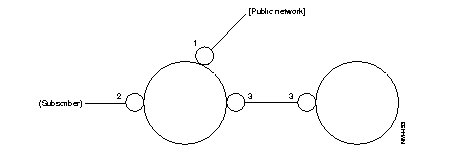
Type of link.
| Primary | Secondary | ||||
| Line X | Profile 18 | Profile 17 | Line Y | ||
| Protocol | Type | C12RXP1 | C12RXP1 | Type | Protocol |
| SDLC | T4 | 16 | 17 | T2.0 | SDLC |
| SDLC | T4 | 18 | - | T2.0/T2.1 | X.25 |
| X.25 | T4 | - | 19 | T2.0 | SDLC |
| SDLC | T4 | 20 | 21 | T2.1 | SDLC |
| SDLC | T2.1 | 22 | 23 | T2.1 | SDLC |
| X.25 | T2.1 | - | 24 | T2.1 | SDLC |
| SDLC | T4 | 25 | 26 | T4 | SDLC |
| NIXD | 27 | 28 | T2.0 | ||
| X.25 | NIXD | - | 29 | T2.0 | |
| RWSI | 30 | 31 | T2.0 | ||
| X.25 | RWSI | - | 32 | T2.0 | |
| X.25 | T4 | - | 34 | * | SDLC |
| NIXD: | Nixdorf protocol |
| RWSI: | Remote WorkStation Interface Protocol |
| * Reserved for special use (0.1.P terminals with T2.0 simulation) |
Type of link.
6 = controller
7 = Host.
Type of link.
8 = BSC controller: TPAD
9 = BSC Host: HPAD.
Type of link.
10 = secondary BSC
11 = primary BSC.
Type of link.
2 = DCE: The PAD is a subscriber of the switch.
Type of link.
0 = user
1 = network (subsequent use).
Type of connection/network
The value of the parameter indicates the network.
| 00 = | X.25 | (X.25 standard) |
| 04 = | TRANSPAC | (France) |
| 08 = | TELENET | (USA) |
| 12 = | TYMNET | (USA) |
| 16 = | INFOSWITCH | (Canada) |
| 20 = | DATAPAC | (Canada) |
| 24 = | DN1 | (Netherlands) |
| 28 = | PSS | (Great Britain) |
| 32 = | DATEX-P | (Germany) |
| 36 = | DCS | (Belgium) |
| 40 = | ITAPAC | (Italy) |
| 44 = | AUSTPAC | (Australia) |
| 52 = | UNINET | (USA) |
| 60 = | TELEPAC | (Switzerland) |
| 64 = | IBERPAC | (Spain) |
| 68 = | DATAPAK | (Sweden) |
| 72 = | HELPAC | (Greece) |
| 76 = | ENTEL | (Argentina) |
| 92 = | DATEX-P | (Austria) |
| 240 = | VIRTUAL ROUTER (only C24 (FastPad)) |
Type de connection.
20 = HDLC-T-T
21 = Frame relay (subscriber).
Country.
0 = France
2 = Switzerland.
Scanning direction of outgoing logical channel numbers.
0 = decreasing
1 = increasing.
In case of an asynchronous line, this parameters are reserved.
With the following table, the values of the parameters 4 to 15 can be found when configuring the logical channels.
| Configuration of the logical channels | Notation | Division to accomplish | Parameters affected | |
| No. of 1st incoming LC (0 to 4096) | A | A: 256 = GA
Remainder LCA | P4 = GA | P5 = LCA |
| No. of incoming LCs (0 to 4096) | B | B: 256 = GB
Remainder LCB | P6 = GB | P7 = LCB |
| No. of 1st both-way LC (0 to 4096) | C | C: 256 = GC
Remainder LCC | P8 = GC | P9 = LCC |
| No. of both-way LCs (0 to 4096) | D | D: 256 = GD
Remainder LCD | P10 = GD | P11 = LCD |
| No. of the 1st outgoing LC (0 to 4096) | E | E: 256 = GE
Remainder LCE | P12 = GE | P13 = LCE |
| No. of outgoing LCs (0 to 4096) | F | F: 256 = GF
Remainder LCF | P14 = GF | P15 = LCF |
with
C = A + B
E = C + D
The values GA to GF are the results of the divisions and the values LCA to LCF correspond to the remainders of the divisions.
The value 256 corresponds to the number of logical channels per group.
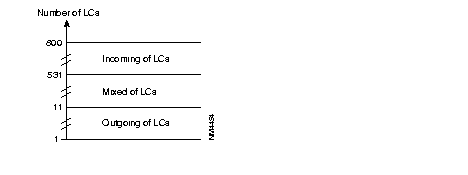
| Configuration of the logical channels | Notation | Division to accomplish | Parameters affected | |
| No. of 1st outgoing LC | 1 | 1: 256 = 0
Remainder 1 | P12 = 0 | P13 = 1 |
| No. of outing LCs | 10 | 10: 256 = 0
Remainder 10 | P14 = 0 | P15 = 10 |
| No. of 1st both-way LC | 11 | 11: 256 = 0
Remainder 11 | P8 = 0 | P9 = 11 |
| No. of both-way LCs | 520 | 520: 256 = 2
Remainder 8 | P10 = 2 | P11 = 8 |
| No. of 1st incoming LC | 531 | 531: 256 = 2
Remainder 19 | P4 = 2 | P5 = 19 |
| No. of incoming LCs | 270 | 270: 256 = 1
Remainder 14 | P6 = 1 | P7 = 14 |
With the following table, the both-way logical channels can be configured
| Use of LC0 | No Use of LC0 | ||||
| DTE | DCE | DTE | DCE | ||
| Parameters designation | N° PAR. | Profile 0 Profile 4 Profile 20 Profile 40 | Profile 1 Profile 2 Profile 5 Profile 21 Profile 41 | Profile 0 Profile 4 Profile 20 Profile 40 | Profile 1 Profile 2 Profile 5 Profile 21 Profile 41 |
| 1st group of incoming LCs | 4 | $ | N | $ | N |
| 1st incoming LC | 5 | 0 | R | 1 | R+1 |
| 1st both-way LC | 9 | 0 | 0 | 1 | 1 |
| Nbr. of groups of both-way LCs | 10 | N | N | N | N |
| Nber of both-way LCs | 11 | R | R | R | R |
| 1st group of outgoing LCs | 12 | N | $ | N | $ |
| 1st outgoing LC | 13 | R | 0 | R+1 | 1 |
| LC | Logical channel. |
| 0 | Value = 0. |
| 1 | Value = 1. |
| $ | Default value. |
| x | Number of both-way LCs to configure. |
| N | Number of groups of necessary both-way LCs. |

If X < 256 then N = 0 and R = x.
Number of the first group of incoming logical channels (call received by the FastPad).
0 to 15 (modulo 256).
Number of the first incoming logical channel.
0 to 255.
Number of groups of incoming logical channels.
0 to 15 (modulo 256).
Number of incoming logical channels.
0 to 255.
Number of the first group of both-way logical channels (call transmitted or received by the FastPad).
0 to 15 (modulo 256).
Number of the first both-way logical channel.
0 to 255.
Number of groups of both-way logical channels.
0 to 15 (modulo 256).
Number of both-way logical channels.
0 to 255.
Number of the first group of outgoing logical channels (call transmitted by the FastPad).
0 to 15 (modulo 256).
Number of the first outgoing logical channel.
0 to 255.
Number of groups of outgoing logical channels.
0 to 15 (modulo 256).
Number of outgoing logical channels.
0 to 255.
Type of coding.
0 = NRZ (default)
1 = NRZI.
Behavior if PVC not ready
| 0 = | Sending of PVC RESET not utilizable on reception of data or reset packet. |
| 7 = | Data or reset packets received in non-utilizable PVC state are ignored. |
SVCs disconnection on no traffic (time-out Ta).
0 = Ta not activated
1 to 254 (in step of 1 mn).
transmission of XID IEEE frame.
0 = transmission of XID IEEE frame by the remote (default)
1 = transmission of XID IEEE frame by the FastPad.
Billing.
0 = no billing
1 = overall billing
2 = detailed billing.
Behavior of FastPad when clear or reset cause packets are received.
| 0 = | transparent |
| 1 = | cause forced to zero |
| 2 = | cause forced to zero if cause code is lower than 128 |
| 3 = | cause forced to the "network trouble" value if received cause codes relates to "local procedure error" or "invalid facility request". |
| Otherwise, transparent mode. | |
| Clears generated internally and resulting from the reception of a restart have a network trouble cause. |
Parameters 18 and 19 allow the configuration of phase identification.
| Parameter | Most sign. nibble | Least sign. nibble |
| 18 | 3rd phase | 1st phase |
| 19 | 4th phase | 2nd phase |
Each nibble may have one of the following values:
| 0 = | not defined |
| 1 = | Terminal Facility Identifier (TFI) without parity (sp) |
| 2 = | TFI with even parity (ep) |
| 3 = | ENQ |
| 4 = | ter? |
When we have the following list: "TFI(np), TFI(ep), ENQ and ter?", this gives the following values:
P18 = 3 * 16 + 1 = 49
P19 = 4 * 16 + 2 = 66
"Waiting" time-out of the 1st data packet following the call confirmation (only when "fast select" is not used; parameter 54 is zero).
1 to 254.
Default: 12.
Behavior of the FastPad in sending of clear or reset cause packets.
0 = no modification of causes
1 = cause forced to DTE.
See parameter 18.
See parameter 18.
Reserved parameter.
Interface state/interface superv. which enables the link to be "in service" and monitored.
| **before**These two parameters must be given in decimal form in configuration.@@before@@ | Warning **after**These two parameters must be given in decimal form in configuration.@@after@@ |
| Physical signals CT | ||
| Parameters 20-21 | Parameters 24-25 | Description |
| 0 1 0
1 | 0 0 1
1 | Signal not monitored and not significant to put into service
Signal monitored (evt. outstanding event) and not significant to put into service Signal monitored but in "OFF" position (contacts opened) Signal monitored but in "ON" position (contacts closed) |
The FastPad detects changes of state of the interface circuits by periodic scanning (period defined by parameter 22) of the interface.
| Bit 5 | P20 | P24 | ||
| SYN | NS | Not significant | 0 | Activity not monitored |
| SYN | 0 | Activity present | 1 | Activity monitored |
| 1 | Activity absent | 1 | Activity monitored |
| 8 | 7 | 6 | 5 | 4 | 3 | 2 | 1 | bit |
| 128 | 64 | 32 | 16 | 8 | 4 | 2 | 1 | |
| 27 | 26 | 25 | 24 | 23 | 22 | 21 | 20 | |
| NS | NS | 108 | SYN | 105 | NS | NS | NS | DCE |
| NS | NS | 106 | SYN | 109 | NS | NS | NS | DTE |
| NS = | 0 = Not significant | |
| 106 = | 1 = 106 OFF | 105 = 1 = 105 OFF |
| 106 = | 0 = 106 ON | 105 = 0 = 105 ON |
| 108 = | 1 = 108 OFF | 109 = 1 = 109 OFF |
| 108 = | 0 = 108 ON | 109 = 0 = 109 ON |
| 8 | 7 | 6 | 5 | 4 | 3 | 2 | 1 | bit |
| 128 | 64 | 32 | 16 | 8 | 4 | 2 | 1 | |
| 27 | 26 | 25 | 24 | 23 | 22 | 21 | 20 | |
| NS | NS | NS | NS | CTE | 141 | 140 | 111 | DCE |
| NS | NS | NS | NS | NS | 117 | 142 | 107 | DTE |
| NS = 0 = Not significant | 140 = 1 = 140 OFF |
| CTE = 1 = defined value | 140 = 0 = 140 ON |
| 141 = 1 = 141 OFF | 111 = 1 = 111 OFF |
| 141 = 0 = 141 ON | 111 = 0 = 111 ON |
| 142 = 1 = 142 OFF | 107 = 1 = 107 OFF |
| 142 = 0 = 142 ON | 107 = 0 = 107 ON |
| 117 = 1 = 117 OFF | 117 = 0 = 117 ON |
Case of a synchronous line where the following monitored signals must all be present so that this line goes to the ON state.
Interface state/interface superv., which enables the link to be in service.
These two parameters must be given in decimal form in the configuration.
The "in service" condition is defined by the value "1" of the corresponding bit of that interface signal.
For a Videotex/PSTN line, parameter 20 should not be changed.
| 128 | 64 | 32 | 16 | 8 | 4 | 2 | 1 | |
| 27 | 26 | 25 | 24 | 23 | 22 | 21 | 20 | |
| NS | NS | 108 | NS | 105 | NS | NS | NS | DCE |
| NS | NS | 106 | NS | 109 | NS | NS | NS | DTE |
| NS = 0 = Not significant | |
| 106 = 1 = 106 OFF | 105 = 1 = 105 OFF |
| 106 = 0 = 106 ON | 105 = 0 = 105 ON |
| 108 = 1 = 108 OFF | 109 = 1 = 109 OFF |
| 108 = 0 = 108 ON | 109 = 0 = 109 ON |
| 128 | 64 | 32 | 16 | 8 | 4 | 2 | 1 | |
| 27 | 26 | 25 | 24 | 23 | 22 | 21 | 20 | |
| NS | NS | NS | NS | CTE | 141 | NS | 111 | DCE |
| NS | NS | NS | NS | NS | 117 | NS | 107 | DTE |
| NS = 0 = Not significant | 140 = 1 = 140 OFF |
| CTE = 1 = defined value | 140 = 0 = 140 ON |
| 141 = 1 = 141 OFF | 111 = 1 = 111 OFF |
| 141 = 0 = 141 ON | 111 = 0 = 111 ON |
| 142 = 1 = 142 OFF | 107 = 1 = 107 OFF |
| 142 = 0 = 142 ON | 107 = 0 = 107 ON |
| 117 = 1 = 117 OFF | 117 = 0 = 117 ON |
| ENABLING CONDITION | PAR. 20 | PAR. 21 | SUPERVISION OF | PAR. 24 | PAR. 25 | |
| TTY - Direct or Minitel Direct (DCE) | 105-108 108 105 None | 40 32 8 0 | 0 0 0 0 | Nothing | 0 | 0 |
| TTY - PSTN or Minitel - PSTN (DTE) | 107-106 106 None | 32 32 0 | 1 0 0 | 109 | 8 | 0 |
| TTY - DL or Minitel - DL (DTE) | 107-106-109 107-106 107-109 106-109 106 109 107 None | 40 32 8 40 32 8 0 0 | 1 1 1 0 0 0 1 0 | Nothing | 0 | 0 |
| TTY - Slaved line (DCE) | 105 None | 8 0 | 0 0 | Nothing | 0 | 0 |
| LSCP - Direct or LSCPA - Direct (DCE) | 108 None | 32 0 | 0 | 105 | 8 | 0 |
| LSCP - DL or LSCPA - DL (DTE) | 107-106 106 None | 32 32 0 | 1 0 0 | 109 | 8 | 0 |
| LSCP - Slaved line or LSCPA - Slaved line (DCE) | None | 0 | 0 | 105 | 8 | 0 |
DL = Dedicated line
LSCP = Low speed computer port
LSCPA = Low speed computer port with automatic calling.
Number of calls.
1 to 254.
"Slow call" time-out.
1 to 254 s (in step of 1 s).
Number of re-transmissions.
1 to 254.
Transparency of Teletel rerouting requests with parameter DR2 = 0 (address towards rerouted end).
| Yes = | a rerouting request (DR) with the length of the parameter DR2 = 0 (.....8200.....) is regarded as a data packet and transmitted transparently. |
| No = | in the same case, the rerouting request (DR) is refused. |
Scan time to detect the transition of the interface signals.
| 1 to 254 | (step of 200 msec) |
| 255 = | No scan time (used specially for modem return C12, profile 36). |
"Wait for reconnection" time-out.
1 to 254 s (in 10 s step).
Reserved parameter.
DR2 mnemonic transparency.
0 = no (default value)
1 = yes.
Filtering and confirmation of interface signal state changes (parameters 20 and 21).
1 to 250 = number of times the period defined by parameter 22 expires.
Declaration of "enabled" state of a synchronous line after 6 seconds' stabilization of the interface.
Param. 22 = 3 (0.6 s)
Param. 23 = 10 expirations.
Reference freezing time-out.
1 to 254 s (in 10 s step).
The multiplication of the values of parameters 22 and 23 defines the time to wait after ringing off a telephone line (duration, the signal 108/1 or 108/2 is "open").
3xP22xP23.
Authorization of intermediate routing.
0 = no
1 = yes.
Reserved parameter.
Position of the reconnection address.
Number of the parameter defined in C8R0.
The value of this parameter corresponds to the position of the address defined in C8 towards which is retransmitted the reconnection call with:
The configured call data are transmitted with the reconnection call. The corresponding facilities are not processed.
See parameters 20 and 21.
Definition of the interface signals on the link to monitor.
These two parameters must be given in decimal form in the configuration.
The FastPad scans periodically the changes of state of the interface signals (scanning interval defined in parameter 22).
The monitoring conditions are defined by the value "1" of the corresponding bit of that interface signal.
Asynchronous case: see P20 and P21.
Example: see parameters 20 and 21 and the previous table.
Reconnect address by means of:
0 = no
1 = yes (taking into account P24).
Value of TTL (Time To Live) equal to life of an IP datagram.
1 to 254.
Forcing of interface circuits.
The circuits present on the output of the interface are chosen in accordance with the following format:
| 128 | 64 | 32 | 16 | 8 | 4 | 2 | 1 | |
| 27 | 26 | 25 | 24 | 23 | 22 | 21 | 20 | |
| NS | NS | NS | 117 | 142 | 109 | 107 | 106 | DCE |
| NS | NS | NS | 141 | 140 | 105 | 111 | 108 | DTE |
Circuit OFF = 1
Circuit ON = 0.
The flow control, LSCP and PSTN state machines have priority over the states defined by parameter 26.
For circuits 109, 107 and 106 to be present on the interface on the FastPad.
Parameter 26 = 7.
Transmission of the protocol identification.
0 = transmission (Balzac)
1 = no transmission.
Type of routing.
0 = routing of IP address ranges
1 = routing of IP address ranges and use of default route
Reserved parameter.
Flow control and command indication parity.
Value | Parity
XON-XOFF | Parity
Indicator | Control Mode |
0 | EP | EP | Norm |
1 | EP | NP | Screen/keyboard norm |
2 | NP | EP | Norm |
3 | NP | NP | Screen/keyboard norm |
4 | 0P | OP | Norm |
5 | EP | EP | Screen/keyboard norm |
6 | NP | NP | Norm |
7 | OP | OP | Screen/keyboard norm |
| EP: Even Parity | OP: Odd Parity | NP: No Parity
|
Sampling of compression rate measurement.
1 to 255.
16.
Reserved parameter.
Value of line clock provided by the FastPad in DCE mode.
| 2 = | 600 bit/s |
| 3 = | 1200 bit/s |
| 6 = | 2400 bit/s |
| 7 = | 3200 bit/s |
| 8 = | 4800 bit/s |
| 10 = | 9600 bit/s |
| 9 = | 14,4 kbit/s |
| 11 = | 19,2 kbit/s |
| 12 = | 38,4 kbit/s |
| 13 = | 48 kbit/s |
| 14 = | 56 kbit/s |
| 15 = | 64 kbit/s |
| 16 = | 72 kbit/s |
| 17 = | 128 kbit/s |
| 18 = | 144 kbit/s |
| 19 = | 256 kbit/s |
| 20 = | 512 kbit/s |
| 21 = | 1 Mbit/s |
| 22 = | 2 Mbit/s. |
Parity (PAD)
3 = even 1 = odd | These values are significant if C13P21 = 3 | |
| 0 = transparent | ||
| 5 = odd (8 bits)
7 = even (8 bits) | These values are significant is C13P21 = 3 and C12P43 = 0 |
Compression dictionary RESET threshold.
0 to 100 in percent.
90.
Number of remote IP ranges C31R14
0 to 200.
Reserved parameter.
Maximum number of buffers per frame. This system parameter makes it possible to supply the FastPad with memory resource buffers according to the length of the received frames. The elementary buffer (memory) allows the reception of frames made up of 128 data bytes. It defines the frame size (N1)
from 1 to 64.
| 1 = | 128-bytes frames |
| 2 = | 256-bytes frames |
| 4 = | 512-bytes frames |
| 8 = | 1024-bytes frames |
| 16 = | 2048-bytes frames |
| 32 = | 4096-bytes frames |
| 64 = | 8192-bytes frames. |
Row of first range of addresses in (C31R14).
1 to 200.
Reserved parameter.
Row of default route in C31 R15 (1 route per Router Function).
1 to 4.
Reserved parameter.
Initial line transmission credit. This parameter makes it possible to load the line with anticipated frame transmissions.
1 to 3.
Transmission of consecutive frames with a single inter-frame flag. In this case the value of parameter 31 is 3.
IP WAN address number index in C31 R7 (1IP Primary WAN address per Router function).
1 to 6.
Reserved parameter.
Value of frame retransmission time-out link (X.25 timer T1).
2 to 250 (unit = 100 ms).
No-reply timer. T1.

Frame repeats time-out T1.

Value of line inactivity time-out in transfer state. When the time-out expires, the call is cleared.
0 = no time-out.
1 to 250 (unit = 10 s).
Value of inactivity time-out of the alarm function. At its expiration, the call is cleared.
0 = no time-out
1 to 250 (unit = 10 s).
No polling reply timer.
1 to 250 (unit 100 ms).
No-host polling timer.
Side TPAD (controller BSC): not significant.
Side HPAD (Host BSC): this value must be higher than the polling time-out fixed by the host (unit: 10 s).
Ta disconnection timer.
10 to 250 s (unit 10 s).
CRC count.
0 = yes
1 = no (transparent).
Number of compression VCs of most significant module 0.
0.
Country version.
0 to 99
Number of local IP at C31R7. It has always to be set to 1.
0 to 6.
Value of frame acknowledge transmission time-out (X.25 timer T2).
1 to 250, T2 = T1 (Par. 32)/2
(unit = 100 ms).
This parameter indicates the number of bytes received by the FastPad in the receive buffers.
1 to 128.
Intersequence polling timer.
1 to 250 (100 ms units).
Profile 50 VIP controller:
Intersequence polling timer.
Profile 51 VIP Host:
Value of interpolling wait time-out for printer
1 to 128 (100 ms units).
Intersequence polling cycle timer.
| TPAD side: | 0.1 to 25 s (100 ms units). |
| HPAD side: | Not significant. |
Tenq Supervision timer.
10 to 250 s (10 s units).
Number of "flags" (transmission).
1 to 15.
Number of compression VCs of least significant module 0.
0 to 10 with 512 kbyte of RAM
0 to 100 with 2 Mbyte of RAM
0 to 230 with 4 Mbyte of RAM.
Protocol type.
0 = LAP-D
1 = LAP-B (subsequent user).
Unnecessary SYN.
0 = The frame is preceded by 2 SYNs during transmission (normal case).
2 = The frame is preceded by 4 SYNs during transmission.
Row of the LAN IP in C31 R8, and R11.
0 to 20.
Sampling time used for counters to data rates.
1 to 180 (step of 10 seconds).
Value of time-out T2 on frame acknowledgment transmission.
1 to 127 (step of 100 ms) T2 < T1
Maximal number of times a transmitted information frame is repeated (X.25 counter N2).
2 to 250.
Type of reception for information messages received from the FastPad.
The character mode means that the reception of a character leads to immediate management of the character.
The block mode means that the complete reception of the block leads to the management of the message carried by this block.
Not significant, depending on chosen X.3 parameters, the most suitable mode is dynamically selected. However, the following modes can be forced:
| 3 = | Block mode. |
| 7 = | Character mode. |
| 11 = | Block mode transmission time-out, calculated according to the line speed. |
| 15 = | Character mode with transmission time-out, calculated according to the line speed. |
Maximum number of unanswered polls.
1 to 250.
No reply counter.
1 to 20.
Retry counter.
2 to 250.
Number of compression VCs of most significant module 1.
0.
Type of access.
0 = basic access
1 = primary access (subsequent user).
(subsequent user, do not modify)
Frame envelope.
0 = CT105 (DTE) or CT109 (DCE) is on (see P26).
1 = CT105 (DTE) or CT109 (DCE) envelopes the transmitted frames.
Sampling time used for counters relative to logical channels and for counters relative to status of interface and of frame level.
1 to 180 (step of 10 seconds).
Frame window size (K).
| 1 to 7 | if modulo 8 |
| 1 to 30 | if modulo 128. |
Frame window size.
1 to 7: modulo 8
Number of stop bits in 1 byte.
| 4 = | 1 stop bit |
| 12 = | 2 stop bits. |
Reception queue width.
1 to 40.
Reception queue width.
The sum of P35 and P69 (packet window default value) must be more than P29 (maximum frame size).
Reception queue width.
1 to 20.
Percentage of line speed for transmit data rate threshold calculation.
0 to 100.
Size transport window.
1 to 15.
Width of frame window.
0 to 100 ; 0 = no check.
Number of compression VCs of Least significant module 1.
0 to 10 with 512 kbyte of RAM
0 to 100 with 2 Mbyte of RAM
0 to 230 with 4 Mbyte of RAM.
Scanning period needed to detect connection to the network.
0 to 255 (step of 200 msec).
Frame window in transmission.
1 to 127 (modulo 128).
Modulo used for numbering of information frames.
| 8 = | modulo 8 |
| 128 = | modulo 128. |
Same as synchronous case.
8 = modulo 8
The SDLC does not support modulo 128.
Type of connection to FastPad interfaces.
| 0 = | Modem access on the PSTN with automatic calling |
| 1 = | Modem access on dedicated line |
| 2 = | Direct access (without modem) |
| 3 = | Direct access with control by 105/106 (par. 20, 21, 24, 25, 26 in class 12 and par. 5, 12 in class 13) |
| 4 = | V.25bis PSTN access by modem. |
Flow control circuits may be elected to be the "in-service" criterion.
Type of coding.
0 = EBCDIC
1 = ASCII
Fast select utilization.
0 = no
1 = yes.
Number of compression VCs of most significant module 2.
0.
When multi-frame is used: the "start of frame regrouping" threshold (= threshold S1).
1 to 33.
Number of scanning period.
0 to 255.
Percentage of line speed for receive data rate threshold calculation.
0 to 100.
Behavior of TPAD after sending of text to cluster controller.
0 = TPAD sends Statistics polling
1 = TPAD sends Controller polling.
Address of primary for transmission of command frames.
1 for DTE
30 for DCE.
Type of parity.
0 = no parity
1 = odd parity
2 = Reserved
If P36 = 1 then P37 = 1.
Reserved parameter.
The HPAD can answer EOT to the host polling if there is no SVC with the TPAD.
| 0 = | no EOT response on the polls |
| 1 to 255 = | EOT response on the polls (255 = default value). |
This parameter is significant for an HPAD profile.
Polling counter, when the station does not reply (slow polling).
1 to 255.
Value of the S0 interface activation time-out.
1 to 150 (step of 200 ms).
Number of compression VCs of least significant module 2.
0 to 10 with 512 kbyte of RAM
0 to 100 with 2 Mbyte of RAM
0 to 230 with 4 Mbyte of RAM.
Remark: For the LMX, the utilization limit is 80 VCs, with compression by module.
Percentage of number of LCs configured for calculating the threshold of busy logical channels.
0 to 100.
Address of secondary for transmission of command frames.
1 for DCE
3 for DTE.
The automatic call number makes it possible to associate a network address, utilities/facilities, and call user data with an asynchronous terminal (e.g. LSCP-A).
This number corresponds to the parameters of recurrences of class 8 (automatic calling table).
P38 = 1
1: means first automatic call defined in C8 par. 0 of all the recurrences.
1 to 200.
0 = service not required.
Percentage of number of buffers free after the initialization of the equipment for calculating the threshold of busy buffers.
0 to 100.
Processing of unknown packets.
0 = Clear the VC (default value profile 17)
1 = Ignored.
Type of paired equipment.
The 1st element mentioned represents the FastPad equipment.
0 = Terminal-Terminal (T-T)
1 = Terminal-CPU (T-CPU)
2 = CPU-CPU (CPU-CPU)
3 = CPU-Terminal (CPU-T).
S0 inactivation time-out.
0 to 5 (step of 200 ms).
Reserved parameter.
Restart Time-out (T10, T20, X.25 timer) Value of supervision time-out for the response of a restart transmitted on the line. The restart is repeated if there is no response by the expiry of the time-out (unit = 10 s).
After N repetitions (P42), the link is reset at the frame level (transmission of a DISC frame).
1 to 250.
FECN and BECN threshold (threshold S2).
Threshold 2 > threshold 1 (P36).
Value of screen message retransmission time-out.
1 to 250 (unit = 10 s).
Management of NUI (Network User Identifier) with respect to the operator and to the format of the call request packet transmitted to the network line.
| 0 = | NUI not checked by the FastPad |
| 1 = | NUI obligatory. The FastPad checks the value (password) assigned to it |
| 2 = | After checking the NUI acquired, the FastPad translates it into an NUA in accordance with the values chosen in class 6. |
| 3 = | NUI optional but reverse charging facility set in call request if NUI missing. |
| 4 = | NUI obligatory and not controlled by the FastPad. Transported in the X.25 facility. |
| 5 = | NUI optional. If present: see "4" if absent: communication established with reverse charging facility. |
| 6 = | NUI inhibited. Communication established with reverse charging facility |
| 10 = | NUI ON or NUI OFF obligatory on PSTN line before any call setup. |
Condition for sending a WACK to the Host.
| 0 = | on detection of a start print bit at 1 |
| 1 = | on network congestion; in this case, the sum of parameters P35 (queuing width) and P69 (packet window size default value) must come out higher than P29 (maximum frame size). |
No reply timer T1. Time-out after an Enq. Tx
1 to 255 (step of 100 ms).
S0 Time-out inactivity.
0 to 5 (step of 200 ms).
NW, dynamic window counter allowing work window incrementation.
The value 4 is recommended, 2 to 10.
Reset time-out (T12, T22, X.25 timer). Value of supervision time-out for the response to a reset transmitted on a logical channel of the link. After the first expiry of the time-out, the reset packet is repeated. After n reset retransmissions, the logical channel is cleared.
1 to 250 (unit = 10 s).
Type of terminal connected to the link.
0 = standard TTY terminal
1 = VDX terminal with Minitel type function key
2 = LSCP (Low Speed Computer Port)
3 = LSCPA (Low Speed Computer Device with Automatic calling).
Length of PSH segment.
7 = 128
8 = 256
Defines threshold S3 where frames received with D bit turned on are discarded.
Threshold 3 > Threshold 2 (P39).
Values of printer message retransmission time-out.
1 to 250 (unit = 10 s).
Reply timer T2.
1 to 255 (unit = 100 ms).
Possibility not to respond to polling/select of the host when the X.25 link is interrupted.
0 = Yes, independent of the state of the VC
1 = Yes when connected (1 station per controller); only in case of BSC3275
Number of available buffers for DMA (Direct Memory Access).
1 to 8.
Clear time-out (T13, T23, X.25-timer). Value of supervision time-out for the response to a clear transmitted on the link. After the first expiry of the time-out, the clear is repeated. After N retransmissions of the clear packet, the logical channel is assumed to be cleared.
1 to 250 (unit = 10 s).
Parity X.25 (VDX).
0 = transparent mode
1 = eighth bit forced to 0.
To define the Data Link Control (DLC) type.
0 = PSH
1 = QLLC.
No reply timer.
0,1 s to 25 s (unit = 100 ms).
No reply timer T3.
0,1 to 25 s (unit = 100 ms).
Refusal threshold (as of a number of frames waiting for transmission equal to this threshold, all news frames are lost. No flow control is possible through Transparent-BSC).
0 to 254.
Priority access to channel D.
0 = priority 8
1 = priority 10.
After reception of a screen message, transmitted by a VIP station, the message flow from that station to the screen, is blocked.
The station is released when a screen message is received from the Host or when the protection time-out expires.
| 0 = | no blocking |
| 1 to 255 = | duration of the blocking of the screen flow (step of 10 s). |
This parameter is only significant in a configuration where a TPAD channel faces VIP terminals.
When this threshold is exceeded, all received frames are ignored (threshold 4).
| HDLC-T-T: | Threshold 4 > Threshold 1 (P36) + Threshold 2 (P39) |
| Frame relay subscriber: | Threshold 4 > Threshold 3 (P40) |
Value of reset, restart and clear packet retransmission counter. This counter is incremented upon the expiry of the reset, restart and clear transmission supervision time-outs.
1 to 250.
Number of significant bits in characters exchanged between the terminal and the FastPad.
8 (7 bits + possible parity defined in X.3 parameters of class 13).
Number of call request packet retransmissions.
0 to 99.
Retry counter.
1 to 7.
Retry counter.
1 to 20.
Number of TEIs per SAPI0 and per interface (*).
| (*) | TEI = | Terminal Equipment Identification |
| SAPI = | Service Access Point Identification (0 = signalling, 16 = packet in D-channel). |
0 and 1.
(subsequent user, do not modify)
0 = no
1 = both-way.
The value 1 must be configured if coding is ASCII with parity and if frames to Transparent-BSC format can be received on the connection.
Elimination of diagnostic code suppression from clear and restart packets sent by the FastPad. This feature ensures compatibility with older X.25 systems.
0 = transparent mode
1 = elimination of diagnostic code suppression.
Window frame in reception.
1 to 127 (modulo 128).
Use of terminal's automatic data rate recognition.
The recognition range is 300 to 9600 bit/s.
| 0 = | no recognition (in this case, the terminal's rate must be the one chosen by the X.3 parameter) |
| 1 = | automatic data rate recognition |
| 2 = | automatic data rate and parity. |
Under unmanagement.
| 1 = | the double SYNs of a normal BSC frame and the DLE SYNs of a transparent-BSC data frame are eliminated on reception and no transmitted on the network. |
| 0 = | these characters are carried to the other end (except for DLE SYN). |
Type of protocol.
0 = 2780
1 = 3780.
Type of TPAD connection.
0 = automatic
1 = DATA.
Number of TEIs per SAPI 16 and per S0 interface
Number of PLLs.
0 to 4.
"Local management" or "transparency" for printer messages.
0 = standard: local management of status messages from the printer.
1 = transparent management, end to end acknowledgment.
Type of X.25 signalling. This parameter defines the signalling processing behavior of the connected line. It is independent of the type of link operation parameter (DTE, DCE, DSE).
0 = X.25 network
1 = X.25 subscriber
2 = X.75.
TEI assignment mode.
0 = No (Switzerland)
1 = Yes (France).
Number of addresses in call request packets sent or received.
| 1 = | one address in call request packets |
| One of the two fields (calling address for packets from subscriber) contains only the suffix (after DNIC-Z0-AB) | |
| 2 = | two addresses in call request packets |
| Both address fields of each of the two types of call request (calling, called) contain complete addresses. |
Automatic TEI allocation.
0 = No
1 = Yes.
This is the AB number of a subscriber connected to a link. The subscriber's number is significant only if the signalling is of the subscriber type (P44 = 1).
This number is added in the calling address for a incoming call.
0 to 98.
Subscriber number (AB) mapped with the SAP's Virtual Router.
00 to 98.
SAPI 0 transmission window (K).
1 up to 7.
Transparency of sub-address restored on the subscriber line.
This configuration parameter indicates the sub-address of the called address field of the call request packet received on a PDN line must be retransmitted on the outgoing line.
| 0 = | call sub-address is not transmitted. |
| This sub-address is not transmitted in the outgoing call request packet. | |
| 1 = | The sub-address of the called party is transmitted on the outgoing line. |
SAPI 16 transmission window (K).
1 to 7.
This parameter specifies the behavior of the FastPad with respect to the closed user group facility. 28 pairs of CUGs (Closed User Group) can be configured for each line (C18R0 to R35).
| 0 = | Not subscriber: clearing if presence of CUG |
| 1 = | Transparent: CUG not tested |
| 2 = | Subscriber: clearing of CUG is absent or if CUG is incorrect |
| 3 = | Subscriber + filtering: same behavior as value 2 but the CUG facility is eliminated from the call request packet sent to the subscriber. |
T303 timer. Time-out after a Tx set-up.
1 to 255 s (step of 1 s)
Reverse charging acceptance.
This parameter specifies the behavior of the FastPad with respect to the reverse charging facility.
0 = subscriber does not accept reverse charging calls
1 = subscriber accepts reverse charging calls.
T305 timer. Time-out after a Tx disconnect.
1 to 255 s (step of 1 s)
(Reserved).
T308 timer. Time-out after a Tx clear.
1 to 255 sec (step of 1 s); for VN2 the value is 4 sec.
Transit delay.
0 = transparent
1 = filtering (see table)
2 = clearing.
| Origin = network line | Origin = subscriber line | |
| Call | Transp. | Transp. |
| Config. call | CLEAR 03.41 | |
| to near-end | ||
| Clearing | CLEAR 05.41 | CLEAR 11.41 |
| to far-end |
T310 timer. Time-out after an Rx call-proceed.
1 to 255 s (step of 1 s)
PDN (Public Data Network) line indicator, configured in the two-address mode. This parameter indicates whether the link is connected directly to a public data network.
0 = no PDN Line
1 = PDN line with compacting/decompacting
2 = Reserved (Muse)
3 = Reserved (TRANSPAC)
4 = PDN line with address transport.
T313 timer. Time-out after a Tx connect.
1 to 255 sec (step of 1 sec); for VN2 the value is 4 sec.
Access number in PDN line table.
This parameter indicates the position in the table of PDN link addresses. It is significant only if the link is a PDN line (parameter 52) and is configured in the two-address mode (parameter 45).
0 = first PDN line used
9 = tenth PDN line used.
Value of the time-out monitoring the time between an N2 clear and an establishment of N2 (T309).
60 to 180 sec (step of 1 sec); for VN2 the value is 60 sec.
Fast select facility for transmission.
Subscription of fast select facility for transmission by the FastPad.
0 = not subscriber
1 = subscriber
2 = transparency.
"Fast select" subscription.
0 = no facility
1 = with facility.
T309 timer. Time-out after a disc and a reestablishment.
1 to 255 sec (step of 1 sec)
The value is 10 sec for VN2.
Tolerance on call data is a received call request packet not containing the "fast select" facility.
2 = authorized call data length up to 128 bytes.
Other value = authorized length up to 16 bytes.
Throughput negotiation facility subscription.
This parameter indicates whether the subscriber connected to the link has subscribed to the throughput class negotiation facility.
0 = not subscriber
1 = subscriber.
Number of B-channels.
0 to 2.
Default throughput class in transmit direction (FastPad to exterior).
| 3 | for | 75 | bit/s |
| 4 | for | 150 | bit/s |
| 5 | for | 300 | bit/s |
| 6 | for | 600 | bit/s |
| 7 | for | 1200 | bit/s |
| 8 | for | 2400 | bit/s |
| 9 | for | 4800 | bit/s |
| 10 | for | 9600 | bit/s |
| 11 | for | 19200 | bit/s |
| 12 | for | 48000 | bit/s |
| 13 | for | 64000 | bit/s |
| 14 | for | 128000 | bit/s |
| 15 | for | 192000 | bit/s |
Establishment mode of channel B1.
0 = without signalling (subsequent use)
1 = with signalling.
Default throughput class in receive direction (exterior to FastPad).
| 3 | for | 75 | bit/s |
| 4 | for | 150 | bit/s |
| 5 | for | 300 | bit/s |
| 6 | for | 600 | bit/s |
| 7 | for | 1200 | bit/s |
| 8 | for | 2400 | bit/s |
| 9 | for | 4800 | bit/s |
| 10 | for | 9600 | bit/s |
| 11 | for | 19200 | bit/s |
| 12 | for | 48000 | bit/s |
| 13 | for | 64000 | bit/s |
| 14 | for | 128000 | bit/s |
| 15 | for | 192000 | bit/s |
The final choice of throughput classes for the transmit and receive directions of a link is made on the call confirmations.
Establishment mode of channel B2.
0 = without signalling (subsequent use)
1 = with signalling.
Maximum throughput class in transmit direction.
| 3 | for | 75 | bit/s |
| 4 | for | 150 | bit/s |
| 5 | for | 300 | bit/s |
| 6 | for | 600 | bit/s |
| 7 | for | 1200 | bit/s |
| 8 | for | 2400 | bit/s |
| 9 | for | 4800 | bit/s |
| 10 | for | 9600 | bit/s |
| 11 | for | 19200 | bit/s |
| 12 | for | 48000 | bit/s |
| 13 | for | 64000 | bit/s |
| 14 | for | 128000 | bit/s |
| 15 | for | 192000 | bit/s |
Network termination timer. Time-out between an alarm and an Rx connect.
1 to 255 sec. in step of 10 sec.
Maximum throughput class in receive direction.
| 3 | for | 75 | bit/s |
| 4 | for | 150 | bit/s |
| 5 | for | 300 | bit/s |
| 6 | for | 600 | bit/s |
| 7 | for | 1200 | bit/s |
| 8 | for | 2400 | bit/s |
| 9 | for | 4800 | bit/s |
| 10 | for | 9600 | bit/s |
| 11 | for | 19200 | bit/s |
| 12 | for | 48000 | bit/s |
| 13 | for | 64000 | bit/s |
| 14 | for | 128000 | bit/s |
| 15 | for | 192000 | bit/s |
Value of the time-out monitoring "no virtual circuits established"
1 to 255 seconds in step of 10 sec.
Subscription to packet size negotiation facility.
0 = no subscriber
1 = subscriber.
Value of the time-out waiting to move into service after having received a "service interrupted" on a B-channel.
1 to 255 sec. in step of 10 sec.
This parameter must be consistent with the length of the frame switched to the line (parameter 29).
Default value of packet size for transmit direction (FastPad to exterior network or subscriber connected to the FastPad).
| 4 | for | 16 | bytes |
| 5 | for | 32 | bytes |
| 6 | for | 64 | bytes |
| 7 | for | 128 | bytes |
| 8 | for | 256 | bytes |
| 9 | for | 512 | bytes |
| 10 | for | 1024 | bytes |
| 11 | for | 2048 | bytes |
| 12 | for | 4096 | bytes |
| 13 | for | 8192 | bytes. |
Default value of packet length with QLLC procedure for transmission from the FastPad to exterior (transmit).
| 4 | for | 16 | bytes |
| 5 | for | 32 | bytes |
| 6 | for | 64 | bytes |
| 7 | for | 128 | bytes |
| 8 | for | 256 | bytes |
| 9 | for | 512 | bytes |
| 10 | for | 1024 | bytes |
| 11 | for | 2048 | bytes |
| 12 | for | 4096 | bytes |
| 13 | for | 8192 | bytes. |
Tx VIP message length.
| 4 | for | 16 | bytes |
| 5 | for | 32 | bytes |
| 6 | for | 64 | bytes |
| 7 | for | 128 | bytes |
| 8 | for | 256 | bytes |
| 9 | for | 512 | bytes |
| 10 | for | 1024 | bytes |
| 11 | for | 2048 | bytes |
| 12 | for | 4096 | bytes |
| 13 | for | 8192 | bytes. |
BSC block length (transmission).
| > 10 | |||
| 10 | for | 1024 | bytes |
| 11 | for | 2048 | bytes |
| 12 | for | 4096 | bytes. |
BSC block length (transmission).
| 7 to 10 | |||
| 7 | for | 12 | bytes |
| 8 | for | 256 | bytes |
| 9 | for | 512 | bytes |
| 10 | for | 1024 | bytes. |
Check on presence of called sub-address.
1 = refused when sub-address is not present
0 = acceptation in all cases.
This parameter must be consistent with the length of the frame switched to the line (parameter 29).
Default value of packet size for transmission from the exterior (network or subscriber connected to the FastPad) to the FastPad.
| 4 | for | 16 | bytes |
| 5 | for | 32 | bytes |
| 6 | for | 64 | bytes |
| 7 | for | 128 | bytes |
| 8 | for | 256 | bytes |
| 9 | for | 512 | bytes |
| 10 | for | 1024 | bytes |
| 11 | for | 2048 | bytes |
| 12 | for | 4096 | bytes |
| 13 | for | 8192 | bytes. |
Default value of packet length with QLLC procedure for transmission from exterior to the FastPad.
| 4 | for | 16 | bytes |
| 5 | for | 32 | bytes |
| 6 | for | 64 | bytes |
| 7 | for | 128 | bytes |
| 8 | for | 256 | bytes |
| 9 | for | 512 | bytes |
| 10 | for | 1024 | bytes |
| 11 | for | 2048 | bytes |
| 12 | for | 4096 | bytes |
| 13 | for | 8192 | bytes. |
Rx VIP message length.
| 4 | for | 16 | bytes |
| 5 | for | 32 | bytes |
| 6 | for | 64 | bytes |
| 7 | for | 128 | bytes |
| 8 | for | 256 | bytes |
| 9 | for | 512 | bytes |
| 10 | for | 1024 | bytes |
| 11 | for | 2048 | bytes |
| 12 | for | 4096 | bytes |
| 13 | for | 8192 | bytes. |
BSC block length reception.
| > 7 | |||
| 7 | for | 128 | bytes |
| 8 | for | 256 | bytes |
| 9 | for | 512 | bytes |
| 10 | for | 1024 | bytes |
| 11 | for | 2048 | bytes |
| 12 | for | 4096 | bytes. |
BSC block length reception.
| 4 to 7 | |||
| 4 | for | 16 | bytes |
| 5 | for | 32 | bytes |
| 6 | for | 64 | bytes |
| 7 | for | 128 | bytes. |
MSN behavior (MSN = Multiple Subscriber Number) or DDI (Direct Dial-in)
0 = call acceptation
1 = check of the destination number.
This parameter must be consistent with the length of the frame switched to the line (parameter 29).
Maximum packet size transmitted by the FastPad.
| 4 | for | 16 | bytes |
| 5 | for | 32 | bytes |
| 6 | for | 64 | bytes |
| 7 | for | 128 | bytes |
| 8 | for | 256 | bytes |
| 9 | for | 512 | bytes |
| 10 | for | 1024 | bytes |
| 11 | for | 2048 | bytes |
| 12 | for | 4096 | bytes |
| 13 | for | 8192 | bytes. |
S0 interface number (position in class 10).
0 to 35.
This parameter must be consistent with the length of the frame switched to the line (parameter 29).
Maximum packet size received by the FastPad.
| 4 | for | 16 | bytes |
| 5 | for | 32 | bytes |
| 6 | for | 64 | bytes |
| 7 | for | 128 | bytes |
| 8 | for | 256 | bytes |
| 9 | for | 512 | bytes |
| 10 | for | 1024 | bytes |
| 11 | for | 2048 | bytes |
| 12 | for | 4096 | bytes |
| 13 | for | 8192 | bytes. |
This parameter is used in case of a multiple backup.
Time-out between two successive attempts on a given ISDN number.
1 to 254.
5 s.
This parameter must be consistent with the length of the frame switched to the line (parameter 29).
Minimum packet size received by the FastPad.
| 4 | for | 16 | bytes |
| 5 | for | 32 | bytes |
| 6 | for | 64 | bytes |
| 7 | for | 128 | bytes |
| 8 | for | 256 | bytes |
| 9 | for | 512 | bytes |
| 10 | for | 1024 | bytes |
| 11 | for | 2048 | bytes |
| 12 | for | 4096 | bytes |
| 13 | for | 8192 | bytes. |
This parameter is used in case of a multiple backup.
Time-out between two successive cycles.
1 to 254.
10 s.
This parameter must be consistent with the length of the frame switched to the line (parameter 29).
Minimum packet size received by the FastPad
| 4 | for | 16 | bytes |
| 5 | for | 32 | bytes |
| 6 | for | 64 | bytes |
| 7 | for | 128 | bytes |
| 8 | for | 256 | bytes |
| 9 | for | 512 | bytes |
| 10 | for | 1024 | bytes |
| 11 | for | 2048 | bytes |
| 12 | for | 4096 | bytes |
| 13 | for | 8192 | bytes. |
This parameter is used in case of a multiple backup.
Number of attempt cycle.
1 to 10.
3.
Transmit window size facility.
0 = not subscriber
1 = subscriber.
This parameter is used in case of a multiple backup.
Maximum time for multiple backup.
5 to 180 (unit = 1s).
100.
Default value of packet window for transmission from FastPad to exterior (network or subscriber connected to the FastPad).
1 to 7.
This parameter is used in connection with PLLs (X.31 case B on D channel).
Time-out 0VC on PLL. This parameter is global to the interface. If different from 0, the PLL becomes half permanent.
0 = not managed 1 to 250 (step of 1s)
0
Default value of packet window for transmission from exterior to the FastPad.
1 to 7.
This parameter applies when PLLs are used (X.31 case B on D channel).
Activation of PLLs on start-up.
0 = No
1 = Yes
0.
Maximum value of packet window for transmission from the FastPad to exterior.
1 to 7.
High layer compatibility (HLC).
One byte coded in 8 bits (bit 0 = least significant bi).
7 6 5 4 3 2 1 0 bit
Reserved | |
| |___HLC I.E transmission
HLC I.E _____ | 0 = no
analysis 1 = yes
0 = no
1 = yes
| 00 = | no transmission and analysis of HLC I.E. |
| 01 = | transmission and no analysis of HLC I.E. |
| 02 = | no transmission and analysis of HLC I.E. |
| 03 = | transmission and analysis of HLC I.E. |
02.
Maximum value of packet window for transmission from exterior to the FastPad.
1 to 7.
Coding type of High Layer Compatibility Information Elements.
One bit coded in 8 bits (bit 0 = least significant bit).
| 7 | 6 | 5 | 4 | 3 | 2 | 1 | 0 | bit |
| | | |______ ___ Presentation
| | | 1 | 0 | bit
| | |
| | | 01 = Method of protocol profile
| | | The other values are reserved
| | |_______________________ __Interpretation
| | 4 | 3 | 2 | bit
| | : 0 : 0 : 0 : = Coding of services:
| | : : : : audiography,
| | : : : : AudioVideotex
| | : : : : and no standardized
| | : : : : application (value not
| | : : : : defined in the ETS 300
| | : : : : 102).
| | : : : :
| | : 1 : 0 : 0 : = Teleservice by parameter
| | 73.
| |
| | The other values are reserved
| |
| |_____________________________________Coding standard
| 6 | 5 | bit
| : 0 : 0 : = ITU-T standard
| : 1 : 0 : = National standard
|
| The other values are reserved
|
|____________________________________________ _Value fixed at 1
In VN3, the values of parameters 72 are:
| · 145 (91 hexa): | ITU-T standard |
| · 193 (C1 en hexa): | National standard* |
| · 209 (D1 en hexa): | National standard |
*The values of tests 2, 3 and 4 are not defined in the ETS 300102. | |
Request call transfer to a backup subscriber when the called subscriber is busy.
0 = transparent
1 = filtering
2 = clearing.
Definition of the teleservice. There are to 2 teleservice groups according to the coding standard:
| 1) | Teleservice with ITU-T coding standard: | |
| 129 (81 hexa): | Telephony | |
| 132 (84 hexa): | Facsimile group 2/3 | |
| 161 (A1 hexa): | Facsimile group 4 Class 1 | |
| 164 (A4 hexa): | Teletex and telecopy group 4 Class 2/3 | |
| 168 (A8 hexa): | Teletex service basic and processable mode of operation | |
| 177 (B1 hexa): | Teletex service basic mode of operation | |
| 178 (B2 hexa): | Syntonic Videotex | |
| 179 (B3 hexa): | International Interworking for videotex service | |
| 181 (B5 hexa): | Telex service | |
| 184 (B8 hexa): | Messages handling systems (MHS) | |
| 193 (C1 hexa): | OSI application | |
| 224 (E0 hexa): | Audiovisual. | |
| 2) | Teleservices with national coding standard | |
| 128 (80 hexa): | Unknown teleservice | |
| 192 (C0 hexa): | Audiography | |
| 200 (C8 hexa): | Audiovideotex | |
| 255 or 127 (FF hexa): | Application not standardized | |
193 = OSI application.
Format of call confirmation transmitted by the FastPad.
0 = complete X.25 format (facilities and addresses)
1 = reduced X.25 format, the (calling, called) address length field is zero (facilities, no address)
2 = reduced format (no facility, no address)
3 = complete X.25 format (facilities and addresses + transparency on addresses).
Low layer compatibility (LLC).
One byte coded in 8 bits (bit 0 = least significant bit).
7 6 5 4 3 2 1 0 bit
Reserved | |
| |___LLC I.E transmission
LLC I.E analysis 0 = no
0 = no 1 = yes
1 = yes
| 00 = | no transmission and analysis of LLC I.E |
| 01 = | transmission and no analysis of LLC I.E |
| 02 = | no transmission and analysis of LLC I.E |
| 03 = | transmission and analysis of LLC I.E |
02
Remark: The content of the LLC I.E can not be configured. If the analysis of this I.E is required, only the following compatibilities are accepted:
· LEV1: | ITU-T X.31 throughput adaptation | |
| LEV2: | ITU-T X.25 level 2 LAPB (SLP) | |
| LEV3: | ITU-T X.25 packet level | |
· LEV1: | ITU-T X.31 throughput adaptation | |
| LEV2: | ITU-T X.25 level 2 multilink (MLP) | |
| LEV3 = | ITU-T X.25 packet level. | |
Subscription X.29/Teletel rerouting.
0 = no (default values of synchronous profiles)
1 = reroutable calls.
Reserved.
Reserved.
Subscription to compression
Facility direction
Facility obligatory/optional
Scrambling
Implementation of service with or without negotiation.
| Value | Subscriber | Direction | Obligatory/ Optional | Scrambling | Negotiation |
| 0, 4, 64, 68, 128, 132,192, 196 | NO | - | - | - | - |
| 1 | YES | Network to subscriber | Optional | NO | YES |
| 2 | YES | Subscriber to network | Optional | NO | YES |
| 3 | YES | Bi-directional | Optional | NO | YES |
| 5 | YES | Network to subscriber | Obligatory | NO | YES |
| 6 | YES | Subscriber to network | Obligatory | NO | YES |
| 7 | YES | Bi-directional | Obligatory | NO | YES |
| 65 | YES | Network to subscriber | Optional | YES | YES |
| 66 | YES | Subscriber to network | Optional | YES | YES |
| 67 | YES | Bi-directional | Optional | YES | YES |
| 69 | YES | Network to subscriber | Obligatory | YES | YES |
| 70 | YES | Subscriber to network | Obligatory | YES | YES |
| 71 | YES | Bi-directional | Obligatory | YES | YES |
| 129, 133 | YES | Network to subscriber | - | NO | NO |
| 130, 134 | YES | Subscriber to network | - | NO | NO |
| 131, 135 | YES | Bi-directional | - | NO | NO |
| 193, 197 | YES | Network to subscriber | - | YES | NO |
| 194, 198 | YES | Subscriber to network | - | YES | NO |
| 195, 199 | YES | Bi-directional | - | YES | NO |
N = Network
A = Subscriber
Time-out associated with packet grouping.
| 0 = | service not implemented |
| 1 to 15 = | value time-out in units of 100 ms. |
Call request answer Time-out (T11, T21, X.25 timer). Value of supervision time-out for response to a call request packet sent on the link. A clear packet is sent if there is no response after this period.
1 to 250 (unit 10 s).
Trunk call-return.
0 = not authorized
2 = authorized with DNIC.ZO.
Type of access to output line (subscriber call return).
0 = multiple access (sending of ringback is line is configured for ringback)
1 = single access (sending of clear even if line is a ringback subscriber).
Supervision of markers.
This parameter specifies the behavior of the FastPad with respect to facility markers. The FastPad accepts all correct incoming markers.
For transmission to the exterior, there are three possibilities.
| 0 = | transparency: the FastPad transmits facility markers |
| 1 = | blocking: the FastPad ignores markers received from the exterior, which are therefore not retransmitted |
| 2 = | filtered: the FastPad filters received markers on the basis of their values and of the protocol elements transmitted (call, call confirmation, or clear). |
| The filtering is as follows: |
| Markers Æ | Network of caller | Network of called party | DTE |
| Packets receivedØ | 0000 | 00FF | 000F |
| Call | Transp. | CLEAR 03.42 to near-end | Transp. |
| Confirm. Call | CLEAR 03.42 to near-end CLEAR 11.42 to far-end | Transp. | Transp. |
| Clear | Irrelevant | Irrelevant | Transp. |
| Markers Æ | Network of caller | Network of called party | DTE |
| Packets received Ø | 0000 | 00FF | 000F |
| Call | CLEAR 03.42 to near-end | Transp. | Transp. |
| Confirm. Call | Transp. | CLEAR 03.42 to near-end CLEAR 11.42 to far-end | Transp. |
| Clear | CLEAR 03.42 to near-end CLEAR 11.42 to far-end | CLEAR 03.42 to near-end CLEAR 11.42 to far-end | Transp. |
Notification of change of called address.
This parameter specifies the behavior of the FastPad with respect to the "Called Line Address Modification" (CLAM) facility in the call confirmation packet.
| 0 = | No consistency check of received call confirmation (presence of facility and existence of called address). The FastPad does not transmit the facility. |
| 1 = | The facility is transmitted in clear and call confirmations if the clear and call confirmation formats are complete. |
| If not, the FastPad transmits a clear. | |
| 2 = | The facility is not transmitted, but the FastPad checks that the called address is present in the received call confirmation. If not, the FastPad sends a clear. |
| 3 = | The facility is transmitted in clear and call confirmations if the formats are complete; otherwise, the FastPad transmits a clear. |
| There is a consistency check to the presence of the called address in the call confirmation; a clear is transmitted if it is missing. |
Format of clear transmitted by the FastPad.
In reception, the FastPad accepts all clear packet formats. The format in which it transmits clear packets depends on this configuration parameter.
| 0 = | Complete X.25 format (address and facility) |
| 1 = | Reduced X.25 format |
| 2 = | Reduced format; the clearing to 5 bytes indicate the cause and the diagnostic |
| 3 = | Complete X.25 format (facilities and addresses + transparency on addresses). |
D bit Management
0 = transparent
1 = clearing
2 = management.
Type of line.
0 = X.25 on dedicated line
2 = X.25 on PSTN.
(exceptionally modifiable)
Supervision time-out for transmission of messages sent to an asynchronous terminal.
| 0 | = no time-out |
| 1 to 250 | = 1 to 250 seconds. |
Behavior with respect to unknown facilities.
0 = transparent mode (no conversion)
1 = facility filtered
2 = communication released
3 = transparent for reception, filtered for transmission
4 = transparent for reception, cleared for transmission
5 = filtered for reception, transparent when transmission
6 = filtered for reception, cleared when transmission
7 = cleared for reception, transparent for transmission
8 = cleared for reception, filtered for transmission
both-way flow control.
0 = no
1 = yes.
This parameter manages the address conversion in accordance with the following values:
| 128 | 64 | 32 | 16 | 8 | 4 | 2 | 1 |
|---|---|---|---|---|---|---|---|
27 | 26 | 25 | 24 | 23 | 22 | 21 | 20 |
| | | | | | | |
| | | | | | | |
| | | | | | | 0 = no conversion
| | | | | | | 1 = Calling address
| | | | | | | conversion on in-
| | | | | | | coming call
| | | | | | | request into the
| | | | | | | FastPad.
| | | | | | |
| | | | | | 1 = called address conversion
| | | | | | on incoming call request
| | | | | | into the FastPad.
| | | | | |
| | | | | 1 = Calling address conversion on
| | | | | outgoing call request from the FastPad.
| | | | |
| | | | 1 = Called address conversion on outgoing call request
| | | | from the FastPad.
| | | |
| | | 0 = Transparency | on incoming call
| | | 1 = Conversion + | request into the FastPad
| | | Clear* |
| | |
| | 0 = Transparency | on outgoing call request
| | 1 = Conversion + | from the FastPad.
| | Clear* |
| |
| 0 = Called address conversion depends on bit 21
| 1 = Called address check and insertion.
|
0 = No check on address supplied by the DTE
1 = Check on address supplied by the DTE (calling address on call request)
address called on call confirmation and clearing request (see Note 3)
* COM cleared if address to be converted is not in conversion table.
Step 1 "Called" address conversion on outgoing call Parameter 89 = 8.
Step 2 "Calling and Called" address conversion on incoming call with clearing if conversion impossible in C9, R11. Parameter 89 = 19.
Number of permanent virtual circuits.
0 to 29 ; PVCs are configured beginning with LC0.
Number of clusters.
1 to 30 for a "Front end" link.
1 to 8 for a "Remote" link.
0.
Number of polled stations (DKU, TCU).
1 to 32.
Number of controllers (TCU).
1 to 10.
Number of controllers.
See appendix G.
Number of DLCIs for FRA
Number of LLC for HDLC-T
1 to 32 (value = 1 for HDLC-T).
Error threshold for the error correction procedure.
1 to 254.
Number of configured LLC (inter-router connections).
0 to 200.
Position of first PVC in C17.
1 to 250.
Position of first cluster in the class 19.
1 to 100.
Position of first controller (DKU, TCU) in class 19.
1 to 200.
Position of the controller in class 19.
1 to 200.
Position of 1st DLCI in class 17 for FRA
Position of the LLC for HDLC-T
1 to 200.
Transmission time-out NACK for the error Correction Procedure.
1 to 254 in step of 100 msec.
both-way flow control.
0 = yes
1 = no.
Position of first SVC in Class 17.
1 to 250.
(Not significant in synchronous case).
Connection to Hewlett Packard equipment.
0 = standard asynchronous equipment
1 = Hewlett Packard Host computer
2 = Hewlett Packard terminal.
Deletion of a PAD character.
0 = no
1 = a PAD character is eliminated at the end of each frame (exception use).
LMI signalling.
0 = no LMI.
1 = subscriber LMI (FRTE or FRCE).
2 = network LMI (FRCE).
0
Type of LAP.
0 = LAP B
1 = LAP A.
Type of call.
| 0 = | standard case, PAD or video-PAD |
| mnemonics obligatory preceded by a "." | |
| digital call command authorized | |
| X.28 command authorized. | |
| call data and password for VDX controlled by remote host | |
| 1 = | used for VDX (Minitel) |
| mnemonics optionally preceded by a "." | |
| digital call command not authorized. | |
| X.28 command not authorized. | |
| call data and password for VDX controlled by the server. | |
| 2 = | used for VDX (TELETEL) |
| mnemonics optionally preceded by a "." | |
| digital call command authorized. | |
| X.28 command not authorized. | |
| call data and password for VDX controlled by the server. | |
| 3 = | used for Minitel |
| mnemonics optionally preceded by a "." | |
| digital call command not authorized. | |
| X.28 command not authorized. | |
| call data and password for VDX controlled locally (C7R3). |
Securized VC.
(See Chapter 3.11 on local calls)
Possible values:
| 0 = | no securized VC. |
| The VCs are considered normal VCs, the equipment does not handle it differently. | |
| 1 = | securized subscriber. |
| All calls transmitted by the subscriber are securized. It is also possible to receive calls from securized subscribers on a securized VC. | |
| 2 = | securization not allowed |
| Securization not allowed for the subscriber. Each attempt to establish a securized VC provokes a 'clear' of the connection. | |
| 3 = | filtered securization. |
| Line to the subscriber: the call is securized in case of reception of a securized call. | |
| Line to the network: if the call comes from a subscriber connected to the unit, the securization is ignored; if the call comes from the network, it is cleared. |
| 0 = | Load | OOS | Signalling | HS | Totalizer | OOS | Compression | OOS |
| 1 = | Load | INS | Signalling | OOS | Totalizer | OOS | Compression | OOS |
| 2 = | Load | OOS | Signalling | INS | Totalizer | OOS | Compression | OOS |
| 3 = | Load | INS | Signalling | INS | Totalizer | OOS | Compression | OOS |
| 4 = | Load | OOS | Signalling | OOS | Totalizer | INS | Compression | OOS |
| 5 = | Load | INS | Signalling | OOS | Totalizer | INS | Compression | OOS |
| 6 = | Load | OOS | Signalling | INS | Totalizer | INS | Compression | OOS |
| 7 = | Load | INS | Signalling | INS | Totalizer | INS | Compression | OOS |
| 8 = | Load | OOS | Signalling | OOS | Totalizer | OOS | Compression | INS |
| 9 = | Load | INS | Signalling | OOS | Totalizer | OOS | Compression | INS |
| 10 = | Load | OOS | Signalling | INS | Totalizer | OOS | Compression | INS |
| 11 = | Load | INS | Signalling | INS | Totalizer | OOS | Compression | INS |
| 12 = | Load | OOS | Signalling | OOS | Totalizer | INS | Compression | INS |
| 13 = | Load | INS | Signalling | OOS | Totalizer | INS | Compression | INS |
| 14 = | Load | OOS | Signalling | INS | Totalizer | INS | Compression | INS |
| 15 = | Load | INS | Signalling | INS | Totalizer | INS | Compression | INS |
| OOS = | Out of service | |||||||
| INS = | In service | |||||||
Activation/deactivation of "load", "signalling", totalizing and compression headings of "Loads statistics" management function.
Possible values:
Sampling time used for the counters of the COMPRESSION heading.
1 to 180 (step of 10 seconds)
Reserved
Acknowledgment of packet 1 for 1.
0 = no
1 = yes.
Reserved.
Echo mask.
0 = The value of the X.3 parameter number ZO of class 13 imposes the echo mask.
Reserved.
This parameter defines whether the line is in full duplex (with echo) or half duplex (without echo).
The echo of a "transfer" mode character is also defined by the X.3 parameter Number 2 in Class 13.
0 = FULL DUPLEX
1 = HALF DUPLEX.
| C12P105 VALUE | C13P2 VALUE | TRANSFER | OTHER |
0 | 0 | Without echo | With echo |
0 | 1 | With echo | With echo |
1 | 0 or 1 | Without echo | Without echo |
This parameter defines the type of character coding (conversion to lower case or not).
0 = ASCII characters, no conversion.
Definition of type of terminal.
127 = Type of terminal defined in classes 12 and 13.
Use of a predetermined type of terminal. The type of terminal may be entered on connection in the form of a mnemonic or predefined.
1 = Type of terminal predefined.
Manual or automatic call.
| 0 = | Manual connection command. |
| 1 = | Automatic connection on establishment of physical path between terminal and PAD. |
| The user cannot enter a connection command. |
Automatic hang-up on PSTN line on clearing of the VC. This hang-up results in the "dropping" of interface signals 106, 107 and 109 for 3 seconds. After 3 seconds, the configured interface signals go high in order to be ready to receive another PSTN call.
1 = Automatic hang-up after clearing of VC.
Type of private network management. This parameter specifies the fields that must be backed up (or restored) in (or from) the address extension facility.
| 128 | 64 | 32 | 16 | 8 | 4 | 2 | 1 |
|---|---|---|---|---|---|---|---|
27 | 26 | 25 | 24 | 23 | 22 | 21 | 20 |
| | | | | | | |
| | | | | | | Called address
| | | | | | | 0 = no
| | | | | | | 1 = yes
| | | | | | |
| | | | | | Calling address
| | | | | | 0 = no
| | | | | | 1 = yes
| | | | | CUG
| | | | | 0 = no
| | | | | 1 = yes
| | | | NS
| | | NS
| | NS
| NS
NS
The values used are:
| 0: | no processing |
| 3: | backup (or restitution) called and calling address |
| 7: | backup (or restitution) called address, calling address and internal CUG |
| 15: | backup (or restitution) called address, calling address, internal CUG and RC |
Activation/deactivation of two data forwarding time-outs defined by parameters C12P112 and C13P4.
When the time-outs are activated, the data are sent upon the expiry of one of the two time-outs.
1 = Activation of time-outs.
Type of behavior to be adopted on X.25 fields. It corresponds to a row in C26 "X.25 field modification table".
0 =no behavior
1 to 20 = row in C26 (1 point on parameter 0 in C26, ..., 20 on parameter 19).
Value of data forwarding time-out.
This time-out is activated on reception of the first character. On expiry of the time-out, the PAD sends the received characters to the network. The time-out is restarted upon reception of the first character to follow.
1 to 255 (step of 50 ms).
Reserved.
Activation/deactivation of "padding" parameters:
| C13P9: | "padding" after CR |
| C13P14: | "padding" after LF |
1 = Activation of "padding".
Defines the X.ON character in the DCE Æ DTE direction.
17 = DC1 character.
Defines the X.OFF character in DCE Æ DTE direction.
19 = DC3 character.
This parameter defines the element (character or sequence of characters) allowing Changeover from "transfer" mode to "command" mode.
This parameter is taken into account only when the parameter C13P1 = 1.
Otherwise, the escape character is defined by parameter C13P1.
1 = Escape character: (CR) @ (CR).
Defines the behavior of the PAD after execution of a command.
1 = The PAD remains in commands mode.
Defined X.ON character in the DTE Æ DCE direction.
17 = DC1 character.
Defined the X.OFF character in the DTE Æ DCE direction.
19 = DC3 character.
Activation/deactivation of parameters 1, 13 and 15 of class 13 as well as parameter C12P106.
| 1 = | Transparent mode. Parameters 1, 13 and 15 of C13 are not taken into account (case of escape, no LF insertion after CR) |
| 2 = | Virtual terminal mode. Parameters 1, 13 and 15 of C13 are not inhibited. |
Reserved
Consolidation counter. Used with DLM.
This parameter defines the number of times that the "traffic/configured threshold" comparison must be made before possible "overflow/backup".
0 to 249
255 = no consolidation.
Configuration of lower percentage threshold relative to the line speed declared in P28.
This threshold is used in connection with overflow backup (DLM).
0 to 100 (in percentage).
Configuration of upper percentage threshold relative to the line speed declared in P28. This threshold is used in connection with overflow backup (DLM).
0 to 100 (in percentage).
DLM functioning mode.
| 0 = | Passive: | transmission of outstanding events only (no action taken) |
| 1 = | Active: | transmission of outstanding events and action configured in P130. |
Load calculation integration time-out.
1 to 250 (step of 10 s).
Cost of the medium.
0 = Direct line, dedicated line
1 = Switch line (ISDN, PSTN).
Spacing of outstanding load events.
1 to 250 (step of 10 s).
Address position of remote equipment in class 22.
This parameter is used mainly for MLP but also for the management of the automatic return of backup and the load changeover.
0 to 250 (see C22).
Backup change-over, overflow, behavior.
| 00 = | no |
| 01 = | backup and automatic return of backup, |
| 03 = | backup and automatic return of backup in MLP, |
| 05 = | load changeover and automatic return of backup, |
| 10 = | load overflow and automatic backup in MLP, |
| 11 = | load overflow and automatic backup in MLP and automatic return of backup. |
Overflow and changeover must be configured on only one end of the link.
Cannot be applied to a frame-relay PLL.
Maximum number of information packets (LSPDU) that a DAR can store in its data base.
1 to 250.
50
Reserved
Configuration of DAR operation
| 0 = | Passive DAR (default value) |
| 1 = | Distribution of inter-DAR topology information without route calculation. |
| 2 = | Active DAR (distribution and calculation of routes). |
Distribution period for topology information (LSPDU) exchanged between DARs.
1 to 250 (in step of 10 s).
3
Calculation period for routes with shortest path used by the DAR.
In order for the calculation of routes to be carried out with the latest information (LSPDU) coming from all the switches of the domain, it is preferable for the value of P135 to be at least twice as high as the distribution period of the LSPDUs (P134).
1 to 250 (in step of 10 s).
6
Storage time for an LSPDU in the DAR data base.
Whenever the DAR performs a route calculation, it decrements the life assigned to each LSPDU of the data base.
When the value is zero, the LSPDU is cleared from the data base.
1 to 250 (in step of 10 s).
120
Expiration thresholds for LSPDUs exchanged, associated with the life of the LSPDU below which the DAR transmitting the LSPDU must redistribute a new LSPDU in the domain. This mechanism avoids clearing the LSPDU transmitted at low frequencies.
1 to 250 (in step of 10 s).
6
Management on M bit.
3 = M bit is equal to 1 in full packets.
Duration of locking of route calculation following an exception LSPDU.
This mechanism avoids the DAR having to carry out several times the same route calculation following a change in topology.
1 to 250 (in step of 1 s).
2
Reserved.
Flow control by signals.
8 = use of flow control by signals.
|
|