This manual describes the features and functions of Release 4.0 of the Cisco ATM Switch Interface Shelf (AXIS), shown in Figure 1-1.
Figure 1-1: AXIS Shelf
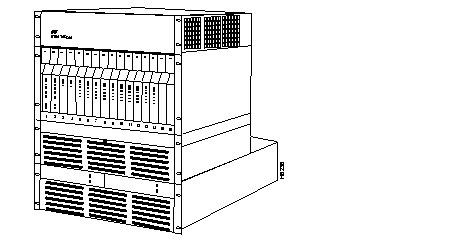
AXIS is designed on the philosophy that large scale deployment of narrowband and medium-band services is best handled using an ATM infrastructure. In fact, support of these services can, by themselves, cost justify an ATM infrastructure. The same infrastructure can then be used to provide broadband services to customers when and where they are needed.
AXIS is an adjunct shelf to Cisco's BPX ATM switch. Architecturally it provides:
- A means for flexibly providing many narrowband and/or medium-band ATM and non-ATM service interfaces without consuming BPX switch slots.
- Conversion of non-ATM traffic streams to and from ATM traffic streams using Adaptation Layer standards.
- A means for concentrating the traffic from the narrowband and/or medium-band interfaces onto the broadband ATM ports of the BPX.
AXIS is a flexible standards-based service access platform. AXIS can support a wide range of services over narrowband and mid-band user interfaces, mapping all the service traffic to and from ATM, based upon standardized interworking methods. The aggregated traffic is sent/received over an ATM interface to an ATM switch (BPX), using up only a single port on the ATM switch.
AXIS Release 4.0 supports up to 80 channelized or non-channelized T1 and E1 interfaces on a single shelf providing support for Frame Relay UNI and NNI; ATM UNI, NNI, and FUNI; Frame Relay to ATM network interworking; Frame Relay to ATM service interworking and circuit emulation services. Using a new Service Resource Module (SRM), multiple T1 interfaces can be supported on physical T3 lines. AXIS Release 4 also supports the use of Inverse Multiplexing for ATM (IMA) to provide ATM trunking below T3/E3.
The system's modular, software-based architecture enables it to support these and other additional user services in the future, through downloadable software upgrades or new hardware modules.
All user information received by AXIS interfaces is converted into 53-byte ATM cells, using standard ATM Adaptation Layers (AALs) for transport over the ATM backbone network. Cell segmentation and reassembly (SAR) and other adaptation functions are distributed to each interface module to eliminate system bottlenecks.
- For Circuit Emulation Services AAL1 is used.
- For Frame Relay (FR to ATM network interworking) AAL5 and FR-SSCS (Frame Relay Service Specific Convergence Sublayer) are used.
- For Frame Relay to ATM service interworking, both transparent and translation modes are supported to map FR to native ATM AAL5.
- For Frame Forwarding AAL5 is used.
Each AXIS connects to the BPX across a T3 or E3 ATM to a BNI module on the BPX or via a SONET ATM link to a BXM-155-8 port on the BPX. Thus, AXIS Release 4.0 supports aggregation of traffic up to 80 T1 or E1 access ports or up to 1240 64-Kbps subscribers, onto a single T3, E3, or OC-3c trunk, using only a single port on the BPX.
AXIS should normally be collocated with the BPX. Figure 1-2 shows how AXIS usage is envisioned in Release 4.0.
Figure 1-2: AXIS/BPX Relationship

For remote locations with limited bandwidth needs, AXIS can be remotely located from the BPX using IMA trunk machines as shown in Figure 1-3.
Figure 1-3: Remote AXIS Configuration

The following subsections provide an overview of the AXIS shelf, the Release 4.0 cards, and management capabilities. In-depth details are provided in subsequent chapters.
Physically, AXIS consists of cards in a 19 inch rack mountable shelf.
The shelf can be powered either from a -48V DC source or from a 220V AC source. The DC version includes DC power entry modules that can be mounted in the shelf. The AC version requires an external rack mounted, AC Power Module. Both versions require a rack mounted cooling assembly. Multiple AXIS shelves can be mounted in the same rack sharing power and cooling assemblies.
AXIS contains 16 slots where each slot can accommodate a front card and a back card. The front row is used for function modules, cards that perform more complex functions within the unit (for example, frame relay to ATM conversion). The back row is used for line modules, cards that provide interfaces to one or more transmission lines connected to AXIS (for example, the trunk line to the BPX or an RS-232 line to a control terminal).
Unless a service module uses the SRM 3T3 distribution bus, AXIS cards are installed as a pair consisting of a front card (function module) and a matching back card (line module) in the same slot, except for the SRM-T1E1 card which only has a front card. Communication between slots is achieved through buses in the shelf backplane.
Release 4.0 consists of the following module pairs:
- AXIS Shelf Controller(ASC)
This is a pair of cards providing overall control of the shelf and providing line interfaces to maintenance and control ports which are used for user configuration and management of the shelf.
- Broadband Network Module (BNM-T3)
This is a pair of cards which together provide the interface to the attached BPX over a T3 ATM interface.
- Broadband Network Module (BNM-E3)
This is a pair of cards which together provide the interface to the attached BPX over a E3 ATM interface.
- Broadband Network Module (BNM-155)
This is a pair of cards which together provide the interface to the attached BPX over a SONET ATM interface.
- Frame Service Module for T1 (FRSM-4T1)
This card provides interfaces for up to four T1 lines, each of which can support one 56 kbps or one Nx64 kbps FR-UNI, FR-NNI port, ATM-FUNI, or a Frame Forwarding port.
- Frame Service Module for T1 (FRSM-8T1)
This card provides interfaces for up to eight T1 lines, each of which can support one 56 kbps or one Nx64 kbps FR-UNI, FR-NNI port, ATM-FUNI, or a Frame Forwarding port.
- Frame Service Module for T1 channelized (FRSM-4T1-C)
This card provides interfaces for up to four T1 lines, each of which can support multiple (up to 24) 56 kbps or Nx64 kbps FR-UNI, FR-NNI, ATM-FUNI, or a Frame Forwarding port.
- Frame Service Module for T1 channelized (FRSM-8T1-C)
This card provides interfaces for up to eight T1 lines, each of which can support multiple (up to 24) 56 kbps or Nx64 kbps FR-UNI, FR-NNI, ATM-FUNI, or Frame Forwarding port.
- Frame Service Module for E1 (FRSM-4E1)
This card provides interfaces for up to four E1 lines, each of which can support one 56 kbps or one Nx64 kbps FR-UNI, FR-NNI, ATM-FUNI, or Frame Forwarding port.
- Frame Service Module for E1 (FRSM-8E1)
This card provides interfaces for up to eight E1 lines, each of which can support one 56 kbps or one Nx64 kbps FR-UNI, FR-NNI, ATM-FUNI, or Frame Forwarding port.
- Frame Service Module for E1, channelized (FRSM-4E1-C)
This card provides interfaces for up to four E1 channelized frame relay lines, each of which can support multiple (up to 31) 56 kbps or Nx64 kbps FR-UNI, FR-NNI, ATM-FUNI, or Frame Forwarding port.
- Frame Service Module for E1, channelized (FRSM-8E1-C)
This card provides interfaces for up to eight E1 channelized frame relay lines, each of which can support multiple (up to 31) 56 kbps or Nx64 kbps FR-UNI, FR-NNI, ATM-FUNI, or Frame Forwarding port.
- ATM UNI Service Module for T1 (AUSM-4T1)
This card provides interfaces for up to four T1 lines, each of which can support one T1 ATM UNI or ATM NNI.
- ATM UNI Service Module for E1 (AUSM-4E1)
This card provides interfaces for up to four E1 lines, each of which can support one E1 ATM UNI or ATM NNI.
- ATM UNI Service Module for T1 (AUSM-8T1)
This card provides interfaces for up to eight T1 lines, each of which can support one T1 ATM UNI or ATM NNI plus additional support for IMA.
- ATM UNI Service Module for E1 (AUSM-8E1)
This card provides interfaces for up to eight E1 lines, each of which can support one E1 ATM UNI or ATM NNI plus additional support for IMA.
- Circuit Emulation Service Module for T1 (CESM-4T1)
This card provides interfaces for up to four T1 lines, each of which is a 1.544 Mbps unstructured synchronous data stream.
- Circuit Emulation Service Module for E1 (CESM-4E1)
This card provides interfaces for up to four E1 lines, each of which is a 2.048 Mbps unstructured synchronous data stream.
- Inverse Multiplexing for ATM Trunk Module--T3 to T1 (IMATM-8T1)
This card acts as an extension of the BPX BNI card and permits the BPX ATM trunk to be used over multiple (up to 8) T1 lines instead of a single T3 line.
- Inverse Multiplexing for ATM Trunk Module--E3 to E1 (IMATM-8E1)
This card acts as an extension of the BPX BNI card and permits the BPX ATM trunk to be used over multiple (up to 8) E1 lines instead of a single E3 line.
- Service Resource Module (SRM-T1E1)
This card provides loopback and bit error rate testing (BERT) functions and 1:N redundancy for the service modules.
- Service Resource Module (SRM-3 T3)
This card provides loopback and bit error rate testing (BERT) functions and 1:N redundancy for the service modules. Three T3 service lines are also provided to carry multiple T1 service lines which are then mapped to T1 based service module slots and ports in the AXIS shelf.
The ASC and the BNM modules must always be present in an AXIS shelf and are referred to as the core modules. AXIS Release 4.0 supports redundant core modules where one ASC/BNM set is an active set and a second ASC/BNM is a standby set. In the event of a malfunction, the standby set automatically takes over as the active set. The SRM is optional. If present, it is part of the core card set, with switchover to the standby upon a malfunction of the active BNM or ASC.
The functions and operation of AXIS are achieved through downloaded firmware. The firmware controls the overall operation of the shelf and responds to configuration and other commands received from a user terminal or workstation. AXIS has a command repertoire of over 60 user commands which are used to configure and display the various operational parameters of the shelf.
The current status and configuration parameters of the AXIS modules are maintained in a Management Information Base (MIB) which is updated by the firmware as changes in status and configuration occur. The MIB can be interrogated using SNMP commands.
Most of the functions of AXIS Release 4.0 can be effected through the graphical user interface provided in StrataView Plus Release 8.4.
The ASC module includes three ports for user input of management commands. A further means of management access is provided inband over the ATM trunk.
The maintenance port is a simple RS-232 port for direct connection to an alpha-numeric terminal into which the user can type commands through a Command Line Interface (CLI).
The control port (SLIP protocol only), the LAN (Ethernet) port and the In-band ATM connection all support the CLI (via Telnet), TFTP and SNMP protocols for communicating with the AXIS shelf.
This section provides a very brief description of the new AXIS features that have been added since Release 3:
- A new Broadband Network Module is available which supports SONET 155 Mbit/s trunking to the BPX.
- The Frame Service Modules (FRSM) now support 4 and 8 ports per card versions.
- AUSM support for eight T1 or E1 ports per card.
- The ATM UNI Service Module (AUSM) now supports a number of new features including SRM BERT support, enhanced CAC (Connection Admission Control) and Virtual Path Connection capability.
- The new optional SRM (Service Resource Module) which provides support for 3 T3 service ports in addition to loopback and BERT testing of lines and ports and 1:N redundancy for service modules as a feature license. Supports bulk distribution of T1 circuits.
- UNI and NNI cell formats have been added to the STI cell format as available modes for communication with the BPX.
- A graceful upgrade procedure has been added which permits upgrading firmware from an earlier version without the need to reset the shelf.
- CLLM is now supported for both UNI and NNI interfaces, previously CLLM was supported for NNI only.
- Standard based OAM segmented loopback cells are now supported for testcom/testdelay operations.
- IMATM8T1/8E1 now supports multiple trunking.
- FRSM-HS1 with 2 HSSI or 4 X.21 ports



