This publication provides international regulatory and safety compliance information for the Cisco 2524 and Cisco 2525 routers. Use this publication with the Cisco 2524 and Cisco 2525 Router User Guide publication.
Note These publications are available on a CD called Cisco Connection Online or printed copies can be ordered.
This document contains the following sections:
Safety Information
The following statements are warnings or safety guidelines. A warning means danger. You are in a situation that could cause bodily injury. Before working on equipment, be aware of the hazards involved with electrical circuitry and standard safety practices to prevent accidents.
- Ultimate disposal of this product should be handled according to all national laws and regulations.
- Before working on equipment that is connected to power lines, remove jewelry (including rings, necklaces, and watches). Metal objects will heat up when connected to power and ground and can cause serious burns or weld the metal object to the terminals.
- When installing the unit, the ground connection must always be made first and disconnected last.
- Read the installation instructions before you connect the system to its power source.
- The device is designed to work with TN power systems.
- This product relies on the building's installation for short-circuit (overcurrent) protection. Ensure that a fuse or circuit breaker no larger than 120 VAC, 15A U.S. (240 VAC, 10A international) is used on the phase conductors (all current-carrying conductors).
- The Ethernet 10BaseT, Token Ring, serial, console, and auxiliary ports contain safety extra-low voltage (SELV) circuits. BRI circuits are treated like telephone-network voltage (TNV) circuits. Avoid connecting SELV circuits to TNV circuits.
- Network hazardous voltages are present in the BRI, fractional T1/T1, and switched 56 cables. If you detach the cable, detach the end away from the router first to avoid possible electric shock. Network hazardous voltages are also present in the area of the BRI (RJ-45), fractional T1/T1 (RJ-48C), and switched 56 (RJ-11 or RJ-48S) ports, regardless of whether power is off or on.
- The ISDN connection is regarded as a source of voltage that should be inaccessible to user contact. Do not attempt to tamper with or open any public telephone operator (PTO)--provided equipment or connection hardware. Any hardwired connection (other than by nonremovable, connect-one-time-only lug) must be made only by PTO staff or suitably trained engineers.
- Only trained and qualified personnel should be allowed to install or replace this equipment.
- The DC-powered unit is intended for installation in restricted access areas.
- Before performing any of the DC-powered unit installation procedures, ensure that power is removed from the DC circuit. To ensure that all power is OFF, locate the circuit breaker on the panel board that services the DC circuit, switch the circuit breaker to the OFF position, and tape the switch handle of the circuit breaker in the OFF position.
- When stranded wiring is required for installing DC-powered units, use approved wiring terminations, such as closed-loop or spade-type with upturned lugs. These terminations should be the appropriate size for the wires and should clamp both the insulation and conductor.
- After wiring the DC power supply, remove the tape from the circuit breaker switch handle and reinstate power by moving the handle of the circuit breaker to the ON position.
- Do not work on the system or connect or disconnect cables during periods of lightning activity.
- This equipment is intended to be grounded. Ensure that the host is connected to earth ground during normal use.
- Before working on a chassis or working near power supplies, unplug the power cord on AC units; disconnect the power at the circuit breaker on DC units.
- Do not touch the power supply when the power cord is connected. For systems with a power switch, line voltages are present within the power supply even when the power switch is off and the power cord is connected. For systems without a power switch, line voltages are present within the power supply when the power cord is connected.
- Before opening the chassis, disconnect the telephone-network cables to avoid contact with telephone-network voltages.
- The fractional T1/T1 and Switched 56 cards are intended to be installed in UL- and CSA-certified equipment in the field by the user in the manufacturer's defined operator access area. Check the equipment manufacturer to verify/confirm if your equipment is suitable for user-installed application cards.
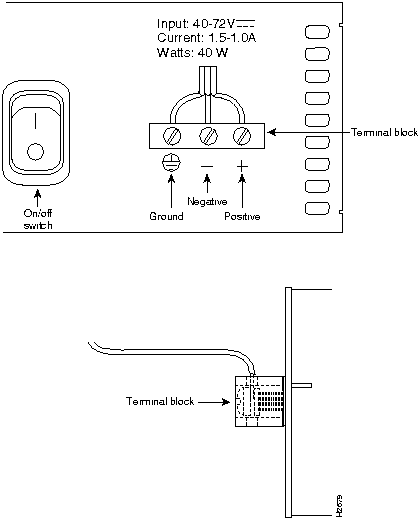
- Figure 1 shows the DC power supply terminal block. Wire the DC power supply using the appropriate lugs at the wiring end, as illustrated. The proper wiring sequence is ground to ground, positive to positive (line to L), and negative to negative (neutral to N). Note that the ground wire should always be connected first and disconnected last.
Figure 1 : DC Input Power Supply Connections
Operating Conditions for Canada
In addition to the warnings and safety guidelines listed in the section "Safety Information," the following warnings apply to models used in Canada:
- The Canadian Department of Communications label identifies certified equipment. This certification means that the equipment meets certain telecommunications network protective operational and safety requirements. The Department does not guarantee the equipment will operate to the user's satisfaction.
- Before installing the equipment, users should ensure that it is permissible to be connected to the facilities of the local telecommunications company. The equipment must also be installed using an acceptable method of connection. In some cases, the company's inside wiring associated with a single line individual service may be extended by means of a certified connector assembly (telephone extension cord). The customer should be aware that compliance with the above conditions may not prevent degradation of service in some situations.
- Repairs to certified equipment should be made by an authorized Canadian maintenance facility designated by the supplier. Any repairs or alterations made by the user to this equipment, or equipment malfunctions, may give the telecommunications company cause to request the user to disconnect the equipment.
- Users should ensure for their own protection that the electrical ground connections of the power utility, telephone lines, and internal metallic water pipe system, if present, are connected together. This precaution may be particularly important in rural areas.

Caution Users should not attempt to make such connections themselves, but should contact the appropriate electric inspection authority, or electrician, as appropriate.
Operating Conditions for the European Community
All warnings and safety guidelines listed in the section "Safety Information" apply to models used in the European Community.
Operating Conditions for Italy
All warnings and safety guidelines listed in the section "Safety Information" apply to models used in Italy. In addition, the following warning applies only to models used in Italy:
- AVVERTENZA PER GLI UTENTI DELLA CISCO 2524, CISCO 2525 PER CONNESSIONI ISDN ACCESSO BASICO
- "Si raccomanda di spegnere il terminale quallora venisse spostato tra due prese dello stesso o di differente bus SO."
- WARNING FOR USERS OF THE CISCO 2524 and Cisco 2525 FOR BASIC ACCESS ISDN CONNECTIONS
- "It is recomended to switch off the terminal equipment when it is moved between two sockets of the same or different bus."
Operating Conditions for the United Kingdom
In addition to the warnings and safety guidelines listed in the section "Safety Information," the following warnings apply to models used in the United Kingdom:
- The routers are designed to meet the requirements of I-CTR2 for products with serial interfaces, and I-CTR3 for products with a BRI interface.
- Interconnection directly, or by way of other apparatus, of ports marked:
- "Safety Warning---See instructions for use"
- with ports marked or not so marked may produce hazardous conditions on the network, and that advice should be obtained from a competent engineer before such a connection is made.
- The BRI connector must be hardwired permanently to the S-reference connection point by using a connect one-time-only, nonremovable plug (RJ-45 with the latch tab removed).
- The following safety warning applies to the Ethernet 10BaseT, Token Ring, serial, console, and auxiliary ports:
- "These ports do not provide isolation sufficient to satisfy the requirement of EN60950:1993; apparatus connected to these ports should either have been approved to EN60950:1993 or have previously been evaluated against British Telecommunications plc (Post Office) Technical Guides 2 or 26 and given permission to attach; any other usage will invalidate any approval given to this apparatus."
- Other usage will invalidate any approval given to this apparatus if as a result it ceases to comply with EN60950:1993.
- This apparatus must be connected to a main socket outlet with a protective earth contact.
Agency Approvals
The following agency approvals apply to the router chassis:
- Safety: UL 1950, CSA 950, EN60950, TUV-GS mark
- EMI: FCC Class A, Canadian DOC Class A
- PTT: CS-03, FCC Part 68
Copyright 1988-1996 © Cisco Systems Inc.



