
Table of Contents
Cisco 2517 and Cisco 2519 Router/Hub Public Network Certification
Cisco 2517 and Cisco 2519 Router/Hub Public Network Certification
This publication provides international regulatory and safety compliance information for Cisco 2517 Router/Hubs. Use this publication with the Cisco 2517 and Cisco 2519 Router/Hub User Guide publication and as an addendum to the Router Products Getting Started Guide.
Note These publications are available on Cisco Connection Documentation CD-ROM or printed copies can be ordered.
All of the following statements are general warnings or safety guidelines that apply to all countries. A warning means danger. You are in a situation that could cause bodily injury. Before working on equipment, be aware of the hazards involved with electrical circuitry and standard safety practices to prevent accidents.
- Before opening the chassis, disconnect the telephone-network cables to avoid contact with telephone-network voltages.
- Do not work on the system or connect or disconnect cables during periods of lightning activity.
- The ports labeled "ETH" (Ethernet), "TR" (Token Ring), and "AUX" (auxiliary) are safety extra low voltage (SELV) circuits. SELV circuits should only be connected to other SELV circuits. Because the BRI circuits are treated like telephone-network voltage, avoid connecting the SELV circuit to the telephone-network-voltage (TNV) circuits.
- The ISDN connection is regarded as a source of voltage that should be inaccessible to user contact. Users should not attempt to tamper with or open any public telephone operator (PTO)--provided equipment or connection hardware. Any hardwired connection (other than by nonremovable, connect-one-time-only lug) must be made only by PTO staff or suitably trained engineers.
- The Cisco 2517 and Cisco 2519 router card is approved only for installation in a PC and with attachments that are either type approved for such apparatus or covered by a general approval.
All warnings and safety guidelines listed in "Safety Information for the Cisco 2517 and Cisco 2519 Router/Hub" apply to Cisco 2517 and Cisco 2519 Router/Hub models used in Italy. In addition, the following warning applies only to Cisco 2517 and Cisco 2519 Router/Hub models AP-EBC and AP-RBC used in Italy:
- AVVERTENZA PER GLI UTENTI DELLA CISCO 2517, CISCO 2519 PER CONNESSIONI ISDN ACCESSO BASICO
- "Si raccomanda di spegnere il terminale quallora venisse spostato tra due prese dello stesso o di differente bus SO."
- WARNING FOR USERS OF THE CISCO 2517 AND CISCO 2519 ROUTER/HUB FOR BASIC ACCESS ISDN CONNECTIONS
- "It is recomended to switch off the terminal equipment when it is moved between two sockets of the same or different bus."
In addition to the warnings and safety guidelines listed in "Safety Information for the Cisco 2517 and Cisco 2519 Router/Hub," the following warnings apply to Cisco 2517 and Cisco 2519 Router/Hub models used in the United Kingdom:
- The Cisco 2517 and Cisco 2519 Router/Hub is designed to meet the requirements of NET1 and NET2 for products with serial interfaces, and NET3 for products with a BRI interface.
- Interconnection directly, or by way of other apparatus, of ports marked "BRI" with ports marked or not so marked may produce hazardous conditions on the network, and that advice should be obtained from a competent engineer before such a connection is made.
- The BRI connector must be hardwired permanently to the S-reference connection point by using a connect one-time-only, nonremovable plug (RJ-45 with the latch tab removed).
- The ports marked "ETH" (Ethernet)," "TR" (Token Ring), and "AUX" (auxiliary) have a safety warning applied to them as follows:
- "These ports do not provide isolation sufficient to satisfy the requirement of EN60950:1992; apparatus connected to these ports should either have been approved to EN60950:1992 or have previously been evaluated against British Telecommunications plc (Post Office) Technical Guides 2 or 26 and given permission to attach; any that other usage will invalidate any approval given to this apparatus."
- Other usage will invalidate any approval given to this apparatus if as a result it ceases to comply with EN60950:1992.
- This apparatus must be connected to a main socket outlet with a protective earth contact.
In order to maintain the independent approval of the router card, it is essential that, when other option cards are installed that use or generate a hazardous voltage, the minimum creepage and clearance specified in the table below are maintained. A hazardous voltage is one that exceeds 42.4 volts peak AC, or 60 volts DC. If you have any doubt, seek advice from a competent engineer before installing other adapter cards in the PC.
The equipment must be installed such that, with the exception of the connections to the PCbus, clearance and creepage distances shown in Table 1 are maintained between the card and any other assemblies that use or generate a voltage shown in the table below. The larger distance shown in brackets applies where the local environment within the chassis is subject to conductive pollution or dry non-conductive pollution that could become conductive due to condensation. Failure to maintain these minimum distances would invalidate the approval.
Except at the edge connector that plugs into the PCbus, clearance and creepage distances of X millimeters (mm) and Y mm as listed in Table 1 must be maintained between the cards and other parts of the chassis including any other expansion cards fitted.
Note that in Table 1 the following definitions apply:
- Clearance distances are defined as the minimum distance measured in air between two points (i.e., line of sight).
- Creepage distances are defined as the minimum distance measured across the surface of an insulator between two points (i.e., following the contour of the insulator).
Table 1 Creepage and Clearance Distances Based on Voltage
| Up to 50 |
2.4 (3.8) |
2.0 |
| Up to 125 |
3.0 (4.8) |
2.6 |
| Up to 250 |
5.0 (8.0) |
4.0 |
| Up to 300(4) |
6.4 (10.0) |
4.0 |
- (1)
- Vrms = root mean square voltage.
- (2)
- VDC = volts direct current.
- (3)
- The creepage distances not in parentheses apply when the equipment is installed in a normal office environment. The larger dimensions, given in parentheses, must be applied when the equipment is installed in an environment in which dust and other types of pollution could conduct electricity because of the effects of dampness and condensation. This applies to locations subject to high humidity.
- (4)
- For a expansion card fitted in the PC using or generating voltage greater than 300V (rms or dc), advice from a competent telecommunications safety engineer must be obtained before installation of the relevant equipment.
Creepage and clearance distances are measured between adjacent parts as shown in Figure 1.
Figure 1 Creepage and Clearance Distances between BRI Module and Components
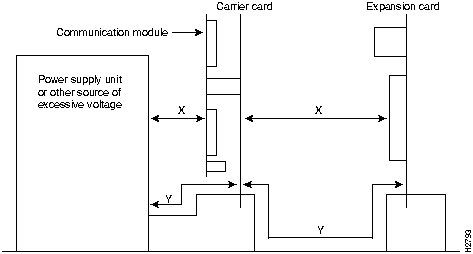
Note that in Figure 1, X indicates the clearance distances between cards and between adjacent cards and components, and Y shows the creepage path across the surface of an insulator and between the two points indicated by X.
The following agency approvals apply to the Cisco 2517 and Cisco 2519 Router/Hubs:
- Safety: UL 1950, CSA 22.2-950, TUV EN60950:1992, AS3260, TS001
- EMI: FCC Part 15 Class A, VDE Class B, Canadian DOC Class A, EN55022 Class A (CISPR 22), VCCI Class 2, IEC 801-2, IEC 801-3 (RFI), IEC 801-4, IEC 801-5
The CE-0344-X mark signifies that the equipment complies with the following European Directives: 91/263/EEC (public telecommunications network compatibility), 89/336/EEC (electromagnetic compatibility), 73/23/EEC (low voltage), and 92/59/EEC (general product safety).

Copyright 1988-1996
©
Cisco Systems Inc.



