


|
|

This chapter contains information on using the Cisco hub synchronous ports, asynchronous serial ports, and BRI port.
The ports labeled "Token Ring," "Console," and "AUX" are safety extra low voltage (SELV) circuits. SELV circuits should only be connected to other SELV circuits. Because the BRI circuits are treated like telephone-network voltage, avoid connecting the SELV circuit to the telephone-network voltage circuits.
Also, make sure the host chassis is connected to earth ground during normal use.
The Cisco 2517 and Cisco 2519 serial ports provide two dedicated serial port interfaces operating in either DTE or DCE mode, compatible with leased-line, circuit-switched, and packet-switched services at speeds up to 2 Mbps. The serial port connectors use flexible serial transition cables that allow easy transition to any of the common physical interfaces, including V.35, EIA/TIA-232, EIA/TIA-449, EIA/TIA-530, and X.21.
The synchronous serial ports can be configured to connect SDLC devices to a corporate internetwork, as shown in Figure 5-1.
Figure 5-1 Cisco 2517 and Cisco 2519 Support for SDLC
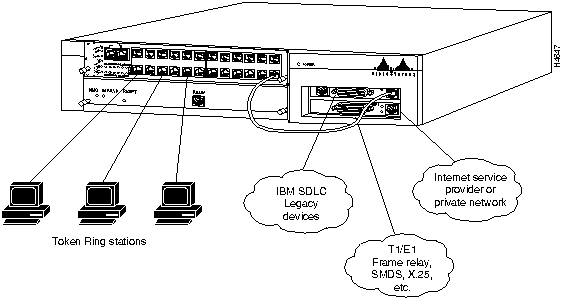
The STUN and SDLC features provide SDLC control over the serial link. The serial ports support NRZ/NRZI and full-duplex functionality, allowing you to maintain your existing SDLC equipment while consolidating all WAN connections on a single network.
The Cisco hub auxiliary interface can be configured to provide an additional dial-up line for asynchronous routing of IP, IPX, and AppleTalk protocols at speeds up to 38.4 Kbps. See Figure 5-2.
Figure 5-2 Asynchronous Routing
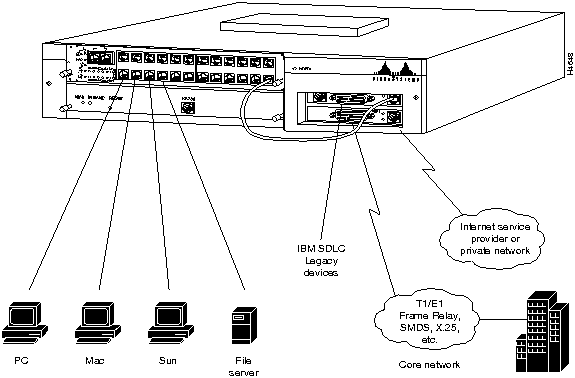
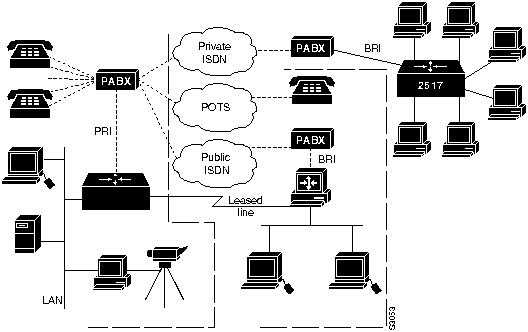
The Cisco 2517 and Cisco 2519 can be used as a secure means of connecting to the public ISDN network and suppliers. ISDN was designed to provide application solutions for voice, data, and video. Figure 5-3 shows an example of a private ISDN network built around ISDN PABXs.
The Cisco hub ISDN BRI port eliminates the need for an external ISDN terminal adapter. The BRI interface supports two 64-kbps B channels for ISDN signaling information between the Cisco hub and ISDN switch.
Figure 5-3 ISDN Multiple Service Solutions

|
Copyright 1988-1995 © Cisco Systems Inc.