


|
|
This chapter provides an overview of the Cisco Asynchronous Transfer Mode PCI network adapter product offering.
Asynchronous Transfer Mode (ATM) networks differ from traditional legacy networks in many ways. Legacy LANs, and the protocols associated with them, favor broadcasts to all endstations attached to the LAN. Legacy networks are adequate when all the endstations are attached to the same length of cable, and when the level of data (i.e., traffic) traveling between endstations is low.
As more endstations are added and more network applications are deployed, data traffic increases to such levels that legacy networks are stressed to capacity. With bandwidth-
intensive applications such as desktop videoconferencing and multimedia on the horizon, this traffic is multiplied to levels that legacy networks cannot adequately handle.
In contrast, ATM networks are connection-oriented, introducing new capabilities to the network. While ATM networks may be attached to the same physical piece of cable, the connection from one endstation to another is logically separate from all other connections. This approach provides many benefits, such as increased network security and distributed bandwidth (i.e., traffic shaping).
One of the most attractive ways to take advantage of ATM today is to combine ATM and Ethernet switching technologies into a single network. This combination enables a workgroup (e.g., a department in a corporation, a building in a campus, etc.) to obtain more usable bandwidth, allowing for larger data traffic to flow between connected endstations. By using ATM as a backbone, your LAN will provide better bandwidth allocation to workgroups while preserving your current investment in network equipment.
Another difference between the legacy LAN and the ATM network is the form of addressing that is used to identify the endstation on the network. The addressing for legacy LAN endstations is a 48-bit flat address space; the 6 byte MAC address is pre-assigned to each endstation during manufacture. The addressing for ATM LAN endstations is 160 bits and hierarchical; the 20 byte ATM address for each endstation is derived from the switch address (or network) to which it is attached.
ATM is a switched, connection-oriented local and wide area networking (LAN/WAN) technology that allows a virtually unlimited number of users to communicate at high speeds.
ATM networks are scalable and can accommodate growth and expansion requirements while offering the following advantages over Ethernet or Token Ring technology:
The Cisco ATM PCI Adapter features a highly integrated design. It contains several high- performance features that reduce internal data flow and minimize overhead imposed on the host processor.
To maximize throughput, the Cisco ATM PCI Adapter supports 32-bit wide data transfers and data bursts of up to 64 bytes. Additional features and benefits of the Cisco ATM PCI Adapter include:
The Peripheral Component Interconnect (PCI) bus is a motherboard resident bus that provides access to system memory and the host processor at speeds approaching that of the processor's full native speed. All read and write transfers over the PCI bus are burst transfers.
The Cisco ATM PCI Adapter features a compact design that fits conveniently into a single PCI slot (Figure 1-1).
Figure 1-1 : Cisco ATM PCI Adapter
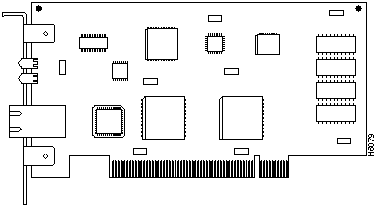
The Cisco ATM PCI Adapter uses an ATM compliant interface that connects to multi-mode fiber or twisted-pair copper topologies. The Cisco ATM PCI Adapter is available in two versions, with the difference being the connector type used:
The ATM physical layer interface requires a specific line encoding. Both fiber and copper 155 Mbps adapters support the Synchronous Optical NETwork (SONET) STS-3c Synchronous Payload Frame and SDH Frame formats.
Cisco ATM PCI Adapters are shipped with a comprehensive software package that provides facilities for data transfer, set up, configuration, and diagnosis:
The Cisco ATM PCI Adapter device driver manages the movement of incoming and outgoing ATM cells between the workstation and the network. By assigning a unique address to the the Cisco ATM PCI Adapter, the local workstation sends ATM packets to and receives ATM packets from other ATM-based systems.
The Cisco ATM PCI Adapter device driver is installed on the host system during installation of the software media kit. Device driver software manages the movement of incoming and outgoing ATM cells to facilitate communication between the host system and other endstations.
The driver must recognize the local Cisco ATM PCI Adapter as well as any connected endstations. To enable the driver to identify the address of connected endstations, you must configure the host and the appropriate endstations into virtual LAN(s). The virtual LAN (VLAN) indicates the logical grouping of endstations of which the host system will attempt to become a member.
An ATM network is a point-to-point, switched environment that requires established connections or virtual channels between ATM endpoints in order to communicate. To configure the host system (in which the Cisco ATM PCI Adapter is installed) as a new endstation in the ATM network, you must establish connection to the other endstations on the network.
The Cisco ATM Initializer loads configuration information from registry saved using the Cisco ATM Administrator on start up of the host system.
The Cisco ATM Administrator provides a user-friendly set of graphical utilities to dynamically monitor, modify and diagnose the active ATM network configuration. In addition, the Cisco ATM Administrator saves the active configuration to an NT registry.

|
Copyright 1988-1996 © Cisco Systems Inc.