


|
|

This chapter provides step-by-step instructions for installing, cabling and verifying the installation for:
A detailed description and installation instructions for all of the optional expansion modules for the Catalyst 3200 are described in Chapter 5, "Expansion Components Installation and Configuration."
Figure 4-1 : Front View of the Catalyst 3200
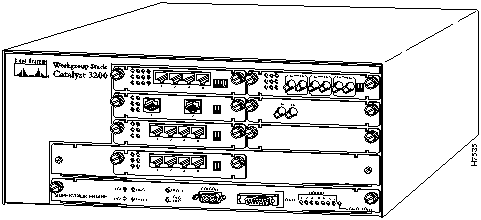
The Catalyst 3200 and the Catalyst Matrix mount in a standard 19-inch rack or cabinet. The installation area should be near a power source and should have enough room around the front and rear panels for cabling and access to controls. Use the following procedures for the installation of Catalyst Stack equipment.
If you install the Catalyst 3200 in a closed or multi-unit rack, observe the environmental guidelines from Chapter 3, "Preparing for Installation." Observe the following warnings and use the following steps for a rack or cabinet installation.
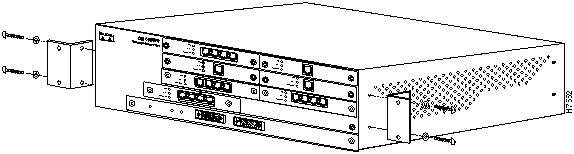
The following steps describe how to mount the Catalyst 3200 or Catalyst Matrix in a rack or cabinet. Only fixed brackets are supplied with these units. If you want to install a sliding pull-out mount, you will need to provide the extra mounting hardware.
Figure 4-2 : Attaching the Mounting Brackets (Similar view for the Catalyst Matrix)
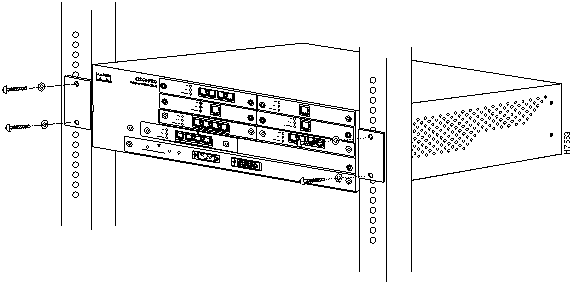
Before starting the next step, be sure you have the proper hardware for mounting the unit to your cabinet or rack.
Figure 4-3 : Mounting in a Rack or Cabinet (Similar View for the Catalyst Matrix)
The Catalyst 3200 should be mounted in an appropriate mounting rack, but if the situation warrants, such as a shortage of rack space or location constraints, the Catalyst 3200 can be surface mounted. The unit operates at a low noise level, which makes it suitable for a work area or almost anywhere with a large enough flat surface such as a table or desktop. Simply place the unit on a clear and level location. Leave enough room around the unit for ventilation and access to the controls and cable connectors.
Catalyst Stack Cable Connections
There are two Catalyst Stack configurations.
How to cable the Catalyst Stack equipment is described in the next two sections. The first section explains connecting two Catalyst switches back-to-back. The next section describes how to connect Catalyst switches to the Catalyst Matrix.
Catalyst Stack Back-to-Back Connection
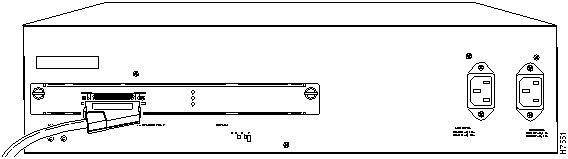
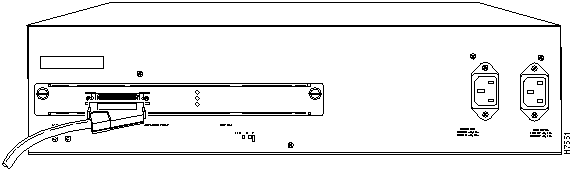
To connect two Catalyst 3000 series switches together, an installed WS-X3004 module must be in the expansion slot in the back of each Catalyst switch. (See Figure 4-4.) For a description of how to install the WS-X3004 rear expansion module into the Catalyst 3200 see Chapter 5, "Expansion Components Installation and Configuration" for the section, "Installing WS-X3004 Stack Port (Rear) Expansion Module." Observe the following statements and cautions and use the following steps to install two Catalyst switches in a back-to-back configuration.
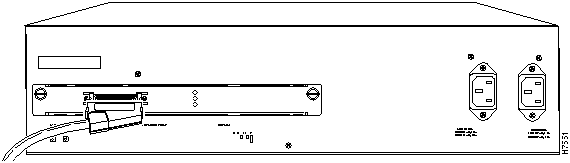
The following illustrations, Figure 4-4 and Figure 4-5, show how two Catalyst switches are cabled together. (The cable connector is shown at an angle for illustration purposes.)
Figure 4-4 : Connecting the Stack Port Cable to the WS-X3004 Module Figure 4-5 : Connect the Other End of the Cable to the Stack Port on the Other Catalyst 3200
Connecting Catalyst Switches to the Catalyst Matrix
Up to eight Catalyst switches can be connected to a Catalyst Matrix. For a detailed description of the Catalyst Matrix see Chapter 5, "Expansion Components Installation and Configuration."
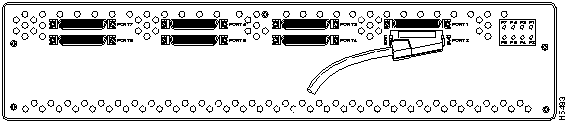
This configuration requires a Catalyst Matrix and a Stack port cable and a WS-X3004 module for each Catalyst switch. The connection is made through one of the eight I/O Stack ports on the back panel of the Catalyst Matrix to the single I/O Stack port on the WS-X3004 installed in the back of each Catalyst switch. Use the following instructions (after mounting the Catalyst switches and Catalyst Matrix in a rack or cabinet) to cable the units together.
Figure 4-6 : Connecting the Stack Port Cable to Port 1 of the Catalyst Matrix
Figure 4-7 : Connecting the Stack Port Cable to the Stack Port on the Catalyst 3200
Before you apply power, inspect the equipment thoroughly. Verify that all cables are installed correctly. Check their routing, so they are not damaged or create a safety hazard. Be sure all equipment is mounted properly and securely.
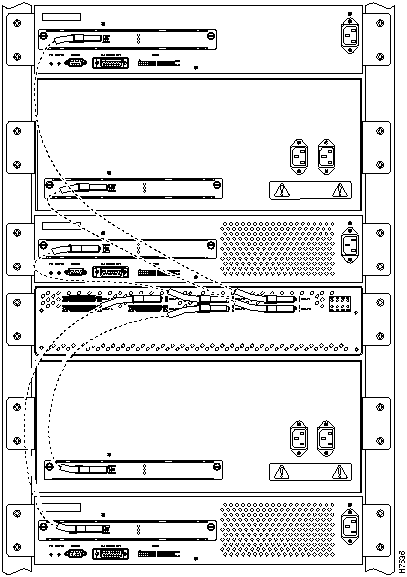
The following figure, Figure 4-8, is an illustration of several Catalyst switches cabled to a Catalyst Matrix
Figure 4-8 : Rear View of a Catalyst Matrix Cabled to Several Catalyst Switches Use the following steps to power on your Catalyst Stack units:
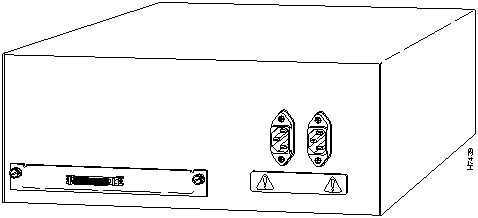
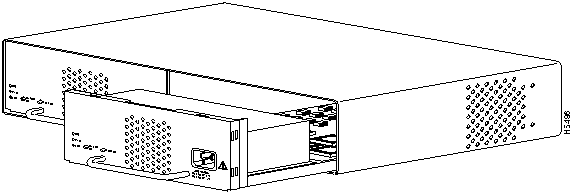
Figure 4-9 : Catalyst 3200 Power Receptacle Location Figure 4-10 : Catalyst Matrix Module Power Receptacle Location The following, Figure 4-11, Table 4-1, Table 4-2, and Table 4-3, provide details for the front control panel switches, LEDs and connectors on the Supervisor Engine (CPU card).
Figure 4-11 : Catalyst 3200 Supervisor Engine Module
Table 4-1 : Supervisor Engine Switches
Table 4-2 : Supervisor Engine LEDs
Table 4-3 : Supervisor Engine Connectors
Copyright 1988-1996 © Cisco Systems Inc.



Before you create a Stack, or add to a Stack, if any of the Catalyst 3200 units will need any downloading, perform the downloading before cabling the Catalyst 3200 units together.




Switch
Function
RESET
Full system reset of software and hardware
SYS REQ
Initiates a set of system request menus on the attached console
LED
Color
Function when illuminated
PS1
PS2
Green
Indicates Power Supplies are functioning properly
DIAG
Yellow
Running self- diagnostic test
FAULT
Red
When on, an unrecoverable error has occurred
If blinking, see Chapter 10, "Troubleshooting," for details
modules
Green
Red
Numbers 1 to 7; Indicate a module is installed in that (front) slot
Module 1 is top left. Numbering sequence is left to right, top to bottom
Number 8 indicates a rear Stack Port module is installed
Red indicates a fault has occurred with that module
Connector
Function
CONSOLE
EIA(RS)-232 (DB-9 conn.)
Console connection for viewing configuration menus and diagnostics
SPAN
AUI - DB15 connector
Switch Probe ANalyser port
This port is for monitoring only. Only one port at a time can be monitored. The monitoring is set through the console or SNMP
The Catalyst Matrix chassis or modules do not run power-on diagnostics, so neither have a DIAG or FAULT LED. When power is applied to the Catalyst Matrix module, the PWR LED and the fan should turn on. If either the PWR LED or the fan does not turn on, see Chapter 10, "Troubleshooting."
