


|
|

Configure the IPeXchange Client Software
This chapter describes how to install the IPeXchange client software on a personal computer or workstation. This chapter contains the following sections:
To install the IPeXchange client software, you need the following:
In addition, to ensure smooth installation and startup on a Windows for Workgroups operating system, check the IPX/SPX version numbers and compatibility of configured frame types before installing the IPeXchange client software.
The IPeXchange client relies on the Novell IPX/SPX components and versions listed in Table 3-1.
Table 3-1 : Required Versions of IPX/SPX Components
| Component | Version | Applicable Operating System | Where Located |
|---|---|---|---|
| IPXODI | 3.0 or later | Windows 3.1 | Typically installed in \nwclient |
| LSL | 2.12 or later | Windows 3.1 | nwclient installed in \nwclient |
| NWIPXSPX.DLL | 4.10 or later | Windows 3.1 | Typically installed in \windows or \windows\system |
| VIPX.386 | 1.19 or later | Windows 3.1 | windows installed in \windows or \windows\system |
To determine the version numbers of your files, you can download the Novell Technical Support (NTS) Windows Diagnostics tool, ntswd.exe. This tool is in a self-extracting file named windr2.exe located at Novell's FTP site, ftp.novell.com/pub/netwire/novfiles/.
If your installed Novell files are outdated, you can download new files from NetWire, CompuServe, or ftp.novell.com.
On Windows for Workgroups computers, the NWLINK component supplied by Microsoft must interoperate with the IPX/SPX component supplied by Novell. These components use different configuration files, but both configuration files must specify the same frame type. Mismatched frame types are a common source of problems.
To ensure that the IPX/SPX frame type and the NWLINK frame type are set to the same value, following these steps:
Table 3-2 : NET.CFG and PROTOCOL.INI Frame Formats
From the Windows File Manager, start the installation of the IPeXchange client software:
The setup program asks you to select the setup program you want to use:
If you choose Express Setup, the Setup program takes the following actions:
If you choose Custom Setup, the Setup program takes the following actions:
After your computer has rebooted, start the IPeXchange client by double-clicking its icon.
The window shown in Figure 3-1 appears, displaying diagnostic information.
Figure 3-1 : Client Status Window When the client connects to a gateway, a message appears identifying it. For example, if the client connects to the gateway IPeX-gateway, the following message is displayed:
Once you have installed the IPeXchange client software and confirmed that the IPeXchange client and gateway work together successfully, you can install and run any of the applications listed in the appendix "Applications Certified for Use with the IPeXchange Gateway," or other Winsock 1.1--compliant applications.
Once the IPeXchange client software is running, you do not usually need to start or stop it explicitly. When any Winsock 1.1--compatible application starts, the IPeXchange client automatically starts and connects to a gateway on behalf of the application. When applications shut down and the client is idle, the IPeXchange client automatically exits.
See the section "Advanced Configuration of the IPeXchange Client" for information about additional software features.
This section describes the following advanced configuration procedures for the IPeXchange client. You do not need to perform these procedures unless you have multiple gateways.
If your site has multiple gateways, the IPeXchange client software performs automatic load balancing by picking a gateway from among those available. However, you can specify a client's preferred gateway---the gateway to which the client tries to connect at startup. Specifying preferred gateways can be useful for dividing the user community---for example, for administrative or accounting purposes. If the preferred gateway is unavailable, the client connects to any available gateway.
To specify a preferred gateway, do one of the following:
To edit the win.ini file, perform the following steps:
If a Windows icon represents an executable program, its Properties window includes information that tells Windows how to start the program. This information is called the command line property in Windows 3.1 and Windows for Workgroups and the target property in Windows 95.
The following command line or target property starts ipexclnt.exe:
gateway-name specifies the client's preferred IJ gateway.
For example, the following property causes the client to try to connect with the gateway boojum:
If boojum is unavailable, the client connects to any available gateway.
To change the preferred gateway, edit the properties of the IPeXchange item. When the IPeXchange client starts, it writes gateway-name into the win.ini file as the new value for the preferred gateway.
Sometimes a client might want to disconnect from one gateway and connect to another. For instance, your network could be configured so that one gateway provides Internet access and another provides internal TCP/IP access, and a client might want to switch between the two.
The Gateways menu in the IPeXchange client window displays a list of known gateways. A check mark indicates the gateway to which the client is currently connected. The client software periodically refreshes the list, adding names as gateway SAP messages arrive, and removing the names of servers that stop sending SAP messages.
To change a client's current gateway, perform the following steps:
When a client changes the current gateway, the new gateway automatically becomes the preferred gateway. The client software writes the gateway name into the WIN.INI file and attempts to connect to that gateway the next time it starts.
The IPeXchange window for the IPeXchange client includes a Status menu item.This option provides information about the client or gateway software and its current connections.
When you first select the Status menu item, the display is static---status appears on the screen once and does not refresh itself.
Click again on the Status menu item to start a low-level tracing program that shows the transmission of SAP messages and routing information packet (RIP) messages. Generating a trace can be helpful if you need to troubleshoot a problem.
To stop the trace program, click again on the Status menu item. An updated static display appears.
Copyright 1988-1996 © Cisco Systems Inc.
Frame Ethernet_802.3
Frame Ethernet_802.2
Frame Ethernet_II
Frame Ethernet_SNAP
Immediately below the lines displayed in Step 2, find one or more of the following lines. If the line is missing, type in the line that specifies the IPX frame type used on your network:
Protocol IPX 0 Ethernet_802.3
Protocol IPX E0 Ethernet_802.2
Protocol IPX 8137 Ethernet_II
Protocol IPX 8137 Ethernet_SNAP
Note the values you typed in Step 2 and Step 3, and close the file.
NET.CFG Format
PROTOCOL.INI Format
Protocol IPX 0 Ethernet_802.3
FRAME=ETHERNET_802.3
Protocol IPX E0 Ethernet_802.2
FRAME=ETHERNET_802.2
Protocol IPX 8137 Ethernet_II
FRAME=ETHERNET_II
Protocol IPX 8137 Ethernet_SNAP
FRAME=ETHERNET_SNAP
Run the Setup Program
A:SETUP
Run Express Setup
device=vipx.386
TimerCriticalSection=10000
Adds the following section to the file:
[vipx]
VipxMappingPages=20
VipxFailOverSizedPackets=ON
Updates the win.ini file with the following lines:
[Internet Junction Client]
Preferred Gateway=Any
Run Custom Setup
device=vipx.386
TimerCriticalSection=10000
Adds the following section to the file:
[vipx]
VipxMappingPages=20
VipxFailOverSizedPackets=ON
Allows you to change the target directory for IPeXchange client files.
[Internet Junction Client]
Preferred Gateway=gateway-name
Test Connectivity to the Gateway
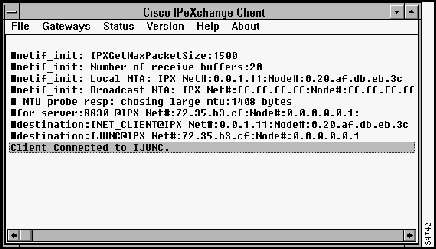
Client Connected to IPeX-gateway
Use the IPeXchange Client
Advanced Configuration of the IPeXchange Client
Change a Client's Preferred Gateway
Edit the win.ini File
[Internet Junction Client]
Preferred Gateway = Any
To specify a gateway, change the value after the equal sign (=) to the name of the gateway.
Modify the Command Line or Target Property
ipexclnt [-g gateway-name]
ipexclnt -g boojum
Change a Client's Current Gateway
Display a Client's Status

