


|
|

Preparing to Install CiscoWorks
Before installing CiscoWorks 1.0(x), you must ensure that your system meets the requirements for CiscoWorks and that you have obtained the information required to install the product.
This chapter describes how to prepare for your installation and configuration of CiscoWorks 1.0(x) and provides worksheets to help you gather the necessary information.
Process Overview for Preparing to Install or Upgrade
This section provides an overview of the tasks you should perform before you install and configure CiscoWorks 1.0(x). Each step is explained in detail in the section cited. Follow these steps to prepare for installing and configuring CiscoWorks 1.0(x) for the first time, upgrading from CiscoWorks Release 1.0(1) or 1.0(2) to Release 1.0(3), or upgrading from NetCentral 1.3 to CiscoWorks 1.0(x). Skip step 4 if you are not upgrading from NetCentral 1.3 to CiscoWorks.
After completing these steps, you are ready to install and configure CiscoWorks on your system.
Verifying Your System Requirements
Before you install CiscoWorks 1.0(x) on your system, make sure that your system meets the hardware and software requirements described in the following sections.
CiscoWorks requires the following hardware:
Table 2-1 : Hard Disk Space Requirements
|
Software |
Minimum Hard Disk Space Requirements |
|---|---|
| CiscoWorks | 27 MB |
| Sybase (provided with CiscoWorks) | 45 MB |
| SunNet Manager | 10 MB |
| OpenWindows V3.0 | 75 MB |
| Sybase tables storage | 43 MB |
| Total Disk Space | 200 MB1 |
|
CiscoWorks Software and Application |
RAM Requirements |
|---|---|
| CiscoWorks1 | 18 MB |
| CiscoWorks applications2 | 14 MB |
| Total RAM for CiscoWorks software and all CiscoWorks applications | 32 MB |
CiscoWorks requires the following software:
CiscoWorks does not run on Solaris 2.x. The configuration management feature of CiscoWorks requires Cisco Systems device software version of Software Release 8.2 or later.
Expanded Hard Disk Space Requirements for Upgrades to CiscoWorks 1.0(3)
The new Sybase server that is installed with CiscoWorks Release 1.0(3) requires extra disk space to store your current database during the upgrade. If you are upgrading from CiscoWorks Release 1.0(1) or 1.0(2) to CiscoWorks Release 1.0(3), see the "Upgrading from CiscoWorks Release 1.0 or 1.0(2) to 1.0(3)" section. If you are upgrading from NetCentral 3.1 to CiscoWorks Release 1.0(3), see the "Upgrading from NetCentral Release 1.3 to CiscoWorks Release 1.0(3)" section.
Upgrading from CiscoWorks Release 1.0 or 1.0(2) to 1.0(3)
When upgrading from CiscoWorks Release 1.0 or 1.0(2) to 1.0(3), make sure your system has a minimum of 70+ MB of free disk space in the database. Sybase requires this space in order to keep the current database running while installing the new database in a different directory.
The amount of space required will display during the installation, but you may want to calculate the space ahead of time. To calculate your disk space requirement, perform the following steps:
Step 1: Back up your current database.
Step 2: To calculate the current amount of disk space used in $SYBASE/data, enter the following command string at the UNIX prompt (%):
Step 3: Divide that number by 1000 to get the approximate number of megabytes.
Step 4: Add 45 MB to the number of megabytes to determine how much extra space will be required during installation.
Use this number to ensure that you have the required amount of disk space before attempting an upgrade to CiscoWorks Release 1.0(3). The CiscoWorks upgrade also requires at least 1 MB of swap space in the database when it upgrades the database.
Upgrading from NetCentral Release 1.3 to CiscoWorks Release 1.0(3)
The upgrade from NetCentral Release 1.3 to CiscoWorks Release 1.0(3) includes the installation of the new Sybase server 4.9.1.
When upgrading from NetCentral Release 1.3 to CiscoWorks Release 1.0(3), make sure your system has the required amount of disk space before proceeding with the installation.
The amount of space required will display during the installation, but you may want to calculate the space ahead of time. To calculate the disk space needed for your NetCentral Release 1.3 upgrade, refer to the "Database Administration" chapter in the CiscoWorks User Guide. Perform the steps described in the sections "Verifying Available Database Space" and "Calculating Disk Space Utilization" to calculate the disk space used. Use this number to ensure that you have sufficient free disk space for that database information and the new Sybase server 4.9.1.
Gathering Information for Installation and Configuration
Before you install and configure CiscoWorks, use the CiscoWorks Installation and Configuration Worksheets to identify installation requirements and obtain the information required for running the installation and configuration scripts.
The "Blank Worksheets" Appendix contains blank installation and configuration worksheets.
The CiscoWorks Installation Worksheet, if properly filled out, will contain the values you need to enter when running the extract_unbundled script. The CiscoWorks Configuration Worksheet enables you to obtain values that you need to enter when running the ncsconfigure script. Complete all preparations so that you can install and configure your CiscoWorks software correctly.
Filling in the CiscoWorks Installation Worksheet
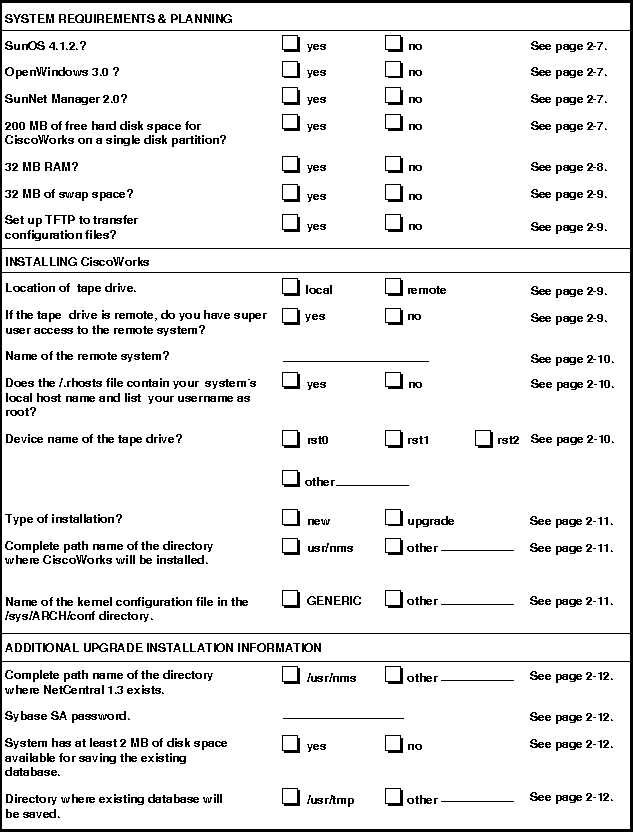
The CiscoWorks Installation Worksheet is shown on the next page. Retrieve the blank CiscoWorks Installation Worksheet provided in Appendix C before continuing. Use it as you proceed through the descriptions to record your information.
Each item in this worksheet is described in the following section, "Installation Worksheet Items."
CiscoWorks Installation Worksheet
This section explains each question in the Installation Worksheet. The information is required for the installation of CiscoWorks. To obtain and verify system information for some items in the worksheet, you may need to be logged in as a super user. For information on how to log in as a super user, refer to "Becoming a Super User."
Your Sun system must have SunOS Version 4.1.2 in order for CiscoWorks to be installed. To find out whether your system is using SunOS 4.1.2, enter the following command at the UNIX prompt:
The SunOS version number is displayed:
Cisco recommends OpenWindows 3.0 on your Sun system. Confirm whether your system is running OpenWindows 3.0.
SunNet Manager software must be installed on your Sun system before you can install CiscoWorks. To find out whether the SunNet Manager software is installed on your system, enter the following command:
If the SNHOME environment variable was defined, the SunNet Manager software version is displayed.
CiscoWorks requires 200 MB of disk space in a single disk partition on your system. Some disk partitions on your system may be full, with inadequate disk space available for CiscoWorks. If that is the case, create either a disk partition, a file system, or both for CiscoWorks software.
To find out how much disk space is available on your system, enter the following command:
Your system should display output similar to the following, indicating the file systems on your system.
The amount of disk space available in each file system is displayed. Select a file system that has sufficient disk space available for installing CiscoWorks. For detailed information on how to manage disk partitions and file systems, refer to the Sun System and Network Administration manual.
If you are unfamiliar with repartitioning disks or creating file systems, contact a knowledgeable system administrator. The following overview summarizes the steps involved in creating a file system. For information on the steps included in this overview, refer to the Sun System and Network Administration manual or the man pages on mkfs, fsck, mkdir, fstab, and mount.
Step 1: Create an empty file system on the disk partition you plan to use.
Step 2: Verify the integrity of the empty file system.
Step 3: Create a mount point directory.
Step 4: Configure the file system table and edit the /etc/fstab file.
Step 5: Mount the new file system.
CiscoWorks requires a minimum of 32 MB of RAM. To find out how much RAM is available on your system, make sure you are logged in as super user. Then enter the following command at the UNIX prompt:
The following type of output is displayed:
The entry "avail mem" indicates the amount of RAM memory available on your system.
CiscoWorks requires a minimum of 32 MB swap space on your system. To find out how much swap space is available on your system, make sure you are logged in as a super user. Then use the following command at the UNIX prompt:
Output similar to the following is displayed, indicating the amount of swap space available on your system:
If the swap space on your system is less than 32 MB, expand the swap space by following the instructions in the Sun System & Network Administration manual.
Configuring TFTP for Configuration Management
Once installed and configured, the CiscoWorks configuration management application enables you to use Trivial File Transfer Protocol (TFTP) to transfer configuration files between your system and other devices on your network that use SNMP.
In order for TFTP to operate, you need to edit the /etc/inetd.conf file on your system as described in "Setting Up TFTP." You can perform this task either before or after CiscoWorks installation and configuration.
Check the box on your worksheet if you want TFTP enabled on your system.
CiscoWorks can be installed from a local tape drive attached to your system or a tape drive attached to a remote system. Identify whether you plan to install from a local or remote tape drive.
Check the appropriate box on your worksheet.
Super User Access to Remote System
If you plan to install CiscoWorks from a tape or a CD-ROM drive attached to a remote system, find out whether you have a login account as a super user (root) on that system. If you do not have a super user access to the remote system, contact the system administrator of the remote system to obtain a login account with a super user access to that system.
If you are installing CiscoWorks from a tape or CD-ROM drive attached to a remote system, obtain the complete host name of the remote system and make sure that this host name is listed in the /etc/hosts file on your system.
Enter the remote system's host name on your worksheet.
The .rhosts file enables users to login to another user's account on a remote system. If you plan to install CiscoWorks from a tape or a CDROM drive attached to a remote system, the .rhosts file on that system must contain your local system's host name and your username specified as super user. To find out if this is true, access the .rhosts file by using a text editor such as vi or textedit.
For more information on the .rhosts file, refer to the SunOS Network Environment manual.
The installation script requires you to specify the device name for the tape or CD-ROM drive. You can either obtain the device name from your UNIX system administrator or view the contents of the /dev directory on your system by following these steps:
Change to the /dev directory:
Verify that you are in the /dev directory by using the following command:
The directory path is displayed.
List the devices available to your system to find out whether you have a device name similar to rst (tape drives usually have device names similar to rst0, rst1, rst2 and so on).
A list of available devices is displayed.
To display the remainder of the list of devices, press the space bar.
If you cannot identify an appropriate device name for your tape drive, contact your UNIX system administrator for help in obtaining device information.
Check the appropriate box on your worksheet and, if applicable, specify the name of the device.
If you are installing CiscoWorks for the first time on your system, you are performing a new installation. If you already have NetCentral 1.3 software on your system and you are upgrading to CiscoWorks, you are performing an upgrade installation.
Check the appropriate box on the worksheet.
If you are upgrading to to CiscoWorks, make sure you fill out the "Upgrade Information" portion of the worksheet.
Directory Path Name for CiscoWorks
Specify the directory where you want the CiscoWorks software to be installed. If the directory does not already exist on your system, the installation script creates the directory and installs the software in that directory. The default directory path name is /usr/nms.
Check the appropriate box on the worksheet. If applicable, specify the the directory pathname you plan to use.
Sybase Modifications to the Kernel Configuration File
All Sun systems contain a kernel. In order for the Sybase Version 4.8 software to work on your system, the kernel needs to be modified. The kernel is built from a configuration file in either the /usr/share/ARCH/conf directory (where ARCH could be sun4c, sun4m, or sun4n) or the /usr/sys/ARCH /conf directory.
Most systems use a generic kernel that is stored in a configuration file called GENERIC. If the kernel was customized for your system, it may be stored in a customized configuration file with a different name. If you choose to allow the installation script to build the new kernel, it uses your current system configuration.
You can allow the CiscoWorks scripts to modify the kernel's configuration file or you can modify it manually by adding the following lines:
If you choose to allow the installation script to modify the kernel configuration file, it saves the old kernel configuration file and names it as vmunix.syb_inst.
You need not allow the installation script to modify your system's kernel if the kernel was already modified for Sybase Version 4.8 or if you wish to modify the kernel manually.
If you want the installation script to modify the existing kernel, check the appropriate box on your worksheet. If you want the installation script to modify a customized configuration file on your system, specify the name of this file on your worksheet.
Additional Installation Information for Upgrading
This section explains items in the Installation Worksheet that are applicable only if you are upgrading from NetCentral 1.3 to CiscoWorks.
Complete Path Name for NetCentral 1.3 Directory
Specify the directory path name for the existing directory where NetCentral 1.3 software exists. The installation script installs the CiscoWorks software in this existing directory.
Check the appropriate box on the worksheet and if applicable, specify the path name for the directory.
During installation, the installation script accesses the existing Sybase database on your system. In order to do so, it prompts you to enter the Sybase password you used for the NetCentral 1.3 Sybase database.
Specify the Sybase password on your worksheet.
Disk Space for Saving the Database
The installation script saves your existing NetCentral 1.3 database in the /usr/tmp directory unless you choose to save the database in a different directory. A minimum of 2 MB of disk space is required to save your database. If your database is larger and requires more than 2 MB of disk space, make sure that your system has the required disk space.
Use the df command to verify that you have adequate disk space for saving the database.
After verifying that your system has the necessary disk space, check the appropriate box on your worksheet.
Directory for Saving the Database
The installation script saves your existing NetCentral 1.3 database in the /usr/tmp directory unless you choose to save the database in a different directory. Check the appropriate box on your worksheet.
Filling in the CiscoWorks Configuration Worksheet
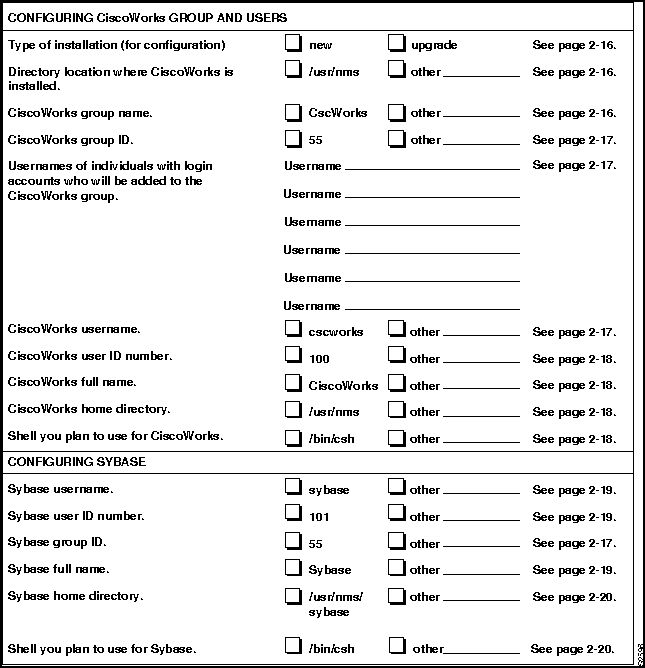
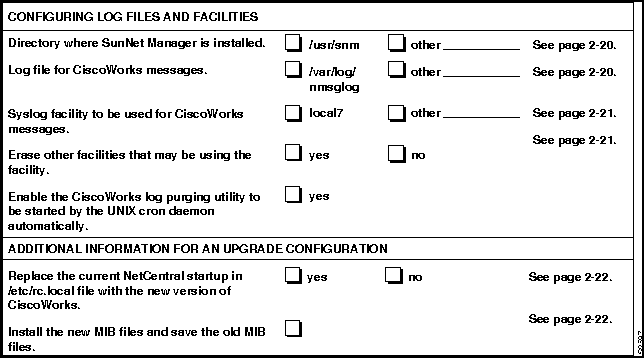
The CiscoWorks Configuration Worksheet is shown on the next page. Retrieve the blank CiscoWorks Configuration Worksheet provided in Appendix C before continuing. Use it as you proceed through the descriptions to record your information.
Each item in this worksheet is described in the following section, "Configuration Worksheet Items."
CiscoWorks Configuration Worksheet
This section explains each question in the Configuration Worksheet. The information is required for the configuration of CiscoWorks. For detailed information on the /etc/passwd and /etc/group files, usernames, user IDs, group names, and group IDs, refer to Sun's System & Network Administration guide.
Verify whether the CiscoWorks installation was a new installation or an upgrade installation. If you performed an upgrade installation, make sure you complete the last portion of the worksheet, which requires additional information on an upgrade configuration. See the section "Additional Information for an Upgrade Configuration."
Check the appropriate box on your worksheet.
Directory Where CiscoWorks Is Installed
Verify the complete directory path where CiscoWorks is installed.
Check the appropriate box on your worksheet, and if applicable, enter the directory path where CiscoWorks was installed.
In order for CiscoWorks users to access and use CiscoWorks, they must belong to a CiscoWorks group that is specified in the /etc/group file on your system. The configuration script prompts you to supply the group name you wish to use for CiscoWorks users. The default name for the group is CscWorks. If you are upgrading from NetCentral 1.3, you can use the NetCentral group name that you used for NetCentral 1.3.
Check the box for the default CscWorks group name on your worksheet or specify a unique name for the CiscoWorks group.
The CiscoWorks group, which is created and added to /etc/group file by the ncsconfigure script, must be assigned with a unique number. The configuration script proposes a default group ID number that you could accept. If you specify a different group ID number for the CiscoWorks group, make sure that it is unique and that no other group specified in the /etc/group file uses it.
Check the box for the default CiscoWorks group ID number on your worksheet or specify a unique group ID number for CiscoWorks.
Usernames for CiscoWorks Group
In order to specify usernames while running the installation script and allow users to access and use CiscoWorks, the following must be true:
If you need to create user login accounts, refer to the instructions in Sun's System & Network Administration guide.
In the worksheet, enter the usernames for users who have valid login accounts on your system and need to use CiscoWorks. If you are upgrading from NetCentral 1.3 to CiscoWorks, the configuration script displays the usernames of existing NetCentral users. You can either accept them and or add new usernames.
In order for the CiscoWorks software to work on your system, it requires a CiscoWorks login account and username. The configuration script prompts you to supply the username for CiscoWorks. Cisco recommends that you use the default username cscworks. The configuration script adds theCiscoWorks login account and username to the /etc/passwd file. In addition, the username is also added to the CiscoWorks group in the /etc/group file.
Check the appropriate box on your worksheet, and if applicable, specify a unique name for the CiscoWorks login account.
Users with valid login accounts and usernames on your system have unique user ID numbers that are specified in the /etc/password file. The CiscoWorks login account, which is created and added to the /etc/password file by the configuration script, must be assigned with a unique user ID number. The configuration script proposes a default user ID number. To specify a different user ID number for the CiscoWorks login account, make sure that it is unique and that no other user login account uses it.
Check the appropriate box on your worksheet, and if applicable, specify a unique user ID number for the CiscoWorks username.
Users with valid login accounts and usernames on your system should have their full names specified in the /etc/password file. A full name must be specified for the CiscoWorks login account. The configuration script proposes a default full name (CiscoWorks) that you could accept.
Check the appropriate box on your worksheet, and if applicable, specify a different full name for theCiscoWorks login account.
The configuration script installs the CiscoWorks software in a directory on your system. The default directory is /usr/nms. You can either accept the default directory or specify a subdirectory within the default directory.
Check the box for the appropriate Sybase directory name on your worksheet, and if applicable, specify a different directory for the Sybase software.
As a user, you interact with the UNIX operating system via a shell. Two standard shells used on UNIX systems are the C-Shell and the Bourne Shell. The C-Shell is the default shell you would use for Sybase-related tasks that are performed at the UNIX prompt.
Check the appropriate box on your worksheet, and if applicable, specify a shell of your choice.
The CiscoWorks software includes Sybase Version 4.8 software. In order for the Sybase software to work on your system, it requires a Sybase login account and username. The configuration script prompts you to supply the username for Sybase. Cisco recommends that you use the default username sybase. The configuration script adds the sybase login account and username to the /etc/passwd file. In addition, the username is also added to the CiscoWorks group in the /etc/group file.
Check the appropriate box on your worksheet, and if applicable, specify a unique name for the Sybase login account.
Users with valid login accounts and usernames on your system have unique user ID numbers that are specified in the /etc/password file. The Sybase login account, which is created and added to the /etc/password file by the configuration script, must be assigned with a unique user ID number. The configuration script proposes a default user ID number. To specify a different user ID number for the sybase login account, make sure that it is unique and that no other user login account uses it.
Check the appropriate box on your worksheet, and if applicable, specify a unique user ID number for the Sybase username.
The Sybase group, which is created and added to /etc/group file by the ncsconfigure script, must be assigned with a unique number. The configuration script proposes a default group ID number that you can accept. If you specify a different group ID number for the Sybase group, make sure that it is unique and that no other group specified in the /etc/group file uses it.
Either check the box for the default Sybase group ID number on your worksheet or specify a unique group ID number.
Users with valid login accounts and usernames on your system should have their full names specified in the /etc/password file. A full name must be specified for the Sybase login account. The configuration script proposes a default full name (Sybase) that you could accept.
Check the appropriate box on your worksheet, and if applicable, specify a different full name for the Sybase login account.
The configuration script installs the Sybase software in a directory on your system. The default directory is $NMSROOT/sybase. You can either accept the default directory or specify a substitute within the default directory.
Check the box for the appropriate Sybase directory name on your worksheet, and if applicable, specify a different directory for the Sybase software.
As a user, you interact with the UNIX operating system via a shell. Two standard shells used on UNIX systems are the C-Shell and the Bourne Shell. The C-shell is the default shell you would use for Sybase-related tasks that are performed at the UNIX prompt.
Check the appropriate box on your worksheet, and if applicable, specify a shell of your choice.
The CiscoWorks software needs to identify the directory where SunNet Manager software was installed on your system. Unless you installed the SNM software in a different directory, the SNM software is generally installed in the default directory /usr/snm.
Verify the directory where the SNM software is installed on your system. If it is installed in the /usr/snm directory, select the default directory path listed on your worksheet. Otherwise, specify the correct directory where the SNM software was installed.
Check the appropriate box on the worksheet. If the SNM software was installed in a directory other than the default directory, specify the correct directory.
Log File for CiscoWorks Messages
The CiscoWorks Log Manager application uses a centralized log file, /var/log/nmslog, which gets messages from the UNIX syslogd process. If you want these messages to be logged to a different file, you can specify a different filename for this log file.
Check the appropriate box on your worksheet and, if applicable, specify the name of the file where the messages can be logged.
Syslog Facility for CiscoWorks Messages
The CiscoWorks Log Manager application uses a centralized log file that gets messages from the UNIX syslogd process. The default facility used by the configuration script is local7.
Use the default facility, local7, if you want to log both CiscoWorks messages and Cisco device messages and view them through the Log Manager application. Cisco routers use the local7 facility. If you specify a facility in the range of local0 through local6, only CiscoWorks messages are logged.
Information about the facility you choose will be stored in the $NMSROOT/etc/nms.rc file. At a later time, you can change the facility you use by modifying your system's rc.local file and either setting the NCSSYSLOG environment variable or editing the nms.rc file. Refer to the CiscoWorks User Guide for instructions on performing these tasks.
Check the appropriate box on your worksheet.
Erasing Applications That Use the Facility
The configuration script asks you whether it can erase any other applications that might be using this facility. If you choose no, note that CiscoWorks log utility may not be able to use this facility to do the following:
Check the appropriate box on your worksheet.
CiscoWorks Log Purging Utility
CiscoWorks contains a centralized log file called nmslog. This log file can be automatically purged and backed up every day. As a result, the log purging utility is started automatically by the UNIX cron daemon. If you want the nmslog file to be purged and backed up automatically, select yes. Otherwise, select no.
Check the appropriate box on your worksheet.
Additional Information for an Upgrade Configuration
If you are upgrading from NetCentral 1.3 to CiscoWorks, the configuration script prompts you for additional information. Complete this portion of the worksheet if you are upgrading.
Replacement of Startup in /etc/rc.local File
You can specify whether you want the CiscoWorks daemons and the Sybase dataserver to be started automatically whenever the system is rebooted. If you choose to allow them to be started automatically, the startup commands are added to the /etc/rc.local file on your system. Otherwise, you may have to perform this task manually.
Check the appropriate box on your worksheet.
The CiscoWorks software contains new MIB files. If you already had any MIB files on your system, they are saved in a file called mibs.BAK in the $NMSROOT/etc directory under the appropriate CiscoWorks directory.
Check the box on the worksheet.
To perform the tasks associated with installing and configuring CiscoWorks, you must log into your system as a super user (root). Being a super user allows you to perform functions restricted from normal users.
To become a super user, you must know the root password. In the following examples, the root password is rootpassword.
If you are not logged in, enter the following commands to log in as a super user:
The UNIX prompt changes to a pound sign (#), indicating that you are logged in as a super user.
If you are already logged in, but not as root, enter the following commands to change your login to root:
The UNIX prompt changes to a pound sign (#), indicating that you are logged in as a super user.
Upgrading from NetCentral 1.3 to CiscoWorks
If you are upgrading from NetCentral 1.3 to CiscoWorks, perform the steps in this section. Skip this section if you are not upgrading.
Shutting Down the Sybase Database
Since CiscoWorks accesses the Sybase database, close all database files and shut down your database before starting the backup process. If you do not perform these steps before you perform your backup, the integrity of your backup cannot be ensured.
To shut down the database, perform the following procedure:
Step 1: Log into your system as a super user.
Step 2: At your UNIX prompt, enter:
Step 3: After starting isql, you get the prompt 1>. At the prompt. enter the shutdown command as follows.
Backing Up Your NetCentral 1.3 Software
Back up your entire NetCentral 1.3 system, including the $NMSROOT directory, current database and map files, as well as any additional Sybase data files stored elsewhere. Refer to the UNIX man pages on tar(1) or cpio(1) for information on making backups of UNIX files.
Opening Sybase Files and Starting nmdaemon
NetCentral's nmdaemon process performs the database queries created with the DBMS Query Configuration command.
Before you upgrade from NetCentral 1.3 to CiscoWorks, enter the following command to open the appropriate NetCentral 1.3 Sybase files and start the nmdaemon process:
This command allows the CiscoWorks installation and configuration scripts to perform a complete upgrade to CiscoWorks.
After you shut down the Sybase database and back up the NetCentral 1.3 software, follow the instructions in the Sun documentation to upgrade from SunOS 4.1.1 to SunOS 4.1.2. Skip this step if you already have SunOS 4.1.2 on your system.
Install SunNet Manager on your system according to the instructions provided in the SunNet Manager 2.0 User's Guide.
The Trivial File Transfer Protocol (TFTP) enables you to transfer files to and from remote systems. The configuration management application in CiscoWorks enables you to edit configuration files by using a text editor and download the files to devices on your network. It also enables you to retrieve a device's configuration file, view it, edit it, add it to the database, or return it to the device. TFTP is used to transfer the configuration files from a device to your system via the network.
You must verify that the TFTP daemon is enabled, the TFTP environment variable is set correctly, and a tftpboot directory exists. If you do not perform these tasks, you will not be able to use the configuration management application and a message will appear on the screen stating that TFTP was not enabled.
In order for CiscoWorks software to operate, the TFTP daemon (tftpd) must be enabled. When you executed the ncsconfigure script to configure CiscoWorks, you may have noted a message stating that TFTP is not set up correctly. The steps in this section will correct that situation.
If you are using the standard Sun software, verify that tftpd is enabled by completing the following steps:
Step 1: Log in as a super user. For information on becoming a super user, see the section, "Becoming a Super User."
Step 2: Using a text editor such as vi, edit the /etc/inetd.conf file.
Step 3: Look in the file /etc/inetd.conf for the line that invokes tftpd. If the line is commented out (starts with a pound sign (#) as in the following example), remove the pound sign with an editor.
Step 4: Save the changes in the edited file and exit.
Step 5: At the UNIX prompt, enter the following command to display the process id number for the inetd configuration.
Step 6: Verify that TFTP is enabled by typing:
Setting the TFTPTYPE Environment Variable
TFTPTYPE is an environment variable used by ncsconfigure to describe which type of TFTP is being used. Sun's TFTP daemon requires that a file that is being transferred must first exist as a "dummy" file on the destination system. Other implementations require that the file does not exist on the destination system.
TFTPTYPE can take the value OVERWRITE (the file must exist and is overwritten) or NOOVERWRITE (the file cannot be overwritten; it must not exist). If you are using the standard Sun TFTP daemon, no action is required to set the TFTPTYPE variable. Otherwise, you must set TFTPTYPE accordingly.
Creating the tftpboot Directory
The tftpboot directory can be used to save and store configuration files that are loaded to a device when using the configuration management application in CiscoWorks. The SNMP device configuration file is saved in the form of a TFTP boot file.
If you upgraded from NetCentral 1.3 to CiscoWorks, the tftpboot directory may already exist on your system. If that is the case, you need not perform these steps.
Follow these steps to create the tftpboot directory.
Step 1: If the tftpboot directory does not exist, use the following command to create the directory:
Step 2: The tftpboot directory must have the appropriate permissions. Modify the permissions with the following command:
Installing from a Local or Remote CDROM
Software for CiscoWorks Release 1.0(3) is distributed on a CD-ROM. To install CiscoWorks from either a CD-ROM drive attached to your system or a drive attached to a remote system, do the following:
Before beginning the installation procedure, place the CiscoWorks CDROM into its caddy and insert it into the CD-ROM drive. If you are using a CD-ROM drive that is connected to your workstation, refer to the following section, "Mounting from a Local CD-ROM." If you are using a CD-ROM drive that is connected to a remote workstation, refer to the section "Mounting from a Remote CD-ROM." These instructions are also provided in the CiscoWorks Release 1.0(3) CDROM insert booklet shipped with the product.
To mount the CD-ROM from a local CD-ROM drive, perform the following steps:
Step 1: Place the CD-ROM into its caddy and insert it into the CD-ROM drive.
Step 2: Become a superuser by entering the following command and supplying your root password:
Step 3: If the /cdrom directory does not already exist, enter the following command to create a new directory:
Step 4: To mount the CD-ROM, enter the following command:
If you plan to use a CD-ROM drive attached to a remote system, CiscoWorks does not require any disk space on the remote system. The software is copied across the network to the local workstation.
The root .rhosts file on the remote system must contain the local host name of your system and your user name. Otherwise, you will not be able to access the remote system to download software from the CD-ROM drive connected to the remote system. For more information, refer to the manual pages on rhosts.
To mount the CD-ROM from a remote CD-ROM drive, perform the following steps on the remote machine:
Step 1: Place the CD-ROM into its caddy and insert it into the CDROM drive.
Step 2: Become a superuser by entering the following command and supplying your root password:
Step 3: If /cdrom directory does not already exist, enter the following command to create a new directory:
Step 4: If the /etc/exports file does not exist, create it.
Step 5: Edit the /etc/exports file to include the following line:
Step 6: If /etc/exports did not exist previously, reboot your workstation to become an NFS server, so the nfsd can be started.
Step 7: To mount the CD-ROM, enter the following command:
Step 8: If the /etc/exports existed previously, run exportfs -a.
Step 9: Become a superuser by entering the following command and supplying your root password:
Step 10: If the /cdrom directory does not already exist, enter the following command to create a new directory:
Step 11: To mount the CD-ROM, enter the following command:
Transferring CD-ROM Documents to Your Hard Disk
Your CD-ROM contains the CiscoWorks Release 1.0 documentation. If you are upgrading from CiscoWorks Release 1.0(2) and have already transferred the CD-ROM documents to your hard disk, you do not need to repeat this procedure.
Perform the following steps to copy these documents from the CDROM to your hard disk:
Step 1: If the CD-ROM is not already mounted, refer to the CiscoWorks 1.0(3) CD-ROM installation booklet or the section entitled "Installing from a Local or Remote CDROM" for instructions on mounting the disc.
Step 2: Create a directory to store the CD-ROM files by entering the following at the UNIX prompt (%). This path allows the documentation to remain with the source software.
Step 3: Change to the new /usr/nms/docs directory by entering the following:
Step 4: To copy all the document files to your /usr/nms/docs directory, enter the following:
Step 5: To copy a specific document file to your /usr/nms/docs directory, enter the following:
Step 6: To copy the complete directory structure with the documents to your system, enter the following:
After completing all the preparations required to install CiscoWorks, you are ready to proceed to the next chapter, "Installing and Configuring CiscoWorks."
Copyright 1988-1996 © Cisco Systems Inc.

% du -s $SYBASE/data
hostname% uname -r
hostname% 4.1.2
hostname% $SNMHOME/bin/snm_version
hostname% df
Filesystem              kbytes       used      avail    capacity     Mounted on
/dev/root                18903      15952       1060       94%       /
/dev/dsk/isc0d3s2       983350     744939     228577       77%       /minxbackup
/dev/dsk/isc0d2s2       983350     870164      14851       98%       /users-dir
/dev/dsk/isc0d1s12      228751     186863      19012       91%       /docs
/dev/dsk/isc0d1s11      391207     343222       8864       97%       /dreggs
/dev/usr                558438     360349     142245       72%       /usr
dirt:/rfc               629610     527525      39124       93%       /mnt_tmp/rfc
clash:/tex              100047      77974      12068       87%       /mnt_tmp/tex
hostname# dmesg | grep mem
mem = 16384K (0x1000000)
avail mem = 14385152
hostname# pstat -s
15608k allocated + 5960k reserved = 21568k used,33448k
available
hostname% cd /dev
hostname% pwd
hostname% ls | more
options "SHMSIZE=0x20000"
options "SEMMNS=640"
options "SHMMNI=256"

login: root
Password: <rootpassword>
hostname% su
Password: <rootpassword>
hostname# setenv SYBASE $NMSROOT/sybase
hostname# $SYBASE/bin/isql -Usa -P <password>
1> shutdown
2> go
hostname# $NMSROOT/etc/nmstartup
tftp  dgram  udp  wait  root  /user/etc/in.tftpd  in.tftpd
-s /tftpboot
hostname# ps -ax | grep -v grep | grep inetd
hostname# 119 ? S 0:05 inetd
hostname# kill -HUP 119
hostname# netstat -a | grep tftp
hostname# udp 0 0 *.tftp *.*
hostname# mkdir /tftpboot
hostname# chmod 777 /tftpboot

login: su

Password: <rootpassword>
hostname# mkdir /cdrom
hostname# mount -rt hsfs /dev/sr0 /cdrom
login: su

Password: <rootpassword>
hostname# mkdir /cdrom
/cdrom -ro
hostname# mount -rt hsfs /dev/sr0 /cdrom
hostname# exportfs -a
login: su

Password: <rootpassword>
hostname# mkdir /cdrom
hostname# mount remote_workstation: /cdrom /cdrom
% mkdir /usr/nms/docs
% cd /usr/nms/docs
% cp /cdrom/documentation/Viewer_docs/UserGuide/* .
% cp /cdrom/documentation/Viewer_docs/UserGuide/filena
me.view .
filename.view
.
% cp -r /cdrom/documentation .
