


|
|

Upgrading Run-From-Flash Software Images in the Cisco 2500
Product Numbers:
SW-G25A-9.14.x=
SW-G25B-9.14.x=
SW-G25C-9.14.x=
SW-G25A-9.21.x=
SW-G25B-9.21.x=
SW-G25C-9.21.x=
SW-G25A-10.0.x=
SW-G25B-10.0.x=
SW-G25C-10.0.x=
Read this entire publication before attempting any of its procedures.
This publication describes how to upgrade Cisco 2500 routers with run-from-Flash software images. It also provides information about the rxboot image, which is a limited ROM-based image you use to perform the Cisco 2500 system software upgrade. These tasks include the following:
The information in this publication is organized within the following sections:
Overview of Image Distribution and Upgrade Methods
The Cisco 2500 supports Flash memory downloading for software images. Downloadable images enable you to download new images over the network, store the images in the router's Flash memory, and load images from Flash at system startup without having to physically access the router.
Some Cisco routers, including the Cisco 2500, are designed to run from Flash memory and can only boot from the first file in Flash memory. To upgrade the system software image on such a router, you must erase the contents of Flash memory so the new system image can be written as the first file. As a result, the upgrade must be performed while running from a media other than Flash. The rxboot image is used for this purpose.
The rxboot image is a bootable image stored in ROM on a Cisco 2500. It is limited in size, and therefore, has only a limited subset of the functionality of a complete router system image.
Functions Supported by the Rxboot Image
The following functions are supported by the rxboot image:
Functions Not Supported by the Rxboot Image
The following functions are not supported by the rxboot image:

To successfully upgrade system software and read-only memory on your Cisco 2500 routers, you should observe the following prerequisites and caveats.
This section describes the general steps required to upgrade your system software on a Cisco 2500 router. The sections that follow describe these steps in greater detail.
Establishing a Route to the TFTP Server
You need a TFTP server to download a new system image. This server can also hold original system images for backup purposes. This section describes how to ensure a route is established between the TFTP server and the router to be upgraded.
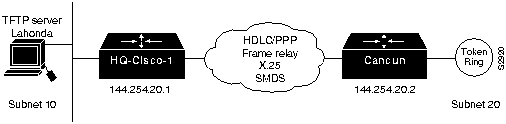
Figure 1 shows an example of a router named Cancun being upgraded with a system software image stored on the TFTP server named Lahonda.
Figure 1 : Sample Upgrade Scenario To configure the router Cancun so that it has a route to Lahonda when at the boot ROM prompt, you would follow these steps:
Having established a route from the TFTP server to each router to be upgraded, refer to the next section "Installing System Software onto Your TFTP Server."
Installing System Software onto Your TFTP Server
This section describes how to use the installation program on the disk with your software upgrade to install the system software onto your DOS-based PC or your desktop SPARCstation.
Refer to the online README file on the software upgrade disk for details about the image for the routers to be upgraded. The README file lists details such as product number, image type, file size, and checksum of the compressed or uncompressed image.
Installing System Software onto a DOS-Based PC
To copy your system software upgrade into the appropriate directory on the PC you plan to use as the TFTP server, follow this procedure. Allow five minutes to complete this procedure.
Installing System Software onto a Sun Workstation
The following procedures describe how to install the system software upgrade onto a desktop SPARCstation with SunOS 4.1.x. The workstation must have a 3.5-inch, 1.44-MB floppy disk drive. Allow ten minutes to complete this procedure.
You must have superuser (SU) access to install the router system software to the UNIX system.
Use the following procedure to create a mount point and install the system software image on your TFTP server. Note that filenames are case sensitive.
Refer to the next section, "Making Your Network Connections."
Making Your Network Connections
This section describes the following topics:
After installing the TCP/IP software you will use to copy the Cisco 2500 software image to the routers on your network, make sure it functions properly by following this procedure:
If you are using PC/TCP Network Software for DOS from FTP Software, Inc., you can verify the appropriate driver and IP address by entering the following command:
You can verify your IP configuration by entering the following command:
If you are using Chameleon TCP/IP for Windows from NetManage, Inc., run its Setup program to verify that you are using the appropriate driver and have configured the TCP/IP software properly.
This section describes how to set up your UNIX system or PC as a TFTP server and start a TFTP session with the router you want to upgrade remotely.
If you are using a PC and do not already have TFTP software, we recommend the following two TCP/IP software packages:
The section "Prerequisites and Caveats" lists some issues to keep in mind while installing the software.
Setting Up TFTP on a Sun Workstation
To set up the Sun system as a TFTP server, you must verify that the TFTP daemon is enabled, the TFTP environment variable is set correctly, and a tftpboot directory exists. To see if TFTP is enabled, enter the following command:
If the TFTP daemon is already enabled, skip to "Creating a tftpboot Directory" on page 12.
The TFTP daemon (tftpd) permits the system to be a TFTP server. If you are using the standard Sun software, verify that tftpd is enabled by completing the following steps:
If there is no output, tftpd is not enabled. For additional information about TFTP, refer to the UNIX man pages about tftp and tftpd.
The tftpboot directory can be used to save and store configuration files that are loaded to a device. Device configuration files can be saved as TFTP boot files.
You must have superuser (SU) access to perform the following steps. These steps describe how to create a tftpboot directory.
After completing all the preparations required to set up the Sun system as a TFTP server, refer to "Testing the TCP/IP Software" on page 10.
You must be able to issue commands to the router you plan to upgrade. For example, this publication will tell you to issue a command to download the image from the TFTP server to the router.
If you have a console port connection to the router, you need not invoke a Telnet session.
If you do not have a console port connection to the router, you must establish a Telnet session with it so that you can issue commands.
You can set up a Telnet session from a Sun workstation or from a PC.
This section presents the following topics:
Backing Up Your Current System Software Image
If you do not already have the current system software image on your TFTP server, make sure you back up this image before copying the new system software image to Flash memory on your router.
First, you must know the exact spelling of the image name. To learn the image name, issue the show flash all command. The following sample output for a compressed Cisco 2500 image (System Software Release 9.14(2)) displays an image name of xk91420z near the bottom of the screen.
Use the name near the bottom of your router's show flash all command (in this case, xk91420z) when you back up the image.
Copying the Image from Flash Memory to the TFTP Server
To copy an image from Flash memory to a TFTP server, use the copy flash tftp command:
The router asks you for the IP address of the TFTP server and the name of the image file you are copying to the server.
A sample of the output for this command using IP address 131.108.10.6 and filename ic92130n follows:
Use the image you backed up to the TFTP server in case the upgrade image becomes damaged.
Reloading the Router to the Boot ROM Prompt
To reboot the router to the boot ROM prompt, you first set the configuration register to 0x101, then issue the reload command, as shown in the following example.
If the following message appears, you can ignore it:
If you had telnetted to the router, your Telnet session is disconnected after the router is reloaded. Wait for the router to complete reloading and log into it again. When you do, the following prompt appears:
Copying the Image from a TFTP Server to Flash Memory
The copy tftp flash command retrieves an image from a TFTP server and copies (writes) the image into the router's Flash memory. The TFTP server can be another Cisco router serving ROM or Flash system software images, or a PC or UNIX workstation set up as a server for remotely downloading new images to routers on the network. If you have already established a connection with the remote server, refer to "Downloading the New Image" on page 16.
In some cases, primarily outside of North America, Cisco Systems distributors may choose not to distribute the new software image on floppy disk. Instead, they can place the new image on TFTP servers and provide their customers with the information they will need to access and download the new image. If you are downloading the new image from your distributor with this process, ensure that your distributor has provided you with all of the following information:
You must have all of this information from your distributor before you can complete the upgrade. Refer to the next section, "Verifying the Connection."
Verify the connection between your router and the remote server by pinging the server using the IP address (this may be provided by your distributor). Following is an example of a successful ping command to a remote server with the address 131.131.101.101:
The console displays either a series of exclamation points (!!!!!) to indicate a good connection between your router and the server or a series of periods (.....) or the messages [timed out] or [failed] to indicate that the connection failed. If the connection fails, verify that you have the correct IP address for the server and that the server is active (powered on), and repeat the ping command.
To download the new image from the TFTP server to your router, issue the copy tftp flash command. When you do, you are prompted for the IP address (or domain name) of the TFTP server. This can be another Cisco router serving ROM or Flash system software images. You are then prompted for the filename of the software image and given the option to erase the existing Flash memory. Type Y. The filename can be lower- or uppercase; the router will see the name as lowercase. The system clears and initializes Flash memory. The entire copying process takes several minutes. This time differs from network to network.
The following sample output shows a system image named The series of exclamation points (!) in the preceding sample output indicates that the copying process is taking place. The series of Vs indicates that a checksum is being calculated. The last line in the sample configuration indicates that the file transfer is complete.
If the process was successful, refer to the next section, "Verifying Software Images in Flash Memory." If it was not successful, refer to the section "Recovering from a Flash Memory Failure" on page 20.
Verifying Software Images in Flash Memory
Before booting from Flash memory, you must verify that the checksum of the compressed image shown at the bottom of the screen after you issue the copy tftp flash command matches the checksum listed in the README file on the software upgrade disk.
If the checksum value is not correct according to the value in the README file on the system upgrade disk, enter the copy tftp flash command and compare the checksums again. If the checksum is repeatedly wrong, copy the original system software image back into Flash memory before you reboot the router from Flash memory.
Returning Your Router to its Original State
Before your router can return to normal operation, you must change the configuration register back to its original state (the boot-from-Flash setting is 0x102) and reload the router, as shown in the following example:
After the router is reloaded with the new software, be sure to make the following changes:
At this point, ensure that your router is set to boot from Flash memory. Refer to the following section "Booting from Flash Memory."
The following sections describe how to boot from Flash, both automatically and manually. When you boot a Cisco 2500 router from Flash memory, the software image actually runs from Flash. Some router models offer both run-from-Flash and run-from-RAM software images. Run-from-RAM images are stored in Flash memory, but are written into RAM when you reload the router.
From the enable-mode prompt on the router, enter the EXEC command write terminal to see whether the boot system flash command line in the configuration file has the filename argument, as follows:
Automatically Booting from Flash
You can configure the router to automatically boot from the image in Flash memory by following this procedure:
If you do not have your router set up to automatically boot from Flash, as specified in the previous section, you can manually boot from Flash by following this procedure:
Recovering from a Flash Memory Failure
If the image fails to load properly into Flash memory, the following error message appears:
If you try loading the image into Flash memory three or more times and repeatedly see this message, contact technical support immediately and inform them of the situation. In an attempt to recover from the error, you can also repeat the upgrade procedure described in this publication.
Repeating the Installation Process
Before repeating the system software upgrade process on subsequent machines, make sure the upgraded router functions properly by performing the following steps:
Only if the ping and show route commands generate positive results should you upgrade subsequent routers.
Obtaining Additional Information
This section provides information for obtaining technical assistance.
Cisco Systems' Customer Information Online (CIO) system provides online information and electronic services to Cisco direct customers and business partners. Basic CIO services include general Cisco information, product announcements, descriptions of service offerings, and download access to public and authorized files, including release notes, and software. Maintenance customers receive a much broader offering, including technical notes, the bug database, and electronic mail access to the TAC. (Maintenance customers must have authorization from their Cisco contract administrators to receive these privileges.)
For dialup or Internet users, CIO supports Zmodem, Kermit, Xmodem, FTP PUT, Internet e-mail, Telnet, rlogin, and fax download options. Internet users also can retrieve files from CIO using FTP.
Registration for CIO is handled on line. To reach CIO via the Internet, use Telnet or FTP to
Copyright 1988-1996 © Cisco Systems Inc.
cancun> enable
Password: <password>
cancun#
cancun# configure terminal
Enter configuration commands, one per line.
Edit with DELETE, CTRL/W, and CTRL/U; end with CTRL/Z

interface serial 1
shutdown
interface serial 0
shutdown
ip default-gateway 144.254.100.1

^Z

cancun# write memory
[ok]
cancun#

C:\> a:
install
********************** IC92130N.DOC **********************************

    PRODUCT NO. SW-G25C-9.21.3=
    System Software Image IC92130N, IGS-BFPX Version 9.21(3)
    Uncompressed size = 1989999 bytes; Checksum=0x5alc
    Copyright (c) 1994 Cisco Systems, Inc.

File IC92130N contains an uncompressed image that supports all software
capabilities for the Cisco 2500 except booting from RAM and ROM.

To install this software in a PCDOS environment enter:
    A:install          (or use the appropriate drive letter)
To install this software in a UNIX environment enter:
    #mount -rt pcfs /dev/fd0 /pcfs
    #/pcfs/install.unx    (where the user has root privileges)

To install this software onto a router, follow the procedures in the
accompanying publication, "Upgrading Run-From-Flash Software Images
in the Cisco 2500."

**********************************************************************
Installation for ic92130n complete!
C:\> cd \tftpboot
C:\>
dir ic10010n.*

hostname#
mkdir /pcfs
hostname#
mount -t pcfs /dev/fd0 /pcfs
hostname#
mount -rt pcfs /dev/fd0 /pcfs
hostname#
/pcfs/install.unx
********************** IC92130N.DOC **********************************

    PRODUCT NO. SW-G25C-9.21.3=
    System Software Image IC92130N, IGS-BFPX Version 9.21(3)
    Uncompressed size = 1989999 bytes; Checksum=0x5alc
    Copyright (c) 1994 Cisco Systems, Inc.

File IC92130N contains an uncompressed image that supports all software
capabilities for the Cisco 2500 except booting from RAM and ROM.

To install this software in a PCDOS environment enter:
    A:install          (or use the appropriate drive letter)
To install this software in a UNIX environment enter:
    #mount -rt pcfs /dev/fd0 /pcfs
    #/pcfs/install.unx    (where the user has root privileges)

To install this software onto a router, follow the procedures in the
accompanying publication, "Upgrading Run-From-Flash Software Images
in the Cisco 2500."

**********************************************************************
Installation for ic92130n complete!
hostname#
cd /tftpboot
hostname#
ls -l ic91470n
.*
router#
ping
ip-address
[timed out]
[failed]
C:\> ifconfig drivers\drivername show
C:\> ipconfig ftp_3c\ipcust.sys show
hostname# netstat -a | grep tftp
# tftp dgram udp wait root /user/etc/in.tftpd

in.tftpd -s /tftpboot
hostname#
ps -ax | grep -v grep | grep inetd
119 ? S 0:05 inetd
hostname#
kill -HUP 119
hostname#
netstat -a | grep tftp
udp 0 0 *.tftp *.*
hostname#
mkdir /tftpboot
hostname#
chmod 777 /tftpboot
router# show flash all
2048K bytes of Flash address space sized on CPU board.
Memory type is Flash.
   Chip    socket   code      bytes     name
    0       U42     89BD   0x040000   INTEL 28F020
    1       U44     89BD   0x040000   INTEL 28F020
    2       U46     89BD   0x040000   INTEL 28F020
    3       U48     89BD   0x040000   INTEL 28F020
    4       U41     89BD   0x040000   INTEL 28F020
    5       U43     89BD   0x040000   INTEL 28F020
    6       U45     89BD   0x040000   INTEL 28F020
    7       U47     89BD   0x040000   INTEL 28F020

Flash address space file directory:
File  name/status
        addr     length    fcksum  ccksum
 0  xk91420z
      0x3000040  1337256   0x5A1C 0x5A1C
 [759832/2097152 bytes free/total]
router#
router# copy flash tftp filename
IP address of remote host [255.255.255.255]? 131.108.10.6
Name of file to copy []? ic92130n
writing ic92130n !!!!!!!!!!!!!!!!!!!!!!!!!!!!!!!!!!!!!!!!!!!
router#
router# configure terminal
Enter configuration commands, one per line.
Edit with DELETE, CTRL/W, and CTRL/U; end with CTRL/Z

router(config)# config-reg 0x101
router(config)# ^Z
router#
%SYS-5-CONFIG_I: Configured from console by console ()

router# reload
[confirm]
Bad arguments to line command
router(boot)#

router(boot)# ping 131.131.101.101 <Return>
Type escape sequence to abort.
Sending 5, 100-byte ICMP Echoes to 131.131.101.101, timeout is 2 seconds:
!!!!!
Success rate is 100 percent (5/5), round-trip min/avg/max = 1/15/64 ms
router(boot)#

ic91470n copied into the current Flash configuration:
router(boot)# copy tftp flash
File  name/status
 0  igs-bfpx.914-7
 [123816/2097152 bytes free/total]

IP address or name of remote host [255.255.255.255]? 131.108.1.111
Name of file to copy? ic91470n
Copy ic91470n from 131.108.1.111 into Flash address space?  [confirm] <Return>
123752 bytes available for writing without erasure.
Erase Flash address space before writing? [confirm] <Return>
bank 0...zzzzzzzzzzzzzzzzvvvvvvvvvvvvvvvveeeeeeeeeeeeeeee
bank 1...zzzzzzzzzzzzzzzzvvvvvvvvvvvvvvvveeeeeeeeeeeeeeee
Loading from 131.108.1.111: !!!!!!!!!!!!!!!!!!!!!!!!!!!!!!!!!!!!!!!!!!!!!!!!!!!!
!!!!!!!!!!!!!!!!!!!!!!!!!!!!!!!!!!!!!!!!!!!!!!!!!!!!!!!!!!!!!!!!!!!!!!!!!!!!!!!!
!!!!!!!!!!!!!!!!!!!!!!!!!!!!!!!!!!!!!!!!!!!!!!!!!!!!!!!!!!!!!!!!!!!!!!!!!!!!!!!!
!!!!!!!!!!!!!!!!!!!!!!!!!!!!!!!!!!!!!!!!!!!!!!!!! [OK - 1337256/2097088 bytes]
Verify checksum...vvvvvvvvvvvvvvvvvvvv
Verification successful: Length = 1999845, checksum = 0x5A1C
router(boot)# configure terminal
Enter configuration commands, one per line.
Edit with DELETE, CTRL/W, and CTRL/U; end with CTRL/Z

router(config)# config-reg 0x102
router(config)# ^Z
router#
%SYS-5-CONFIG_I: Configured from console by console ()

router# reload
[confirm]

router> enable
Password:
router# wr term
Current configuration:
!
(text deleted)
boot system flash
(text deleted)
router#
configure terminal
no boot system flash ic92130n
(Removes old filename)
boot system flash ic10020n
(Tells the system to boot new filename)
^Z
router#
write memory
[ok]
router#
router#
reload
[confirm]
%SYS-5-RELOAD: Reload requested
System Bootstrap, Version 4.14(2), SOFTWARE
Copyright (c) 1986-1994 by cisco Systems
2500 processor with 4096 Kbytes of memory
>
>
i
System Bootstrap, Version 4.14(1), SOFTWARE
Copyright (c) 1986-1994 by cisco Systems
2500 processor with 4096 Kbytes of memory
>
b
flash
Checking Link Status...OK
Booting ic92130n from flash memory RRRRRRRRRRRRRRRRRRRRRRRRRRRRRRRRRRRRRRR
RRRRRRRRRRRRRRRRRRRRRRRRRRRRRRRRRRRRRRRRRRRRRRRRRRRRRRRRRRRRRRRRRRRRRRRRRR
RRRRRRRRRRRRRRRRRRRRRRRRRRRRRRRRRRRRRRRRRRRRRRRRRRRRRRRRRRRRRRRRRRRRRRRRRR
RRRRRRRRRRRRRRRRRRRRRRRRRRRRRRRRRRRRRRRRRRRRRRRRRRRRRRRR
[OK - 1337256/3532618 bytes]
#########################################################################
#########################################################################
#########################################################################
##############################################################
F3: 1926336+46904+183152 at 0x12000
Restricted Rights Legend
Use, duplication, or disclosure by the Government is
subject to restrictions as set forth in subparagraph
(c) of the Commercial Computer Software - Restricted
Rights clause at FAR sec. 52.227-19 and subparagraph
(c) (1) (ii) of the Rights in Technical Data and Computer
Software clause at DFARS sec. 252.227-7013.
              Cisco Systems, Inc.
              170 W. Tasman Drive
              San Jose, California
IOS (tm) 2500-BFPX Software, Version 10.0(2.0)
Copyright (c) 1986-1994 by cisco Systems, Inc.
Compiled Tue 31-May-94 06:34 by daveu
Cisco 2500 (68030) processor (revision 0xA0) with 4096K/4096K bytes of memory.
Processor ID 5008909
DDN X.25 software, Version 2.0.
Bridging software.
1 Ethernet/IEEE 802.3 interface.
1 Token Ring/IEEE 802.5 interface.
2 Serial network interfaces.
128K bytes of non-volatile configuration memory.
2048K bytes of Flash address space sized on CPU board.
Press RETURN to get started!
router#
Error programming flash memory
show protocol route network.
tac@cisco.com
. For upgrade or product information, contact the Customer Response Center at 800 553-6387, 415 9037208, or
cs-rep@cisco.com
.
cio.cisco.com
(131.108.89.33). To reach CIO by dialup, use 415 9038070 (Mountain View, California) or 33 1 6446 4082 (Paris, France).

