


|
|

The Statistics Collection Manager (SCM) is a GUI-based process that uses the standard trivial file transfer protocol (TFTP) for statistics collection. TFTP provides faster statistics collection with minimal overhead. The Statistics Collection Manager is normally installed as an integral part of StrataView Plus. These notes describe how to install an SCM as a stand-alone product on a Sun SPARCStation and how to integrate the stand-alone SCM with a Sun SPARCStation running StrataView Plus Release 8.2 or higher.
Stand-alone SCM Hardware Minimum Requirements
Currently, for new Sun workstations, the minimum recommended hard disk, memory and monitor configuration consists of two 1-Gigabyte disks, a minimum of 128 Mbytes of memory, and a 19-inch color monitor. Minimum hardware requirements for earlier hardware are as follows:
Minimum Requirements for a Stand-alone SCM SPARCStation
Minimum Requirements for a Sun SPARCstation IPX
Stand-alone SCM Software Requirements
The stand-alone SCM workstation requires the following software elements:
TCP/IP network support must also be installed on the stand-alone SCM workstation.
Installing Stand-alone SCM on Your Sun SPARCStation
An initial installation of stand-alone SCM includes installing Motif, setting up a StrataView Plus user and group account on the operating system disk, and using the tar command to install the stand-alone SCM application. After you install the stand-alone SCM software, you must configure the statistics collection parameters within SCM.
Proceed as follows to perform an initial (first time) installation of stand-alone SCM:
Prior to the installation of SCM, Motif must be installed. Most of the information in this section is referred to in the DECwindows Motif for the Sun SPARCstation Installation Guide.
root
, do so now.
mkdir /usr/users/motif <RETURN>
cd /usr/users/motif <RETURN>
tar xvpf /dev/nrst0 <RETURN>
tar xvpf /dev/rst0 <RETURN>
if you have a rewinding tape drive.
DECW_MOTIF_INSTALL <RETURN>
<RETURN>
<RETURN>
y <RETURN>
| Subset | Size | Description | |
| 1 | 8225 | Base Product (Libraries, Mwm, and UIL compiler) | |
| 2 | 3600 | Examples, (WML and Motif demo programs) | |
| 3 | 5910 | DEC windows 75 dpi Fonts | |
| 4 | 7370 | DEC windows 100 dpi Fonts | |
| 5 | 1543 | Man Pages | |
| 6 | 26648 | All of the above | |
| 7 | None of the above |
<RETURN>
y <RETURN>
<RETURN>
<RETURN>
<RETURN>
<RETURN>
<RETURN>
<RETURN>
<RETURN>
Open the door and remove the tape cartridge.
Creating the SV+ Group Account
You must create a group name and account number for the svplus user account.
root
, if not do so now.
Edit the
/etc/group
file by adding the following line:
/usr/users
, contact StrataCom ISC.
Creating the SV+ Login Account
cd /usr/etc/install <RETURN>
add_user svplus 271 21 'StrataView Plus' /usr/users/svplus /bin/csh <RETURN>
passwd svplus <RETURN>
and follow on-screen directions.
Installing the SCM Files from Tape
root
, if not do so now.
su

password: superuser password
cd /usr/users/svplus <RETURN>
tar xvpf /dev/nrst0 <RETURN>
tar xvpf /dev/rst0 <RETURN>
if you have a rewinding tape drive.
chmod 755 .openwin-init <RETURN>
755
indicates that the user has read, write, and execute privileges, while the group and others have only read and execute (no write) privileges.
Configuring Your Stand-alone SCM to Share Statistics Files with a StrataView Plus System Using NFS
This section presents the procedures required to configure a stand-alone SCM to share statistics files with one StrataView Plus system using NFS. This allows the statsparser process running on the StrataView Plus system to parse the statistics files on the stand-alone SCM and put the data into the StrataView Plus database just like a co- located StrataView Plus with SCM system does.
Proceed as follows to configure your newly installed stand-alone SCM:
Adding Stand-alone SCM Support to StrataView Plus
2
Welcome to StrataView Plus 8.2

MAIN MENU
---------
1) Start SV+
2) Stop SV+
3) Start GUI
4) Dump db data
5) Start SNMP Agent
6) Current db name
7) Bulk Statistics
8) Start Stats Mgr GUI

Enter number or x to exit: 2
svplus% mkdir /usr/users/svplus/NFS.scmhostname
su

password: superuser password
/etc/exports
file by entering:
vi /etc/exportsto begin editing the
/etc/exports
file.
/etc/exports
file:
/usr/users/svplus/scmhostname<tab>

-access=scmhostname,rw=scmhostname,root=scmhostname
scmhostname.
There should be no spaces in this line.
Linking StrataView Plus to the Stand-alone SCM Workstation
svplus

password: svplus user password
svplus% mkdir /usr/users/svplus/NFS.scmhostname
scmhostname.
su

password: superuser password
/etc/fstab
file by entering:
vi /etc/fstabto begin editing the
/etc/fstab
file.
/etc/fstab
file:
svhostname:/usr/users/svplus/NFS.scmhostname /usr/users/svplus/NFS.scmhostname nfs
rw,soft,bg,timeo=15,retrans=15 0 0
scmhostname
and the StrataView Plus workstation name substituted for
svhostname.
Do not add any extra spaces to this entry.
mount /usr/users/svplus/NFS.scmhostname
scmhostname
.
Please login:
prompt:
Please login: svplus
password: *******
SV+As a result of entering the
SV+
command, the StrataView Plus Menu Screen is displayed on the Sun SPARCstation:
Welcome to StrataView Plus 8.2

MAIN MENU
---------
1) Start Stats Mgr GUI

      Enter number or x to exit:
Verifying Mounting Information on the StrataView Plus Workstation
su

password: superuser password
showmount -aEntering this command should display the following:
scmhostname:/usr/users/svplus/NFS.scmhostname
scmhostname
.
Verifying Mounting Information on the Stand-alone SCM Workstation
enter number or x to exit:
", enter "
x
" to return to the system prompt:
x
Welcome to StrataView Plus 8.2

MAIN MENU
---------
1) Start Stats Mgr GUI

      Enter number or x to exit: x

%
df /usr/usersEntering this command should display something similar to the following:
Filesystem  kbytes  used  avail  capacity  Mounted on

svhostname:/usr/users/svplus/NFS.scmhostname  41432  20718  20718  50%

    /usr/users/svplus/NFS.scmhostname
scmhostname
.
Configuring Your Stand-alone SCM Software
Configuring the stand-alone SCM requires that you configure the SCM on the co-located StrataView Plus workstation to use the mounted filesystems as the temporary file directory and the incoming file directory. Also, the following parameters must be set the same on both workstations:
Configuring the SCM on the StrataView Plus Workstation
Proceed as follows to configure the Statistics Collection Manager (SCM) on the co-located StrataView Plus workstation.
SV+
8
         Welcome to StrataView Plus 8.2

              MAIN MENU
              ---------
             1) Start SV+
             2) Stop SV+
             3) Start GUI
             4) Dump db data
             5) Start SNMP Agent
             6) Current db name
             7) Bulk Statistics
             8) Start Stats Mgr GUI

      Enter number or x to exit: 8
The Statistics Manager main window is displayed.
Statistics Manager Main Window
The Statistics Manager main window is illustratedbelow. It provides all the configuration, control, and display features for user interface to this process. The table that follows describes the features of this window.
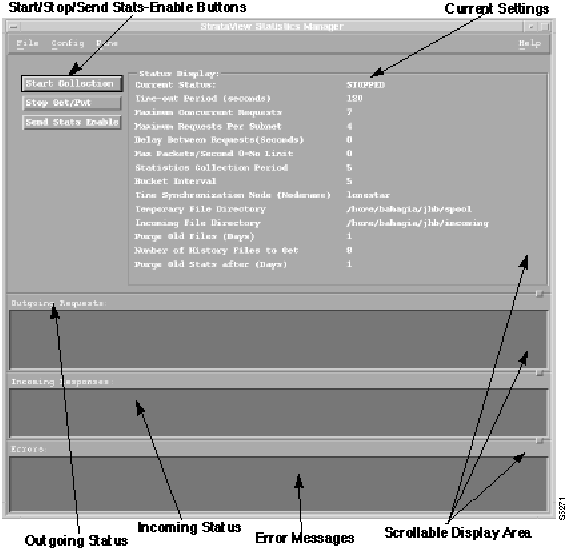
| Window Feature | Description |
|---|---|
| Enable Buttons | Control (soft) buttons to start statistics collection, to stop a get or put process, or to send a statistics enable table to a node. |
| Current Settings panel | Displays the current status of the Statistics Manager. These parameters may be changed by selecting Network Parameters from the Config pull-down menu. |
| Outgoing Status panel | Displays outgoing messages to the node(s). |
| Incoming Status panel | Displays incoming messages from the node(s). |
| Error Messages panel | Displays any error conditions in this process. |
Changing Statistics Parameters
To prepare for collecting statistics from the network, the statistics collection parameters must be reviewed and changed, if desired.
The Status Display field in the Statistics Manager main window lists some, but not all, of the possible parameters that you may want to consider setting. To view all of the possible parameters and to change any of them, select Network Parameters from the Config pull down menu. The Statistics Parameters dialog box appears. Most of the parameters, described in the table that follows the illustration, can be left at the default. The parameters that you should review are:
| Time Synchronization Node | Select the node supplying the master system timing. If your network crosses over time zones, it is important that all nodes in all time zones remain synchronized to a single clock (the clock in the node defined as the Time Synchronization Node in the Statistics Manager main window). |

| Peak Statistics Enable Toggle button | This should be left off unless peak statistics are really necessary. |
| Statistics Collection Period | Often called collection interval |
| Bucket Interval | Bucket size must not exceed the collection period. |
| Purge Old Files | Recommended unless doing a long-term study on only one or a few statistics. |
| Temporary File Directory | The Temporary file directory must be renamed to reflect the StrataView Plus NFS mounted file system. The default is ~svplus/spool. Change this to ~svplus/nfs.scmhostname/spool. |
| Incoming File Directory | The Incoming file directory must be renamed to reflect the StrataView Plus NFS mounted file system. The default is ~svplus/incoming. Change this to ~svplus/nfs.scmhostname/incoming. |
cnfdate
or
cnftime
commands to configure all the nodes in your network to the same time as the Time Synchronization Node. Use the
cnftmzn GMT
command to set the node time to GMT (Greenwich Mean Time). Once all the nodes are using the same time as the Time Synchronization Node, you can use the
cnftmzn
command to set the node time to whichever timezone you want, but the time MUST come from the Time Synchronization Node
These parameters should be configured before any statistics collection is initiated. They can be changed later but the statistics collection process must first be stopped. This dialog box can be iconicized if desired.
Statistics Parameters Dialog Box
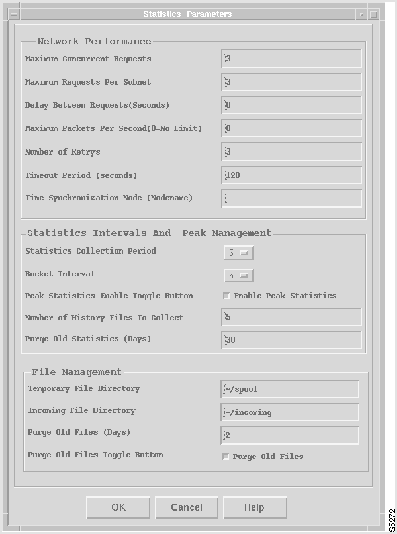
| Parameter | Description | Range 1 |
|---|---|---|
| Maximum Outstanding Requests | This field controls the number of child processes that will be created. Since each child process is responsible for one file transfer at a time, it indicates the number of concurrent requests to the network. | 1 to 15
(3) |
| Maximum Requests Per Subnet | This field limits the Number of requests per subnet. It is used to throttle the number of requests being retrieved from the network on a particular access point. Statistics enable files are not considered part of this throttling. | 1 to15
(3) |
| Delay between Requests (Seconds) | This field will cause the child process to sleep for this many seconds before each request. | 0 to 15
(0) |
| Maximum Packets Per Second | This field limits the maximum packets transmitted from the child process. A packet is fixed at 512 bytes in TFTP specifications. This indicates that a value of 500 will transfer at up to 256K/Second. (0=unlimited transfer rate). | 1 to 500
(0) |
| Number of Retries in Seconds | This field defines the number of retries the child process makes in attempting to get files from the network. (Recommend using default of 3). | 1 to 20
(3) |
| Time-out Period | This is the time-out (in seconds) for the TFTP GET requests. Increase this value on busy networks. | 30 to 600 sec.
(120) |
| Time Synchronization Node | This is the node that the Statistics Manager uses for time synchronization. It should be set to the node closest to the stand-alone SCM workstation (least number of hops). The node must have NPCs and must be configured in /etc/hosts. Note: Yellow Pages are supported for the /etc/hosts file. If the node is unavailable, the nodes in the Selected Node list will be scanned in ascending alphabetical order.The first reachable node becomes the time synchronization node. | nodename |
| Statistics Collection Period | This is the interval (in minutes) that stats are gathered from the network. | 5, 10, 15, 30, 60
(60) |
| Bucket Interval | This is the Bucket Interval Period (in minutes) that will be kept for the single bucket on the node. | 5,10, 15, 30, 60
(60) |
| Peak Interval Toggle Button | This button turns on or off peak values on all stats on a network. | On/Off
(On) |
| Number of History Files to Collect | The total number of history files to collect. If, for example, a user selects 5, and the interval is set at 60 minutes, then the current hour and the prior 4 hours will be tracked for collection from the network. This is to say, "history" on collection completion or failure will be tracked for 5 files(1 file = 1 collection interval). It is recommended you select at least 5 for this number. | 1 to 24
(5) |
| Purge Old Statistics (Days) | This field identifies the number of days to keep old statistics. Statistics older than the current date/time less this filed in days are DELETED from the database, automatically. A value of zero (0) will disable stats deletion. If you choose a value of zero, your database can become full in a very short time. | 0 to 364
(30) |
| Temporary File Directory | This is the temporary file directory for incoming files. | filename |
| Incoming File Directory | This is the incoming file directory used by the parser to locate incoming files to be parsed. The incoming and temporary directories must be within the same UNIX partition, or NFS mounted partition. | filename |
| Purge File in Days | The file purge file in days is used to purge old statistics files. This parameter will take effect when the disc space in the Incoming partition drops below ten megabytes. The files with a date `N' days older than today's date will be purged. (0= no purging to be done. | 0 to 365
(2) |
| Purge Old Files Toggle Button | This toggle is used to enable purging files as they are parsed from the stats parser. If this field is set to NO PURGE, then files will be moved to the directory ~/save. Currently, the save directory is not configurable. It is recommended that you delete old files. | On/Off
(On) |
The next step is setting the same parameters on the Statistics Collection Manager (SCM) on the stand-alone SCM workstation. This is described in the next section.
Configuring the SCM on the Stand-alone SCM Workstation
Proceed as follows to configure the Statistics Collection Manager (SCM) on the stand-alone SCM workstation.
SV+
1
         Welcome to StrataView Plus 8.2

              MAIN MENU
              ---------
             1) Start Stats Mgr GUI

      Enter number or x to exit: 1
The Statistics Manager main window is displayed.
Statistics Manager Main Window
The Statistics Manager main window is illustrated below. It provides all the configuration, control, and display features for user interface to this process. The table that follows describes the features of this window.
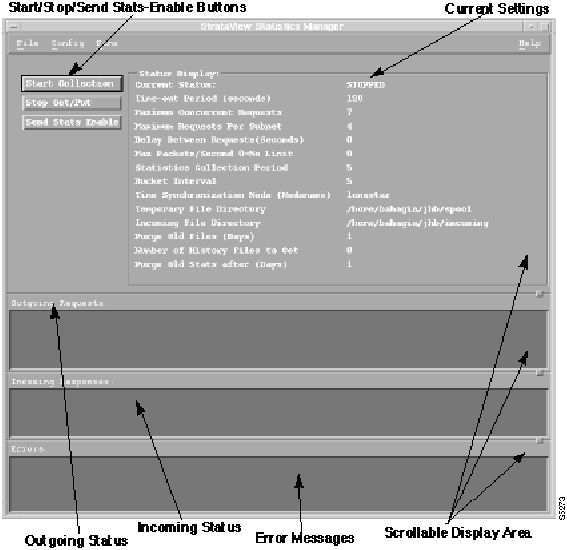
| Window Feature | Description |
|---|---|
| Enable Buttons | Control (soft) buttons to start statistics collection, to stop a get or put process, or to send a statistics enable table to a node. |
| Current Settings panel | Displays the current status of the Statistics Manager. These parameters may be changed by selecting Network Parameters from the Config pull-down menu. |
| Outgoing Status panel | Displays outgoing messages to the node(s). |
| Incoming Status panel | Displays incoming messages from the node(s). |
| Error Messages panel | Displays any error conditions in this process. |
Changing Statistics Parameters
To prepare for collecting statistics from the network, the statistics collection parameters must be reviewed and changed, if desired.
The Status Display field in the Statistics Manager main window lists some, but not all, of the possible parameters that you may want to consider setting. To view all of the possible parameters and to change any of them, select Network Parameters from the Config pull down menu. The Statistics Parameters dialog box appears. Most of the parameters, described in the table that follows the illustration, can be left at the default. The parameters that you should review are:
| Time Synchronization Node | Select the node supplying the master system timing. If your network crosses over time zones, it is important that all nodes in all time zones remain synchronized to a single clock (the clock in the node defined as the Time Synchronization Node in the Statistics Manager main window). |

| Peak Statistics Enable Toggle button | This should be left off unless peak statistics are really necessary. |
| Statistics Collection Period | Often called collection interval |
| Bucket Interval | Bucket size must not exceed the collection period. |
| Purge Old Files | Recommended unless doing a long-term study on only one or a few statistics. |
| Temporary File Directory | The Temporary file directory must be renamed to reflect the StrataView Plus NFS mounted file system. The default is ~svplus/spool. Change this to ~svplus/nfs.scmhostname/spool. |
| Incoming File Directory | The Incoming file directory must be renamed to reflect the StrataView Plus NFS mounted file system. The default is ~svplus/incoming. Change this to ~svplus/nfs.scmhostname/incoming. |
cnfdate
or
cnftime
commands to configure all the nodes in your network to the same time as the Time Synchronization Node. Use the
cnftmzn GMT
command to set the node time to GMT (Greenwich Mean Time). Once all the nodes are using the same time as the Time Synchronization Node, you can use the
cnftmzn
command to set the node time to whichever timezone you want, but the time MUST come from the Time Synchronization Node
These parameters should be configured before any statistics collection is initiated. They can be changed later but the statistics collection process must first be stopped. This dialog box can be iconicized if desired
Statistics Parameters Dialog Box.
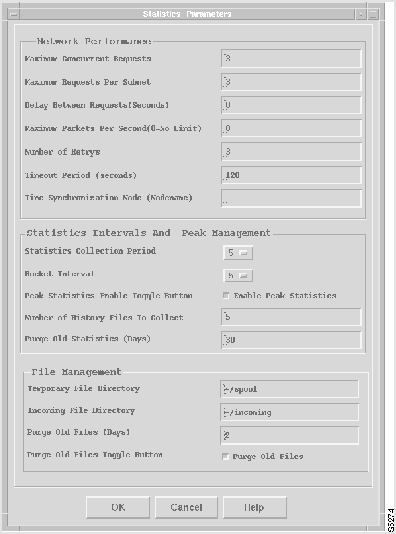
| Parameter | Description | Range 1 |
|---|---|---|
| Maximum Outstanding Requests | This field controls the number of child processes that will be created. Since each child process is responsible for one file transfer at a time, it indicates the number of concurrent requests to the network. | 1 to 15
(3) |
| Maximum Requests Per Subnet | This field limits the Number of requests per subnet. It is used to throttle the number of requests being retrieved from the network on a particular access point. Statistics enable files are not considered part of this throttling. | 1 to 15
(3) |
| Delay between Requests (Seconds) | This field will cause the child process to sleep for this many seconds before each request. | 0 to 15
(0) |
| Maximum Packets Per Second | This field limits the maximum packets transmitted from the child process. A packet is fixed at 512 bytes in TFTP specifications. This indicates that a value of 500 will transfer at up to 256K/Second. (0=unlimited transfer rate). | 1 to 500
(0) |
| Number of Retries in Seconds | This field defines the number of retries the child process makes in attempting to get files from the network. (Recommend using default of 3). | 1 to 20
(3) |
| Time-out Period | This is the time-out (in seconds) for the TFTP GET requests. Increase this value on busy networks. | 30 to 600 sec.
(120) |
| Time Synchronization Node | This is the node that the Statistics Manager uses for time synchronization. It should be set to the node closest to the stand-alone SCM workstation (least number of hops). The node must have NPCs and must be configured in /etc/hosts. Note: Yellow Pages are supported for the /etc/hosts file. If the node is unavailable, the nodes in the Selected Node list will be scanned in ascending alphabetical order.The first reachable node becomes the time synchronization node. | nodename |
| Statistics Collection Period | This is the interval (in minutes) that stats are gathered from the network. | 5, 10, 15, 30, 60
(60) |
| Bucket Interval | This is the Bucket Interval Period (in minutes) that will be kept for the single bucket on the node. | 5,10, 15, 30, 60
(60) |
| Peak Interval Toggle Button | This button turns on or off peak values on all stats on a network. | On/Off
(On) |
| Number of History Files to Collect | The total number of history files to collect. If, for example, a user selects 5, and the interval is set at 60 minutes, then the current hour and the prior 4 hours will be tracked for collection from the network. This is to say, "history" on collection completion or failure will be tracked for 5 files(1 file = 1 collection interval). It is recommended you select at least 5 for this number. | 1 to 24
(5) |
| Purge Old Statistics (Days) | This field identifies the number of days to keep old statistics. Statistics older than the current date/time less this filed in days are DELETED from the database, automatically. A value of zero (0) will disable stats deletion. If you choose a value of zero, your database can become full in a very short time. | 0 to 364
(30) |
| Temporary File Directory | This is the temporary file directory for incoming files. | filename |
| Incoming File Directory | This is the incoming file directory used by the parser to locate incoming files to be parsed. The incoming and temporary directories must be within the same UNIX partition, or NFS mounted partition. | filename |
| Purge File in Days | The file purge file in days is used to purge old statistics files. This parameter will take effect when the disc space in the Incoming partition drops below ten megabytes. The files with a date `N' days older than today's date will be purged. (0= no purging to be done. | 0 to 365
(2) |
| Purge Old Files Toggle Button | This toggle is used to enable purging files as they are parsed from the stats parser. If this field is set to NO PURGE, then files will be moved to the directory ~/save. Currently, the save directory is not configurable. It is recommended that you delete old files. | On/Off
(On) |

|
Copyright 1988-1996 © Cisco Systems Inc.