


|
|

StrataCom switches have the following troubleshooting commands to help you diagnose and correct faults.
Table 16-1 :
| Description | Page | |
|---|---|---|
| addalmslot | Add alarm slot | 16-3 |
| addextlp | Add external loopback | 16-5 |
| addloclp | Add local loopback | 16-7 |
| addlocrmtlp | Add local-remote loopback | 16-12 |
| addrmtlp | Add remote loopback | 16-14 |
| clrchstats | Clear channel statistics | 16-19 |
| clrclkalm | Clear clock alarm | 16-21 |
| clrclnalm | Clear circuit line alarm | 16-23 |
| clrclnerrs | Clear circuit line errors | 16-25 |
| clreventq | Clear the events queues | 16-29 |
| clrlnalm | Clear line alarm | 16-23 |
| clrlnerrs | Clear line errors | 16-25 |
| clrlog | Clear log | 16-33 |
| clrmsgalm | Clear message alarm | 16-35 |
| clrportstats | Clear port statistics | 16-37 |
| clrslotalms | Clear slot alarms | 16-39 |
| clrsloterrs | Clear slot errors | 16-40 |
| clrtrkalm | Clear trunk alarm | 16-41 |
| clrtrkerrs | Clear trunk errors | 16-44 |
| clrtrkstats | Clear trunk statistics | 16-46 |
| cnfbus | Configure Bus | 16-47 |
| cnflnalm | Configure line alarm | 16-49 |
| cnfslotalm | Configure slot alarm | 16-55 |
| cnftrkalm | Configure trunk alarm | 16-57 |
| dellp | Delete loopback | 16-59 |
| dncd | Down card | 16-61 |
| dspalms | Display alarms | 16-62 |
| dspbob | Display Breakout Box | 16-65 |
| dspbuses | Display Buses | 16-68 |
| dspclnerrs | Display circuit line errors | 16-70 |
| dspeventq | Display the event queue names and the data in each. | 16-73 |
| dspfrcbob | Display FRC-2/FRM-2 breakout box | 16-75 |
| dsplog | Display event log | 16-77 |
| dsplnalmcnf | Display line alarm configuration | 16-79 |
| dsplnerrs | Display line errors | 16-82 |
| dsppwr | Display power | 16-84 |
| dspslotalms | Display slot alarms | 16-89 |
| dspsloterrs | Display slot errors | 16-91 |
| dspslotstatcnf | Display slot statistics configuration | 16-93 |
| dsptrkerrs | Display individual or all trunk errors. | 16-95 |
| prtclnerrs | Print circuit line errors | 16-99 |
| prtlnerrs | Print line errors | 16-101 |
| prtlog | Print log | 16-100 |
| prttrkerrs | Print trunk errors | 16-102 |
| resetcd | Reset card | 16-103 |
| resetpc | Reset Port Concentrator | 16-105 |
| switchcc | Switch controller card | 16-106 |
| tstcon | Test connection | 16-108 |
| tstconseg | Test connection segment | 16-112 |
| tstdelay | Test delay | 16-115 |
| tstpcs | Test Port Concentrator Shelf | 16-118 |
| tstport | Test port | 16-119 |
Enables the MAJOR and MINOR alarm indicators on an Alarm Relay Card (ARC) or Alarm Relay Module (ARM). It also configures the slot to support external alarms from the Alarm Relay Interface (ARI) back card. You can use this command at any node that can provide external alarm indications to an alarm reporting system. The ARC or ARM can reside in any front slot but usually resides in the right-most slot.
Full Name
Add alarm slot
Syntax
addalmslot <slot number>
Related Commands
delalmslot, dspalms
Attributes
| Privilege | 1--4 |
| Jobs | No |
| Log | Yes |
| Node | IPX, IGX |
| Lock | Yes |
Example 1
addalmslot 16
Description
Enable alarm reporting from slot 16 in a node.
System Response
beta           TRM   YourID:1        IPX 32    8.2      Mar.  3 1996 14:27 MST

Alarm summary   (Configured alarm slots: 16)
Connections Failed:       None
Groups Failed:            None
PLN Alarms:               1 Major
CLN Alarms:               None
Cards Failed:             1
Missing Cards:            None
Remote Node Alarms:       1 Major
Remote Domain Alarms:     None


Last Command: addalmslot 16


Next Command:
Places an external device in loopback mode. The addextlp command applies to existing connections on an SDP, HDM, LDP, or LDM. A 'near' loopback causes the NEAR EIA template to be applied. A `far' loopback causes the FAR EIA template to be applied to the data port. The loopback remains in place until removed by the dellp command.
The dspcons command shows which connections are in loopback mode. Specifying an "n" after the channel indicates a near loopback, and an "f" indicates a far loopback. Because addextlp takes the specified connections out of service, use it only when a service disruption is tolerable.
Full Name
Add External Loop to Connection
Syntax
addextlp <channel> < n | f >
Related Commands
dellp, dspcons
Attributes
| Privilege | 1--2 |
| Jobs | Yes |
| Log | Yes |
| Node | IPX, IGX |
| Lock | Yes |
Example 1
addextlp 5.1 n
Description
Place the device connected to channel 5.1 in near loopback.
System Response
alpha          TRM   YourID:1        IPX 16    8.2    Mar. 16 1996 12:53 PST

 Local      Remote      Remote                                      Route
 Channel    NodeName    Channel    State  Type    Compression  Code Avoid COS O
 N5.1       beta        25.1       Ok     256                  7/8         0  L
 9.1.100    gamma       8.1.200    Ok     fr                               0  L
 9.2.400    beta        19.2.302   Ok     fr                               0  L
 14.1       gamma       15.1       Ok     v                                0  L


Last Command: addextlp 5.1 n


Next Command:
Table 16-2 :
| Parameter | Description |
|---|---|
| channel | Specifies the channel to loopback in the format slot.port. |
| n /f | Specifies whether the loopback is near or far. An "n" specifies near; an "f" specifies far. For a non-DDS port, the near or far modem is placed in loopback, if it supports this function. For a DDS port, the external DDS device is placed in CSU loopback. Local channels must be configured as OCU in order to place them in external loopback. |
The addloclp command places the following types of channels in local loopback mode:
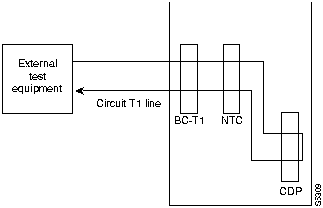
For voice connections, addloclp loops the information stream from the designated channel or group of channels on an incoming circuit line back to the circuit line. External test equipment can then test the integrity of the path at the T1 DS0 level. The following illustrates a local loopback on a voice channel.
Figure 16-1 : Local Loopback on a Voice Channel
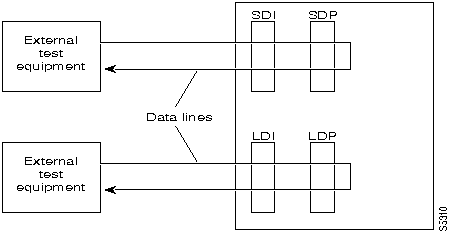
For data connections, addloclp loops the information stream from the incoming data port or set of ports back to these same port(s) through the local CDP/CVM, SDP/HDM, or LDP/LDM. External test equipment can then test the integrity of the path. The following figure illustrates a local loopback on a data connection.
Figure 16-2 : Local Loopback on a Data Connection
A local loopback can simultaneously exist at both ends of a connection. However, a local loopback and a remote loopback cannot co-exist on a connection. (See the addrmtlp description for more information.)
Prior to executing a loopback, the IPX or IGX performs signal and code conditioning to remove the connection from service. The loopback remains in place until removed by the dellp command. Only existing connections can be looped back. Use the dspcons command to see which connections are looped back. A flashing right parenthesis ")" or left parenthesis "(" is used in the connections display to indicate a loopback. The direction and location of the parenthesis depends on whether the loopback is local or remote and which end of the connection was used to establish the loopback. A local loopback initiated from the local end of the connection looks like this in the connections display:
| Local Channel | Remote Node | Remote Channel |
| 12.1 | alpha | 15.1 |
A local loopback initiated from the remote end of the connection looks like this:
| Local Channel | Remote Node | Remote Channel |
| 12.1 | alpha | 15.1 |
In frame relay connection loopback mode (DLCI included in command), all packets from the far-end of the connection are dropped. The far-end system software is informed of the loopback. In port loopback mode (port specified without a DLCI), all packets for this port are dropped and each opposite end is informed of the loopback mode. The format slot.port is used in port mode to loop just the port. The data is looped directly in the FRI back card, so no data reaches the MUXBUS or CELLBUS. The format slot.port.DLCI is used in connection (channel) mode to loop a specific channel. Note that this can affect up to 252 connections (channels) in port loopback mode.
Because the addloclp command causes the connection(s) to be removed from service, loopbacks should be used only when a service disruption can be tolerated. Remote loopbacks are established with the addrmtlp command. Both local and remote loopbacks are removed by the dellp command. Loopbacks for data channels can also be initiated by pressing a button on the front of the associated data card.
Frame Relay Local Loops with Port Concentrator
When a frame relay port or connection is located on a Port Concentrator instead of directly on an FRP or FRM card, the data test path is different. When just the <port> parameter is used, incoming data is looped back out on the Port Concentrator port:
Figure 16-3 : Local Loop on Port Concentrator
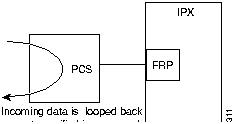
This loop disrupts all frame relay connections on the port that is under test.
When a connection is specified by <port.dlci> parameters, the connection is looped back at the FRM-2 or FRP-2 interface with the IGX or IPX card bus:
Figure 16-4 : Local Loop on FRM-2 or FRP-2
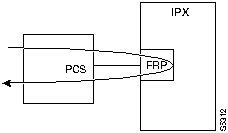
As shown, this test verifies the operation of all components from the Port Concentrator to IPX/IGX interface with the FRP-2 or FRM-2 card.
This tests interrupts only the specified connection on the Port Concentrator port.
Full Name
Add local loopback to connections on a port
Syntax
addloclp parameters (see parameters table)
Related Commands
addrmtlp, dellp, dspcons, dspfrport
Attributes
| Privilege | 1--2 |
| Jobs | Yes |
| Log | Yes |
| Node | IPX, IGX, BPX |
| Lock | Yes |
Example 1
addloclp 14.1
Description
The connections screen appears with connection 14.1 highlighted. The system prompts to confirm the loopback. To confirm it, enter y.
System Response
Next Command:
alpha          TRM   YourID:1        IPX 16    8.2    Mar. 23 1996 11:03 PST

 Local      Remote      Remote                                      Route
 Channel    NodeName    Channel    State  Type    Compression  Code Avoid COS O
 5.1        beta       )25.1       Ok     256                  7/8         0  L
 9.1.100    gamma       8.1.200    Ok     fr                               0  L
 9.1.200    gamma       8.1.300    Ok     fr                               0  L
 9.2.400    beta        19.2.302   Ok     fr(Grp)                          0  L
 14.1      )gamma       15.1       Ok     v                                0  L


Last Command: addloclp 14.1


Next Command:
Table 16-3 : addloclp -- Parameters (voice)
| Parameter | Description |
|---|---|
| slot | Specifies the slot number of the card containing the port to loop at the local node. |
| channel (s) | Specifies the channel or set of channels to loop at the local node. |
| port | Where applicable for the connection type, specifies the port. |
Table 16-4 : addloclp -- Parameters (data)
| Parameter | Description |
|---|---|
| slot | Specifies the slot number of the card containing the port to loop at the local node. |
| port | Specifies the local port to loop at the local node. |
Table 16-5 : addloclp -- Parameters (Frame Relay)
| Parameter | Description |
|---|---|
| slot | Specifies the slot number of the FRP card containing the port to be looped at the local node. |
| port | Specifies the local port to loop at the local node. |
Table 16-6 : addloclp -- Parameters (Frame Relay connection)
| Parameter | Description |
|---|---|
| slot | Specifies the slot number of the FRP card containing the port to loop at the local node |
| port | Specifies the local port to loop at the local node. |
| DLCI | Specifies the Data Link Connection Identifier (DLCI) number of the channel to loop at the local node. |
Table 16-7 : addloclp - parameters (ATM connection)
| Parameter | Description |
|---|---|
| slot | Specifies the slot number of the ATM card containing the port to loop at the local node |
| port | Specifies the local port to loop at the local node. |
| vpi.vci | The vpi range is 0 - 7, and the vci range is 1 - 255. An asterisk (*) indicates a virtual path |
Adds support of a local-remote loopback for testing multi-segment connections in a tiered network. The effect is to instruct the remote node to set up a remote loopback. The addlocrmtlp command must be executed prior to using tstcon and tstdelay for multi-segment connections. For interface shelves, you can execute addlocrmtlp on either the interface shelf (after telnetting to it). After testing is complete, remove the local-remote loop by executing dellp. A parenthesis on the screen shows the loop's endpoint.
Full Name
Add local-remote loopback in a tiered network
Syntax
addlocrmtlp <channel(s)>
Related Commands
tstcon, tstdelay, dellp, dspcons, dspfrport
Attributes
| Privilege | 1--2 |
| Jobs | Yes |
| Log | Yes |
| Node | BPX, IPX/AF, IPX, IGX |
| Lock | Yes |
Example 1
addlocrmtlp 5.1.3.100
Description
The connections screen appears with the connection highlighted and a prompt for confirmation.
System Response
pubsbpx1       TN    StrataCom       BPX       8.2    July 13 1996 14:41 PDT

 Local          Remote      Remote
 Channel        NodeName    Channel         State  Type      Compress  Code COS
 5.1.3.100 (       pubsbpx3    7.1.2.49         Ok   aftr                       0


This Command: addlocrmtlp 5.1.3.100


Loopback these connections (y/n)?
Table 16-8 : addlocrmtlp -- Parameters
| Parameter | Description |
|---|---|
| channels(s) | The connection endpoint on the local node. |
The addrmtlp command places the following types of channels in remote loopback mode:
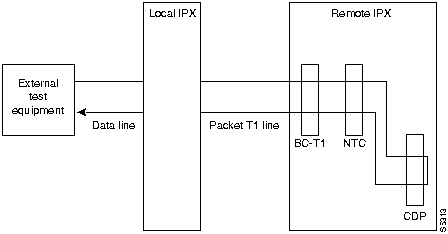
For voice connections, addrmtlp loops the information stream from the designated channel or group of channels on an incoming circuit line across the network and loops it back to the circuit line by way of the remote CDP or CVM. External test equipment can then test the integrity of the path at the T1 DS0 level. The following illustrates a remote loopback on a voice channel.
Figure 16-5 : Remote Loopback on a Voice Channel
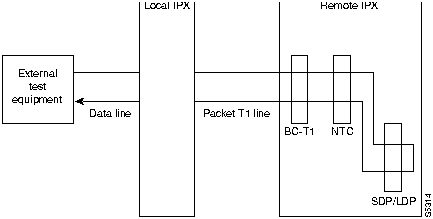
For data connections, addrmtlp transfers the information stream from the designated channels through the network and loops it back to the data port(s) through a remote SDP, HDM, LDM, or LDP. External test equipment can then test the integrity of the path. The following illustrates a data connection remote loopback.
Figure 16-6 : Remote Loopback on a Data Connection
Prior to executing the loopback, the IPX or IGX applies signalling template bit patterns to the A, B, C, and D signalling bits at the remote end to remove the connection from service. The loopback remains in place until removed by the dellp command. Only existing connections (those that have been entered with the add-on command) can be looped back. You cannot establish a remote loopback on a connection that is already looped back, either locally or remotely. (See the addloclp command for more information on local loopbacks.)
Use the dspcons command to see which connections are looped back. A flashing left parenthesis "(" or right parenthesis ")" is used in the connections display to indicate a loopback. The direction and location of the parenthesis depends on whether the loopback is local or remote and which end of the connection was used to establish the loopback. A remote loopback initiated from the local end of the connection looks like this:
| Local Channel | Remote Channel | Remote Node |
| 3.2 | alpha | 12.1 |
A remote loopback initiated from the remote end of the connection looks like this:
| Local Channel | Remote Node | Remote Channel |
| 3.2 | alpha | 12.1 |
For remote loopback of frame relay connections, note that in remote loopback mode, if the transmit minimum bandwidth exceeds the receive minimum bandwidth, then loopback data may be dropped. For this reason, the connection speeds will be checked and the user will receive the following message if there is a problem:
Because the addrmtlp command causes the connection to be removed from service, loopbacks should be used only when a service disruption can be tolerated. Local loopbacks are established with the addloclp command. Both local and remote loopbacks are removed by the dellp command. Loopbacks for data channels can also be initiated by pressing a push-button on the front of the associated data card.
Remote Loopbacks and the Port Concentrator Shelf
For frame relay remote loops, DLCI MUST be specified; entering only port number only generates an error message.
Unlike local loopbacks, remote loopbacks are not supported for frame relay ports; connections must be specified. Data incoming on the frame relay port is looped at the remote end FRM-2 or FRP-2 card.
Figure 16-7 : Frame Relay Remote Loops
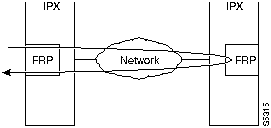
As shown, this test verifies the operation of IPX/IGX network components up to the interface with the remote-end FRM-2 or FRP-2. This test interrupts data traffic for only the connection specified by DLCI.
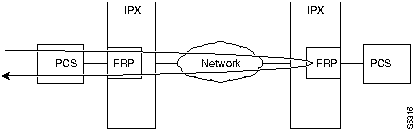
If a port concentrator is attached to the FRM-2 or FRP-2, the only difference in the loop is that the port specified to loop data is on the Port Concentrator:
Figure 16-8 : Frame Relay Remote Loops with Port Concentrator
Full Name
Add remote loopback to connections
Syntax
addrmtlp (see parameter tables)
Related Commands
addloclp, dellp, dspcons
Attributes
| Privilege | 1--2 |
| Jobs | Yes |
| Log | Yes |
| Node | IPX, IGX, BPX |
| Lock | Yes |
Example 1
addrmtlp 5.1
Description
The connections screen appears with connection 5.1 highlighted. The system prompts to confirm the loopback. To confirm it, enter y. A flashing parenthesis ")" appears in the "Remote Channel" column of the connection to indicate that the connection is looped back.
System Response
alpha          TRM   YourID:1        IPX 16    8.2    Mar. 16 1996 12:57 PST

 Local      Remote      Remote                                      Route
 Channel    NodeName    Channel    State  Type    Compression  Code Avoid COS O
 5.1        beta       )25.1       Ok     256                  7/8         0  L
 9.1.100    gamma       8.1.200    Ok     fr                               0  L
 9.2.400    beta        19.2.302   Ok     fr                               0  L
 14.1       gamma       15.1       Ok     v                                0  L


Last Command: addrmtlp 5.1


Next Command:
Table 16-9 : addrmtlp -- Parameters (voice)
| Parameter | Description |
|---|---|
| slot | Specifies the slot number of the card containing the port to loop at the local node. |
| channel (s) | Specifies the channel or set of channels to loop at the local node. |
| port | Where applicable for the connection type, specifies the port. |
Table 16-10 : addrmtlp -- Parameters (data)
| Parameter | Description |
|---|---|
| slot | Specifies the slot number of the card containing the port to loop at the local node. |
| port | Specifies the local port to loop at the local node. |
Table 16-11 : addrmtlp -- Parameters (Frame Relay connections)
| Parameter | Description |
|---|---|
| slot | Specifies the slot number of the FRP card containing the port to loop at the local node |
| port | Specifies the local port to loop at the local node. |
| DLCI | Specifies the Data Link Connection Identifier (DLCI) number of the channel to loop at the local node. |
Table 16-12 : addrmtlp -- Parameters (ATM)
| Parameter | Description |
|---|---|
| slot | Specifies the slot number of the card containing the port to loop at the local node. |
| channel (s) | Specifies the channel or set of channels to loop at the local node. |
| port | Where applicable for the connection type, specifies the port. |
| vpi.vci | Specifies vpi/vci. |
Clears the channel utilization statistics for either all frame relay channels or a specified frame relay channel. Statistics generated within the last one minute are not cleared.
Full Name
Clear channel statistics
Syntax
clrchstats <channel | *>
Related Commands
dspchstats
Attributes
| Privilege | 1--5 |
| Jobs | Yes |
| Log | Yes |
| Node | IPX, IGX |
| Lock | Yes |
Example 1
clrchstats 9.2.400
Description
Clear the statistics of channel 9.2.40.
System Response
alpha          TRM   YourID:1        IPX 16    8.2    Mar. 16 1996 13:24 PST

Channel Statistics for 9.2.400    Cleared: Mar. 16 1996 13:23
MIR: 9.6 kbps           Collection Time: 0 day(s) 00:02:42      Corrupted: NO
                     Frames   Avg Size Avg    Util          Packets     Avg
                              (bytes)  (fps)  (%)                      (pps)
From Port:                0          0      0    0
To Network:               0          0      0    0                0         0
Discarded:                0          0      0    0
From Network:             0          0      0    0                0         0
To Port:                  0          0      0    0
Discarded:                0          0      0    0                0         0

                   ECN Stats:  Avg Rx VC Q:             0    ForeSight RTD    --
Min-Pk bytes rcvd:          0  FECN Frames:             0    FECN Ratio (%)    0
Minutes Congested:          0  BECN Frames:             0    BECN Ratio (%)    0


This Command: clrchstats 9.2.400


OK to clear (y/n)?
Table 16-13 : clrchstats -- Parameters
| Parameter | Description |
|---|---|
| channel | Specifies the frame relay channel for which to clear statistics. <channel> is specified in the format slot.port.DLCI. An "*" specifies all channels. |
Clears the alarm condition attached to a clock source, either circuit line or trunk. The clock test runs continuously in a node, comparing the frequency of the node's clock source to a reference on the NPC/BCC/CC/control card. If a clock source is found to be outside preset frequency limits, it is declared defective and another clock source is selected. In order for the node to return to the original clock source, the alarm must be cleared using the clrclkalm command. The alarm may be either a "Bad Clock Source" or "Bad Clock Path" alarm.
Full Name
Clear clock alarm
Syntax
clrclkalm <line type> <line number>
Related Commands
cnfclksrc, dspclksrcs, dspclns, dspcurclk, dsptrks
Attributes
| Privilege | 1--5 |
| Jobs | No |
| Log | Yes |
| Node | IPX, IGX |
| Lock | Yes |
Example 1
clrclkalm c 12
Description
Clear a clock alarm on circuit line 12
Example 2
clrclkalm p 12
Description
Clear a clock alarm on packet line 12
Table 16-14 : clrclkalm -- Parameters
| Parameter | Description |
|---|---|
| c/p | Specifies the type of line. A "c" is entered for a circuit line, and a "p" is entered for a trunk. |
| line number | Specifies the number of the circuit or trunk for which to clear the clock alarm. |
Clears the alarms associated with a circuit line. Since the statistical alarms associated with a circuit line have associated integration times, they can keep a major or minor alarm active for some time after the cause has been rectified. This command allows these alarms to be cleared, allowing any new alarms to be quickly identified. The clrclnalm command can only clear alarms caused by the collection of statistical data. Alarms caused by a network failure cannot be cleared. For example, an alarm caused by a collection of bipolar errors can be cleared, but an alarm caused by a card failure cannot.
Full Name
Clear circuit line alarm
Syntax
clrclnalm <line_number> <fail_type>
Related Commands
dspclns, dspclnerrs
Attributes
| Privilege | 1--5 |
| Jobs | No |
| Log | Yes |
| Node | IPX, IGX |
| Lock | Yes |
Example 1
clrclnalm 14 2
Description
Clear the minor alarm caused by frame slips on circuit line 14
System Response
alpha          TRM   YourID:1        IPX 16    8.2    Mar. 16 1996 13:10 PST

                             Line Alarm Configuration

                       Minor                               Major

  Violation    Rate    Alarm Time  Clear         Rate    Alarm Time  Clear
  1) Bpv        10E-7  10 min       3 min         10E-3   10 sec      10 sec
  2) Fs          .01%  10 min       3 min           .1%   10 sec      10 sec
  3) Oof       .0001%  10 min       3 min          .01%   10 sec      10 sec
  4) Vpd           2%   5 min       3 min            5%   60 sec      10 sec
  5) Tsdp        .01%   5 min       3 min           .1%   60 sec      10 sec
  6) Ntsdp       .01%   5 min       3 min           .1%   60 sec      10 sec
  7) Pkterr      .01%  10 min       3 min           .1%  125 sec      10 sec
  8) Los       .0001%  10 min       3 min          .01%   10 sec      10 sec


This Command: clrclnalm 14 2


Continue?
Table 16-15 : clrclnalm -- Parameters
| Parameter | Description |
|---|---|
| line number | Specifies the number of the circuit line for which to clear the alarm. |
| failure type | Specifies the type of alarm to clear. |
Clears the alarms associated with a circuit line. Since the statistical alarms associated with a circuit line have associated integration times, they can keep a major or minor alarm active for some time after the cause has been rectified. This command allows these alarms to be cleared, allowing any new alarms to be quickly identified. The clrclnalm command can clear only those alarms that the collection of statistical data has caused. Alarms caused by a network failure cannot be cleared by clrclnalm.
Full Name
Clear circuit line errors
Syntax
clrclnerrs [<line_number>]
Related Commands
dspclnerrs, prtclnerrs
Attributes
| Privilege | 1--5 |
| Jobs | Yes |
| Log | Yes |
| Node | IPX, IGX |
| Lock | Yes |
Example 1
clrclnerrs
Description
Clear circuit line error counts. In response to the prompt, enter "y" to reset all circuit line error counts to "0".
System Response
alpha          TRM   YourID:1        IPX 16    8.2    Mar. 16 1996 13:12 PST

Total Errors

From  Code    Frame   Out of  Loss of Frame   CRC     Out of
CLN   Errors  Slips   Frames  Signal  BitErrs Errors  MFrames AIS-16
14          0       0       0       -       0       -       -       -


Last Command: clrclnerrs


Next Command:
Clears the alarms associated with a circuit line. Since the statistical alarms associated with a line have associated integration times, they can keep a major or minor alarm active for some time after the cause has been rectified. This command allows these alarms to be cleared, allowing any new alarms to be quickly identified.
The clrclnalm command can only clear alarms caused by the collection of statistical data. Alarms caused by a network failure cannot be cleared. For example, an alarm caused by a collection of bipolar errors can be cleared, but an alarm caused by a card failure cannot.
Full Name
Clear circuit line alarm
Syntax
clrclnalm <line_number> <fail_type>
Related Commands
dsplns, dsplnerrs
Attributes
| Privilege | 1--5 |
| Jobs | No |
| Log | Yes |
| Node | IPX, IGX |
| Lock | Yes |
Example 1
clrlnalm 14 2
Description
Clear the minor alarm caused by frame slips on 14. The 2 indicates frame slips.
System Response
alpha          TRM   YourID:1        IPX 16    8.2    Mar. 16 1996 13:10 PST

                             Line Alarm Configuration

                       Minor                               Major

  Violation    Rate    Alarm Time  Clear         Rate    Alarm Time  Clear
  1) Bpv        10E-7  10 min       3 min         10E-3   10 sec      10 sec
  2) Fs          .01%  10 min       3 min           .1%   10 sec      10 sec
  3) Oof       .0001%  10 min       3 min          .01%   10 sec      10 sec
  4) Vpd           2%   5 min       3 min            5%   60 sec      10 sec
  5) Tsdp        .01%   5 min       3 min           .1%   60 sec      10 sec
  6) Ntsdp       .01%   5 min       3 min           .1%   60 sec      10 sec
  7) Pkterr      .01%  10 min       3 min           .1%  125 sec      10 sec
  8) Los       .0001%  10 min       3 min          .01%   10 sec      10 sec


This Command: clrclnalm 14 2


Continue?
Table 16-16 : clrclnalm -- Parameters
| Parameter | Description |
|---|---|
| line number | Specifies the number of the circuit line for which to clear the alarm. |
| failure type | Specifies the type of alarm to clear. |
Clears high water marks for fail handler event queues.
Full Name
Clear event queues from the fail handler
Syntax
clreventq
Related Commands
dspeventq
Attributes
| Privilege | 1--6 |
| Jobs | No |
| Log | Yes |
| Node | IPX, IGX, BPX |
| Lock | Yes |
Example 1
clreventq
Description
Clear the fail handler event queue.
System Response
sw151          TN    StrataCom       IGX 16    8.2       Sep. 12 1996 19:18 GMT

  QUEUE                 LENGTH           THROTTLING
NUM NAMES          MAX   HIGH CURRENT      POINT
 1  Fail_Xid               26      1        7000
 2  Fail_ Q                25      0
 3  Mt_Sv_Q[0]      300     9      0         270
 4  sv_mt_bufq              9      0


This Command: clreventq


OK to clear HIGH counts(y/n)?
Clears accumulated line error counts for all lines on a node.
Full Name
Clear line errors
Syntax
clrlnerrs [<line_number>]
Related Commands
dsplnerrs, prtlnerrs
Attributes
| Privilege | 1--5 |
| Jobs | Yes |
| Log | Yes |
| Node | IPX, IGX |
| Lock | Yes |
Example 1
clrlnerrs
Description
Clear the line error counts. In response to the prompt enter "y" to reset all line error counts to "0".
System Response
alpha          TRM   YourID:1        IPX 16    8.2    Mar. 16 1996 13:12 PST

Total Errors

From  Code    Frame   Out of  Loss of Frame   CRC     Out of
CLN   Errors  Slips   Frames  Signal  BitErrs Errors  MFrames AIS-16
14          0       0       0       -       0       -       -       -


Last Command: clrclnerrs


Next Command:
Clears the event log. When the log is cleared, one entry remains, "Info Log Cleared". Before the event log is cleared, a prompts you to confirm. See the dsplog command for more information on the event log.
Full Name
Clear event log
Syntax
clrlog
Related Commands
dsplog
Attributes
| Privilege | 1--5 |
| Jobs | Yes |
| Log | Yes |
| Node | IPX, IGX |
| Lock | Yes |
Example 1
clrlog
Description
Clear the event log. When the log is cleared, one entry remains, "Info Log Cleared". Enter "y" to confirm.
System Response
sw151          TN    StrataCom       IGX 16    8.2       Sep. 12 1996 19:19 GMT

Most recent log entries (most recent at top)
Class  Description                                             Date     Time
Info   User StrataCom logged out (Local)                       09/12/96 18:18:57
Major  LN 5.6 Loss of Sig (RED)                                09/12/96 18:12:22
Info   User StrataCom logged out (Local)                       09/12/96 18:11:17
Info   Clock switch to oscillator of SCC                       09/12/96 18:10:46
Clear  LN 5.6 OK                                               09/12/96 18:05:11
Minor  LN 5.6 Out of Multi-Frames                              09/12/96 18:03:27
Info   Clock switch to LINE 5.6                                09/12/96 18:03:12
Clear  LN 5.6 OK                                               09/12/96 18:02:42
Info   Clock switch to oscillator of SCC                       09/12/96 17:59:24
Major  LN 5.6 Loss of Sig (RED)                                09/12/96 17:59:24
Info   Clock switch to LINE 5.6                                09/12/96 17:59:20
Clear  LN 5.6 OK                                               09/12/96 17:59:20
Major  LN 5.6 Loss of Sig (RED)                                09/12/96 17:58:51

This Command: clrlog


OK to clear (y/n)?
Clears the minor alarm due to an alarm message received at an alarm collection port.
Full Name
Clear message alarm
Syntax
clrmsgalm
Related Commands
dspalms, dsplog
Attributes
| Privilege | 1--5 |
| Jobs | No |
| Log | Yes |
| Node | IPX, IGX, BPX |
| Lock | Yes |
Example 1
clrmsgalm
Description
Clear a minor alarm due to an alarm message.
System Response
alpha          TRM   YourID:1        IPX 16    8.2    Mar. 23 1996 10:59 PST


Last Command: clrmsgalm

No message alarm set
Next Command:
Clears the statistics for any port on an FRP. This includes the data byte count in the transmit and receive directions and error counts associated with the port. Statistical accumulation then resumes for that port.
Statistics collecting takes place once per minute, so clrportstats may not clear statistics that are less than one minute old.
Full Name
Clear port statistics
Syntax
clrportstats <port | *>
Related Commands
dspportstats
Attributes
| Privilege | 1--5 |
| Jobs | Yes |
| Log | Yes |
| Node | IPX, IGX |
| Lock | Yes |
Example 1
clrportstats 9.1
Description
Clear the port statistics for port 1 on an FRP card in slot 9. Type "y" to confirm.
System Response
alpha          TRM   YourID:1        IPX 16    8.2   Mar. 23 1996 10:57 PST

Port Statistics for 9.1         Cleared: Mar. 11 1996 15:32
Port Speed: 256 kbps    Collection Time: 11 day(s) 19:22:09     Corrupted: YES

                      Bytes      Average (kbps)     Util (%)         Frames
From Port:                0            0               0                  0
To Port:                  0            0               0                  0
Frame Errors               LMI Receive Protocol Stats   Misc Statistics
Invalid CRC            0   Status Enq Rcvd          0   Avg Tx Port Q         0
Invalid Alignment      0   Status Xmit              0   FECN Frames           0
Invalid Frm Length     0   Asynch Xmit              0        Ratio (%)        0
Invalid Frm Format     0   Seq # Mismatches         0   BECN Frames           0
Unknown DLCIs          0   Timeouts                 0        Ratio (%)        0
Last Unknown DLCI      0   Invalid Req              0   Rsrc Overflow         0
                           Sig Protocol:  None          DE Frms Dropd         0


This Command: clrportstats 9.1


OK to clear port statistics (y/n)?
Clears the alarm messages associated with the alarms displayed for the Display Slot Alarms command. Alarm messages are cleared for the specified slot only. These counters should be cleared before beginning any monitoring session. This command prompts the user with a "OK to Clear?" message before actually clearing the counters. Use dspslotalms to observe the slot alarms. Refer to the dspslotalms command for a description of the counters cleared by the clrslotalms command.
Full Name
Clear slot alarms
Syntax
clrslotalms parameters
Related Commands
dspslotalms
Attributes
| Privilege | 1--5 |
| Jobs | Yes |
| Log | Yes |
| Node | BPX |
| Lock | Yes |
Example 1
clrslotalms 3
Description
Clear alarm on slot 3
Table 16-17 : clrslotalms -- Parameters
| Parameter | Description |
|---|---|
| slot number | Specifies shelf slot in the BPX node for which to clear trunk alarms. |
Clears the counters for the error counts displayed for the Display Slot Errors command. Counters are cleared for the specified slot only. These counters should be cleared before beginning any monitoring session. This command prompts the user with a "OK to Clear?" message before actually clearing the counters. Use dspsloterrs to observe the slot errors. Refer to the dspsloterrs command for a description of the counters cleared by the clrsloterrs command.
Full Name
Clear slot errors
Syntax
clrsloterrs <slot number | *>
Related Commands
dspsloterrs
Attributes
| Privilege | 1--5 |
| Jobs | Yes |
| Log | Yes |
| Node | IPX, IGX, BPX |
| Lock | Yes |
Example 1
clrsloterrs 3
Description
Clear the slot errors in slot 3
Table 16-18 : clrsloterrs -- Parameters
| Parameter | Description |
|---|---|
| slot number | Specifies the shelf slot in the node. |
Clears statistical alarms associated with either a physical or virtual trunk. Since the statistical alarms associated with a trunk have associated integration times, they can keep a major or minor alarm active for some time after the cause has been rectified. The clrtrkalm allows these alarms to be cleared, allowing any new alarms to be quickly identified.
The clrtrkalm command can only clear alarms caused by the collection of statistical data. Alarms caused by a network failure cannot be cleared. For example, an alarm caused by a collection of bipolar errors can be cleared, but an alarm caused by a card failure cannot.
Full Name
Clear trunk alarm
Syntax
clrtrkalm <trunk number> <failure type>
Related Commands
dsptrks, dsptrkerrs
Attributes
| Privilege | 1--5 |
| Jobs | No |
| Log | Yes |
| Node | IPX, IGX, BPX |
| Lock | Yes |
Example 1
clrtrkalm
Description
Statistical trunk alarms are cleared
System Response
beta           TRM   YourID:1        IPX 32    8.2    Mar. 15 1996 15:15 MST

PLN  Type      Current Line Alarm Status               Other End
7    E1/32     Clear - Line OK                         alpha.10
9    T1/24     Clear - Line OK                         gamma.10
13   T1/24     Clear - Line OK                         alpha.14
15   T1/24     Clear - Line OK                         gamma.15
20   T3/3      Clear - ATM Missing                     -


Last Command: clrtrkalm


Next Command:
Example 2
clrtrkalm 7 4
Description
Clear the minor alarm type 4 caused by dropped voice packets on trunk 7. Respond to the "Continue?" prompt with "y" (for yes) to clear and display the remaining alarms.
System Response
beta           TRM   YourID:1        IPX 32    8.2    Mar. 15 1996 15:15 MST

PLN  Type      Current Line Alarm Status               Other End
7    E1/32     Clear - Line OK                         alpha.10
9    T1/24     Clear - Line OK                         gamma.10
13   T1/24     Clear - Line OK                         alpha.14
15   T1/24     Clear - Line OK                         gamma.15
20   T3/3      Clear - ATM Missing                     -


Last Command: clrtrkalm 7 4


Next Command:
Table 16-19 : clrtrkalm -- Parameters
| Parameter | Description |
|---|---|
| trunk number | Specifies the trunk. Note that, for virtual trunks, no virtual trunk parameter is required---just slot.port. The format is either slot (for a single-trunk card) or slot.port. |
| failure type | Specifies the type of alarm to clear. |
Clears the statistical error counters at the node for the specified physical or virtual trunk. You should do this before you begin any monitoring session and periodically thereafter to determine exactly when a trunk problem begins. Use dsptrkerrs to observe errors without clearing counters.
Full Name
Clear trunk errors
Syntax
clrtrkerrs <trunk_number | *>
Related Commands
dsptrkerrs, prttrkerrs
Attributes
| Privilege | 1--5 |
| Jobs | Yes |
| Log | Yes |
| Node | IPX, IGX, BPX |
| Lock | Yes |
Example 1
clrtkerrs *
Description
Clear all trunk errors.
System Response
pubsbpx1       TN    StrataCom       BPX 15    8.2       Sep. 12 1996 19:37 PST

Total Errors

      Code    Rx Cell Out of  Loss of Frame   HCS     Tx Cell Cell    Cell
TRK   Errors  Dropped Frames  Signal  BitErrs Errors  Dropped Errors  Oofs
 1.1        0       0       0       0       -       0       0       -       -
 1.2        0       0       0       0       -       0       0       -       -


This Command: clrtrkerrs *


Clears errors on all trunks. Continue (y/n)?
Table 16-20 : clrtrkerrs -- Parameters
| Parameter | Description |
|---|---|
| trunk number | Specifies the trunk counter to clear. |
Clears the node counters used for the Display Trunk Statistics. Counters are cleared for a physical or virtual trunk. These counters should be cleared before beginning any monitoring session. This is similar to the clrtrkerrs command for errors. This command prompts the user with a "OK to Clear?" message before actually clearing the counters. Use dsptrkstats to observe the trunk statistics. See the dsptrkstats command for a description of the counters cleared by the clrtrkstats command.
Full Name
Clear trunk statistics
Syntax
clrtrkstats <trunk number>
Related Commands
dsptrkstats
Attributes
| Privilege | 1--5 |
| Jobs | Yes |
| Log | Yes |
| Node | BPX |
| Lock | Yes |
Example 1
clrtrkstats
Description
Clear the statistics on trunk 3
Table 16-21 : clrtrkstats -- Parameters
| Parameter | Description |
|---|---|
| trunk number | Specifies the trunk. Note that, for virtual trunks, no virtual trunk parameter is required---just slot.port. The format is either slot (for a single-trunk card) or slot.port. |
Selects the active System Bus. It should only be necessary to use this command when a problem is suspected with the currently active System Bus. As a safeguard against bus failure, each IPX node is equipped with redundant System Buses, Bus A and Bus B. Either bus can be configured as the active bus and the remaining bus is reserved as standby. Use the dspbuses command to display the current bus configuration when configuring the buses with the cnfbus command.
Full Name
Configure active bus
Syntax
cnfbus <a/b/t>
Related Commands
dspbuses
Attributes
| Privilege | 1--3 |
| Jobs | Yes |
| Log | Yes |
| Node | IPX, IGX |
| Lock |
Example 1
cnfbus t
Description
Configure the system bus to toggle.
System Response
pubsigx1       TN    StrataCom       IGX 32    8.2       Sep. 12 1996 19:42 GMT

                                Bus Info

Bus Bandwidth usage in Fastpackets/second   (Snapshot)

    Allocated = 20000      ( 2%)

    Available = 1148000    (98%)


-----------
Bus A: Standby - OK
Bus B: Active - OK


Last Command: cnfbus t


Next Command:
Table 16-22 : cnfbus -- Parameters
| Parameter | Description |
|---|---|
| a | Select Bus A as the active bus. |
| b | Select Bus B as the active bus. |
| t | Toggles between buses. It changes the standby bus to the active bus and the active bus to the standby bus |
Sets the packet line (trunk) and circuit line alarm values for failures that are statistical in nature. Statistical alarms are declared by the IPX/BPX software when the cards supporting these lines report too many errors. An alarm is declared if the detected error rate equals the specified "error rate" for the period of time designated by "alarm time". Error rates that exceed the specified error rate cause an alarm in a proportionately shorter period of time. An alarm is cleared when the error rate remains below the rate specified by "error rate" for a period of time designated by "clear time".
Only the thresholds for alarms caused by the collection of statistical data can be configured. Alarms caused by a network failure cannot be configured. For example, the threshold for an alarm caused by a collection of bipolar errors can be configured, but an alarm caused by a card failure cannot. There are six parameters for each alarm type, three each for minor and major alarms respectively. When configuring any one item or more of a minor or major alarm, a value must be entered. The value may be a new value or the current value.
Full Name
Configure line alarms
Syntax
cnflnalm <fail_type> <alarm_class> <rate> <alarm_time> <clear_time>
Related Commands
clrclnalm, clrtrkalm, dspclnerrs, dsplnalmcnf, dsptrkerrs
Attributes
| Privilege | 1--3 |
| Jobs | No |
| Log | Yes |
| Node | IPX, IGX |
| Lock | Yes |
Example 1
cnflnalm 27 1 4 4 3
Description
Set Alarm Type 27, the Minor alarm time threshold, from a default of 5 minutes to 4 minutes. In this example, the cnflnalm command is followed by the alarm type (27), the alarm minor or major (1 for minor, 2 for major), the current rate (which is a default value of.001%, (which is a 4), the new value for Alarm Time of 4 minutes (which is a "4" entry), and the existing Alarm Clear time of "3".
System Response
pubsigx1       TN    StrataCom       IGX 32    8.2        Aug. 20 1996 17:19 GMT

                             Line Alarm Configuration

                       Minor                               Major

  Violation    Rate    Alarm Time  Clear         Rate    Alarm Time  Clear
  25) Rxbdapd   .001%   5 min       3 min           .1%   60 sec      10 sec
  26) Rxbdbpd   .001%   5 min       3 min           .1%   60 sec      10 sec
  27) Rxhppd    .001%   4 min       3 min           .1%   60 sec      10 sec
  28) Atmhec      .1%  10 min       3 min            1%  120 sec      10 sec
  29) FSyncErr   .01%  10 min       3 min           .1%  200 sec      10 sec
  30) Rxspdm     .01%   4 min       2 min         .001%   30 sec       5 sec


Last Command: cnflnalm 27 1 4 4 3


Next Command:
Table 16-23 : cnflnalm -- Parameters
| Parameter | Description |
|---|---|
| Alarm type | Specifies the alarm type. Following defines the alarm types. (Items with an asterisk, items 18 to 30, pertain to ATM packet lines only.
|
| alarm class | Specifies the class of alarm to be configured for the specified alarm type. Valid alarm classes are:
|
| Error rates | Specifies the rate at which the error must occur on the line before it is registered. The choices for error rates vary depending on the "alarm type" and the "alarm class". The user choices are called out as Error Rate Options. The default error rates are indicated. With the exception of a Vpd (voice packets dropped) failure, you enter the number corresponding to the desired error rate. For Vpd (voice packets dropped) failures, you enter any dropped packet rate from 1% to 10%. See following for alarm types and error rates. |
Table 16-24 :
| Alarm Type | Alarm Class | Error Rate Options * | Alarm Time | Clear Time |
|---|---|---|---|---|
|
1--Bpv |
1--minor 2- major |
Option B
Default = 4 Default = 2 |
10 Minutes 10 Seconds |
3 Minutes 10 Seconds |
|
2--Fs |
1--minor 2--major |
Option A
Default = 3 Default = 2 |
10 Minutes 10 Seconds |
3 Minutes 10 Seconds |
| 3--Oof | 1--minor | 1 -- 1%
2 -- .1% 3 -- .01% 4 -- .001% 5 -- .0001% (Def.) |
10 Minutes | 3 Minutes |
| 2--major | 1 -- 1%
2 -- .1% 3 -- .01% (Def.) 4 -- .001% |
10 Seconds | 10 Seconds | |
| 4- Vpd | 1--minor
2--major |
Any dropped packet
rate from 1% to 10% |
5 Minutes
60 Seconds |
3 Minutes
10 Seconds |
|
5- Tspd |
1--minor 2--major |
Option A
Default = 3 Default = 2 |
5 Minutes 60 Seconds |
3 Minutes 10 Seconds |
|
6--Ntspd |
1--minor 2--major |
Option A
Default = 3 Default = 2 |
5 Minutes 60 Seconds |
3 Minutes 10 Seconds |
| 7- Pkterr | 1--minor
2--major |
Any error count
from 1--10,000 |
10 Minutes
125 Seconds |
3 Minutes
10 Seconds |
|
8-Los |
1--minor 2--major |
Option A
Default = 5 Default = 3 |
10 Minutes 10 Seconds |
3 Minutes 10 Seconds |
|
9- Fer |
1--minor 2--major |
Option A
Default = 3 Default = 2 |
10 Minutes 200 Seconds |
3 Minutes 10 Seconds |
|
10- CRC |
1--minor 2--major |
Option A
Default = 3 Default = 2 |
10 Minutes 200 Seconds |
3 Minutes 10 Seconds |
|
11--Pkoof |
1--minor 2--major |
Option A
Default = 3 Default = 2 |
10 Minutes 200 Seconds |
3 Minutes 10 Seconds |
|
12- Oom |
1--minor 2--major |
Option A
Default = 4 Default = 2 |
10 Minutes 10 Seconds |
3 Minutes 10 Seconds |
|
13- Ais16 |
1--minor 2--major |
Option A
Default = 5 Default = 3 |
10 Minutes 10 Seconds |
3 Minutes 10 Seconds |
|
14--Bdapd |
1--minor 2--major |
Option A
Default = 4 Default = 2 |
5 Minutes 60 Seconds |
3 Minutes 10 Seconds |
|
15- Bdbpd |
1--minor 2--major |
Option A
Default = 4 Default = 2 |
5 Minutes 60 Seconds |
3 Minutes 10 Seconds |
|
16--Badclk |
1--minor 2--major |
Option A
Default = 2 Default = 1 |
10 Minutes 50 Seconds |
3 Minutes 10 Seconds |
|
17--Pccpd |
1--minor 2--major |
Option A
Default = 4 Default = 2 |
5 Minutes 60 Seconds |
3 Minutes 10 Seconds |
|
18--Lcv |
1--minor 2--major |
Option B
Default = 3 Default = 1 |
10 Minutes 10 Seconds |
3 Minutes 10 Seconds |
|
19--Pcv1 |
1--minor 2--major |
Option B
Default = 3 Default = 1 |
10 Minutes 10 Seconds |
3 Minutes 10 Seconds |
|
20--Pcvp |
1--minor 2--major |
Option B
Default = 3 Default = 1 |
10 Minutes 10 Seconds |
3 Minutes 10 Seconds |
|
21--Bcv |
1--minor 2--major |
Option B
Default = 3 Default = 1 |
10 Minutes 10 Seconds |
3 Minutes 10 Seconds |
|
22--Rxvpd |
1--minor 2--major |
1--10%
Default =1% 1--10% Default = 4% |
5 Minutes 60 Seconds |
3 Minutes 10 Seconds |
|
23--Rxtspd |
1--minor 2--major |
Option A
Default = 3 Default = 2 |
5 Minutes 60 Seconds |
3 Minutes 10 Seconds |
|
24--Rxbdapd |
1--minor 2--major |
Option A
Default = 3 Default = 2 |
5 Minutes 60 Seconds |
3 Minutes 10 Seconds |
|
25--Rxbdbpd |
1--minor 2--major |
Option A
Default = 4 Default = 2 |
5 Minutes 60 Seconds |
3 Minutes 10 Seconds |
|
26--Rxntspd |
1--minor 2--major |
Option A
Default = 4 Default = 2 |
5 Minutes 60 Seconds |
3 Minutes 10 Seconds |
|
27--Rxhppd |
1--minor 2--major |
Option A
Default = 4 Default = 2 |
5 Minutes 60 Seconds |
3 Minutes 10 Seconds |
|
28--Atmhec |
1--minor 2--major |
Option A
Default = 4 Default = 2 |
10 Minute 120 Seconds |
3 Minutes 10 Seconds |
|
29--Plcpoof |
1--minor 2--major |
Option A
Default = 4 Default = 2 |
10 Minutes 200 Seconds |
3 Minutes 10 Seconds |
|
30--Rxspdm |
1--minor 2--major |
Option A
Default = 4 Default = 2 |
4 Minutes 10 Seconds |
2 Minutes 5 Seconds |
Table 16-25 :
| Error Rate Options | ||
|---|---|---|
| Option | Alarm Class | Error Rate |
| A | 1 - minor | 1 - 1% 2 -.1% 3 -.01% 4 -.001% 5 -.0001% |
| 2 - major | 1 - 1% 2 -.1% 3 -.01% | |
| B | 1 - minor | 1 - 10E-4 2 - 10E-5 3 - 10E-6 4 - 10E-7 5 - 10E-8 |
| 2 - major | 1 - 10E-2 2 - 10E-3 3 - 10E-4 4 - 10E-5 5 - 10E-6 | |
Table 16-26 :
| Alarm time | Specifies the time that the condition must exceed the selected threshold before an alarm is declared. For minor alarms, the "alarm time" is entered as minutes and can range from 3 to 10. For major alarms, the "alarm time" is entered as seconds and can range from 10 to 250. |
| Clear time | Specifies the time that the condition must exceed the selected threshold before the alarm is cleared. For minor alarms, the "clear time" is entered as minutes and can range from 3 to 10. For major alarms, the "clear time" is entered as seconds and can range from 10 to 250. |
Configures the alarm parameters for the various card types. Upon command entry, the system displays a screen with a choice of 8 card-alarm types. It then displays "Enter Type" and waits for a number in the range 1--12. Upon entry of the alarm type, the system displays the error rates of the selected type.
Full Name
Configure slot alarm parameters
Syntax
cnfslotalm <fail_type> <alarm_class> <rate> <alarm_time> <clear_time>
Related Commands
dspslotalms
Attributes
| Privilege | 1 |
| Jobs | Yes |
| Log | Yes |
| Node | BPX |
| Lock | Yes |
Example 1
cnfslotalm 10
Description
Configure the alarm parameters
System Response
pubsbpx1       TN    StrataCom       BPX 15    8.2.0r    Sep. 12 1996 19:43 PST

  Slot Alarm Types

  1) Standby PRBS Errors                  11) Poll Clk Errors
  2) Rx Invalid Port Errs                 12) CK 192 Errors
  3) PollA Parity Errors
  4) PollB Parity Errors
  5) Bad Grant Errors
  6) Tx Bip 16 Errors
  7) Rx Bip 16 Errors
  8) Bframe parity Errors
  9) SIU phase Errors
  10) Rx FIFO Sync Errors


This Command: cnfslotalm


Enter Type:
The screen display after selecting alarm type 10:
pubsbpx1       TN    StrataCom       BPX 15    8.2       Sep. 12 1996 19:47 PST

                             Slot Alarm Configuration

                       Minor                               Major

  Violation    Rate    Alarm Time  Clear         Rate    Alarm Time  Clear
  1) SPRBS        .1%  10 min       3 min            1%  100 sec     100 sec
  2) InvP         .1%  10 min       3 min            1%  100 sec     100 sec
  3) PollA        .1%  10 min       3 min            1%  100 sec     100 sec
  4) PollB        .1%  10 min       3 min            1%  100 sec     100 sec
  5) BGE          .1%  10 min       3 min            1%  100 sec     100 sec
  6) TBip         .1%  10 min       3 min            1%  100 sec     100 sec
  7) RBip         .1%  10 min       3 min            1%  100 sec     100 sec
  8) Bfrm         .1%  10 min       3 min            1%  100 sec     100 sec
  9) SIU          .1%  10 min       3 min            1%  100 sec     100 sec
  10) RFifo       .1%  10 min       3 min            1%  100 sec     100 sec

Last Command: cnfslotalm 10


Next Command:
Configures trunk alarm reporting. When trunks are upped and added to the network, they automatically have their alarm reporting enabled. This command permits alarms from upped trunks to be disabled. This may be useful, for example, for trunks that are connected to the node but not yet in service or if the node is experiencing occasional bursts of errors but is still operational. When the alarms are enabled, they will cause an alarm output from the DTI Group Alarm Connector (if equipped) and an alarm indication from the StrataView Plus terminal.
Full Name
Configure trunk alarms
Syntax
cnftrkalm <trunk number> <e|d>
Related Commands
dspalms, dsptrks
Attributes
| Privilege | 1--5 |
| Jobs | Yes |
| Log | Yes |
| Node | IPX, IGX, BPX |
| Lock | Yes |
Example 1
cnftrkalm 14 d
Description
Disable a trunk alarm for trunk 14, which has a major alarm. After using this command to disable the alarms, the only indication that the alarms have been disabled is to observe the dspalms screen while a trunk alarm exists. This indicates "disabled" after PLN Alarms. Therefore, when disabling any trunk alarm, be sure to make note of it so that it may be enabled after the trunk failure has been corrected.
System Response
alpha          TRM   YourID:1        IPX 16    8.2    Mar. 16 1996 13:04 PST

From Type      Current Line Alarm Status               Other End
14   T1/24     Major - Tx NTS Packets Dropped          beta.13


Last Command: cnftrkalm 14 d


Next Command:
Example 2
cnftrkalm 14 e
Description
Enable the alarms after they have been disabled
Table 16-27 : cnftrkalm -- Parameters
| Parameter | Description |
|---|---|
| e/d | Enable/disable |
Deletes an external, local, remote, or local-remote (tiered nets) loopback form the designated channel, set of channels, or port. After the loopback is deleted, any conditioning applied during the loopback process is removed and service is restored. Local loopbacks are added with the addloclp command, and remote loopbacks are added with the addrmtlp command. External loopbacks are added with the addextlp command. A local loop can be deleted only from the node that added it. However, a remote loop can be deleted from the node at either end of the connection. Local-remote loopbacks are added with the addlocrmtlp command. Note that with local-remote loopbacks, execution of dellp is mandatory after testing is complete, otherwise continuity errors will follow.
Full Name
Delete loopback from connections or a port
Syntax
dellp <channel(s)>
Related Commands
addextlp, addloclp, addlocrmtlp, addrmtlp
Attributes
| Privilege | 1--2 |
| Jobs | Yes |
| Log | Yes |
| Node | IPX, IGX, BPX |
| Lock | Yes |
Example 1
dellp 4.1.11
Description
Delete the loopback on channel 4.1.11. The connections screen appears with connection 4.1.11 highlighted. The system prompts to confirm deletion of the loopback. To confirm enter "y". Channel 5.1 is no longer looped back and is no longer highlighted, as below.
System Response
sw83           TN    StrataCom       IPX 16    8.2       Jan. 31 1996 19:58 PST

 From           Remote      Remote
 4.1.11         NodeName    Channel         State  Type      Compress  Code COS
 4.1.11         sw79        4.1.11          Ok     fst                      0
 4.1.12         sw79        4.1.12          Ok     fst                      0
 4.1.13         sw79        4.1.13          Ok     fst                      0
 4.1.14         sw79        4.1.14          Ok     fst                      0
 4.1.15         sw79        4.1.15          Ok     fst                      0
 4.1.16         sw79        4.1.16          Ok     fst                      0
 4.1.17         sw79        4.1.17          Ok     fst                      0
 4.1.18         sw79        4.1.18          Ok     fst                      0
 4.1.19         sw79        4.1.19          Ok     fst                      0
 4.1.20         sw79        4.1.20          Ok     fst                      0
 4.1.21         sw79        4.1.21          Ok     fst                      0
 4.1.22         sw79        4.1.22          Ok     fst                      0
 4.1.23         sw79        4.1.23          Ok     fst                      0

This Command: dspcons


Continue?
Table 16-28 : dellp -- Parameters
| Parameter | Description |
|---|---|
| channels | Specifies the channel or set of channels whose loopback is to be deleted. <channel> can be specified in one of three formats as follows:
slot.channel voice connection slot.port data connection slot.port.DLCI frame relay connection slot.port.vpi.vci ATM connections |
Downs or deactivates a card. When a card is downed, it is no longer available to the software as a node resource. A card should be downed before it is removed from the card cage. When an active card is downed, the node verifies that a standby card is available. If not, you are given an opportunity to abort the command. If a standby card of the same type is available and you execute the command, standby card will activate. If no standby card is available and you execute the command, a major alarm will result. If a card is removed from the card cage without being downed, no warning is given. Cards are upped with the upcd command. The NPC/BCC card cannot be downed. To change a NPC/BCC from active to standby or vice versa, use the switchcc command.
Full Name
down card
Syntax
dncd <slot number>
Related Commands
dspcds, resetcd, upcd
Attributes
| Privilege | 1--3 |
| Jobs | Yes |
| Log | Yes |
| Node | IPX, IGX, BPX |
| Lock | Yes |
Example 1
dncd 9
Description
Down card 9
Table 16-29 : dncd -- Parameters
| Parameter | Description |
|---|---|
| slot number | Specifies the slot number of the card to be downed. |
Displays major and minor alarms throughout the network and more specific alarms at the local node. The dspalms command displays the following information:
Trunk alarms are differentiated between those trunks that are disabled and those that are not. For more details on each type of alarm, use the "display" command associated with each failed item as shown below:
Table 16-30 :
| Command | Description |
|---|---|
| dspcds | Displays cards in the node, with "F" for failures. |
| dspclns | Displays circuit lines. |
| dspcons | Displays connections. |
| dspdmns | Displays the domain and node alarms in the network. |
| dsplog | Displays events affecting the node. |
| dspnds | Displays unreachable nodes within domains. |
| dspnw | Displays alarm status of each domain in network. |
| dsptrks | Displays trunks. |
| dsppwr | Displays power supply status and internal temperature. |
Full Name
Display current node alarms
Syntax
dspalms
Related Commands
dspcds, dspclns, dspcons, dsplog, dspnw, dsptrks, dsppwr
Attributes
| Privilege | 1--6 |
| Jobs | No |
| Log | No |
| Node | IPX, IGX, BPX |
| Lock | No |
Example 1
dspalms
Description
See a summary of all alarms affecting the node
System Response
alpha          TRM   YourID:1        IPX 16    8.2    Mar. 23 1996 10:50 PST

Alarm summary   (Configured alarm slots: 16)
Connections Failed:       None
Groups Failed:            None
PLN Alarms:               1 Major
CLN Alarms:               None
Cards Failed:             1
Missing Cards:            None
Remote Node Alarms:       2 Majors
Remote Domain Alarms:     None


Last Command: dspalms


Next Command:
Example 2
dspalms
Description
The current alarms on a BPX.
System Response
sw53           TN    StrataCom       BPX 15    8.2     July 21 1996 15:18 GMT

Alarm summary   (Configured alarm slots: None)
Connections Failed:       100
Groups Failed:            None
TRK Alarms:               None
Line Alarms:              None
Cards Failed:             None
Slots Alarmed:            None
Missing Cards:            None
Remote Node Alarms:       1 Unreachable, 5 Majors, 5 Minors
Remote Domain Alarms:     None

Interface Shelf Alarms:   2 Unreachables, 2 Minors
ASM Alarms:               None


Last Command: dspalms


Next Command:

                   SW                                                MAJOR ALARM
Shows the current state of all inputs from user equipment to the node the state of all outputs from the node to the user equipment. The display is real-time and updated at a user-specified interval. The display refreshes at the designated interval until the Delete key is pressed or until it times out. See the cnfict description for information on configuring data interfaces. When used with Frame Relay T1/E1 applications, dspbob displays the message "This FRP does not support V.35 ports."
Displaying Signal Status for Port Concentrator Ports
If an FRM-2 or FRP-2 card connects to a Port Concentrator Shelf (PCS), up to 44 ports can be specified with the port parameter. In this case, dspbob displays the signal status for ports on the PCS. The PCS relays any changes in signal states to the FRM-2 or FRP-2, so a slight delay occurs when signals are updated.
When used for PCS ports, dspbob has an optional parameter of measuring port clock speed. Selection of this parameter temporarily interrupts all traffic on the logical port. The events that take place upon input of this parameter are:
Full Name
Display breakout box
Syntax
dspbob <port> [interval] [(measure clock speed) y | n ]
Related Commands
cnfict, dspcon, dspict
Attributes
| Privilege | 1--6 |
| Jobs | No |
| Log | No |
| Node | IPX, IGX |
| Lock | Yes |
Example 1
dspbob 5.1
Description
See the breakout box display for channel 5.1
System Response
alpha          TRM   YourID:1        IPX 16    8.2    Mar. 23 1996 11:29 PST

Port:           5.1
Interface:      V35   DCE
Clocking:       Normal       (255999 Baud)

      Inputs from User Equipment              Outputs to User Equipment
 Lead  Pin  State   Lead  Pin  State     Lead  Pin  State   Lead  Pin  State
 RTS   C    Off                          CTS   D    On
 DTR   H    Off                          DSR   E    On
 TxD   P/S  Idle                         DCD   F    Off
 TT    U/W  Unused                       RI    J    Off
                                         TM    K    Off
                                         RxD   R/T  Idle
                                         RxC   V/X  Active
                                         TxC   Y/a  Active


This Command: dspbob 5.1


Hit DEL key to quit:
Example 2
dspbob 9.1
Description
See the breakout box display for frame relay connections
System Response
alpha          TRM   YourID:1        IPX 16    8.2    Mar. 23 1996 11:29 PST

Port:           9.1
Interface:      FRI-V35   DTE
Clocking:       Normal

      Inputs from User Equipment              Outputs to User Equipment
 Lead  Pin  State   Lead  Pin  State     Lead  Pin  State   Lead  Pin  State
 CTS   D    Off                          RTS   C    On
 DSR   E    Off                          DTR   H    On
 DCD   F    Off                          LT    L    Off
 (TM)  n    Off                          (RLB) N    Off


This Command: dspbob 9.1


Hit DEL key to quit:
Table 16-31 : dspbob -- Parameters
| Parameter | Description |
|---|---|
| slot | Specifies the slot number of the card containing the port whose input and output pins are to be displayed. |
| port | Specifies the data port or frame relay port whose input and output pins are to be displayed. |
Table 16-32 : dspbob -- Optional Parameters
| Parameter | Description |
|---|---|
| interval | Specifies the time in seconds, between updates of the breakout box display. The range is from 1 to 60 seconds. If no interval is specified, the display is updated at five second intervals. Do not use an interval of "1" second in a busy network. |
| measure clock speed | For Port Concentrator Shelf only: directs the system to measure the clock speed.
If a Port Concentrator port is selected, the last measured clock speed is displayed on the Clocking line. When Measure Clock Speed is entered as an optional parameter, the clock is measured first, and the results are displayed. Clock speed measurement for PCS ports is described in the System Manual information for the PCS. |
Displays the status of the System Buses on an IPX or IGX node. As a safeguard against bus failure, each node is equipped with redundant System Buses: Bus A and Bus B. Either bus can be configured as the active bus with the other bus as standby. The cnfbus command is used to switch the active bus. Each System Bus contains the following buses: Control Bus, Time Division Multiplex (TDM) bus, clock bus and power bus. In addition to showing which System Bus is active and which is standby, the dspbuses command also shows which sub-bus needs diagnostics or has failed. Bus status is displayed at the bottom of the screen. Possible statuses that may be displayed are listed below.
Table 16-33 :
| Status | Description |
|---|---|
| OK | Bus operation satisfactory |
| Failed TDM | A failed TDM Bus |
| Failed CNTL | A failed Control Bus |
| Needs Diagnostics TDM | The TDM bus needs diagnostics |
| Needs Diagnostics CNTL | The Control Bus needs diagnostics |
The remaining MUXBUS or CELLBUS bandwidth available to assign to cards and circuits is displayed. This is primarily used when configuring the AIT card on the IPX or BTM card on the IGX. The user can assign MUXBUS or CELLBUS bandwidth for the IPX or IGX, respectively. Available bandwidth falls into two categories, namely, dedicated and pooled. Dedicated bandwidth is reserved by the system for specific purposes, for example Statistical Reserve for PCC traffic. Pooled bandwidth is available and can be assigned to any use but primarily will be used for an ATM trunk.
MUXBUS or CELLBUS bandwidth is assigned in quantities of "switches", "slices", and "circuits" and the available bandwidth is displayed in three rows accordingly. A single DS0 circuit occupies 333 packets/second of MUXBUS or CELLBUS bandwidth, a "slice" of bandwidth is equivalent to three DS0 circuits for a total of 1000 packets/second. And a switch is eight slices for a total of 8000 packets/second of bus bandwidth. In a newly installed node with no cards and no circuits installed, the total bus bandwidth that is available to be assigned is listed in the right column of the following table, which is the sum of the dedicated and pooled bandwidth. As cards and circuits are added to the node, the available bandwidth decreases accordingly.
Table 16-34 :
| Unit of BW | Quantity | MUXBUS/CELLBUS Capacity |
|---|---|---|
| switch | 8 slices or 8000 packets/sec. | 20 |
| slice | 3 DS0's or 1000 packets/sec. | 160 |
| DS0 | 333 packets/sec. | 480 |
Full Name
Display status of buses
Syntax
dspbuses
Related Commands
cnfbus
Attributes
| Privilege | 1--6 |
| Jobs | No |
| Log | No |
| Node | IPX, IGX |
| Lock | No |
Example 1
dspbuses
Description
Display status and bandwidth available. The status of Bus A and Bus B is displayed. In this example, both buses are OK and B is the active Control bus (normal operation is for bus A to be the active bus).
System Response
alpha          TRM   YourID:1        IPX 16    8.2    Mar. 16 1996 13:34 PST

                                Bus Info

Available MUXBUS bandwidth (snapshot)

Dedicated  Pooled  Units
---------  ------  -----
0          13      8000 pkts/sec
5          104     1000 pkts/sec
22         312     ds0 circuits

Bus Status
-----------
Bus A: Standby - OK
Bus B: Active - OK


Last Command: dspbuses


Next Command:
Displays the accumulated error count since the last time errors were reset. The following table lists the types of circuit line errors. The clrclnerrs command clears the error counters for circuit lines.
Table 16-35 :
| Type | Explanation |
|---|---|
| Bipolar errors | Number of times two consecutive pulses have the same polarity (AMI coding only). |
| Frame slips | Number of times a frame is discarded to re-establish synchronization. |
| Out of frames | Number of times a loss of-frame synchronism is detected on this circuit line. |
| Loss of signal | Number of times the signal level at the circuit line input went below the minimum acceptable level. |
| Frame bit errors | Number of times the frame bit failed to alternate (frame error). |
| CRC errors | Number of times the generated CRC character did not match the received CRC character (applies only if CRC checking is enabled). |
| Out of MFrames | Number of times a multiframe synch error was detected (E1 lines only). |
| AIS - 16 | Number of times the Alarm Information Signal (Blue signal) was received. |
Full Name
Display circuit line errors
Syntax
dspclnerrs [slot | slot.line]
Related Commands
clrclnerrs, prtclnerrs
Attributes
| Privilege | 1--6 |
| Jobs | No |
| Log | No |
| Node | IPX, IGX |
| Lock | No |
Example 1
dspclnerrs
Description
Display a summary of all circuit line errors.
System Response
sw151          TN    StrataCom       IGX 16    8.2       June 20 1996 12:45 GMT

Total Errors

      Code    Frame   Out of  Loss of Frame   CRC     Out of
CLN   Errors  Slips   Frames  Signal  BitErrs Errors  MFrames AIS-16
 9          0       -       0       0       -       0       -       -
 5.1        0       -       0       0       -       0       -       -
12          0       0       0       0       -       0       -       -
 5.2        0       -       0       0       -       0       -       -


Last Command: dspclnerrs


Next Command:
Example 2
dspclnerrs 5.1
Description
Display the circuit line errors for line 5.1 on the UFM card in slot 5. A UFM
System Response
sw151          TN    StrataCom       IGX 16    8.2       June 20 1996 12:38 GMT

Circuit Line  5.1 Status:Major - Out of Frm (RED)       Clrd: 06/20/96 12:08:38
Type              Count ETS   Status    Type              Count ETS   Status
Bipolar Err           0     0           Loss of Sig (RED)     0     -
Frame Slips           -     -           AIS         (BLU)     0     -
Out of Frms           0     0           Out of Frms (RED)     2     -
Loss of Sig           0     0           Frm Err Rate(RED)     -     -
Frame BitErrs         -     -           AIS-16      (RED)     -     -
CRC Err               0     0           Rmt Oof     (YEL)     0     -
AIS-16                -     -           Out of MFms (RED)           -
Out of MFms           -     -           Rmt Oom     (YEL)     -     -
                                        Local CGA   (RED)     -     -
                                        Remote CGA  (YEL)     -     -


Last Command: dspclnerrs 5.1


Next Command:

                   SW                                                MAJOR ALAR
Table 16-36 : dspclnerrs -- Optional Parameters
| Parameter | Description |
|---|---|
| slot or
slot.line |
For most circuit lines, the slot number is the line number. For the UFM card, one of eight line numbers is necessary to use this optional parameter. With no optional parameter specification, a summary screen for all circuit line errors appears. |
Display information about any configured event queues from the fail event handler.
Full Name
Display event queue
Syntax
dspeventq
Related Commands
clreventq
Attributes
| Privilege | 1--6 |
| Jobs | No |
| Log | No |
| Node | IPX, IGX, BPX |
| Lock | No |
Example 1
dspeventq
Description
Display the contents of the fail event handler on the current node.
System Response
swstorm        TN    StrataCom       BPX 15    8.2    Jan. 24 1996 11:00 GMT

  QUEUE                 LENGTH           THROTTLING
NUM NAMES          MAX   HIGH CURRENT      POINT
 1  Fail_Xid                4      1       14000
 2  Fail_ Q                 4      0


Last Command: dspeventq


Next Command:
Displays the current state of the signals on the FRM-2 or FRP-2 physical port. The display is real-time and updated according to the interval parameter. The display refreshes at a user-specified interval until either the Delete key is pressed or until a timeout occurs.
This command does not show inputs from the user equipment. It shows inputs from the Port Concentrator module to the FRI-2.
For the Inputs from the User Equipment, the display shows the signals as either On, Off, Active, or Inactive For the Outputs to User Equipment, the display shows the signals as either On, Off, Active, or Inactive. X.21 State Names and Leads for DTC and DCE interfaces are also displayed as ON or OFF.
Full Name
Display FRC/FRM breakout box
Syntax
dspfrcbob <slot.pot> <interval>
Related Commands
dspbob, dspfrcport
Attributes
| Privilege | 1--3 |
| Jobs | No |
| Log | No |
| Node | IPX, IGX |
| Lock | Yes |
Example 1
dspfrcbob 5.2
Description
Display the signals states for port 2 in slot 5.
System Response
tecate            LAN   StrataCom       IPX 32    8.2    Apr. 4 1996  15:09 GMT

Physical Port:  5.2
Interface:      FTI-X21   DCE
Clocking:       Normal       (512224 bps)

      Inputs from User Equipment              Outputs to User Equipment
 Lead  Pin  State   Lead  Pin  State     Lead  Pin  State   Lead  Pin  State
 C     3/10 On                           I     5/12 On
 T     2/9  Active                       R     4/11 Active


              X.21 State Name    DTE Lead T  C    DCE Lead R  I
              1 Ready                     1  OFF           1  OFF
             13 S Send Data               D  ON            1  OFF
             13 R Receive Data            1  OFF           D  ON
             13 Data Transfer             D  ON            D  ON

This Command: dspfrcbob 6.2 1


Hit DEL key to quit:
Table 16-37 : dspfrcbob -- Parameters
| Parameter | Description |
|---|---|
| slot.pot | Specifies the slot and port of an FRM-2/FRC-2 physical port. Port range is 1-4. |
| interval | Specifies the screen update interval in seconds. The default is 5 seconds. |
Displays the event log for a node. Events affecting the node are displayed in chronological order with the most recent events at the top of the log. Events from the FastPAD are integrated into the log. The display includes a description of the event, the date and time of the event, and the alarm class of the event. A "Continue?" prompt is displayed if more than one screen is required to display all the log entries. Events generating alarms are marked "Major" or "Minor", and events clearing alarms are marked "Clear". Specific events are logged only within a domain. Events occurring in other domains are not reported at all.
Full Name
Display event log
Syntax
dsplog
Related Commands
clrogs
Attributes
| Privilege | 1--6 |
| Jobs | No |
| Log | No |
| Node | IPX, IGX |
| Lock | No |
Example 1
dsplog
Description
Display the event log fot the node.
System Response
alpha          TRM   YourID:1        IPX 16    8.2    Mar. 16 1996 13:35 PST

Most recent log entries (most recent at top)
Class  Description                                             Date     Time
Info   User YourID logged in (Local)                           03/16/95 13:31:41
Info   Standby NPC 2 Update Completed                          03/16/95 13:31:14
Major  PLN 14 Tx NTS Packets Dropped                           03/16/95 13:27:50
Info   CDP 7 Inserted                                          03/16/95 13:27:41
Info   NPC 2 Restarted due to a NPC Switchover                 03/16/95 13:27:39
Info   Clock switch to oscillator of gamma via PLN 10          03/16/95 13:27:31
Info   CDP 7 Removed                                           03/16/95 13:27:31
Info   NPC 2 Removed - Activated NPC 1                         03/16/95 13:27:31
Clear  PLN 14 Line OK                                          03/16/95 13:27:30
Major  PLN 14 Tx NTS Packets Dropped                           03/16/95 13:27:05
Clear  PLN 14 Line OK                                          03/16/95 13:26:55

This Command: dsplog


Continue?
Displays alarm configuration by alarm type. Each alarm type includes:
The alarm threshold, alarm time, and alarm are set in the cnflnalm command. See the cnflnalm command for descriptions of these parameters.
Full Name
Display line alarm configuration
Syntax
dsplnalmcnf
Related Commands
cnflnalm, dspclnerrs, dsptrkerrs
Attributes
| Privilege | 1--6 |
| Jobs | No |
| Log | No |
| Node | IPX, IGX |
| Lock | No |
Example 1
dsplnalmcnf
Description
View the line alarm threshold configurable for a node. Following are system responses:
System Responses
alpha          TRM   YourID:1        IPX 16    8.2    Mar. 23 1996 10:51 PST

                             Line Alarm Configuration

                       Minor                               Major

  Violation    Rate    Alarm Time  Clear         Rate    Alarm Time  Clear
  1) Bpv        10E-7  10 min       3 min         10E-3   10 sec      10 sec
  2) Fs          .01%  10 min       3 min           .1%   10 sec      10 sec
  3) Oof       .0001%  10 min       3 min          .01%   10 sec      10 sec
  4) Vpd           2%   5 min       3 min            5%   60 sec      10 sec
  5) Tsdp        .01%   5 min       3 min           .1%   60 sec      10 sec
  6) Ntsdp       .01%   5 min       3 min           .1%   60 sec      10 sec
  7) Pkterr      .01%  10 min       3 min           .1%  125 sec      10 sec
  8) Los       .0001%  10 min       3 min          .01%   10 sec      10 sec


This Command: dsplnalmcnf


Continue?

---------------

alpha          TRM   YourID:1        IPX 16    8.2    Mar. 23 1996 10:51 PST

                             Line Alarm Configuration

                       Minor                               Major

  Violation    Rate    Alarm Time  Clear         Rate    Alarm Time  Clear
  9) Fer         .01%  10 min       3 min           .1%  200 sec      10 sec
  10) CRC        .01%  10 min       3 min           .1%  200 sec      10 sec
  11) Pkoof      .01%  10 min       3 min           .1%  200 sec      10 sec
  12) Oom       .001%  10 min       3 min           .1%   10 sec      10 sec
  13) Ais16    .0001%  10 min       3 min          .01%   10 sec      10 sec
  14) Bdapd     .001%   5 min       3 min           .1%   60 sec      10 sec
  15) Bdbpd     .001%   5 min       3 min           .1%   60 sec      10 sec
  16) Badclk      .1%  10 min       3 min            1%   50 sec      10 sec


This Command: dsplnalmcnf


Continue?


----------------

alpha          TRM   YourID:1        IPX 16    8.2    Mar. 23 1996 10:52 PST

                             Line Alarm Configuration

                       Minor                               Major

  Violation    Rate    Alarm Time  Clear         Rate    Alarm Time  Clear
  17) Pccpd     .001%   5 min       3 min           .1%   60 sec      10 sec
  18) Lcv       10E-6  10 min       3 min         10E-2   10 sec      10 sec
  19) Pcvl      10E-6  10 min       3 min         10E-2   10 sec      10 sec
  20) Pcvp      10E-6  10 min       3 min         10E-2   10 sec      10 sec
  21) Bcv       10E-6  10 min       3 min         10E-2   10 sec      10 sec
  22) Rxvpd        1%   5 min       3 min            4%   60 sec      10 sec
  23) Rxtspd     .01%   5 min       3 min           .1%   60 sec      10 sec
  24) Rxntspd    .01%   5 min       3 min           .1%   60 sec      10 sec


This Command: dsplnalmcnf


Continue?

----------------

alpha          TRM   YourID:1        IPX 16    8.2    Mar. 23 1996 10:52 PST

                             Line Alarm Configuration

                       Minor                               Major

  Violation    Rate    Alarm Time  Clear         Rate    Alarm Time  Clear
  25) Rxbdapd   .001%   5 min       3 min           .1%   60 sec      10 sec
  26) Rxbdbpd   .001%   5 min       3 min           .1%   60 sec      10 sec
  27) Rxhppd    .001%   4 min       3 min           .1%   60 sec      10 sec
  28) Atmhec      .1%  10 min       3 min            1%  120 sec      10 sec
  29) Plcpoof    .01%  10 min       3 min           .1%  200 sec      10 sec
  30) Rxspdm     .01%   4 min       2 min         .001%   10 sec       5 sec


Last Command: dsplnalmcnf


Next Command:
Displays the accumulated error count since the last time errors were reset. The following lists the error types displayed. The clrlnerrs command clears the error counters for circuit lines by resetting all error counts to 0.
Table 16-38 :
| Type | Explanation |
|---|---|
| Bipolar errors | Number of times two consecutive pulses have the same polarity (AMI coding only). |
| Frame slips | Number of times a frame is discarded to re-establish synchronization. |
| Out of frames | Number of times a loss of-frame synchronism is detected on this circuit line. |
| Loss of signal | Number of times the signal level at the circuit line input went below the minimum acceptable level. |
| Frame bit errors | Number of times the frame bit failed to alternate (frame error). |
| CRC errors | Number of times the generated CRC character did not match the received CRC character (applies only if CRC checking is enabled). |
| Out of MFrames | Number of times a multiframe synch error was detected (E1 lines only). |
| AIS - 16 | Number of times the Alarm Information Signal (Blue signal) was received. |
Full Name
Display line errors
Syntax
dsplnerrs [line_number]
Related Commands
clrclnerrs, prtclnerrs
Attributes
| Privilege | 1--6 |
| Jobs | No |
| Log | No |
| Node | IPX, IGX |
| Lock | No |
Example 1
dsplnerrs
Description
Display the circuit line errors for all lines.
Table 16-39 : dsplnerrs -- Optional Parameters
| Parameter | Description |
|---|---|
| line number | Specifies the circuit for which to display a detailed description of the error counts. Otherwise, a summary screen for all circuit lines is displayed |
The dsppwr command displays the current status of the power supplies and the temperature in the cabinet.
Full Name
Display power
Syntax
dsppwr
Related Commands
resetcd
Attributes
| Privilege | 1--6 |
| Jobs | No |
| Log | No |
| Node | IPX, IGX, BPX |
| Lock | No |
Example 1
dsppwr
Description
Display the power status and temperature inside the current IPX.
System Response
pubsipx1       TN    StrataCom       IPX 16    8.2    Nov. 8 1996  04:24 PDT

         Power Supply Status                               Cabinet Temperature

Monitor      Status          Revision                         26        78
Installed    Active             FP
                                                           C  60  |  |  140  F
                                                           e      |  |       a
   Power Supply Type   +5v   +12v  -12v  -48v  Temp        n  50  |--|  122  h
                                                           t      |  |       r
A  Empty                                                   i  40  |  |  104  e
B  Empty                                                   g      |  |       n
C  AC 400W IPX         Ok    Ok    Ok          Ok          r  30  |  |  86   h
D  AC 400W IPX         Ok    Ok    Ok          Ok          a      |  |       e
                                                           d  20  |  |  68   i
                                                           e      `--'       t


Last Command: dsppwr


Next Command:
Example 2
dsppwr
Description
Display the power status and temperature inside the current IGX.
System Response
sw151          TN    StrataCom       IGX 16    8.2       Aug. 23 1996 11:50 GMT

Power Supply Status                                        Cabinet Temperature

Monitor Rev AK, Ser # 247582  -  Status: Active               30        86

   AC Supply    Status                                     C  60  |  |  140  F
A  1  875W      OK                                         e      |  |       a
B  1  875W      OK                                         n  50  |--|  122  h
C  1  Empty                                                t      |  |       r
D  2  Empty                                                i  40  |  |  104  e
E  2  Empty                                                g      |  |       n
F  2  Empty                                                r  30  |  |  86   h
                                                           a      |  |       e
                                                           d  20  |  |  68   i
                                                           e      `--'       t


Last Command: dsppwr


Next Command:
Example 3
dsppwr
Description
Display the power status and temperature inside the current BPX.
System Response
batman         TN    StrataCom       BPX 15    8.2       May  17 1996 11:06 GMT

         Power Status                                      Cabinet Temperature

ASM Status: Active                                            21        69

Power voltage A/B:      0 / 49 V                           C  60  |  |  140  F
                                                           e      |  |       a
PSU  Ins Type Rev SerNum Failure                           n  50  |--|  122  h
 A    N  N/A  N/A   N/A    N/A                             t      |  |       r
 B    Y  ????  00 ......  None                             i  40  |  |  104  e
                                                           g      |  |       n
            Fan Status                                     r  30  |  |  86   h
                                                           a      |  |       e
     FAN   1    2    3                                     d  20  |  |  68   i
         0000 3300 3240 RPM                                e      `--'       t


Last Command: dsppwr


Next Command:
Displays the slot alarm configuration for the BPX.
Full Name
Display slot alarm configuration.
Syntax
dspslotalmcnf [slot]
Related Commands
dspslotalms
Attributes
| Privilege | 1--6 |
| Jobs | No |
| Log | No |
| Node | BPX |
| Lock | No |
Example 1
dspslotalmcnf 7
Description
Display the slot alarm configuration for the BPX.
System Response
D1.jea         TRM   StrataCom       BPX 15    8.2    Mar. 30 1996 12:04 GMT

                             Slot Alarm Configuration

                       Minor                               Major

  Violation    Rate    Alarm Time  Clear         Rate    Alarm Time  Clear
  1) SBus        .01%  10 min       3 min           .1%   10 sec      10 sec
  2) InvP        .01%  10 min       3 min           .1%   10 sec      10 sec
  3) PollA       .01%  10 min       3 min           .1%   10 sec      10 sec
  4) PollB       .01%  10 min       3 min           .1%   10 sec      10 sec
  5) BGE         .01%  10 min       3 min           .1%   10 sec      10 sec
  6) TBip        .01%  10 min       3 min           .1%   10 sec      10 sec
  7) RBip        .01%  10 min       3 min           .1%   10 sec      10 sec
  8) Bfrm        .01%  10 min       3 min           .1%   10 sec      10 sec
  9) SIU         .01%  10 min       3 min           .1%   10 sec      10 sec


Last Command: dspslotalmcnf 7


Next Command:
Table 16-40 : dspslotstatcnf -- Optional Parameters
| Parameter | Description |
|---|---|
| slot number | Specifies the slot number of the card to be displayed. |
Displays statistical alarms associated with the SIU on each BPX card. It displays a single line for each slot in a local BPX node occupied by a card. Both the card type and current card alarm status is listed. If a card is operating normally, a "Clear - Slot OK" is displayed. If fault conditions persist to cause the slot errors (described in the Display Slot Errors command) to exceed a preset threshold, this will be displayed under column labeled Current Card Alarm Status. The clrslotalms command clears these alarm messages if the alarm condition has retired.
Full Name
Display slot alarms
Syntax
dspslotalms
Related Commands
dspsloterrs
Attributes
| Privilege | 1--6 |
| Jobs | No |
| Log | No |
| Node | BPX |
| Lock | No |
Example 1
dsplotalms 1
Description
Display the card slot status
System Response
D1.jea         TRM   StrataCom       BPX 15    8.2    Mar. 30 1996 12:00 GMT

Slot  Type     Current Slot Alarm Status
   7 BCC       Clear - Slot OK
  11 BNI-T3    Clear - Slot OK


Last Command: dspslotalms


Next Command:
Table 16-41 : dspslotalms -- Parameters
| Parameter | Description |
|---|---|
| slot number | Specifies the slot number of the card to be displayed. |
Displays statistical alarms associated with the SIU on each BPX card. It displays a single line for each slot in a local BPX node occupied by a card. Both the card type and current If a card is operating normally, a "Clear - Slot OK" is displayed. If fault conditions persist to cause the slot errors (described in the Display Slot Errors command) to exceed a preset threshold, this will be displayed under column labeled Current Card Alarm Status. The clrslotalm command clears these alarm messages if the alarm condition has retired. Following are the errors displayed.
Table 16-42 :
| Error | Description |
|---|---|
| Standby Bus Errors | Indicates a background test over the standby bus produced an error. |
| Invalid Port Errors | Indicates port number was out of the range 1 - 3. |
| Polling Bus A Errors | Parity error occurred on this polling bus. |
| Polling Bus B Errors | Parity error occurred on this polling bus. |
| Bad Grant Errors | Error indicates arbiter did not issue a grant to send data before a time-out. |
| Tx BIP-16 Errors | Data frame transmitted had a checksum error. |
| Rx BIP-16 Errors | Data frame received with a checksum error. |
| SIU Phase Errors | Serial Interface Unit on the card did not detect the frame synch properly. |
| Bframe Errors | Errors detected in the BPX frame on the StrataBus or in a memory operation. |
Full Name
Display slot errors.
Syntax
dspsloterrs
Related Commands
dspslotalms
Attributes
| Privilege | 1--6 |
| Jobs | No |
| Log | No |
| Node | BPX |
| Lock | No |
Example 1
dspsloterrs 7
Description
Display the slot alarm configuration for the BPX
System Response
D1.jea         TRM   StrataCom       BPX 15    8.2    Mar. 30 1996 12:01 GMT

BCC 7           Status: Clear - Slot OK                 Clrd: Date/Time Not Set
Type              Count ETS   Status    Type              Count ETS   Status
Stby PRBS Errs        0     0
Rx Invld Prt Errs     0     0
Poll Bus A Parity     0     0
Poll Bus B Parity     0     0
Bad Grant Errs        0     0
Tx BIP-16 Errs        0     0
Rx BIP-16 Errs        0     0
SIU Phase Errs        0     0
Bfrm. Par. Errs       0     0


Last Command: dspsloterrs 7


Next Command:

----------------

swstorm        TN    StrataCom       BPX 15    8.2    July 21 1996 15:40 GMT

                        Summary of Slot Errors

           Invld Poll  Poll        Tx    Rx          B-    Rx
     Stdby Rx    A Bus B Bus Bad   BIP-  BIP-  SIU   Frame FIFO  Poll  CK-
     PRBS  Port  Par   Par   Grant 16    16    Phase Par   Sync  Clk   192
Slot Errs  Errs  Errs  Errs  Errs  Errs  Errs  Errs  Errs  Errs  Errs  Errs
1        0     0     0     0     0     0     0     0     0     0     0     0
4      15K     0     0     0     0     0     0     0     0     0     0     0
7        0     0     0     0     0     0     0  8660  3366     0     0     0
13       0     0     0     0     0     0     0     0     0     0     0     0


Last Command: dspsloterrs


Next Command:

                   SW                                                MAJOR ALARM
Displays the enabled statistics for the specified slot.
Full Name
Display statistics enabled for a slot.
Syntax
dspslotstatcnf [slot]
Related Commands
dspslotalmcnf
Attributes
| Privilege | 1--6 |
| Jobs | No |
| Log | No |
| Node | BPX |
| Lock | No |
Example 1
dspslotstatcnf 7
Description
Display thresholds for slot 7
System Response
D1.jea         TRM   StrataCom       BPX 15    8.2    Mar. 30 1996 12:03 GMT

Statistics Enabled on Slot 7

Statistic                            Samples  Interval  Size  Peaks  Owner
-----------------------------------  -------  --------  ----  -----  ----------
Standby PRBS Errors                       60         0     4   NONE  Automatic
Rx Invalid Port Errors                    60         0     4   NONE  Automatic
Polling Bus A Parity Errors               60         0     4   NONE  Automatic
Polling Bus B Parity Errors               60         0     4   NONE  Automatic
Bad Grant Errors                          60         0     4   NONE  Automatic
Transmit Bip 16 Errors                    60         0     4   NONE  Automatic
Receive Bip 16 Errors                     60         0     4   NONE  Automatic
Bframe parity Errors                      60         0     4   NONE  Automatic
SIU phase Errors                          60         0     4   NONE  Automatic


Last Command: dspslotstatcnf 7


Next Command:
Displays the accumulated line error counts, by failure type, for the specified trunk(s). If no trunk number is entered, a one-line summary of errors for all trunks at the local node is displayed. The following shows the types of errors that are displayed with a brief description of each type. If a specific trunk number is entered with the command, a detailed analysis, including error threshold (ETH), is displayed. Disabled trunks have their trunk number displayed in dim, reverse video on the screen. The clrtrkerrs command resets all error counts to 0.
Table 16-43 :
| Line Type | Error | Explanation |
|---|---|---|
| All except ATM | Bipolar errors | Number of times two consecutive pulses have the same polarity (AMI coding only). |
| Frame slips | Number of times a frame is discarded to re-establish synchronization. | |
| Out of frames | Number of times a loss of-frame synchronism is detected on this circuit line. | |
| Loss of signal | Number of times the signal level at the circuit line input went below the minimum acceptable level. | |
| Frame bit errors | Number of times the frame bit failed to alternate (frame error). | |
| CRC errors | Number of times the generated CRC character did not match the received CRC character (applies only if CRC checking is enabled). | |
| Out of MFrames | Number of times a multiframe synch error was detected (E1 lines only). | |
| AIS - 16 | Number of times the Alarm Information Signal (Blue signal) was received. | |
| Only ATM | Out of Frames | Number of times a momentary loss of-DS3 frame alignment was detected. |
| Loss of sync (XX) | Number of times a loss of-DS3 frame alignment lasting more than XX seconds was detected. | |
| Packet Error | Number of CRC errors for a packet address. | |
| Line Code Errors | Number of B3ZS code errors detected. | |
| P-bit Parity Errors | Number of parity errors for the DS3 parity bit (P-bit) sequence. | |
| C-bit Parity Errors | Number of parity errors for the DS3 control bit (C-bit) sequence. | |
| Comm Fails | Number of BCC failed to communicate to the other node. | |
| Loss of signal | Number of times the signal level at the trunk line input went below the minimum acceptable level. | |
| Only ATM | AIS (BLU) | Number of times the Alarm Information Signal (Blue signal) was received. |
| Out of MFrames | Number of times a loss of-frame synchronism in the DS3 multiframe alignment was detected. | |
| Remote Oof | Number of times the DS3 remote alarm (indicating remote end was out of frame alignment) was received. |
Full Name
Display trunk errors
Syntax
dsptrkerrs [slot | slot.port]
or
dsptrkerrs <slot.port> (for virtual trunks)
Related Commands
clrtrkerrs, prttrkerrs
Attributes
| Privilege | 1--6 |
| Jobs | No |
| Log | No |
| Node | IPX, IGX, BPX |
| Lock | No |
Example 1
dsptrkerrs
Description
Display a summary of all trunk errors at the local node
System Response
alpha          TRM   YourID:1        IPX 16    8.2    Mar. 16 1996 13:13 PST

Total Errors

      Code    Rx Pkts Out of  Loss of Frame   CRC     Tx Pkts Packet  Packet
PLN   Errors  Dropped Frames  Signal  BitErrs Errors  Dropped Errors  Oofs
10          -       -       0       0       0       0       0       0       1
14          0       0       0       -       0       -    218M       0       -


Last Command: dsptrkerrs


Next Command:
Example 2
dsptrkerrs 16
Description
Display a detailed description of the errors for trunk 16
System Response
D2.ipx4        TRM   YourID:1        IPX 16    8.2    Aug. 4 1996  16:34 PST

Packet Line 16  Status: Clear - Line OK                 Clrd: Date/Time Not Set
Type              Count ETS   Status    Type              Count ETS   Status
Bipolar Err  0  0  Comm Fails    0  -
Out of Frms  0  0  Loss of Sig  (RED)  1  -
Loss of Sig  0  0  AIS  (BLU)  0  -
Frame BitErrs  0  0  Out of Frms  (RED)  0  -
Tx Voice Pkt Drp  0  0  Rmt Oof  (YEL)  0  -
Tx TS Pkt Drp  0  0  Packet Oofs  (RED)  1  -
Tx Non-TS Pkt Drp  0  0  Rmt Alarms  (YEL)  0  -
Tx NPC Pkt Drp  0  0
Tx Bdata A Pkt Drp  0  0
Tx Bdata B Pkt Drp  0  0
Packet Err  4  1
Packet Oofs  0  0


Last Command: dsptrkerrs 16


Next Command:
Table 16-44 : dsptrkerrs -- Parameters
| Parameter | Description |
|---|---|
| Specifies the trunk for which to display detailed description of its statistical error counts. Otherwise, a summary screen for all trunks is displayed. |
Prints the accumulated error count since the last time errors were reset. This command uses the same syntax and prints the same information as is displayed using the dspclnerrs command. The clrclnerrs command clears the error counters for circuit lines by resetting all error counts to 0.
Full Name
Print circuit line errors
Syntax
prtclnerrs
Related Commands
clrtrkerrs, prttrkerrs
Attributes
| Privilege | 1--6 |
| Jobs | Yes |
| Log | No |
| Node | IPX, IGX |
| Lock | Yes |
Example 1
prtclnerrs
Description
Print a summary of all trunk errors at the local node
System Response
None available as command produces hardcopy.
Prints the event log for a node. Events affecting the node are displayed in chronological order with the most recent events at the top of the log. The printout includes a description of the event, the date and time of the event, and the alarm class of the event. This command uses the same syntax and prints the same information as is displayed using the dsplog command. See the dsplog command for output information.
Full Name
Print event log
Syntax
prtlog
Related Commands
dsplog
Attributes
| Privilege | 1--6 |
| Jobs | Yes |
| Log | No |
| Node | IPX, IGX, BPX |
| Lock | Yes |
Example 1
prtlog
Description
Print the event log for a node
System Response
None available as command produces hardcopy.
Prints the accumulated error count since the last time errors were reset. This command uses the same syntax and prints the same information as is displayed using the dsplnerrs command. The clrlnerrs command clears the error counters for circuit lines by resetting all error counts to 0.
Full Name
Print line errors
Syntax
prtlnerrs
Related Commands
dsplnerrs
Attributes
| Privilege | 1--6 |
| Jobs | Yes |
| Log | No |
| Node | IPX, IGX, BPX |
| Lock | Yes |
Example 1
prtlnerrs
Description
Print errors for all upped lines on a node
System Response
None available as command produces hardcopy.
Prints a summary of the trunk error counts for both physical and virtual trunks on the local node. This is the same information as is displayed using the dsptrkerrs command. See the dsptrkerrs command for output information.
Full Name
Print trunk errors
Syntax
prttrkerrs
Related Commands
dsptrkerrs
Attributes
| Privilege | 1--6 |
| Jobs | Yes |
| Log | No |
| Node | IPX, IGX, BPX |
| Lock | Yes |
Example 1
prttrkerrs
Description
Print a summary of trunk errors
System Response
None available as command produces hardcopy.
Resets the hardware and software for a specified card. A hardware reset is equivalent to physically removing and reinserting the front card of a card group and causes the card's logic to be reset. When you reset the hardware of an active card other than a controller card (an NPC, NPM, or BCC), a standby card takes over if one is available. A failure reset clears the card failures associated with the specified slot. If a slot contains a card set, both the front and back cards are reset.
Do not use the reset command on an active NPC, NPM, or BCC because this causes a temporary interruption of all traffic while the card is rebooting. (Resetting a controller card does not destroy configuration information.) Where a redundant NPC, NPM, or BCC is available, the switchcc command is used to switch the active controller card to standby and the standby controller card to active. If a standby card is available, resetting an active card (except for a NPC, NPM, or BCC) does not cause a system failure. H/F Resetting of an active card that has no standby does disrupt service until the self-test finishes.
Full Name
Reset card
Syntax
resetcd <slot_num> <reset_type>
Related Commands
resetcd
Attributes
| Privilege | 1--3 |
| Jobs | Yes |
| Log | Yes |
| Node | IPX, IGX, BPX |
| Lock | Yes |
Example 1
resetcd
Description
Reset the card in slot 23
System Response
No display produced.
Table 16-45 : resetcd -- Parameters
| Parameter | Description |
|---|---|
| slot number | Specifies the card number to be reset. |
| H/F | Specifies whether the hardware or failure history for the card is to be reset. An "H" specifies hardware; an "F" specifies failure history. |
The resetpc command resets a PCS attached to a specified FRM-2 or FRP-2 physical port. Concentrated links, logical ports, and all connections are temporarily suspended while the PCS hardware performs a warm boot.
Once the PCS re-establishes communication with the FRM-2 or FRP-2, logical ports are reconfigured and connections repaired. A series of messages describing each of the concentrated links failing and being re-established is generated.
Full Name
Reset Port Concentrator
Syntax
resetpc <slot.port>
Related Commands
tstpcs, dsppcs
Attributes
| Privilege | 1--3 |
| Jobs | Yes |
| Log | Yes |
| Node | IPX, IGX, BPX |
| Lock | Yes |
Example 1
resetpc 2.3
Description
Reset the card in slot 23
System Response
No display produced. (Use dsppcs to check status.)
Table 16-46 : resetpc -- Parameters
| Parameter | Description |
|---|---|
| slot.port | Specifies the card and port number to be reset. |
Switches the standby BCC or NPC (or NPM) card to active and the active card to standby. If a standby BCC is not available, the command is not executed. If a standby BCC is available but not ready to go active, a prompt asks you to confirm or abort the switch. This command was previously called switchpcc. Executing switchcc has the following effect:
Immediately after the switch, the controller card that was previously active reverts to a download mode. This is indicated by the flashing front panel FAIL lamp. The system software image that is always stored in ROM is downloaded to RAM in the event that the system software was corrupted.
After this is completed, the configuration database is downloaded from the newly active controller card to complete the download. This process takes a number of minutes so this controller card not available for standby operation until this download process is completed. The switchcc command results in a very brief interruption of all traffic. Consequently, you should use switchcc only when the network can tolerate a brief interruption.
Full Name
Switch control card
Syntax
switchcc [f]
Related Commands
dspcd, dspcds
Attributes
| Privilege | 1--3 |
| Jobs | Yes |
| Log | No |
| Node | IPX, IGX, BPX |
| Lock | Yes |
Example 1
switchcc
Description
Change the active NPC/BCC to standby, and the standby NPC/BCC to active
System Response
No display produced.
The tstcon command tests the integrity of an IPX or IGX data path by inserting node-generated test data. The connection service is affected for only a few seconds during the test. One channel at a time is tested to minimize disruption. Because service is disrupted for a short time, no conditioning is applied during the test.
The tstcon command can also test an IPX that has been configured as an interface shelf (IPX/AF) in a tiered network but only after a local-remote loopback has been set up with the addlocrmtlp command. After testing is complete, the loopback established with addlocrmtlp must be removed by dellp.
Test results are reported as follows:
Table 16-47 :
| Result | Description |
|---|---|
| Completed | total number of tests that were run. |
| Aborted | number of tests that did not run because the connection was not testable because of loopbacks or missing or failed hardware. |
| Failures | number of tests that failed. |
| Repaired | number of connections that failed a previous test and have passed the current test. |
If a failure is detected, the fault is isolated to a replaceable IPX or IGX, and the standby module (if available) automatically goes into service. During fault isolation, conditioning is applied to both ends of the connection. Only existing connections can be tested. If you enter a range of channels (with connections and some without), the unconnected channels are skipped. The tstcon command can be entered from the node at either end of the connection. Unlike the addloclp and addrmtlp commands, the tstcon command does not require external test equipment. Connections cannot be tested with the tstcon command if they are currently looped back with either the addloclp or addrmtlp commands. Example commands follow:
Table 16-48 :
| Command | Description |
|---|---|
| tstcon * | test all connections. |
| tstcon * f | test all frame relay connections. |
| tstcon * v x | test all voice connections, abort on first failure. |
| tstcon 1.3 | test connection on channel 1.3. |
| tstcon 4.2.200 | test connection on channel 4.2.200. |
| tstcon 1.13-16 | test connections on channels 1.13-16. |
| tstcon 3.21-24 x | test connections on channels 3.21-24, abort on first failure. |
| tstcon 3.11-20 v | test voice connections only on channels 3.11-20. |
| tstcon 3.11-20 v x | test voice connections only on channels 3.11-20, abort on first failure. |
| tstcon 3.21-22 v 5 | test voice connections only on channels 3.21-22 and repeat the test 5 times. |
| tstcon 3.14-15 d x 5 | test data connections only on channels 3.14-15: repeat test 5 times, but abort on failure. |
For V.35 ports configured for DTE, the following three bulleted items apply:
Full Name
Test connections
Syntax
testcon <channel(s)> [-nolp] [type] [failure abort] [repeat count]
Related Commands
dspcons, dspcons
Attributes
| Privilege | 1--2 |
| Jobs | Yes |
| Log | Yes |
| Node | IPX, IGX |
| Lock | Yes |
Example 1
tstcon 9.1.100
Description
Test connection 9.1.100. The connections screen appears with the connection for channel 9.1.100 highlighted. The system prompts to confirm the test. A "T" after channel under test indicates that the test is currently running on that channel. When the first test is completed, a message appears indicating the results of the tests. As each test is completed, the T moves to the next channel to be tested and the message is updated to include the cumulative results of the tests. When the test is completed for all the specified connections, the "T" disappears and the message indicates the total number of tests and the cumulative results of the test.
System Response
alpha          TRM   YourID:1        IPX 16    8.2    Mar. 23 1996 11:04 PST

 Local      Remote      Remote                                      Route
 Channel    NodeName    Channel    State  Type    Compression  Code Avoid COS O
 5.1 T      beta       )25.1       Ok     256                  7/8         0  L
 9.1.100    gamma       8.1.200    Ok     fr                               0  L
 9.1.200    gamma       8.1.300    Ok     fr                               0  L
 9.2.400    beta        19.2.302   Ok     fr(Grp)                          0  L
 14.1       gamma       15.1       Ok     v                                0  L


Last Command: tstcon 9.1.100

Tests: Completed = 1, Aborted = 0, Failed = 1, Connections Repaired = 0
Next Command:
Table 16-49 : tstcon -- Parameters
| Parameter | Description |
|---|---|
| channels | Specifies the specifies the channel or set of channels whose connections are to be tested. An "*" specifies all connections. Channel is specified in one of the following formats:
slot.channel voice connection slot.port data connection slot.port.DLCI frame relay connection |
Table 16-50 : tstcon -- Optional Parameters
| Parameter | Description |
|---|---|
| -nolp | No automatic loopback. This parameter applies only to local-remote loopbacks and is mandatory for testing a multi-segment connection in a tiered network. |
| type | Restricts the test to the designated connection type. Valid connection types are listed below. If no connection type is designated, all connections are tested.
v Tests only voice connections. d Tests only data connections. f Tests only frame relay connections. |
| x | Aborts the test as soon as a failure is detected. If an "x" is not entered, all specified connections are tested regardless of the test results for each individual connection. |
| repeat count | Specifies the number of times the test is to be repeated. The range is from 1 to 50. If no test count is specified, the test is run once. |
Externally tests the integrity of a connection by inserting OAM segment loopback cells. The connection service is affected for only a few seconds while the data path is tested. To minimize this disruption, each channel is tested individually. This means only one connection at a time is removed from service. Because service is disrupted for only a short time, no conditioning is applied during the test.
The tstconseg command can also test the connection to an IPX that has been configured as an interface shelf (IPX/AF) in a tiered network but only after a local-remote loopback has been set up with the addlocrmtlp command. After testing is complete, the loopback established with addlocrmtlp must be removed by dellp.
Test results are reported as follows:
Table 16-51 :
| Result | Description |
|---|---|
| Completed | total number of tests that were run. |
| Aborted | number of tests that did not run because the connection was not testable because of loopbacks or missing or failed hardware. |
| Failures | number of tests that failed. |
| Repaired | number of connections that failed a previous test and have passed the current test. |
Full Name
Test connection segment
Syntax
tstconseg <channel> <iteration count> [A | a]
Related Commands
dspcons, dspcons
Attributes
| Privilege | 2 |
| Jobs | Yes |
| Log | Yes |
| Node | BPX |
| Lock | Yes |
Example 1
tstconseg 11.2.10.17
Description
Test connection segment 11.2.10.17. The connections screen appears with the connection for channel 11.2.10.17 highlighted. The system prompts to confirm that the test should begin. A "T" after the channel under test indicates the test is currently running on that channel. When the first test is complete, a message appears indicating the results of the tests. As each test is completed, the T moves to the next channel to be tested and the message is updated to include the cumulative results of the tests. When the test is completed for all the specified connections, the "T" disappears and the message indicates the total number of tests and the cumulative results of the test.
System Response
nmsbpx23       TN    StrataCom       BPX 15    8.2    Aug. 16 1996 12:37 PST

 Local           Remote      Remote                             Route
 Channel         NodeName    Channel         State  Type        Avoid COS O
 11.2.10.17      nmsbpx23    11.1.11.17      Ok     atfst


This Command: tstconseg 11.2.10.17 1


Perform a tstconseg on this connection (y/n)?

----------------

nmsbpx23       TN    StrataCom       BPX 15    8.2    Aug. 16 1996 12:38 PST

External Connection Segment Test

Status: Test Complete

Connection ID      Test Count     Failure Count  Success Count
11.2.10.17             1               1              0


Last Command: tstconseg 11.2.10.17 1


Next Command:
Table 16-52 : tstconseg -- Parameters
| Parameter | Description |
|---|---|
| channel | Specifies the slot.port.vpi.vci of the channel to be tested. |
| iteration | Number of times to repeat the test. |
Table 16-53 : tstconseg -- Optional Parameters
| Parameter | Description |
|---|---|
| A|a | Specifies that the test be aborted if an error occurs (not case sensitive). |
Puts the remote end of the connection into a loopback state, requests the FRP (frame relay) or ASI (ATM) to generate a test packet, calculates the round trip delay (RTD), and displays the round trip delay. This delay includes the FRP or ASI and trunk queuing and processing delays throughout the network. The measured delay using tstdelay differs from the ForeSight RTD, which uses a high-priority packet and does not include processing and queuing delays. Using the tstdelay command requires that the FRP is at least a Model D. This test interrupts transmission on the connection during the test. Test results appear at the bottom of the screen (this may include a timeout message, as in Example 1).
Testing an IPX that has been configured as an interface shelf (IPX/AF) requires execution of addlocrmtlp prior to tstdelay and a tstdelay parameter that applies only to tiered networks (see optional parameter table). After testing is complete, the loopback established with addlocrmtlp must be removed by dellp.
Full Name
Test Frame Relay connection delay
Syntax
tstdelay <slot.port.DLCI> [count] | tstdelay <slot.port.vpi.vci> [-nolp] [count] [y]
Related Commands
addlocrmtlp, dellp, dspcons, dspcons
Attributes
| Privilege | 1--2 |
| Jobs | Yes |
| Log | Yes |
| Node | IPX, IGX, BPX |
| Lock | Yes |
Example 1
tstdelay 9.1.100
Description
Test the delay on frame relay channel 9.1.100.
System Response
alpha          TRM   YourID:1        IPX 16    8.2    Mar. 23 1996 11:05 PST

Conn:  9.1.100    gamma       8.1.200     fr
   MIR       CIR    VC Q Depth      PIR      Cmax   ECN QThresh    QIR    FST
 9.6/9.6   9.6/9.6      5/5       256/256    10/10  65535/65535  9.6/9.6   n
% Util: 100/100
Owner: LOCAL  Restriction: NONE  COS: 0                     Status: Failed Test
Group: NONE  Priority: H  TestRTD: 0 msec

Path:     alpha   14--13beta    15--15gamma
Pref:     alpha   14--13beta    15--15gamma


alpha 9.1.100                                    gamma 8.1.200
FRP:   OK                                        FRP:   OK
FRI:   OK                                        FRI:   OK


Last Command: tstdelay 9.1.100

Test delay timed out
Next Command:
Example 2
tstdelay 9.1.1.1
Description
Test the delay on ATM connection 9.1.1.1. The first prompt that follows initial command entry is for whether the ForeSight RTD should be included. The second prompt is for confirming that the test should proceed.
System Response
bpx1           TN    StrataCom       BPX 15    8.2       Jan. 31 1996 13:45 PST

Conn:  9.1.1.1         ]bpx6        11.1.1.1          abr      Status: OK
    SCR           MBS           MCR         ABR PCR     UPC FST CLP  % util
 4000/4000     1000/1000     4000/4000     4000/4000     y   y   y  100/100
Owner: REMOTE  Restriction: NONE  COS: 0
Group: NONE  ForeSightRTD: 40 msec  TestRTD: 10 msec

Path:   bpx1     1.3-- 3.3bpx6
Pref:   Not Configured


bpx1          ASI-T3    : OK           bpx6      ASI-T3    : OK
              Line  9.1 : OK                     Line 11.1 : OK
              OAM Cell RX: Clear


Last Command: tstdelay 9.1.1.1 n

Round trip delay is 10 msec.
Next Command:
Table 16-54 : tstdelay -- Parameters
| Parameter | Description |
|---|---|
| channel | Specifies the channel of the connection to be tested. It can be a frame relay connection specified as slot. port. DLCI or an ATM connection specified as slot.port.vpi.vci. |
Table 16-55 : tstfdelay -- Optional Parameters
| Parameter | Description |
|---|---|
| -nolp | No automatic loopback. This parameter applies only to local-remote loopbacks and is mandatory for testing a multi-segment connection in a tiered network. |
| repeat count | Specifies the number of times the test is to be repeated. The range is from 1 to 50. If no test count is specified, the test is run once. |
| ForeSight RTD (y/n) | Specifies that the ForeSight RTD is included and applies to ATM connections only. |
The tstpcs command tests the data path for PCS ports for a selected module. The port parameter specifies the particular PCS module. The port parameter specifies an FRM-2 or FRP-2 physical port to which one of the PCS modules connects.
Upon command entry, each of the 11 ports for the PCS goes into a loop state. In this state, data goes to each port and loops back to the PCS module. Test frames go to a port and are checked for integrity when they return. The test frames also go out on the port.
During this test, any frame relay connection data received by the FRM-2 or FRP-2 destined for one of the ports is discarded. The other three Port Concentrator modules are unaffected. After the test, the port is returned to its previous configuration.
The PCS tests available RAM, and sets each of the 11 ports into a loop mode. Ten frames of data are sent to each port and checked to make sure the same frames are received in entirety and order.
During a test, the dsppcs screen shows "Testing" then either "Passed" or "Failed." The test takes about 15 seconds.
Full Name
Test Port Concentrator Shelf
Syntax
tstpcs <slot.port>
Related Commands
dsppcs, resetpc
Attributes
| Privilege | 1--2 |
| Jobs | Yes |
| Log | Yes |
| Node | IPX, IGX |
| Lock | Yes |
Table 16-56 : tstpcs -- Parameters
| Parameter | Description |
|---|---|
| slot.port | Slot is the location of an FRM-2 or FRP-2 card. Port selects the physical port to which one of the Port Concentrator modules is connected. The range for port is 1--4. |
Executes a port loopback test on the specified data port. Using tstport without the optional parameter performs an internal test. The loopback for the internal test is performed on the IPX or IGX back card and is used to test just the IPX or IGX front and back cards. The test disables the communications for that port and the back card is placed into a loopback mode. The applicable card sets for the tstport command are the FRP, FRM, SDP, HDM, LDP, and LDM. The card under test sends several frames of data to the port on the interface card, loops them back, and checks their integrity.
If connections exist on the port being tested, the dspcons screen appears. If no connections are present, the dspfrport screen appears. A flashing `T' in the connections screen indicates those connections affected by the test. Either a "(" character or a ")" character indicates the loopback in the dspfrport. If a local or remote test fails, the port itself is automatically tested (internal) to determine if the IPX or IGX caused the failure. The following are example command lines:
| tstport 5.3 | internal loopback port test---this is the default loopback |
| tstport 5.3 n | near external port loopback test |
| tstport 5.3 f | far external port loopback test. |
For a frame relay port or an LDP or LDM port, an external loopback may be placed at the near (local) or far (remote) modem during the test. For a DDS port, the external loopback is a CSU or DSU loopback at the remote DSU device. If an external port loopback test fails, the internal port loopback test is executed to determine if the IPX or IGX caused the failure. The cnfict command can be used to specify the interface control lead template used to condition the output control leads during loopback.
The local and remote modem tests that test the near end and far end modems or NTUs require the IPX or IGX back card to operate as a DTE, so the modem acts as a DCE in this case. The back card asserts the local or remote loopback pin of the V.35 port. For X.21 ports, which do not have a loopback pin defined, the back card sends a loopback command in the data stream to cause the NTU to go into loopback mode. The test then begins.
The loopback test operation sends several frames of test data, receives them back, compares them, and verifies their integrity. The loopback pin subsequently returns to the inactive state, and the modems return to normal operation. The local or remote test works with only those modems that recognize a local and remote loopback command.
Before starting a test, the user must be sure the cabling is correct for the specific equipment. The test conventions are described in CCITT V.54 and X.21 specifications. Only the near (n) and far (f) options are available for the Model C SDP. If the near or far tests fail, no internal test is executed on the SDP to isolate the problem. The SDP is not failed due to a tstport failure.
Full Name
Test port
Syntax
tstport <slot.port> [n | f]
Related Commands
cnfict, dspcons, dspfrport
Attributes
| Privilege | 1--2 |
| Jobs | Yes |
| Log | Yes |
| Node | IPX, IGX |
| Lock | Yes |
Example 1
tstport 9.1
Description
Perform an internal port test on a frame relay port.
System Response
alpha          TRM   YourID:1        IPX 16    8.2    Mar. 23 1996 11:27 PST

Conn:  9.1.100    gamma       8.1.200     fr
   MIR       CIR    VC Q Depth      PIR      Cmax   ECN QThresh    QIR    FST
 9.6/9.6   9.6/9.6      5/5       256/256    10/10  65535/65535  9.6/9.6   n
% Util: 100/100
Owner: LOCAL  Restriction: NONE  COS: 0                     Status: Failed Test
Group: NONE  Priority: H  TestRTD: 0 msec

Path:     alpha   14--13beta    15--15gamma
Pref:     alpha   14--13beta    15--15gamma


alpha 9.1.100                                    gamma 8.1.200
FRP:   OK                                        FRP:   OK
FRI:   OK                                        FRI:   OK


Last Command: tstport 9.1

No external clock is detected for DTE
Next Command:
Example 2
tstport 32.1 n
Description
Perform a local (near end) loopback test on port 32.1 (requires port to be configured as DTE).
Example 3
tstport 32.1 f
Description
Perform a remote (far end) loopback test on port 32.1 (requires port to be configured
as DTE).
Example 4
tstport 9.1
Description
Perform a test of an FRP port.
Table 16-57 : tstport -- Parameters
| Parameter | Description |
|---|---|
| slot | Specifies the slot number of the FRP, FRM, LDP, LDM, HDM, or SDP. |
| port | Specifies the number of the port to test. The range is 1--4. |
Table 16-58 : tstport -- Optional Parameters
| Parameter | Description |
|---|---|
| n/f | Specifies that an external loopback test should run at the near or far-end modem. An "n" specifies a "near-end" test. An "f" specifies a "far-end" test. Without one of these optional parameters, the test runs internally. |

|
Copyright 1988-1996 © Cisco Systems Inc.