I recently had to deliver a session about post quantum crypto to a large crowd, a mix of engineers (with various degree of focus on security) and less technical people… I still wanted to give them a basic understanding of the threat…so I came with the following analogy. I had tried it on my own kids upfront and it worked well.
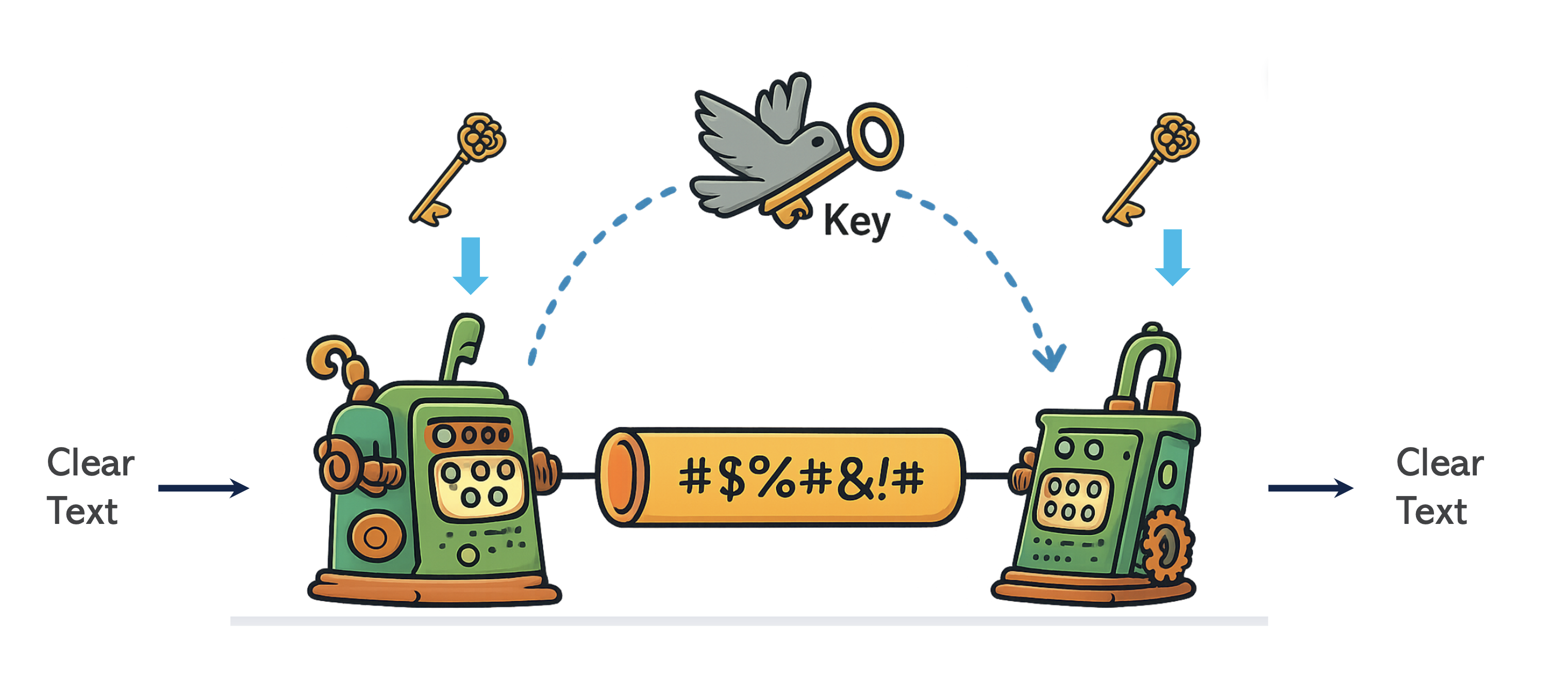
Explaining symmetric crypto is fairly simple. You have a simple key that you use both to encrypt and decrypt the traffic. The challenge here is obviously to get the same key on both side. This is illustrated here with a pigeon carrying a copy of the key (maybe inspired by the Avian carrier RFC)
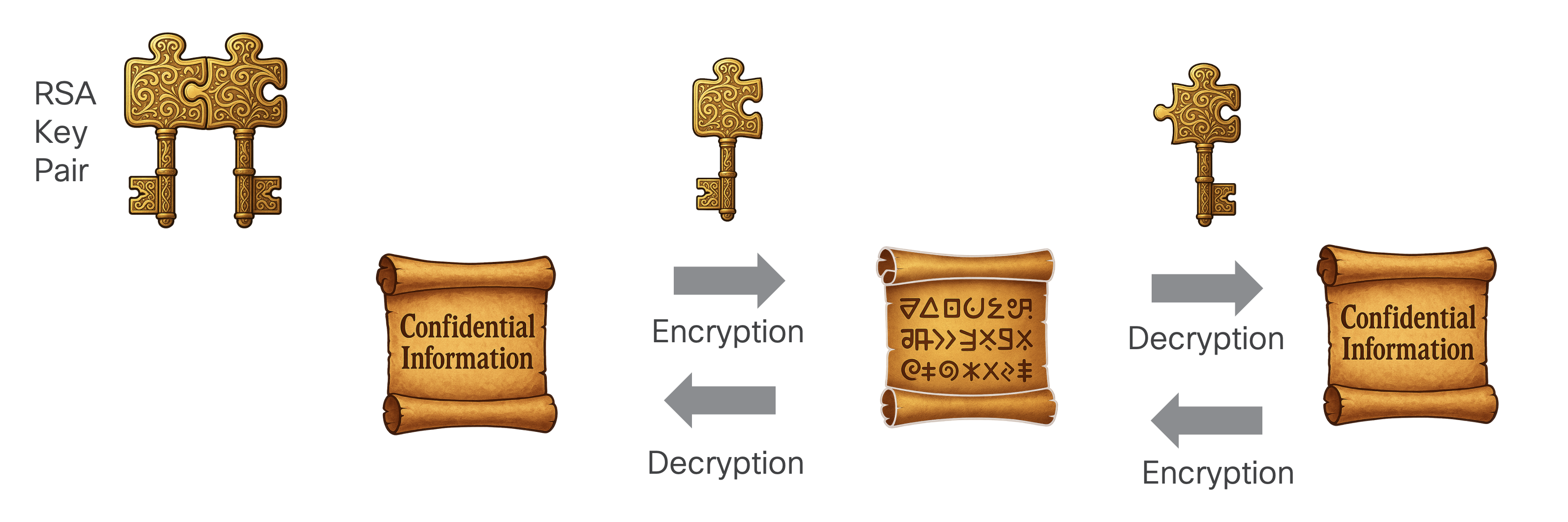
As for asymmetric crypto, this is where this is getting interesting. In order to represent the RSA key, I came up with the idea of a locksmith that crafted that pair of twin keys along with a special lock. When a chest is locked by one key, it can only be unlocked by the other key. One key would be private, your own treasure, and the other one would be public. You share it with anyone and anyone can make its own copy of it. If you encrypt something with your private key, anyone can decrypt it, this is what is being used for signature. If something is encrypted with your public key, only you can decrypt it.
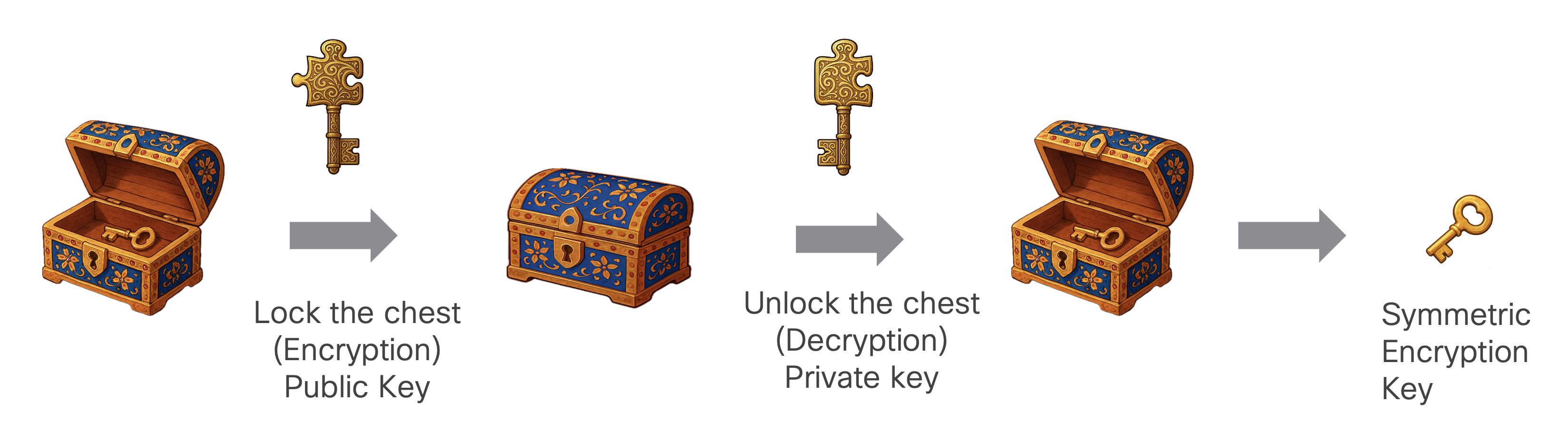
Now we can make use of this concept. The pigeon was not very practical to carry the key. Instead someone who wants to communicate privately with you can obtain your public key. It will place the symmetric key in a chest and lock it with your public key. That means you are the only one able to open the chest thanks to your private key and… to get the session key inside.
On a side note, I think the analogy is pretty good to explain a key exchange but it doesn’t really apply to Diffie Hellman, this is rather similar to a “KEM”.
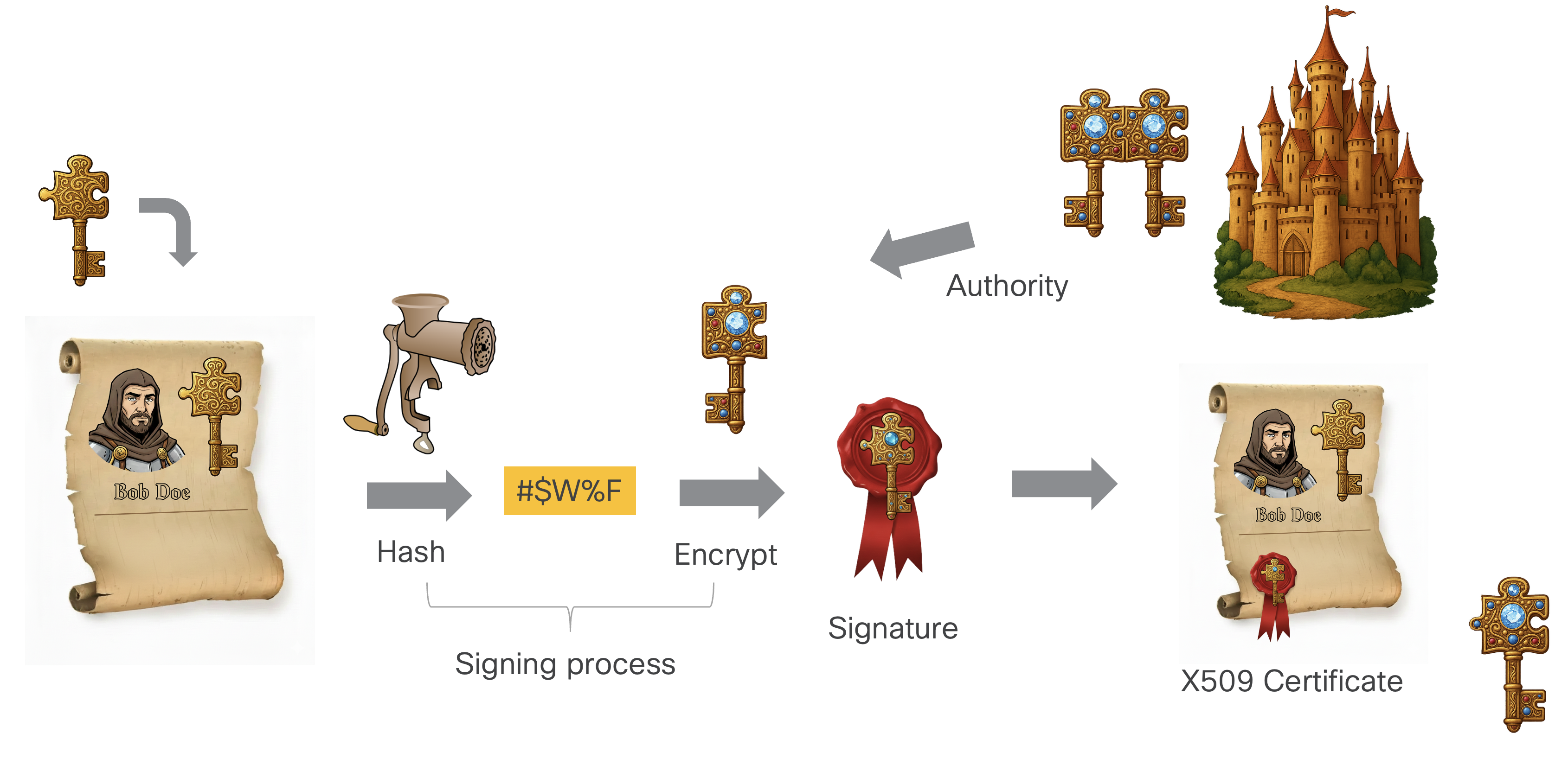
Since asymmetric crypto is also used for PKI, the next step was to explain what a certificate is. So Bob wants to advertise his public key so that people can communicate privately with him or validate his signature. He will distribute copies of his public key attached to a scroll describing who he is, how he looks, where he lives,… That’s all good except nothing prevents evil Mallory from distributing his own public key pretending this is Bob’s key. The scroll would still mention Bob’s name but possibly with a different address or other information pointing to Mallory. To prevent this identity spoofing, Bob would go to the nearby castle. The king has his own pair of keys and since he is the king, everyone knows and trusts his public key. The king will take Bob’s scroll, Bob’s public key and based on that, he will generate some unique message (hash) that he will encrypt with his private key. That information will be used to craft a seal. Anyone with the king’s public key is able to verify that seal is legit… Mallory is upset, unless he manages to trick the king, he can no longer pretend to be Bob!!
That is the current state of crypto…except a gentleman named Peter Shor, no need to introduce him, came up with a way to break that kind of cryptography. His algorithm can efficiently factor large numbers. That is the mathematical problem RSA relies on. If you know a public key, thanks to this algorithm, you could find the corresponding private key…assuming you have a “CRQC”, a Cryptographically Relevant Quantum Computer, a Quantum Computer powerful enough to break RSA. It doesn’t exist yet but lots of effort are currently invested into building one.
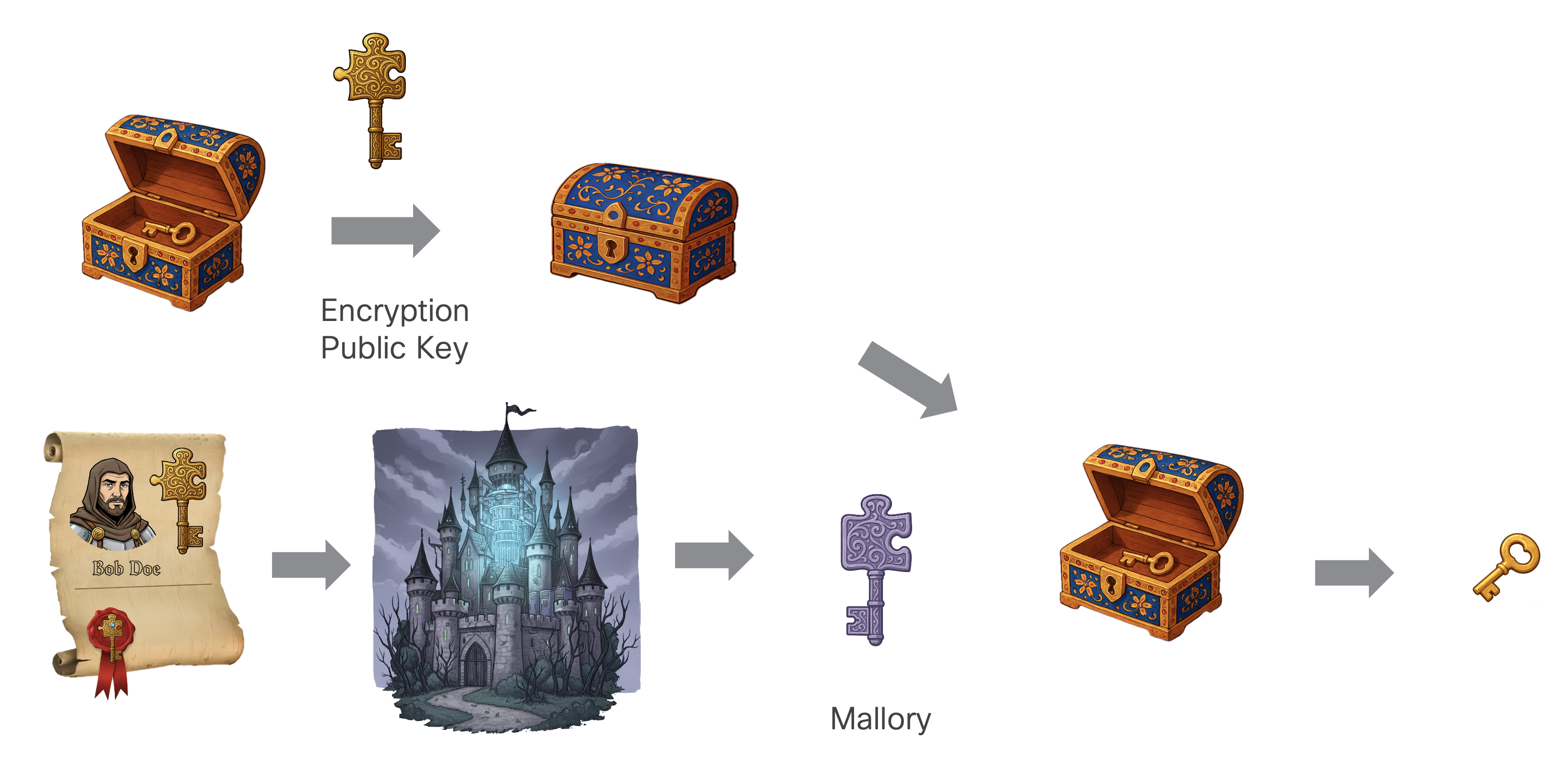
When that day happens (Q-day), if we are considering Alice and Bob exchanging their session key in a chest, that chest could be intercepted and since Bob’s public key is known, his private keys could be forged thanks to Shor’s algorithm and the CRQC. Malicious Malory would then be able to open the chest and get the session key. He would take a copy of it, lock the chest again and forward it to Bob. When Alice and Bob would then start encrypting their communication with the session key, Malory would be able to decrypt it as well.
I have represented that CRQC in a castle because chances are that initially, this won’t be something commonly available…probably limited to state-sponsored threat actor or similar.
I haven’t done it but, next time, I could also illustrate the “Harvest Now, Decrypt Later” or HNDL threat by representing the malicious actor sitting on a heap of encrypted scrolls and chests that he is collecting from the Internet, waiting for the availability of a future CRQC to be decrypted.
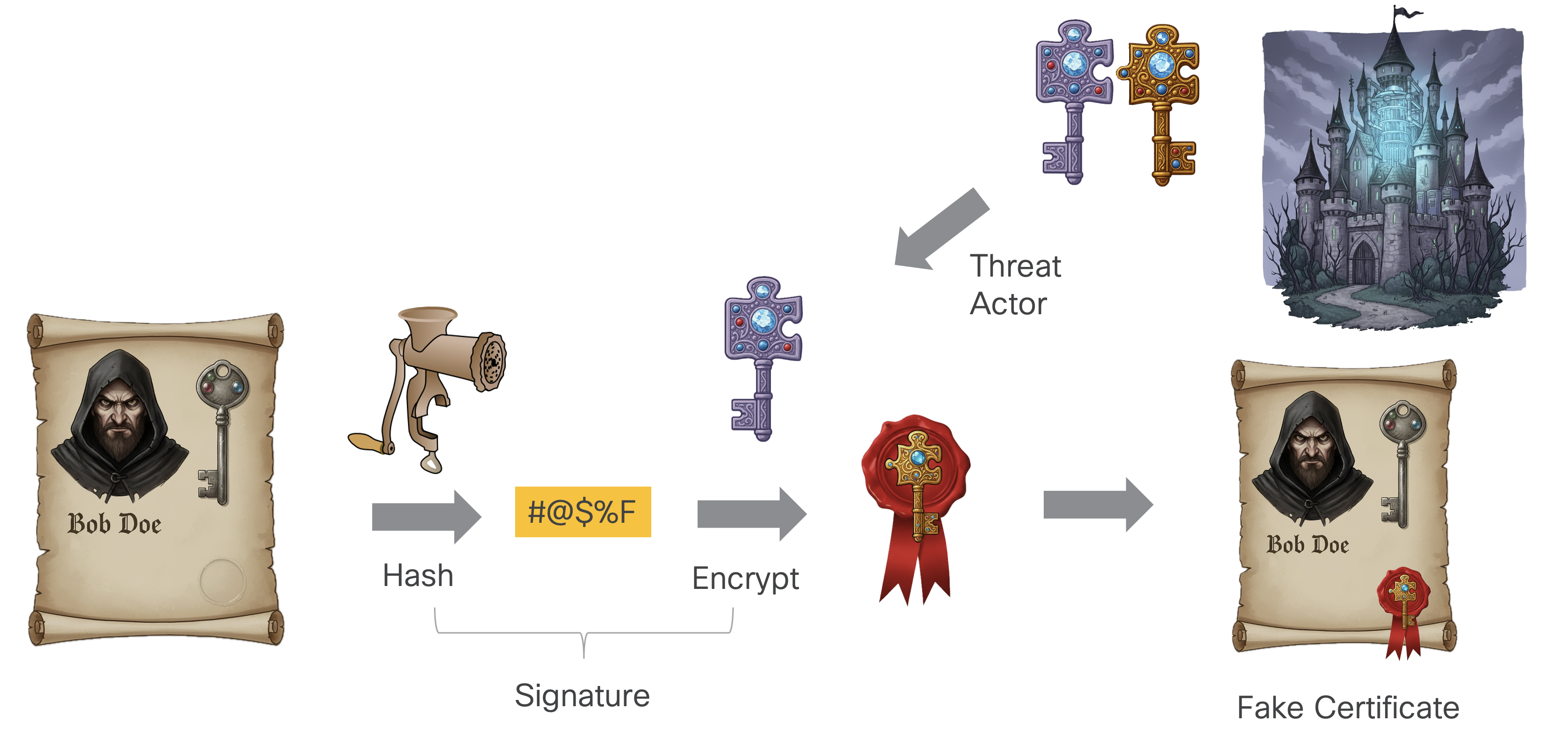
Now the other main threat, is what is called “Trust Now, Forge Later”. Remember, we were trusting the king to provide a seal for Bob’s certificate? Well, the day a CRQC is available, nothing prevents Mallory from forging the private key of the king himself! Even if it takes him a couple of weeks, once this is done he literally “owns the keys of the kingdom” and can generate any kind of seal he wishes… …in this specific example, he would be able to provide a certificate pretending to be Bob. Anyone trusting the king would check the seal with the king’s public key and it would look legitimate!