


|
|

There are several ways to troubleshoot problems associated with Catalyst 2820 or 1900 installation and performance. The LEDs on the front panel are the quickest way to evaluate the operation of the switch; statistics provided by the management console or SNMP management station can provide more details about the cause of connectivity and performance problems; the power-on self-test (POST) ensures that the switch is functioning properly at installation and when subsequently powered on.
If the switch does not operate properly or you are unable to access the management console, you can resolve these problems by using the diagnostic console described in "Diagnostic Console Recovery Procedures."
Potential problems can be grouped into the following categories:
When the switch is first turned on and begins its POST, the system and port LEDs are green. As each of the 13 tests is run, the port LEDs, starting with number 16, turn off. Because there are only 13 tests, LEDs 15, 14, and 13 are unaffected.
If you are installing a 12-port Catalyst 1900, the LED for port A, the 100BaseT port, turns off first, followed by ports 12, 11, 10, and so on.
After the POST completes successfully, the port LEDs blink green and go off, indicating that the switch is operational. If a test fails, the port LEDs turn green, the port LED associated with the test stays off, and the system LED turns amber.
All POST failures except the real-time clock test (number 5) are fatal. If the real-time clock fails POST, the switch begins forwarding packets, but the system LED turns amber, and a POST-failure message appears on the console screen. Certain switch features, such as the bandwidth utilization meter, are lost if the real-time-clock test fails.
Use Table 7-1 to identify your problem and resolve it. Note that those problems that refer to modules inserted in high-speed expansion slots apply only to the Catalyst 2820.
| Symptom | Possible Cause | Resolution |
|---|---|---|
| Poor Performance or Excessive Errors | Incorrect Full-Duplex Settings for 100BaseT Connections
The full-duplex LED on the module front panel indicates a full-duplex setting. Fixed 100BaseTX full-duplex port status is shown with the Mode button and the FDUP LED. Check the port statistics: | |
|
Configure port for half duplex. | |
|
Configure the port for full duplex. | |
| Cabling Distance Exceeded
Port statistics show excessive FCS, late-collision, or alignment errors. For 100BaseTX connections: | ||
|
Reduce the cable length to within the recommended distances. | |
|
See your 100BaseT repeater documentation for cabling guidelines. | |
| For 10BaseT connections: The distance between the port and the attached device exceeds 100 meters. | Reduce the cable length to within the recommended distances. | |
| Bad Adapter in Attached Device
Excessive errors found in port statistics. |
Run adapter card diagnostic utility. | |
| No Connectivity | Incorrect or Bad Cable The following are indicated by no link at both ends:
|
See the "Connector Pinouts" section in the Appendix "Technical Specifications" for the correct pinouts and the proper use of crossover vs. straight-through cables. |
|
Replace with a tested good cable. | |
| NetWare Network Numbers Misconstrued
If NetWare is used, the following message can appear on the server screen: Router configuration error detected. Node xxxxxxxx claims network zzzzzzzz should be yyyyyyyy. If you're using the IP protocol, try pinging the other end. |
All the nodes connected to ports in a single VLAN should be assigned the same network number. | |
| VLANs Misconfigured | ||
|
Ensure the two nodes are connected to ports on the same VLAN. See the "VLAN Configuration" section in the "Out-of-Band Management" chapter to list ports of a VLAN. If using SNMP, see the "Catalyst 2820 and 1900 Enterprise-Specific MIB" section in the "In-Band Management" chapter for the MIB objects to use. | |
|
If there is a router, check the router configuration. Eliminate one of the two connections between the two VLANs. | |
| Expansion Slot A or B LEDs Off | Incorrect Catalyst 2820 Module Installation | See the Troubleshooting section of the Catalyst 2820 Modules User Guide. |
| System LED amber; port LEDs off | Corrupt Firmware | Attach a monitor to the serial port to display the diagnostic console. See the "Systems Engineering Menu" section of this chapter for firmware upgrade instructions. |
| No management console access |
|
Use the diagnostic console as described in the "Systems Engineering Menu" section of this chapter to reset the switch. Reset the modem parameters to their factory defaults with the diagnostic console. |
The diagnostic console allows you to perform the following tasks:
How you access the diagnostic console depends on which task you are performing. Some diagnostic console functions, such as recovering a lost or forgotten password, depend on the version of the boot firmware you are using.
Follow this procedure to display the diagnostic console:
Step 1 Attach a monitor to the switch RS-232 port.
Step 2 Disconnect the power cord from the rear panel.
Step 3 Press the LED Mode button on the front panel, and hold it in.
Step 4 While holding in the LED Mode button, reconnect the power cord. The Diagnostic Console Logon screen shown in Figure 7-1 appears.
Step 5 If you are prompted for a password, enter the password you set for the management console.
Step 6 Press Return to display the Systems Engineering Menu shown in Figure 7-2.
Follow this procedure if you have lost or forgotten the management console password:
Step 1 Follow the procedure in the section "Displaying the Diagnostic Console."
Step 2 Check the boot firmware version number displayed on the menu.
Step 1 Follow the steps in the section "Displaying the Diagnostic Console."
Step 1 From the Systems Engineering Menu, select option U.
Step 2 You are prompted to confirm the download. Enter Y at the prompt:
Do you wish to continue with the download process, [Y]es or [N]o?
It can take up to a minute to erase the existing firmware. If you are using boot firmware version 1.10 or higher, you are then prompted to choose a transmission speed. Enter a 5 or 9 at the prompt.
Do you wish to upgrade at [9]600 (console speed) or [5]7600?
The baud rate used by the switch returns to 9600 after the download is complete.
The following prompt appears:
Waiting for image at the configured baud rate
Step 3 Start the XMODEM transfer from the application you are running.
Step 4 The Diagnostic Console logon screen is displayed when the upgrade is complete. Press Return to display the Systems Engineering Menu, and then select C to restart the switch using the upgraded firmware.

There can be times when you need the diagnostic console even though the firmware is valid. This could happen, for example, if the switch configuration prevents the firmware from executing properly and you cannot display the management console.
Step 1 Use the procedure described in the section "Displaying the Diagnostic Console" to display the Systems Engineering Menu shown in Figure 7-2.
Step 2 Select option F and press Return to reset the system to the factory defaults.
Step 1 Display the Systems Engineering Menu with the procedure described in the section "Displaying the Diagnostic Console."
Step 2 Select S and press Return to display the System Debug Interface Menu.
Step 3 Select option R and press Return.
Use this menu, shown in Figure 7-2, to troubleshoot firmware problems and then bring up the firmware as usual.
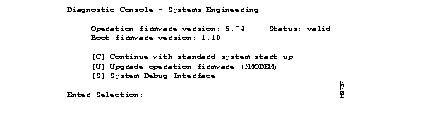
| Operation firmware version: | The current version of the switch firmware. |
| Status: | Valid or invalid. If the firmware is not valid, option C is not displayed and the following warning is displayed:
WARNING!!! Operation Firmware is invalid |
| Boot firmware version: | Current version of the write-protected part of the firmware that supports the diagnostic console. |
[C] Continue with standard system start up. Select this option after you have resolved the firmware problems with options [U] or [S]. It brings up the firmware as usual.
[U] Upgrade operation firmware. Select this option to initiate a firmware upgrade. This option works with XMODEM and uses the default RS-232 parameters: 9600 baud; eight data bits; one stop bit; parity: none. If you are using the boot version firmware 1.10 or higher, you are prompted to choose a baud rate of 9600 or 57600 baud for the download.
[S] System Debug Interface. Select this option to display the System Debug Interface Menu shown in Figure 7-3. You can use this menu to reset the management console RS-232 interface or the entire switch to the factory defaults.
Use this menu, shown in Figure 7-3, to reset the management console RS-232 interface or the entire switch to the factory defaults. You can also use this menu to display the factory-installed management console password.
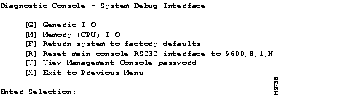
[G] Generic I/O. For Cisco personnel only.
[M] Memory (CPU) I/O. For Cisco personnel only.
[F] Return system to factory defaults. Use this option to return the switch to its factory settings. All static and dynamic addresses are removed, as are the IP address and all other configurations. Enter Y or N and press Return. The changes take effect the next time the switch is reset.
[R] Reset main console RS232 interface to 9600, 8, 1, N. Select this option if you have lost the management console connection because of an improper modem configuration. The next time the switch is reset, the default RS-232 configuration is used.
[V] View Management Console password. Use this option to display the factory-installed password.
|
|