


|
|

This appendix describes procedures for adding and replacing memory. It contains the following sections:
 | Warning Only trained and qualified personnel should be allowed to install or replace this equipment. (To see translated versions of this warning, refer to the Regulatory Compliance and Safety Information document that accompanied the router.) |
 | Caution Before performing any procedures described in this appendix, review the sections "Safety Recommendations," "General Site Requirements," "Installation Checklist," and "Required Tools and Equipment" in the chapter "Preparing to Install the Router." |
This section describes how to remove the cover. You must remove the chassis cover to gain access to the router's internal components, such as memory modules and the ROM.
You need a Number 1 Phillips or flat-blade screwdriver to complete this procedure.
| Warning Do not touch the power supply when the power cord is connected. For systems with a power switch, line voltages are present within the power supply even when the power switch is OFF and the power cord is connected. For systems without a power switch, line voltages are present within the power supply when the power cord is connected. (To see translated versions of this warning, refer to the Regulatory Compliance and Safety Information document that accompanied the router.) |
Take the following steps to remove the cover:
Step 1 Turn OFF the power to the router. However, to channel ESD voltages to ground, do not unplug the power cable.
| Warning Before opening the chassis, disconnect the telephone-network cables to avoid contact with telephone-network voltages. (To see translated versions of this warning, refer to the Regulatory Compliance and Safety Information document that accompanied the router.) |
Step 2 Remove all network interface cables from the rear panel.
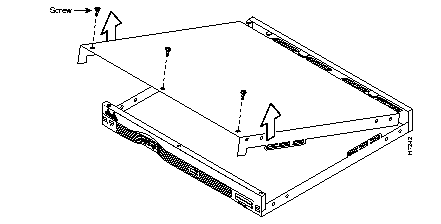
Step 3 Place the router so the front panel is facing you. Remove the three screws located on top of the cover near the front edge, as shown in Figure A-1. Set the screws aside in a safe place.
Step 4 Lift the front edge of the cover until the cover clears the front of the chassis, as shown in Figure A-1.
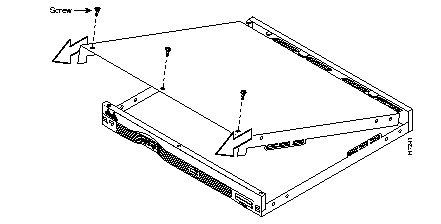
Step 5 Pull the cover toward you until the metal tabs on the rear edge separate from the chassis bottom, as shown in Figure A-2.
Step 6 Lift the cover free and set it aside.
When you are ready to replace the cover, refer to the section "Replacing the Cover" later in this appendix.
The router uses two types of replaceable or upgradable memory, DRAM and Flash memory.
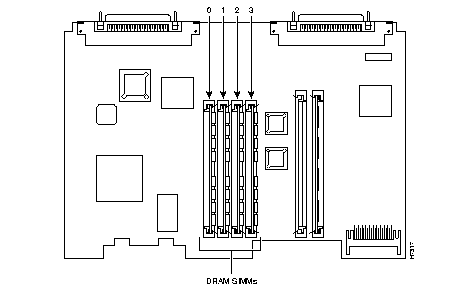
The router contains four 72-pin SIMM sockets (or banks) for DRAM. (See Figure A-3.) Each socket can be filled with a single 32-bit-wide 72-pin DRAM SIMM. DRAM can be configured as a mixture of shared memory, which is used for data transmitted or received by network modules and WAN interface cards, and primary or main memory, which is reserved for the CPU.
Only certain combinations of DRAM SIMMs are permitted. These combinations are shown in Table A-1.
| Bank 0 (SIMM 0) (MB) | Bank 1 (SIMM 1) (MB) | Bank 2 (SIMM 2) (MB) | Bank 3 (SIMM 3) (MB) | Total Memory (MB) |
|---|---|---|---|---|
| 4 | - | - | - | 4 |
| 4 | 4 | - | - | 8 |
| 4 | 4 | 4 | - | 12 |
| 4 | 8 | - | - | 12 |
| 4 | 4 | 8 | - | 16 |
| 4 | 16 | - | - | 20 |
| 8 | - | - | - | 8 |
| 8 | 4 | - | - | 12 |
| 8 | 8 | - | - | 16 |
| 8 | 16 | - | - | 24 |
| 8 | 8 | 4 | - | 20 |
| 8 | 8 | 8 | - | 24 |
| 8 | 8 | 4 | 4 | 24 |
| 8 | 8 | 4 | 8 | 28 |
| 8 | 8 | 8 | 4 | 28 |
| 8 | 8 | 16 | - | 32 |
| 16 | - | - | - | 16 |
| 16 | 4 | - | - | 20 |
| 16 | 8 | - | - | 24 |
| 16 | 16 | 4 | - | 36 |
| 16 | 16 | 8 | - | 40 |
| 16 | 16 | 4 | 4 | 40 |
| 16 | 16 | 8 | 4 | 44 |
| 16 | 16 | 4 | 8 | 44 |
| 16 | 16 | 8 | 8 | 48 |
| 16 | 16 | 16 | - | 48 |
| 16 | 16 | 16 | 4 | 52 |
| 16 | 16 | 4 | 16 | 52 |
| 16 | 16 | 16 | 8 | 56 |
| 16 | 16 | 8 | 16 | 56 |
| 16 | 16 | 16 | 16 | 64 |
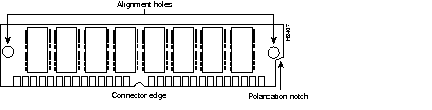
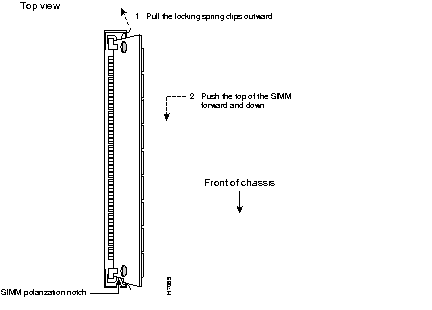
SIMMs are manufactured with a polarization notch to ensure proper orientation, and alignment holes to ensure proper positioning. Figure A-4 shows the polarization notch and alignment holes on a SIMM card. DRAM SIMM cards are installed with the connector edge down, the polarization notch near the front of the chassis, and the component side facing the right side of the chassis.
| Caution To avoid damaging ESD-sensitive components, observe all ESD precautions. To avoid damaging the underlying motherboard, avoid using excessive force when you remove or replace SIMMs. |
Take the following steps to remove DRAM SIMMs:
Step 1 Attach an ESD-preventive wrist strap and ensure that it makes good contact with your skin. Connect the equipment end of the wrist strap to the metal back plate of the chassis, avoiding contact with the connectors.
Step 2 On the motherboard, locate the DRAM SIMM sockets shown in Figure A-3.
| Caution Handle SIMMs by the card edges only. SIMMs are ESD-sensitive components and can be damaged by mishandling. |
Step 3 Remove one SIMM at a time, beginning with the SIMM in bank 3. To lift the SIMM out of its socket, pull the locking spring clips on both sides outward and tilt the SIMM toward the right side of the chassis, free of the clips. (See Figure A-5.)
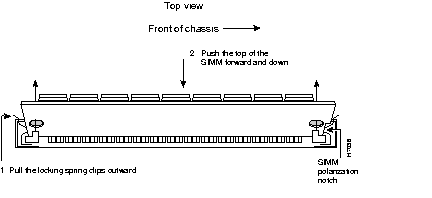
Step 4 Hold the SIMM by the edges with your thumb and index finger and lift it out of the socket. Place the removed SIMM in an antistatic bag to protect it from ESD damage.
Step 5 Repeat Step 3 and Step 4 for each SIMM.
When you have removed the existing SIMMs, proceed to the next section, "Installing DRAM SIMMs," to install the new SIMMs.
Take the following steps to install DRAM SIMMs:
Step 1 Attach an ESD-preventive wrist strap and ensure that it makes good contact with your skin. Connect the equipment end of the wrist strap to the metal back plate of the chassis, avoiding contact with the connectors.
Step 2 On the motherboard, locate the DRAM SIMM card sockets shown in Figure A-3.
| Caution Handle SIMMs by the card edges only. SIMMs are ESD-sensitive components and can be damaged by mishandling. |
Step 3 Hold the SIMM with the polarization notch on the right, near the front of the chassis, and the components at the top, with the connector edge at the bottom. (See Figure A-4.)
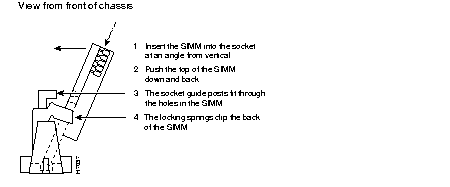
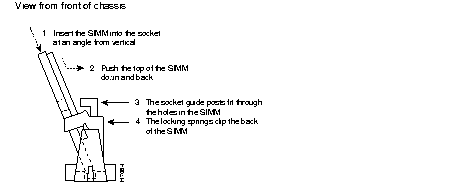
Step 4 Beginning with bank 0, insert the SIMM into the connector slot at an angle, tilted toward the right side of the chassis. Rock the SIMM into a vertical position (see Figure A-6), using the minimum amount of force required. When the SIMM is properly seated, the socket guide posts fit through the alignment holes, and the connector springs click into place.
Step 5 Ensure that each SIMM is straight and that the alignment holes (as shown in Figure A-6) line up with the plastic socket guides on the socket.
| Caution It is normal to feel some resistance, but do not use excessive force on the SIMM, and do not touch the surface components. |
Step 6 Repeat Step 3 to Step 5 for each SIMM.
When you finish replacing SIMMs, proceed to the section "Replacing the Cover" later in this appendix.
This section describes how to upgrade the Flash memory SIMMs. The system code (Cisco IOS software) is stored in the Flash memory SIMMs. You might need to replace or add Flash memory SIMMs to upgrade to a new Cisco IOS software feature set.
The router contains one or two 80-pin Flash memory SIMMs. These SIMMs are not interchangeable with DRAM SIMMs. You can upgrade Flash memory by replacing the existing 4-MB SIMM with an 8-MB or 16-MB SIMM, or by adding a SIMM to the second Flash memory socket. You can install from 4 MB to 32 MB of Flash memory. The size of the SIMMs in the two Flash memory sockets need not be the same. Table A-2 lists the Flash memory SIMM configurations possible and the resulting total Flash memory.
| Bank 0 | Bank 1 | Total Memory |
|---|---|---|
| 4 MB | - | 4 MB |
| 4 MB | 4 MB | 8 MB |
| 4 MB | 8 MB | 12 MB |
| 4 MB | 16 MB | 20 MB |
| 8 MB | - | 8 MB |
| 8 MB | 4 MB | 12 MB |
| 8 MB | 8 MB | 16 MB |
| 8 MB | 16 MB | 24 MB |
| 16 MB | - | 16 MB |
| 16 MB | 4 MB | 20 MB |
| 16 MB | 8 MB | 24 MB |
| 16 MB | 16 MB | 32 MB |
Figure A-7 shows the Flash memory SIMM locations.
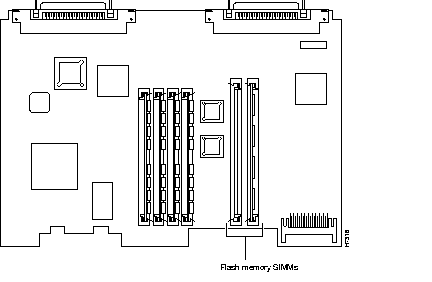
SIMMs are manufactured with a polarization notch to ensure proper orientation, and alignment holes to ensure proper positioning, similar to those shown in Figure A-4. Flash SIMM cards are installed with the connector edge down, the polarization notch near the front of the chassis, and the component side facing the right side of the chassis.
| Caution To avoid damaging ESD-sensitive components, observe all ESD precautions. To avoid damaging the underlying motherboard, do not use excessive force when you remove or replace SIMMs. |
Take the following steps to remove an existing Flash memory SIMM:
Step 1 Attach an ESD-preventive wrist strap and ensure that it makes good contact with your skin. Connect the equipment end of the wrist strap to the metal back plate of the chassis, avoiding contact with the connectors.
Step 2 Locate the Flash memory SIMM sockets on the motherboard. (See Figure A-7.)
| Caution Handle SIMMs by the card edges only. SIMMs are ESD-sensitive components and can be damaged by mishandling. |
Step 3 To lift the Flash memory SIMM out of its socket, pull the locking spring clips on both sides outward and tilt the SIMM toward the right side of the chassis, free of the clips. (See Figure A-8.)
Take the following steps to install Flash memory SIMMs:
Step 1 Locate the Flash memory SIMM sockets on the motherboard. (See Figure A-7.)
| Caution Handle SIMMs by the edges only. SIMMs are ESD-sensitive components and can be damaged by mishandling. |
Step 2 Hold the SIMM with the polarization notch on the right and the component side away from you, with the connector edge at the bottom.
Step 3 Referring to Figure A-9, insert the Flash memory SIMM into its connector slot at an angle, tilted toward the left side of the chassis. Rock the SIMM into a vertical position (see Figure A-6) using the minimum amount of force required. When the SIMM is properly seated, the socket guide posts fit through the alignment holes, and the locking springs click into place. Use the minimum amount of force required.
| Caution It is normal to feel some resistance, but do not use excessive force on the SIMM and do not touch the surface components to avoid damaging them. |
Step 4 Check the alignment of each SIMM to make sure that it is straight and that the alignment holes are lined up with the plastic socket guides.
When you finish replacing SIMMs, proceed to the section "Replacing the Cover" later in this appendix.
To upgrade the router ROM software to a new ROM monitor, you must replace the existing ROM.
You will need the following tools:
Take the following steps to replace an existing ROM:
Step 1 Attach an ESD-preventive wrist strap and ensure that it makes good contact with your skin. Connect the equipment end of the wrist strap to the metal back plate of the chassis, avoiding contact with the connectors.
| Caution Correct placement of the ROM is crucial. If improperly positioned, the new component could be damaged when the router is powered on. Read all instructions before proceeding. To prevent damage to the ROM from ESD (when handling the router and its components), follow the ESD procedures described in the section "Preventing Electrostatic Discharge Damage" in the chapter "Preparing to Install the Router." Be careful not to damage or scratch the printed circuit card under the ROM. |
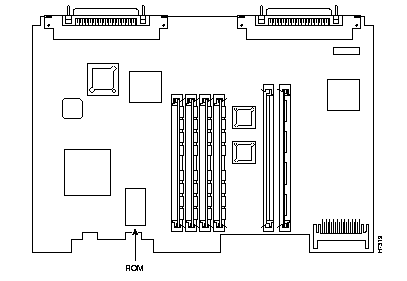
Step 2 Locate the ROM on the motherboard. (See Figure A-10.)
Step 3 Gently remove the old ROM with a ROM extraction tool or a small flat-blade screwdriver, and set it aside.
Step 4 Insert the new ROM in its socket in the orientation shown in Figure A-10, being careful to not bend or crush any of the bottom pins. To straighten out a bent pin, use needlenose pliers. Align the notch in the new ROM with the notch in the ROM socket, ignoring the orientation of the label.
| Caution The notch on the ROM must match the notch on the socket on the card. Installing the ROM backward will damage it. |
When you finish replacing the ROM, proceed to the section "Replacing the Cover" later in this appendix.
Test your installation by rebooting the router. If you installed the ROM correctly, the router will boot into the ROM monitor or operating system.
Take the following steps if you suspect that the ROM is inserted incorrectly:
Step 1 Open the chassis. (See the section "Removing the Cover" earlier in this appendix.)
Step 2 Gently remove the old ROM with a ROM extraction tool or a small flat-blade screwdriver, and set it aside.
Step 3 Use needlenose pliers to straighten any bent pins on the ROM.
Step 4 Insert the new ROM in its socket in the orientation shown in Figure A-10, being careful to not bend or crush any of the bottom pins. Align the notch in the new ROM with the notch in the ROM socket, ignoring the orientation of the label.
Step 5 Replace the cover following the steps provided in the next section "Replacing the Cover."
Step 6 Try rebooting the router.
If you are still having problems after following the steps in this procedure, refer to the appendix "Troubleshooting."
This section describes how to replace the router cover. You need a number 1 Phillips screwdriver to complete this procedure.
Take the following steps to replace the cover:
Step 1 Place the chassis so the front panel is closest to you.
Step 2 Hold the cover so the tabs at the rear of the cover are aligned with the chassis bottom, as shown in Figure A-11.
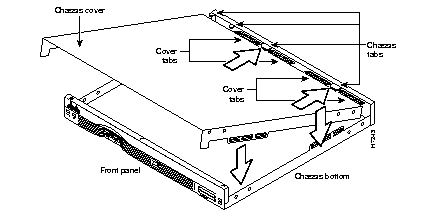
Step 3 Push the cover toward the rear, making sure that the cover tabs fit under the rear panel of the chassis, and the chassis tabs fit under the top cover.
Step 4 Lower the front of the cover onto the chassis, making sure that the tabs on the side of the cover fit inside the chassis side panels, and the tabs on the side of the chassis fit under the cover side panels.
Step 5 Fasten the cover with the three screws you set aside in Step 3 in the section "Removing the Cover" earlier in this appendix.
Step 6 Reinstall the chassis on a rack, desktop, or table.
Step 7 Reinstall network interface cables.
If the router does not power on, refer to the appendix "Troubleshooting."
This section describes how to install Flash memory cards in the router and includes selected configuration examples for common procedures. For further configuration information, refer to the Cisco IOS configuration guides and command references.
This section includes the following subsections:
Flash memory cards are sensitive to electrostatic discharge (ESD) damage. ESD damage, which can occur when electronic cards or components are handled improperly, can result in complete or intermittent failures.
Follow these guidelines to prevent ESD damage:
| Caution For safety, periodically check the resistance value of the antistatic strap. The measurement should be between 1 and 10 megohm (Mohm). |
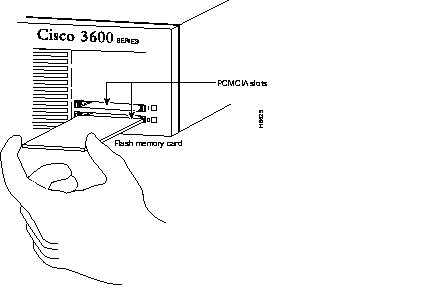
The router includes two Personal Computer Memory Card International Association (PCMCIA) slots. You can install 4-, 8-, or 16-MB Flash memory cards in these slots.
Follow these steps to install a Flash memory card:
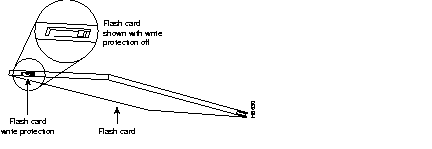
Step 1 Verify that the Flash memory card is set to write-protect off. The write-protect switch is at the top left edge of the card, when you view it with the label side toward you. (See Figure A-12.)
Step 2 Locate the PCMCIA slots, labeled Card-1 and Card-0, at the bottom right corner of the front panel of the chassis. (See Figure A-13.)
Step 3 Insert the connector end of the Flash memory card, label side up, into one of the PCMCIA slots until the card is seated in the connector. (See Figure A-13.)
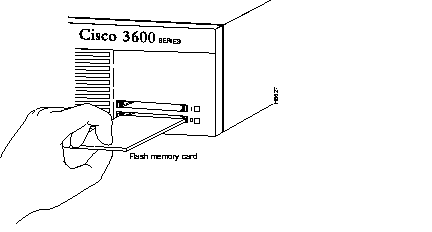
Follow these steps to remove a Flash memory card:
Step 1 Grasp the card near the slot and pull it free from the connector. (See Figure A-14.)
| Caution Do not remove the Flash memory card while it is performing a read or write operation, because the router will halt. |
Step 2 Place the removed Flash memory card on an antistatic surface or in a static shielding bag.
Flash memory cards ordered from Cisco Systems ship blank (without software installed). Before copying files to a Flash memory card, you might want to partition it.
Follow these steps to partition a Flash memory card:
Step 1 Enter privileged EXEC mode:
enable
enablepassword
Step 2 Enter global configuration mode:
config terminal
Step 3 Enter the partition {slot0: | slot1:} [partition-number] [partition-size] command:
partition slot1: 2 2
To display the contents of a Flash memory card, enter the show {slot0: | slot1:} command, for example:
Router# show slot1:
PCMCIA Slot1 flash directory, partition 1:
File  Length   Name/status
  1   1933052  c3620-i-mz.111-6.3.AA
[1933116 bytes used, 6455492 available, 8388608 total]
8192K bytes of processor board PCMCIA Slot1 flash (Read/Write)
PCMCIA Slot1 flash directory, partition 2:
File  Length   Name/status
  1   3399444  c3620-j-mz.111-7.AA
[3399508 bytes used, 794796 available, 4194304 total]
4096K bytes of processor board PCMCIA Slot1 flash (Read/Write)
PCMCIA Slot1 flash directory, partition 3:
File  Length   Name/status
  1   2359     running-config
[2424 bytes used, 4191880 available, 4194304 total]
4096K bytes of processor board PCMCIA Slot1 flash (Read/Write)
Similarly, you can display the contents of system (onboard) Flash by entering the show flash: command.
You can use a Flash memory card to store a backup copy of a Cisco IOS image or other file. Follow these steps to copy a file from system (onboard) Flash memory to a Flash memory card:
Step 1 Enter privileged EXEC mode:
Router> enable
Password: enablepassword
Step 2 Enter the copy flash:[partition:filename] {slot0: | slot1:}[partition:filename] command. Replace partition with the partition number and filename with the name of the file, for example:
copy flash:2:TESTFILE slot0:3:TESTFILE
n
Step 3 Press Return to erase the current contents of the partition or enter n to save the contents. Then confirm your selection:
y
You can also use a Flash memory card to store a backup copy of a configuration file. Follow these steps to copy a configuration file to a Flash memory card:
Step 1 Enter privileged EXEC mode:
Router> enable
Password: enablepassword
Step 2 Enter the copy running-config {slot0: | slot1:}[partition:filename] command. Replace partition with the partition number and filename with the name of the file, for example:
copy running-config slot0:3:myconfig
n
Step 3 Press Return to erase the current contents of the partition or enter n to save the contents. Then confirm your selection:
y
You can copy files from a Flash memory card to system (onboard) Flash memory (for instance, when restoring a backup). Follow these steps to copy a file from a Flash memory card to system Flash memory:
Step 1 Enter privileged EXEC mode:
Router> enable
Password: enablepassword
Step 2 Enter the copy {slot0: | slot1:}[partition:filename] flash:[partition:filename] command. Replace partition with the partition number and filename with the name of the file, for example:
copy slot0:3:TESTFILE flash:2:TESTFILE2
n
Step 3 Press Return to erase the current contents of the partition or enter n to save the contents. Then confirm your selection:
y
This section describes how to copy a file from one Flash memory card to another Flash memory card in the other slot.
Follow these steps to copy a file between two slots:
Step 1 Enter privileged EXEC mode as follows:
enable
enablepassword
Step 2 Insert the Flash memory card that contains the source file into the slot labeled Card-0.
Step 3 Insert a second Flash memory card into the slot labeled Card-1. This card does not have to be partitioned.
Step 4 Enter the copy {slot0: | slot1:}[partition:filename]{slot0: | slot1:} [partition:filename] command to copy a file from one slot to the other. In the following example, there are no partitions on the destination Flash memory card:
copy slot0:3:TESTFILE slot1:
n
Step 5 Press Return to erase the current contents of the destination partition (if any) or enter n to save the contents. Then confirm your selection:
y
You can configure the router to boot from a Cisco IOS image on the Flash memory card, rather than from system Flash. The router boots the image on the Flash memory card, copies the image to onboard DRAM, and then executes the image from DRAM. The router does not execute the image directly from the Flash memory card.
Follow these steps to specify the image on the Flash memory card as the boot image:
Step 1 Enter privileged EXEC mode:
enable
enablepassword
Step 2 Enter global configuration mode:
config terminal
Step 3 Enter the boot system flash {slot0: | slot1:}[partition:filename] command to specify the boot image location and name. In the following example, the boot image is located on the Flash memory card in the Card-0 slot, partition 3, and the filename is new.image:
no boot system
boot system flash slot0:3:new.image
Step 4 Set the configuration register to 0x2102 (the default setting), which indicates that the router should attempt to boot a Cisco IOS image from Flash memory:
config-register 0x2102
Step 5 Exit global configuration mode:
exit
Step 6 Enter the copy running-config startup-config command to save the configuration changes to NVRAM.
Step 7 Enter the reload command to reload the router. When the router reloads, it will boot the image new.image from the Flash memory card in the Card-0 slot.
To erase a partition or the entire contents of a Flash memory card, enter the command erase {slot0: | slot1:} [partition:]. Replace partition with the partition number. You cannot specify a filename. The following example erases the contents of partition 3 of the card in slot0:
Router# erase slot0:
Partition   Size    Used      Free      Bank-Size  State          Copy Mode
  1         8192K   5147K     3044K     4096K      Read/Write     Direct
  2         4096K   3319K      776K     4096K      Read/Write     Direct
  3         4096K      3K     4092K     4096K      Read/Write     Direct
[Type ?<no> for partition directory; ? for full directory; q to abort]
Which partition? [default = 1] 3
PCMCIA Slot0 flash directory, partition 3:
File  Length   Name/status
  1   2359     running-config  [invalid checksum]
  2   922      configfile
[3412 bytes used, 4190892 available, 4194304 total]
Erase flash device, partition 3? [confirm]
Are you sure? [yes/no]: y
Erasing device... eeeeeeeeeeeeeeeeeeeeeeeeeeeeeeee ...erased
Router#
|
|