


|
|

Your router goes through extensive testing and burn-in before leaving the factory. If you do encounter problems, use the information in this appendix to help isolate problems, or to rule out the router as the source of the problem.
This appendix contains the following sections:
If you cannot locate the source of the problem, contact a customer service representative for information on how to proceed. For technical support information, refer to the information packet that shipped with your router. Before you call, have the following information ready:
The key to problem solving is to isolate the problem to a specific subsystem by comparing what the router is doing to what it should be doing.
The LEDs on the front panel of the router enable you to determine router performance and operation. For a description of these LEDs, refer to the section "Reading Front-Panel LEDs" later in this appendix.
When problem solving, consider the following subsystems of the router:
Both the system LED and the fans can help you to troubleshoot a power problem. Check the following items to help isolate the problem:
If the router is operating at an abnormally high temperature, you see the following message displayed:
%SYS-1-OVERTEMP: System detected OVERTEMPERATURE condition. Please resolve cooling problem immediately!
Some causes of abnormally high router temperature are the following:
Take steps to correct the problem. See also the sections "Site Environment" and "Equipment Racks" in the chapter "Preparing to Install the Router."
Network problems can be caused by a module, cables or cable connections, or external devices such as a modem, transceiver, hub, wall jack, WAN interface, or terminal. Check for the following symptoms to help isolate the problem:
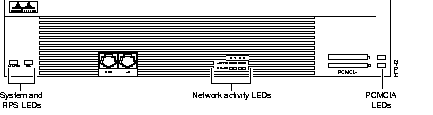
The LEDs on the front panel of the router enable you to determine router performance and operation. Figure B-1 illustrates the LEDs on the front panel of the router. Table B-1 describes the system LED, Table B-2 describes the redundant power supply (RPS) LED, and Table B-3 describes the active, ready, and PCMCIA LEDs.
| Color | RPS Status |
|---|---|
| Off | Not installed |
| Green | Operational |
| Amber | Installed but not operational |
The module LEDs are all visible through cutouts in the rear of the chassis.
The following sections describe module LEDs:
All module s have an enable LED. When on, the enable LED indicates the module has passed its self-tests and is available to the router.
Figure B-2 shows the 1-port Fast Ethernet network module's LEDs.
All network modules have an Enable LED. The Enable LED indicates that the module has passed its self-tests and is available to the router.
The 1-port Fast Ethernet network module has the following additional LEDs:
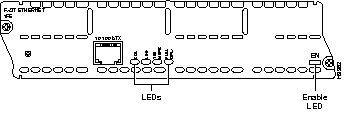
The LEDs on Ethernet modules are described in Table B-4.
| LEDs | Indication |
|---|---|
| ACT (activity) | System is transmitting or receiving data |
| LNK (link) | 10BaseT is selected and the link is available |
The LEDs on the Ethernet modules are labeled as shown in Figure B-3 through Figure B-6.
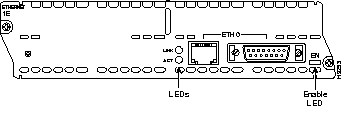
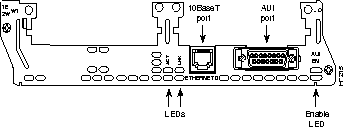
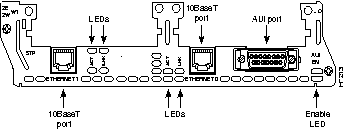
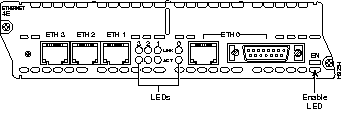
The LEDs on Ethernet and Token Ring modules are described in Table B-5.
| LEDs | Indication |
|---|---|
| 16 MBPS lighted | Ring speed of 16 Mbps |
| 16 MBPS unlighted | Ring speed of 4 Mbps |
| In-ring | Token Ring interface is inserted into the ring |
The LEDs on the 1 Ethernet 1 Token Ring 2 WAN car slot (1E1R 2-slot) module are labeled as shown in Figure B-7.
 | Time Saver When the in-ring LED is off, you can unplug the Token Ring cable without causing a problem on the ring. |
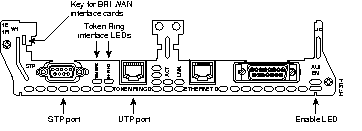
The LEDs on the 4-port serial module are described in Table B-6 and illustrated in Figure B-8.
| LED | Meaning |
|---|---|
| CN/LP | Connect when green, loopback when yellow |
| RXC | Receive clock |
| RXD | Receive activity |
| TXC | Transmit clock |
| TXD | Transmit activity |
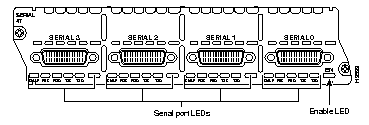
The LEDs on the A/S serial modules are described in Table B-7 and illustrated in Figure B-9 and Figure B-10.
| LEDs | Indication |
|---|---|
| CN/LP | Indicates connect when green, loopback when yellow |
| RXC | Receive clock |
| RXD | Receive activity |
| TXC | Transmit clock |
| TXD | Transmit activity |
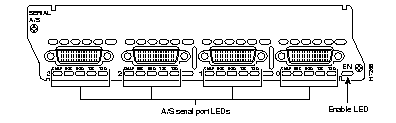
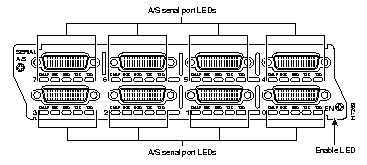
The LEDs on the BRI S/T modules are described in Table B-8, and illustrated in Figure B-11, and Figure B-12.
| LEDs | Indication |
|---|---|
| B1 | Call established on the B1 channel |
| B2 | Call established on the B2 channel |
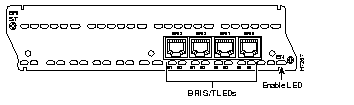
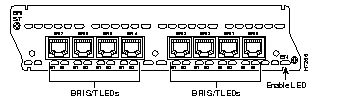
The LEDs on the BRI U modules are described in Table B-9. and illustrated in Figure B-13, Figure B-14.
| LEDs | Indication |
|---|---|
| B1 | Call established on the B1 channel |
| B2 | Call established on the B2 channel |
| NT1 | Synchronous status of the NT1--solid green indicates synchronization with the Telco ISDN switch |
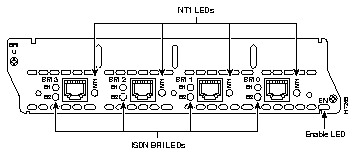
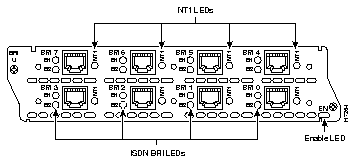
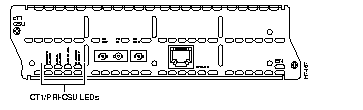
The LEDs on the CT1/PRI modules are described in Table B-10, and illustrated in Figure B-15, and Figure B-16.
| LEDs | Indication |
|---|---|
| REMOTE ALARM | Remote alarm condition |
| LOCAL ALARM | Local alarm condition |
| LOOPBACK | Loopback condition |
| CARRIER DETECT | Received carrier on the telco link |
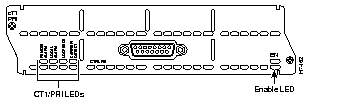
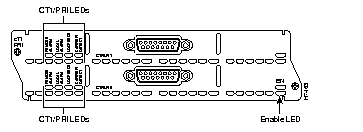
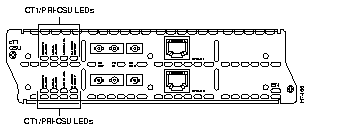
The LEDs on the CT1/PRI-CSU modules are described in Table B-11, and illustrated in Figure B-17, Figure B-18.
| LEDs | Indication |
|---|---|
| REMOTE ALARM | Remote alarm condition |
| LOCAL ALARM | Local alarm condition |
| LOOPBACK | Loopback condition |
| CARRIER DETECT | Received carrier on the telco link |
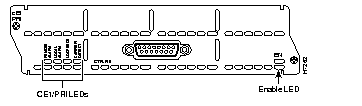
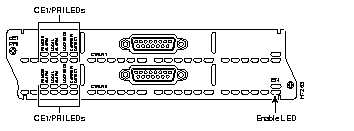
The LEDs on the CE1/PRI-B and CE1/PRI-U modules are described in Table B-12, and illustrated in Figure B-19, Figure B-20. The same LEDs are used for balanced (120 ohm) and unbalanced (75 ohm) E1 interfaces.
| LEDs | Indication |
|---|---|
| REMOTE ALARM | Remote alarm condition |
| LOCAL ALARM | Local alarm condition |
| LOOPBACK | Loopback condition |
| CARRIER DETECT | Received carrier on the telco link |
The WAN interface card LEDs are all visible on the faceplate of the card.
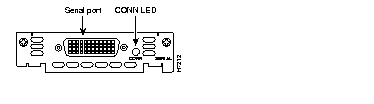
The serial WAN interface card has one LED (CONN) that indicates a connection on the serial port. (See Figure B-21.)
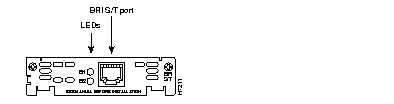
The older BRI S/T WAN interface card has two LEDs. (See Figure B-22.) The LEDs, labeled B1 and B2, indicate the status (up/down) of the two ISDN BRI B channels.
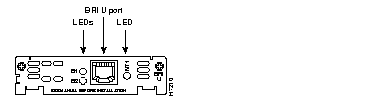
The older BRI U WAN interface card has three LEDs. (See Figure B-23.) Two of the LEDs, labeled B1 and B2, indicate the status (up/down) of the two ISDN BRI B channels. The third LED, labeled NT1, indicates the synchronous status of the NT1.
The newer BRI S/T WAN interface cards have three LEDs, shown in Figure B-24.

The B1 and B2 LEDs indicate call activity on the two ISDN-BRI B-channels, as listed in Table B-8.
| LED | Meaning |
|---|---|
| B1 | Call active on B1 channel |
| B2 | Call active on B2 channel |
| OK | ISDN port has synchronized with the central office switch (the D-channel is active) |
Newer BRI U WAN interface cards also have three LEDs, as shown in Figure B-25.

Two of these LEDs indicate call activity on the two ISDN-BRI B-channels, as listed in Table B-9. The third LED, labeled NT1, indicates synchronization status of the NT1.
| LED | Meaning |
|---|---|
| B1 | Call active on B1 channel |
| B2 | Call active on B2 channel |
| NT1 | Synchronous status of NT1 |
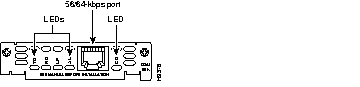
The switched 56 WAN interface card has five LEDs. These LEDs are shown in Figure B-26 and described in Table B-10.
| LED | Meaning |
|---|---|
| TD | Data is transmitting to the DTE interface. |
| RD | Data is being received from the DTE interface. |
| LP | The internal DSU/CSU is in loopback mode. |
| AL | An alarm condition is present. |
| CD | The internal DSU/CSU in the WAN interface card in communicating with another DSU/CSU. |
This section describes how to recover a lost enable password.
Take the following steps to recover a lost enable password:
Step 8 Reboot the router. Enter no at the prompt asking if you would like to enter the initial dialog:
no
You are now in the router's normal operating mode.
Step 9 After a few seconds you see the user EXEC prompt (Router>). Enter the show version command to display the existing configuration register and make a note of that value.
Step 10 If Break is enabled, send a Break. This action causes the terminal to display the ROM monitor prompt (rommon>). Proceed to Step 12.
Step 11 If Break is disabled, you do not know whether Break is enabled, or sending a Break fails, turn the router OFF, wait five seconds, and turn it ON again. Within five seconds of turning ON the router, press the Break key. This action causes the terminal to display the ROM monitor prompt (rommon>).
Step 12 Enter the configure register command (confreg) at the ROM monitor prompt.
confreg
Step 13 Enter y at the following prompt:
y
Step 14 Enter n in response to all prompts until you reach the following prompt, then enter y:
y
Step 15 Enter n in response to all prompts until you reach the following prompt, then enter y:
y
Step 16 At the following prompt, enter 2 and press Return:
2
A configuration summary is displayed.
Step 17 Enter n at the following prompt:
n
Step 18 Enter reset at the ROM monitor prompt. The router reboots.
Step 19 Enter n at the following prompt:
n
Step 20 Enter enable to enter privileged EXEC mode:
enable
Configuration changes can be made only in enable mode. The prompt changes to the privileged EXEC prompt (#):
Step 21 Enter the show startup-config command to display the enable password in the configuration file:
show startup-config
Step 22 Enter the configure terminal command to enter configuration mode:
configure terminal
Step 23 Enter the configure register command followed by a number to return the original value you noted in Step 9.
Step 24 Press Ctrl-Z to exit configuration mode.
Step 25 Reboot the router and enter the recovered password.
If both the boot and system images have been erased and only the ROM monitor is available, you can use the ROM monitor xmodem command to copy a Cisco IOS image to Flash memory from the console. The console can be connected directly to the router through the console port, or remotely through a modem connected to the auxiliary port.
The console must have the following files to transfer a Cisco IOS image to Flash memory in the router:
Take the following steps to copy the Cisco IOS image to Flash memory:
Step 1 Connect the console following the instructions in the section "Network Connections" in the chapter "Installing the Router."
Step 2 Turn ON the router. The power-on self-test diagnostics run and the boot ROM searches for a valid boot image and Cisco IOS image in Flash memory. If the boot image and Cisco IOS image are not found, the boot ROM monitor prompt is displayed:
Step 3 Enter the xmodem command and the name of the source file containing the Cisco IOS image.
filename
Step 4 The source file is searched for and found. Messages similar to the following appear:
Step 5 Enter yes to copy the Cisco IOS image into Flash memory. Messages similar to the following appear:
|
|