Product Overview
CiscoWorks network management software enables you to monitor complex internetworks and aids in in-depth network planning, troubleshooting, and analysis of your Cisco devices. It is integrated with HP OpenView as a suite of CiscoWorks applications that are accessible through HP OpenView menus.
CiscoWorks uses network maps that you can create either by entering information about devices manually or by using the HP OpenView Manage Objects command. The HP OpenView database can store and maintain multiple network maps. CiscoWorks also contains the Sybase relational database to store information about the devices displayed in the network maps. CiscoWorks uses the Simple Network Management Protocol (SNMP) to monitor and control any SNMP device on your network.
The functions performed by CiscoWorks can be broadly classified into the following five categories:
- Fault management--Network problems can arise from a variety of sources including devices, lines, interfaces, environment, and so on. CiscoWorks applications help you identify and diagnose the problems by monitoring or checking information about devices and displaying the information. For example, you can display the network path between two devices to see the sequence of hops between the source and destination. You can compare alternative routing paths and decide if any changes in the routing paths would improve the routing process. Centralized logging provides the capability to store, query, and delete messages gathered from devices on the internetwork.
- Performance management--Optimal network performance depends on a variety of factors, such as the amount of traffic on your network, the amount of traffic generated by specific protocols, the number of packet errors, and so on. CiscoWorks applications enable you to monitor your network performance by retrieving or polling performance information from a number of devices. You can analyze the acquired information and make performance-related decisions for your network. You can poll specific MIB variables on a device and display the information either in the form of a text summary or as a visual graph. The new Export command in Polling Summary allows data to be exported from the database to a flat file which can then be loaded into a spreadsheet program so you can perform further analysis and calculations. You also can create custom reports by using the Sybase Data Workbench function provided by the Sybase software.
- Configuration management--Each network device contains configuration information that specifies how the device is set up and how it will perform. CiscoWorks provides the capability to edit the configuration file of a Cisco device with a UNIX text editor and store it in the database. In addition, you can retrieve, modify, and download configuration files to Cisco devices. Depending on your needs, these functions can be automated so that a centralized administrator can maintain configuration files at remote sites. For example, by using the AutoInstall application in CiscoWorks, you can upgrade all configuration files at remote sites in one step. The Configuration Snap-In Manager application allows you to apply a configuration command to all routers using that protocol. Finally, stored configuration files for a device can be compared with one another or with the current device configuration.
- Device management--A database with an inventory of network devices and associated information is helpful for retrieving information when needed. CiscoWorks enables you to create a database with information on devices, individuals responsible for maintaining them, and associated locations. In addition, the Device Management application contains a database synchronization feature that allows you to match the device lists in each database.
- Security management-- Specify the type of network management tasks that can be performed by individuals with a valid password and login account. This protection ensures that only authorized users can perform tasks such as configuring a router, deleting database information, or defining polling configurations. You can also apply the concept of groups (logical collections of user names) and domains (logical groupings of devices) to add another level of security. With this scheme, the ability of a user to exercise one or more features of a given CiscoWorks application becomes defined by the group and domain association.
Figure 1-1 provides a visual overview of the tasks explained in this publication, including installation, configuration, validation of installation, and learning to use some simple CiscoWorks applications.
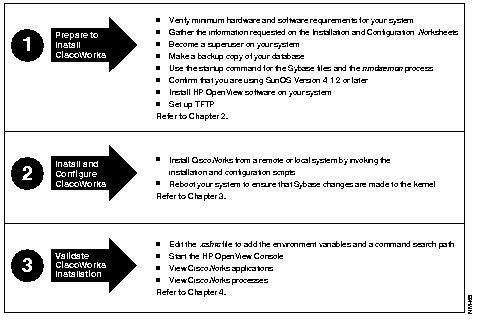
Figure 1-1: Document Roadmap



