After AtmDirector is installed on your system, you can start and shut down the application by entering the correct commands from the UNIX command line. Command options allow you to perform special functions, such as running AtmDirector in debug mode or checking the version of AtmDirector. Refer to Appendix A, "Troubleshooting," for information about using these and other command options.
The AtmDirector application displays a window that provides useful information about your network and options for accomplishing most of the tasks you want to perform.
There are additional utilities that you can execute from the UNIX command line to back up, recover, and enlarge the database. Refer to Appendix B, "AtmDirector Database Management."
To start the AtmDirector application, follow these steps:
Step 1 Log in to your system.
Step 2 Bring up your window manager.
Step 3 Open an xterm window.
Step 4 Change directory by entering the following command:
Note If you installed AtmDirector in a directory other than
CSCOatmd, enter that directory name. If the AtmDirector bin directory is in your search path, you can enter the command to start AtmDirector from any directory.
Step 5 Enter the following command to start AtmDirector:
The system displays the AtmDirector main window.
When you start AtmDirector, the AtmDirector window appears, as shown in Figure 2-1. The window contains the following elements:
- Title bar--Displays the name of the selected network fabric map.
- Menu bar--Provides access to all AtmDirector functionality. Table 2-1 through Table 2-6 list and explain the options under each menu.
- Toolbar--Provides quick-access buttons for accessing the Update, Navigator, OAM Ping, SPVP Setup, VC List, Zoom In, and Zoom Out options.
- Fabric list--Contains a list of ATM network fabric maps.
- Topology map--Shows the topology map for the selected network fabric map.
- Status bar--Displayed at the bottom of the window. Provides the application name, a New Device Counter box showing the number of new devices discovered since the map was last updated, and a Status icon showing the status of the discovery process. The status icon is yellow with a happy face when discovery is running and blue with a sad face when discovery is not running.
Figure 2-1: AtmDirector Window
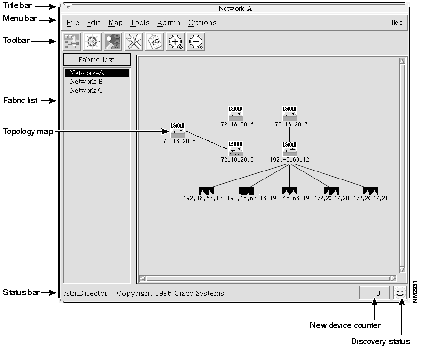
Table 2-1: File Menu Options
| Option
| Description
|
|---|
| Print
| Brings up a window where you can select whether to print the entire map or only the part of the map that is visible. You can print the map to a printer or to a file.
|
| Close
| Closes the current topology map window.
|
| Exit
| Closes all windows and exits the application.
|
Table 2-2: Edit Menu Options
| Option
| Description
|
|---|
| Delete
| Lets you delete a device or a link.
|
| Rename Fabric
| Displays a window for changing the name of a network fabric.
|
| Update
| Adds new devices to the topology map. New devices are those that have been discovered since the map was opened or updated.
|
Table 2-3: Map Menu Options
| Option
| Description
|
|---|
| Navigator
| Opens a navigation window for viewing a specific area of the network topology map.
|
| Zoom In
| Increases the size of the objects in the topology map and narrows the view area.
|
| Zoom Out
| Decreases the size of the objects in the topology map and widens the view area.
|
| Object
| Displays a cascaded menu that provides options for managing objects.
|
|
| Option
| Description
|
|
| Describe
| Shows detailed information about the selected device or link.
|
|
| CiscoView
| Invokes CiscoView for the selected device.
|
|
| Hide endhosts
| Conceals the end hosts and links connected to the selected switch from view on the topology map.
|
|
| Show endhosts
| Reveals all of the end hosts and links connected to the selected switch on the topology map.
|
|
| Manage/Unmanage
| Tells AtmDirector to poll the device for status information. Unmanage tells AtmDirector not to poll the device for status information.
|
| Refresh
| Redraws the AtmDirector windows.
|
| Relayout
| Redraws the topology layout in a default layout.
|
| New Devices
| Displays a list of devices discovered since the last update. After the topology map is updated, this list is cleared.
|
Table 2-4: Tools Menu Options
| Options
| Description
|
|---|
| OAM Ping
| Initiates an OAM ping to a selected device and link.
|
| Soft PVC/PVP Setup
| Displays a window that lets you set up a SPVC or SPVP between end hosts.
|
| VC List
| Displays a cascaded menu for choosing the VCs to list. You can select all connection or connections by SVC addresses.
|
Table 2-5: Admin Menu Options
| Option
| Description
|
|---|
| Clear State
| Resets the previously down status of the selected device.
|
| Clear State All
| Resets the previously down status of all devices in the fabric.
|
Table 2-6: Options Menu Options
| Option
| Description
|
|---|
| Global Options
| Opens the Global Options window, where you can configure discovery SNMP polling parameters (polling interval, timeout, and retries) and miscellaneous parameters (default network fabric and zoom factor). You can also turn on and off topology and discovery debug options for logging messages.
|



