


|
|

This chapter is a guide to performing an initial (first time) installation of StrataView Plus and associated software programs. There are two methods for installing StrataView Plus:
Most initial installations of StrataView Plus will be preformed using the instructions in in this chapter. The main reason for doing a manual installation is if you need to set up a different raw partition size for Informix. NetView and Motif 1.2 should be installed on your workstation before installing StrataView Plus 8.2. Refer to the installation instructions included with each software product.
Install and brand the WingZ software according to the instructions provided in the WingZ Installation Guide that came with your WingZ software. Follow the WingZ instructions for branding by entering the serial number and key.
The automatic StrataView Plus installer (SPI) is included on the StrataView Plus tape and can be used for most installations of StrataView Plus. The automatic installer checks to see on which hard disk the operating system is installed.
During an initial installation, the SPI will perform only necessary minor changes to the operating system disk drive. These changes include adding required user directories.
Swap space should be two times real memory, as a minimum. The maximum amount of swap space you should allocate would be five times real memory.
To set up the Informix partition, follow these steps:
The installation procedure should appear on your screen. Respond to the prompts, by typing in the appropriate information.
An initial installation of StrataView Plus includes the partitioning of the second disk, setting up Informix and StrataView Plus user and group accounts on the operating system disk, and running the automatic StrataView Plus Installer program (SPI). The SPI script installs Informix and the StrataView Plus application, including the On-Line Help files. After you install the StrataView Plus software, you must configure your StrataView Plus workstation to BPX/IPX interface for either an RS-232 or LAN connection.
Proceed as follows to perform an initial (first time) installation of StrataView Plus:
su password:<superuser password>
StrataView Plus uses the "extract_unbundled" script to install the software from tape. For the IBM AIX system, enter the following commands to copy the "extract_unbundled" script from the StrataView Plus Release 8.2 tape to your hard drive:
cd /tmp
mt -f /dev/rmtn.1 rewind
dd if=/dev/rmtn.1 | tar xvfBb - 20b -f
chmod 777 extract_unbundled
extract_unbundled
This command results in the following message:
Enter media drive location [local | remote]:lEnter Device Name (e.g. rst0, rmt0, rfd0c) : /dev/rmt0{you type mt0 for /dev/rmt0}**Please mount the release media if you haven't done so already.**Press return when ready:
The following product will be installed:2+0 records in2+0 records out
StrataView Plus 8.2.02Copyright (c) 1997 StrataCom, Inc. All rights reserved.This software product is copyrighted and all rights are reserved byStrataCom, Inc. StrataCom, Inc. reserves the right to make periodicmodifications to this product without obligation to notify any personor entity of such revision. Copying, duplicating, selling, or otherwisedistributing any part of this product without the prior written consentof an authorized representative of StrataCom, Inc. are prohibited.StrataCom, IPX, IGX, BPX,AXIS, FastPad and FastPacket are registered trademarks andStrataView Plus is a trademark of StrataCom, Inc.Do you want to continue [y|n]? y*** Starting main driver script at Jan 22 13:45:15 PDT 1997. *********************************************************************************** Welcome to the StrataView Plus Installer! ** This program will install StrataView Plus software ** on your workstation. ** ** Copyright (c) 1997 StrataCom, Inc. All rights reserved. ** *************************************************************************************************************************************** Running pre-checks for main driver. ********************************************************** Checking basic setup. ***Checking that user is root.Checking core script files*** Determining type of installation. ***>> This installer will automatically perform the configuration necessary>> for StrataView Plus. If you have special configuration needs, you can>> just load the StrataView Plus files from tape and perform the rest of>> the configuration manually.
Follow the procedures described in this chapter to install StrataView Plus manually.
You will need the following items to complete the manual installation:
You must create a group name and account number for the Informix database. The group account number [79] must be used, as it is already incorporated into the files on the software installation tape. You will also create a group for the svplus user account.
root, if not do so now.
/etc/group file by adding the following two lines:
users:*:21:svplus
informix:*:79:informix
cd /usr/etc/install <RETURN>
/etc/group file.
mk_user informix id= '270' Pgrp = 'informix' home = '/usr/users/informix' shell= '/bin/csh' gecos='Informix Software' informix <RETURN>
mk_user informix id= '271' Pgrp = 'users' home = '/usr/users/svplus' shell= '/bin/csh' gecos='StrataView Plus' svplus <RETURN>
setenv  LD_LIBRARY_PATH /lib:/usr/lib/x11:/usr/lib <RETURN>
setenv  INFORMIXDIR  /usr/users/informix  <RETURN>
Save the file and exit the editor.
chown svplus /usr/users/svplus/.cshrc <RETURN>
This completes the creation of the SV+ and Informix accounts.
The installation script guides you through the Informix ESQL/C and Informix OnLine installation procedure.
Installing directory .
Installing directory bin
The script sample included in this section explains the procedure for installing Informix OnLine.
This installation procedure must be run by root (super-user).
It will change the owner, group, and mode of all files of this
package in this directory.  There must be a user "informix" and a
group "informix" known to the system.
Press RETURN to continue,or the interrupt key
(usually CTRL-C or DEL) to abort.
When prompted, enter the serial number and key for the software. The following substitute numbers are provides only as an example.
Enter your serial number (for example, XXX#X999999) > VVV#V123456
Enter your serial number KEY (uppercase letters only) >
ABCDEF

NOTE:  This INFORMIX SOFTWARE, INC. software is licensed for
use by unlimited SIMULTANEOUS USERS on this computer system.
Press RETURN to continue,
or the interrupt key (usually CTRL-C or DEL) to abort.
Installing directory .
Installing directory bin
Installing directory lib
Installing directory msg
Installing directory etc
Installing directory release
Installing directory forms
Installing directory demo
Installing directory demo/dbaccess
Installation of INFORMIX-OnLine complete.
Running the final StrataView Plus configuration program.
Verifying user and group accounts.
Verifying the check-sums of the extracted files.
Initializing the database.
Perform the following steps to install StrataView Plus:
INSTALL
StrataView Plus uses FrameViewer to display the IPX/BPX Online Help files. The INSTALL script adds FrameViewer to your system.
Welcome to the On-Line Help INSTALLATION of StrataView Plus Checking for the existence of On-Line Help... Installing Frameviewer... Reconfiguring user setup files... Adding Frameviewer environment strings... ./fmusersetup: The FrameMaker user installation program. This script is used to reconfigure your path setting. When you are asked a yes or no question below, type the letter 'y' or 'n' and then press Return. Note that the default answer (shown in brackets next to the question) is usually correct. To use the default answer, press Return in response to the question. Would you like a description of what this script does? [y]:y <RETURN>Checking installation... FrameMaker is not already installed in your .cshrc file. OK to add these two lines: ---- # FMHOME line added by the FrameMaker user's setup program setenv FMHOME /files/users/svplus/frame; set path=( $FMHOME/bin $path ) ---- to /usr/users/svplus/.cshrc? [y]:y <RETURN>------------------------------------------------------------ OK. Adding the lines to the end of your .cshrc file Original version of .cshrc saved in /usr/users/svplus/.cshrc.fmsave. FrameMaker installation in your .cshrc is now complete. Press Return to continue. (You may want to remove old or redundant copies of FrameMaker) IMPORTANT: ------------------------------------------- In order for the changes in your login file to take effect, you MUST exit X windows and log out *completely* (until you see the UNIX 'login:' prompt). Then log in and start X windows. From then on, you can start FrameMaker from any X windows window by typing: maker ----------------------------------------------------- Please exit X windows and log out and back in again. ------------------------ Please be sure that each person who wishes to use FrameMaker runs this installation script (./fmusersetup). If any files were changed by this script there will a corresponding .fmsave file produced that contains the original version of the file. To be sure that this script changed things appropriately, you should diff the files. IMPORTANT: Don't forget to log out completely now so that the changes to your login file will take effect.
Licensing Frameviewer..
Frameviewer has already been licensed ..
Do you wish to verify the Frameviewer installation (y/n)? n <RETURN>
Normally, "n" is chosen, as verification of FrameViewer takes considerable time, and successful installation of FrameViewer is verified by the satisfactory operation of the IPX/BPX On-Line Help.
The following message appears:
Bypassing On-Line Help Installation Verification
INSTALLATION has completed !
The BPX/IPX On-Line Help files for StrataView Plus come on a separate tape that is installed after StrataView Plus has been installed.
Proceed as follows to install the IPX On-Line Help files:
mkdir onlinehelp
cd /usr/users/svplus/onlinehelp
pwd
tar xvpf /dev/rmt0
cd ..
The Statistics Collection Manager (SCM) files for StrataView Plus are installed by SPI as part of the StrataView Plus installation. If there are multiple NMS workstations used to control the network or if this is a structured network, you must upgrade each instance of StrataView Plus and configure SCM on each NMS workstation. Proceed as follows to configure the network for management by SCM:
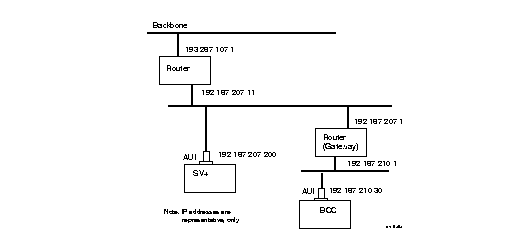
192.187.207.1 alpha
exit
The config.sv file contains a single line (or lines for more than one network or domain) of parameters used by StrataView Plus to establish a connection to the BPX/IPX node at startup. After both an upgrade and an initial installation, this file will contain the default values (user configurable) of /dev/ttya and 9600.
For an initial (first time) installation of StrataView Plus, the default parameters gateway and 9600 are not applicable. the config.sv file should be modified to set up the required links from StrataView Plus to the attached network(s) or domains.
Configure the workstation interface to the node LAN port as follows:
0|Network1|sanfran|19200|0|7|3|0|30|1024|8.2|IP-OFF
Leave the other fields as is. For example, the baud rate of 19200 does not apply to a LAN connection.
Follow the instructions in Section to configure your StrataView Plus system for a BPX/IPX LAN port.
StrataView Plus uses one file for all network configurations; therefore, if more than one network is supported by StrataView Plus, just duplicate the first line and change the network id (first field, which must be unique), the network name and serial port (and perhaps the baud rate and telephone number). For example, for a second network, duplicate the first line and change the first field to 1, the second field to Network2 or any name you want for this field, and the port to ttyb. In this example, the other parameters are the same for the second network.
You would then have:
0|Network1|/dev/ttya|19200|0|7|3|0|30|1024|8.2|IP-OFF
1|Network2|/dev/ttyb|19200|0|7|3|0|30|1024|8.2|IP-OFF
StrataView Plus uses one file for all domain configurations; therefore, if more than one domain is supported by StrataView Plus, first change the network name in the first line from Network1 to Domain1. (You can use any name you want; Domain1 is just an example.) Then just duplicate the first line and change the domain id (first field, which must be unique), the domain name and serial port (and perhaps the baud rate and phone #). For example, for a second domain, duplicate the first line and change the first field to 1, the second field to Domain2, and the port to ttyb. For a third domain, duplicate the first line and change the first field to 2, the second field to Domain3, and the port to ttyDD (e.g., for a terminal server). In this example, the other parameters are the same for the second and third domains. You would then have:
0|Domain1|/dev/ttya|19200|0|7|3|0|30|1024|8.2|IP-OFF
1|Domain2|/dev/ttyb|19200|0|7|3|0|30|1024|8.2|IP-OFF
2|Domain3|/dev/ttyDD|19200|0|7|3|0|30|1024|8.2|IP-OFF
Use a serial connection only when using the StrataView Plus workstation as a dumb terminal. For StrataView Plus operation, StrataView Plus should be configured for LAN operation. Configure the workstation interface to the node control port as follows:
0|Network1|/dev/ttya|19200|0|7|3|0|30|1024|8.2|IP-OFF
where:
The first field is the network id and must be unique.
IPXAdmin -p/dev/ttyXX -ebaud_rate
For example, for a serial port of ttya at 9600 bps, or a terminal server port of ttyDD at 19,200 bps, you would enter the following, respectively:
IPXAdmin -p/dev/ttya -e9600
IPXAdmin -p/dev/ttyDD -e19200
To test that a LAN connection to the IPX/BPX port is okay, for example, a hostname of "sanfran" entered in the config.sv file, you could enter the following:
ping sanfran
Press shift-backspace (or shift-delete, and return, also) a few times and the Node Administration Window should appear. The window should show an IPX/BPX response such as "Enter User ID". If it does not, the link is not working correctly. Click on the DISMISS button on this screen to dismiss it and exit. On a serial port, the IPX control port defaults to 9600 baud. If it is not at 9600, you will have to try a different rate, probably 19200, in the IPXAdmin -p/dev/ttyXX -ebaud_rate command in order to establish a link.
If the System Administrator takes care of the addressing for the workstation, including the /etc/services file, proceed to step 3. If not, and an NIS is not being used, do the following:
Internet Address																		192.187.207.200
Host Name 	hedgehog
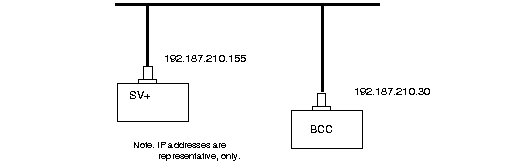
Internet Address			192.187.210.30
Host Name		sanfran
IPX_PORT 5120/tcp ipx_port
The Official Internet Service Name IPX-Port
Transport Protocol tcp
Socket Port Number 5120
Unofficial Internet Service Names IPX-Port
0|Network1|sanfran|19200|0|7|3|0|30|1024|8.2|IP-OFF
Leave the other fields as is. For example, the baud rate of 19200 does not apply to a LAN connection.
The cnflan command configures the node's communication parameters so that the node can communicate with a StrataView Plus terminal over an Ethernet LAN using the TCP/IP protocol. The parameters contain address information about the Ethernet TCP/IP network that is used to connect the StrataView Plus station to an IPX or BPX node. The values used must conform to those of the network and should be supplied by the Ethernet network administrator.
The cnflan command has the following parameters:
D2.cb1         LAN   StrataCom       BPX 15    8.2 Oct. 1996 14:23 PST
Active IP Address:                     192.187.210.30
IP Subnet Mask:                        255.255.255.0
TCP Service Port:                      5120
Default Gateway IP Address:            192.187.207.1
Maximum LAN Transmit Unit:             1500
Ethernet Address:                      00.55.43.00.04.55
Control Socket - Ready
Base Socket Descriptor - 1
Socket Closed
Last Command: cnflan
Next Command:
ping sanfran
D2.cb1         LAN   StrataCom       BPX 15    8.2 Oct. 1996 14:27 PST
Active IP Address:                     192.187.210.30
IP Subnet Mask:                        255.255.255.0
TCP Service Port:                      5120
Default Gateway IP Address:            192.187.207.1
Maximum LAN Transmit Unit:             1500
Ethernet Address:                      00.55.43.00.04.55
Control Socket - Ready
Base Socket Descriptor - 1
Open Socket Descriptor - 2
Last Command: dsplan
Next Command:
The first time that StrataView Plus is started, it obtains the current network topology information and enables default trunk and circuit line statistics that you selected using the SCM software.
Before starting up StrataView Plus, you need to plan the statistics types that you want to enable automatically and enable these using the SCM program. Refer to Chapter 5 of the StrataView Plus Operations Guide for information on enabling statistics using SCM.
Start up StrataView Plus as follows:
SV+
If you have not done so, please refer to Appendix C, Informix Database, Backup and Changing Size, in the StrataView Plus Operations Manual.
The following paragraphs describe how to connect an StrataView Plus workstation to a BPX/ IPX node via a modem. These procedures are for a typical connection. Refer also to the applicable Sun SPARCstation System Administration User's Guide, and the Codex V.34 RSA Modem User's Guide.
Contact StrataCom ISC for further information.
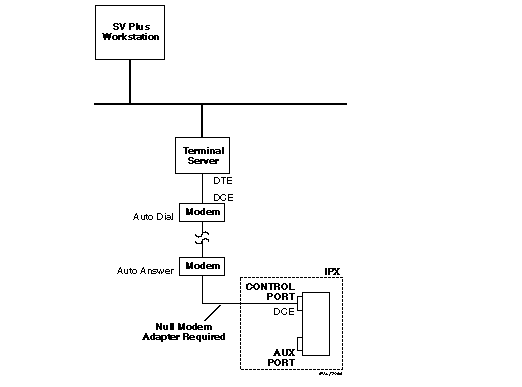
The connection of a StrataView Plus workstation to an IPX via a terminal server and modem is shown in Figure 2-5.
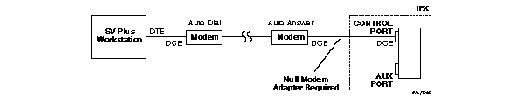
The connection of a StrataView Plus workstation to an IPX via modem (without using a terminal server) is shown in Figure 2-6.
The following commands are provided for configuring the Codex V.34 RSA modem.
Using the cnfport command, set the IPX Control port (CONTROL TERMINAL port) to 9600 bps and disable the XON/XOFF flow control. Using the cnfportfunc command, set the terminal type to VT100/StrataView. To program the modem, temporarily attach a terminal to the modem using a 25-pin straight through cable. The modem EIA port will automatically match the 9600 bps setting of the terminal. Enter the following commands:
| 1. | AT&F | Reset to factory default and save. |
| 2. | ATSØ=1 | Enables Auto-Answer Mode (answer on first ring). |
| 3. | ATL1 | Modem speaker at low volume. |
| 4. | AT*SM3 | Enables automatic MNP error correction. |
| 5. | AT*DCØ | Disables data compression. |
| 6. | AT*FLØ | Disables XON/XOFF flow control. |
| 7. | AT&S1 | Sets DSR to "normal". |
| 8. | ATEØ | Disables local character echo. |
| 9. | ATQ1 | Disables result codes. (Modem will appear "dead".) |
| 10. | AT&W | Saves current configuration settings in non-volatile memory. |
Connect the workstation to the modem, with the serial port set to 9600 bps, using a 25-pin straight-through cable (uses RS-232 protocol) and enter the following commands:
| 1. | AT&F | Initializes factory defaults. |
| 2. | ATLØ | Modem speaker at minimum volume. |
| 3. | AT*SM3 | Enables automatic MNP error correction. |
| 4. | AT*DCØ | Disables data compression. |
| 5. | AT*SC1 | Enables DTE speed conversion |
| 6. | AT*FLØ | Disables XON/XOFF flow control. |
| 7. | AT&C1 | DCD controlled by modem. |
| 8. | AT&D2 | Modem disconnects when IPX toggles DTR. |
| 9. | AT&V | Verify entries. |
| 10. | AT&W | Saves current settings to non-volatile memory. |
For information on configuring an IBM workstation for communication via modem, refer to the applicable IBM user's guides.
The StrataCom ISC (International Support Center) can provide support for the customer StrataView Plus workstation via a dial-up modem connection. This support is available when a Motorola Codex modem is provided at the customer site. There are two procedures to be performed before the ISC can dial into the workstation.
The following paragraphs describe how to set up a dial-in connection. These procedures are for a typical connection. Refer also to the applicable IBM product's System Administration User's Guide, and the Codex V.34 RSA Modem User's Guide.
The connection from StrataCom ISC to a StrataView Plus workstation via a terminal server and modem is shown in Figure 2-7.
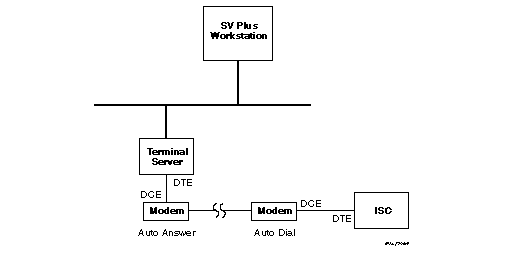
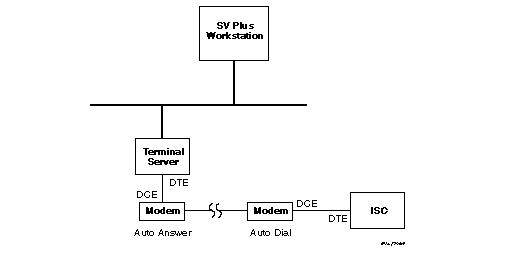
The connection from StrataCom ISC to a StrataView Plus workstation via a modem is shown in Figure 2-8.
Setup of an IBM Workstation for incoming modem calls:
ttyb "/usr/etc/getty D9600" dialup on remote
ps -ef | fgrep getty
Note the process ID so you can kill it and restart the getty.
kill -9 <process ID>
kill -HUP 1
This command restarts the new getty.
Configure the modem connected to the workstation per the Auto Answer procedure.
| DCD - On | AT&CØ |
| DTR - On | AT&DØ |
| DSR - Normal | AT&S1 |
| CTS - ON when connected | AT&R1 |
| ATSØ=1 (answer on first ring) |
When the system is up, the ISC is capable of calling into StrataView Plus via the serial port on the workstation.
This section describes how to start a copy of the GUI on another user's workstation.
The workstation must have the following software installed:
Multiple WingZ licenses are required for multiple users.
xhost <host-workstation-name>
For example, where the local workstation is maui:
in csh:setenv DISPLAY maui:0.0in sh or ksh:export DISPLAY;DISPLAY=maui:0.0
cd /usr/users/svplus
SV+
to display the StrataView Plus main menu, and select option 3 (Start DeskTop).
192.9.200.8 xt008
/usr/lib/X11/ncd fonts
/usr//bin/x11/xhost +
setenv DISPLAY xtname:0.0
source setncd.csh
|
|