


|
|

This chapter describes how to install and remove the Catalyst 2820 modules and how to use the module LEDs to interpret the results of the module power-on self-test (POST). When unpacking the Catalyst 2820 modules, check the contents of the package against the list in "Packing List" in the "Introduction" chapter.
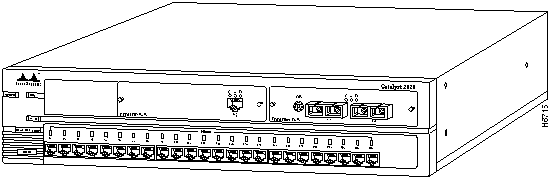
Blank faceplates on the Catalyst 2820 cover the high-speed expansion slots, as shown in Figure 2.1.
Figure 2-1 : Catalyst 2820 with Blank Faceplates
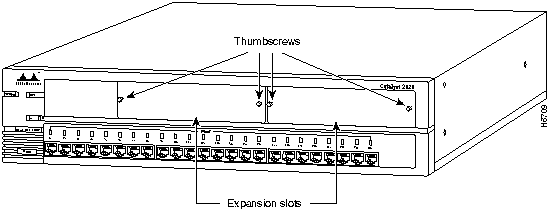
To remove a faceplate, follow these steps:
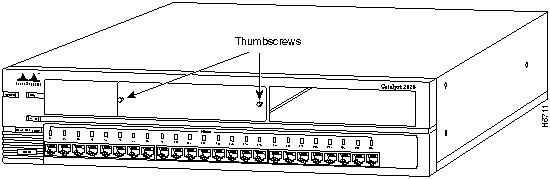
Figure 2-2 : Catalyst 2820 with an Empty Expansion Slot After the faceplate has been removed, follow these steps to install a module in an empty Catalyst 2820 high-speed expansion slot:
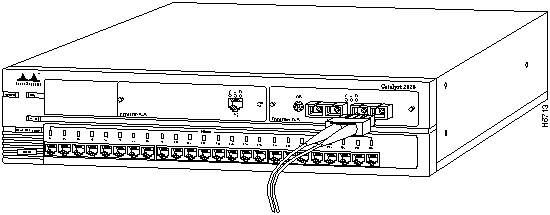
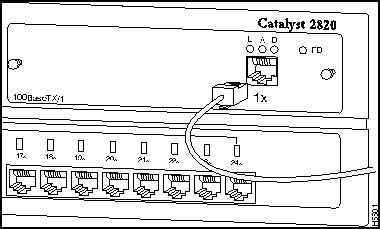
Figure 2-3 : Attaching a Fiber-Optic Cable to the FDDI Module Figure 2-4 : Attaching a UTP Cable to a 100BaseT Module
Figure 2-5 : Installed FDDI Modules Figure 2-5 shows a Catalyst 2820 with two FDDI modules installed. To remove a module from a Catalyst 2820 slot, follow these steps:
When first powered on, the expansion slot LED of the Catalyst 2820 and all LEDs on the module front panel are green. A power-on self-test (POST) is automatically started. If the module passes the POST, the expansion slot LED (A or B) on the Catalyst 2820 remains green. If the module fails the POST, the expansion slot LED turns amber.
If an FDDI module fails the POST, the LEDs on the module indicate the type of failure. Table 2-1 shows how to use the LEDs to interpret POST failures.
For more information about the A and B expansion slot LEDs, refer to the Catalyst 2820 and Catalyst 1900 User Guide.
Table 2-1 : LED Indicators of Failed FDDI POST
When first powered on, all LEDs on the module front panel are green, and a POST automatically begins. If the module passes POST, the expansion slot LED (A or B) on the Catalyst 2820 remains green. If the module fails POST, the expansion slot LED turns amber.
For a complete description of each LED, see "100BaseT Module LEDs" in the chapter "Introduction."
Copyright 1988-1996 © Cisco Systems Inc.


Failed Component
Connected LED
Activity LED
Disabled LED
Response
CPU
On
On
On
Call for assistance.
FLASH
On
On
On
Local RAM
On
On
On
Shared RAM
Slow blink
On
Slow blink
Start the management console and check for errors.
100-Mbps controller
Slow blink
Slow blink
On
FDDI controller
Slow blink
On
On
ES loopback test
Fast blink
Slow blink
On
FDDI loopback test
Fast blink
On
On
Player+ (A)
On
On
Fast blink
Player+ (B)
On
Fast blink
On

