


|
|
This chapter provides a tutorial describing virtual LAN (VLAN) concepts and configuration issues to consider as you design and set up the Cisco ATM PCI Adapter for network operation. Because ATM supports multiple networking solutions, you should understand VLAN concepts before choosing a particular method for your site. If you already understand these issues, skip to Chapter 5, "Using Cisco ATM Administrator to Customize Your ATM System."
ATM design and communication methods are described emphasizing ATM applications that use IP over ATM and LAN Emulation protocols. The terms IP over ATM (IPATM) and/or Logical IP Subnet (LIS) are used when referring to IP over ATM Logical Subnets. The terms LAN Emulation (LANE) and/or Emulated LAN (ELAN) are used when referring to LAN Emulation.
A virtual LAN (VLAN) is an arbitrary grouping of nodes utilizing a similar protocol on the network (Figure 4-1). This promotes efficient use of network resources and facilitates optimal distribution of repetitive network transactions.
Figure 4-1 : Cisco ATM Implementation of a Subnet is a "VLAN"
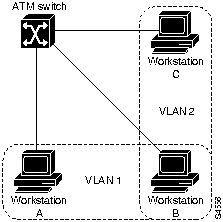
The ATM network technology -- with its connection orientation, physical link and speed independence, and ability to provide guaranteed quality of service -- is an enabler for new applications. Additionally, ATM is quite useful for improving the quality and performance of current computing applications. To be effective, however, the ATM network must be compatible with existing applications.
Conceptually, a virtual LAN allows the network administrator to structure, separate or partition an ATM network to match the structure and organization used by existing protocols and applications. These structures in existing LANs are, for example, subnets in IP networks or broadcast domains in bridged networks. These logical structures typically have been closely linked to physical network elements; a single LAN segment is a collision domain, and if connected to a router LAN port, is often also an IP subnet.
When multiple LAN segments are bridged together, the bridged segments still "see" all broadcast and multi-cast traffic on each LAN that is physically connected to the bridges and shared media hubs. The number of stations or LAN segments that can be bridged without exceeding practical broadcast traffic loads is limited. Therefore, networks must be divided into subnets; the subnet structure (Figure 4-2) is limited by the physical LAN structure.
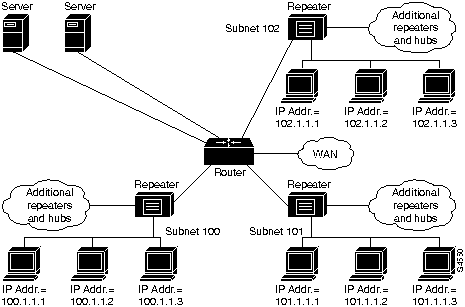
In ATM networks, the connection-oriented nature of the switching technology and the use of dedicated media per port differs from the shared media notion that is common in hubs. Because of this difference, there is no inherent relationship between the physical location of a node and the subnet, broadcast domain, or similar protocol group of which the node is a member. To allow the use of subnets and similar concepts where appropriate, the Cisco ATM software provides a virtual LAN concept.
A node can be configured using the Cisco ATM Administrator to become a member of one or more virtual LANs. In this way, nodes can be arbitrarily connected together to form heterogeneous network(s).
The driver software must recognize the local Cisco ATM PCI Adapter, as well as any connected network nodes. To enable the driver to identify these addresses, you must configure virtual LAN(s), thereby indicating the subnet(s) of which the local endstation will attempt to become a member.
As with Ethernet adapters, the Cisco ATM PCI Adapter supports applications transmitting over standard protocol stacks (TCP/IP, SPX/IPX, Netbeui, etc.). Beneath the network layer, however, a variety of low-level ATM drivers have been implemented to support emerging ATM hardware in a modular fashion. Two distinct paths are available to act as an interface between the network and AAL layers. This requires that you choose the appropriate protocol(s) for your particular site.
You must configure virtual LAN(s) to comply with the needs and capabilities of the host workstation and the network. For a particular VLAN, choose one of the following low-level ATM protocols to serve as an interface between ATM and the IP layer:
Cisco ATM software provides support for any combination of the following connection types:
A Permanent Virtual Circuit (PVC) is a virtual channel that is manually established between ATM endstations. A PVC is statically configured and requires that each direction of the connection be manually configured at the endstation to identify the other. Also, Virtual Path Identifier (VPI) and Virtual Circuit Identifier (VCI) tables must be configured in switches and in endstations for the entire path of the connection. A network management system may aid in the management of PVC connections.
Ideally, PVC connections should only be implemented if there are relatively few endstations, where the endstations are not likely to be physically moved or removed from the network, and/or SVC signaling software is not available for connected network devices. For example, if one endstation is removed, all remaining endstations connected to the node will require modification (i.e., to delete the PVC entry for the removed node from the VPI/VCI table).
Once a PVC is established between two endstations, it remains as a permanent connection until one of the endstations terminates the link.
Signaling provides a mechanism to establish SVC connections between endpoint devices. In operation, signaling messages are exchanged over the predefined signaling channel, where VPI = 0 and VCI = 5. The switch and the endstation negotiate an available channel and the SVC is established. This allows for dynamic communication between the switch and the endstation.
A Switched Virtual Circuit (SVC) is a virtual channel that is dynamically established, using signaling software, between ATM endstations. Signaling software in the Cisco ATM driver (on the host system) negotiates through the ATM switch over a specific VPI/VCI channel (0/5). An available channel is identified and an SVC connection is established.
SVC connections provide more efficient resource utilization and universal connectivity. Unlike PVC connections, SVC connections support automated administration and do not require a network management system for configuration of the channel. In fact, an administrator of the ATM address (i.e., connection table) is the only management required for SVC operation; this requirement is further simplified if ILMI is available.
SVC connections are virtual channels that are both dynamically opened and dynamically closed. If the channel is not used for a specified period of time, then it closes, to optimize resources.
Classical IP and ARP over ATM, defined in RFC1577, is aimed at making IP run over ATM in the most efficient manner, utilizing as many ATM facilities as possible. IP over ATM considers the application of ATM as a direct replacement for the "classical" LAN-based model. RFC1483 defines the encapsulation of IP datagrams (or other protocols) directly in AAL5.
The IP over ATM protocol provides a useful mechanism for ATM client to ATM server connectivity. While IPATM is not suitable for running Ethernet clients on an ATM network, it is the most efficient protocol for configurations utilizing IP applications in which every network device (e.g., workstations, servers, switches) supports common ATM capabilities.
One member of the virtual LAN (VLAN) is designated as the server. The server must initialize the VLAN (usually performed on boot up) before the member clients attempt to join.
As shown in Figure 4-3, the following components perform IPATM services on the ATM network:
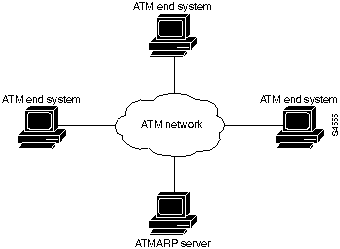
An ARP Server must be set up for each virtual LAN (VLAN). The ARP Server is an internal instrument that identifies the ATM address of network endpoints.
When the ARP Server is passed an IP address, it scans the table for the value and returns the corresponding ATM address of a registered endstation.
A client ARP table is located on each ATM client. After a virtual LAN is initialized, ARP Table entries may be added or removed.
The IP protocol queries the IPATM module to request the ATM address associated with a given IP address. The IPATM module sends a query to the Client ARP Table as the quickest way to achieve this data. Data contained in the Client ARP Table is built both dynamically (when the ATM user makes a transmittal, the ATM address is automatically stored in the Client ARP Table) and statically (when the information has been "hard coded" into the Client ARP Table). A combination of these methods is desirable because the dynamic data contained in the Client ARP table will time-out after a given period, and certain ATM addresses prefer to be permanently listed in the Client ARP Table. If the ATM address is known to the Client ARP Table, the information is sent from the IP/ATM module to the IP module. If the ATM address is not known to the Client ARP Table, it is because that ATM Addressee has not sent or received data recently.
The Client ARP Table then forwards the query to the ATMARP Server. If the ATMARP Server contains the requested data, it is sent to the IP Module via the Client ARP Table (where the information is dynamically built into the table). If the address is unknown to the ATMARP Server, the transmission cannot take place because the address is not known to any of the Client ARP Tables that communicate with the server.
The last piece of the query is the state of the linkage between the IP address, ATM address and the VPI/VCI connection. This data is contained in the ARP Conn Table. The purpose of this screen is to provide the following information:
A server ARP table is needed for VLANs configured for IPATM only. The server ARP table is located on the ARP Server (an ATM endstation with the server ARP table designated as "Local").
When a client workstation session is started (e.g., on boot-up of the system) a new entry is automatically added to the server ARP table, indicating the IP address and the ATM address of the host adapter.
When connection to an ATM client is desired, application software running on the host workstation first queries the client ARP table (located on the host workstation) to identify the target's ATM address. If the target IP address is not found in the client ARP table, the application software queries the ARP Server.
If an entry in the server ARP table matches the requested IP address:
The application software may then open a channel to the target ATM client. Upon each successful query of the server ARP table, an entry is added to the client ARP table. After the connection is established, and information is transferred, the entry remains in the client ARP table to minimize redundant queries of the ARP Server.
In order to establish an ATM connection at the UNI, both the user and the network must know the ATM address(es) which are in effect at that UNI. These ATM addresses are then available for use in Calling Party Number and Called Party Number information elements of signaling messages sent by the user.
Address registration procedures provide the means for the dynamic exchange of addressing information between the user and the network at the UNI, at initialization and at other times as required. Through this dynamic exchange the user and network can agree on the ATM address(es) in effect.
Even though ATM is conceptually different than a TCP/IP network, an IP address can be assigned to the Cisco ATM PCI Adapter for IPATM processing. This assignment will enable the Cisco ATM PCI Adapter to communicate with other devices on the network using TCP/IP protocol.
When configuring a virtual LAN (e.g., using the Cisco ATM Administrator), you will be prompted for the IP address(es) of adapters that are installed in the host and target workstations. For assistance in determining the IP address of the host system, consult your network administrator.
Along with the IP address, a subnet mask can be defined for the ATM network. The subnet mask is used to distinguish between the portion of an IP address that identifies the network and the part that identifies the network nodes (hosts).
The subnet mask is used by routers, bridges and other network devices in order to route packets to the proper location. The network part of the IP address tells the device whether the destination for the packet is on the same network or a different one. Once the correct network for the packet is identified, the host portion is used to determine the packet's endpoint (destination or source).
The subnet mask is specified as decimal "dot" notation. Thus, all nodes using an IP address with the same network address will receive broadcast packets. For example, devices on the 200.10.1 subnet might have an IP address in the range from 200.10.1.0 to 200.10.1.254.
Multiple virtual LANs are supported for each physical link connected into the subsystem. This enables multiple subnets to share the same physical link. As such, the subnets are capable of a different Quality of Service (e.g., dissimilar traffic characteristics) for each virtual LAN (VLAN).
The total aggregate rate is 136 Mbps after accounting for SONET and ATM overhead. On a per VLAN and/or PVC basis, the traffic characteristics are configured by setting the peak data rate, average data rate, and minimum data rate. The actual speed will be parceled as necessary for packet transmission by dividing the number of VLANs and taking into consideration the traffic characteristics for each VLAN.
Table 4-1 Quality of Service - VLAN Parameters
| Parameter | Description | Range | Def | Units |
|---|---|---|---|---|
| Peak Data Rate | Maximum rate at which cells are allowed to transfer over the connection. | 1-136 | 136 | Mbps |
| Average Data Rate | Average (sustained) rate at which cells are allowed to transfer over the connection.The specified value must be at or below the peak data rate. | 1-136 | 136 | Mbps |
| Maximum Burst | The maximum number of cells that can be sent at the peak rate. Burst size is not used if the average rate is set equal to the peak rate. | 1-255 | 10 | Cells |
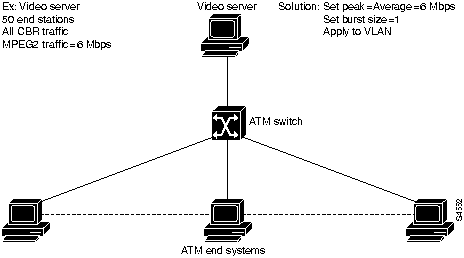
Video and video/data servers with multimedia endstation clients are typical IP over ATM applications. Figure 4-4 and Figure 4-5 illustrate traffic shaping for video applications.
In Figure 4-4, a single video server uses constant bit rate (CBR) traffic for video data and sets the peak and average data rate to 6 Mbps for the VLAN. This value is applied to all channels on this VLAN.
Figure 4-4 : Traffic Shaping for a Video Server
In Figure 4-5, the two types of data traffic are required: CBT video and data variable bit rate (VBR). The video utilizes its own VLAN for LBR traffic. The data traffic in the above example utilizes two VBR traffic patterns by using a VLAN for each VBR traffic pattern desired.
Figure 4-5 : Traffic Shaping for Video and Data
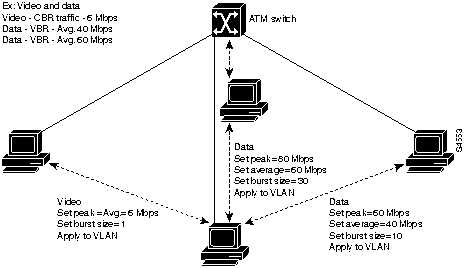
Figure 4-6 illustrates traffic shaping to limit data to a low bandwidth LAN or WAN.
Figure 4-6 : Traffic Shaping for Limiting Traffic
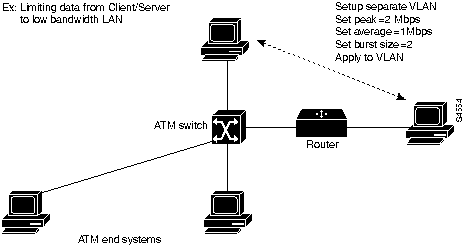
A useful application for traffic shaping is when you want to limit data to a low bandwidth LAN or WAN. In this example, the channels setup for the low bandwidth LAN is limited to a peak value of 2 Mbps with an average value of 1 Mbps. This limits the amount of data on the VLAN and minimizes congestion problems.
To support existing applications operating in a LAN with Ethernet endstations, an ATM network must have an interface at the desktop, or endstation and router, which emulates the behavior of a shared media LAN, such as Ethernet. The ATM Forum LAN Emulation (LANE) Specification defines how ATM endstations and legacy LAN systems (e.g., Ethernet) attached to the ATM network by bridges, edge devices, and routers establish connections in order to build a heterogeneous network. LANE emulates the disparities between shared or switched LANs and connection-oriented ATM networks.
LANE permits seamless execution of existing LAN applications over the combined ATM/Ethernet network. By allowing the LAN-based applications to run without changes the ATM network acts as a backbone, interconnecting existing LANs and their associated servers or workstations. Therefore, the LAN can be upgraded to ATM in a controlled manner to improve performance and enable new applications. One physical ATM network could provide support to many logically separate LANs.
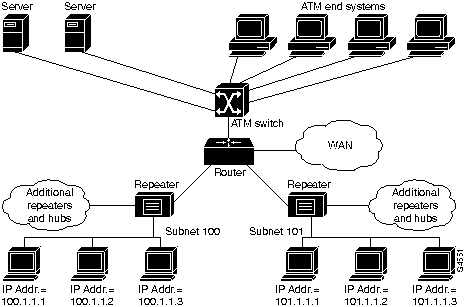
The Cisco ATM implementation of LAN Emulation supports multiple MAC addresses, enabling ATM endstations to communicate over logically separate LANs (VLANs, which are commonly referred to as ELANS). Figure 4-7 depicts a typical LANE network. The ATM endstations and servers can communicate with each other using IPATM on their own VLANS (or LIS), but need to use LAN emulation on a separate VLAN/ELAN for communication with the Ethernet endstations.
Figure 4-7 : Typical ATM Network - LANE
As shown in Figure 4-8, the following components perform LAN Emulation services on the ATM network:
The modules can reside on an ATM router, switch, edge device, or endstation.
Figure 4-8 : LAN Emulation - Client/Server Components
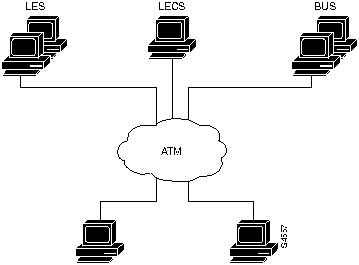
The LAN Emulation Client module (LEC) is loaded on the ATM endstation in the form of the Cisco ATM device driver. The remaining components must be obtained separately in the form of a LAN Emulation Server component and can be located on a router, switch or end system.
The LEC establishes a connection to one or more peer LEC members of a particular VLAN via an initialization phase (described in the following section). An LEC must be identified by a unique MAC address and ATM address for each host VLAN that is running LANE software.
The LANE Configuration Server (LECS) is the administrator of LEC membership to a VLAN. The LEC contacts the LECS to resolve the LES address. The LECS will return the ATM address of the LES based on either a default VLAN, or via the ELAN name or via the LEC's ATM address. One LECS is required for all VLANs within an administrative domain.
The LANE Server (LES) is essentially a table mapping a specific MAC address to a corresponding ATM address. The LEC contacts the LECS and asks to become a member of a particular VLAN. The LES either denies membership or grants membership to the LEC and indicates the address of the Broadcast and Unknown Server (BUS). An LES is required for each VLAN (to provide essential services).
The Broadcast and Unknown Server (BUS) does not look at packets it receives, but can simply distribute data with multicast MAC addresses (the BUS also delivers unicast data prior to establishing a data direct VC between two LEC endstations). A BUS is required for each VLAN.

|
Copyright 1988-1996 © Cisco Systems Inc.