


|
|

Before installing the Catalyst 1200 series switch, read this chapter carefully.
Follow these guidelines to ensure general safety:
Follow these guidelines when working on equipment powered by electricity.
Preventing Electrostatic Discharge Damage
Electrostatic discharge (ESD) can damage equipment and impair electrical circuitry. It occurs when electronic components are improperly handled and can result in complete or intermittent failures. Always follow ESD-prevention procedures when removing and replacing components. Ensure that the chassis is electrically connected to earth ground using an ESD mat or a ground wire. Wear an ESD-preventive wrist strap, ensuring that it makes good skin contact. To safely channel unwanted ESD voltages to ground, connect the clip to an unpainted surface of the chassis frame. To properly guard against ESD damage and shocks, the wrist strap and cord must operate effectively. If no wrist strap is available, ground yourself by touching the metal part of the chassis.
Following are the site requirements for installation.
Choose a clean, dust-free, (preferably) air-conditioned location. Avoid direct sunlight, heat sources, or areas with high levels of electromagnetic interference (EMI).
Make the front panel of the switch accessible so that you can monitor the LED indicators and access the reset switch. Leave at least 24 inches (60.9 centimeters) clearance at the rear of the switch for easier cabling and service.
Two fans, located at the front of the switch, cool the interior by drawing air through vents in the front and forcing heated air through holes in the rear. If the internal temperature exceeds 122°F (50°C), a temperature alarm is generated.
The source electrical outlet should be installed near the switch, be easily accessible, and be properly grounded. Power should come from a building branch circuit. Use a maximum breaker current rating of 20A for 110V, or 8A for 230V. Note the power consumption ratings of the unit before you connect to a power source.
Following are cabling requirements for installation. For cable pinouts, refer to the appendix "Wiring Specifications."
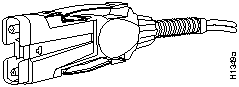
The multimode FDDI connectors on the switch accept 62.5/125-micron multimode fiber, or 50/125-micron multimode fiber, with standard FDDI media interface connectors (MICs). The single-mode connectors accept 8.7 to 10/125-micron single-mode fiber, with standard FDDI ST-type connectors. Table 2-1 lists FDDI maximum transmission distance specifications, and Figure 2-1 and Figure 2-2 illustrate single-mode and multimode connectors, respectively.
Table 2-1 : FDDI Maximum Transmission Distances
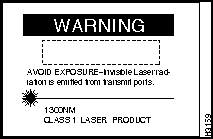
Figure 2-1 : Single-Mode FDDI Interface Connector---ST Type Warning Invisible laser radiation may be emitted from the aperture ports of the single-mode FDDI card when no cable is connected. Avoid exposure and do not stare into open apertures. To see translated versions of this warning, refer to the appendix "Translated Safety Warnings." Following is an example of the warning label that appears on the product:
Figure 2-2 : Multimode FDDI Interface Connector---MIC Type Check all existing cables for conformance with CDDI/MLT-3 distance requirements and to ensure that you have the proper connectors (modular
When you plan your CDDI installation, remember the following:
The IEEE 802.3 Ethernet 10BaseF ports accept ST-type connections using 62.5/125-micron multimode optical fiber. The distance limitation for 10BaseF is 1.2 miles (2 km). 10BaseF supports both the 10BaseFL (fiber link) and fiber-optic interrepeater link (FOIRL) standards.
In general, distance limitations depend on the combined effects of fiber, connectors, and the power levels of other devices on the fiber link. Table 2-2 lists the maximum power levels for 10BaseF and FOIRL.
Table 2-2 : 10BaseF and FOIRL Power Levels
The Ethernet 10BaseT ports accept modular RJ-45 connectors. For pinouts of the Ethernet 10BaseT ports, refer to the appendix "Wiring Specifications." 10BaseT requires a minimum of category 3 UTP cable as specified by the EIA/TIA-568-B wiring standard. The distance limitation for 10BaseT is a maximum of 328 feet (100 m) between segments.
As with all signaling systems, EIA/TIA-232 signals can travel a limited distance at any given bit rate. Generally, the slower the data rate, the greater the distance. Table 2-3 shows the relationship between baud rate and maximum distance. The EIA/TIA-232 admin. port requires a modular RJ-45 connector for the switch end, and an RJ-45-to-DB-25 adapter for the console terminal where it is attached.
Table 2-3 : EIA/TIA-232 Speed and Distance Limitations
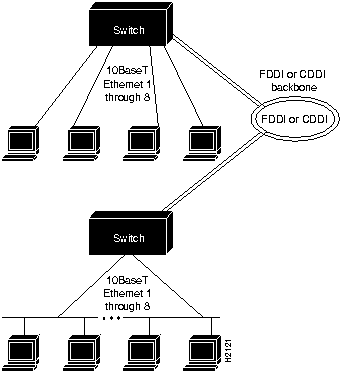
When the switch is installed in your network, the resulting topology might resemble the high-speed transparent and translational bridging overview shown in Figure 2-3. This consists of workstations connected to the 10BaseT Ethernet ports of two switches. The 10BaseF ports might be connected in a similar manner. The switches are connected to a CDDI or FDDI dual ring, which is part of a larger CDDI or FDDI backbone.
Figure 2-3 : High-Speed Translational and Transparent Bridging Topology Operating the switch with a modem is optional. To connect the switch to a modem, you should consult the modem documentation. At a minimum, you need to connect the modem to the EIA/TIA-232 admin. port on the switch. You need to configure the modem to operate with the switch because no configuration is possible at the switch. As an example modem configuration, Table 2-4 lists the dual inline package (DIP) switch settings for the U.S. Robotics Sportster 14,400-baud fax modem.
Table 2-4 : Modem DIP Switch Settings
Table 2-5 provides a list of tools and supplies you need to install the switch. The switch can be mounted in a standard 19-inch rack, on a wall in a wiring closet or office, or placed on a desktop in a work area.
Table 2-5 : Tools and Materials Required for Installation
Copyright 1988-1996 © Cisco Systems Inc.


Transceiver Type
Maximum Distance between Stations
Single-mode
18.6 miles (30 km)
Multimode
1.2 miles (2 km)


RJ-45). Following are cable and distance specifications:
Maximum Power
10BaseF
FOIRL
Transmit power at transmitter
--12 dB1
--9 dB
Receive power at receiver
--32.5 dB
--27 dB
1 dB = decibel.
Data Rate (baud)
Distance (feet)
Distance (meters)
2,400
200
60
4,800
100
30
9,600
50
15
19,200
25
7.6
38,400
12
3.7
Switch
Setting
Function
Explanation
1
Down
DTR override
Modem ignores Data Terminal Ready (DTR).
2
Up
Audible results
Modem returns audible result messages instead of a number.
3
Up
Suppress results
Modem does not return any result messages. Required because this function is not configurable on the switch.
4
Down
No echo of
offline commands
Modem does not echo when it is offline and it receives a command.
Required because this function is not configurable on the switch.
5
Up
Auto answer on ring
Modem answers automatically after one ring. Required because this function is not configurable on the switch; therefore, the modem must answer automatically.
6
Down
CD override
Modem always asserts Carrier Detect (CD).
7
Down
Load factory defaults
This is modem-dependent.
8
Up
Dumb mode
Modem does not recognize modem attention (AT) command.
Type of Installation
Tools and Hardware
Rack
Wall
Desk
Rack-mount kit (standard):
Two brackets
Eight screws (attach brackets to switch)
Four screws (switch to rack---you supply these)
Yes
No
No
Wall-mount kit1(optional):
Two brackets
Four screws (attach brackets to switch)
Four screws (attach to wall---you supply these)
Wall-mounting template
No
Yes
No
No. 2 Phillips screwdriver
Yes
Yes
No
Flat-blade screwdriver (to remove
A/B port cards or blank plates)
Yes
Yes
Yes
3/8'' (0.952 cm) drill with 1/4'' (0.635 cm) bit
No
Yes
No
1 Model number WS-C1670.
