|
|

Preparing to Install CiscoWorks on HP-UX
This chapter describes how to prepare to install and configure CiscoWorks so that it runs on HP OpenView on HP-UX.
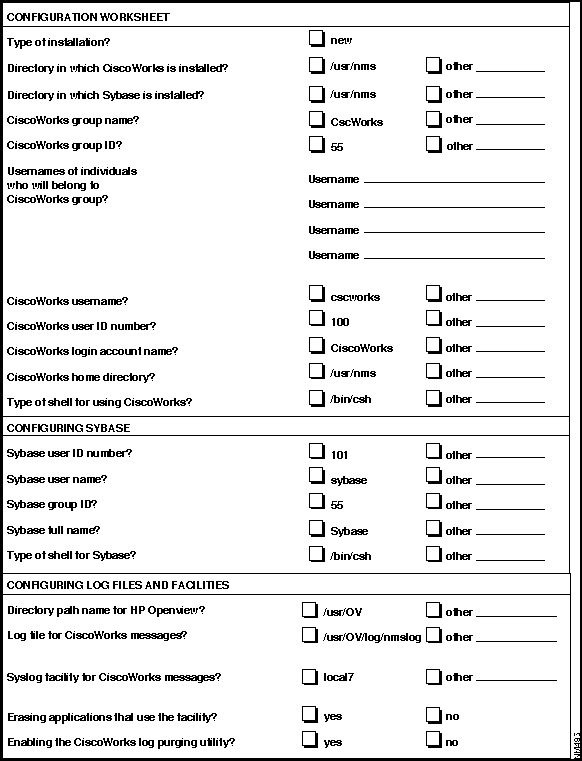
As you read this chapter, you should complete the CiscoWorks Installation Worksheet and the CiscoWorks Configuration Worksheet, which are included in this chapter. You can then refer to the worksheets as you proceed with the installation.
If you are installing CiscoWorks 2.1 on HP-UX, you will perform a new installation of CiscoWorks. There is no upgrade path from CiscoWorks on SunNet Manager (SNM) to CiscoWorks 2.1 on
HP OpenView on HP-UX. If you need further help, please contact your service support representative.
Verifying Your System Requirements
Before you install CiscoWorks on your system, make sure that your system meets the general system requirements described in Table 2-1.
Table 2-1 : General System Requirements for CiscoWorks 2.1
|
Operating System |
Free Hard Disk Space |
RAM |
Swap Space |
Free Root Partition |
|---|---|---|---|---|
| HP-UX A.09.03 or
HP-UX A.09.05 |
1,000 MB | 64 MB | 110 MB (minimum)
128 MB (recommended) |
5 MB
|
The minimum swap space requirement (110 MB) is suitable for managing small networks. For managing larger numbers of devices, you need more swap space. Specifically, for managing more than 75 to 100 devices, Cisco recommends at least 128 MB of swap space.
The memory and swap space requirements ultimately depend on such factors as which applications you want to run, the number of applications you want to run concurrently, and the number of network devices that you want to manage with CiscoWorks. As a result, you may need to increase the swap space beyond the general minimum requirements, depending on your particular network management needs.
Additional Hardware Requirements
In addition to the general system requirements, CiscoWorks requires the following hardware:
Additional Software Requirements
In addition to the general system requirements, CiscoWorks requires the following software:
Several CiscoWorks applications have specific Cisco Systems software requirements. For more information, refer to the CiscoWorks User Guide. The Configuration Management application, for example, requires Cisco Systems Software Release 8.2 or later.
The following sample configuration represents the system requirements used by a network manager who ran six common CiscoWorks applications on HP OpenView in order to manage five network devices. Table 2-2 lists the swap space requirements of this sample network.
Table 2-2 : Swap Space Used to Manage Five Network Devices
| CiscoWorks Network Management Components | Swap Space Usage |
|---|---|
| CiscoWorks daemons (collective processes that perform the specific functions of CiscoWorks) | 15,704 KB1 |
| Sybase database | 2682 KB |
| HP OpenView windows | 9000 KB |
| HP-UX | 30,720 KB (approximately) |
| Configuration Snap-In Manager | 26,969 KB |
| Process Manager | 3588 KB |
| Configuration Management | 7893 KB |
| Device Management | 5082 KB |
| Global Command Manager | 7121 KB |
| Sync w/Sybase | 7168 KB |
| Total amount of swap space usage | 10,8975 KB or 106.42 megabytes (MB) |
The collective swap space used by the CiscoWorks daemons (15704 KB) in Table 2-2 reflects what is used by the three significant CiscoWorks daemons as they manage five devices. As more devices are added, the swap space requirements increase, as shown in Table 2-3.
Table 2-3 : Swap Space Used by Daemons to Manage Five Network Devices
| CiscoWorks Daemons that Use
Significant Swap Space |
Swap Space Usage |
Swap Space Required for Each Additional Device |
|---|---|---|
| nmlogd | 676 KB | No adjustments |
| nmpolld | 8192 KB | 500 KB |
| nmeventd | 2536 KB | No adjustments |
|
Total |
11404 KB or 11.1 megabytes (MB) |
500 KB of swap space for each new device managed by CiscoWorks |
Depending on the router you are using, the Device Software Manager application requires a specific Cisco Systems Software Release, as shown in Table 2-4. Before trying to run Device Software Manager, confirm that your router meets the software requirement as defined in the following table:
Table 2-4 : Router and Software Requirements for Use with Device Software Manager
| Cisco Router Type | Router System Software Requirement |
|---|---|
| Cisco 2500 | Software Release 9.14(4)-9.14(8) or later |
| Cisco 3000 | Software Release 9.1(7.5) or later |
| Cisco AGS+ | Software Release 9.1(7.5) or later |
| Cisco 4000 | Software Release 9.14(3.4) or later |
| Cisco 7000 | Software Release 9.17(5.2) or later |
| all Cisco routers (collection of Cisco 3000, Cisco 4000, Cisco 7000, or AGS+ routers) | Software Release 9.21(0.26) or later or 9.1(8) or later |
| Cisco 7000 routers on which you want to perform microcode upgrades | Software Release 9.17(5.2) or later; 9.21(0.32) or later |
Gathering Information for Installation and Configuration
Before you install and configure CiscoWorks, use the CiscoWorks Installation Worksheet and the Configuration Worksheet to identify installation requirements and gather the information required for running the installation and configuration scripts.
When properly completed, the CiscoWorks Installation Worksheet provides the information you must enter when running the installation script, and the CiscoWorks Configuration Worksheet helps you gather the information you need to run the configuration script.
Complete both worksheets and refer to them when installing and configuring your CiscoWorks software.
CiscoWorks Installation Worksheet
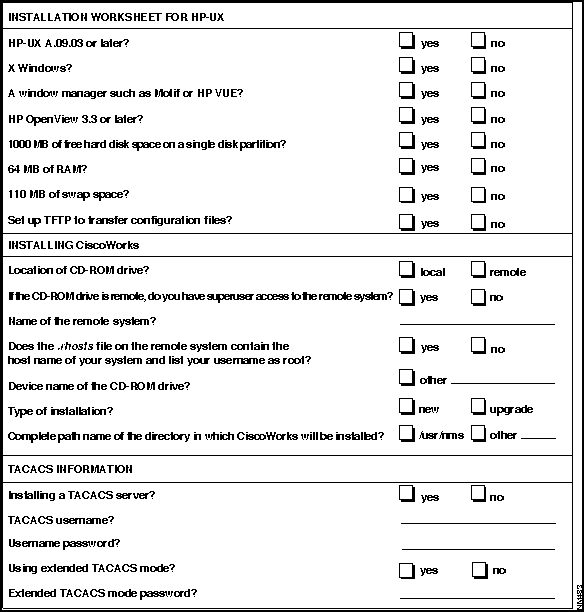
This section explains each question on the Installation Worksheet. This information is required for the installation of CiscoWorks. To obtain and verify system information for some items in the worksheet, you will need to be logged in as a superuser. Logging in as a superuser is described in the section "Becoming a Superuser," in Chapter 3.
Your workstation must be running HP-UX Version A.09.03 or later before you can install CiscoWorks. To determine what version of HP-UX you are running, enter:
hostname% uname -r
The HP-UX version number displays on your monitor, similar to the following:
A.09.03
On your worksheet, indicate whether your system meets this requirement.
Confirm that your system is running X Windows as well as a window manager such as Motif or HP Visual User Environment (VUE). On your worksheet, indicate whether your system meets these two requirements.
You must install HP OpenView 3.3 on your workstation before you can install CiscoWorks. To find out whether HP OpenView is already installed on your system, enter the following command:
hostname% /usr/OV/bin/ovlicense
If HP OpenView is properly installed, you should see output similar to the following:
Valid permanent activation key for HP OpenView

for IP address 198.90.32.12
The output verifies that your HP OpenView license is valid. On your worksheet, indicate whether your system meets this requirement. If you check no, you need to install or upgrade to HP OpenView Version 3.3.
CiscoWorks requires 1,000 MB of disk space in a single disk partition on your system. You can install CiscoWorks and Sybase with as little as 500 MB of disk space, but Cisco recommends about 1,000 MB to allow for entering data in your Sybase database. If the disk partitions on your system are full, with inadequate disk space available for CiscoWorks, create a disk partition, a file system, or both for CiscoWorks software.
Calculating Disk Space Requirements
To find out how much disk space is available on your system, enter the following command:
hostname% bdf
The amount of disk space available in each file system is displayed. Select a file system that has sufficient disk space available for installing CiscoWorks.
The following overview summarizes the steps involved in creating a file system:
For more information, refer to the manual pages on mkfs, fsck, mkdir, fstab, and mount. If you are unfamiliar with repartitioning disks or creating file systems, contact a knowledgeable system administrator.
On your worksheet, indicate whether your system meets this requirement. If you check no, you need to increase the disk partition.
CiscoWorks requires a minimum of 64 MB of RAM. To find out how much RAM is available on your system, log in as superuser, then enter the following command:
HP-UX displays information about your system's memory. The information includes a line similar to the following:
The output indicates the amount of available RAM. On your worksheet, indicate whether your system has at least 64 MB of RAM. If you check no, you need to upgrade your memory.
CiscoWorks requires a minimum of 110 MB of swap space on your system, although for installations with more than 100 devices, 128 MB is recommended. To find out how much swap space you have, log in as superuser, then enter the following command:
HP-UX displays information about your system's swap space, like this:
The Kb Avail, Kb Used, and Kb Free fields indicate the amount of swap space that is available, used, and free on your system.
On your worksheet, indicate whether your system has at least 110 MB of swap space. If you check no, you need to upgrade. If the swap space on your system is less than 110 MB, expand the swap space by following the instructions in the publications that come with your HP workstation.
After CiscoWorks is installed and configured, you can use several of its applications with the Trivial File Transfer Protocol (TFTP) to transfer configuration files between your system and other devices on your network that use SNMP.
The CiscoWorks installation script can set up the necessary TFTP directory and boot files so that you can use TFTP. On your worksheet, check yes if you want the installation script to set up a TFTP directory.
You can install CiscoWorks from a local or remote CD-ROM drive. On your worksheet, indicate which method you will use.
If you are planning to install CiscoWorks from a CD-ROM drive attached to a remote system, find out whether you have a login account as a superuser (in other words, root) on that system. If you do not have superuser access to the remote system, you can obtain it by contacting the system administrator of the remote system.
If you are installing CiscoWorks from a remote CD-ROM drive, obtain the complete host name of the remote system and make sure that this host name is listed in the /etc/hosts file on your system.
On your worksheet indicate whether you have superuser access, and if you use a remote system, its host name.
The .rhosts file enables users to log into another user account on a remote system. If you plan to install CiscoWorks from a remote CD-ROM drive, the .rhosts file on that system must contain the host name of your local system and your username specified as a superuser. To verify the local host name and that your username is specified as superuser, access the .rhosts file by using a text editor such as vi or vuepad.
On your worksheet, indicate whether your host name is in the .rhosts file and your username is specified as a superuser.
The installation script requires that you specify the device name of the CD-ROM drive. You can either obtain the device name from your UNIX system administrator or display the contents of the /dev/dsk directory on your system by performing the following steps:
Because you are installing CiscoWorks 2.1 on HP OpenView on HP-UX, you must perform a new installation. You do not have the option of migrating from an earlier version of CiscoWorks on SunNet Manager to CiscoWorks 2.1.
On your worksheet, check new to indicate that you will perform a new installation.
Directory Path Name for CiscoWorks
You must specify the directory where you want the CiscoWorks software to be installed. If the directory does not already exist on your system, the installation script creates the directory and installs the software in that directory. The default directory path name is /usr/nms.
On your worksheet, indicate where the CiscoWorks software will be installed. If applicable, specify the directory path name you plan to use.
Selecting a Disk Partition for Sybase and Transaction Log Installation
The installation script allows you to specify the disk partition on which you want to install Sybase and the corresponding transaction log, or to accept the default $NMSROOT. Depending on your needs, you can share the Sybase installation across several disk partitions. In addition to choosing a location, you can specify the size of your database and transaction log.
Because the size of your particular database can vary, the installation program prompts you for how much space you want to allocate for Sybase and for the corresponding transaction log. For Sybase, specify a size that is at least 10 MB; or you can accept the default size of 50 MB. For the transaction log, specify a size that is at least 4 MB; or you can accept the default size of 10 MB.
After you specify a size and location for the disk partition, the installation script automatically checks to make sure you have the specified disk space before installing the database. If you do not have the disk space you requested, CiscoWorks automatically prompts you to select other partitions.
CiscoWorks provides support for TACACS, an authentication protocol that requires users to supply a username and password in order to access Cisco devices.
Installing a TACACS Server
When prompted by the installation script, you must indicate whether your network system will be set up as a TACACS server. On your worksheet, indicate yes or no.
If you do not set up as a TACACs server, you may be unable to use several CiscoWorks applications.
Start TACACS Daemon During Installation
If you set up your network system as a TACACS server, the TACACS daemon startup facility will be automatically added to the /etc/rc file. During installation, if you respond yes to set up a TACACS server, the TACACS daemon will start right away and will set the /etc/rc file to start the TACACS daemon automatically when you restart the system. If you answer no, the TACACS daemon will still be added to your /etc/rc file but will be commented out. On your worksheet, indicate whether you want this functionality.
TACACS Username
If you elect to set up a TACACS server, you need to supply a username when prompted by the installation script. The username you supply here is the one that is requested when a user attempts to remotely log in to manage Cisco devices.
Username Password
If you elect to set up a TACACS server, you need to supply a TACACS password. On your worksheet, indicate the password for the specified TACACS username.
Using Extended TACACS Mode
The TACACS extended account, named $enable$, is used to access routers that use the extended TACACS mode. For more information on the $enable$ account, see the CiscoWorks User Guide. On your worksheet, indicate whether you want your system to run in extended TACACS mode.
Extended TACACS Mode Password
If you answered yes to accept an extended TACACS mode, you are then prompted to supply the password for the special TACACS $enable$ account. On your worksheet, indicate the password that should be used for the extended TACACS user account.
CiscoWorks Configuration Worksheet
This section explains each item on the Configuration Worksheet. This information is required for the configuration of CiscoWorks. For detailed information on the /etc/passwd and /etc/group files, usernames, user IDs, group names, and group IDs, refer to the HP-UX system manuals.
If you are installing CiscoWorks 2.1 on HP OpenView on HP-UX, you are performing a new installation. Because you cannot upgrade or migrate from an older version of CiscoWorks to CiscoWorks 2.1, check new on the worksheet and enter N or No during the installation process.
Directory Where CiscoWorks Is Installed
By default, CiscoWorks is installed in the directory /usr/nms, but you can specify another directory, if you choose. On your worksheet, check /usr/nms, or enter another directory path.
Directory Where Sybase Is Installed
By default, Sybase is installed in the same directory as CiscoWorks, /usr/nms. You can specify another directory, if you choose. On your worksheet, check /usr/nms or enter another directory path to record where the Sybase database is installed.
In order for CiscoWorks users to access and use CiscoWorks, they must belong to a group that is specified in the /etc/group and the /etc/logingroup files on your system. The configuration script prompts you to supply the group name you want to use for CiscoWorks users. The default name for the group is CscWorks.
On your worksheet, check CscWorks to accept the default, or specify a unique name for the CiscoWorks group.
The CiscoWorks group has a unique ID number, in addition to a name. The default CiscoWorks group number is 55. You can specify a different group number, but you must first make sure that no other group specified in the /etc/group file uses that number.
On your worksheet, select the default or specify a unique group ID number.
Before you add an individual user to the group, ensure the following:
For more information about creating login accounts, refer to the HP-UX system manuals. On your worksheet, enter the usernames for those users who have valid login accounts on your system and need to access CiscoWorks.
CiscoWorks itself has a username and login account on your system, which you must specify when the configuration script prompts you. Cisco recommends that you use the default username cscworks. The configuration script adds the CiscoWorks username to the /etc/passwd file and the /etc/group file.
On your worksheet, indicate that you accept the default username, or specify a unique username for CiscoWorks.
CiscoWorks also has a unique user ID number that identifies it to HP-UX. The CiscoWorks user ID number is added to the /etc/passwd file by the configuration script. The default user ID number for CiscoWorks is 100. If you want to specify a different user ID number, make sure that no other user already has that number.
On your worksheet, check 100 to accept the default number, or specify a unique user ID number.
Because CiscoWorks is a user on your system, you must specify its full name in the /etc/passwd file, just as you specify the full names of other users there. The default full name is CiscoWorks, although you can specify a different full name if you choose.
On your worksheet, check CiscoWorks to accept the default name or specify a different name.
Because CiscoWorks is a user on your system, it has a home directory, just as each user on your system has a home directory. The CiscoWorks home directory is usually the same directory in which CiscoWorks is installed.
By default, the CiscoWorks home directory is /usr/nms. On your worksheet, check /usr/nms to accept the default name, or specify a different home directory for CiscoWorks.
Type of Shell for Using CiscoWorks
As a user, you interact with the UNIX operating system by means of a shell. You use the UNIX shell for some CiscoWorks tasks that you perform at the UNIX prompt. By default, the configuration script starts the UNIX C shell (/bin/csh).
On your worksheet, check /bin/csh to accept the default, or specify a shell of your choice.
Because Sybase is a user on your system, it must have a unique user ID number that is specified in the /etc/passwd file. By default, the configuration script assigns the number 101. If you specify a different user ID number for Sybase, make sure that no other user login account uses it.
On your worksheet, check 101 to accept the default user ID number or specify a unique user ID number for Sybase.
Because Sybase is a user on your system, it must have a unique user name. By default, the configuration script assigns the user name sybase.
On your worksheet, check sybase to accept the default user name, or specify a unique user name. The configuration script adds the user name to the /etc/passwd and the /etc/group files.
The Sybase group, which is added to the /etc/group file by the configuration script, must be assigned a unique group ID number. The configuration script proposes the default group ID number 55.
On your worksheet, check 55 to accept the default group ID number, or specify a number that is not already in use and entered in the /etc/group file.
Because Sybase is a user on your system, it must have a full name specified in the /etc/passwd file. On your worksheet, check Sybase to accept the default Sybase full name, or specify a different full name for the Sybase login account.
The C shell (/bin/csh) is the default shell you use for Sybase-related tasks that are performed at the UNIX prompt.
On your worksheet, check /bin/csh to accept the default shell, or specify a shell of your choice.
Directory Path Name for HP OpenView
By default, HP OpenView is installed in the directory /usr/OV. Verify the directory in which HP OpenView is installed on your system. If it is installed in the /usr/OV directory, check /usr/OV on your worksheet. Otherwise, specify the directory in which it is installed.
Log File for CiscoWorks Messages
The CiscoWorks Log Manager application adds messages to a centralized log file, /usr/OV/log/nmslog. If you want the messages to be logged to a different file, you can specify a different filename.
On your worksheet, check /usr/OV/log/nmslog to accept the default log file, or specify a different filename where the messages can be logged.
Syslog Facility for CiscoWorks Messages
The CiscoWorks Log Manager application uses a centralized log file that gets messages from the UNIX syslogd process. The default facility is local7.
If you want to log both CiscoWorks messages and Cisco device messages and view them through the Log Manager application, use the default facility local7. Cisco routers use the local7 facility. If you specify a facility in the range of local0 through local6, only CiscoWorks messages are logged.
Information about the facility you choose will be stored in the $NMSROOT/etc/nms.rc file. For instructions on performing these tasks, refer to the CiscoWorks User Guide.
On your worksheet, check local7 to accept the default facility, or specify a facility of your choice.
Erasing Applications That Use the syslog Facility
The configuration script asks you whether it can erase any other applications that are using this facility. If you answer no, the CiscoWorks log utility might not be able to use the syslog facility to do the following:
On your worksheet, indicate whether you want the script to erase applications using the facility.
Enabling the CiscoWorks Log Purging Utility
CiscoWorks contains a centralized log file called nmslog. This log file can be automatically purged and backed up every day. As a result, the log purging utility is started automatically by the UNIX cron daemon. A daemon is a UNIX process that repeatedly runs in the background, independent of any user's workstation or terminal.
On your worksheet, indicate whether you want the nmslog file to be purged and backed up automatically.
Copyright 1988-1996 © Cisco Systems Inc.
hostname# /etc/dmesg | grep Kbytes
Memory Information:

Physical: 81920 Kbytes, lockable: 73384 Kbytes, available: 75188 Kbytes
hostname# swapinfo
          Kb      Kb      Kb   PCT  START   Kb
TYPE   AVAIL    USED    FREE  USED   LIMIT RESERVE  PRI  NAME
dev   101753   45929   55824   45%  923286       -    0  /dev/dsk/c201d6s0
dev   102444      44  102400    0%  923286       -    1  /dev/dsk/c201d5s0
hostname%
cd /dev/dsk
hostname%
ls | more