
Table of Contents
Preparing to Install CiscoWorks
Preparing to Install CiscoWorks
Before you install, configure, and validate CiscoWorks, make sure you have the following:
- Root user authority
- Hardware prerequisites for CiscoWorks
- Software prerequisites for CiscoWorks
- Information necessary for installation and configuration
The user named root can perform functions restricted from normal users. To install and configure CiscoWorks, you must know the root user's password and log in to your system as the root user or become the root user by use of the su command.

Caution If you are a relatively inexperienced AIX user, limit your activities as the root user to the tasks described in this publication. As the root user, you can adversely affect your operating environment if you are unaware of the effects of the commands you use.
If you are not logged in, enter the following commands to log in as the root user:
login: root
Password: rootpassword

hostname#
The prompt changes to a pound sign (#), indicating that you are logged in as the root user.
If you are already logged in, but not as the root user, enter the following to change your login to root:
hostname% su
Password: rootpassword
The AIX prompt changes to a pound sign (#), indicating that you are logged in as the root user:
hostname#
CiscoWorks requires the following hardware:
- IBM RISC System/6000 workstation, Model 340 or higher
- Color monitor
- PostScript-compatible printer (for printing window images)
- CD-ROM drive on the host system, or CD-ROM drive on an accessible remote host
CiscoWorks requires the following software products, conditions, and preparation. Details and verification methods for each requirement are outlined in the paragraphs following this list.
- AIX version---either of the following
- IBM AIX Version 3, Release 2.5, with program temporary fixes (PTFs) 45257, 41600, 38605, and 43714
- IBM AIX Version 4, Release 1
- NetView for AIX---Version 3.1 or 4.1.x
- System software---X Window System Version 11, Release 5; Motif Version 1, Release 2
- Hard disk space---5 MB or more in the root directory, 250 MB or more in the /usr directory, plus 120 MB or more in the directory where the Sybase databases will reside (typically /usr).
- RAM size---64 MB or more.
- Swap space size---128 MB or more.
- Preparation for remote installation---Verify root access to the remote host, and check the /etc/hosts and .rhost files.
- TFTP configuration for device configuration management---Perform this task before or after installation, configuration, and validation.
To ascertain the operating system level, log in as the root user and enter
hostname% oslevel
Output similar to the following appears:
Processing.....Please Wait.
<>3250
This output indicates Version 3, Release 2.5.
To ascertain the version of NetView for AIX, log in as the root user and enter:
hostname% lslpp -L nv6000.base.obj
Output similar to the following appears:
Processing.....Please Wait.
nv6000.base.obj 3.1.0.0
   No Maintenance Level Applied.
This output indicates Version 3.1
Several CiscoWorks applications require the managed Cisco devices to be running specific versions of the Cisco Internetwork Operating System (Cisco IOS) software. See Table 2-1.
Table 2-1 Software and Hardware Requirements for Particular CiscoWorks Applications and Cisco Devices
| AutoInstall Manager |
Any Cisco device running Software Release 9.1(7) or later |
Neighbor router running Software Release 8.3 or later |
|
|
New router runningSoftware Release 9.1(7) or later |
| CiscoConnect |
|
AIX sendmail daemon |
| CiscoView |
Cisco 4000, 4500 |
Software Release 9.21 through 10.3 |
|
Cisco 2505, 2507 |
Cisco IOS Release 10.0(6) through 10.3 |
|
Cisco 2501, 2502, 2503, 2504, 2509, 2511, 2512, 2513, 2514, 2515, 2516 |
Cisco IOS Release 10.2(1.3) through 10.3 |
|
Cisco 7000 series (7000, 7010) and Cisco 7500 series (7505, 7507, 7513) |
Software Release 9.21 through 11.0(2) |
|
Catalyst 5000, 1600, and 1200 series |
Catalyst software version 1.0 or later |
|
Catalyst 3000 and Kalpana EPS 2015 switches, CiscoPro CPW16, CPW2115, and CPW500 switches |
none |
|
WS-C1400 series and WS-C1100 series workgroup concentrators |
none |
|
Cisco LightStream100 (previously known as A100 Hyperswitch) |
Cisco IOS Software Release 1.2(0) or later |
| Configuration Management |
|
Software Release 8.2 through Cisco IOS Release 10.0 |
| Device Polling |
|
Supports MIB I and II, and Cisco MIB variables, through Cisco IOS Release 10.3 |
| Environmental Monitor |
Cisco 7000 |
Software Release 9.0 or Cisco IOS Release 10.0, with ENVM card Revision 4 and Microcode version 2.0 or later |
|
Cisco AGS+ |
|
Software Library Manager
Software Inventory Manager
Device Software Manager |
Devices with Flash Memory: |
|
|
Cisco AGS+ |
Software Release 9.1(7.5) or later, or 9.1(8) or later |
|
Cisco 4000 |
Software Release 9.14(3.4) or later, or 9.14(4) or later |
|
Cisco 7000 |
Software Release 9.17(5.2) or later, or 9.17(6) or later |
|
Cisco 7000 routers on which you want to perform microcode upgrades |
Software Release 9.17(5.2) or later, or 9.21(0.32) or later |
|
Any collection of Cisco 3000, Cisco 4000, Cisco 7000, or AGS+ routers |
Software Release 9.21(0.26) or later, 9.21(1) or later, or 9.1(8) or later |
|
Devices withRun-from-Flash Images: |
|
|
Cisco 2500 |
Software Release 9.21 or later |
CiscoWorks requires 5 MB of disk space in the root directory and 250 MB of disk space in the /usr directory, and Sybase 10 requires 120 MB (typically in the /usr directory).
To find out how much disk space is available on your system, enter the following at the command prompt:
hostname% df -I
Output similar to the following appears:
Filesystem    Total KB    used    free %used Mounted on
/dev/hd4         16384   10008    6376   61% /
/dev/hd9var      32768    3756   29012   11% /var
/dev/hd2       1003520  871324  132196   86% /usr
/dev/hd3         16384     732   15652    4% /tmp
/dev/hd1          4096     240    3856    5% /home
/dev/hd10        16384     544   15840    3% /usr/sys
/dev/lv00      2002944  586868 1416076   29% /disk
The amount of disk space available in each filesystem is displayed. Note that 1,000 KB equal 1 MB. If you do not have sufficient space in the filesystem mounted on the /usr directory, you must create a filesystem mounted on the /usr/nms directory.

Caution CiscoWorks can be installed only in the /usr/nms directory. If you create a filesystem, its mount point must be /usr/nms. If /usr/nms already exists on your system, you must back up all the data in that directory before installing CiscoWorks. Installation of CiscoWorks overwrites any existing data.
The following overview summarizes the steps you follow to create a filesystem:
- Step 1 Create an empty filesystem.
- Step 2 Verify the integrity of the empty filesystem.
- Step 3 Create a mount point directory.
- Step 4 Configure the filesystem table and edit the /etc/filesystems file.
- Step 5 Mount the new filesystem.
For more information, refer to your IBM documentation or the manual (man) pages for the mkfs, fsck, mkdir, and mount commands. If you are unfamiliar with repartitioning disks or creating filesystems, contact a knowledgeable system administrator.

Caution If you use Network File System (NFS) to mount a remote file system, the Sybase system and its databases must reside and be configured in entirety on one host.
CiscoWorks requires a minimum of 64 MB of RAM. To find out how much RAM is available on your system, make sure you are logged in as the root user. (Refer to the section "Becoming the Root User" in this chapter.) Enter the following command at the AIX prompt:
hostname# lscfg | grep mem
Output similar to the following appears:
+ mem0              00-0B             32 MB Memory Card
+ mem1              00-0C             32 MB Memory Card
If your workstation does not have at least 64 MB of RAM, upgrade its memory.
CiscoWorks typically requires 128 MB of swap space on the AIX system.
Swap space requirements of CiscoWorks depend on such factors as the applications you run, the number of applications you run concurrently, and the number of network devices you manage with CiscoWorks. As a result, you might have to increase the swap space beyond the general minimum requirement.
To find out how much swap space is available on your system, make sure you are logged in as the root user. (Refer to the section "Becoming the Root User" in this chapter.) Enter the following command at the prompt:
hostname# lsps -a
Output similar to the following appears:
Page Space  Physical Volume   Volume Group    Size   %Used  Active  Auto  Type
paging00    hdisk1            external       160MB      17     yes    no    lv
hd6         hdisk0            rootvg          80MB      41     yes   yes    lv
Add the numbers in the Size column to determine your system's total swap space. In the previous example, the system's swap space is 240 MB.
If the swap space on your system is less than 128 MB, expand the swap space by following the instructions in your IBM documentation.
Before installing software from a CD-ROM drive on a remote host:
- Be sure you have the root user's password for that system. If you do not have root access to the remote system, contact the system administrator of the remote system.
- Be sure the remote host's Internet Protocol (IP ) address and name are listed in the local /etc/hosts file.
- Depending on the convention used at your site for specifying trusted hosts and users, each host's .rhosts file lists trusted host names, or trusted host name and trusted usernames. Be sure the local host name, or the local host and the root username, appears in the remote system's .rhosts file. For details on the .rhosts file, refer to the man page for the .rhosts file.
If the /etc/hosts and .rhosts files in your network are maintained and distributed by a system administrator, ask the administrator to make necessary changes in the master files.
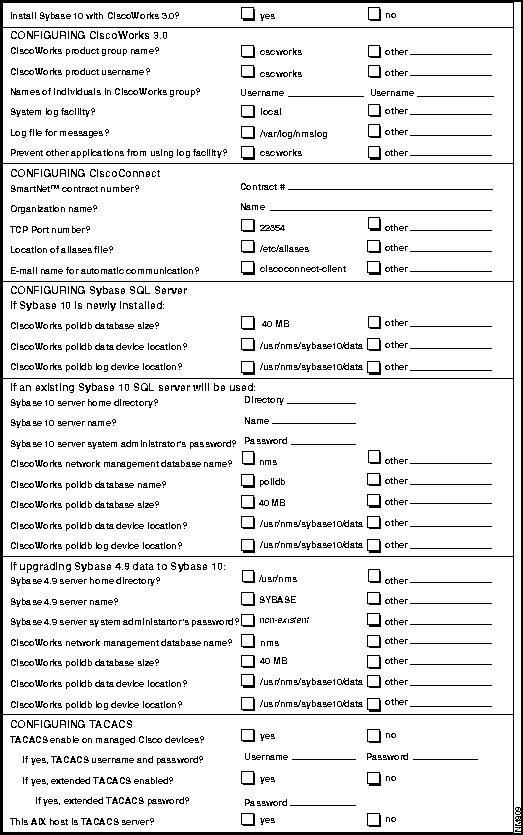
Before you install and configure CiscoWorks, determine the following information. Write your results in the worksheet shown in Figure 2-1.
- Whether you will install SYBASE SQL Server Release 10.0 software from the CiscoWorks CD-ROM--- If Sybase 10 is already on your host, you need not install it again.
- CiscoWorks base product configuration information---Fields with default values may be accepted with those defaults.
- CiscoWorks product group name. Decide in advance whether to override the default CiscoWorks group cscworks. This is the name to be listed in the /etc/group file and to which intended users of CiscoWorks will be assigned.
- CiscoWorks product user name. Decide in advance whether to override the default CiscoWorks username cscworks. This is the AIX username assigned to the CiscoWorks application itself.
- Usernames for the CiscoWorks product group. Decide in advance which existing AIX users (as listed in /etc/password) will be members of the CiscoWorks group. Users in the CiscoWorks group are able to use CiscoWorks.
- Name of the system log facility for collecting CiscoWorks and Cisco router messages. CiscoWorks utilizes the AIX syslogd daemon to collect messages from itself and from managed devices, and forwards them to the NetView event monitoring window. The daemon's default collection facility is local7 because Cisco routers use that facility. If you choose to override local7 with a facility in the range local0 through local6, only CiscoWorks messages are logged.
- The facility name you choose is stored in the $NMSROOT/etc/nms.rc file. After first-time configuration, you can change the facility by using the System Management Interface Tool (SMIT) or by editing the $NMSROOT/etc/nms.rc file.
- Name of the log file for CiscoWorks and Cisco router messages. Decide whether you will override the log file name used by the CiscoWorks log daemon to collect CiscoWorks and Cisco router messages via the AIX syslogd process. The default log file name is /var/log/nmslog.
- Whether to prevent other applications from using the system log facility. During CiscoWorks configuration, you are asked whether to remove existing syslog.conf entries. Doing so prevents applications other than CiscoWorks from using the facility named in the preceding item (such as local7). If you do not prevent other applications from using the named facility, messages from other applications might appear in the log file.
- CiscoConnect configuration information---Fields with default values may be accepted with those defaults.
- Obtain the SmartNet contract number from your CiscoWorks paperwork.
- Decide the exact form of your organization's name to be used by CiscoConnect in communications with the Cisco Technical Assistance Center (TAC).
- Decide whether to override the default TCP port number 22854.
- Determine whether your host uses an e-mail aliases file other than the default /etc/aliases.
- Decide whether to override the default username that CiscoConnect uses for e-mail with the Cisco TAC. The default is ciscoconnect-client.
- SYBASE SQL Server configuration information---Read one set of the following requirements depending on your situation:
- If this is the installation of a new Sybase 10 database management system, decide whether to override any of the following defaults for the new server to be configured: polldb database size of 40 MB, polldb data device location /usr/nms/sybase10/data, and polldb log device location /usr/nms/sybase10/data.
- If you will utilize an existing Sybase 10 data server (and not install Sybase 10 from the distribution CD-ROM), ascertain the following for the existing Sybase 10 server: home directory, server name, and system administrator's password.
- In addition, decide whether to override any of the following defaults for the new server to be configured: CiscoWorks network management database name nms, CiscoWorks polldb database name polldb, polldb database size of 40 MB, polldb data device location /usr/nms/sybase10/data, and polldb log device location /usr/nms/sybase10/data.
- If this installation is an upgrade from CiscoWorks 2.1 to CiscoWorks 3.0, and data managed by the old Sybase 4.9 system must be upgraded to be managed by the Sybase 10 installed with CiscoWorks 3.0, determine whether Sybase 4.9 has any characteristics other than the following defaults: home directory /usr/nms/sybase, server name SYBASE, system administrator's password (nonexistent), and CiscoWorks network management database name nms.
- Also decide whether to override any of the following defaults for the new server to be configured: polldb database size of 40 MB, polldb data device location /usr/nms/sybase10/data, and polldb log device location /usr/nms/sybase10/data.
- TACACS information---CiscoWorks provides support for the Terminal Access Controller Access Control System (TACACS). TACACS is an authentication protocol that requires users (and CiscoWorks itself) to supply a username and password to access Cisco devices.
- Determine whether TACACS is enabled on the Cisco devices to be managed by CiscoWorks. If so, find out the TACACS username and password to be used by CiscoWorks for accessing those devices.
- Determine whether the routers to be accessed by CiscoWorks are operating in extended TACACS mode. If so, obtain the password for the extended TACACS $enable$ account.
- Determine whether this AIX host is a TACACS server.
Figure 2-1 Installation and Configuration Worksheet
Copyright 1988-1995
©
Cisco Systems Inc.



