


|
|

The IPX16/32 uses the following functional card groups.
Table 1-2 lists the cards that an IPX node can support.
Table 1-2 : IPX 16/32 Plug-In Card Summary
| Card
Acronym |
Card Name
|
Front
or Back |
Model |
|---|---|---|---|
| NPC | Nodal Processor Card | Front | |
| SCC | System Clock Card | Back | |
| LEC | Lower Expansion Card | Back | |
| CDP | Channelized Data PAD | Front | |
| BC-E1 | E1 Trunk Interface Card (Back Card) | Back | |
| BC-T1 | T1 Trunk Interface Card (Back Card) | Back | |
| BC-J1 | J1 Trunk Interface Card | Back | |
| BC-Y1 | Y1 Trunk Interface Card | Back | |
| BC-SR | Subrate Trunk Interface Card (Back Card) | Back | |
| FRP | Frame Relay PAD Card, V.35 | Front | |
| FRP-6 | Frame Relay PAD Card, w/6 chan. | Front | |
| FRP-31 | Frame Relay PAD Card, w/31 chan. | Front | |
| FRI | Frame Relay Interface Card; V.35, T1/E1, X.21 | Back | |
| FRP-2 | Frame Relay Pad for Port Concentrator | Front | |
| FRP-2 -X21 | Frame Relay Pad for Port Concentrator I/F | Back | |
| FTC | FastPAD Card | Front | |
| FPC | FastPAD Card | Back | |
| SDP | Synchronous Data PAD | Front | |
| AIT | ATM Interworking Trunk | Front & | |
| AIT T3 or E3 | ATM Interworking Trunk Interface Card | Back | |
| SDI | Synchronous Data Interface:
RS-232C, RS-232D, RS-422/449 X.21, V.24, and V.35 |
Back | |
| LDP | Low Speed Data PAD | Front | |
| ARC | Alarm Relay Card | Front | |
| ARI | Alarm Relay Interface Card | Back | |
| LDI | Low-Speed Data Interface
RS-232C/D, 4-port, 8-port V.24, 4-Port, 8-Port DDS, 4-port |
Back | |
| MT3 | T3 Mux/Demux Card | Front | |
| BC-T3 | T3 Trunk Interface Card (Back Card) | Back | |
| NTC | Network Trunk Card | Front |
Common Alarms, Controls, and Indicators
The alarms, controls, and indicators reside on the face plates of the front and rear cards and on the power supplies. Each plug-in card has both a green ACTIVE LED and a red FAIL LED at the bottom of the front panel. In general, the meaning of each LED is indicated in Table 1-3. Some other cards have additional indicators, connectors, or controls. These are described in the specific section describing that card.
Table 1-3 : Common Card Status Indicators
| Indicators | Status | Meaning |
|---|---|---|
| FAIL | ON Steady | Indicates that the card has failed. |
| FAIL | Blinking | On an NPC in a redundant system, this indicates the card is in an update state. |
| ACTIVE | ON steady | Indicates the card is active and carrying traffic or processing data. |
| ACTIVE | ON momentarily | Indicates that the card has undergone self-test. |
| BOTH | OFF | Indicates the card part of a redundant pair and is in the standby mode or not being used at all. |
| BOTH | ON | Indicates the card has failed but remains active because no standby card is available. For an SDP or LDP card, this could indicate that one or more of the data channels failed, but the others are still active. |
An IPX system contains several types of buses. A brief description follows for each bus. Of particular note are the utility buses because they are selected for the card configuration used in the nodes. With two exceptions, the Local Utility Bus LB00 is used between all interface cards. The exceptions are the SDP card, which uses the UB240 utility bus, and the AIT card set, which uses the Local Bus 2. The controller cards use local utility buses exclusive to the type of controller cards installed.
The 32.768 Mbps System Bus resides on the MUXBUS backplane (Figure 1-12) and consists of two major buses. These buses are the control bus and the time division multiplex (TDM) bus. The PCC uses the control bus to monitor and control the other system unit cards and to control the flow of voice and data through the system. The TDM bus, or MUXBUS, carries packets of data between various packet assembler/disassembler (PAD) cards and the interface cards.
All cards communicate with the controller card (NPC) through the IPX System Bus. As a safeguard against card driver failure or bus failure, the backplane has redundant system buses. In a two-shelf system, a cable between the SCC back card and the LEC back card extends the System Bus to the lower shelf. The cable also connects the NPC in the upper shelf to the NPC in the lower shelf if a redundant NPC is present.
One of two different utility buses work with the NPC card. The two buses are the UBE-1 and the UBS-2. The SCC card type determines which bus is used. Note that in a node with redundant processors, the buses must be the same type.
If the NPC is a replacement for a PCC, no change of utility bus is necessary. If the NPC is used with the SCC-B card (with Ethernet capability), the utility bus must be changed. In a two-shelf node using redundant NPCs and SCC-B, the upper shelf and lower shelf use the UBE-1 utility bus (single-slot wide). In a single-shelf node using redundant NPCs and an SCC-B, the UBS-2 utility bus (two slots wide) is installed.
The processor group consists of the Nodal Processor Card (NPC), the System Clock Card (SCC), the Lower Expansion Card (LEC), and the System Bus. Through the System Bus, this card group (Figure 1-15) controls overall IPX communication between the central processor and other cards and communication between all the nodes in the network. System timing, network control, and status reporting functions are also performed by the processor group.
The NPC is a microprocessor-based system controller. This front card contains the software for controlling, configuring, diagnosing, and monitoring the IPX. It also maintains the alarm and event logs. The NPC controls statistics gathering and communicates with the other plug-in system cards over the control bus.
In addition to communicating with cards on the node in which it resides, the NPC communicates with other IPX, IGX, and BPX nodes. For this, the NCC uses a reserved, low-speed data link on a trunk. The NPC's communication link with other IPX nodes is used for rerouting, sending signalling information, information on new connections, and topology changes when new nodes are added or removed.
In general, the NPC:
The NPC can serve in redundant or non-redundant node configurations and is installed in the shelf slots reserved for the active and standby NPC cards. The back card used with the NPC can be either an SCC or an SCC-B. If an Ethernet connection is required (e.g., connection to StrataView Plus) The SCC-B is required.
NPC memory can expand up to the following limits. This is a factory upgrade:
The RS-232 ports support connections to network management terminals and modems. The modems are for remote access to the node.
Figure 1-15 : NPC Ethernet Port Switches
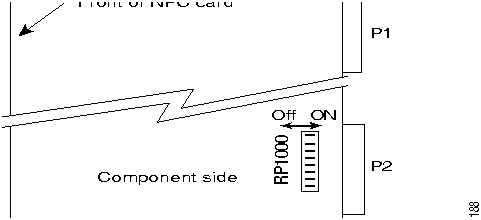
The front panel of the NPC has a green ACTIVE LED and a red FAIL LED. The NPC monitors its own activity and, if it detects a failure, lights the FAIL LED. If the NPC is configured for redundancy, the on-line NPC is indicated by the lit ACTIVE LED. The standby NPC has no lit indicators. The state of any NPC can also be determined with the dspcd command.
System Clock Card With Ethernet (SCC-B)
The SCC-B is installed with the NPC in nodes with an attached NMS that is capable of using an Ethernet connection. The SCC-B incorporates a modification of the SCC back card. Changing out the SCC in all other existing nodes gives no advantage because the existing SCC is compatible with the NPC and the PCC. The SCC-B can be used with the PCC but does not provide the Ethernet LAN port.
Hardware and Software Requirements
The software and hardware requirements for the SCC-B are:
The SCC-B uses an Attachment Unit Interface (AUI) connector in place of the RMU connector on the SCC faceplate. The AUI is a 15-pin sub miniature connector (DB-15).
The Ethernet port circuitry is on the NPC. Therefore, the SCC-B is required for the NPC to use Ethernet. When an SCC-B card is used with an NPC, the utility bus for the IPX 8 and IPX 16 must be the dual-slot version. This two-slot wide bus adds several traces for routing the Ethernet connection between the NPC and SCC-B. For redundant NPC applications, the traces carrying the Ethernet signal from the two NPC cards are bridged on the SCC-B card to provide port redundancy for the circuitry. See Figure 1-16.
Two configurations of the SCC-B with the NPC are possible. One is for either an IPX 8 or IPX 16. These single-shelf nodes have an SCC-B and a dual-slot utility bus. The dual utility bus supports single or redundant NPCs. The other configuration is an IPX 32 node with an upper and a lower shelf. It comes with an SCC-B for the upper shelf, an LEC for the lower shelf, and two single-width utility buses---one for each shelf. An existing IPX 32 does not require a change in NPC/PCC utility buses. Table 1-4 shows model numbers, and Table 1-5 shows AUI pin assignments.
Table 1-4 : SCC-B Utility Buses
| Utility Bus | Model No. | Used With | Qty. | Comments |
|---|---|---|---|---|
| Dual | 550058 | IPX 8 /16, single shelf | 1 | Used with NPC and SCC-B |
| Single | 550059 | IPX 32, dual shelf | 2 | Used with NPC, SCC-B, LEC |
Table 1-5 : AUI Connector Pin Assignments (DB 15-connector)
| Pin | Name | Pin # | Name |
|---|---|---|---|
| 1 | Shield | -- | -- |
| 2 | Collision Presence + | 9 | Collision Presence--- |
| 3 | XMT + | 10 | XMT--- |
| 4 | Reserved | 11 | Reserved |
| 5 | RCV + | 12 | RCV--- |
| 6 | Power return | 13 | Power (+12V) |
| 7 | Reserved | 14 | Reserved |
| 8 | Reserved | 15 | Reserved |
Figure 1-16 : SCC-B Connectors and Indicators
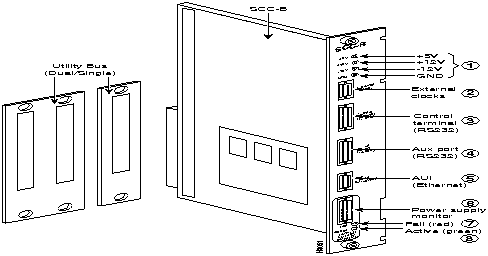
Table 1-6 : SCC-B Faceplate Connectors and Indicators
| No. | Connector/Indicator | Function |
|---|---|---|
| 1. | +5, --12, +12, GND | Test points to measure power supply voltages. |
| 2. | EXTERNAL CLOCKS | DB15 connector for connecting a primary and optional redundant external source of system clock. |
| 3. | CONTROL TERMINAL
(RS-232) |
A DB25 connector for connecting a VT100 or equivalent terminal for an operator control terminal. Can also be used for dial-in modem. This is a bi-directional port. |
| 4. | AUX. PORT (RS-232) | A DB25 connector for connecting a system printer. Can also be used for out-dial modem. This is a one-way, outgoing port. |
| 5. | AUI | DB15 Attachment Unit Interface (AUI) for Ethernet LAN connection. |
| 6. | POWER SUPPLY MONITOR | A system connection to the power supplies so that they can be monitored by circuits inside the SCC. |
| 7. | FAIL light (red) | Indicates that the card has failed. |
| 8. | ACTIVE light (green) | Indicates an active and normally functioning card. |
The System Clock Card (SCC) card provides a centralized clock generation function for the IPX. It generates the system clock and trunk synchronizing clocks. The SCC phase-locks the internal IPX timing to the selected clock source for network synchronization. Each IPX node must have an SCC.
The SCC is a back card that plugs directly into the NPC card in slot 1. The NPC and SCC card set are the backbone of the IPX system. The NPC controls and monitors the SCC control buses. A single SCC can support redundant NPCs.
The SCC circuits include of the following:
The SCC has duplicates of the internal clock circuitry and its associated phase lock loops and NPC-related control circuitry. One operates off the System A Bus, and the other operates off the System B Bus. Both circuits are independent and are monitored separately to provide complete backup if a circuit fails (FAIL lamp comes on). However, since both the System A bus and System B bus clock circuits exist on a single card, removing the SCC disrupts system operation. The lower priority SCC circuits are not duplicated. The lower priority circuits are the external clock inputs, control and auxiliary ports, and monitoring circuits for power supplies, cabinet temperature, fan detection, and fan speed. A failure in a lower priority circuit does not cause a system failure, but the SCC reports the problem.
The DB-15 connector labeled Ext Clocks on the faceplate of the SCC connects two external sources for a high-stability clock (primary and redundant). These inputs are 1.544 MHz for T1 systems and 2.048 MHz for CEPT systems. In addition, one of the trunk or circuit line inputs may also serve as a source of timing for the node. If no clock source is selected, the clock source is the internal IPX clock.
Refer to Figure 1-17 and Table 1-7 for details on the SCC faceplate. When correlating the descriptions in the table with the callouts in the figure, read from the top down.
In addition to the clock functions, the SCC provides a pair of low-speed, serial communications ports. The first port (CONTROL TERMINAL) is a bi-directional port used for connecting the IPX to a local network control terminal or to a modem for remote terminal connection. The second port connects to a maintenance log printer or to an auto-dial modem for automatic reporting of local IPX alarm conditions. This modem can be programmed to dial StrataCom ISC for assistance when a network alarm occurs
Table 1-7 : SCC Front Plate Connections and Indicators
The IPX supports both Asynchronous Transfer Mode (ATM) trunks and FastPacket (FP) trunks. ATM trunks are supported by the ATM Internetworking Trunk (AIT) front and back card set.
FastPacket trunks are supported by the NTC front card and one of the following back cards:
The ATM trunks transmit data in 53-byte cells over T3 or E3 lines to another AIT in an IPX, or to a BNI in the BPX. While the AIT trunk is T3/E3, the maximum data rate to the AIT is throttled down to 8000 packets per second because of MuxBus limits.
The AIT card set consists of a front card and a back card and is used for IPX to IPX and IPX to BPX traffic using ATM cell relay protocol over a single T3 or E3 trunk.
The AIT Card Set consists of an AIT front and either a T3 or E3 AIT backcard.
The IPX card set can be used to:
The AIT card set provides a single T3 or E3 ATM port for an IPX node. The card set consists of a front card (AIT-FC) and a back card (AIT-BC). Each card occupies a single slot in an IPX node. The cards connect through the Local Bus 2 utility bus.
The AIT front card is connected to the node through the MUXBUS for data (in FastPacket format) and the CBUS for control. The front card provides interfaces to the MUXBUS and CBUS, controls the back card, and performs the necessary routing and computation on the data streams. A RISC module attached to the front card performs the computation. The front card contains four LED indicators that indicate status and alarm conditions.
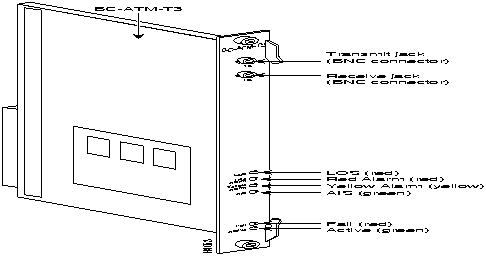
The AIT back card is available in two versions. One version supports a single ATM T3 port, and the other supports a single ATM E3 port. The back card provides the interface to the trunk line and performs all necessary CRC generation and checking. The trunk port consists of two BNC connectors (one for transmit and one for receive). The back card contains six LED indicators that indicate the status of the port and various alarm conditions (see below for details).
The AIT card set operates in either of two gateway modes, Simple Gateway or Complex Gateway.
The Simple Gateway mode is used when the AIT card set performs FastPacket/ATM interworking. In this mode, the card set permits the IPX node to perform bi-directional transmission of FastPackets by encapsulating them in ATM cells over ATM trunks. The Simple Gateway can be used for both IPX to IPX and IPX to BPX transmissions.
Simple Gateway
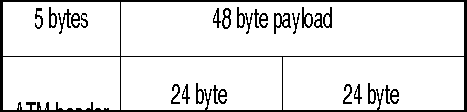
When operating as a simple gateway, FastPackets containing any valid type of FastPacket data (including frame relay, data, voice, etc.), are received by the AIT front card over the Muxbus. The AIT assembles the data, two consecutive packets at a time, to provide the payload for an ATM cell. The AIT card waits only a predefined time period for the second packet. If the second packet is not received when the time period expires, the cell is transmitted with only the first packet as the payload. The two 24-byte FastPackets comprise the 48-byte cell payload as shown in Figure 1-18.
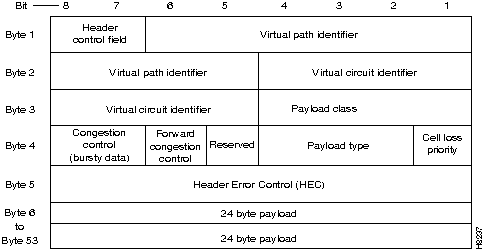
Figure 1-18 : ATM Cell for Simple Gateway Simple Gateway uses a StrataCom proprietary ATM header (STI) as shown in Figure 1-19.
Figure 1-19 : STI Header Format The payload type determines the queue into which the traffic is placed. Table 1-8. lists the payload types.
Table 1-8 : FastPacket (Payload) Types
The Complex Gateway mode is used when the AIT card set performs Frame Relay to ATM interworking (ATF). In this mode, frame relay data received over the Muxbus is extracted from the FastPackets (which are discarded) and inserted into the payload portions of consecutive ATM cells for transmission over the ATM trunk. Similarly, frame relay data is extracted from cells received over the trunk and is inserted into FastPackets for transmission over the MuxBus.
The Complex Gateway provides an efficient method for transmitting frame relay data over broadband trunks, and it allows users to migrate to ATM as their bandwidth needs expand.
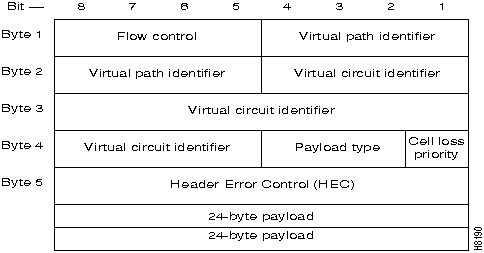
The Complex Gateway is used only for transporting frame relay connections across an ATM network. The ATM UNI header is used by the Complex Gateway (Figure 1-20), and the payload is formatted as AAL5 for bursty data.
The Complex Gateway performs frame relay to ATM address mapping as follows. For frame relay data received over the Muxbus, the frame relay address is converted to a VPI/VCI field of the ATM cell header. For ATM cells received over the AIT trunk, the VCI field in the ATM header is converted to the DCLI of the frame relay FastPacket.
Operation and Maintenance (OAM) cells (except level F4 are supported by the Complex Gateway mode.
Figure 1-20 : ATM Cell with UNI Header, showing Payload The AIT(IPX) or BTM(IGX) can operate in several different addressing modes selected by the user (see Table 1-9 and Figure 1-21). In the BPX Addressing Mode (BAM), used for all StrataCom networks, the system software determines VPI and VCI values for each connection that is added to the network. The user enters the beginning and end points of the connection and the software automatically programs routing tables in each node that will carry the connection to translate the VPI/VCI address. The user does not need to enter anything more. This mode uses the STI header format and can support all of the optional StrataCom features.
To allow the IPX or IGX to be used in mixed networks with other ATM switches, there are two other addressing modes available, Cloud Addressing Mode (CAM) and Simple Addressing Mode (SAM). In the Simple Addressing Mode, the user must manually program the path whole address, both VPI and VCI values. The Cloud Addressing Mode is used in mixed networks where the virtual path addresses are programmed by the user and the switch decodes the VCI address. Both CAM and SAM utilize the UNI header type.
Table 1-9 : ATM Cell Addressing Modes
Figure 1-21 : BAM, CAM, and SAM Configurations The AIT backcard provides a variety of CRC checking and generation algorithms to support the two gateways as follows:
The front panel of the AIT front card has four LEDs. An ACTIVE LED indicates the card is active and functioning normally. An AIT card failure triggers the FAIL LED.
The other two LEDs are summary alarms for the back card conditions. A yellow MINOR LED indicates non-service interrupting faults or incidents of error statistics that exceed a preset threshold. A red MAJOR LED indicates service-affecting failures.
The AIT back card has six LED indicators as shown in Figure 1-22.
Figure 1-22 : AIT Back Card Faceplate Table 1-10 : AIT Back Card Indicators
AIT cards support Y-cable redundancy on ATM trunks in IPX-to-IPX and IPX-to-BPX applications.
Y-Cable Redundancy requires the redundant card set to be in a physically adjacent slot and that both cards be upped (uptrk) and added (addtrk) before redundancy is assigned.
The AIT card performs a clock test on the input line source. If either the clock or card fails, a switch occurs to a Y-cabled redundant AIT trunk card set if available. If the switch occurs, the primary ATM trunk card is failed, and the red FAIL indicator is turned on. If Y-cable redundancy is not available, the ATM trunk switches to another clock source and marks the line as a failed clock source.
The AIT front and back cards are installed in combination with the standard Local Bus (LB2). The T3/E3 connections are BNC type connectors. The transmit jack is the upper of the two connectors.
AIT Trunk Maintenance and Troubleshooting
No maintenance is required on AIT card except for replacement after failure. The AIT cards are considered trunks for purposes of troubleshooting. The tstcon command does not work on an AIT card since the card cannot be isolated from the BPX or other connecting ATM trunk.
A trunk loopback test is run when an ATM trunk detects an integrated alarm. The loopback test indicates if the line or the card is faulty. A loopback test "pass" means the line is faulty, and a line alarm is indicated. A loopback test "fail" means the card is faulty. In the case of a faulty card, a switch occurs to an available Y-Cable equipped redundant card.
The AIT trunk card are recognized by the appropriate existing trunk commands, and the screens display the appropriate information for the cards. Refer to the Command Reference for command and screen details.
Each Network Trunk Card (NTC) in an IPX coordinates FastPacket data transmission out on a trunk line to an IPX at the other end of the connection. The multifunction NTC card performs a variety of important IPX operations. Included in its functions, the NTC:
An NTC can reside in any of the IPX 16/32 front slots 2-16 and 18-32 or the IPX 8 front slots 3 - 8. This front card must be used with a corresponding BC back card. A local utility bus (LB00) connects the NTC and back card. In an IPX 32 node, up to 14 E1 or 16 T1 trunk line interfaces to NTCs are possible. The IPX 8 can have up to 6 trunk line interfaces with NTCs.
The NTC is a front card that interfaces with four different types of back cards. The choice of back card depends on the trunk interface type.
Fractional T1 trunk lines can be interfaced by using an NTC Model B or later with a BC-T1 back card. Fractional trunk interfaces use a specific group of 64 Kbps channels that constitute a partial T1 trunk. For example, a 512 Kbps fractional T1 trunk might use every third channel from 1 through 24. The network operator assigns the channels.
The NTC supports subrate trunks when used with a BC-SR back card and appropriate local bus. Subrate trunks interface to the digital transmission facility at specified trunk rates that range from 64 Kbps to 1.92 Mbps. Unlike fractional trunks, which use a basic trunk frequency such as 1.544 Mbps for the clock rate, the clock rate used by a subrate trunk is the same as the subrate---256 Kbps for a 256 Kbps subrate trunk, for example.
The NTC implements a unique link protocol for framing packets on the trunk. To avoid any dependency on the particular framing pattern of the trunk, the NTC uses a packet framing scheme based on the CRC in the FastPacket.
The FastPacket format has a five-bit CRC field in the least significant bits of the third byte. This CRC covers the first four bytes of the packet header. This framing algorithm uses the CRC to detect the packet boundaries. No additional trunk bandwidth is required to do framing. This algorithm allows the IPX packet to be independent of the trunk frame structure and thus allows the full utilization of the available bandwidth and even permits the NTC to use unframed trunks.
The NTC and a BC-E1, BC-T1, BC-SR, and BC-Y1 can be configured for 1:1 redundancy by using a second, identical, card set for the redundant pair and a Y-cable for connection to the packet or circuit line.
The NTC Model C (and later) facilitates the full utilization of NTC operation. The selection of the local bus depends on which back card is installed.
The front panel of the NTC card has four LEDs. An ACTIVE LED indicates the card is active and functioning normally. An NTC card failure triggers the FAIL LED.
The other two LEDs are a summary alarm for the back card conditions. A yellow MINOR LED indicates either a non-service interrupting fault or that error statistics have exceeded a preset threshold. A red MAJOR LED indicates a service-affecting failure. The alarms and line conditions monitored by the NTC include:
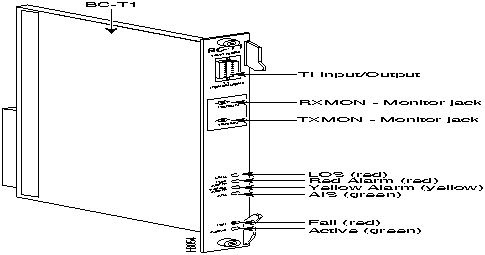
The T1 Trunk Interface Card (BC-T1) card (Figure 1-23 and Table 1-11) terminates a single 1.544 Mbps T1 trunk line on the NTC. The BC-T1 can reside in any of the rear slots 2-16 or 18-32 of the IPX 16/32 (3-8 of the IPX 8). It connects to the NTC through the Local Bus (LB) and can be made redundant by providing a standby unit and using a Y-cable at the input/output connector.
The BC-T1 has the following features:
B8ZS supports 64 Kbps clear channel operation because B8ZS eliminates the possibility of a long string of zeros. B8ZS is preferable whenever available, especially on trunks.
The BC-T1 supports two clock modes. These are normal clocking and loop timing. The system operator selects the mode through software control. Normal clocking uses the receive clock from the network for incoming data and supplies the transmit clock for outgoing data. This clock can be used to synchronize the node.
Loop timing uses the receive clock from the network for the incoming data and turns the receive clock around for timing the transmit data.
Refer to Figure 1-23 and Table 1-11 for the front plate features of the BC-T1. The standard port connector is a DB15 female. The BC-T1 and BC-E1 indicator lamps are similar, but the BC-T1 does not have multiframe alignment (MFRA and MFYA) alarms.
Table 1-11 : BC-T1 Controls and Indicators
Figure 1-23 : BC-T1 Front Plate E1 Interface Back Card (BC-E1)
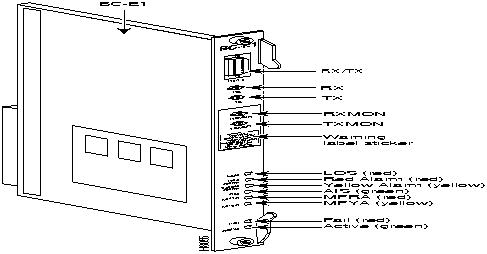
The E1 Trunk Interface Card (BC-E1) provides an E1 trunk interface for the Network Trunk Card (NTC) and the Channelized Data PAD (CDP). The BC-E1 can reside in any of the rear slots 2-16 or 18-32 of the IPX 16/32 (slot 3-8 of the IPX 8). It connects to the NTC or CDP through the Local Bus, (LB). See Table 1-12 for a list of controls and indicators.
The BC-E1 supports the following:
Table 1-12 : BC-E1 Controls and Indicators
Statistics are kept on most line errors and fault conditions, including the following:
The BC-E1 supports two clock modes. These are normal clocking and loop timing. The system operator selects the mode through software control. Normal clocking uses the receive clock from the network for incoming data and supplies the transmit clock for outgoing data. This clock can be used to synchronize the node.
Loop timing uses the receive clock from the network for the incoming data and turns the receive clock around for timing the transmit data.
Figure 1-24 and Table 1-12 illustrate the BC-E1 front plate connectors and indicators.
Figure 1-24 : BC-E1 Front Plate Subrate Interface Back Card (BC-SR)
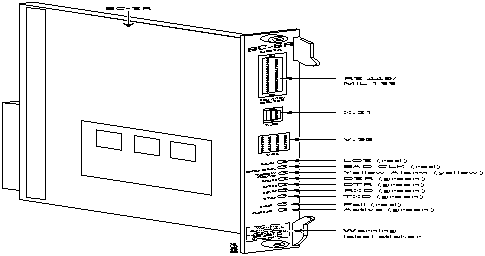
The Subrate Trunk Interface Card (BC-SR) card is used for terminating only subrate trunks on the NTC. The subrate trunk uses only a portion of the full E1 or T1 bandwidth and is used primarily as tail circuitry or where little traffic exists. The subrate trunk interface is a DCE interface, and the subrate channel acts like a synchronous data channel. Therefore, the IPX subrate back card must always be configured as a DTE. Only leased lines are supported; dial-up lines are not supported.
The BC-SR supports the following:
Note that subrate trunks cannot pass clocks between nodes.
Refer to Figure 1-25 and Table 1-13 for descriptions of controls and indicators on the BC-SR front plate. The data signals and EIA leads supported by the subrate interface appear in Table 1-14. The following alarm conditions are monitored and displayed for subrate trunks:
Table 1-13 : BC-SR Card Controls and Indicators
Table 1-14 : Data and Control Leads Supported with BC-SR
Figure 1-25 : BC-SR Indicator Lights Y1 Interface Back Card (BC-Y1)
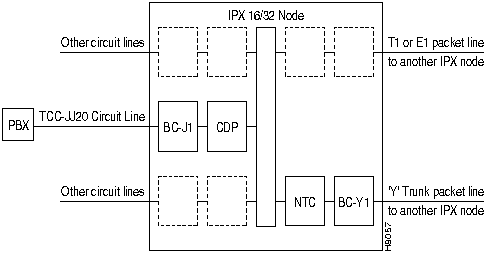
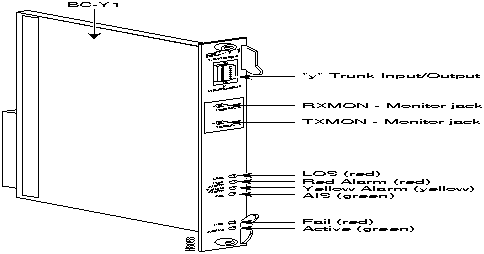
The BC-Y1 back card provides a Japanese Y1 trunk interface for an NTC. The BC-Y1 is a standard IPX back card and can reside in rear slot 2--16 or 18--32 of the IPX node, and the NTC must reside in the corresponding front slot. The two cards connect through the Local Bus (LB00). The BC-Y1 supports the following:
The BC-Y1 supports two clock modes. These are normal clocking and loop timing. The system operator selects the mode through software control. Normal clocking uses the receive clock from the network for incoming data and supplies the transmit clock for outgoing data. This clock can be used to synchronize the node.
Loop timing uses the receive clock from the network for the incoming data and turns the receive clock around for timing the transmit data.
Figure 1-26 : IPX Node with BC-J1 and BC-Y1 Back Cards Figure 1-27 : BC-Y1 Front Plate Table 1-15 : BC-Y1 Connectors and Indicators
Copyright 1988-1996 © Cisco Systems Inc.

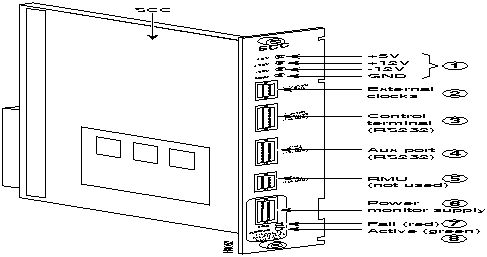
No.
Connector/Indicator
Function
1.
+5, -12, +12, GND
Test points to measure power supply voltages.
2.
EXTERNAL CLOCKS
DB15 connector for connecting a primary and optional redundant external source of system clock.
3.
CONTROL TERMINAL
(RS-232)
A DB25 connector for connecting a VT100 or equivalent terminal for an operator control terminal. Can also be used for dial-in modem. This is a bi-directional port.
4.
AUX. PORT
(RS-232)
A DB25 connector for connecting a system printer. Can also be used for out-dial modem. This is a one-way, outgoing port.
5.
RMU
Not used.
6.
POWER SUPPLY MONITOR
A system connection to the power supplies so the supplies can be monitored by circuits on the SCC.
7.
FAIL light (red)
Indicates that the card has failed.
8.
ACTIVE light (green)
Indicates that the card is active and functioning normally.
Queue
Traffic types
High Priority
NPC, First 2 packets of voice
Non-Time-Stamped Data
Data > 56 Kbps, "a", "t" voice, modem
Time-Stamped Data
Data £ 56 Kbps
Voice and ADPCM
"c", "v" voice
Bursty Data
Frame relay
Addressing Mode
Hdr. Type
Derivation of VPI/VCI
Where Used
BAM---BPX Addressing Mode
STI
VPI/VCI = Node Derived Address
Between IPX (or IGX) and BPX nodes, or between IPX (or IGX) nodes.
CAM---Cloud Addressing Mode
UNI
VPI = User Programmed
VCI = Node Derived Address
IPX to IPX (or IGX) connections over networks using ATM switches that switch on VPI only. VPI is manually programmed by user. Terminating IPX converts VCI address to FastPacket address.
SAM---Simple Addressing Mode
UNI
VPI/VCI = User Programmed
IPX to IPX (or IGX) connections over networks using ATM switches that switch where all routing is manually programmed by user, both VPI and VCI.

Connector/Indicator
Function
FAIL light (red)
Indicates that a failure has been detected on the card and that the card cannot reliably carry data. The card must be replaced.
ACTIVE: light (green)
Indicates that the card is in service and that active circuits are present.
LOS light (red)
Indicates loss of signal at the local end.
Red Alarm light (red)
Indicates loss of local T3 or E3 frame alignment, or cell alignment.
Yellow Alarm light (yellow)
Indicates loss of frame alignment at remote end, or
cell alignment.
AIS light (green)
Indicates the presence of all ones on the line.

No.
Connector/Indicator
Function
1.
FAIL light (red)
Indicates that an error occurred. Resetting the card with the resetcd f command is suggested first. If the LED comes on again, call the StrataCom ISC.
2.
ACTIVE: light (green)
Indicates that the card is in service and that active circuits are present.
3.
LOS light (red)
Indicates loss of signal at the local end.
4.
Red Alarm light (red)
Indicates loss of local E1 frame alignment, or packet alignment (NTC).
5.
Yellow Alarm light (yellow)
Indicates loss of frame alignment at remote end, or packet alignment (NTC).
6.
AIS light (green)
indicates the presence of all ones on the line.
7.
T1 INPUT/OUTPUT
DB15 connector for T1 line.
8.
RX MON
BNC test connector for monitoring receive T1 line.
9.
TX MON
BNC test connector for monitoring transmit T1 line.
No.
Connector/Indicator
Function
1.
FAIL light (red)
Indicates that a failure has been detected on the card and that the card cannot reliably carry data. The card must be replaced.
2.
ACTIVE: light (green)
Indicates that the card is in service and that active circuits are present.
3.
LOS light (red)
Indicates loss of signal at the local end.
4.
Red Alarm light (red)
Indicates loss of local E1 frame alignment or packet alignment (NTC).
5.
Yellow Alarm light (yellow)
Indicates loss of frame alignment at remote end or packet alignment (NTC).
6.
AIS light (green)
Indicates the presence of all ones on the line.
7.
MFRA light (red)
Indicates loss of multiframe alignment (E1 only).
8.
MFRY light (yellow)
Indicates loss of multiframe at the remote end (E1 only).
9.
RX
BNC connector for receive E1 line (alternate to #9).
10.
TX
BNC connector for transmit E1 line (alternate to #9).
11.
RX MON
BNC test connector for monitoring receive E1 line.
12.
TX MON
BNC test connector for monitoring transmit E1 line.
13.
RX-TX
Female DB15 connector for XMT and RCV E1.
No.
Connector/Indicator
Function
1.
FAIL light (red)
Indicates that a failure has been detected on the card and that the card cannot reliably carry data. The card must be replaced.
2.
ACTIVE: light (green)
Indicates that the card is in service and that active circuits are present.
3.
LOS light (red)
Indicates loss of signal at the local end.
4.
Bad CLK light (red)
Indicates loss of clock or clock out of range.
5.
Yellow Alarm light (yellow)
Indicates loss of frame alignment at remote end, or packet alignment (NTC).
6.
DSR light (green)
Indicates the DSR lead is high (ON).
7.
DTR light (green)
Indicates the DTR lead is high (ON).
8.
RXD light (green)
Indicates the receive data line shows activity.
9.
TXD light (green)
Indicates the transmit data line shows activity.
10.
RS-449 data connector
DB37 female connector.
11.
X.21 data connector
DB15 female connector.
12.
V.35 data connector
34-pin female MRAC connector.
Transmit
Receive
Lead
Name
Interface
Lead
Name
Interface
TX
Transmit data
All
RX
Receive data
All
RTS
Request to Send
188, V.35
CTS
Clear to Send
188, V.35
DTR/C
Data Terminal Ready
All
DSR/I
Data Set Ready
All
LL
Local Loop
188
DCD
Data carrier select
188, V.35
RL
Remote Loop
188
RI/IC
Ring Incoming Call
188, V.35
IS
Terminal In Service
188
TM
Test mode
188. V.35
SS
Select standby
188, V.35
SB
Standby indicator
188
SF
Sig rate select
188
SI
Signalling rate
188
No.
Connector/Indicator
Function
1.
FAIL light (red)
Indicates that a failure has been detected on the card, and that the card cannot reliably carry data. The card must be replaced.
2.
ACTIVE light (green)
Indicates that the card is in service and that active circuits are present.
3.
LOS light (red)
Indicates loss of signal at the local end.
4.
Red Alarm light (red)
Indicates loss of local frame alignment.
5.
Yellow Alarm light (yellow)
Indicates loss of frame alignment at the remote end.
6.
AIS light (green)
Indicates the presence of all ones on the line.
7.
Y1 Trunk INPUT/OUTPUT
DB15 connector for Y1 Trunk
8
RX MON
BNC test connector for monitoring receive Y1 line
9.
TX MON
BNC test connector for monitoring transmit Y1 line
