
Table of Contents
Frame Relay Connections
Frame Relay Connections
The frame relay commands support the activating, configuring, and statistical reporting for frame relay connections. In addition to describing the commands, this chapter describes how to:
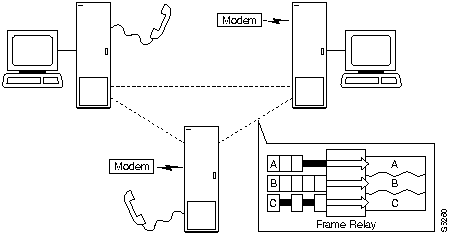
- Set up a Frame Relay connection
- Set up a Frame Relay connection group
- Use Frame Relay classes
- Use interface control templates
- Configure channel utilization
- Set channel priorities
- Display statistics
, or an FRSM card in an AXIS shelf (connected to a BPX). For information on the FRSM and the applicable AXIS commands, refer to the AXIS Reference Manual. The FastPADs and supporting service card set can also provide frame relay, but these items and related commands are documented in the FastPAD manuals.
For a greater number of lower-speed, logical connections, the Port Concentrator Shelf (PCS) is available. This external device requires an FRM-2 in the IGX or an FRC-2 in an IPX. The back card that the PCS uses is the FRI-2. The node recognizes an FRM-2 or FRC-2 and accepts command parameters for the PCS.
Physical and Logical Frame Relay Ports
This section describes the command-related issues for physical and logical frame relay ports.
In the IGX, the frame relay card series is the FRM. In the IPX series, the frame relay card set is the FRC/FRI. In these card sets, both physical and logical ports can exist. A logical port is a convention used for a T1 or E1 back card. (This is different from a logical channel, which is one or more DS0s.) In contrast, the ports on an X.21 or V.35 back card are physical. The reason that T1 and E1 ports are logical is as follows:
- The FRI-T1 and E1 back cards have one, bi-directional connector. To support the range of possible PVCs, the traffic passes through a de-multiplexer on this type of FRI. Therefore, although only one connector exists on the card, the frame relay commands accept port numbers 1--24 (T1) or 1--31 (E1). When a frame relay command takes the parameter slot.port, the port in this case is logical, and the node tracks it accordingly.
Setting Up a Frame Relay Connection
The supported frame relay connections exist between the following cards:
- FRP or FRM to any FRP or FRM
- FRP or FRM to ASI (ATM): This supports frame relay-to-network interworking
- FRP or FRM to an FRSM in an Axis: Frame relay encapsulated in ATM and terminated on an Axis
- FRP or FRM to a FastPAD port
An IPX or IGX provides a Permanent Virtual Circuit (PVC) Frame Relay Service for interconnecting user devices (routers, bridges, and packet switches). The PVCs are internally created on the IPX or IGX and rely on FastPacket switching. The user device is connected to the Frame Relay Interface (FRI) card installed in the node. The FRI provides the adaptation layer function to convert between the Frame Relay format and the FastPacket format.
Frame relay connections are added to an existing network. In addition to the interface cards listed at the beginning of this section, frame relay connections require a trunk card. Trunk cards can be an NTC or AIT in an IPX or an NTM or BTM in an IGX. In addition, since Frame Relay is a purchasable option, StrataCom must enable the feature at all nodes carrying the traffic.
A number of user devices can operate in conjunction with an IPX or IGX. The configuration on these devices be appropriate for the type of interface that the FRI card supports.
Step 1 Activate a frame relay port with the upfrport command.
Step 2 Use the cnffrport command to specify the frame relay parameters for the frame relay service. If the external device is a Port Concentrator Shelf (PCS), use cnffrcport to specify the frame relay parameters for the FRP-2 or FRM-2 card set.
Step 3 Use the dspcls command to view the existing frame classes. Select a class (from 1 to 10) if a suitable class exists, otherwise create a suitable class using the cnffrcls command. Use the selected class number in the following addcon command.
Step 4 Use the vt command to get to the node at the remote end of the proposed frame relay connection and use the upfrport and cnffrport commands as in steps 1 and 2 above.
Step 5 Use the addcon command at one end of the connection to activate the frame relay connection.
Setting Up a Frame Relay Connection Group
A frame relay group is a routing entity into which up to 16 individual frame relay connections (virtual circuits) can be included. The included connections can then be routed as a group.
- Use the addcongrp command to set up a frame relay connection group. For example, if the connection group is to be between alpha and beta, enter:
addcongrp beta.1
This command identifies beta as the other (remote) end of the connection group and the ".1" assigns a group number of "1" between alpha and beta. The command creates the connection group with the unique name of "beta.1" at the alpha end and the name of "alpha.1" at the beta end. Any unused group number between 1 and 255 can be specified. If a group number is not specified, the system automatically assigns the next higher unused number.
- Use the grpcon command to include frame relay virtual circuits in the group. Initially, the group is empty and individual frame relay circuits (up to a maximum of 16) must be included in the group through the use of the grpcon command. The connections to be included must be an inter-node, non-bundled, frame relay connections that already exist through the addcon command. For example, to include the frame relay circuit 8.1.101 into the beta.1 connection group enter:
grpcon beta.1 8.1.101
When the group has been created, the routing parameters of the whole group (all the individual circuits in the group) can be modified and displayed by using the group name (remote node.group number) in the cnfcos, upcon, dncon, cnfpref, dsprts, and dspcons commands. Non-connection parameters, such as the fail state, loop state, and configuration can be specified for each individual connection within the group. Other frame relay connection group commands are:
|
|
dspcongrps
|
displays all current connection groups at the node.
|
|
|
delcongrp
|
deletes a connection group. The group must first be emptied of connections by using the delcon command.
|
Using Frame Relay Classes
Each frame relay connection has an associated connection class. A connection class is the set of parameters that are the bandwidth and congestion-prevention characteristics of the connection.The parameters for the connection classes are observable with the dspfrcls command. StrataCom provides 10 predefined classes, but these classes are also user-configurable. A frame relay class is configurable with the cnffrcls command.
In addition to changing a frame relay parameter by using the cnffrcls command, one or more parameters are configurable through the addcon command. When a frame relay connection is added with addcon, a prompt appears for selecting a frame relay class. At this point, users can do one of the following:
- Select a default class.
- Select a class that has been modified through the cnffrcls command.
- Override one or more parameters in a connection class by typing its number (without pressing the Return key) then continue the command line by typing either a new value or an asterisk (*) for each parameter. (The asterisk causes the connection to use the existing parameter.)
Note The class number is relevant only at the time of adding the connection: once the connection is added, the system has no association between the connection and the class number.
The following parameters make up a frame relay class and are collectively known as frp_bw:
- MIR/MIR is defined as fr_MIR_Tx /fr_MIR_Rx. Parameter fr_MIR_Tx is the minimum transmit information rate for the connection. If the minimum receive rate (fr_MIR_Rx) is not included, it is unchanged from the existing value. If only the receive value is to change, an "*" may be used in place of the transmit value. The values are specified in Kbps. The range is 2.4 - 2048 Kbps.
- CIR/CIR is defined as fr_CIR_Tx and fr_CIR_Rx, where fr_CIR_Tx is defined as the committed information rate guaranteed to the user. If the receive CIR (fr_CIR_Rx) is not specified, it does not change from the existing value.
- The range of values for FRP and FRM card sets is 0 - 2048 Kbps. Using a CIR of 0 is not a standard setting. (The standard minimum is 2.4 Kbps.) CIR = 0 is an accepted parameter only if the connection terminates at both ends on either an FRM or FRP. Additionally, the CIR = 0 specification is necessary at only one end of the connection. Before specifying a CIR = 0 with either the addcon or cnffrcls command, enable IDE-to-DE mapping with the cnffrport command. Without executing cnffrport as stated, the range for CIR is 2.4 Kbps - 2048 Kbps. On FRP-2 and FRM-2 cards sets, the CIR range is 2.4 Kbps - 2048 Kbps.
- VC_Q/VC_Q is defined as fr_vc_q_Tx/fr_vc_q_Rx, where fr_vc_q Tx is the transmit VC maximum queue depth size. If the receive VC maximum queue depth, fr_vc_q_Tx, is not included, it is unchanged from the existing value. If only the receive value is to be changed, an "*" can be used in place of the transmit value. This value is specified in bytes and can be 1 - 65535.
- OR
- Bc/Bc is defined as fr_Bc_Tx /fr_Bc_Rx>. If frame relay standard parameters are used, the Committed Burst, Bc, is entered for this parameter instead of vc_q. Bc is defined as the amount of data the network agrees to accept over a variable time interval Tc for committed delivery on a particular PVC. Bc is specified in bytes and is meaningful for only FST connections.
- PIR]/PIR is defined as fr_PIR_Tx /fr_PIR_Rx where fr_PIR_Tx is the transmit peak information rate for the connection. If the receive peak information rate, fr_PIR_Rx, is not included, it is unchanged from the existing value. If only the receive rate is to be changed, an "*" may be used in place of the transmit value. The values are specified in kbps and can be 2.4 - 2048. In addition, the value 0 may be used to default to the port speed. PIR can have the following format:
- PIR | * | 0
- In the first case (PIR) a value is entered for peak information rate, in the second case (*) there is no change to the value, and in the third case (0) the port speed is used.
- OR
- Be/Be is defined as fr_Be_Tx /fr_Be_Rx. If frame relay standard parameters are used, the Excess Burst, Be, is entered for this parameter instead of PIR. Be is the amount of data over and above the number of bytes set by Bc that may be sent if there is enough spare bandwidth, but where there are no guarantees on delivery. This value is specified in bytes and only has meaning for FST connections.
- Cmax/Cmax is defined as fr_cmax_Tx /fr_cmax_Rx where fr_cmax_Tx is the maximum credits accrued for the connection. If the receive max credits, fr_cmax_Rx is not included, it is unchanged froFramm the existing value. If only the receive value is to be changed, an "*" may be used in place of the transmit value. This value is specified in packets and can be 1--255.
- ECNQ_thresh/ECNQ_thresh are the transmit and receive threshold settings for the explicit congestion notification control queues. If the threshold settings parameter is not included, it is unchanged from the existing value. If only the receive value is to be changed, an "*" may be used in place of the transmit value. This value is specified in bytes and can be 1--65535.
- QIR]/QIR is defined as fr_QIR_Tx /fr_QIR_Rx where fr_QIR_Tx is the transmit quiescent information rate for the connection, which is the initial transmit rate after a period of inactivity on the channel. If the receive quiescent information rate, fr_QIR_Rx, is not included, it is set to the transmit value. The values are specified in kbps and can range between the MIR to the PIR. In addition, the value 0 may be used to default to the MIR. This parameter only has meaning for FST connections.
- FST is used to enable or disable ForeSight option for this connection. Valid values are y (use ForeSight) or n (do not use ForeSight). If ForeSight status is changed, the connection will be rerouted.
- %utl/%utl are the percentage transmit and receive utilization settings for the frame relay class. If the utilization settings parameter is not included, it is unchanged from the existing value. If only the receive value is to be changed, an "*" may be used in place of the transmit value. This value is specified as a percentage from 0% to 100%.
The parameter values for a frame relay connection that is being added default to the value of the selected frame relay class and often need not be entered. They can, however, be entered to override the parameters in the specified class. When adding a connection where these parameters are to be modified, an asterisk can be entered if a particular parameter does not need to be changed. Since each direction of the connection can be modified independent of the other, the transmit and receive direction parameter s are separated by a slash ("/"). The dspfrcls command is used to display the current settings for each of the connection classes. To redefine any of the ten classes, use the cnffrcls command.
Using Interface Control Templates
Frame relay X.21 ports use a fixed, active control template, so the signals cannot be configured. V.35 and V.28 ports can use only the active control template, but the signals in the active state can be set to on or off. These ports cannot use looped, conditioned, near, or far.
Configuring Channel Utilization
You can use the cnfchutl command to enter the expected channel utilization of a frame relay circuit into the system. This command helps the system allocate the proper bandwidth to the circuit.
Setting Channel Priorities
Frame relay circuits have either a low or a high priority. The default is low priority. You can use the cnfchpri command to assign a high priority to a circuit or to re-assign a high priority circuit to low priority.
Displaying Statistics
IPX and IGX systems collect frame relay traffic, channel utilization, and Explicit Congestion Notification statistics. Use the dspchstats command to display these statistics. Use the clrchstats command to clear these statistics and begin collecting a new set of statistics. The dspportstats command displays frame relay usage and error statistics for a single frame relay port on a FRI4V.35 back card.
Summary of Commands
This table lists the full name and starting page number of the description for each frame relay command.
Table 9-1 :
| addcon
|
Add connection
|
9-8
|
| addcongrp
|
Add connection group
|
9-17
|
| addfrport
|
Add frame relay port
|
9-19
|
| cnfchpri
|
Configure channel priority
|
9-22
|
| cnfcondsc
|
Configure connection descriptor
|
9-24
|
| cnffrcls
|
Configure frame relay class
|
9-26
|
| cnffrcon
|
Configure frame relay connection
|
9-29
|
| cnffrcport
|
Configure frame relay port on a Port Concentrator Shelf
|
9-32
|
| cnffrport
|
Configure frame relay port
|
9-34
|
| cnfict
|
Configure interface control template
|
9-42
|
| cpyict
|
Copy interface control template
|
9-47
|
| delcon
|
Delete connection
|
9-50
|
| delcongrp
|
Delete connection group
|
9-52
|
| delfrport
|
Delete frame relay port
|
9-54
|
| dnfrport
|
Down frame relay port
|
9-56
|
| dspchcnf
|
Display channel configuration
|
9-58
|
| dspchstats
|
Display channel statistics
|
9-60
|
| dspcon
|
Display connection
|
9-63
|
| dspcongrp
|
Display connection group
|
9-65
|
| dspcongrps
|
Display connection groups
|
9-67
|
| dspcons
|
Display connections
|
9-69
|
| dspfrcls
|
Display frame relay class
|
9-77
|
| dspfrport
|
Display frame relay port
|
9-79
|
| dspict
|
Display interface control template
|
9-86
|
| dspportids
|
Display port IDs
|
9-92
|
| dspportstats
|
Display port statistics
|
9-94
|
| grpcon
|
Group connections
|
9-99
|
| prtchcnf
|
Print channel configuration
|
9-102
|
| prtcongrps
|
Print connection groups
|
9-103
|
| prtcons
|
Print connections
|
9-104
|
| prtict
|
Print interface control template
|
9-106
|
| upfrport
|
Up frame relay port
|
9-107
|
addcon
The frame relay form of the addcon command adds a frame relay data connection to the network. After a connection is added with the addcon command, the system automatically routes the connection. The node where the addcon command is entered is considered the "owner" of the added connections. The concept of ownership is important because automatic rerouting and preferred routing information for a connection must be entered from the node that owns the connection. See the cnfpref and cnfcos commands for more information on automatic rerouting. Before the system adds a connection, connection parameters appear on the screen with a prompt for confirmation.
Four types of frame relay connections can be added:
- normal
- bundled (not supported on a Port Concentrator Shelf)
- grouped
- frame forwarding
Table 9-2 :
| Normal
|
A single permanent virtual circuit where each endpoint is defined by slot.port.DLCI, for example:
addcon 4.2.200 alpha 6.1.300 2
defines a connection from the local node slot.port 4 with a DLCI of 200 to node
alpha slot 6.port1 with a DLCI of 300. The 2 represents connection class 2 (see the section titled "Using frame relay classes").
|
| Bundled
|
A connection that is part of a consecutively-numbered, mesh-bundled group. This is a shorthand method of defining the connections in the bundle. The number of remote terminations does not have to be the same as the number of local terminations. A bundle can have a maximum of 16 connections. With bundled connections, the system uses the Port ID instead of DLCIs. Use dspfrport to see the Port ID. To add a bundled connection, use slot.port [port] syntax. For example:
addcon 6.1x3 alpha 7.2x3 1
The preceding command defines the following six connections:
local node slot 6.port 1 to node alpha slot 7.port 2
local node slot 6.port 2 to node alpha slot 7.port 2
local node slot 6.port 3 to node alpha slot 7.port 2
local node slot 6.port 1 to node alpha slot 7.port 3
local node slot 6.port 2 to node alpha slot 7.port 3
local node slot 6.port 3 to node alpha slot 7.port 3
Note that each connection has the connection class of 1, the last parameter on the command line. Also, note that a PCS does not support bundled connections.
|
| Grouped
|
A frame relay connection that is part of a frame relay group: for a grouped connection, add all connections as described for a normal frame relay connection (using DLCIs at each end). Define a connection group for the node if it has not already been done (refer to addcongrp command). Then add each connection to the group using the grpcon command. Note that each connection to be added to a group must be already defined using the addcon command. A group can contain up to 16 connections.
|
| Frame forwarding
|
A non-frame relay data connection (such as HDLC or SDLC) that is routed through frame relay cards can bypass a router or take advantage of DFM at higher data rates. The format slot.port.* identifies a frame forwarding connection. An example is:
addcon 11.2.* alpha 12.3.* 2
The "*" indicates to the node that a DLCI does not apply.
|
For frame relay connections, the type specifier in the addcon command becomes the frame relay "class" specifier that defines bandwidth parameters for a class of frame relay connections. In addition, any or all of these parameters can be entered to override the class parameters. Frame relay connections do not use the coding specifier because coding is always 8/8. This is because since the frame relay cards guarantee ones density.
The maximum number of frame relay connections on an FRC or FRM is 252. The range of DLCIs is 1 - 1023. DLCI 16 - 1007 are typically available on the node for local and remote channels. DLCI values 1-15 and 1008 - 1022 are reserved by ANSI standards. DLCI 1023 is for LMI.
If a user device can automatically determine the network configuration by using the LMI, the device does not require manual input of the DLCIs that exist in the network. If a user device cannot dynamically interrogate the network to determine the DLCIs in the network, manual entry of the network DLCIs into the user device is necessary.
Note When Y-cable redundancy is currently in use, new connections can be added to only the primary card.
Full Name
Add a connection
Syntax
addcon <required parameters> [optional parameters]
Related Commands
delcon, dncon, dspcon, dspcons, upcon
Attributes
| Privilege
|
1--2
|
| Jobs
|
Yes
|
| Log
|
Yes
|
| Node
|
IPX, IGX
|
| Lock
|
Yes
|
Example 1 (local addressing)
addcon 6.1.100 beta 6.2.200 3
addcon 6.1 101 delta 4.1.102 2
addcon 4.1.100 beta 6.2.101 4
addcon 4.1.200 gamma 5.1.300 1
Description
Execute the preceding commands at node Alpha to configure the following network.
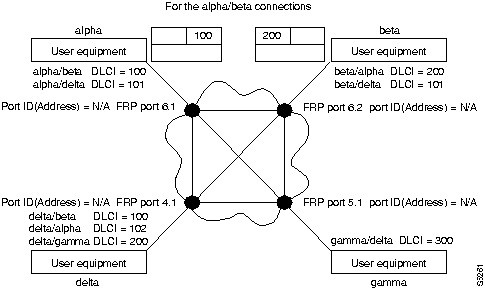
Example 1a
addcon 9.1.200 gamma 8.1.300 1
Description
Add the connection between the user device at alpha port 9.1 and the user device at gamma port 8.1. The user device at alpha refers to this connection using the local DLCI of 200. The user device at gamma refers to this connection using the local DLCI of 300. The DLCIs have only local significance. There is a restriction that the same DLCI cannot be used for more than one destination from the same port.
System Response
alpha          TRM   YourID:1        IPX 16    8.2    Mar. 23 1996 10:12 PST

Local   Remote  Remote    Route
Channel  NodeName   Channel   State   Type  Compression  Code  Avoid  COS  O
 5.1  beta  25.1  Ok  256  7/8      0  L
 9.1.100  gamma  8.1.200  Ok  fr        0  L
 9.1.200  gamma  8.1.300  Ok  fr         0  L
 9.2.400  beta  19.2.302  Ok  fr         0   L
 14.1  gamma  15.1   Ok  v        0  L


Last Command: addcon 9.1.200 gamma 8.1.300 1


Next Command:
Example 1b
addcon 9.1.100 beta 6.2.300 2
Description
Add another connection at alpha from alpha port 9.1. A DLCI of 100 is used at alpha. A DLCI of 300 can be used at beta as well as at gamma, because the DLCIs have only local significance.
Example 2 (global addressing)
addcon 6.1.80 beta 9.2.79 2
addcon 6.1.81 gamma 4.1.79 1
addcon 4.1.80 beta 6.2.81 5
Description
Configure the following network.
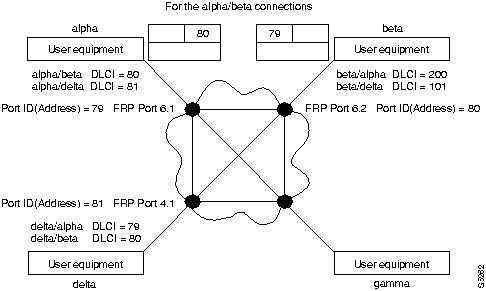
Each FRP port (and associated user device) is identified by a unique DLCI. No two ports in the network can be defined to have the same DLCI. For example, alpha port 6.1, beta port 6.2, and delta port 4.1 are assigned the unique DLCIs of 79, 80, and 81, respectively. The user device at alpha refers to the connection between alpha and beta using the DLCI of 80 assigned to beta. The user device at beta refers to this connection using the DLCI of 79 assigned to alpha.
The user device at alpha refers to the connection between alpha and delta using the DLCI of 81 assigned to delta. The user device at delta refers to this connection using the DLCI of 79 assigned to alpha. The user device at delta refers to the connection between delta and beta using the DLCI of 80 assigned to beta. The user device at beta refers to this connection using the DLCI of 81 assigned to delta.
Note that global addressing is required in FastPAD connections.
Example 3 (bundled)
addcon 8.1x3 alpha 19.2x4 1
Description
Add a bundle of frame relay connections between frame relay ports 8.1-3 on node gamma and 19.2-4 on node alpha. This connection routes traffic only between gamma FRP port 8.2 and alpha FRP port 19.2.
System Response
gamma          TRM   YourID:1        IPX 16    8.2    Mar. 23 1996 12:02 CST

CLN 15 Configuration   T1/24               NTC slot: 12
Loop clock:    --

Line framing:    --
     coding:     --
     CRC:    --
     recv impedance:    --
     E1 signalling:    --
     encoding:    --
     T1 signalling:    --
     cable type:    --
     length:    --
     56KBS Bit Pos:    --
     pct fast modem:     --


This Command: addcon 8.1x3 alpha 19.2x4 1


Add these connections (y/n)?
Frame relay bundled connections are a set of closely related, consecutively-numbered PVCs between two groups of frame relay ports forming a mesh. DLCIs are not used with the bundled frame relay connections. Instead, each port is assigned a sufficient number of DLCIs to complete the mesh. These DLCIs are assigned starting with the Port ID assigned to each port. The cnffrport command is used to assign Port IDs. When a bundled connection is added between the two groups of ports, every port of the first bundle is connected to every port of the other group. The Port ID is used as a starting DLCI and replaces the normal frame relay DLCI specified in the addcon command.
Example 4 (group)
At node alpha enter the following:
addcon 7.1.100 beta 15.1.300
addcon 7.1.200 beta 15.1.110
addcon 8.2.400 beta 9.1.120
Description
Create groups by using the addcongrp command:
addcongrp beta
Group the connections by using the grpcon command:
grpcon beta.1 7.1.100 7.1.200 8.2.400
Frame relay grouped connections are a loosely related set of PVCs between two groups of frame relay ports. The only requirement is that all connections in the group originate and terminate on the same node and use the same route. Generally, connections are grouped when the number of connections becomes too large for the routing capabilities of the IPX.
Since, in many cases, the connections already exist, all that is required to group them is to define a connection group with the addcongrp command and to add each connection to the appropriate group using the grpcon command. If the connection to be grouped does not exist, it can be added singly as a normal frame relay connection. A group may have as few as one connection and as many as sixteen.
Example 5 (forwarding)
addcon 8.2.* alpha 19.2.* 1
Description
Add a frame forwarding connection between frame relay ports 8.2 on node gamma and 19.2 on node alpha. Frame forwarding connections provide a mechanism for connecting non-frame relay frames (HDLC and SDLC). These frames do not conform to frame relay specifications, but they may be routed over FRP cards in a fixed frame-forwarding connection.
System Response
gamma          TRM   YourID:1        IPX 16    8.2   Mar. 23 1996 12:04 CST

Local  Remote  Remote           Route
 Channel  NodeName  Channel  State  Type  Compression  Code  Avoid  COS  O
 6.1  beta   25.2  Ok  256   7/8      0  R
 8.1.200   alpha   9.1.100  Ok  fr        0  R
 8.2.300  beta   19.1.101  Ok  fr        0  R
 15.1  alpha  14.1  Ok  v         0   R


This Command: addcon 8.2.* alpha 19.2.* 1


Add these connections (y/n)?
Example 6 (modifying bandwidth)
addcon 8.3.101 beta 19.3.201 7
* * * * 30/30 * * Y 80/80
Parameters specified by frame relay class #7 for this connection are modified by substituting 30 for Cmax in both directions, enabling ForeSight on this connection, and reducing percent utilization to 80% from 100%.
System Response
gamma          TRM   YourID:1        IPX 16    8.2   Mar. 23 1996 12:10 CST

 Local      Remote      Remote                                     Route
 Channel    NodeName    Channel    State  Type   Compression  Code Avoid COS O
 6.1        beta        25.2        Ok     256                 7/8         0  R
 8.1.200    alpha       9.1.100     Ok     fr                              0  R
 8.2.300    beta        19.1.101    Ok     fr                              0  R
 15.1       alpha       14.1        Ok     v                               0  R


Last Command: dspcons


Next Command: addcon 8.3.101 beta 19.3.201 7 * * * * 30/30 * * Y 80/80
Table 9-3 : addcon -- Parameters
| local channel
|
Specifies the local channel to connect. The format for an FRP or FRM card set is:
slot.port.DLCI | x port | .*
|
| node
|
Specifies the name of the remote node at the other end of the connection.
|
| remote channel
|
Specifies the frame relay channel at the other end of the connection in the
following format:
slot.port.DLCI | x port | .*
|
| class
|
Specifies 1 of 10 connection classes that define the operating parameters for a class of connections. Any or all of these parameters can be entered to override the class parameters. Classes are defined by the cnffrcls command.
|
Table 9-4 : addcon -- Optional Parameters
| frp bw
|
Specifies optional StrataCom parameters that modify the bandwidth assigned to the connection:
frp_bw = MIR/MIR, CIR/CIR, VC_Q/VC_Q, PIR/PIR, Cmax/Cmax ECNQ_thresh/ECNQ-thresh, QIR/QIR, FST, %utl/%utl
Specifies optional standard parameters that modify the bandwidth assigned to the
connection:
frp_bw = MIR/MIR, CIR/CIR, Bc/Bc, Be/Be, Cmax/Cmax, ECNQ_thresh/ECNQ-thresh, QIR/QIR, FST, %utl/%utl
Refer to the section titled "Using Frame Relay Classes" earlier in this chapter for important information on setting CIR=0 and other details regarding frp_bw parameters.
StrataCom Parameters Standard Parameters
PIR (peak information rate) Be (excess burst)
VC_Q (VC queue depth) Be (committed burst)
|
| avoid
|
Specifies the type of trunk to avoid for the connection. The default is no avoidance. The choices are:
*s avoid satellite trunks.
*t avoid terrestrial trunks.
*z avoid trunks using zero code suppression techniques that modify any bit
position to prevent long strings of zeros.
|
addcongrp
Defines a frame relay connection group between the local node and the specified remote node. The resulting connection group is a routing entity that is initially empty and into which individual connections (virtual circuits) may be added using the grpcon command. Connections added to a group must be of the inter-node, non-bundled, frame relay type. The connections must have the same routing parameters, such as owner, class of service (COS), routing state, route restrictions, and ForeSight enable status.
Connection grouping permits a node to have up to 1000 frame relay connections. A connection group may have up to 16 connections, and up to 250 connection groups can exist at a node. The addcongrp parameters, remote node name, followed by the period ("."), followed by the group number, combine to provide a unique connection group name. If the remote node name only is entered in the command, the system automatically generates the period (".") and the group number. For group number, the system uses the next unused number between the two nodes. An example of a connection group name between the alpha and beta nodes is:
If a second group is created between alpha and beta with the addcongrp command but with no specified group number, the automatically generated group names for the second group would be:
|
|
beta.2
|
at alpha
|
|
|
alpha.2
|
at beta
|
Full Name
Add connection group
Syntax
addcongrp <remote node>[.group number]
Related Commands
delcongrp, grpcon, delcon, dspcongrps, dspcons, dspcongrp
Attributes
| Privilege
|
1--2
|
| Jobs
|
Yes
|
| Log
|
Yes
|
| Node
|
IPX, IGX
|
| Lock
|
Yes
|
Example 1
addcongrp gamma
Description
Add a connection group gamma. If only the remote node name is entered in the command, the system automatically generates a period and the group number.
System Response
beta           TRM   YourID:1        IPX 32    8.2    Mar. 15 1996 15:49 MST

Only to                        Route
gamma            Count  State  Avoid  COS  FST  Owner
gamma.1          0                              Local


Last Command: addcongrp gamma


Next Command:
Table 9-5 : addcongrp -- Parameters
| remote node
|
Specifies the name of the remote node of the connection group.
|
Table 9-6 : addcongrp -- Optional Parameters
| group number
|
Specifies a separator (period) followed by the number of the group (between 1 and 250) that is being created between the local and remote nodes.
|
addfrport
The addfrport command adds a logical frame relay port by using the slot number of the FRI/FRP and the DS0/timeslots that make up the logical port. This command applies to a T1 or E1 line. It does not apply to ports on a Port Concentrator Shelf or to an FRP with a V.11 or V.35 back card. The following table lists the error and warning messages for this command.
Table 9-7 :
| "Slot is out of range"
|
Line number not correct for FRP T1/E1.
|
| "Line must first be upped"
|
Line is down.
|
| "invalid channel range"
|
Channel number is out of range (1-24) or (1-31, no 16).
|
| "Channel is busy"
|
Channel is already assigned to a logical por.t
|
| "You cannot use signalling channel 16" (E1)
|
CAS channel 16 included in logical port (E1). CCS permits the use of channel 16 but not in all countries.
|
| "Invalid rate"
|
Entered rate is not 56 Kbps or 64 Kbps.
|
| "This rate is available for single channel only"
|
Entered rate is 56 Kbps, but multiple channels specified.
|
Full Name
Add Frame Relay port T1/E1
Syntax
For FRM/FRI card sets: addfrport <slot.port> [DS0 channel] [56 | 64]
Related Commands
upcln, delfrport, cnffrcport, cnffrport, dspfrport
Attributes
| Privilege
|
1--2
|
| Jobs
|
Yes
|
| Log
|
Yes
|
| Node
|
IPX, IGX
|
| Lock
|
Yes
|
Example 1
addfrport 21.9 -15
Description
Add a single frame relay port that occupies DS0s (timeslots) in the range 9 - 15. For a T1 line, this channel rate is 7 x 64 Kbps = 448 Kbps, as the screen example shows.
System Response
gamma          TRM   YourID:1        IPX 16    8.2    Mar. 15 1996 17:28 CST

Port configuration for FRP 21

From  Chan  Speed  Interface  State

1  9-15  448  FRI T1  INACTIVE


Last Command: addfrport 21.9-15


Next Command:
Table 9-8 : addfrport -- Parameters
| slot.port (for FRP or FRM series)
|
Specifies the FRI T1 or E1 line number and the logical port number. For example, a slot.port of 8.14 is physical slot 8 and timeslot (or channel) 14.
|
Table 9-9 : addfrport -- Optional Parameters
| - chan
|
Specifies that multiple DS0/timeslots should form one logical port. A "-" separates the starting and ending DS0/timeslot in the range). Timeslots must be contiguous. An example is addfrport 8.1-5. The system uses the lowest DS0/timeslot number as the logical port number and shows this in relevant displays.
|
| rate
|
Specifies the rate of a single logical port. By default, a single logical port (or channel) is 64Kbps. A single DS0 (timeslot) may be 56 Kbps or 64 Kbps. If no rate is entered, the rate is 64 Kbps. For example, addfrport 8.14 56 specifies a rate of 56 Kbps for 8.14.
|
clrfrcportstats
Clears port statistics for FRM-2 or FRP-2 physical ports connected to a PCS. These are the statistics that dspfrcportstats displays. The controller card collects statistics from the FRM-2 or FRP-2 once per minute. This command clears statistics on the controller card, so any statistics generated within the last minute may not be cleared.
Full Name
Clear FRC/FRM port statistics
Syntax
clrfrcportstats <slot.port | *>
Related Commands
dspfrcportstats
Attributes
| Privilege
|
1--5
|
| Jobs
|
Yes
|
| Log
|
Yes
|
| Node
|
IPX, IGX
|
| Lock
|
No
|
Table 9-10 : clrfrcportstats -- Parameters
| slot,port | *
|
Slot and port of the physical port. The range for port is 1 - 4. An asterisk (*) specifies all FRC-2/FRM-2 physical ports.
|
cnfchpri
Sets the circuit priority for a frame relay circuit. The Circuit Priority feature permits some frame relay traffic to receive a higher priority, within a port queue, than other frame relay traffic on a per-connection basis. This command sets the priority for a given connection; default priority is low. The FRP must be Rev. D or later to accept a high priority and IPX software must be at least Release 6.1 or later. IPX frame relay LMI ports can be configured to communicate this priority to the router. Changes in priority require communications with the remote end of the connection.
Full Name
Configure Frame Relay channel priority
Syntax
cnfchpri <connection> <priority>
Related Commands
dspchcnf
Attributes
| Privilege
|
1--2
|
| Jobs
|
Yes
|
| Log
|
Yes
|
| Node
|
IPX, IGX
|
| Lock
|
Yes
|
Example 1
cnfchpri 9.1.100 h
Description
Configure a high priority for frame relay connection 100 of port 1 in slot 9
System Response
alpha          TRM   YourID:1        IPX 16    8.2    Mar. 15 1996 16:00 PST

Conn:  9.1.100    gamma       8.1.200     fr
   MIR       CIR    VC Q Depth      PIR      Cmax   ECN QThresh    QIR    FST
 9.6/9.6   9.6/9.6      5/5       256/256    10/10  65535/65535  9.6/9.6   n
% Util: 100/100
Owner: LOCAL  Restriction: NONE  COS: 0                     Status: OK
Group: NONE  Priority: H  TestRTD: 0 msec

Path:     alpha   14--13beta    15--15gamma
Pref:     Not Configured


alpha 9.1.100                                    gamma 8.1.200
FRP:   OK                                        FRP:   OK
FRI:   OK                                        FRI:   OK


Last Command: cnfchpri 9.1.100 h


Next Command:
Table 9-11 : cnfchpri -- Parameters
| channels
|
Specifies the channel or range of channels over which the command applies and must include card-port-DLCI.
|
| h | l
|
The priority: h = high.; l = low (l).
|
cnfcondsc
Assigns a user-specified, reference description to a connection. The connection descriptor is independently configurable at each end of a connection. To remove a descriptor, enter this command and specify a null descriptor. A descriptor cannot be deleted in a job, just reconfigured. The dspcon and dspcons +d commands display any existing connection descriptors.
Full Name
Configure connection description
Syntax
cnfcondsc <channel> <descriptor>
Related Commands
dspcon, dspcons
Attributes
| Privilege
|
1--2
|
| Jobs
|
Yes
|
| Log
|
Yes
|
| Node
|
IPX, IGX
|
| Lock
|
Yes
|
Example 1
cnfcondsc 5.1 gracie's_fax
Description
Give a descriptive name to channel 5.1. In this example, the name "gracie's_fax" is given to the connection 5.1. If a descriptor is desired for the other end of the connection, the user can "vt" to the other end of the connection and use the cnfcondsc command on that connection. The same name can be assigned or a different name.
System Response
alpha          TRM   YourID:1        IPX 16    8.2     Mar. 15 1996 15:40 PST

Conn:  5.1        beta        25.1        256 7/8    Desc: gracie's_FAX


Owner: REMOTE  Restriction: NONE  COS: 0                    Status: OK
Compression: NONE

Path:     alpha   10-- 7beta
Pref:     Not Configured


alpha 5.1                                        beta 25.1
SDP:   OK                                        SDP:   OK
SDI:   OK                                        SDI:   OK
Clock: OK                                        Clock: OK

Last Command: cnfcondsc 5.1 gracie's_fax


Next Command:
Table 9-12 : cnfcondsc -- Parameters
| channel
|
Specifies the local voice, data, frame relay, or ATM channel to describe.
|
| descriptor
|
Specifies a string of up to 20 displayable characters. The descriptor cannot begin with a number, and no spaces are allowed.
|
cnffrcls
Configures a system-wide frame relay connection class. Refer to the section titled "Using Frame Relay Classes" at the beginning of this chapter for a definition of a frame relay class. The following are characteristics of this command:
- Network-wide classes should be configured only when all nodes are reachable.
- Beware of conflicting values with existing, joined networks.
- Changing a class does not affect any existing connections. An altered frame relay class affects only connections that are added using the changed class.
Full Name
Configure Frame Relay class
Syntax
cnffrcls <class_num> [<BW params>] [<description>]
Related Commands
addcon, dspfrcls
Attributes
| Privilege
|
1--2
|
| Jobs
|
Yes
|
| Log
|
Yes
|
| Node
|
IPX, IGX
|
| Lock
|
Yes
|
Example 1
cnffrcls 1 *
Description
Configure frame relay class #1 to operate with ForeSight. The list of * parameters leaves those parameters unchanged, and "y" enables ForeSight. Because the utilization and description parameters are not entered, any existing values for these parameters remain in effect.
System Response
alpha          TRM   YourID:1        IPX 16    8.2    Mar. 15 1996 16:05 PST

                        Frame Relay Connection Classes

 #    MIR       CIR    VC Q Depth      PIR      Cmax   ECN QThresh    QIR   FST
.6/9.6   9.6/9.6  65535/65535    128/128  10/10  65535/65535  9.6/9.6  y
   % Util: 100/100 Description: "Default 9.6"
 2 19.2/19.2 19.2/19.2 65535/65535     */*      10/10  65535/65535 19.2/19.2 n
   % Util: 100/100 Description: "Default 19.2"
 3   16/16     16/16   65535/65535     */*      10/10  65535/65535   16/16   n
   % Util: 100/100 Description: "Default 16"
 4   32/32     32/32   65535/65535     */*      10/10  65535/65535   32/32   n
   % Util: 100/100 Description: "Default 32"
 5   56/56     56/56   65535/65535     */*      10/10  65535/65535   56/56   n
   % Util: 100/100 Description: "Default 56"


Last Command: cnffrcls 1 * * * * * * * y


Continue (y): y
System Response
alpha          TRM   YourID:1        IPX 16    8.2    Mar. 15 1996 16:03 PST

                        Frame Relay Connection Classes

 #    MIR       CIR    VC Q Depth      PIR      Cmax   ECN QThresh    QIR   FST
 6   64/64     64/64   65535/65535     */*      10/10  65535/65535   64/64   n
   % Util: 100/100 Description: "Default 64"
 7  128/128   128/128  65535/65535     */*      10/10  65535/65535  128/128  n
   % Util: 100/100 Description: "Default 128"
 8  192/192   192/192  65535/65535     */*      10/10  65535/65535  192/192  n
   % Util: 100/100 Description: "Default 192"
 9  256/256   256/256  65535/65535     */*      10/10  65535/65535  256/256  n
   % Util: 100/100 Description: "Default 256"
10  512/512   512/512  65535/65535     */*      10/10  65535/65535  512/512  n
   % Util: 100/100 Description: "Default 512"


Last Command: cnffrcls 1 * * * * * * * y


Next Command:
Table 9-13 : cnffrcls -- Parameters
| class num
|
Specifies the connection class to configure. The range is 1--10.
|
Table 9-14 : cnffrcls -- Optional Parameters
| frp_bw
|
Specifies the frame relay bandwidth parameters. These parameters default to the value of the chosen class and need not be entered. They can, however, be entered to override the parameters in the specified class. StrataCom parameters that modify the bandwidth assigned to the connection:
frp_bw = MIR/MIR, CIR/CIR, VC_Q/VC_Q, PIR/PIR, Cmax/Cmax ECNQ_thresh/ECNQ-thresh, QIR/QIR, FST, %utl/%utl
Specifies optional standard parameters that modify the bandwidth assigned to the
connection:
frp_bw = MIR/MIR, CIR/CIR, Bc/Bc, Be/Be, Cmax/Cmax, ECNQ_thresh/ECNQ-thresh, QIR/QIR, FST, %utl/%utl
Refer to the section titled "Using Frame Relay Classes" earlier in this chapter for important information on setting CIR=0 and other details regarding frp_bw parameters.
Stratacom Parameters Standard Parameters
PIR (peak information rate Be (excess burst)
VC_Q (VC queue depth) Bc (committed burst)
An "*" is used to maintain positional dependence if a particular parameter is not entered. If a value is not entered, the existing value remains unchanged. See "Use Frame Relay Classes" for a description of the frp_bw parameters.
|
| description
|
Any text string up to 25 characters terminated by a <RET>. This is used to provide the user with a descriptive identifier for the class.
|
cnffrcon
Configures the frame relay bandwidth parameters for a specified connection. The MIR value should be assigned or at least adjusted accurately. If it is set too high, bandwidth is wasted. If it is set too low, the connection may drop data. The statistics reports are the best source of information for deciding how to adjust this. The PIR value is usually set to the port speed. It can be adjusted lower if other constraints on the data generation rate exist. If it is adjusted too low, frames are dropped. If it is set too high, bandwidth may be wasted unless ForeSight is enabled.
The Cmax, VC Q, and ECN Q values should be changed only by knowledgeable users and when tuning data is available. These values affect system buffering resources, so any change from the default requires caution. Refer to the Release 8.2 System Manual for more details on connection parameters.
If the connection type has ForeSight enabled (FST = y), the result of the last test round trip delay command results (Test RTD) is displayed. Note that this is not the current RTD but the result of the last user-specified test. High or low connection priority is displayed for both standard frame relay connections and ForeSight connections.
Several checks on the bandwidth parameters are done to promote efficient use of network bandwidth. The following messages reflect the checks on bandwidth usage.
| Error
|
Min cannot exceed peak.
|
| Warning
|
Min exceeds this port's speed.
|
| Warning
|
Sum of mins exceeds port's speed.
|
| Warning
|
Peak exceeds this port's speed.
|
Warning messages are informational and do not indicate the command is failing to execute. Error messages indicate the command is not executing.
When specifying the optional frp_bw parameters, enter all changes (or unchanged values indicated by an asterisk) on the line. Determine any intended changes before starting this command. The parameters section of this command description lists frp_bw parameters, and the section titled "Using frame relay classes" at the beginning of this chapter describes these parameters.
Full Name
Configure Frame Relay Connection
Syntax
cnffrcon <channel> [frp_bw]
Related Commands
addcon, dspcon
Attributes
| Privilege
|
1--2
|
| Jobs
|
Yes
|
| Log
|
Yes
|
| Node
|
IPX, IGX
|
| Lock
|
Yes
|
Example 1
cnffrcon 8.1.200
Description
Configure frame relay port 8.1.200.
System Response
gamma          TRM   YourID:1        IPX 16    8.2    Mar. 15 1996 17:28 CST

Conn:  8.1.200    alpha       9.1.100     fr
   MIR       CIR    VC Q Depth      PIR      Cmax   ECN QThresh    QIR    FST
 9.6/9.6   9.6/9.6      5/5       256/256    10/10  65535/65535  9.6/9.6   n
% Util: 100/100
Owner: REMOTE  Restriction: NONE  COS: 0                    Status: OK
Group: NONE  Priority: L  TestRTD: 0 msec

Path:     gamma   15--15beta    13--14alpha
Pref:     Not Configured


gamma 8.1.200                                    alpha 9.1.100
FRP:   OK                                        FRP:   OK
FRI:   OK                                        FRI:   OK


Last Command: cnffrcon 8.1.200


Next Command:
Table 9-15 : cnffrcon -- Optional Parameters
| channel
|
Specifies the channel for which to configure connection parameters. The command configures connection information for one channel at a time. You cannot specify a set of channels. Channel is specified in the following format:
slot.port.DLCI
|
Table 9-16 : cnffrcon -- Optional Parameters
| frp_bw
|
Specifies the bandwidth parameters in the following format:
frp_bw = MIR/MIR, CIR/CIR, VC_Q/VC_Q, PIR/PIR, Cmax/Cmax ECNQ_thresh/ECNQ-thresh, QIR/QIR, FST, %utl/%utl
See "Using frame relay classes" earlier in this chapter for more information regarding frp_bw parameters. Any parameters not specified default to the current values. An "*" is used to maintain positional dependence if a particular parameter is not entered. If a value is not entered, the existing value remains.
|
cnffrcport
Configures the port speed and percent of utilization on the concentrated link of a Port Concentrator Shelf (PCS). This is not a standard command. Primarily, you would use cnffrcport to adjust the rate on the concentrated link due to some unusual system configuration.
Because this command applies to the FRC interface (the concentrated link) rather than the user port for the CPE, the port number and the range of speeds is the same as that of the FRP or FRM card. Thus, the port numbers are 1 - 4 with rates varying from 56 Kbps through 2 Mbps. During port configuration, a prompt for each parameter appears. To keep the current value of the parameter, press the Return key without typing anything.
Full Name
Configure frame relay port
Syntax
cnffrcport <slot.port> <percent utilization>
Related Commands
upfrport, dnfrport, dspfrport, dspcd
Attributes
| Privilege
|
1--2
|
| Jobs
|
Yes
|
| Log
|
Yes
|
| Node
|
IPX, IGX
|
| Lock
|
Yes
|
Example 1
cnffrcport 6.1 512 88
Description
Reconfigure PCS port 6.1 to have a speed of 512 Kbps and a concentrated link utilization of 88%. (Note that executing dspcd for this slot would show a port count of 44, which indicates that the card set supports a PCS. The Configured Clock of 512 Kbps by itself does not indicate a PCS because a standard FRP-2 or FRM-2 also supports this rate.
System Response
minnow         TN    StrataCom       IPX 8     8.2       Aug. 30 1996 10:16 PST

Physical Port: 6.1            [INACTIVE]
Interface:  FRI-X21 DCE                       Configured Clock:   512 Kbps
Clocking:   Normal                            Measured Rx Clock:    0 Kbps
                                       Min Flags / Frames           1
Port ID                     1022
Port Queue Depth           65535       OAM Pkt Threshold            3 pkts
ECN Queue Threshold        65535       T391 Link Intg Timer        10 sec
DE Threshold                 100 %     N391 Full Status Poll        6 cyl
Signalling Protocol         None       EFCI Mapping Enabled        No
Asynchronous Status           No       CLLM Enabled/Tx Timer   No/  0 msec
T392 Polling Verif Timer      15       IDE to DE Mapping          Yes
N392 Error Threshold           3       Interface Control Template
N393 Monitored Events Count    4          Lead      I
Communicate Priority          No          State   ON
Upper/Lower RNR Thresh  75%/ 25%       Concentrated Link Util    88%

Last Command: cnffrcport 6.1 512 88


Next Command:
Table 9-17 : cnffrcport -- Parameters
| slot.port
|
Specifies the card slot and port number. Because the port number is that of the concentrated link rather than the user port number, the range is 1--4 (not 1--44).
|
| speed
|
Specifies the port clock speed for a 2.0 Mbps FRP-2 or FRM-2. The display shows the configured speed as Configured Clock and the actual speed as Measured Rx Clock. The available speeds are:
1 port (selected speeds, 56--2048 Kbps)
2 ports (selected speeds, 56--1024 Kbps)
3 ports (selected speeds, 56--672 Kbps)
4 ports (selected speeds, 56--512 Kbps)
|
| utilization
|
Specifies the percent of utilization of the concentrated link.
|
cnffrport
Configures the parameters of a frame relay port. The supported card sets are the FRP, FRM, FRM-2 and FRP-2. The Port Concentrator Shelf (PCS) uses either an FRM-2 or FRP-2.
During port configuration, a prompt for each parameter appears. To keep the current value of the parameter, press the Return key without typing anything. When a parameter is not configurable for a particular application, the parameter appears shaded. You can mix the data rate for each of the ports if the total for all ports does not exceed the maximum composite data rate that the card set supports. The first of the following tables shows the supported data rates for individual T1 and E1 lines
Table 9-18 : .
| 56
|
112
|
168
|
224
|
64
|
128
|
192
|
256
|
| 280
|
336
|
392
|
448
|
320
|
384
|
448
|
512
|
| 504
|
560
|
616
|
672
|
576
|
640
|
704
|
768
|
| 728
|
784
|
840
|
896
|
832
|
896
|
960
|
1024
|
| 952
|
1008
|
1064
|
1120
|
1088
|
1152
|
1216
|
1280
|
| 1176
|
1232
|
1288
|
1344
|
1344
|
1408
|
1472
|
1536
|
| 1400
|
1456
|
1512
|
1568
|
1600
|
1664
|
1728
|
1792
|
| 1624
|
1680
|
1736
|
1792
|
1856
|
1920
|
1984
|
2048
|
The following table shows the available data rates on a single, PCS user-port. For the FRP-2 and FRM-2 cards, the maximum composite data rate over the 44 logical, user-ports is 1.792 Mbps.
Table 9-19 :
| 9.6
|
14.4
|
16
|
19.2
|
32
|
38.4
|
48
|
56
|
| 64
|
112
|
128
|
168
|
192
|
224
|
256
|
280
|
| 320
|
336
|
384
|
|
|
|
|
|
For a PCS, some additional rules for assigning data rates to the 44 ports apply:
- No single user-port should have a speed greater than 384 Kbps.
- The total for each group of 11 ports should not exceed 448Kbps. The software allows higher rates, but the system may drop data if user-equipment passes data above the aggregate total of 448 Kbps.
- The port numbers for the 11-port groups are 1-11, 12-22, 23-33, and 34-44.
The 1 Mbps FRI
The data rates available with the 1 Mbps FRI are as follows:
Table 9-20 :
| 1024
|
512
|
256
|
128
|
| 896
|
448
|
224
|
112
|
| 768
|
384
|
192
|
64
|
| 672
|
336
|
168
|
56
|
The rules for assigning data rates to the four ports when using the 1 Mbps FRI are as follows:
- If you assign a data rate of 672 Kbps or higher on any port, you cannot use any other port.
- If you assign a data rate of between 384 Kbps and 512 Kbps to any port, you can specify a second port with an available data rate of 512 Kbps or less.
- If you assign a data rate of 336 Kbps to any port, you can specify two other ports for any available data rates of 336 Kbps or less.
- If the data rate of any port does not exceed 256 Kbps, you can specify all four ports with any available data rates of 256 Kbps or less.
Full Name
Configure frame relay port
Syntax (T1/E1 ports)
cnffrport <slot.port>
<port queue depth> <ecn queue threshold> <de threshold>
- <signalling protocol> <protocol parameters>
Syntax (All other ports)
cnffrport <slot.port>
Related Commands
upfrport, dnfrport, dspfrport
Attributes
| Privilege
|
1--2
|
| Jobs
|
Yes
|
| Log
|
Yes
|
| Node
|
IPX, IGX
|
| Lock
|
Yes
|
Example 1
cnffrport 3.1 48000 48000 100 n N Y 1
Description
Change frame relay port 3.1 to have queue depths of 48000. This is a T1interface.
System Response
pubsigx1       TN    StrataCom       IGX 32    8.2       Sep. 10 1996 16:25 GMT

Port:       3.1               [ACTIVE  ]
Interface:  FRI-T1                            Configured Clock:    64 Kbps
Clocking:   None                              Measured Rx Clock: None
                                       Min Flags / Frames           1
Port ID                        -       Channel Range                1
Port Queue Depth           48000       OAM Pkt Threshold            3 pkts
ECN Queue Threshold        48000       T391 Link Intg Timer        10 sec
DE Threshold                 100 %     N391 Full Status Poll        6 cyl
Signalling Protocol         None       EFCI Mapping Enabled        No
Asynchronous Status           No       CLLM Enabled/Tx Timer   No/  0 msec
T392 Polling Verif Timer      15       IDE to DE Mapping          Yes
N392 Error Threshold           3       Channel Speed               64
N393 Monitored Events Count    4
Communicate Priority          No
Upper/Lower RNR Thresh  75%/ 25%

Last Command: cnffrport 3.1 48000 48000 100 n N Y 1


Next Command:
Example 2
cnffrport 5.1 256 n 12000 10000 100 a N N 15 3 4 3 y y 100 Y 1
Description
Reconfigure frame relay port 8.1 to change queue depths. This is a V.351 interface, so optional parameters begin with the clock speed specification (which has a default of 256 Kbps). An explanation of the screen appears after the screen example.
System Description
padma       VT    StrataCom       IPX 8     8.2       Sep. 10 1996 16:39 GMT

Port:       5.1               [ACTIVE  ]
Interface:  FRI-V35 DCE                       Configured Clock:   256 Kbps
Clocking:   Normal                            Measured Rx Clock:  256 Kbps
                                       Min Flags / Frames           1
Port ID                        0
Port Queue Depth           12000       OAM Pkt Threshold            3 pkts
ECN Queue Threshold        10000       T391 Link Intg Timer        10 sec
DE Threshold                 100 %     N391 Full Status Poll        6 cyl
Signalling Protocol  Annex A UNI       EFCI Mapping Enabled       Yes
Asynchronous Status           No       CLLM Enabled/Tx Timer  Yes/100 msec
T392 Polling Verif Timer      15       IDE to DE Mapping          Yes
N392 Error Threshold           3       Interface Control Template
N393 Monitored Events Count    4          Lead    CTS    DSR    DCD
Communicate Priority          No          State   ON     ON     ON
Upper/Lower RNR Thresh  75%/ 25%

Last Command: cnffrport 5.1 256 NORMAL 0 12000 10000 100 a N N 15 3 4 3 y y 100
Y 1

Next Command:
The screen in Example 2 shows the following:
| · Port Queue Depth
|
12000
|
Depth of port queue is set at 12000 bytes.
|
| · ECN Queue Depth
|
10000
|
Port queue must reach 10000 bytes before FECN and BECN bits are set.
|
| · DE Threshold
|
100
|
Port buffer level must be at 100% of capacity before dropping DE frames.
|
| · Signalling Protocol
|
Annex A
|
The selected protocol for the UNI.
|
| · Asynchronous Status
|
N
|
No asynchronous messages to user device; wait for polling from user device.
|
| · Polling Verify Timer
|
15
|
15 seconds heartbeat period
|
| · Error Threshold
|
3
|
3 failures trigger port comm failure
|
| · Monitored Events Count
|
4
|
4 events are monitored
|
| · Communicate Priority
|
N
|
Do not communicate port priority to user device.
|
| · Upper RNR Threshold
|
75
|
75% of buffer capacity triggers receiver not ready condition
|
| · Lower RNR Threshold
|
25
|
25% of buffer capacity clears a receiver not ready condition
|
| · Minimum Flags/Frame
|
1
|
One flag exists for each FR data frame.
|
Note The following table describes both mandatory and optional parameters because some parameters are mandatory for T1/E1 lines and option for other line types.
Table 9-21 : cnffrport -- Parameters
| slot.port
|
Specifies the FRP or FRM slot and port number. For a T1/E1 line, port is a logical number. For a Port Concentrator Shelf, port refers to the logical port in the range 1--44.
|
| interface type
|
Specifies a an interface type for a Port Concentrator Shelf. This parameter applies to only the user interface display and not the PCS. System software does not detect the interface type in the PCS. To change the user-interface type, you must change a card in the PCS.
|
| slot.port.line
|
Specifies the UFM slot, port, and line number, where port can be 1--48 and line 1--8. Note that the maximum number of T1/E1 lines per node is 32. This maximum could be, for example, spread over 4 UFM-C card sets that use all 8 lines on each card.
|
| speed
|
Specifies a port clock speed in Kbps for a 2.0 Mbps FRP or FRM. The configured speed appears under the Configured Clock heading. The actual clock rate appears under the Measured Rx Clock heading. Note that this option does not apply to T1/E1 lines because these line types use 64 or 56 Kbps timeslots. The range of speeds according to the number of active ports is as follows:
- 1 port (selected speeds, 56--2048 Kbps)
- 2 ports (selected speeds, 56--1024 Kbps)
- 3 ports (selected speeds, 56--672 Kbps)
- 4 ports (selected speeds, 56--512 Kbps)
Refer to the table at the beginning of this command description for the available clock rates for all port combinations.
|
| clocking
|
Specifies the port clock type for V.35 and X.21 lines. The clocking parameter does not apply to T1, E1, or PCS lines. The clock type is either normal or looped.
Four combinations of clocking are available for the FRI-V.35. Two combinations of clocking are available for the FRI-X.21. Note that the clock and data direction for DCE mode is the opposite of the direction for DTE mode.
- FRP or FRM is DCE with normal clocking (V.35 and X.21)
- FRP or FRM is DCE with looped clocking (V.35 only)
- FRP or FRM is DTE with normal clocking (V.35 and X.21)
- FRP or FRM is DTE with looped clocking (V.35 only)
For a description of looped and normal clocking, refer to the IGX Reference manuals, the IPX Reference, or the System Manual.
|
| port type
|
Specifies the port type as either "FR" for frame relay or "ATM" for asynchronous transfer mode. Specify "ATM" when the node uses an AIP or BTM for a V.35 circuit interface to a frame relay port. The port type also configures alarm reporting and other miscellaneous functions for a port. This parameter does not apply to PCS ports.
When you use cnffrport in a job, the port type parameter follows slot.port. This parameter is not necessary in standard use of cnffrport. Valid entries are V.35, X.21, PORT, or LINE (where LINE indicates a T1 or E1 line).
|
| port ID
|
Specifies the DLCI associated with the port (0 - 1024) {0}. A node uses this number when you add bundled connections. Otherwise, port ID can be used as a network destination number in global addressing. The port ID does not apply to T1, E1, or PCS ports.
|
| port queue depth
|
Specifies the maximum bytes queued for transmission from the FRP or FRM port. The range is 0--65535. The default is 65535.
|
| ecn queue threshold
|
Specifies the threshold at which the system begins to generate explicit congestion notification (BECN and FECN bits) for the port. The range is 0--65535. The default is 65535.
|
| de threshold
|
Specifies the port queue depth above which the system discards frames with a set Discard Eligibility (DE) bit. The range is 0--100%. The default is 100%. A threshold of 100% disables DE for the port because a queue cannot contain more than 100% of its capacity.
|
| signalling protocol
|
Specifies the LMI operation mode. The range is 0--255. The default is LMI=2. The system recognizes the following definitions:
LMI = 0 LMI is disabled at this port.
LMI = 1 StrataCom LMI and the asynchronous update process is enabled at this port. Greenwich Mean Time is also enabled.
LMI = 2 LMI is disabled at this port.
LMI = 3 StrataCom LMI is enabled at this port, but asynchronous update process is disabled.
LMI = 4 The port configuration is UNI using CCITT Q.933 Annex A parameters.
LMI = 5 The port configuration is UNI using ANSI T1.617 Annex D parameters.
LMI = 6 The port configuration is NNI using CCITT Q.933 Annex A parameters.
LMI = 7 The port configuration is NNI using ANSI T1.617 Annex D parameters.
|
| asynchronous status
|
Specifies whether the node should send unsolicited LMI update messages when they appear or wait for the user device to poll. Enter y (yes) or n (no).
|
| polling verify timer
|
Specifies a Link Integrity Verification Timer heartbeat (keep-alive) period. The range is 5--30. The default is 15. Set the timer to 5 secs. more than the setting in the user equipment.
|
| error threshold
|
Specifies the number of failures in the monitored events that cause the "keep alive" process to report an alarm. The theoretical range is 0--255. The valid range is 1--10. A threshold of 0 reverts to 1. A threshold greater than 10 reverts to 10.
|
| monitored events count
|
Specifies the number of monitored events for the "keep alive" process. It has a theoretical range of 0 - 255 and a valid range of 1--10. A port communication-fail condition is cleared after this number of successful polling cycles. A value of 0 reverts to 1, and a value more than 10 reverts to 10.
|
| communicate priority
|
Specifies whether the system should communicate the SNA priority of the connections to the user device on the port. Enter y (yes) or n (no). (SNA priority is either H or L.)
|
upper/lower RNR
threshold
|
Specifies the receiver not ready (RNR) thresholds. The upper threshold is the number of receiver not ready indications from the user equipment before an alarm is generated for this port. The lower RNR threshold is the number of indications from the user equipment before an alarm is cleared. The range is 1--255. The default for the upper RNR threshold is 75. The default for the lower RNR threshold is 25.
|
| Enable EFCI to BECN mapping
|
Directs the system to map the Frame Relay BECN bit to the EFCI bit in a FastPacket.
|
| ForeSight over port
|
Specifies whether the system should use CLLM over the port.
|
| min. flags/frame
|
Specifies the minimum number of flags between frames when the direction of transmission is from the node to the user-equipment. Any value greater than 0 is valid on the FRP or FRM. The default is 1. On a Port Concentrator Shelf, the range is 1--16.
|
OAM FastPacket
threshold
|
Specifies how many OAM FastPackets must arrive from a remote NNI port before the local port generates "A-bit = 0" in the signalling protocol message to the locally attached device. The range for this parameter is 0--15 packets. The default is 3 packets. A 0 disables this function. The OAM FastPacket threshold setting applies to UNI and NNI ports. The following two paragraphs provide a more detailed explanation of the A-bit and OAM FastPacket threshold usage.
On any frame relay port (UNI or NNI) that is using a signalling protocol (StrataCom LMI, Annex A, or Annex D), the FRP or FRM provides a Status message to the attached equipment in response to a Status Enquiry message or as an Asynchronous Update. These Status messages contain details about every PVC configured on the port. In particular, the "PVC Active" bit (the A-bit) represents whether a PVC is active (A-bit=1) or out of service (A-bit = 0). If the other end of the PVC terminates on a UNI port, then the only conditions that can cause the local FRP or FRM to send an A-bit=0 are:
- the PVC being "down" (intentionally taken out of service) or
- the PVC being failed for any reason (such as a hardware failure, trunk failure with no ability to reroute, and so on).
If the other end of the PVC terminates on an NNI port, one additional condition can cause the local FRP or FRM to send an A-bit=0 to the local device: if the remote NNI port on the FRP or FRM receives an A-bit=0 from the remote network over the remote NNI, then the local FRP or FRM can propagate an A-bit=0 out the local port. The mechanism by which the remote FRP or FRM notifies the local FRP or FRM of the A-bit=0 coming from the remote network is OAM FastPackets. The local node sends one OAM FastPacket every 5 seconds for as long as the A-bit coming from the remote network is 0.
|
link integrity timer
(T391)
|
Specifies the interval after which the system sends Status Enquiry messages across the NNI port. The range for the interval is 5 - 30 seconds. The default is 6 seconds. Both networks do not need to have the same T391 value.
On a frame relay NNI port, the Link Integrity Timer (T391) specifies how often the FRP or FRM generates a Status Enquiry message to the attached network using the selected NNI signalling protocol (Annex A or Annex D). The FRP or FRM should receive a Status message for every Status Enquiry message it transmits. If the FRP or FRM receives no responses or invalid responses, a Port Communication Failure results. (This causes a minor alarm.) Using the default values for N392 Error Threshold and N393 Monitored Events Count in an example: an error occurs when no response (or a bad response) arrives for 3 out of the last 4 Status Enquiry messages. (The default for N392 Error Threshold is 3. For N393 Monitored Events Count, the default is 4.)
|
| N392 error threshold
|
Specifies the number of bad or undelivered responses to Status Enquiry messages that can occur before the system records a Port Communication Failure. The range is 1--10. The default is 3. See the description of the link integrity timer parameter for example usage.
|
| N393 monitored events count
|
Specifies the number of Status Enquiry messages in a period wherein the system waits for responses to the enquiries. The range is 1--10. The default is 4. See the description of the link integrity timer parameter for example usage.
|
| full status polling cycle (N391)
|
Specifies the interval at which the system sends the Full Status Report request for all PVCs across the NNI port. The range is 1--255 polling cycles. The default is 10 cycles. The Full Status reports the status of all the connections across the NNI.
|
| card type
|
Specifies the card type when you enter the cnffrport command in a job. This parameter is not available except when you specify cnffrport in a job by using the addjob command. During the job specification, you enter the card type just after the slot.port during the command specification phase of addjob. Valid card types are "V.35," "X.21," "port," and "line," where "line" indicates a T1 or E1 line.
|
| CLLM status Tx Timer
|
Specifies an interval for the system to send ForeSight congestion messages across the NNI. The range is 40 ms - 350 ms. The default is 100 ms. Both networks must be StrataCom networks.
|
| IDE to DE mapping
|
Specifies whether the destination system should map the internal DE bit (IDE) status in the FastPacket or ATM cell to the frame relay DE bit at the destination. Enter y (yes) or n (no). If you specify the non-standard case of CIR=0 with either addcon or cnffrcls, you must first enable IDE to DE mapping. Refer to the section titled "Using Frame Relay Classes" for important information on setting CIR=0.
|
interface control
template
|
Specifies the control leads available on the V.35 and X.21 physical frame relay ports and the meaning for each lead.
|
| channel range
|
Specifies the DS0s for the T1 or E1 logical port. The value can be 1 or a contiguous combination in the range 1--24 for T1 or 1--31 for E1. For example, 7--12 indicates 6 DS0s for the port, starting with DS0 7. Before you use this command, specify the valid channel range with the addfrport command.
|
| channel speed
|
Specifies the bandwidth available to a logical port. The speed is 64 Kbps times the number of DS0s you specify with the channel range parameter.
|
cnfict
Sets the interface control template signals. Each data channel has a default interface control template for its active, conditioned, and looped-near and far states. The cnfict command is used to change a control template. Each interface control lead must be individually configured. The signals available to cnfict to set depend on the type of back card and whether the hardware mode is DCE or DTE. On an IPX, the applicable front cards are the SDP, LDP, FRP, CDP (for data), and FTC (for data). On an IGX, the applicable front cards are the LDM, HDM, FRM, CVM (for data), and FTM (for data).
Note The cnfict command is not valid for V.11 and X.21 interfaces. For FRP V.35 and Port Concentrator V.35 and V.28 interfaces, only the active template is usable, and leads can be configured to only on or off.
When Y-cable redundancy is in effect, the control template configuration for the data channels terminating at the primary slot is also applied to the data channels of the secondary slot. Any configuration information for the secondary slot is ignored. The following lists which leads are configurable for each type of data interface supported by the IPX or IGX. The entries under the "IPX or IGX Name" column indicate the abbreviations to use when specifying input or output leads on the command line.
Table 9-22 :
| DTE
|
RTS
|
CA
|
CA
|
RS
|
C
|
|
F4
|
105
|
Request to Send
|
| DCE
|
CTS
|
CB
|
CB
|
CS
|
D
|
|
F4
|
106
|
Clear to Send
|
| DCE
|
DSR
|
CC
|
CC
|
DM
|
E
|
|
F3
|
107
|
Data Set Ready
|
| DCE
|
DCD
|
CF
|
CF
|
RR
|
F
|
|
F7
|
109
|
Data Carrier Detect (RLSD)
|
| DCE
|
QM
|
QM
|
QM
|
|
|
|
|
|
Equalizer Mode
|
| DTE
|
pin 11
|
11
|
11
|
|
|
|
|
|
Sometimes used for Data
|
| DCE
|
SDCD
|
SCF
|
SCF
|
|
|
|
|
122
|
Secondary Data Carrier Detect
|
| DCE
|
SCTS
|
SCB
|
SCB
|
|
|
|
|
121
|
Secondary Clear to Send
|
| DTE
|
STxD
|
SBA
|
SBA
|
|
|
|
F5
|
118
|
Secondary Transmit Data
|
| DTE
|
NS
|
|
|
NS
|
|
|
F7
|
|
New Sync
|
| DCE
|
SRxD
|
SBB
|
SBB
|
|
|
|
F5
|
119
|
Secondary Receive Data
|
| DCE
|
DCR
|
DCR
|
|
|
|
|
|
|
Divided Receiver Clock
|
| DTE
|
RL
|
|
RL
|
RL
|
|
|
F6
|
|
Remote Loopback
|
| DTE
|
SRTS
|
SCA
|
SCA
|
|
|
|
|
120
|
Secondary Request to Send
|
| DTE
|
DTR
|
CD
|
CD
|
TR
|
H
|
|
F3
|
108.2
|
Data Terminal Ready
|
| DCE
|
SQ
|
CG
|
CG
|
SQ
|
|
|
|
110
|
Signal Quality Detect
|
| DCE
|
RI
|
CE
|
CE
|
IC
|
J**
|
|
|
125
|
Ring Indicator
|
| DTE
|
SF
|
CH
|
CH
|
SF
|
|
|
|
111
|
Signal Rate Select (to DCE)
|
| DCE
|
SI
|
CI
|
CI
|
SI
|
|
|
|
112
|
Signal Rate Select (to DTE)
|
| DTE
|
BSY
|
BSY
|
|
IS
|
|
|
F1
|
|
Busy (In Service)
|
| DCE
|
SB
|
|
TST
|
SB
|
|
|
F1
|
|
Test Indicator
|
| DTE
|
LL
|
|
|
LL
|
|
|
F2
|
|
Local Loopback
|
| DCE
|
TM
|
|
|
TM
|
K**
|
|
F6
|
|
Test Mode
|
| DTE
|
SS
|
|
|
SS
|
|
|
|
|
Select Standby
|
| DTE
|
C
|
|
|
|
|
C
|
|
|
Control
|
| DCE
|
I
|
|
|
|
|
I
|
|
|
Indicator
|
Asterisk (**) indicate the listing is applicable to only an SDP or HDM card. Pins 11 and 23 on an RS-232 port are bi-directional, and their default direction is input. See the cnfcldir command for information on changing the direction of these pins. The cpyict command can be used to copy an interface control template from one data channel to another. The template can then be edited using the cnfict command. The dspbob command displays the state of leads at specified intervals.
The preceding list shows the equivalence between RS-232C, RS-232D, RS-449, V.35, and X.21 interfaces. An IPX or IGX treats leads impartially for non-interleaved connections. Any signal arriving on an EIA pin at one end may be transmitted to any pin at the other end. An imposed maximum of 12 EIA leads applies to any interface type. For interleaved EIA connections, the "Fast EIA" column shows which leads are carried in the interleaved bytes in the data packets. All remaining leads are carried in traditional control lead packets.
Full Name
Configure interface control template
Syntax
cnfict <port> <template> <output> <source>
Related Commands
addextlp, dspict, tstport
Attributes
| Privilege
|
1--2
|
| Jobs
|
Yes
|
| Log
|
Yes
|
| Node
|
IPX, IGX
|
| Lock
|
Yes
|
Example 1
cnfict 25.1 a cts on
Description
Configure the active interface control template for channel 25.1 to CTS-on. This means that when the port is active, the CTS lead is asserted.
System Response
beta           TRM   YourID:1        IPX 32    8.2    Mar. 15 1996 17:36 MST

Data Channel:      25.1
Interface:         RS232   DCE
Clocking:          Normal

            Interface Control Template for Connection while ACTIVE

 Lead    Output Value                   Lead    Output Value
 RI      OFF                            DSR     ON
 CTS     ON                             SRxD    ON
 DCR     OFF                            DCD     ON
 SCTS    ON                             SDCD    ON
 SQ      ON


Last Command: cnfict 25.1 a cts on


Next Command:
Example 2
cnfict 9.1 a rts on
Description
Configure the active interface control template to have RTS-on. This means that when the port is active. the RTS lead is asserted.
System Response
alpha          TRM   YourID:1        IPX 16    8.2    Mar. 23 1996 10:23 PST

Port:       9.1               [ACTIVE  ]
Interface:  FRI-V35 DTE                       Configured Clock:   256 Kbps
Clocking:   Normal                            Measured Rx Clock:    0 Kbps
Port ID                        7
Port Queue Depth           65535       OAM Pkt Threshold            3 pkts
ECN Queue Threshold        65535       T391 Link Intg Timer         6 sec
DE Threshold                 100 %     N391 Full Status Poll       10 cyl
Signalling Protocol         None       ForeSight (CLLM)            No
Asynchronous Status           No       CLLM Status Tx Timer         0 msec
T392 Polling Verif Timer      15       Interface Control Template
N392 Error Threshold           3          Lead       State
N393 Monitored Events Count    4           RTS        ON
Communicate Priority          No           DTR        ON
Upper/Lower RNR Thresh  75%/ 25%
Min Flags / Frames            1

Last Command: cnfict 9.1 a rts on


Next Command:
Example 3
cnfict 31.1 n dsr on
Description
Configure the near interface control template for 31.1, to DSR on (DDS trunk).
System Response
beta           TRM   YourID:1        IPX 32    8.2    Mar. 15 1996 17:38 MST

Data Channel:      31.1
Interface:         DDS-4   OCU Config
Clocking:          Looped

            Interface Control Template for Connection while NEAR EXT LOOPED

 Lead    Output Value                   Lead    Output Value
 DSR     ON                             CTS     ON
 DCD     ON


Last Command: cnfict 31.1 near dsr on


Next Command:
Table 9-23 : cnfict -- Parameters
| port
|
Specifies the data channel or frame relay port whose interface control template is to be configured. Entered as: slot.port
|
| template
|
Specifies which interface control template to configure for the channel and has the format: a/c/l/n/f. Valid entries are:
|
|
|
Entry
|
Template
|
Description
|
|
|
|
a
|
Active
|
The "active" control template is in effect while the data channel is active (normal operation) i.e. when the connection is routed and not failed.
|
|
|
c
|
Conditioned
|
The "conditioned" control template is in effect when conditioning is applied to the data channel. The conditioned template is used when the network detects that it cannot maintain the connection because of card failures or lack of bandwidth (The connection is failed.)
|
|
|
l
|
Looped
|
The "looped" template is in effect when the data channel is being looped back in either direction. The looped template is used when addloclp or addrmtlp has been used to loop the connection within the network.
|
|
|
n
|
Near loopback
|
The "near" template is in effect when running a tstport n or an addextlp n on a port. The port is configured such that the external near modem is placed in a loopback.
|
|
|
f
|
Far loopback
|
The "far" template is in effect when running a tstport f or an addextlp f on a port. The port is configured such that the external far-end modem is placed in a loopback.
|
|
|
The only valid template for a frame relay port, X.21 or V.35, is the ACTIVE template. Also, all the output leads have steady state values and do not follow local or remote inputs.
|
| output
|
Specifies the output lead to configure. Valid abbreviations for output leads are listed in the previous parameter (template). Configurable output leads vary depending on the type of data interface: RS-232, V.35, X.21, or RS-449.
|
| source
|
Specifies how the lead is to be configured and has the format:
- on | off |local|remote input delay
Delay is an optional parameter. The following lists the valid source choices:
|
|
|
on
|
The output lead is asserted.
|
|
|
off
|
The output lead is inhibited.
|
|
|
l
|
(for local) indicates that the output follows a local lead.
|
|
|
r
|
(for remote) indicates that the output follows a remote lead.
|
|
|
input
|
The name of the local or remote input lead that the output lead follows.
|
|
|
delay
|
The time in milliseconds that separates the "off" to "on" lead transitions. Delay is valid only when the output lead is CTS and the input lead is local RTS. "On" to "Off" lead transitions are not subject to this delay.
|
cpyict
Copies all control template information associated with a given channel: the active template information, the conditioned template information, and the looped template information near, far. Once copied, the control template information may be edited with the cnfict command. See the cnfict command for more information on interface control templates.
Full Name
Copy SLDP/LDP/FRP interface control template
Syntax
cpyict <source_port> <destination_port>
Related Commands
cnfic, dspict
Attributes
| Privilege
|
1--2
|
| Jobs
|
Yes
|
| Log
|
Yes
|
| Node
|
IPX, IGX
|
| Lock
|
Yes
|
Example 1
cpyict 25.1 25.2
Description
Copy the interface control template on channel 25.1 to channel 25.2
System Response
beta           TRM   YourID:1        IPX 32    8.2    Mar. 15 1996 17:40 MST

Data Channel:      25.2
Interface:         RS232   DCE
Clocking:          Normal

            Interface Control Template for Connection while ACTIVE

 Lead    Output Value                   Lead    Output Value
 RI      OFF                            DSR     ON
 CTS     ON                             SRxD    ON
 DCR     OFF                            DCD     ON
 SCTS    ON                             SDCD    ON
 SQ      ON


Last Command: cpyict 25.1 25.2


Next Command:
Example 2
cpyict 25.1 25.2
Description
Copy the frame relay interface control template on port 25.1 to 25.2
System Response
beta           TRM   YourID:1        IPX 32    8.2    Mar. 15 1996 17:40 MST

Data Channel:      25.2
Interface:         RS232   DCE
Clocking:          Normal

            Interface Control Template for Connection while ACTIVE

 Lead    Output Value                   Lead    Output Value
 RI      OFF                            DSR     ON
 CTS     ON                             SRxD    ON
 DCR     OFF                            DCD     ON
 SCTS    ON                             SDCD    ON
 SQ      ON


Last Command: cpyict 25.1 25.2


Next Command:
Table 9-24 : cpyict -- Parameters
| source channel
|
Specifies the data channel or frame relay port whose interface control template information.
|
| destination channel
|
Specifies the data channel or frame relay port that will receive the copied control template information.
|
delcon
Removes connections from the network. A prompt appears for confirming the deletion. Connections can be deleted from the node at either end of the connection. Do not delete a connection when the node at the other end of the connection is unreachable. The unreachable node will not recognize the deletion. It is especially important not to delete a connection to an unreachable node and then connect that channel to another node. Channel connections are added to the network with the addcon command.
Full Name
Delete connections
Syntax
delcon <channel(s)>
Related Commands
addcon, dspcon, dspcons
Attributes
| Privilege
|
1--2
|
| Jobs
|
Yes
|
| Log
|
Yes
|
| Node
|
IPX, IGX
|
| Lock
|
Yes
|
Example 1
delcon 25.1
Description
Delete connection 25.1. The connections to delete are highlighted. A prompt asks you to confirm the deletion. Respond with "y" for yes. Connection 25.1 is deleted.
System Response
beta           TRM   YourID:1        IPX 32    8.2    Mar. 15 1996 15:43 MST

 Local      Remote      Remote                                      Route
 Channel    NodeName    Channel    State  Type    Compression  Code Avoid COS O
 19.1.101   gamma       8.2.300    Ok     fr                               0  L
 19.2.302   alpha       9.2.400    Ok     fr                               0  R
 25.2       gamma       6.1        Ok     256                  7/8         0  L


Last Command:


Next Command: delcon 25.1
Table 9-25 : delcon -- Parameters
| channel
|
Specifies the channel or set of channels whose connections to delete. <channel> is specified in the following format: slot.port.DLCI
|
delcongrp
Deletes a group. The group must be empty (all connections must first have been removed with the delcon command). You can delete a group from either the local or remote end of the group.
Full Name
Delete connection group
Syntax
delcongrp [remote node] <connection group>
Related Commands
dspcongrp, grpcon, delcon, dspcongrps, dspcons, addcongrp
Attributes
| Privilege
|
1
|
| Jobs
|
Yes
|
| Log
|
Yes
|
| Node
|
IPX, IGX
|
| Lock
|
Yes
|
Example 1
delcongrp gamma.1
Description
Delete connection group gamma.1.
System Response
beta           TRM   YourID:1        IPX 32    8.2    Mar. 15 1996 16:19 MST

                               Route
Group            Count  State  Avoid  COS  FST  Owner


Last Command:


Next Command:  delcongrp gamma.1
Table 9-26 : delcongrp -- Parameters
| remote node
|
Specifies the name of the remote node of the connection group.
|
| group number
|
Specifies the number of the group (between 1 and 250) to delete between the local and remote nodes.
|
delfrport (T1/E1)
The information in this description applies to only frame relay T1/E1 applications. The delfrport command deletes logical FRP or FRM ports and unassigns associated DS0/timeslots. The unassigned DS0/timeslots may be recombined with the addfrport command to create new logical ports. The port screen (normally seen with the dspfrport command) appears regardless of successful port deletion. The screen displays the defined port numbers for the specified line. Error messages appear when the procedure is incorrect. The following lists the error and warning messages for this command.
Table 9-27 :
| "Slot is out of range"
|
Line number not correct for FRP T1/E1
|
| "Port does not exist"
|
Logical port number does not exist
|
| "You must first down the port"
|
Logical port is up
|
| "You must first down the port"
|
Specified port is not first DS0/timeslot of logical port
|
Full Name
Delete Frame Relay port (T1/E1)
Syntax
delfrport <slot.port>
Related Commands
addfrport, dspfrport, dnfrport
Attributes
| Privilege
|
1
|
| Jobs
|
Yes
|
| Log
|
Yes
|
| Node
|
IPX, IGX
|
| Lock
|
Yes
|
Example 1
delfrport 8 .1
Description
Delete frame relay port 8.1
System Response
alpha TRM   YourID:1        IPX 16    8.2    Mar. 15 1996 17:28 CST

Port configuration for FRP 8

From  Chan  Speed  Interface  State

1  9-15  448  FRI T1  ACTIVE

20  20-24  320  FRI T1  ACTIVE


Last Command: delfrport 8.1


Next Command:
Table 9-28 : delfrport (T1/E1) -- Parameters
| slot
|
Specifies the physical FRP or FRM T1 or E1 line. The range of logical port numbers is 1 - 24 for T1 lines and 1 - 31 for E1 lines.
|
| port
|
Specifies the logical port number of the port to delete.
|
dnfrport
Downs the specified frame relay port. All connections must be removed from the port before the port can be deactivated.
Full Name
Down Frame Relay port
Syntax
dnfrport <slot.port>
Related Commands
cnffrport, dspfrport, upfrport
Attributes
| Privilege
|
1--2
|
| Jobs
|
Yes
|
| Log
|
Yes
|
| Node
|
IPX, IGX
|
| Lock
|
Yes
|
Example 1
delfrport 3.1
Description
Down frame relay port 3.1
System Response
pubsigx1       TN    StrataCom       IGX 32    8.2      Aug. 14 1996 03:49 GMT

Port:       3.1               [INACTIVE]
Interface:  FRI-T1                            Configured Clock:    64 Kbps
Clocking:   None                              Measured Rx Clock: None
                                       Min Flags / Frames           1
Port ID                        -       Channel Range                1
Port Queue Depth           65535       OAM Pkt Threshold            3 pkts
ECN Queue Threshold        65535       T391 Link Intg Timer        10 sec
DE Threshold                 100 %     N391 Full Status Poll        6 cyl
Signalling Protocol         None       EFCI Mapping Enabled        No
Asynchronous Status           No       CLLM Enabled/Tx Timer   No/  0 msec
T392 Polling Verif Timer      15       IDE to DE Mapping          Yes
N392 Error Threshold           3       Channel Speed               64
N393 Monitored Events Count    4
Communicate Priority          No
Upper/Lower RNR Thresh  75%/ 25%

Last Command: dnfrport 3.1


Next Command:
Table 9-29 : dnfrport -- Parameters
| slot
|
Specifies the slot number of the frame relay card with the port to down.
|
| port
|
Specifies the port number to down on the specified frame relay card.
|
dspchcnf
Displays configuration details for voice, data, or frame relay channels.
| Voice channels display:
|
Utilization, Adaptive Voice, Gain, Dial Type, Interface Type, and OnHook and Conditioning specifications.
|
| Data channels display:
|
Maximum EIA Update Rate, Percentage Utilization, DFM Pattern Length, and DFM Status.
|
| Frame relay channels display:
|
Minimum Information Rate, VC Queue Buffer Size or Bc, Peak Information Rate or Be, Maximum Credits, ECN Queue Buffer Size, Quiescent Information Rate, ForeSight enabled or not, and Percentage Utilization.
|
If the channel specified is a voice channel, the display includes configuration details for all channels on the specified circuit line starting with the specified channel. If the channel specified is a data channel, the display includes configuration details for all channels on the specified data card (CDP, SDP or LDP) starting with the specified channel. If the channel specified is a frame relay channel, the display includes configuration details for all channels on the specified FRP port starting with the specified channel. If you specify a frame relay port only with no DLCI, the display includes configuration details for all channels on the frame relay port specified. The display also indicates either StrataCom parameters or standard frame.
Full Name
Display channel configuration
Syntax
dspchcnf [channel]
Related Commands
cnfchadv, cnfchdfm, cnfchdl, cnfcheia, cnfchgn, cnfchpri, cnfchutl, cnffrcon
Attributes
| Privilege
|
1--6
|
| Jobs
|
No
|
| Log
|
No
|
| Node
|
IPX, IGX
|
| Lock
|
No
|
Example 1
dspchcnf 9.1
Description
Display configuration values for all channels on frame relay port 9.1
alpha          TRM   YourID:1        IPX 16    8.2    Mar. 15 1996 15:56 PST

                Frame Relay Channel Configuration  Port: 9.1

 Channel    MIR   CIR  VC Q Depth    PIR  Cmax  ECN QThresh   QIR   FST   % Util
 9.1.100    9.6   9.6         5      256    10     65535      9.6    n      100


Last Command: dspchcnf 9.1


Next Command:
Table 9-30 : dspchcnf -- Parameters
| channel
|
Specifies the channel at which the display begins. The format is slot.port.DLCI. The DLCI parameter is optional.
|
dspchstats
Displays traffic statistics and the statistics collection period for the specified channel. The display shows when the statistics were last cleared and the period that has elapsed during the current collection period. The statistical parameters displayed include:
- the number of frames transmitted.
- the average frame size in bytes.
- the average frame rate in frames per second.
- the number of packets transmitted.
- the average packet rate in packets per second.
- the percentage utilization of the channel.
For each parameter the values are broken into the following categories:
- From the port (received from the attached device into the node).
- To the network (transmitted from the node into the network).
- Discarded (received from the attached device but not transmitted to the network).
- From the network (received from the network into the node).
- To the port (transmitted from the node to the attached device).
- Discarded (received from the network but not transmitted to the attached device).
The dspchstats command also displays ECN (Explicit Congestion Notification) statistics.
| · FECN:
|
Lists number of frames sent to the receiving end router with the FECN (Forward Explicit Congestion Notification) bit set and the ratio of these frames to the total number of frames sent. This is a measure of frame relay congestion and the extent to which the receiving router has been informed of frames received that encountered congestion.
|
| · BECN:
|
Lists number of frames sent to the transmitting end router with the BECN (Backward Explicit Congestion Notification) bit set and the ratio of these frames to the total number of frames sent. This is a measure of frame relay congestion and the extent to which the transmitting router has been informed of frames received that encountered congestion.
|
| · Min-Pk. bytes rcvd:
|
Lists number of bytes received at the receiving end router during the greatest minute-peak of bytes received.
|
| · minutes congested:
|
Lists number of congested minutes of received data since the command was started.
|
Full Name
Display Frame Relay channel statistics
Syntax
dspchstats <channel> [interval]
Related Commands
clrchstats, cnfchstats
Attributes
| Privilege
|
1--6
|
| Jobs
|
No
|
| Log
|
No
|
| Node
|
IPX, IGX
|
| Lock
|
No
|
Example 1
dspchstats 5.1.100
Description
Display the channel statistics for FR channel 5.1.100
System Response
pubsipx1       TN    StrataCom       IPX 16    8.2    Aug. 7 1996  04:04 PDT

Channel Statistics: 5.1.100       Cleared: July 25 1996 06:07
MIR: 9.6 kbps           Collection Time: 12 day(s) 21:48:41     Corrupted: YES
                     Frames   Avg Size Avg    Util          Packets     Avg
                              (bytes)  (fps)  (%)                      (pps)
From Port:                0          0      0    0
To Network:               0          0      0    0            58732         0
Discarded:                0          0      0    0
From Network:             1          5      0    0                1         0
To Port:                  0          0      0    0
Discarded:                1          5      0    0                1         0
                   ECN Stats:  Avg Rx VC Q:             0    ForeSight RTD    --
Min-Pk bytes rcvd:          0  FECN Frames:             0    FECN Ratio (%)    0
Minutes Congested:          0  BECN Frames:             0    BECN Ratio (%)    0
Frames rcvd in excess of CIR:       0  Bytes rcvd in excess of CIR:         0
Frames xmtd in excess of CIR:       0  Bytes xmtd in excess of CIR:         0

This Command: dspchstats 5.1.100


Hit DEL key to quit:
Table 9-31 : dspchstats -- Parameters
| channel
|
Specifies the channel for which to display connection details. The command displays connection information for one channel at a time. You cannot specify a set of channels. Channel is specified in the following format slot.port
|
Table 9-32 : dspchstats -- Optional Parameters
| interval
|
Specifies the refresh interval time for data. The range is 1 - 60 seconds. The default interval is 1 second.
|
dspcon
Displays connection information for a channel. The information displayed includes:
- The channel number at both the local and remote ends of the connection
- The node name at both ends of the connection
- The type or data rate of the connection
- The routing restriction
- The class of service (COS) of the connection
- The connection route, which lists the end nodes and any intermediate nodes
- The preferred route for the connection (if configured)
- The status of the cards associated with the connection
- Any Y-cable conflicts (LDI, CDP for example)
- The compression status (VAD on or off, ADPCM on or off, DFM on or off, frame relay compression on or off)
- The connection bandwidth parameter values for frame relay
- The connection descriptor (if configured)
- The circuit round trip delay (RTD) if ForeSight is enabled
A failure that affects the connection flashes on the screen. For frame relay NNI ports, the NNI value indicates the A-bit value received over the NNI from the remote network. The possible status messages are:
| · OK
|
Connection OK.
|
| · FAILED
|
Connection failed.
|
| · MISSING
|
DLCI was deleted in other network at NNI. A previous status report indicated a valid DLCI present but an updated report did not.
|
| · UNUSED
|
indicates the UNI port does not support reporting of NNI A-bit status.
|
Full Name
Display connections
Syntax
dspcon <slot.port.DLCI>
Related Commands
addcon, cnfcondsc, cnfcos, cnfpref, dspcons
Attributes
| Privilege
|
1--6
|
| Jobs
|
No
|
| Log
|
No
|
| Node
|
IPX, IGX
|
| Lock
|
No
|
Example 1
dspcon 19.1.101
Description
Display connection information for frame relay channel 19.1.101
System Response
beta           TRM   YourID:1        IPX 32    8.2    Mar. 15 1996 15:42 MST

Conn:  19.1.101   gamma       8.2.300     fr
   MIR       CIR    VC Q Depth      PIR      Cmax   ECN QThresh    QIR    FST
 9.6/9.6   9.6/9.6  65535/65535   256/256    10/10  65535/65535  9.6/9.6   n
% Util: 100/100
Owner: LOCAL  Restriction: NONE  COS: 0                     Status: OK
Group: NONE  Priority: L  TestRTD: 0 msec

Path:     beta    15--15gamma
Pref:     Not Configured


beta 19.1.101                                    gamma 8.2.300
FRP:   OK                                        FRP:   OK
FRI:   OK                                        FRI:   OK


Last Command: dspcon 19.1.101


Next Command:
Table 9-33 : dspcon -- Parameters
| channel
|
Specifies the channel for which to display connection details. The command displays connection information for one channel at a time using the following format:
dspcon slot.port.DLCI
|
dspcongrp
Displays detailed information for a connection group.
Full Name
Display connection with a group
Syntax
dspcongrp [remote nodename] <connection group>
Related Commands
delcongrp, grpcon, delcon, dspcongrps, dspcons, addcongrp
Attributes
| Privilege
|
1
|
| Jobs
|
No
|
| Log
|
No
|
| Node
|
IPX, BGX, IGX
|
| Lock
|
No
|
Example 1
dspcongrp gamma 1
Description
Display connection group gamma.1
System Response
beta           TRM   YourID:1        IPX 32    8.2    Mar. 15 1996 15:56 MST

 Local      Remote      Remote                     Only in          Route
 Channel    NodeName    Channel    State  Type     Group            Avoid COS O
 19.1.101   gamma       8.2.300    Ok     fr(Grp)  gamma.1                 0  L


Last Command: dspcongrp gamma.1


Next Command:
Table 9-34 : dspcongrp -- Parameters
| remote node
|
Specifies the name of the remote node of the connection group.
|
| group number
|
Specifies the number of the group (between 1 and 250) between the local and remote nodes to display.
|
dspcongrps
Displays current connection groups.
Full Name
Display connection groups
Syntax
dspcongrps [node name | group name]
Related Commands
delcongrp, grpcon, delcon, dspcongrp, dspcons, addcongrp
Attributes
| Privilege
|
1
|
| Jobs
|
No
|
| Log
|
No
|
| Node
|
IPX, IGX
|
| Lock
|
No
|
Example 1
dspcongrps
Description
Display all the current connection groups
System Response
beta  TRM     YourID:1  IPX 32    8.2    Mar. 15 1996 15:56 MST

     Route
Group  Count   State   Avoid   COS FST    Owner
gamma.1  1  Ok     0  n  Local
gamma.2  6  Ok     0  n  Local
gamma.3  12  Ok     0  n  Local


Last Command: dspcongrps


Next Command:
Example 2
dspcongrps alpha
Descriptions
Display the connection groups between the local node and the remote node alpha
Example 3
dspcongrps alpha.1
Descriptions
Display connection group alpha.1
Table 9-35 : dspcongrps -- Optional Parameters
| remote node
|
Specifies the name of the remote node for which to display connection groups.
|
| group number
|
Specifies the remote node name and group number of the connection to display.
|
dspcons
Displays information about the connections on an IPX or IGX node. The following table lists all possible information headings that appear in the display. The actual headings that appear depend on the choice of selected optional parameters --- including no parameters. Entering the command with no parameters display all connections. The screen examples reflect various optional parameters, beginning with no parameters.
Table 9-36 :
| Local Channel
|
The connection's channel at this node.
|
| Remote Node Name
|
The name of the node at the other end of the connection.
|
| Remote Channel
|
The connection's channel at the remote node.
|
| State
|
The state of the connection(s) are as follows
|
|
|
State
|
Description
|
|
|
OK
|
routed, A-bit = 1
|
|
|
Down
|
downed
|
|
|
Failed
|
unrouted, but trying; A-bit = 0
|
| Type
|
The type of connection. For example, this can be frame relay, frame relay with interworking, voice, data, and so on.
|
| Only __
|
If one parameter pre-empts another, this heading appears with the accepted parameter type. To name two examples: if the parameter is -d for data or -fail for failed connections only, this heading becomes either "Only d" or Only fail," respectively.
|
| Code
|
The encoding used for data connections (7/8 = data byte is 7 bits of user data plus a "1" in the last bit position, 8/8 = data byte is 8 bits of user data, 8/8I = data byte is 8 bits of inverted user data).
|
| Route Avoid
|
The type of lines to avoid when routing (satellite lines, terrestrial lines, lines with zero code suppression).
|
| Compression
|
The type of compression applied to the connection (PCM, PCM and VAD, ADPCM, VAD and ADPCM for voice connections), (DFM for data connections).
|
| COS
|
The Class Of Service.
|
| A-bit
|
A-bit status at both ends of the connection.
|
| Descriptor
|
The connection descriptor string.
|
| Loopback
|
This is not a heading but rather the standard loopback symbols indicating the presence of a test loop. See the "Troubleshooting" chapter for an explanation of these symbols.
|
Full Name
Display connections
Syntax
dspcons [start_channel] [nodename] [+d] [-f] [-v] [-d] [-g] [-atfr] [-abit] [-fabit] [-fail] [-down]
where
| start_channel
|
is the starting channel to display
|
| nodename
|
specifies that connections for only the named node appear in the display
|
| +d
|
equals display the connection's optional descriptor specified by the cnfcondsc command
|
| -f
|
equals display frame relay connection only
|
| -v
|
equals display only voice connections
|
| -d
|
equals display only data connections and do so in Kbps.
|
| -g
|
equals display only grouped connections
|
| -atfr
|
equals frame relay to ATM interworking connections (also displays atfr with ForeSight)
|
| -abit
|
equals show status of the A-bit
|
| -fabit
|
equals show only connections with failed A-bits
|
| -fail
|
equals show only failed connections
|
| -down
|
equals show only downed connections
|
Note Some parameters may supersede other parameters.
Related Commands
addcon, cnfchadv, chfchdfm
Attributes
| Privilege
|
1--6
|
| Jobs
|
No
|
| Log
|
No
|
| Node
|
IPX, IGX
|
| Lock
|
No
|
Example 1
dspcons
Description
Displays all connections
System Response
sw83           VT    StrataCom       IPX 16    8.2       Feb. 14 1996 12:58 PST

 From           Remote      Remote
 3.1.27         NodeName    Channel         State  Type      Compress  Code COS
 3.1.27         sw86        13.1.1.27       Ok     atfst                    0
 3.1.28         sw86        13.1.1.28       Ok     atfst                    0
 3.1.29         sw86        13.1.1.29       Ok     atfst                    0
 3.1.30         sw86        13.1.1.30       Ok     atfst                    0
 3.1.31         sw86        13.1.1.31       Ok     atfst                    0
 3.1.32         sw86        13.1.1.32       Ok     atfst                    0
 3.1.33         sw86        13.1.1.33       Ok     atfst                    0
 3.1.34         sw86        13.1.1.34       Ok     atfst                    0
 3.1.35         sw86        13.1.1.35       Ok     atfst                    0
 3.1.36         sw86        13.1.1.36       Ok     atfst                    0
 3.1.37         sw86        13.1.1.37       Ok     atfst                    0
 3.1.38         sw86        13.1.1.38       Ok     atfst                    0
 3.1.39         sw86        13.1.1.39       Ok     atfst                    0

This Command: dspcons


Continue?
Example 2
dspcons 19.1
Description
Display connections starting with 19.1. This example shows frame and data connections.
System Response
beta           TRM   YourID:1        IPX 32    8.2    Mar. 15 1996 15:37 MST

 Local      Remote      Remote                                      Route
 Channel    NodeName    Channel    State  Type    Compression  Code Avoid COS O
 19.1.101   gamma       8.2.300    Ok     fr                               0  L
 19.2.302   alpha       9.2.400    Ok     fr                               0  R
 25.1       alpha       5.1        Ok     256                  7/8         0  L
 25.2       gamma       6.1        Ok     256                  7/8         0  L


Last Command: dspcons 19.1


Next Command:
Example 3
dspcons 19.1.101 +d
Description
Display connections starting at 19.1.101 and include any connection descriptors. (A connection descriptor is specified by the cnfcondsc command.)
System Response
beta           TRM   YourID:1        IPX 32    8.2    Mar. 15 1996 15:39 MST

 Local      Remote      Remote
 Channel    NodeName    Channel    State  Type            Descriptor
 19.1.101   gamma       8.2.300    Ok     fr              Igantius
 19.2.302   alpha       9.2.400    Ok     fr              Xavier
 25.2       gamma       6.1        Ok     256             Jogues


Last Command: dspcons +d


Next Command:
Example 4
dspcons -f
Descriptions
Display frame relay connections only.
System Response
beta           TRM   YourID:1        IPX 32    8.2    Mar. 15 1996 15:38 MST

 Local      Remote      Remote            Only                      Route
 Channel    NodeName    Channel    State  f       Compression  Code Avoid COS O
 19.1.101   gamma       8.2.300    Ok     fr                               0  L
 19.2.302   alpha       9.2.400    Ok     fr                               0  R


Last Command: dspcons -f


Next Command:
Example 5
dspcons -abit
Descriptions
Display connections and show the status of the A-bit on the local and remote nodes.
System Response
sw83           VT    StrataCom       IPX 16    8.2      Feb. 14 1996 13:02 PST

 Local          Remote      Remote                    Local     Remote
 Channel        NodeName    Channel         State      A-bit     A-bit
 3.1.1          sw86        13.1.1.1        Ok        OK        OK
 3.1.2          sw86        13.1.1.2        Ok        OK        OK
 3.1.3          sw86        13.1.1.3        Ok        OK        OK
 3.1.4          sw86        13.1.1.4        Ok        OK        OK
 3.1.5          sw86        13.1.1.5        Ok        OK        OK
 3.1.6          sw86        13.1.1.6        Ok        OK        OK
 3.1.7          sw86        13.1.1.7        Ok        OK        OK
 3.1.8          sw86        13.1.1.8        Ok        OK        OK
 3.1.9          sw86        13.1.1.9        Ok        OK        OK
 3.1.10         sw86        13.1.1.10       Ok        OK        OK
 3.1.11         sw86        13.1.1.11       Ok        OK        OK
 3.1.12         sw86        13.1.1.12       Ok        OK        OK
 3.1.13         sw86        13.1.1.13       Ok        OK        OK

This Command: dspcons -abit


Continue?
Table 9-37 : dspcons -- Optional Parameters
| start channel
|
Specifies the channel to begin the display. <start channel> is specified in one of the following formats:
slot.port.DLCI frame relay channel
remote node.groupname frame relay group connection
If no starting channel is specified, the display begins with the first connected channel.
|
| node name
|
Specifies that only connections to this remote node from the local note be displayed. If no "nodename" is designated, connections from the local node to all other nodes are displayed
|
| -v
|
Voice only
|
| -d
|
Data only
|
| -f
|
Frame relay only
|
| -atfr
|
Interworking connections
|
| -g
|
Grouped connections
|
| +d
|
Connection descriptor
|
| -abit
|
A-bit status
|
| -fabit
|
A-bit errors
|
| -fail
|
Failed connections
|
| -down
|
Downed connections
|
| type
|
Types listed in Syntax section. The state that may be displayed for frame relay and NNI connection types includes:
OK: Connection OK, A-bit = 1.
FAILED: Connection failed, A-bit = 0.
MISSING: DLCI was deleted in other network NNI. A previous status report indicated a valid DLCI present but an updated report did not.
UNUSED: The UNI port does not support reporting of NNI A-bit status.
|
dspfrcls
Displays the configuration of a frame relay class. Network-wide classes are available to provide a shortcut for adding frame relay connections. Refer to the section titled "Using Frame Relay Classes" at the beginning of this chapter for a definition of a frame relay class.
Full Name
Display Frame Relay classes
Syntax
dspfrcls
Related Commands
addcon, cnffrcls
Attributes
| Privilege
|
1--2
|
| Jobs
|
No
|
| Log
|
No
|
| Node
|
IPX, IGX
|
| Lock
|
No
|
Example 1
dspfrcls
Description
Display the Frame Relay class configurations
The screen display is the same as that for the cnffrcls command.
System Response
sw83           TN    StrataCom       IPX 16    8.2      Aug. 23 1996 13:43 GMT

                        Frame Relay Connection Classes

 #    MIR       CIR     VC Q Depth       PIR      Cmax     ECN QThresh
 1  9.6/9.6   9.6/9.6  65535/65535       */*      10/10    65535/65535
   QIR:  9.6/9.6  FST: n % Util: 100/100 Description: "Default 9.6"
 2 19.2/19.2 19.2/19.2 65535/65535       */*      10/10    65535/65535
   QIR: 19.2/19.2 FST: n % Util: 100/100 Description: "Default 19.2"
 3   16/16     16/16   65535/65535       */*      10/10    65535/65535
   QIR:   16/16   FST: n % Util: 100/100 Description: "Default 16"
 4   32/32     32/32   65535/65535       */*      10/10    65535/65535
   QIR:   32/32   FST: n % Util: 100/100 Description: "Default 32"
 5   56/56     56/56   65535/65535       */*      10/10    65535/65535
   QIR:   56/56   FST: n % Util: 100/100 Description: "Default 56"


This Command: dspfrcls


Continue?
dspfrport
Displays various types of information on frame relay cards and physical and logical ports. Command execution displays the following according to the included arguments:
- The status of all frame relay ports in a node
- General information on all ports on a selected card
- Configuration information on a single frame relay port.
The following are examples of the dspfrport command syntax and resulting information:
|
|
dspfrport
|
displays states of all frame relay ports in the node
|
|
|
dspfrport 8
|
displays the port states for FRP in slot 8
|
|
|
dspfrport 8.1
|
displays the configuration for port 1 of the FRP in slot 8
|
|
|
dspfrport 6.44
|
displays the configuration for logical port 44 of the FRP-2 in slot 6
|
The following is a list of possible displayed port parameters for a single port. For a more detailed description of these parameters, refer to the cnffrport command.
Table 9-38 :
| Port number
|
Polling Verification Timer
|
| DLCI number
|
Error Threshold
|
| State: Active or inactive
|
Monitored Events Count
|
| Interface Type: V.35 or X.21, DCE or DTE
|
Priority Communicated
|
| Configured clock speed in Kbps
|
The lead states in the Interface Control Template
|
| Measured clock speed in kbps
|
Receiver Not Ready Thresholds
|
| The port VC queue depth in bytes
|
Flags per frame
|
| The VC queue ECN threshold in bytes
|
OAM FastPacket Threshold (for NNI ports)
|
| The DE threshold
|
Link Integrity Timer (for NNI ports FRP rev. F/H or above)
|
| The Signalling Protocol
|
Full Status Polling cycle (for NNI ports)
|
| Asynchronous Status
|
|
Full Name
Display Frame Relay port
Syntax
dspfrport [slot | slot.port]
Related Commands
cnffrport, upfrport, dnfrport
Attributes
| Privilege
|
1--2
|
| Jobs
|
No
|
| Log
|
No
|
| Node
|
IPX, IGX
|
| Lock
|
No
|
Example 1
dspfrport
Description
Display the port status of the FRPs in the node
System Response
alpha          TRM   YourID:1        IPX 16    8.2    Mar. 15 1996 15:48 PST

FRP Port States
Port  ID   State
9.1   0    ACTIVE
9.2   0    ACTIVE
9.3   0    INACTIVE
9.4   0    INACTIVE


Last Command: dspfrport


Next Command:
Example 2
dspfrport 5
Description
Display the status of the ports on the FRP in slot 5.
System Response
pubsipx1       TN    StrataCom       IPX 16    8.2    Sep. 7 1996  02:11 PDT

Port configuration for FRP 5

Port   ID       Speed     Interface           State       Protocol     Port Type
1      0        256       FRI-V35 (DCE)       ACTIVE      None         FR
2      0        256       FRI-V35 (DCE)       INACTIVE    None         FR
3      0        256       FRI-V35 (DCE)       INACTIVE    None         FR
4      0        256       FRI-V35 (DCE)       INACTIVE    None         FR


Last Command: dspfrport 5


Next Command:
Example 3
dspfrport 5.1
Description
Display port status for the frame relay port 5.1
System Response
D2.ipx5        TRM   YourID:1        IPX 16    8.2    Aug. 4 1996  16:39 PST

Port:       5.1               [ACTIVE  ]
Interface:  FRI-X21 DCE  Configured Clock:  256  Kbps
Clocking:  Normal  Measured Rx Clock:  256  Kbps
Port Type  FR    Min Flags / Frames  1
Port ID  0
Port Queue Depth  65535    OAM Pkt Threshold3pkts
ECN Queue Threshold  65535    T391 Link Intg Timer  6    sec
DE Threshold  100  %  N391 Full Status Poll  10  cyl
Signalling Protocol  None    ForeSight (CLLM)  No
Asynchronous Status  No    CLLM Status Tx Timer  0  msec
T392 Polling Verif Timer  15    IDE to DE Mapping  Yes
N392 Error Threshold  3    Interface Control Template
N393 Monitored Events Count  4    Lead  I
Communicate Priority  No    State  ON
Upper/Lower RNR Thresh  75%/ 25%

Last Command: dspfrport 5.1


Next Command:
Example 4
dspfrport
Description
Display port status for all the Port Concentrator port s at slot 5
System Response
tecate         LAN   StrataCom       IPX 16    8.2     Apr. 6 1996  09:59 PST

Port configuration for FRP 5

Port   ID       Speed     Interface           State       Protocol
1      0        64        V.35    (DCE)       ACTIVE      None
2      0        64        V.35    (DCE)       ACTIVE      None
3      0        38.4      V.11    (DTE)       ACTIVE      None
4      0        38.4      V.11    (DCE)       ACTIVE      None
5      0        38.4      V.11    (DCE)       ACTIVE      None
6      0        38.4      V.11    (DTE)       ACTIVE      None
7      0        19.2      V.11    (DCE)       ACTIVE      None
8      0        19.2      V.28    (DCE)       ACTIVE      None
9      0        19.2      V.28    (DTE)       ACTIVE      None
10     0        38.4      V.28    (DCE)       INACTIVE    None
11     0        38.4      V.28    (DCE)       INACTIVE    None
12     0        38.4      V.28    (DCE)       INACTIVE    None

Last Command: dspfrport 5


Continue ?
Example 5
dspfrport 6.44
Description
Display port configuration for frame relay port 6.44 (a Port Concentrator port)
System Response
singha         TN    StrataCom       IPX 32    8.2       July 7 1996  13:38 GMT

Port:       6.44               [FAILED]
Interface:  V.11    DCE                       Configured Clock:  38.4 Kbps
Clocking:   Normal                            Startup Rx Clock:     0 Kbps
                                       Min Flags / Frames           1
Port ID                        0
Port Queue Depth           65535       OAM Pkt Threshold            3 pkts
ECN Queue Threshold        65535       T391 Link Intg Timer        10 sec
DE Threshold                 100 %     N391 Full Status Poll        6 cyl
Signalling Protocol         None       EFCI Mapping Enabled        No
Asynchronous Status           No       CLLM Enabled/Tx Timer   No/  0 msec
T392 Polling Verif Timer      15       IDE to DE Mapping          Yes
N392 Error Threshold           3       Interface Control Template
N393 Monitored Events Count    4          Lead      I
Communicate Priority          No          State   ON
Upper/Lower RNR Thresh  75%/ 25%

Last Command: dspfrport 6.44


Next Command:
dspfrcport
Displays physical port configuration for FRM-2 or FRP-2 ports connected to a Port Concentrator.The following is a list of possible displayed parameters for a port.
Note The screen displayed with this command includes fields for standard frame relay ports on the FRM card. Only the fields in the following table have meaning for a Port Concentrator.
Table 9-39 :
| Interface
|
Always FRI-X.21 DCE for PCS ports.
|
| Clocking
|
Always Normal for PCS ports.
|
| Port Type
|
Specifies port type, always FR (Frame Relay) for PCS ports.
|
| Port ID
|
Specifies the DLCI for the port, always 1022 for PCS ports.
|
| Port Queue Depth
|
Specifies the maximum bytes queued for transmission from the FRM-2 or FRP-2 port. The range is 0 - 65535; 65535 is the default.
|
| DE Threshold
|
Specifies the port depth queue above which frames with the Discard Eligibility bit set will be discarded. Valid entries are 0 - 100%, with a default of 100%. 100% effectively disables DE for the port.
|
| Signalling Protocol
|
For Frame Relay ports, specifies LMI operation mode. For PCS ports, this is set to None.
|
| Measured Rx Clock
|
The actual speed of received data as clocked by the FRM-2 or FRP-2. Under normal operation, this should always display the fixed concentrated link speed of 512 Kbps. Clock speed is measured by the FRM-2 or FRP-2 once per minute
|
| Concentrated Link Util
|
Current utilization percentage of the concentrated link. Utilization is defined as the percentage of the fixed link speed (512K) used for data. Since the maximum allowable aggregate for each link's 11 ports is 448 Kbps, 88% is the maximum value for this field.
|
| Min Flags / Frames
|
Specifies the minimum number of flags per frame. All values greater than zero are valid; the default is 1.
|
| OAM Pkt Threshold
|
Specifies the OAM FastPackets used within the local node to transmit the NNI status from the remote network. The range of values is 0 - 15 packets. The default is 3. A 0 disables this function.
|
Full Name
Display FRC-2/FRM-2 port configuration
Syntax
dspfrcport <slot.port> <interval>
Related Commands
dspfrcport, dspbob
Attributes
| Privilege
|
1--2
|
| Jobs
|
No
|
| Log
|
No
|
| Node
|
IPX, IGX
|
| Lock
|
No
|
Example 1
dspfrcport 3.1
Description
Display the configuration of port 3.1.
System Response
tecate         LAN   StrataCom       IPX 16   8.2     Apr. 6 1996  10:25 PST
Physical Port:       3.1           [ACTIVE]
Interface:  FRI-X.21 DCE                       Configured Clock:   512 Kbps
Clocking:   Normal                            Measured Rx Clock:  512 Kbps
Port Type                     FR       Min Flags / Frames           1
Port ID                     1022
Port Queue Depth           65535       OAM Pkt Threshold            3 pkts
ECN Queue Threshold        65535       T391 Link Intg Timer         6 sec
DE Threshold                 100 %     N391 Full Status Poll       10 cyl
Signalling Protocol         None       ForeSight (CLLM)            No
Asynchronous Status           No       CLLM Status Tx Timer         0 msec
T392 Polling Verif Timer      15       IDE to DE Mapping          Yes
N392 Error Threshold           3       Interface Control Template
N393 Monitored Events Count    4          Lead I
Communicate Priority          No          State   ON
Upper/Lower RNR Thresh  75%/ 25%       Concentrated Link Util 88%


Last Command: dspfrcport 3.1


Next Command:
Table 9-40 : dspfrport -- Parameters
| slot.port
|
Specifies the physical slot and port of the frame relay card set. The range is 1 - 4.
|
| interval
|
Specifies the screen update interval in seconds. The default is 5 seconds
|
dspict
Displays interface control template information for data channels and frame relay ports. The information includes:
The specified channel.
The type of template: a, c, l, n, or f.
The associated output leads and their status:
- ON.
OFF.
Following a local input.
Following a remote input.
For frame relay ports, the entire port configuration scree is displayed (see dspfrport command). The input being followed is specified, when applicable. Any RTS to CTS delay is also shown.
Full Name
Display interface control template
Syntax
dspict <port> <template>
Related Commands
cnfict, cpyict
Attributes
| Privilege
|
1--2
|
| Jobs
|
No
|
| Log
|
No
|
| Node
|
IPX, IGX
|
| Lock
|
No
|
Example 1
dspict 25.1 a
Description
Display the active interface control template for channel 25.1
System Response
beta           TRM   YourID:1        IPX 32    8.2    Mar. 15 1996 17:33 MST

Data Channel:      25.1
Interface:         RS232   DCE
Clocking:          Normal

            Interface Control Template for Connection while ACTIVE

 Lead    Output Value                   Lead    Output Value
 RI      OFF                            DSR     ON
 CTS     ON                             SRxD    ON
 DCR     OFF                            DCD     ON
 SCTS    ON                             SDCD    ON
 SQ      ON


Last Command: dspict 25.1 a


Next Command:
Example 2
dspict 9.1 a
Description
Display the frame relay data channel 9.1 interface control template
System Response
alpha          TRM   YourID:1        IPX 16    8.2    Mar. 23 1996 10:26 PST

Port:       9.1               [ACTIVE  ]
Interface:  FRI-V35 DTE                       Configured Clock:   256 Kbps
Clocking:   Normal                            Measured Rx Clock:    0 Kbps
Port ID                        7
Port Queue Depth           65535       OAM Pkt Threshold            3 pkts
ECN Queue Threshold        65535       T391 Link Intg Timer         6 sec
DE Threshold                 100 %     N391 Full Status Poll       10 cyl
Signalling Protocol         None       ForeSight (CLLM)            No
Asynchronous Status           No       CLLM Status Tx Timer         0 msec
T392 Polling Verif Timer      15       Interface Control Template
N392 Error Threshold           3          Lead       State
N393 Monitored Events Count    4           RTS        ON
Communicate Priority          No           DTR        ON
Upper/Lower RNR Thresh  75%/ 25%
Min Flags / Frames            1

Last Command: dspict 9.1 a


Next Command:
Table 9-41 : dspict -- Parameters
| port
|
Specifies the physical slot and port of the frame relay card set.
|
| template
|
Specifies the template. Choices are a, c, n, l, and f.
|
dsppcs
Displays status and level information for either a specific Port Concentrator Shelf or all Port Concentrators attached to the node. When the command has a specific slot number for an argument, information appears for each concentrated link. The information for each concentrated link (see Example 1) is as follows:
Status, where "OK" means the FRM-2 or FRP-2 is communicating with the PCS, and "Failed" means the FRM-2 or FRP-2 is not communicating with the PCS on the concentrated link.
- Status, where "OK" means the FRM-2 or FRP-2 is communicating with the PCS, and "Failed" means the FRM-2 or FRP-2 is not communicating with the PCS on the concentrated link.
- No Test means no test (tstpcs command) has occurred since last reset.
- Passed means the last PCS test (tstpcs command) detected no errors in the PCS hardware.
- Failed means the last PCS test (tstpcs command) detected errors in the PCS hardware.
- Testing means a test (tstpcs command) is in progress.
- FW Revision is the firmware revision of the PCS module.
- Boot PROM Date is the boot firmware date of PCS module.
- Boot PROM Revision is the boot firmware revision of PCS module.
When the command executes without a specified slot, a general status statement and the firmware revision for each port appear (see Example 2).
Full Name
Display Port Concentrator Shelf
Syntax
dspport [slot]
Related Commands
cnffrport, dspfrcport, dspfrcbob, dspportstats
Attributes
| Privilege
|
1--3
|
| Jobs
|
No
|
| Log
|
No
|
| Node
|
IPX, IGX
|
| Lock
|
No
|
Example 1
dsppcs 6
Description
Display PCS information for port 6
System Response
singha         TN    StrataCom       IPX 32    8.2       July 7 1996  14:04 GMT

Detailed Port Concentrator Display For FRP in slot 6

Link Number:         1                 Link Number:         3
Status:              Failed            Status:              OK
Test Status:         No Test           Test Status:         Passed
FW Revision:                           FW Revision:         P3
Boot PROM Date:                        Boot PROM Date:      11/9/95
Boot PROM Revision:                    Boot PROM Revision:  P3

Link Number:         2                 Link Number:         4
Status:              Failed            Status:              OK
Test Status:         No Test           Test Status:         Passed
FW Revision:                           FW Revision:         P3
Boot PROM Date:                        Boot PROM Date:      11/9/95
Boot PROM Revision:                    Boot PROM Revision:  P3


Last Command: dsppcs 6

 Next Command:
Example 2
dsppcs
Description
Display information for all Port Concentrator Shelves
System Response
singha         TN    StrataCom       IPX 32    8.2    July 7 1996  14:02 GMT

Port Concentrator Status

Slot.Port    Status        FW Revision
6.1          Failed
6.2          Failed
6.3          OK            P3
6.4          OK            P3


Last Command: dsppcs


Next Command:
Table 9-42 : dsppcs -- Optional Parameters
| slot
|
Specifies slot whose ports are to be displayed.
|
dspportids
Displays port ids. The id is a user-specified identifier for a particular frame relay port where several virtual circuits share the same physical interface. The port id can be any numeric value in the range 1 to 1024. The command for specifying port ids is cnffrport. Note that a Port Concentrator does not use port ids.
Full Name
Display port IDs
Syntax
dspport IDs
Related Commands
cnffrport
Attributes
| Privilege
|
1--2
|
| Jobs
|
No
|
| Log
|
No
|
| Node
|
IPX, IGX
|
| Lock
|
No
|
Example 1
dspportids
Description
Display the port IDs throughout the network
System Response
alpha          TRM   YourID:1        IPX 16    8.2    Mar. 15 1996 15:55 PST

Frame Relay Port IDs
ID   Node
7    alpha    |
9    alpha    |


Last Command: dspportids


Next Command:
dspportstats
Command displays a summary of port statistics for the frame relay port specified. Only frame relay ports are valid for this command. These include the data byte count in the transmit and receive directions, and error counts associated with the port. The display indicates the date and time that the statistics were cleared and the statistics collection time since the last clearance. Bytes transmitted indicates the amount of data transmitted out the port to the user device.
Bytes received indicates the amount of data received from the user device at the port. Corrupted statistics result from channel/port loopbacks or port tests. A yes in this field indicates that such loopback or port test have occurred since the statistics were last cleared. The statistics for User to Network Interfaces (UNI) ports i.e. for connections to user devices, are displayed with one screen. The following lists the usage statistics displayed in screen 1.
Table 9-43 :
| Invalid CRC
|
Status Enquiries Received
|
Average TX Port Q
|
| Invalid Alignment
|
Status Xmit
|
FECN Frames
|
| Invalid Frame Length
|
Update Xmit
|
FECN Ratio (%)
|
| Invalid Frame Format
|
Invalid Requests
|
BECN Frames
|
| Unknown DLCIs
|
Sequence # Mismatches
|
BECN Ratio (%)
|
| Last Unknown DLCI
|
Timeouts
|
Resource Overflow
|
|
|
Signalling Protocol
|
DE Frames Dropped
|
Network to Network (NNI) ports require two screens to display all the parameters. The first screen is the same as described previously for UNI ports, the second screen is displayed by responding with a "y" for yes to the Continue? prompt. The second screen compares receive LMI statistics with transmit LMI statistics. The LMI receive statistics are repeated from the middle column of the first screen and displayed again for easy comparison. The following lists the usage statistics displayed in screen 2.
Table 9-44 :
| Status Enquiries Received
|
Status Inquiries Transmitted
|
| Status Transmitted
|
Status Received
|
| Asynchronous Status Transmitted
|
Asynchronous Status Received
|
| Sequence # Mismatches
|
Sequence # Mismatches
|
| Timeouts
|
Timeouts
|
| Invalid Frames
|
|
| Signalling Protocol
|
|
The command displays the following statistics: frame error, LMI, and miscellaneous. A summary and description of these statistics follows:
Table 9-45 :
| CRC errors
|
Based on a CRC CCITT 16-bit frame check sequence, which is a cyclic redundancy check. If the frame received at a port has an incorrect CRC, it is flagged as a CRC error, and the frame is discarded.
|
| Alignment error
|
Frame was not an integral number of bytes.
|
| Frame length errors
|
Frames < 5 bytes or >4096 bytes.
|
Frame format
errors
|
Occurs when either of the least significant bits in the first two bytes of the frame relay header are set incorrectly. These two bytes are the frame's address field. The first byte's least significant bit is defined to be a zero, meaning that there is a second byte to the address. The second byte's least significant bit is defined to be a one, meaning this is the last byte of the address because it's a two byte address field.
|
| Unknown DLCI
|
Occurs when a frame arrives at a frame relay port and the DLCI has not been mapped and the frame is discarded.
|
| Last unknown DLCI
|
Displayed so that the user can see the unknown DLCI.
|
Table 9-46 :
| Status inquiries transmitted/received
|
The number of Status Inquiry messages transmitted and received from the user device.
|
Status
transmit/received
|
The number of Status messages sent to the user device.
|
| Async status Xmit
|
The number of asynchronous status messages sent to the user device.
|
| Invalid requests
|
The number of invalid requests received from the user device.
|
| Timeouts
|
The number of LMI protocol timeouts.
|
| Sequence number mismatches
|
The number of LMI protocol sequence number mismatches.
|
| Signalling protocol
|
The protocol selected for this frame relay port interface, StrataCom LMI, Annex A UNI, Annex D UNI, Annex A NNI, or Annex D NNI.
|
Table 9-47 :
| Average queue depth
|
The average fill of the VQ queue at the input of the FRP.
|
| BECN frames
|
Number Explicit Congestion Notification frames transmitted to the receiving router
Number of Explicit Congestion Notification frames transmitted to the transmitting router.
Percentage of BECN frames sent to the total number of frames sent
|
| FECN frame
|
The percentage of FECN frames sent to the total number of frames sent.
|
| Rsrc overflow
|
Resource overflow indicates the number of times the port shut down due to receive frame buffer overflow or receive queue entries.
|
| DE Frames Dropped
|
The total number of frames with Discard Eligibility that were discarded.
|
Full Name
Display Frame Relay port statistics
Syntax
dspportstats <slot.port> [interval]
Related Commands
clrportstats
Attributes
| Privilege
|
1--6
|
| Jobs
|
No
|
| Log
|
No
|
| Node
|
IPX, IGX
|
| Lock
|
Yes
|
Example 1
dspportstats 4.1
Description
Display the port statistics for Frame Relay port 4.1.
System Response
alpha32        LAN   StrataCom       IPX 32    8.2     Mar. 21 1996 12:44 PST

Port Statistics for 4.1         Cleared: Mar. 21 1996 09:45          Snapshot
Port Speed: 256 kbps    Collection Time: 0 day(s) 02:56:48      Corrupted: NO

                      Bytes      Average (kbps)     Util (%)         Frames
From Port:                0            0               0                  0
To Port:                  0            0               0                  0
Frame Errors               LMI Receive Protocol Stats   Misc Statistics
Invalid CRC            0   Status Enq Rcvd          0   Avg Tx Port Q         0
Invalid Alignment      0   Status Xmit              0   FECN Frames           0
Invalid Frm Length     0   Asynch Xmit              0        Ratio (%)        0
Invalid Frm Format     0   Seq # Mismatches         0   BECN Frames           0
Unknown DLCIs          0   Timeouts                 0        Ratio (%)        0
Last Unknown DLCI      0   Invalid Req              0   Rsrc Overflow         0
                           Sig Protocol:  None          DE Frms Dropd         0


Last Command: dspportstats 4.1


Continue to next page? (y/n)
Enter "y" to see subsequent screens.
alpha32        LAN   StrataCom       IPX 32    8.2     Mar. 21 1996 12:49 PST

Port Statistics for 4.1         Cleared: Mar. 21 1996 09:45
Port Speed: 256 kbps    Collection Time: 0 day(s) 03:03:42      Corrupted: NO

                      Bytes      Average (kbps)     Util (%)         Frames
From Port:                0            0               0                  0
To Port:                  0            0               0                  0
LMI Receive Protocol Stats LMI Transmit Protocol Stats  CLLM (ForeSight) Stats
Status Enq Rcvd          0 Status Enq Xmit      --      Frames Rcvd       --
Status Xmt               0 Status Rcd           --      Bytes Rcvd        --
Asynch Xmit              0 Asynch Rcvd          --      Frames Xmt        --
Seq # Mismatches         0 Seq # Mismatches     --      Bytes Xmt         --
Timeouts                 0 Timeouts             --      CLLM Failures     --
Invalid Frames           0

Sig Protocol: None

This Command: dspportstats 4.1


Hit DEL key to quit:
Table 9-48 : dspportstats -- Parameters
| slot
|
Specifies the Frame Relay card set slot.
|
| port
|
Specifies the port on the FRP back card. Range is 1-4.
|
Table 9-49 : dspportstats -- Optional Parameters
| interval
|
Specifies the refresh interval time for data. The range is 1 - 60 seconds. The default interval is 1 second.
|
grpcon
Adds a connection to a group. Adding a connection to a group has two prerequisites:
- The connection must already exist on the node (see the addcon command).
- The connection group must already exist (see the addcongrp command).
No command exists to delete an individual connection from a group. Instead, the connection must be deleted (using delcon) then added again. The grpcon command may be used to add either a single connection or multiple connections. Through the <channel>. <channel> parameter format, a range of 1 - 16 connections may be added to the group in one command. All connections in the group must be of the inter-node, non-bundled frame relay type. They must also have the same endpoints, routing characteristics, and ForeSight enable status.
The first connection added to a group determines the routing characteristics of the entire group. All subsequent connections must match the first connection's characteristics of ownership, COS, routing state, routing restrictions, and ForeSight. An attempt to add a mismatched connection results in an error message "mismatched connection/group" characteristic and the command is rejected. For example, the ownership of both the connection group and the connection itself must be either local or remote. Non-connection parameters, such as fail state, loop state, and configuration, can be specified for an individual connection in the group after the connection has been added to the group.
Full Name
Add Frame Relay connections to group
Syntax
grpcon <connection group> <chan> [<chan> ... <chan>]
Related Commands
delcongrp, addcongrp, delcon, dspcongrps, dspcons, dspcongrp
Attributes
| Privilege
|
1--2
|
| Jobs
|
Yes
|
| Log
|
Yes
|
| Node
|
IPX, IGX
|
| Lock
|
Yes
|
Example 1
grpcon beta.1 9.2.400
Description
Add connection 9.2.400 to group beta.1
System Response
alpha          TRM   YourID:1        IPX 16    8.2    Mar. 23 1996 10:16 PST

 Local      Remote      Remote                                      Route
 Channel    NodeName    Channel    State  Type    Compression  Code Avoid COS O
 5.1        beta       )25.1       Ok     256                  7/8         0  L
 9.1.100    gamma       8.1.200    Ok     fr                               0  L
 9.1.200    gamma       8.1.300    Ok     fr                               0  L
 9.2.400    beta        19.2.302   Ok     fr(Grp)                          0  L
 14.1       gamma       15.1       Ok     v                                0  L


Last Command: dspcons


Next Command: grpcon beta.1 9.2.400
Example 2
grpcon alpha.1 8.4.330 8.4.331 8.4.340
Description
Add multiple FR connections, for example, 8.4.330, 8.4.331, and 8.4.340 to group beta.1
System Response
alpha          TRM   YourID:1        IPX 16    8.2    Mar. 23 1996 10:16 PST

 Local      Remote      Remote                                      Route
 Channel    NodeName    Channel    State  Type    Compression  Code Avoid COS O
 5.1        beta       )25.1       Ok     256                  7/8         0  L
 9.1.100    gamma       8.1.200    Ok     fr                               0  L
 9.1.200    gamma       8.1.300    Ok     fr                               0  L
 9.2.400    beta        19.2.302   Ok     fr(Grp)                          0  L
 14.1       gamma       15.1       Ok     v                                0  L


Last Command: grpcon beta.1 9.2.400


Next Command: grpcon alpha.1 8.4.330 8.4.331 8.4.340
Table 9-50 : grpcon -- Parameters
| group name
|
Specifies the name of the existing group. It has the format:
remote node.group number
|
| channel
|
Specifies the connection(s) to add to the group.
|
prtchcnf
Prints the configuration details for voice channels or data channels. This command uses the same syntax, and prints the same information as is displayed using the dspchcnf command. See the dspchcnf command for syntax and output information.
Full Name
Print channel configurations
Syntax
prtchcnf [start_channel] (see dspchcnf description)
Related Commands
dspschcnf
Attributes
| Privilege
|
1--2
|
| Jobs
|
Yes
|
| Log
|
Yes
|
| Node
|
IPX, IGX
|
| Lock
|
Yes
|
prtcongrps
Prints information for all groups of which this node is an endpoint. This command uses the same syntax, and prints the same information as is displayed using the dspcongrps command. See the dspcongrps command for syntax and output information.
Full Name
Print connection group
Syntax
prtcongrps [node name | group name] (see the dspcongrps command)
Related Commands
dspcongrps
Attributes
| Privilege
|
1--6
|
| Jobs
|
Yes
|
| Log
|
No
|
| Node
|
IPX, IGX
|
| Lock
|
Yes
|
prtcons
Prints a summary of connections terminated at the IPX or IGX node. This command uses the same syntax and prints the same information as is displayed using the dspcons command. See the dspcons command for syntax and output information.
Full Name
Print connection
Syntax
prtcons [start_channel] [nodename] [type] [+d]
Related Commands
dspcons
Attributes
| Privilege
|
1--6
|
| Jobs
|
Yes
|
| Log
|
No
|
| Node
|
IPX, IGX
|
| Lock
|
Yes
|
Table 9-51 : prtcons -- Optional Parameters
| start channel
|
Specifies the channel to begin the display. <start channel> is specified in one of the following formats:
slot.port.DLCI frame relay channel
remote node.groupname frame relay group connection
If no starting channel is specified, the display begins with the first connected channel.
|
| node name
|
Specifies that only connections to this remote node from the local note be displayed. If no "nodename" is designated, connections from the local node to all other nodes are displayed
|
| -v
|
Voice only
|
| -d
|
Data only
|
| -f
|
Frame relay only
|
| -atfr
|
Interworking connections
|
| -g
|
Grouped connections
|
| +d
|
Connection descriptor
|
| -abit
|
A-bit status
|
| -fabit
|
A-bit errors
|
| -fail
|
Failed connections
|
| -down
|
Downed connections
|
| type
|
Types listed in Syntax section. The state that may be displayed for frame relay and NNI connection types includes:
OK: Connection OK, A-bit = 1.
FAILED: Connection failed, A-bit = 0.
MISSING: DLCI was deleted in other network NNI. A previous status report indicated a valid DLCI present but an updated
report did not.
UNUSED: The UNI port does not support reporting of NNI A-bit status.
|
prtict
Prints a data channel's interface control template. This command uses the same syntax, and prints the same information as is displayed using the dspict command. See the dspict command for syntax and output information.
Full Name
Print interface control template
Syntax
prtict <port> <template>
Related Commands
dspict
Attributes
| Privilege
|
1--2
|
| Jobs
|
Yes
|
| Log
|
No
|
| Node
|
IPX, IGX
|
| Lock
|
Yes
|
Table 9-52 : prtict -- Parameters
| port
|
Specifies the physical slot and port of the frame relay card set.
|
| template
|
Specifies the template. Choices are a, c, n, l, and f.
|
upfrport
Activates a port on a frame relay card. If the port has not been configured, the default configuration values apply.
With a Port Concentrator Shelf (PCS), upping the first port causes the FRP-2 or FRM-2 to begin communicating with the four PCS modules and to download code to them if necessary.
Full Name
Up Frame Relay port
Syntax
upfrport <slot.port>
Related Commands
dnfrport, cnffrport
Attributes
| Privilege
|
1--2
|
| Jobs
|
Yes
|
| Log
|
Yes
|
| Node
|
IPX, IGX
|
| Lock
|
Yes
|
Example 1
upfrport 9.2
Description
Activate port 2 on the FRP in slot 9.
System Response
alpha          TRM   YourID:1        IPX 16    8.2    Mar. 15 1996 15:51 PST

Port:       9.2               [ACTIVE  ]
Interface:  FRI-V35 DTE                       Configured Clock:   256 Kbps
Clocking:   Normal                            Measured Rx Clock:    0 Kbps
Port ID                        0
Port Queue Depth           65535       OAM Pkt Threshold            3 pkts
ECN Queue Threshold        65535       T391 Link Intg Timer         6 sec
DE Threshold                 100 %     N391 Full Status Poll       10 cyl
Signalling Protocol         None       ForeSight (CLLM)            No

Asynchronous Status           No       CLLM Status Tx Timer         0 msec
T392 Polling Verif Timer      15       Interface Control Template
N392 Error Threshold           3          Lead       State
N393 Monitored Events Count    4           RTS        ON
Communicate Priority          No           DTR        ON
Upper/Lower RNR Thresh  75%/ 25%
Min Flags / Frames            1

Last Command: upfrport 9.2


Next Command:
Table 9-53 : upfrport -- Parameters
| slot
|
Specifies slot number of the card containing the port to be upped.
|
| port
|
Specifies the port. The range is 1 - 4 on an FRP or FRM and 1 - 44on an FRP-2 or FRM-2.
|
| line
|
Applies to UFM only. The line is the physical connector. The range is 1 - 8 for T1 or E1,
1 - 10 for X.21, or 1 - 4 for HSSI
|
Copyright 1988-1996 © Cisco Systems Inc.



