


|
|

This chapter provides an overview of the Cisco 3800 Expansion Router Module (ERM) and its relationship to the Cisco 3800.
The Cisco 3800 ERM is an optional subsystem you can add to the Cisco 3800 chassis to provide multiprotocol routing and bridging capabilities between Ethernet and Token Ring LANs and the WAN facilities of the Cisco 3800. The ERM is a Cisco 2513 router modified to fit the Cisco 3800 chassis, and substantially enhances the Cisco 3800 product. See Figure 1-1.
This chapter contains the following sections:
The Cisco 3800 ERM installs in a three-slot Cisco 3800 chassis and is cabled to a serial port on the Cisco 3800 Combo card using a special serial transition cable. The Cisco 3800 ERM receives power from the backplane, but it does not perform any communications over the backplane. There is no integration internal to the Cisco 3800 chassis on the backplane or in the control, management, and data transfer aspects of the systems.
The Cisco 3800 ERM when installed in the Cisco 3800 chassis functions like a Cisco 2513 router installed externally and cabled to the Cisco 3800. The Cisco 3800, however, is impacted by the traffic load coming from the Cisco 3800 ERM. On a network topology map, the combined system looks like a separately installed Cisco 2513 router connected to a Cisco 3800.
All Cisco 3800 ERM trunk traffic is placed over its serial port to the Cisco 3800, which routes it to the appropriate Cisco 3800 trunk as configured. Both the Cisco 3800 ERM and the Cisco 3800 are configured manually to create the appropriate connections.

The Cisco 3800 ERM installs into one slot in the Cisco 3800 chassis. When it is installed, it must be connected to the Combo card via a serial cable. (See Figure 1-2.)
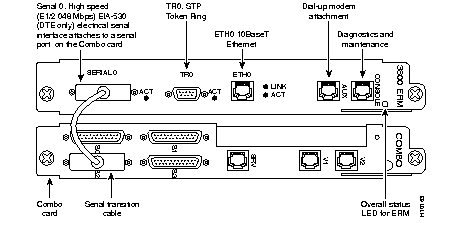
The Cisco 3800 ERM provides all the functionality of a Cisco 2513 router except for modifications in number of serial ports and connector types:
The Cisco 3800 ERM includes on-board -48V power conversion to required voltages for the card. Power is taken from the Cisco 3800 backplane via the standard connector used by the Combo card.
The major features of the Cisco 3800 ERM are as follows:
The major features of the Cisco 3800 in relation to the Cisco 3800 ERM card are as follows:
The combined system consisting of a Combo card (or Cisco 3800) and a Cisco 3800 ERM in a three-slot Cisco 3800 chassis (the Cisco 3803) has the following characteristics:
In addition to the interfaces listed in Table 1-1, the Cisco 3800 ERM includes the following hardware features:
The LEDs indicate the current operating condition of the Cisco 3800 ERM. (See Figure 1-3.) You can observe the LEDs, note the fault condition the Cisco 3800 ERM is encountering, and contact your system administrator or, if necessary, customer service. See the section "Reading Front Panel LEDs" in the appendix "Maintaining the Cisco 3800 ERM" for a description of the LEDs on the front panel of the Cisco 3800 ERM.
The system specifications of the Cisco 3800 ERM are listed in Table 1-1.
| Description | Specification |
|---|---|
| Processor | 20-MHz Motorola 68EC030 |
| Main memory | 4-MB (minimum) DRAM for main memory and shared memory (expandable to 8 or 16 MB). |
| Flash memory | 4-MB (minimum) Flash memory to run Cisco IOS software. |
| NVRAM | 32-KB NVRAM to store configuration information. |
| Interfaces |
|
|
Operating environment | 32-104×F (0-40×C) |
| Nonoperating temperature | -40-185×F (-40-85×C) |
| Operating humidity | 5-95%, noncondensing |
| Input voltage, backplane sourced Current Power dissipation | -48 volts DC 0.625A (maximum) 30W (maximum), 101.6 Btus/hr |
| Agency approvals | See the document Regulatory Compliance and Safety Information for the Cisco 3800 ERM that shipped with your ERM. |
The Cisco 3800 ERM is supported in Cisco IOS Release 11.2(7)P or later.
For more information about Cisco 3800 ERM software configuration, refer to the Cisco IOS configuration guide and command reference publications.
|
|
