


|
|
This chapter provides physical and functional overviews of the Cisco uBR7246 universal broadband router. The Cisco uBR7246 is the first model available in the Cisco uBR7200 series of universal broadband routers. It contains physical descriptions of the universal broadband router hardware and major components, and functional descriptions of hardware-related features. Descriptions and examples of software commands are included only when they are necessary for replacing, installing, configuring, or maintaining the universal broadband router hardware.
The Cisco uBR7246 is part of a new class of Cisco data-over-cable products designed to allow two-way transmission of digital data over hybrid fiber coaxial (HFC) cable. The Cisco uBR7246 supports Internet Protocol (IP) routing with a wide variety of protocols and any combination of Ethernet, Fast Ethernet, high-speed serial interface (HSSI), and asynchronous transfer mode (ATM) media.
The Cisco data-over-cable products, the Cisco uBR7246 universal broadband router and the Cisco cable modem, are compliant with Multimedia Cable Network Partners, Ltd. (MCNS) specifications. MCNS is a consortium of cable television companies whose goal is to create standards for interoperable data over cable systems.
Network interfaces reside on port adapters that provide the connection between the router and external networks (the Internet). HFC interfaces reside on cable modem cards and provide the connection to the cable television (CATV) network. The Cisco uBR7246 has four slots for cable modem cards, two slots for port adapters, one slot for an Input/Output (I/O) controller, and one slot for a network processing engine. You can place the port adapters in either of the two available slots and the cable modem cards in any of the four available slots.
There are bays for up to two AC-input power supplies. The Cisco uBR7246 will operate with one power supply. While a second power supply is not required, it allows load sharing and increased system availability.
The Cisco uBR7246 provides the following features:
The front of the Cisco uBR7246 provides access to an I/O controller, up to two network interface port adapters, and up to four cable modem cards (see Figure 1-1). The I/O controller contains the following: a local console port for connecting a data terminal (or data terminal equipment [DTE]) and an auxiliary port for connecting a modem (or other data communications equipment [DCE]) or other devices for configuring and managing the router; two Personal Computer Memory Card International Association (PCMCIA) slots for Flash memory cards; an optional Fast Ethernet port. The Fast Ethernet port provides a 100-Mbps connection to the network.
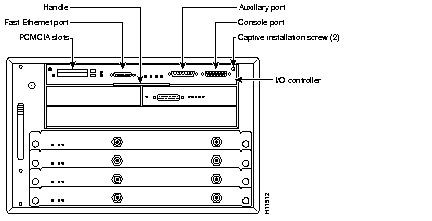
The port adapters installed in the Cisco uBR7246 are of the same type as those installed in the Cisco 7200 series routers and on the second-generation Versatile Interface Processors (VIP2s) in the Cisco 7500 series routers. The port adapters installed in the Cisco uBR7246 support OIR. For an explanation of OIR, refer to the section "Online Insertion and Removal" later in this chapter.
 | Caution The I/O controller does not support OIR. You must power down the Cisco uBR7246 before removing the I/O controller from the universal broadband router. The cable modem cards currently available for field trials do not support OIR. You must power down the Cisco uBR7246 before removing any of these cable modem cards from the universal broadband router. |
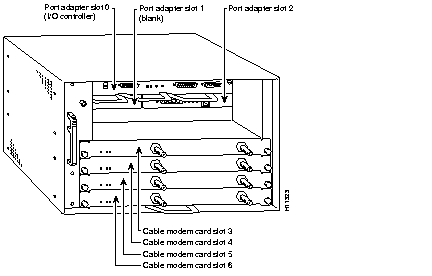
Port adapter slots in the Cisco uBR7246 universal broadband router are numbered from left to right, port adapter slot 1 and port adapter slot 2. Port adapter slot 0 is the Fast Ethernet port on the I/O controller (refer to Figure 1-2).
The cable modem card slots are numbered from top to bottom, cable modem card slot 3, slot 4, slot 5, and slot 6 (refer to Figure 1-2).
In Figure 1-1 and Figure 1-2, a blank port adapter is installed in slot 1. To ensure adequate airflow across the port adapters and cable modem cards, each port adapter slot must be filled with a port adapter or a blank port adapter, and each cable modem card slot must be filled with a cable modem card or a blank cable modem card.
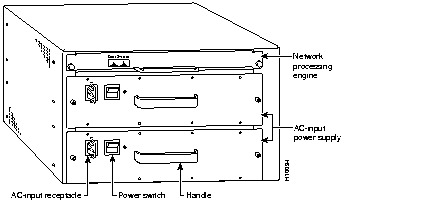
The rear of the Cisco uBR7246 universal broadband router provides access to the network processing engine and up to two power supplies (refer to Figure 1-3).
| Caution The network processing engine does not support OIR. You must power down the Cisco uBR7246 before removing the network processing engine from the router. |
The network processing engine has no external connectors or LEDs. There is one handle for removing and installing the network processing engine and two captive installation screws for securing it to the chassis.
The Cisco uBR7246 universal broadband router comes equipped with one 550W AC-input power supply. A fully configured Cisco uBR7246 operates with only one installed power supply; however, a second, optional power supply provides hot-swappable, load-sharing, redundant power. Figure 1-3 shows the rear of a Cisco uBR7246 configured with two
AC-input power supplies.
The power supply has the router's main power switch, OK LED, and an AC-input power receptacle. Adjacent to the lower power supply bay there are two M5 chassis grounding receptacles that provide a chassis ground connection for ESD equipment or a two-hole grounding lug.
Seven internal fans draw cooling air into chassis and across internal components to maintain an acceptable operating temperature. (Refer to Figure 1-1.) The seven fans are enclosed in a tray that is located in the subchassis.
| Caution To ensure the proper flow of cooling air across the internal components, make sure blank port adapters are installed in unoccupied port adapter slots, blank cable modem cards are installed in unoccupied cable modem card slots, and power supply filler plates (with their attached air dams) are installed in unoccupied power supply bays. |
The I/O controller, port adapters, cable modem cards, power supplies, and network processing engine slide into their respective chassis slots and connect directly to the universal broadband router's midplane; there are no internal cables to connect. The midplane distributes DC power from the power supplies to the I/O controller, port adapters, cable modem cards, fan tray, and network processing engine.
The midplane also identifies OIR of the port adapters and cable modem cards, bridges the PCI buses from the port adapters to packet static random-access memory (SRAM) on the network processing engine, arbitrates traffic across the PCI buses, and generates the clock signals for the port adapters on each PCI bus.
The Cisco uBR7246 operates as either a tabletop or rack-mounted unit. A rack-mount kit is standard equipment included with all Cisco uBR7246 universal broadband routers when they are shipped from the factory. The kit provides the hardware needed to mount the router in a standard 19-inch equipment rack or a telco rack. Steps for installing the Cisco uBR7246 in an equipment rack are explained in the chapter "Installing the Cisco uBR7246." If you are not rack-mounting your Cisco uBR7246, place it on a sturdy tabletop or platform.
A fully configured Cisco uBR7246, with two installed power supplies and all chassis slots filled, weighs approximately 100 pounds (45.4 kilograms [kg]). For clearance requirements and rack-mount installation considerations, refer to the section "Site Environment" in the chapter "Preparing for Installation."
Table 1-1 lists the Cisco uBR7246 universal broadband router physical specifications and power requirements.
| Description | Specification |
|---|---|
| Midplane | Two primary PCI buses and one secondary PCI bus with an aggregate bandwidth of 600 Mbps1 |
| Dimensions (H x W x D) | 10.5 x 16.25 x 21.25 in. (26.67 x 41.28 x 53.98 cm) |
| Weight | Chassis fully configured with a network processing engine, I/O controller, 2port adapters, 4 cable modem cards2, 2 power supplies, and a fan tray: ~ 100 lb (45.4 kg) |
| Heat dissipation | 800W (2730 Btu3) |
| AC-input power | 800W maximum (with either a single or dual power supply configuration) |
| Maximum AC-input voltage | 100-240 VAC4 wide input with power factor correction |
| AC-input current rating | 7A5 maximum at 110 VAC and 3.5A maximum at 240 VAC with the chassis fully configured |
| AC-input cable | 18 AWG6 three-wire cable, with a three-lead IEC-320 receptacle on the power supply end, and a country-dependent plug on the power source end |
| DC-output power | 550W maximum (with either a single or dual power supply configuration) |
| DC voltages supplied | +3.5V, +5.2V, +12.2V, -12.2V, +16V, -16V |
| Frequency | 50/60 Hz7 |
| Airflow | ~120 cfm8 |
| Temperature | 32 to 104°F (0 to 40°C) operating; -4 to 149°F (-20 to 65°C) nonoperating |
| Humidity | 10 to 90% noncondensing |
| Software requirement | For a Cisco uBR7246 universal broadband router without cable modem cards, you must run Cisco IOS Release 11.3(1) or later When the Cisco MC11 cable modem cards become available, you must run Cisco IOS Release 11.3(3)T or later9 |
| Agency approvals | Safety: UL 1950, CSA 22.2 No. 950, EN60950 EMI: FCC Class A, CSA Class A, EN60555-2, EN55022 Class B, VCCI Class 2, AS/NRZ 3548 Class A Immunity: IEC-1000-4-2, IEC-1000-4-3, IEC-1000-4-4, IEC-1000-4-5, IEC-1000-4-6, IEC-1000-4-11, IEC 1000-3-2 |
The Cisco uBR7246 universal broadband router is easy to service; all its major components are field replaceable units (FRUs). The following Cisco uBR7246 components are FRUs:
The following sections provide brief overviews of each FRU. Instructions for removing and replacing FRUs are contained in separate documents called configuration notes. For example, If you need to replace the fan tray in your Cisco uBR7246 universal broadband router, refer to the configuration note Cisco uBR7246 Universal Broadband Router Fan Tray Replacement Instructions (Document Number 78-4939-xx). This configuration note accompanies every fan tray shipped from the factory as a FRU. The configuration note is also available on the Documentation CD-ROM and on Cisco Connection Online (CCO).
For ordering information, contact a customer service representative.
The network processing engine maintains and executes the system management functions for the Cisco uBR7246 universal broadband router. The network processing engine also shares the system memory and environmental monitoring functions with the I/O controller. The network processing engine used in the Cisco uBR7246 is the NPE-150. The Cisco uBR7246 universal broadband router does not currently support the NPE-100 or
NPE-200 networking processing engines.
The network processing engines consist of the following components:
The network processing engine performs the following system management functions:
Figure 1-4 shows the NPE-150.
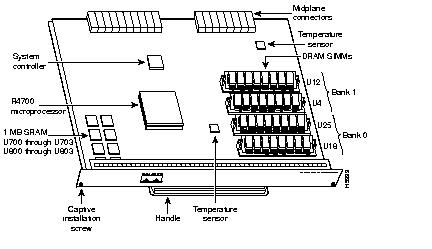
Table 1-2 lists the network processing engine memory components.
| Memory Type | Size | Quantity | Description | Location |
|---|---|---|---|---|
| DRAM | 32 to 128 MB | 2 or 4 | 16- or 32-MB SIMMs (based on maximum DRAM required) | Bank 0: U18 and U25 or U11 and U25
Bank 1: U4 and U12 or U42 and U52 |
SRAM
|
1 MB |
8 |
Eight chips, each being 128K words x 9 bits wide |
U700 through U703 |
| Boot ROM1 (NPE-150 and NPE-200) | 256 KB | 1 | EPROM for the ROM monitor program | Socket U92 |
| Unified cache | 512 KB | 4 | Secondary cache for the R4700 and R5000 RISC processors | NPE-150
|
Table 1-3 lists the network processing engine factory-installed DRAM configurations and their product numbers.
| Total DRAM | DRAM Bank 0 | Quantity | DRAM Bank 1 | Quantity | Product Number |
|---|---|---|---|---|---|
32 MB | U18 and U25 | 2 16-MB SIMMs | U4 and U12 | - | MEM-NPE-32MB1 |
64 MB | U18 and U25 | 2 32-MB SIMMS | U4 and U12 | - | MEM-NPE-64MB1 |
| 128 MB | U18 and U25 | 2 32-MB SIMMs | U4 and U12 | 2 32-MB SIMMs | MEM-NPE-128MB1 |
The Input/Output controller shares the system memory functions and the environmental monitoring functions for the Cisco uBR7246 universal broadband router with the network processing engine.
The I/O controller is available with an optional Fast Ethernet port. Figure 1-5 shows an I/O controller without the Fast Ethernet port. Figure 1-6 shows an I/O controller with the Fast Ethernet port. The I/O controller consists of the following components:
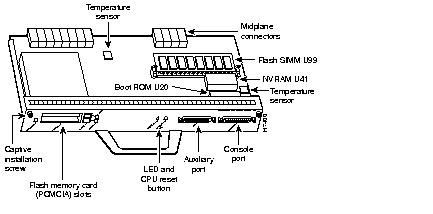
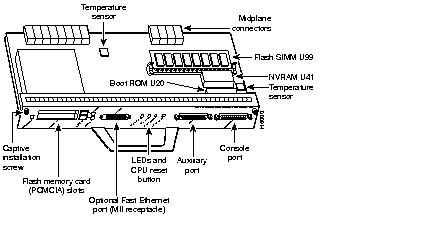
Table 1-4 lists the I/O controller memory components.
| Memory Type | Size | Quantity | Description | Location |
|---|---|---|---|---|
| Boot ROM | 256 KB | 1 | EPROM for the ROM monitor program | U20 |
| Flash SIMM
Flash memory card | 4 MB
8 MB to 20 MB | 1
Up to 2 | Contains the default boot helper image
Contains the default Cisco IOS image | U99
PCMCIA |
| NVRAM | 128 KB | 1 | Nonvolatile EPROM for the system configuration file | U41 |
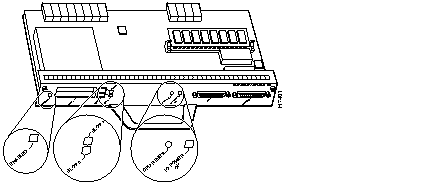
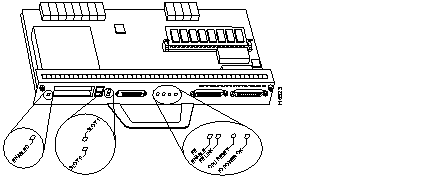
Depending on whether the Fast Ethernet port is present, either two or four LEDs on the
I/O controller faceplate indicate system status; two additional LEDs indicate the status of the Flash memory cards installed in either PCMCIA slot.
Figure 1-7 shows the LEDs on an I/O controller that does not have the Fast Ethernet port. Figure 1-8 shows the LEDs of an I/O controller that has the Fast Ethernet port. Table 1-5 lists I/O controller LEDs and their functions. To use the LEDs for troubleshooting the I/O controller, refer to the section "Identifying Startup Problems" in the chapter "Troubleshooting the Installation."
A CPU reset button is located next to the IO power OK LED on the I/O controller faceplate. The CPU reset button resets the entire system.
| Caution To prevent system errors and problems, use the CPU reset button only at the direction of your service representative. |
| LED | Function |
|---|---|
| IO Power OK | Indicates that the I/O controller is on and receiving DC power from the router midplane. This LED comes on during a successful router boot and remains on during normal operation of the router. |
| Enabled | Indicates that the network processing engine and the I/O controller are enabled for operation by the system; however, it does not mean that the Fast Ethernet port on the I/O controller is functional or enabled. This LED comes on during a successful router boot and remains on during normal operation of the router. |
| FE enable | Indicates that the Fast Ethernet port on the I/O controller is initialized and enabled for operation by the system. This LED comes on after the I/O controller has been enabled and remains on during normal operation of the router. |
| FE link | Indicates that the Fast Ethernet port on the I/O controller is receiving a carrier signal from the network. This LED remains off during normal operation of the router, unless there is an incoming carrier signal. |
| Slot 0 Slot 1 | These LEDs indicate which PCMCIA slot is in use and blink when either slot is being accessed by the system. |
The Cisco uBR7246 is shipped from the factory with up to two installed port adapters that provide a variety of network media types (based on your order). The port adapters connect directly to the universal broadband router's midplane. Port adapters installed in the Cisco uBR7246 universal broadband router support OIR.
Table 1-6 lists the port adapters currently supported by the Cisco uBR7246.
| Product Number1 | Description |
|---|---|
| PA-4E | 4-port Ethernet 10BASE-T port adapter |
| PA-8E | 8-port Ethernet 10BASE-T port adapter |
| PA-FE-TX | 1-port 100BASE-TX Fast Ethernet port adapter |
| PA-FE-FX | 1-port 100BASE-FX Fast Ethernet port adapter |
| PA-H | 1-port HSSI port adapter |
| PA-A1-OC3SMI | 1-port ATM single-mode intermediate reach port adapter |
| PA-A1-OC3MM | 1-port ATM multimode port adapter |
For a description of OIR, refer to the section "Online Insertion and Removal" later in this chapter. For general instructions about how to remove and replace a port adapter, refer to the section "Replacing a Port Adapter" in the chapter "Maintaining the Cisco uBR7246."
| Caution To ensure adequate airflow across the router's port adapters, a port adapter or a blank port adapter must be installed in each port adapter slot. |
The Cisco uBR7246 is shipped from the factory with up to four cable modem cards that provide connectivity to the HFC network.
The cable modem cards connect directly to the universal broadband router's midplane. Cable modem cards installed in the Cisco uBR7246 universal broadband router do not currently support OIR.
For general instructions about how to remove and replace a cable modem card, refer to the section "Replacing a Cable Modem Card" in the chapter "Maintaining the Cisco uBR7246."
| Caution To ensure adequate airflow across the router's cable modem cards, a cable modem card or a blank cable modem card must be installed in each cable modem card slot. |
The Cisco uBR7246 comes equipped with one 550W AC-input power supply. You must order the second power supply separately.
A handle on the AC power supplies provide a grip point for removing and replacing the power supply. (Figure 1-9 shows the faceplate of the AC-input power supply.) Two captive installation screws secure the power supply to the chassis and seat the power supply in the router midplane. A Power OK LED indicates that the power supply is delivering +5 VDC to the router midplane.
The AC-input power supply has a receptacle for an AC-input power cable. A modular power cable connects the AC-input power supply to the site AC power source. A cable-retention clip secures the power cable to the AC-input power supply.
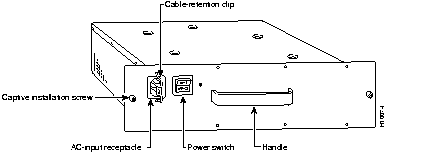
| Caution To ensure adequate airflow across the universal broadband router's power supplies, a power supply or a power supply filler plate (with its attached air dam) must be installed in each power supply bay. |
Table 1-1 lists the AC-input power supply system power specifications, including input voltage and operating frequency ranges.
The Power OK LED goes off and the power supply will shut itself down when the internal DC voltages exceed allowable tolerances or the internal temperature of the power supply exceeds allowable tolerances. The power supply will remain in a shut down state until it is disconnected and reconnected to the source power, and then restarted with the power switch. The power switch turns the power supply on and starts the system. For a description of power-supply shutdown conditions and thresholds, refer to the section "Environmental Monitoring and Reporting Functions" in this chapter.
| Caution When the power switch on a Cisco uBR7246 power supply is turned to the off position, the power supply will enter a reset cycle for ninety (90) seconds. Wait at least ninety (90) seconds before turning the power switch back to the on position. If you do not wait the full ninety (90) seconds, the power supply will not restart. |
The fan tray, shown in Figure 1-10, consists of seven fans that are attached to a metal tray. The fan tray is located in the subchassis and receives -12 VDC through a DC power harness that connects directly to the router midplane. To remove the fan tray from the subchassis, loosen the captive installation screw on the front of the fan tray and slide the tray out, using the attached handle.
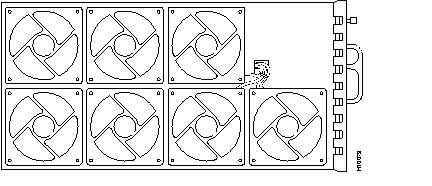
The fan tray draws cooling air in through the intake vent on the right side of the chassis (when viewing the router from the front), and moves the air across the internal components and out the exhaust vent on the left side of the chassis.
Figure 1-11 shows the air flow through the router.
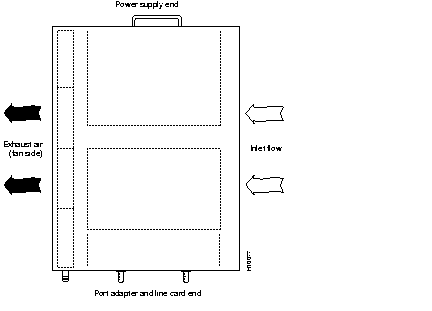
The left and right sides of the chassis must remain unobstructed to ensure adequate air flow and prevent overheating inside the chassis; we recommend at least three inches of clearance. (See the section "Site Requirements" in the chapter "Preparing for Installation.")
Temperature sensors on the network processing engine and I/O controller monitor the internal air temperature and send warning messages when the internal air temperature approaches a specified threshold. If the internal temperature exceeds the specified threshold, the system environmental monitor shuts down all internal power to prevent equipment damage from excessive heat.
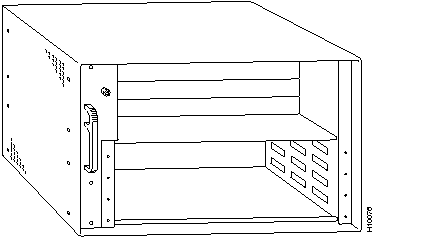
The Cisco uBR7246 chassis, shown in Figure 1-12, has two slots for the port adapters, four slots for cable modem cards, one slot for the I/O controller, and one bay for the subchassis. To replace the chassis, you must remove all of the internal components.
The Cisco uBR7246 supports up to two installed Intel Series 2+ Flash memory cards.
Flash memory (Flash memory cards and the Flash SIMM on the I/O controller) allows you to remotely load and store multiple system and boot helper images. You can download a new image over the network and then add the new image to Flash memory or replace existing files. You can also transfer images between Flash memory cards and the onboard Flash memory SIMM. You can then boot the router either manually or automatically from any of the stored images. Flash memory can also function as a TFTP server to allow other routers to boot remotely from stored images or copy them into their own Flash memory.
Table 1-7 lists the Flash memory card options supported by the Cisco uBR7246.
| Memory Size | Product Number |
|---|---|
8 MB | MEM-I/O-FLC8M1 |
| 16 MB | MEM-I/O-FLC16M1 |
20 MB | MEM-I/O-FLC20M1 |
The rack-mount and cable-management kit for the Cisco uBR7246 consists of two
rack-mount brackets and one cable-management bracket. These brackets are designed for mounting your router in 19-inch four-post or telco-type equipment racks and for relieving strain on interface cables that are installed on port adapters and cable modem cards in the universal broadband router. The rack-mount kit is shipped with each Cisco uBR7246 and is also available as a single FRU.
For detailed instructions about how to install the rack-mount and cable-management brackets on your Cisco uBR7246, refer to the sections "Rack-Mounting Cisco uBR7246" and "General Installation" in the chapter "Installing the Cisco uBR7246."
This section provides a functional overview of the Cisco uBR7246. It describes the numbering and addressing of the port adapters for the router, the environmental monitoring and reporting functions, and online insertion and removal (OIR). These descriptions will help you become familiar with the capabilities of the Cisco uBR7246 universal broadband router.
The two port adapters and the four cable modem cards in the Cisco uBR7246 provide the connection between the router's three Peripheral Component Interconnect (PCI) buses, called mb0, mb1, and mb2, and external networks. Bus mb0 is for the optional Fast Ethernet port on the I/O controller, bus mb1 is for port adapter slot 1 and cable modem card slot 3 and slot 5, and bus mb2 is for port adapter slot 2 and cable modem card slot 4, and slot 6.
In the Cisco uBR7246, the slot number is the chassis slot in which a port adapter is or a cable modem card is installed, while the logical interface number is the physical location of the interface port on a port adapter.
Port adapter slots are numbered 1 and 2; port adaptor slot 0 is the Fast Ethernet port on the I/O controller. Cable modem card slots are numbered from 3 to 6 (Refer to Figure 1-2 for the numbering scheme of the port adapter and cable modem card slots.) The number of logical interfaces depends on the type of port adapter or cable modem card.
The Media Access Control (MAC)-layer or hardware address is a standardized data link layer address that is required for certain network interface types. These addresses are not used by other devices in the network; they are specific and unique to each port. The Cisco uBR7246 uses a specific method to assign and control the MAC-layer addresses of its port adapters. For a description of the MAC-layer address, refer to the section "MAC-Layer Address" later in this chapter.
Port adapter and cable modem card slots maintain the same slot number regardless of whether other port adapters or cable modem cards are installed or removed. However, when you move a port adapter or cable modem card to a different slot, the logical interface number changes to reflect the new slot number
| Caution The cable modem cards currently available for field trials do not support OIR. You must power down the Cisco uBR7246 before removing any of these cable modem cards from the universal broadband router, or moving them to another slot. |
For complete descriptions and instructions of the commands used to configure your Cisco uBR7246, refer to the Configuration Fundamentals Configuration Guide and Configuration Fundamentals Command Reference publications, which are available on the Documentation CD-ROM or in print.
You can identify port adapter slots by using software commands to display information about a specific port adapter or for all port adapters in the Cisco uBR7246. To display information about all port adapter slots, use the show interfaces command. To display information about a specific port adapter slot, use the show interfaces command with the port adapter type and slot number in the format show interfaces [type slot/port]. If you abbreviate the command (sh int) and do not specify port adapter type and slot number (or arguments), the system interprets the command as show interfaces and displays the status of all port adapters, all cable modem cards, and all ports.
Router# sh int
FastEthernet0/0 is administratively up, line protocol is up
Hardware is DEC21140, address is 0000.0000.0000 (bia 0000.0000.0000)
Internet address is 1.1.1.3
MTU 1500 bytes, BW 100000 Kbit, DLY 100 usec, rely 255/255, load 1/255
(display text omitted)
Hssi1/0 is administratively down, line protocol is down
Hardware is MIF68840_MM, address is 0000.0000.0000 (bia 0000.0000.0000)
Internet address is 1.1.1.0
MTU 4470 bytes, BW 100000 Kbit, DLY 100 usec, rely 255/255, load 1/255
(display text omitted)
Ethernet2/0 is administratively up, line protocol is up
Hardware is AmdP2, address is 0000.0000.0000 (bia 0000.0000.0000)
Internet address is 1.1.1.7
MTU 1500 bytes, BW 100000 Kbit, DLY 1000 usec, rely 255/255, load 1/255
(display text omitted)
Cable3/0 is up, line protocol is up
Hardware is CMTS, address is 0009.0ed6.ee18 (bia 0009.0ed6.ee18)
Internet address is 1.1.1.1/24
MTU 1500 bytes, BW 27000 Kbit, DLY 1000 usec, rely 255/255, load 1/255
(display text omitted)
You can also use arguments such as the interface type (Ethernet, Fast Ethernet, ATM, HSSI, and so forth) and the port address (slot/port) to display information about a specific port adapter interface only.
The following example shows the display for the first port on the Ethernet port adapter in port adapter slot 2:
Router# sh int e 2/0
Ethernet2/0 is up, line protocol is up
  Hardware is AmdP2, address is 00e0.f74f.d810 (bia 00e0.f74f.d810)
  Internet address is 10.17.2.162/24
  MTU 1500 bytes, BW 10000 Kbit, DLY 1000 usec, rely 255/255, load 1/255
  Encapsulation ARPA, loopback not set, keepalive set (10 sec)
  ARP type: ARPA, ARP Timeout 04:00:00
  Last input 00:00:02, output 00:00:00, output hang never
  Last clearing of "show interface" counters never
  Queueing strategy: fifo
  Output queue 0/40, 0 drops; input queue 0/75, 0 drops
  5 minute input rate 0 bits/sec, 0 packets/sec
  5 minute output rate 0 bits/sec, 0 packets/sec
     67008 packets input, 5888732 bytes, 0 no buffer
     Received 65968 broadcasts, 0 runts, 0 giants
     0 input errors, 0 CRC, 0 frame, 0 overrun, 0 ignored, 0 abort
     0 input packets with dribble condition detected
     50858 packets output, 5060074 bytes, 0 underruns
     0 output errors, 0 collisions, 1 interface resets
     0 babbles, 0 late collision, 0 deferred
     0 lost carrier, 0 no carrier
     0 output buffer failures, 0 output buffers swapped out
To display information about a specific cable modem card slot's downstream channel, use the show interfaces cable command with the cable modem card slot number and downstream port number in the format show interfaces cable slot/downstream-port [downstream].
You must use the slot number and downstream port number to display information about a downstream interface. You can you abbreviate the command to sh int c.
The following example shows the display for downstream channel port 0 in cable modem slot 3,:
Router# sh int c 3/0
Cable3/0 is up, line protocol is up
Hardware is CMTS, address is 0009.0ed6.ee18 (bia 0009.0ed6.ee18
Internet address is 1.1.1.1/24
MTU 1500 bytes, BW 27000 Kbit, DLY 1000 usec, rely 255/255, load 1/255
Encapsulation MCNS, loopback not set, keepalive not set
ARP type: ARPA, ARP Timeout 04:00:00
Last input 00:00:00, output 00:00:00, output hang never
Last clearing of "show interface" counters never
Queueing strategy: fifo
Output queue 0/40, 0 drops; input queue 0/75, 0 drops
5 minute input rate 41000 bits/sec, 45 packets/sec
5 minute output rate 43000 bits/sec, 45 packets/sec
1616534 packets input, 184284660 bytes, 0 no buffer
Received 0 broadcasts, 0 runts, 0 giants, 0 throttles
0 input errors, 0 CRC, 0 frame, 0 overrun, 0 ignored, 0 abort
1616534 packets output, 184284660 bytes, 0 underruns
0 output errors, 0 collisions, 0 interface resets
0 output buffer failures, 0 output buffers swapped out
To display information about a specific cable modem card slot's upstream channel, use the show interfaces cable command with the cable modem card slot number, downstream port number, and upstream port number in the format show interfaces cable slot/downstream-port [upstream] upstream-port.
The following example shows the display for upstream channel port 0 in cable modem slot 3,
Router# sh int c 3/0 0
Cable3/0 Upstream 0 is administratively up, line protocol is up
Hardware is CMTS, address is 00e0.1e5f.7428 (bia 00e0.1e5f.7428)
Internet address is 1.1.1.1/24
MTU 1500 bytes, BW 27000 Kbit, DLY 1000 usec, rely 255/255, load 1/255
Encapsulation MCNS, loopback not set, keepalive not set
ARP type: ARPA, ARP Timeout 04:00:00
Last input never, output never, output hang never
Last clearing of "show interface" counters never
Queueing strategy: fifo
Output queue 0/40, 0 drops; input queue 0/75, 0 drops
5 minute input rate 0 bits/sec, 0 packets/sec
5 minute output rate 0 bits/sec, 0 packets/sec
1616534 packets input, 184284660 bytes, 0 no buffer
Received 0 broadcasts, 0 runts, 0 giants, 0 throttles
0 input errors, 0 CRC, 0 frame, 0 overrun, 0 ignored, 0 abort
1616534 packets output, 184284660 bytes, 0 underruns
0 output errors, 0 collisions, 0 interface resets
0 output buffer failures, 0 output buffers swapped out
All local-area network (LAN) interfaces (ports) require unique MAC-layer addresses, also known as hardware addresses. Typically, the MAC address of an interface is stored on a memory component that resides directly on the interface circuitry; however, the OIR feature requires a different method. For a description of OIR, refer to the section "Online Insertion and Removal" later in this chapter.
The OIR feature allows you to remove a port adapter and replace it with another identically configured one. If the new port adapter matches the port adapter you removed, the system immediately brings it on line. In order to allow OIR, an address allocator with a unique MAC addresses is stored in an EEPROM on the universal broadband router midplane. Each address is reserved for a specific port and slot in the router regardless of whether a port adapter resides in that slot.
The MAC addresses are assigned to the slots in sequence. The first addresses are assigned to port adapter slot 0 and slot 1, and the next addresses are assigned to port adapter slot 2 through cable modem card slot 6. This address scheme allows you to remove port adapters and insert them into other universal broadband routers without causing the MAC addresses to move around the network or be assigned to multiple devices.
| Caution The cable modem cards currently available for field trials do not support OIR. You must power down the Cisco uBR7246 before removing any of these cable modem cards from the universal broadband router. |
Note that if the MAC addresses were stored on each port adapter, OIR would not function because you could never replace one port adapter with an identical one; the MAC addresses would always be different. Also, each time a port adapter was replaced, other devices on the network would have to update their data structures with the new address, and, if they did not do so quickly enough, could cause the same MAC address to appear in more than one device at the same time.
All port adapters in the Cisco uBR7246 support online insertion and removal (OIR).This function allows you to install and replace port adapters while the universal broadband router is operating; you do not need to notify the software or shut down the system power.
The following is a functional description of OIR for background information only; for specific procedures for installing and replacing a port adapter in a Cisco uBR7246 universal broadband router, refer to the appropriate configuration note.
Each port adapter has a bus connector that connects it to the universal broadband router's midplane. Each midplane connector has a set of tiered pins in three lengths. The pins send specific signals to the system as they make contact with the port adapter. The system assesses the signals it receives and the order in which it receives them to determine if a port adapter is being removed or inserted into the midplane. From these signals, the system determines whether to reinitialize a new interface or shut down a removed interface. For example, when inserting a port adapter, the longest pins make contact with the port adapter first, and the shortest pins make contact last. The system recognizes the signals and the sequence in which it receives them.
When you remove or insert a port adapter in a Cisco uBR7246 universal broadband router, the midplane pins send signals to notify the system, which then performs as follows:
OIR functionality allows you to add, remove, or replace port adapters while the system is on line. This provides a method that is seamless to end users on the network, maintains all routing information, and ensures session preservation.
Environmental monitoring and reporting functions are controlled by the network processing engine and allow you to maintain normal system operation by identifying and resolving adverse conditions prior to loss of operation. The environmental monitoring functions constantly monitor the internal chassis air temperature and DC supply voltages and currents. Each power supply monitors its own voltage and temperature and shuts itself down if it detects a critical condition within the power supply. If conditions reach shutdown thresholds, the system shuts down to avoid equipment damage from excessive heat. The reporting functions periodically log the values of measured parameters so that you can retrieve them for analysis later, and the reporting functions display warnings on the console if any of the monitored parameters exceed defined thresholds.
The environmental monitoring functions use the following levels of status conditions to monitor the system. Four sensors, two on the network processing engine and two on the
I/O controller, monitor the temperature of the cooling air as it moves through the chassis. Table 1-8 lists the temperature thresholds for the processor-monitored levels.
Table 1-9 lists the DC power thresholds for the normal, warning, and critical (power-supply-monitored) levels.
| Parameter | High Warning | High Critical | Shutdown |
|---|---|---|---|
| Chassis inlet | 104°F (40°C) | 122°F (50°C) | - |
| Chassis outlet 1 | 109°F (43°C) | 127°F (53°C) | 136°F (58°C) |
| Chassis outlet 2 | 167°F (75°C) | 167°F (75°C) | - |
| Chassis outlet 3 | 131°F (55°C) | 149°F (65°C) | 158°F (70°C) |
| Chassis outlet 4 | 131°F (55°C) | 149°F (65°C) | - |
| Sample Point | Low Critical | Low Warning | High Warning | High Critical |
|---|---|---|---|---|
| +3.5V | +3.30V | +3.39V | +3.61V | +3.69V |
| +5.2V | +4.91V | +5.03V | +5.36V | +5.48V |
| +12.2V | +11.43V | +11.72V | +12.67V | +12.96V |
| -12.2V | -9.72V | -10.96V | -13.44V | -14.68V |
| +16.0V | +15.12V | +15.12V | +19.81V | +19.81V |
| -16.0V | -15.12V | -15.12V | -19.81V | -19.81V |
If the air temperature exceeds a defined threshold, the system controller displays warning messages on the console terminal and, if the temperature exceeds the shutdown threshold, it shuts down the system. The system stores the present parameter measurements for both temperature and DC voltage in NVRAM, so that you can retrieve them later as a report of the last shutdown parameters.
The power supplies monitor internal power supply temperature and voltages. A power supply is either within tolerance (Normal) or out of tolerance (Critical), as shown in Table 1-9. If an internal power supply temperature or voltage reaches a critical level, the power supply shuts down without any interaction with the system processor.
The Cisco uBR7246 displays warning messages on the console if chassis interface-monitored parameters exceed a desired threshold. You can also retrieve and display environmental status reports with the show environment, show environment all, show environment last, and show environment table commands. Parameters are measured and reporting functions are updated every 60 seconds. A brief description of each of these commands follows.
| Caution To prevent overheating the chassis, ensure that your system is drawing cool inlet air. Overtemperature conditions can occur if the system is drawing in the exhaust air of other equipment. Ensure adequate clearance around the sides of the chassis so that cooling air can flow through the chassis interior unimpeded and exhaust air exits the chassis and is not drawn into the inlet vent of other device. |
The show environment command display reports the current environmental status of the system. The report displays parameters that are out of the normal values. No parameters are displayed if the system status is normal. The example that follows shows the display for a system in which all monitored parameters are within Normal range:
Router# show env
All measured values are normal
If the environmental status is not normal, the system reports the worst-case status level. Following is an example overvoltage warning:
Router# show env
Warning: +3.45 V measured at +3.83 V
Following is sample output of the show env last command:
Router# show env last
Temperature readings:
chassis inlet previously measured at 18C/64F
chassis outlet 1   previously measured at 21C/69F
chassis outlet 2   previously measured at 27C/80F
chassis outlet 3   previously measured at 35C/95F
chassis outlet 4   previously measured at 21C/69F
Voltage readings:
+3.5 V             previously measured at +3.58
+5.2 V             previously measured at +5.22
+12.2 V            previously measured at +12.25
-12.2 V            previously measured at -12.44
+16 V              previously measured at +16.06
-16 V              previously measured at -18.31
Reason for last shutdown:
power supply
The show environment table command displays the temperature and voltage thresholds for each temperature sensor and for each monitored status level, which are related to those thresholds listed in Table 1-8 and Table 1-9. The display also lists the shutdown threshold for the system.
Following is sample output of the sh env table command:
Router# show env table
Sample Point     LowCritical   LowWarning     HighWarning   HighCritical
chassis inlet                                   40C/104F       50C/122F
chassis outlet 1                                43C/109F       53C/127F
chassis outlet 2                                75C/167F       75C/167F
chassis outlet 3                                55C/131F       65C/149F
chassis outlet 4                                55C/131F       65C/149F
+3.5 V            +3.30          +3.39          +3.61          +3.69
+5.2 V            +4.91          +5.03          +5.36          +5.48
+12.2 V           +11.43         +11.72         +12.67         +12.96
-12.2 V           -9.72          -10.96         -13.44         -14.68
+16 V             +15.12         +15.12         +19.81         +19.81
-16 V             -15.12         +15.12         +19.81         +19.81
System shutdown for chassis outlet 1 58C/136F
System shutdown for chassis outlet 3 70C/158F
Following is sample of the sh env all command:
Router# show env all
Power Supplies:
Power supply 1 is empty.
Power supply 2 is Zytek DC Power Supply. Unit is on.
Temperature readings:
chassis inlet measured at 23C/73F
chassis outlet 1 measured at 25C/77F
chassis outlet 2 measured at 32C/89F
chassis outlet 3 measured at 41C/105F
chassis outlet 4 measured at 46C/114F
Voltage readings:
+3.5 V measured at +3.59 V
+5.2 V measured at +5.22 V
+12.2 V measured at +12.29 V
-12.2 V measured at -12.39 V
+16 V measured at +15.46 V
-16 V measured at -18.29 V
When the system power is on, all seven fans should be operational. The system will continue to operate if a fan fails; however, if the air temperature exceeds a defined threshold, the system controller displays warning messages on the console terminal and, if the temperature exceeds the shut down threshold, it shuts down the system.
If the system does shutdown because the temperature exceeded the shutdown threshold, the system will display the following message on the console screen and in the environment display when the system restarts:
Queued messages:
%ENVM-1-SHUTDOWN: Environmental Monitor initiated shutdown
For complete descriptions and instructions of the environmental monitor commands refer to the Configuration Fundamentals Configuration Guide and Configuration Fundamentals Command Reference publications, which are available on the Documentation CD-ROM or in print.
|
|